

Most lists of HVAC SEO companies tell you who made the list but not how the firms were judged. That leaves an owner comparing badges, deliverable counts, and sales claims while the real risks, including weak attribution, unclear ownership, market conflicts, and poor implementation, stay hidden.
This guide takes a different route. It gives HVAC owners, executives, operators, and marketing leaders a transparent scorecard for comparing providers against the work that affects qualified demand, booked jobs, business control, and long-term search visibility.






The Broadstaff case study shows how Percepture connected search authority, credible content, and qualified B2B lead generation.
What makes an HVAC SEO company worth hiring?
The best HVAC SEO companies can show how they handle local search, seasonality, technical SEO, service and location architecture, authority, AI-search readiness, conversion tracking, and booked-job attribution. Compare providers by relevant proof, reporting, ownership, contracts, market conflicts, pricing, implementation, and fit, not by a generic top-agency badge.
Executive decision summary
Judge the business trail
Visibility should connect to qualified visits, calls, appointments, booked work, revenue, and gross profit where the contractor’s systems allow it.
Protect ownership
The contractor should understand who controls the domain, website, content, analytics, search accounts, business profiles, call data, and CRM records.
Buy the right operating model
A single-location contractor, a franchise group, and a private-equity platform need different approval paths, reporting, location governance, and service depth.
Request evidence
Ask for relevant cases, references, sample reports, named team members, implementation details, and plain answers about links, conflicts, contracts, and exit terms.
A useful comparison begins with these controls. It does not begin with a promise about rankings.
Which agency model fits your business?
Single-location contractor
Look for a focused local plan, a manageable approval process, strong call-handling insight, and a scope that does not bury the company in unused deliverables.
Multi-location operator
Require location governance, duplicate prevention, roll-up reporting, local flexibility, access controls, and a repeatable market-launch process.
Franchise system
Ask how national standards, local pages, franchise profiles, reviews, paid media, and territory rules will work together.
Private-equity platform
Prioritize acquisition migrations, shared measurement, brand transitions, scalable templates, market-level reporting, and executive visibility.
What does an HVAC SEO company do?
An HVAC SEO company improves how a contractor is found, understood, and chosen in organic and local search. The work can include technical repairs, Google Business Profile support, service and location architecture, content, internal links, authority development, conversion improvements, and reporting.
The scope should reflect how the business operates. Emergency repair demand is different from planned replacement demand. A hidden-address service-area business has different local needs than a company with staffed offices. A multi-location group also needs rules for location pages, profiles, reviews, approvals, analytics, and brand consistency.
SEO may sit beside paid search, Local Services Ads, email, public relations, and conversion work. Percepture’s omnichannel marketing service explains how those channels can operate as one customer journey rather than isolated campaigns. Contractors focused on immediate demand can also review paid search services.
Check lead quality before adding more traffic
When current marketing produces calls but too few serviceable opportunities, diagnose the lead trail before expanding search spend. Review source, market, job type, call outcome, booking status, and sales follow-up before asking a provider to increase traffic.
Run a Lead Quality DiagnosticUse the first sample to test whether the market, account, contact, and next action are actually relevant.
How to compare HVAC SEO companies
Start with a written evaluation standard. Without one, the firm with the strongest pitch can appear safer than the firm with the strongest operating plan.
Percepture’s HVAC Search Revenue Fit Scorecard uses ten weighted categories. The weights favor local execution and revenue attribution because rankings alone do not tell an owner whether the right calls became appointments and booked jobs.
| Evaluation category | Weight | Proof to request |
|---|---|---|
| Local SEO, Google Business Profile, and maps | 15 | Local audit, profile workflow, review process, service-area plan, and reporting example |
| HVAC operations, territory, seasonality, and job economics | 10 | Planning examples tied to markets, job types, capacity, and seasonal demand |
| Technical SEO and multi-location architecture | 12 | Crawl findings, templates, migration controls, indexing checks, and location governance |
| Content, intent, service, and city execution | 10 | Content map, editorial workflow, subject review, and quality controls |
| Authority, links, reviews, and digital PR | 10 | Source policy, sample placements, risk controls, and relevance standards |
| AI-search and entity readiness | 8 | Entity audit, retrieval tests, tracked prompts, source plan, and measurement limits |
| Calls, booked jobs, CRM, and revenue attribution | 15 | Call taxonomy, form tracking, CRM fields, lead-quality process, and revenue reporting |
| Relevant proof, references, and review quality | 10 | Comparable cases, source access, references, dates, definitions, and limitations |
| Pricing, contracts, ownership, and conflicts | 5 | Full fee schedule, asset ownership, cancellation terms, and market-conflict policy |
| Team, communication, implementation, and escalation | 5 | Named team, work allocation, cadence, approval process, and escalation path |
Score each category from zero to five, then convert it by weight. A zero means no usable evidence or a material concern. A three means credible standard capability. A five requires unusually strong, current, directly relevant evidence. Apply the same rules to every provider, including Percepture.
HVAC specialist or integrated agency?
A specialist may begin with a shorter HVAC learning curve and established home-services workflows. An integrated agency may offer deeper technical, analytics, public-relations, paid-media, conversion, and AI-search resources. A generalist may still fit when it has relevant proof and a clear plan for learning the contractor’s markets.
| Model | Potential fit | Questions to resolve |
|---|---|---|
| HVAC specialist | Contractors seeking established industry workflows | Same-market conflicts, technical depth, asset ownership, creative range, and customization |
| Home-services agency | Companies coordinating HVAC with plumbing, electrical, or related services | Brand distinction, location scale, account load, and reporting depth |
| Integrated agency | Growth programs combining SEO, paid media, PR, content, CRO, analytics, and GEO | HVAC learning process, implementation ownership, team continuity, and budget fit |
| SEO-only firm | Businesses with strong internal creative, development, analytics, and media teams | Handoffs, dependency risk, authority work, conversion support, and attribution |
| Consultant or freelancer | Focused audits, strategy, oversight, or internal-team support | Execution capacity, coverage, continuity, escalation, and specialist access |
Do not assume the biggest provider is safest or the smallest is most attentive. Compare staffing, account load, work ownership, response times, escalation, and how much work is performed by employees, contractors, offshore teams, or white-label partners.
For a wider strategy view, read the HVAC SEO guide. Buyers preparing to hire can use the HVAC SEO agency selection guide as the next step.
What a strong provider should deliver
The proposal should define the starting condition, priority markets, intended work, dependencies, owners, measurement, timing, fees, exclusions, and exit process before asking for a long commitment.
Technical foundation
Inspect crawling, indexing, canonicals, redirects, sitemaps, robots directives, mobile usability, page templates, structured data, internal links, duplicate pages, and migration history. Distinguish necessary repairs from optional rebuilding.
Complex groups can compare enterprise SEO capabilities. A focused repair backlog may fit an SEO Sprint.
Local and service-area execution
Cover business profiles, categories, services, landing pages, reviews, citations, duplicate listings, service areas, office eligibility, and local conversion paths. City pages should provide distinct value rather than swap place names into the same copy.
Review the deeper local SEO for HVAC guide.
Content and search intent
Repair, replacement, installation, maintenance, financing, emergency, equipment, and location searches represent different buyer needs. Map each useful intent to the right page and avoid creating several pages that compete for the same query.
Use the HVAC keyword and search-intent map and Percepture’s content marketing service.
Authority and conversion
Ask where links and mentions come from, why those sources matter, and what the provider refuses to do. Relevant partnerships, trade coverage, useful data, strong resources, and earned media are more defensible than unexplained link volume.
Review digital PR services, the HVAC public relations agency guide, and conversion-rate optimization.
Pricing framework for comparing HVAC SEO companies
Compare pricing by scope, responsibility, risk, and expected business value, not by the retainer alone. Public prices are often incomplete, and this guide does not assign unsupported price ranges to individual firms.
| Model | Useful when | Buyer check |
|---|---|---|
| Monthly retainer | Ongoing technical, local, content, authority, and reporting work | Define included production, unused capacity, term, increases, and cancellation |
| Fixed project | Audit, migration, rebuild support, architecture, or a defined repair program | Define deliverables, implementation, change requests, and post-project support |
| Hourly advisory | Internal teams needing strategy, review, or specialist support | Define availability, response time, documentation, and execution ownership |
| Hybrid | A stable program with separately scoped builds or media work | Separate recurring work, projects, media, software, and pass-through costs |
| Performance-linked | Situations with agreed measurement and controllable conversion data | Inspect attribution rules, lead definitions, brand demand, margins, and ownership |
Ask whether content, development, call tracking, reporting software, links, listings, travel, photography, paid media, and landing pages are included. Then calculate the booked jobs needed to cover the fee using the contractor’s close rate, average job value, gross margin, and service mix.
The HVAC SEO pricing guide provides a deeper budgeting framework. Percepture also publishes SEO pricing packages.
Compare scope before comparing retainers
Place every proposal into the same scorecard. Separate recurring services, projects, media, software, tracking, production, development, and pass-through costs before making a price decision.
Review Percepture Pricing OptionsUse the pricing page as a planning reference, then compare actual scope and ownership line by line.
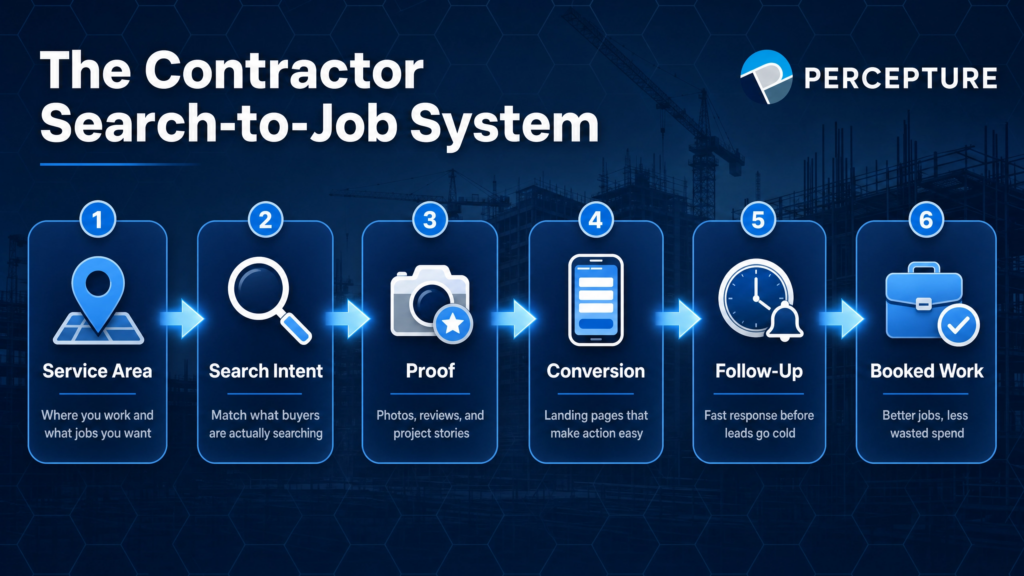
The Percepture Search-to-Revenue Control Loop
The framework keeps search strategy tied to business outcomes while preserving the leading indicators needed before revenue data matures.
- 1Findability
Track local, organic, paid, and AI-assisted discovery by market, service, location, and intent.
- 2Qualification
Separate serviceable prospects from spam, job seekers, existing customers, vendors, and out-of-area demand.
- 3Conversion
Measure calls, forms, appointments, and the path from landing page to booking.
- 4Revenue
Connect booked work to revenue and gross profit where source and CRM data support the connection.
- 5Iteration
Change market priorities, pages, offers, media, and operating handoffs based on the full trail.
What should the first 90 days include?
The first 90 days should establish control, repair the largest blockers, and create an operating rhythm. A responsible provider explains dependencies and planned outputs without promising a fixed ranking or lead result.
Complete access and ownership audits, analytics baselines, call-tracking review, technical and local audits, content inventory, market priorities, and an approval map. The checkpoint is whether the baseline, risks, owners, and first backlog are clear.
Implement priority technical fixes, profile corrections, architecture decisions, tracking repairs, content briefs, internal links, and reporting setup. The checkpoint is whether implementation is moving and delays are documented.
Begin publishing, authority work, conversion tests, local execution, lead-quality review, early trend analysis, and the next-quarter roadmap. The checkpoint is evidence of completed work, cleaner measurement, and a sound forward plan.
Competition, technical debt, approvals, access, migrations, market size, website quality, and seasonality can change the timeline. Prepare content before demand peaks, but use each market’s history and operating plan to set the calendar.
How should local and multi-location programs work?
For multi-location brands, the hard part is governance. Each office may need local proof and flexibility, while the parent brand needs consistent naming, tracking, access, templates, reporting, and escalation.
Ask how the provider handles closed locations, moved offices, mergers, duplicate profiles, acquisitions, rebrands, hidden-address businesses, and franchise territories. Maps, organic search, Local Services Ads, and paid search should be reviewed together so channels do not optimize toward conflicting goals.
How to evaluate AI-search capability
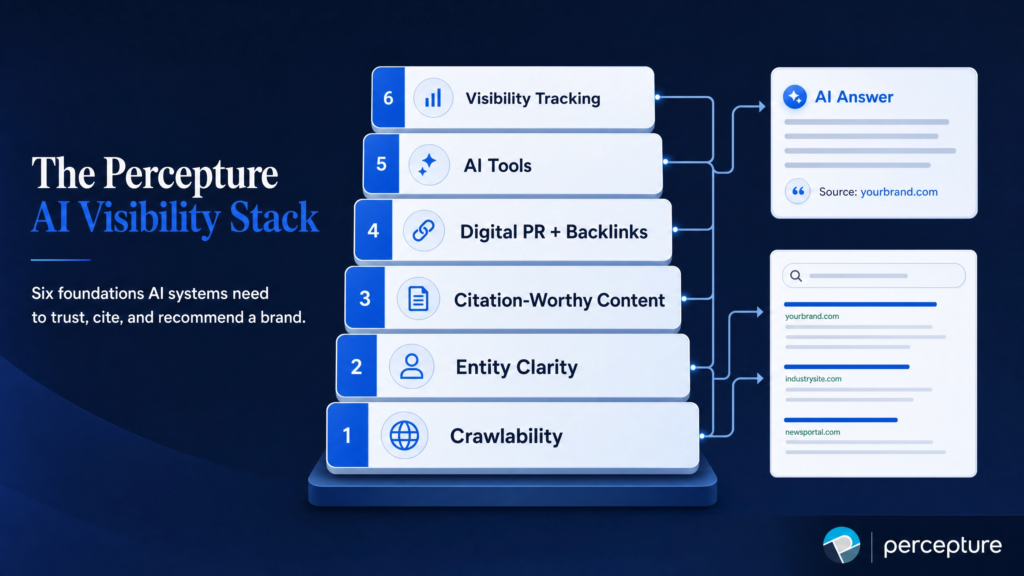
AI-search work should strengthen the same foundation needed for durable search visibility: crawlable pages, clear entities, useful answers, credible sources, expert review, consistent business information, relevant mentions, and sound technical access.
No provider can guarantee inclusion in an AI answer. Ask which prompts are tracked, how branded and non-branded visibility are separated, how citations are documented, how retrieval is tested, and how the findings change content or authority work.
Percepture’s GEO services cover generative-search visibility. Contractors can also review HVAC AI-search optimization, GEO for HVAC, and the HVAC AI visibility audit.
How are calls and booked jobs measured?
Reporting should follow a defined chain: search visibility, qualified visits, calls or forms, appointments, booked jobs, revenue, gross profit, and lifetime value when available. Rankings remain useful leading indicators, but they should not stand alone.
Strong providers define how spam, existing customers, vendors, job seekers, wrong numbers, and out-of-area calls are filtered. They also distinguish repair, maintenance, replacement, emergency, and financing demand when those categories matter to staffing and margins.
Ask whether source data can pass into the contractor’s CRM and whether the provider can work with existing call, scheduling, and reporting systems. Percepture’s attribution and analytics service covers measurement architecture. The lead-generation service addresses the wider demand and qualification process.
How to inspect a case study
- Confirm the client type, market, period, starting condition, and work performed.
- Separate branded demand from non-branded discovery.
- Ask whether reported leads were qualified, booked, or merely submitted.
- Check whether revenue attribution uses documented source and CRM data.
- Request context for migrations, paid media, seasonality, acquisitions, and operating changes.
- Ask what did not work and what the team changed.

Percepture’s Broadstaff search visibility and qualified-lead case study provides another example of inspecting the path from visibility to lead quality.
What questions should I ask before signing?
Proof and strategy
- Which comparable situations have you handled?
- Can we speak with an appropriate reference?
- What would make our company a poor fit?
- Which proposal assumptions still need testing?
- How will you plan around seasonality and dispatch capacity?
Local, technical, and content
- What will you audit before implementation?
- Who makes website and profile changes?
- How will service and location pages be organized?
- Who writes and reviews technical HVAC content?
- Where will links and mentions come from?
Measurement and team
- How will calls, forms, appointments, and booked jobs be tracked?
- Who reviews lead quality?
- Which team members perform each part of the work?
- What is the meeting and reporting cadence?
- What happens when access or approvals are delayed?
Ownership, conflicts, and exit
- Who owns the website, content, accounts, and data?
- Do you serve direct competitors in the same market?
- Is territory exclusivity available?
- What are the term, renewal, cancellation, and transfer rules?
- Which fees sit outside the quoted scope?
Use the same questions with every provider. A consistent process makes meaningful differences easier to see and reduces the influence of presentation style.
What red flags should I avoid?
- Guaranteed rankings, leads, revenue, or AI citations. No provider controls those outcomes.
- Unexplained links, review tactics, traffic sources, or subcontracting. The method and risk should be visible.
- Thin city pages produced by changing place names. Location pages need distinct value and genuine facts.
- Reports built around impressions and rankings without lead-quality review. Visibility needs an operating trail.
- Pressure to rebuild before a documented technical assessment. The audit should explain what is necessary.
- Agency-owned domains, profiles, analytics, content, or phone numbers. Ownership should be clear before launch.
- Unclear cancellation, renewal, export, or migration terms. Exit requirements belong in the agreement.
- No written answer about same-market competitors. Conflict policy should be explicit.
- Case studies without dates, definitions, scope, or business context. Proof needs enough detail to evaluate.
- A strategy that ignores call handling, capacity, service areas, or job mix. Search demand must fit the operation.
How do I switch agencies safely?
Begin with an ownership and access inventory. Confirm control of the domain, hosting, website, content, Google Business Profile, analytics, Search Console, tag manager, call tracking, paid accounts, CRM integrations, dashboards, listings, and creative files.
Export baselines, keyword maps, content calendars, technical backlogs, redirect plans, link records, reports, and tracking documentation. When old and new providers overlap, define who may change the website, profiles, tags, and campaigns during the transition.
Remove old access only after required assets and records have transferred. During a redesign or migration, document URLs, redirects, canonicals, templates, analytics, forms, phone tracking, and launch checks before deployment.
How Percepture should be evaluated
Percepture should be evaluated with the same scorecard used for other HVAC SEO companies. Buyers should inspect its approach to integrated SEO, GEO, content, digital PR, paid media, conversion, analytics, implementation, ownership, conflicts, contracts, and reporting rather than treating inclusion in this guide as a ranking.
Percepture may fit businesses that want search connected with wider demand, authority, conversion, and measurement work. A narrow, lowest-cost, SEO-only engagement may call for another operating model. The integrated marketing approach provides service context, while the HVAC lead-generation agency guide addresses the broader pipeline decision.
Frequently asked questions
How much does HVAC SEO cost?
Cost depends on location count, competition, technical debt, website condition, content needs, local-search work, authority development, tracking, and implementation responsibility. Compare the complete scope rather than the retainer alone. Request included work, exclusions, software, media, production, setup costs, contract terms, and cancellation rules.
How long does HVAC SEO take?
There is no fixed timeline for every contractor. Competition, technical problems, website history, access, approvals, migrations, location count, content quality, authority, and seasonality affect progress. The first 90 days should still produce a clear baseline, completed priority work, stronger measurement, and a documented roadmap.
Is HVAC SEO worth it for a small contractor?
It can be when the contractor has service capacity, a clear market, sound call handling, useful margins, a workable website, and enough budget to maintain the program. A smaller contractor should first address routinely missed calls, unclear service areas, absent tracking, or an inability to implement agreed changes.
Can HVAC SEO companies guarantee rankings or AI citations?
No provider controls search rankings or inclusion in an AI-generated answer. A responsible provider can improve technical eligibility, local execution, content quality, entity clarity, authority, measurement, and iteration. Treat guarantees of rankings, leads, revenue, or AI citations as contract and risk questions rather than proof of capability.
Who should own the website, content, accounts, and data?
The contractor should understand and approve ownership before work begins. The agreement should address the domain, hosting, website, source files, content, analytics, Search Console, business profiles, call-tracking numbers, CRM data, dashboards, paid accounts, creative assets, and export rights after cancellation.
Should an HVAC company hire a specialist or an integrated agency?
Choose based on proof and operating fit. A specialist may offer faster industry familiarity. An integrated agency may provide broader technical, public-relations, paid-media, conversion, analytics, or AI-search depth. Compare the learning process, team quality, local execution, conflicts, customization, ownership, reporting, and implementation.
What should happen if there is little movement after 90 days?
Review completed work, access delays, technical fixes, indexing, local changes, content production, authority work, conversion tracking, lead quality, and competitive movement. Separate implementation failure from a normal lag in outcomes. The provider should explain what changed, what remains blocked, and whether to correct, expand, pause, or end the plan.
Does GEO replace traditional SEO?
No. Generative engine optimization builds on crawlability, clear entities, useful content, credible sources, technical access, authority, and brand consistency. It adds prompt tracking, citation review, retrieval testing, and source-oriented content decisions.
What proof should an HVAC SEO agency provide?
Request comparable cases, source access, dates, definitions, work performed, starting conditions, implementation details, sample reports, references, and limitations. Ask how branded demand, paid media, seasonality, acquisitions, and operational changes affected the result.
How should a contractor compare two SEO proposals?
Place both proposals into the same scorecard. Separate recurring services, projects, media, software, tracking, content production, development, and pass-through costs. Compare ownership, staffing, market conflicts, implementation responsibility, measurement, cancellation, and asset-transfer terms.
Compare your plan with the scorecard
Use the HVAC Search Revenue Fit Scorecard to compare your current agency, proposals, or internal plan. Percepture can review how you are comparing HVAC SEO companies across local search, technical work, content, authority, AI readiness, attribution, ownership, pricing, and implementation.
Book a Strategy ConversationThe review can begin with one proposal, one market, or one measurement problem.

Key takeaway: the right way to compare HVAC SEO companies is to use one transparent scorecard covering local execution, technical depth, relevant proof, AI-search readiness, qualified demand, ownership, pricing, conflicts, implementation, and the path to booked revenue.