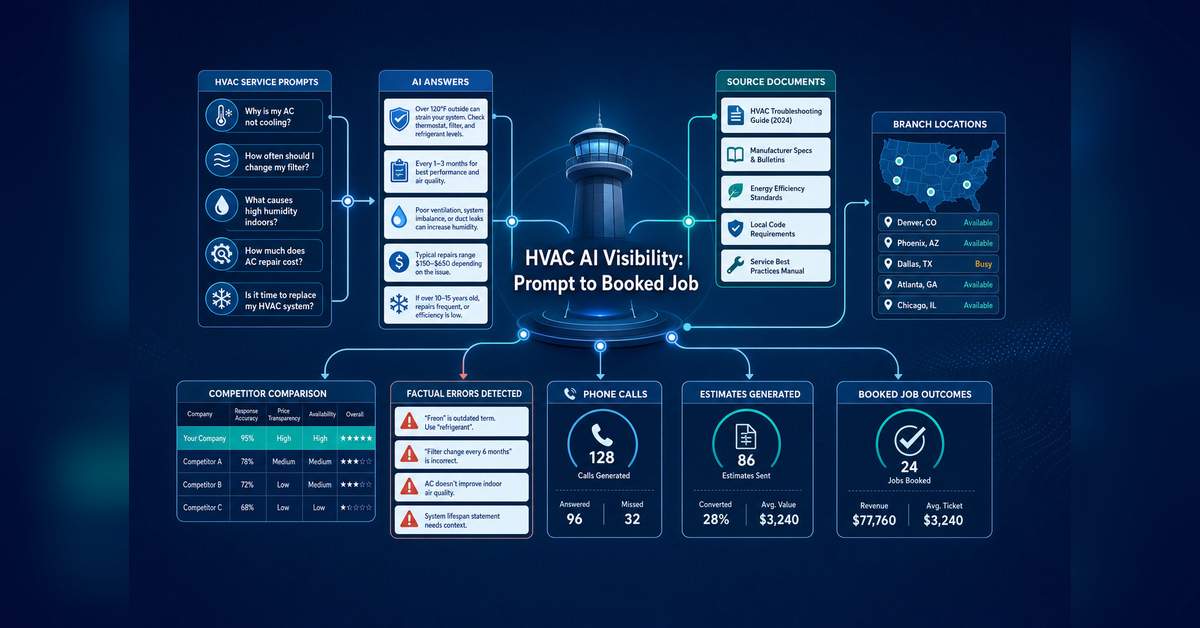

HVAC AI visibility measures how often and how accurately an HVAC company appears in AI-generated answers for defined prompts, services, markets and buyer situations. A useful audit records the platform, prompt, location, answer, sources, competitors, accuracy and business outcome. One scan or one score is not enough.
This guide gives HVAC owners, executives and marketing leaders a defensible measurement process before investing in broader generative engine optimization services. It explains what to test, how to interpret the evidence and how to turn findings into work that can improve visibility and conversion.
See how Percepture turns complex expertise into visible demand
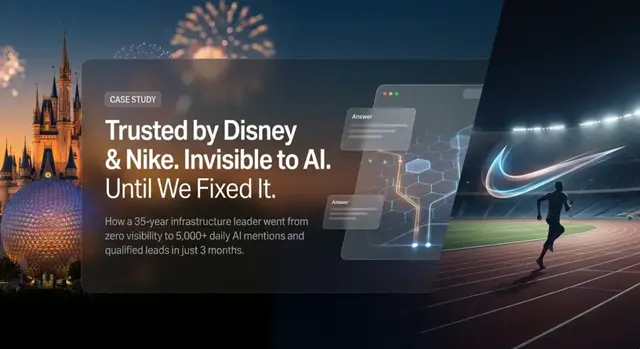
OPTK Networks operates across fiber, telecom and data-center markets where buyers expect technical clarity and credible proof. This adjacent-market case study shows Percepture’s working approach. It is not presented as an HVAC client result or a guarantee that every campaign will move at the same speed.

OPTK Networks
“They understand the technical side, but they also understand how to make the market care.”
Cody Clegg on Percepture’s technical-market execution.
What does a credible HVAC AI search audit show?
A credible HVAC AI visibility audit records where a company is mentioned, recommended or cited across a controlled set of buyer prompts. It also captures the platform, market, search mode, answer, visible sources, competitors, factual accuracy and identifiable lead outcomes so the team can decide what to correct, build and retest.
Executive summary
Test a defined sample
Set prompts, markets, services, platforms, search modes and repeat runs before comparing results.
Separate the outcomes
An appearance, mention, recommendation and visible citation are different events. Report each one separately.
Check operational truth
Wrong hours, phone numbers, service areas or branch capabilities can create risk even when visibility looks strong.
Measure the funnel
HVAC AI visibility becomes commercially useful when the team can follow identifiable demand through calls, estimates, jobs, revenue and margin.
Questions buyers ask about AI search visibility for HVAC
How do I know whether my HVAC company appears in ChatGPT?
Run a documented set of service, market, comparison and reputation prompts. Save the exact answer, sources, competitors, location context, search state and date.
What makes an HVAC company easier for AI systems to recommend?
Accurate local data, crawlable service pages, clear entity information, reviews, useful expert content, credible third-party sources and a strong conversion path all help.
Is a mention the same as a citation or recommendation?
No. A mention names the company. A citation links to a visible source. A recommendation presents the company as an option for the buyer.
Does AI visibility replace traditional SEO?
No. Technical access, useful pages, internal links, local relevance and authority remain the foundation. AI-search work extends those signals across answer engines and source ecosystems.
How often should an HVAC company retest?
Retest after major corrections and on a consistent reporting schedule. Preserve the same prompts, markets, platforms and search modes so changes are easier to interpret.
What should the audit produce?
A useful audit produces a prompt register, answer captures, source map, competitor gaps, factual-error log, conversion review and an action queue with owners and dates.
What Is HVAC AI Visibility?
HVAC AI visibility is a record of observed answers, not a permanent search position. The record should state what was asked, which AI product answered, whether search was enabled, which market was represented and when the test ran.
Working glossary
| Term | Practical meaning | What to record |
|---|---|---|
| Appearance | The company is present anywhere in the answer or source area. | Answer, interface area and run details |
| Mention | The answer names the company. | Exact language and sentiment |
| Recommendation | The answer presents the company as an option for the user. | Prompt intent and surrounding context |
| Citation | A visible source link points to the company or one of its pages. | Domain, URL and cited claim |
| Retrieval | A source appears to support an answer when the interface exposes that information. | Exposed source details without assuming causation |
| Observed share | The company’s share within the defined test sample. | Denominator, markets, platforms and dates |
| Factual fidelity | The share of checked material claims that are accurate. | Claim, source of truth and result |
| Referral | An identifiable visit from an AI source. | Landing page, source and downstream action |
Why One AI Visibility Score Can Mislead
A single AI visibility score can hide how the test was built. A result may change when the prompt wording, location, search mode, platform, prior context or test date changes. One run also cannot show whether an answer is stable.
Generic benchmark prompts can make the sample larger while making it less useful. An emergency repair prompt outside a branch’s service area should not carry the same value as a serviceable, high-intent prompt in that branch’s market.
A score is most useful as a summary of disclosed observations. It should never replace the prompt register, captured answers, visible sources, accuracy log or confidence labels behind it.
What each buyer needs from the audit
Owner or CEO
A concise AI visibility view of competitor gaps, reputation risks and the three actions that matter first.
CFO
Attribution limits, cost, qualified demand, booked revenue and margin where tracking supports them.
Marketing leader
AI visibility trends by prompt, source gaps, confidence labels and a clear implementation queue.
Operations leader
Correct hours, service areas, routing, equipment claims and branch capabilities.
Check your AI search presence
Bring your website, priority services, markets and top competitors. Percepture can help you identify the first prompts, source gaps and factual risks worth reviewing.
- See where your company appears or disappears
- Find incorrect facts and weak source coverage
- Leave with a short list of next actions
What Should an HVAC AI Search Audit Measure?
The scorecard should combine exposure, evidence, truth and business outcomes. That keeps AI visibility reporting from becoming a collection of screenshots with no decision value.
Metric dictionary
| Metric | Calculation or test | Decision supported |
|---|---|---|
| Prompt coverage | Approved priority prompts tested divided by total approved prompts | Whether the planned AI visibility sample was completed |
| Observed mention rate | Valid responses naming the company divided by valid responses | How often the brand appears in the sample |
| Observed recommendation rate | Recommendations divided by valid hiring-intent responses | Where the company enters buyer consideration |
| Citation rate | Responses with a visible company citation divided by responses where citations are available | Whether owned evidence receives visible attribution |
| Answer consistency | Repeated runs with materially similar recommendations divided by repeated runs | How stable an observation appears |
| Factual fidelity | Verified material claims divided by material claims checked | Where correction work is required |
| Competitor gap | Priority prompts where a competitor appears and the company does not | Which AI visibility prompt and evidence gaps deserve review |
| Qualified outcomes | Tracked calls, forms, estimates, jobs, revenue and margin | Whether observed demand contributes to the business |
Vanity metrics versus decision metrics
| Weak summary | Better decision metric | Reason |
|---|---|---|
| Total mentions | Mentions by service, market and intent | Shows whether the demand is serviceable |
| One visibility percentage | Recommendation rate with sample and confidence | Discloses what the percentage represents |
| Total citations | Citations by page, source type and claim | Points to evidence that can be improved |
| AI traffic | Qualified calls, estimates and booked jobs from identifiable sources | Connects attention to business value |
The Percepture HVAC AI Search Control Tower
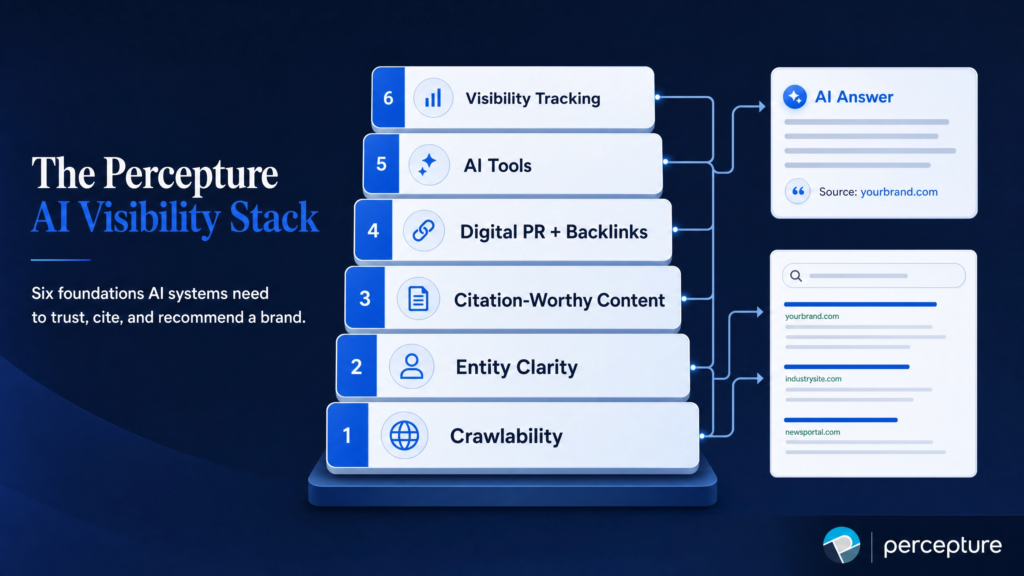
The Percepture AI visibility Control Tower is a six-stage method for moving from buyer demand to observed answers, evidence, truth, outcomes and assigned action. It gives owners a repeatable way to manage AI visibility without treating any platform output as a permanent rank.
The six stages
- 1Map demand. Build prompt families from customer questions, sales objections, service pages, reviews, site search, call themes, Search Console data and paid-search demand data.
- 2Run the test matrix. Record platform, product, search mode, location, exact prompt, context, date and run number.
- 3Capture the answer. Save whether the company was absent, mentioned, cited, compared or recommended. Record competitors and visible sources.
- 4Trace the evidence. Review owned pages, local listings, reviews, directories, trade sources, manufacturer pages, associations, media and other exposed evidence.
- 5Verify truth and experience. Check material facts and confirm that the landing, call, form or scheduling path supports the user’s next step.
- 6Connect and prioritize. Tie identifiable demand to the funnel, rank actions by impact, confidence, feasibility and effort, then assign an owner and review date.
How to Build an HVAC Prompt Set
A useful AI visibility test starts with prompt families that reflect how buyers ask for help. Include emergency, repair, replacement, maintenance, cost, financing, reputation, comparison, equipment, commercial, brand and market questions.
Each prompt needs operating fields: service, market, urgency, residential or commercial, buyer stage, expected value and serviceability. Pricing prompts should be separated from recommendation prompts because they require different evidence and user outcomes.
Prompt-priority matrix
| Prompt family | Example intent | Priority factors | Primary outcome |
|---|---|---|---|
| Emergency | Immediate repair in a defined market | Serviceability, hours, routing, urgency | Qualified call or booking |
| Repair | Diagnosis or repair provider | Equipment, market, proof, availability | Appointment or estimate |
| Replacement | System options and installer comparison | Buyer stage, financing, margin, capability | Estimate |
| Pricing | Cost range or repair-versus-replace question | Accuracy, assumptions, market and update date | Qualified research visit |
| Commercial | Capability, uptime or procurement need | Equipment, geography, safety, controls and proof | Qualified opportunity |
| Brand | Reputation or company comparison | Entity accuracy, reviews and source quality | Consideration or direct visit |
How many prompts and runs should be tested?
Percepture’s planning baseline is 40 to 60 priority prompts across four or more prompt families and at least three relevant AI surfaces. Priority prompts may be repeated at least three times when consistency matters. This is a working methodology, not a universal platform standard.
The final sample depends on the number of branches, markets, services and buyer types. A multi-location operator should preserve branch-level tests instead of expanding one national prompt set and averaging away local gaps.
Which AI Platforms Should HVAC Companies Track?
Platform selection should follow buyer behavior and business relevance. AI visibility testing may include Google AI experiences, ChatGPT Search, Gemini, Microsoft Copilot or Bing, Perplexity and other approved surfaces, but the same measurement fields should be used across the test.
Platform measurement comparison
| Surface | Useful observation | Control to record | Important limit |
|---|---|---|---|
| Google AI experiences | Answer presence, visible sources and destination pages | Query, location, device and search experience | Observation does not reveal Google’s internal selection logic |
| ChatGPT Search | Answer language, recommendations and source links | Exact prompt, location context and search state | No official HVAC recommendation rank |
| Gemini | Brand, service and source observations | Product, prompt, account state and market | Results may vary between runs |
| Copilot or Bing | Answer and visible citation observations | Product, search mode, market and date | A citation is not proof of rank or authority |
| Perplexity | Answer, source and follow-up behavior | Prompt, mode, location context and run | Visible sources do not prove a causal ranking factor |
Google states that technical eligibility, indexing and established Search practices remain foundational for its AI search experiences. Its guidance also warns that eligibility does not guarantee appearance. See Google’s AI features and website guidance.
How to Audit Citations and Sources
Start at the answer, then work backward. Record each visible domain and URL, the claim it appears to support, the company associated with it and whether the source is owned, earned, local, editorial, manufacturer, association, review, directory, video or community content.
Look for source overlap between the company and its competitors. If a frequently cited source contains useful competitor evidence but no equivalent company evidence, log it as a source opportunity rather than assuming that inclusion will cause a recommendation.
Source work can lead to better owned pages, stronger local data and legitimate earned coverage. Percepture combines digital PR services with search and content work so the action plan can address both owned and third-party evidence.
How to Audit Wrong or Missing HVAC Information
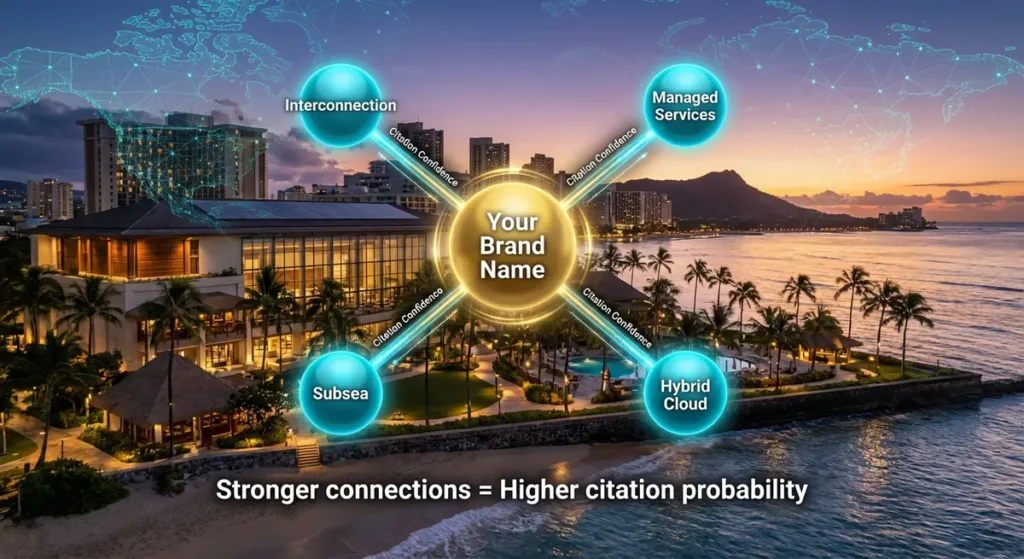
Accuracy belongs in the main scorecard, not in an appendix. Prioritize facts that can send a buyer to the wrong place or create an expectation the branch cannot meet: emergency hours, service areas, branch phone numbers, residential or commercial capabilities and supported services.
Factual-error log
| Field | What to enter |
|---|---|
| Fact checked | The material claim, such as hours, market or service |
| Observed answer | The exact wording shown during the test |
| Visible source | The source displayed with the answer, when available |
| Operational risk | How the error could affect a buyer, branch or call path |
| Source of truth | The approved record used to correct the fact |
| Owner and dates | Correction owner, correction date and retest date |
Review local entity consistency alongside the site. The same discipline used in a technical SEO audit service can uncover blocked pages, conflicting canonicals, rendering issues or weak internal paths that limit retrieval.
How Multi-Location HVAC Companies Should Report Results
Multi-location reporting should begin with branch, market, service and urgency. Parent-brand rollups come later. This prevents a strong market from hiding a branch that is absent or represented with the wrong facts.
- Maintain one approved source of truth for branch names, phones, hours, services and service areas.
- Run local prompts for each priority market and branch.
- Separate emergency demand from planned replacement or maintenance.
- Track acquisitions and rebrands until old and new entity references are reconciled.
- Retest after closures, hours changes, routing changes or material service updates.
Branch evidence also benefits from the same market discipline used in SEO for construction companies, where service scope and geographic relevance must remain clear.
Residential Versus Commercial AI Search Visibility
Residential and commercial buyers should not share one prompt set or one conversion definition. Their questions, evidence and next steps are materially different.
Residential and commercial scorecard differences
| Dimension | Residential | Commercial |
|---|---|---|
| Core intent | Urgent local repair, replacement, maintenance or price research | Capability, equipment, controls, uptime, geography or procurement |
| Trust evidence | Local accuracy, reviews, availability, financing and service fit | Capabilities, safety, service levels, technical proof and case evidence |
| Location model | Homeowner market and service area | Facility geography and operating coverage |
| Conversion | Call, schedule request or estimate | Qualified inquiry, site review, bid or sales opportunity |
| Accuracy risk | Wrong hours, phone, availability or service area | Wrong equipment, capability, geography or response commitment |
What First-Party Data Can Support the Audit?
No single source provides the whole picture. Search Console can show search demand and destination-page performance available to the account. Analytics can identify referral sessions when source information is present. Call tracking, forms, scheduling systems, CRM records and sales data supply the lead and revenue layers.
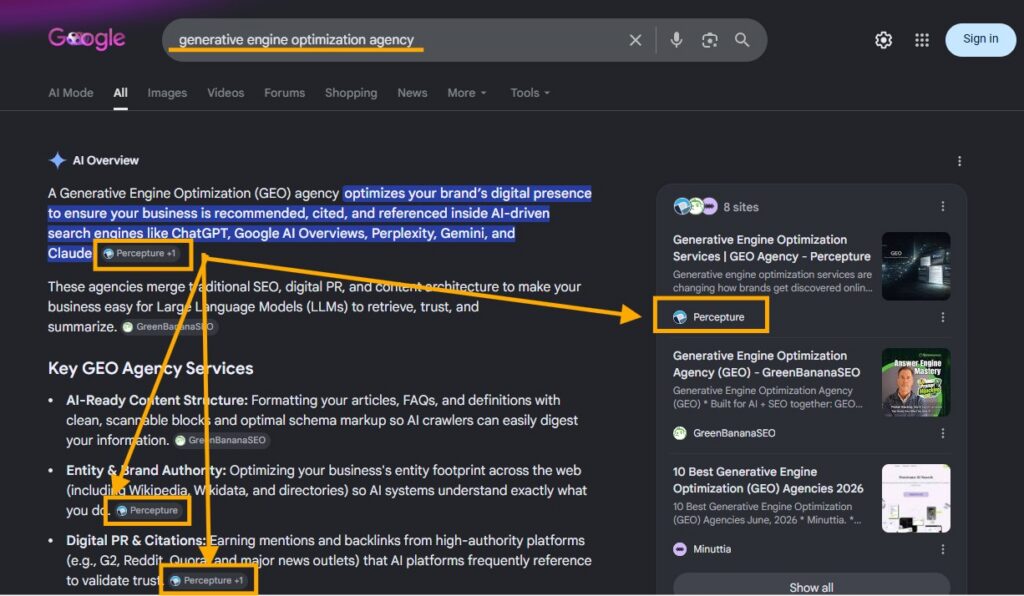
OpenAI explains that ChatGPT Search can display source links, use general location and send referral URLs that include utm_source=chatgpt.com. That supports referral analysis, but it does not create a first-party HVAC recommendation score. See the official ChatGPT Search documentation.
Use attribution and analytics services to define the source fields, qualified-lead stages and reporting joins required across analytics, calls and CRM.
AI Visibility Software Versus a Managed Audit
AI visibility software can reduce collection work, but buyers should compare methodology and implementation support before comparing dashboard features or pricing. The best option depends on internal capacity, branch complexity and the level of attribution required.
Audit delivery framework
| Option | Best fit | Strength | Buyer must supply |
|---|---|---|---|
| DIY spreadsheet | Small prompt set and one market | Full control over fields and captures | Manual testing, QA and interpretation |
| General visibility platform | Broad brand tracking | Workflow, trend and competitor reporting | HVAC prompt design and serviceability review |
| SEO suite add-on | Teams consolidating search tools | Convenient reporting environment | Accuracy, branch and funnel analysis |
| HVAC-specific software | Operators needing industry prompt workflows | More relevant categories and market views | Method review, CRM joins and implementation ownership |
| Managed Percepture audit | Complex markets, branches or buyer committees | Prompt design, evidence review, accuracy, attribution and action planning | Business priorities and access after scope is defined |
How to Turn Findings Into an Action Plan
The AI visibility action plan should map each finding to a destination, owner, metric and deadline. Common workstreams include crawl and index corrections, branch data, service and location content, pricing evidence, reviews, digital PR, conversion paths, call routing and CRM measurement.
Use organic SEO services for search eligibility and useful destination pages. Use content marketing services to close evidence gaps with expert-led service, comparison and decision content. For construction-sector context, Percepture’s guides to construction content marketing and digital marketing for construction companies show how connected channels support complex buying paths.

How to Connect AI Search Visibility to Leads and Revenue
AI visibility is an upstream measure. The commercial path is AI referral or identifiable call, landing page, qualified lead, estimate, booked job, revenue and gross margin. Not every platform visit will be identifiable, so reports should state attribution limits.
Instrument calls, forms and CRM stages before declaring success. conversion rate optimization services can address weak landing pages and scheduling paths, while lead generation services can align demand capture with qualification and sales follow-up.
See AI search pricing options
Compare strategy, prompt testing, source analysis, technical work, content, digital PR, conversion support and reporting before choosing a scope.
- Match the scope to your branches and markets
- See which services are included
- Choose a practical starting point
A 90-Day AI Visibility Audit Cycle
A 90-day cycle gives the team a planning cadence for baseline work, corrections and retesting. It is not a promise that a platform will change an answer within a set period.
| Period | Work | Output |
|---|---|---|
| Days 0–15 | Confirm markets, branches, services, competitors, qualified-lead rules, tracking and prompt set. Run the documented baseline. | Approved test register and baseline captures |
| Days 16–30 | Trace sources, check facts and audit technical, local, content, reputation and conversion gaps. | Accuracy log, source map and priority queue |
| Days 31–60 | Correct high-risk facts and improve priority pages, proof, local records and conversion paths. | Implemented actions with owners and dates |
| Days 61–90 | Repeat controlled tests and review source, analytics, call, CRM and sales observations. | Change report and next-quarter action plan |
Common Audit Mistakes
Weak the audits usually fail because the sample, controls or business outcome is unclear.
- Testing only branded prompts or one city
- Running each prompt once
- Mixing search-enabled and non-search answers
- Calling a mention a citation
- Treating recommendation order as a stable rank
- Ignoring wrong facts and serviceability
- Combining residential and commercial prompt sets
- Reporting attention without calls, CRM or sales feedback
- Comparing different dates or products as if the tests were identical
- Claiming causation from a source correlation
Why Percepture
Percepture was founded in 2004 and integrates SEO, GEO, technical SEO, digital PR, paid media, content, conversion work, analytics and lead generation. The Control Tower method brings those disciplines into one the audit with a defined action owner for each finding.
The work does not stop when a monitoring tool produces a chart. The team reviews prompts, visible sources, material facts, landing paths and downstream measurement so leaders can decide what to correct, build or test next.
Built for technical, construction and infrastructure buyers





AI Search Visibility FAQs for HVAC Companies
What is HVAC AI visibility?
HVAC AI visibility is the observed presence and accuracy of an HVAC company across a defined sample of AI-generated answers. A useful sample records prompts, platforms, markets, search modes, dates, repeat runs, competitors, citations and identifiable business outcomes.
What is an HVAC AI visibility audit?
An HVAC AI visibility audit is a controlled review of buyer prompts, AI answers, visible sources, competitors and material facts. It also checks whether recommended landing paths can convert serviceable demand and whether analytics, calls and CRM data can connect that demand to qualified outcomes.
How is AI visibility different from an SEO ranking?
An SEO ranking usually refers to a page position for a search query under defined conditions. An AI answer can synthesize several sources, rewrite a query, vary by context and present brands without a stable ranked list, so the audit records answer-level evidence.
Can AI visibility be measured with one score?
A score can summarize a disclosed test sample, but it should not stand alone. Decision-makers also need the prompt register, denominator, repeat runs, markets, source captures, competitor results, accuracy checks and confidence labels.
How many prompts and runs should an HVAC company track?
The count depends on services, markets, branches and buyer types. Percepture uses a planning baseline of 40 to 60 priority prompts across four or more families and at least three relevant surfaces, with repeat runs for priority questions when consistency matters.
Which AI platforms should HVAC companies monitor?
Track the platforms that matter to the company’s buyers and markets. A practical set may include Google AI experiences, ChatGPT Search, Gemini, Microsoft Copilot or Bing and Perplexity. Record the exact product, prompt, market, mode, run and date.
Why do AI answers change between tests?
Answers may vary because of prompt wording, prior context, search mode, location, account state, product changes, available sources and normal response variation. Repeated controlled tests show whether an observation appears stable enough to guide a decision.
How can an HVAC company improve AI visibility?
Start with accurate business and branch data, crawlable service pages, clear expertise, useful answer-focused content, strong reviews, legitimate third-party coverage, structured internal links and conversion paths that match the buyer’s next step.
How much does an HVAC AI visibility audit cost?
Cost depends on the number of branches, markets, services, prompt families, AI surfaces, repeat runs, source reviews, accuracy checks, attribution needs and implementation support. Compare scope and deliverables before comparing a single price.
Can an agency guarantee AI visibility or citations?
No agency controls an AI platform’s answer selection. A provider can improve technical access, entity clarity, content, source quality, local accuracy and measurement, but it should not promise a permanent recommendation, citation or number-one placement.
Want a clear HVAC AI visibility plan?
Bring your priority services, markets, branches, competitors and lead definition. Percepture can help you scope the prompt register, source review, accuracy log, conversion plan and action queue.
- See where your brand is absent, wrong or weak
- Identify the sources and pages that need work
- Connect the audit to calls, leads and booked work