
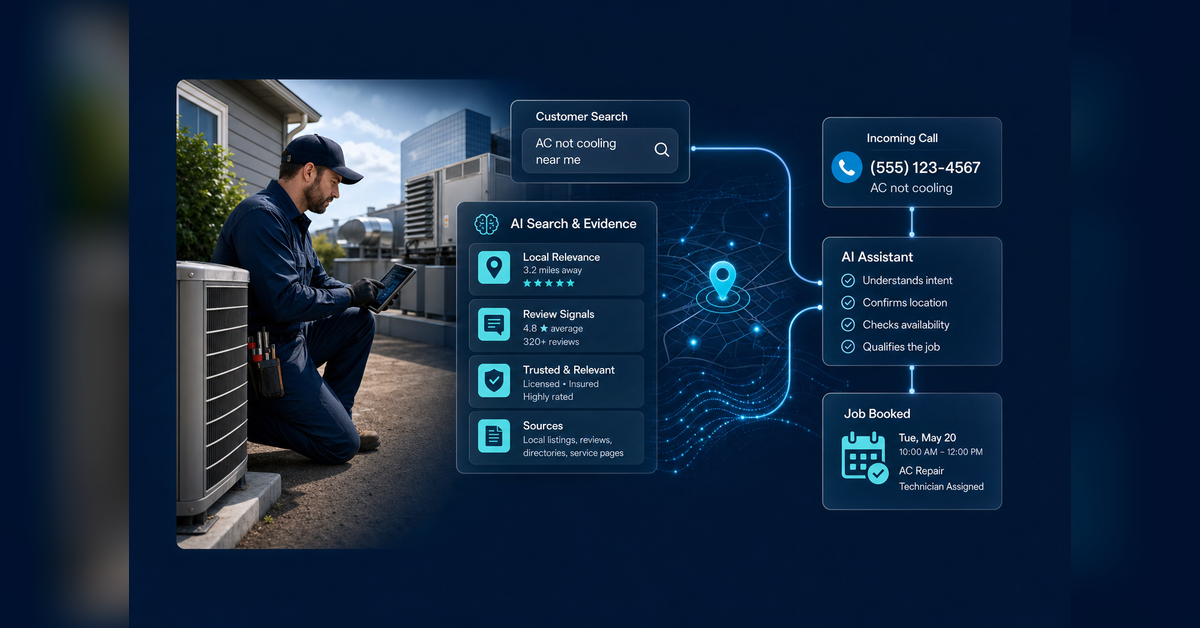

AI systems can answer an HVAC buyer’s question before that buyer reaches a contractor’s website. That makes hvac ai search optimization a visibility and evidence problem—not a project for installing receptionists, dispatch tools, or sales agents.
This guide explains how an HVAC company can become easier to find, understand, verify, cite, and recommend across AI-assisted discovery. It also shows how to connect that visibility to calls, appointments, booked jobs, and revenue without treating a citation as the final business result.
See how Percepture earns visibility in technical markets
HVAC companies that serve data centers, construction projects, mission-critical facilities and infrastructure buyers need accurate technical positioning, strong proof and a clear path from visibility to a qualified conversation.
Mirror the markets your best buyers already understand
Commercial HVAC providers often sell into data centers, construction programs, fiber facilities, critical infrastructure and complex B2B operations. Those buyers expect technical accuracy, documented proof and a clear next step.

See what your HVAC company is missing
Meet with Bob and the Percepture team. We will review your markets, services and current visibility, then show you the first gaps worth fixing.
- Clear visibility gaps
- Priority pages and proof
- Simple 90-day next steps
What makes an HVAC company visible in AI search?
HVAC AI search optimization is the process of making an HVAC company easier for AI-powered search systems to find, understand, verify, cite, and recommend. It combines technical SEO, clear services and locations, direct answers, expert-reviewed content, reviews, local data, third-party authority, prompt tracking, and conversion measurement.
The executive view
Build eligibility first
Pages must be indexable, crawlable, internally linked, and readable as text before they can become dependable source candidates.
Make the business clear
Service lines, locations, hours, credentials, people, and operating details should agree across owned and third-party sources.
Answer real buying questions
Emergency, cost, repair, replacement, equipment, location, and commercial prompts need useful answers with clear assumptions.
Measure business outcomes
Track mentions and citations, but also follow visits, calls, forms, appointments, booked jobs, assisted conversions, and revenue.
Who this strategy is for
Local HVAC owners
Use an HVAC AI visibility program when the website, local profiles, reviews, and service facts are accurate enough to support growth.
Multi-location operators
Use an HVAC AI visibility program to create consistent entity, location, service, content, and measurement standards without publishing duplicate local pages.
Commercial HVAC firms
Use an HVAC AI visibility program to present vertical expertise, service coverage, procurement information, project evidence, and named technical reviewers.
Marketing and finance leaders
Use an HVAC AI visibility program when the team needs clear scope, ownership, costs, leading indicators, conversion reporting, and implementation priorities.
What Is HVAC AI Search Optimization?
HVAC AI visibility coordinates search, content, local data, entity clarity, authority, and analytics around the questions buyers ask AI-supported systems. The goal is to improve the probability that accurate information about the company can be discovered and supported by credible sources.
It does not replace complete HVAC SEO strategy. Search engines and AI interfaces still depend on accessible pages, understandable content, internal links, and reliable business information. Google’s guidance says established SEO practices remain relevant to its AI search features and that no special AI markup is required.
It also does not mean installing an AI receptionist or automating dispatch. Those use cases belong under operational AI for HVAC. Search visibility focuses on how a company is represented during research and vendor selection.
How HVAC Customers Use AI Before Calling
A homeowner with a failed air conditioner may ask for an emergency provider nearby. A replacement buyer may compare heat pumps, financing, warranties, expected costs, and installer qualifications. A facility director may research commercial maintenance providers with experience in a specific building type.
These are different prompt families. Each has its own urgency, evidence needs, geography, service line, and conversion path. Effective AI-assisted HVAC discovery work maps those differences instead of tracking one broad question such as “Who is the best HVAC company?”
Buyer-question map
| Buyer situation | Example question | Evidence to publish | Conversion path |
|---|---|---|---|
| Emergency service | Who repairs AC near me now? | Accurate coverage, hours, service details, phone number, and current operational information | Tap-to-call or short booking path |
| Planned replacement | Should I repair or replace my system? | Decision criteria, assumptions, equipment expertise, warranties, financing information, and expert review | Estimate or consultation request |
| Cost research | What affects HVAC replacement cost in my area? | Cost drivers, geographic limits, scope assumptions, exclusions, and update date | Qualified estimate request |
| Commercial procurement | How should I evaluate a commercial HVAC provider? | Markets served, technical capabilities, credentials, project evidence, response process, and procurement details | Scope review or working session |
HVAC AI Search Optimization vs SEO, AEO, and GEO
HVAC AI visibility is an umbrella operating system. SEO builds discoverability in conventional search. Answer engine optimization structures concise, retrievable answers. GEO focuses on how content and entities may be represented in generative responses. Local SEO manages location relevance, business profiles, maps, reviews, and local consistency.
| Discipline | Primary goal | Typical work | Primary measurement |
|---|---|---|---|
| SEO | Earn qualified organic visibility | Technical access, pages, links, intent alignment, and search presentation | Rankings, impressions, clicks, conversions, and revenue |
| Local SEO | Build visibility for location-based demand | Business profiles, local pages, reviews, citations, and service-area clarity | Local visibility, actions, calls, leads, and booked work |
| AEO | Provide clear answers to specific questions | Definitions, concise answers, tables, steps, FAQs, and supporting context | Answer visibility, engagement, and assisted conversions |
| GEO | Improve representation in generative answers | Entity clarity, source-worthy content, corroboration, and authority | Mentions, citations, sentiment, sources, referrals, and conversions |
| Integrated AI search | Connect HVAC AI visibility to business outcomes | SEO, local, content, authority, testing, attribution, and conversion work | Prompt visibility through booked-job and revenue measures |
For deeper definitions, read Percepture’s guide to generative engine optimization for HVAC and its guide to local SEO for HVAC.
The HVAC Prompt-to-Booking Visibility Stack
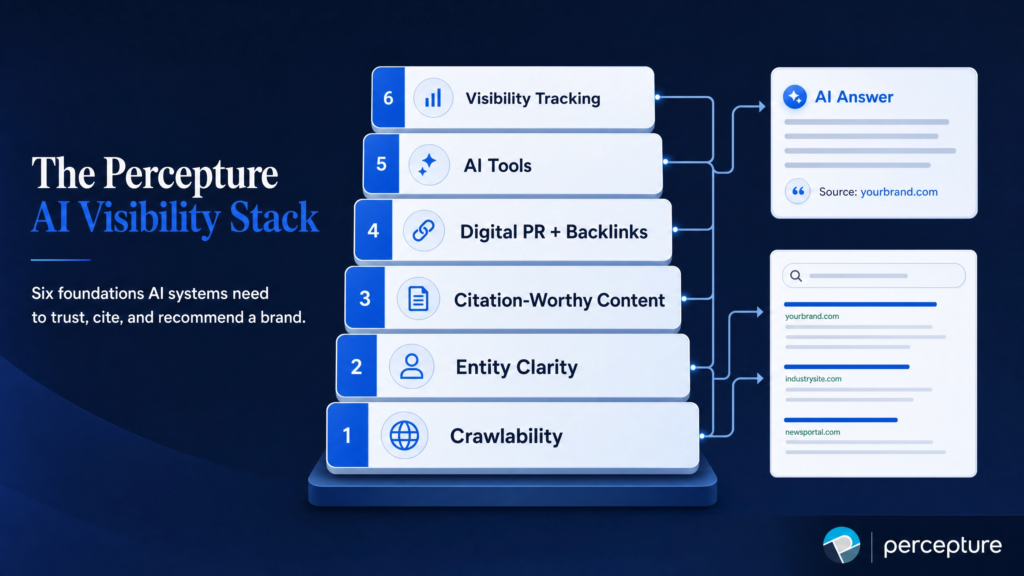
Percepture’s HVAC Prompt-to-Booking Visibility Stack organizes HVAC AI visibility into seven connected layers. A weakness near the bottom can limit every layer above it, while visibility without measurement can produce activity that never becomes accountable growth.
Seven layers from discovery to revenue
- Discovery and technical access. Keep important pages indexable, canonical, crawlable, mobile-friendly, and available as readable text. Review robots rules, sitemaps, redirects, internal links, JavaScript dependencies, and CDN or firewall controls.
- Entity, service, and location clarity. Align the company name, service lines, markets, hours, phones, leadership, qualifications, and specialties across the site and relevant third-party profiles.
- Prompt and intent coverage. Map emergency, repair, replacement, maintenance, cost, equipment, comparison, location, commercial, and trust questions by persona and decision stage.
- Source-worthy answer architecture. Answer first, then support the answer with assumptions, comparisons, tables, checklists, expert input, original evidence, and clear update practices.
- Real-world trust and local proof. Connect web claims to licenses, team expertise, detailed reviews, project examples, warranties, service processes, and accurate local information.
- Third-party authority and source overlap. Earn relevant confirmation through associations, trade or local media, manufacturer relationships, community activity, expert commentary, and credible directories.
- Visibility, sentiment, and booking measurement. Record prompts, platforms, locations, answers, mentions, citations, competitors, sources, referrals, calls, appointments, booked jobs, and revenue.
The Fresh Prompt Visibility Loop
The companion method is simple: define a stable prompt set, run it by platform and buyer context, identify answer and source gaps, correct technical or evidence problems, allow rediscovery, capture the prompts again, and compare conversion outcomes. Repeatable captures are more useful than an isolated screenshot.
Check your HVAC AI visibility
See whether buyers and AI systems can find, understand and verify the services you want to sell.
- Find missing service, location and proof signals
- See which buyer questions need stronger answers
- Separate visibility gaps from booking and tracking gaps
How AI Search Platforms Differ
Google AI features, ChatGPT Search, Gemini, Perplexity, Bing, and Copilot do not produce identical responses. Results can vary with the platform, prompt wording, available sources, location, context, personalization, and time. A company may be mentioned without a clickable citation, while a cited page may not belong to the company being discussed.
That is why an HVAC AI visibility program should test a defined set of buyer questions across the platforms that matter to the business. The purpose is not to reverse-engineer private model logic. It is to document observable outputs, source patterns, errors, competitors, and conversion opportunities.
| Surface | What to observe | What to record | Limitation |
|---|---|---|---|
| Google AI features | Answer presentation, links, local elements, and follow-up paths | Query, device, location context, sources, visibility, and resulting visits | AI presentation and source selection can change |
| ChatGPT Search | Brand mentions, cited pages, descriptions, and recommended actions | Prompt, date, citations, competitors, factual errors, and referrals | Appearance is not guaranteed |
| Gemini | Response framing, source links, and context sensitivity | Prompt version, answer, links, brand treatment, and changes over time | Outputs can differ from Google Search |
| Perplexity | Displayed sources, synthesized claims, and follow-up questions | Citations, source types, competitors, answer order, and gaps | A citation alone does not prove commercial impact |
| Bing and Copilot | Search-supported answers, sources, and local context | Prompt, answer, citations, referral activity, and factual consistency | Reporting and presentation differ by surface |
See the platform-focused guide to ChatGPT and Google AI Overviews for HVAC for a deeper operational comparison.
Prompt Research and Buyer-Question Mapping
For HVAC AI visibility, start with calls, form submissions, sales notes, search queries, autocomplete, related questions, reviews, and customer objections. Group questions by intent instead of creating a separate page for every wording variation. A good map covers the buyer’s task, location, urgency, property type, service line, budget concern, and decision stage.
Keep a stable baseline set for comparison, then add new prompts as demand changes. Record the exact wording used, because small changes can produce different answers. Percepture’s guide to HVAC keywords and search intent explains how to organize the wider search-demand map.
Build the Technical and Entity Foundation
HVAC AI visibility begins with normal search eligibility. Google states that pages shown as supporting links in its AI features must be indexed and eligible to appear with a snippet. Its official documentation also says there is no special schema or AI text file required for these features. Structured data should describe visible, accurate content rather than add claims that users cannot see.
OpenAI separates its search crawler, OAI-SearchBot, from GPTBot controls. A site seeking discovery in ChatGPT Search should review whether OAI-SearchBot is allowed, while recognizing that access does not guarantee inclusion.
Technical and entity checklist
- Confirm indexability, canonical tags, robots directives, sitemaps, redirects, status codes, and internal links.
- Keep service, location, qualification, leadership, warranty, and operating information in readable page text.
- Check whether bot management, a CDN, or a firewall blocks desired search crawlers.
- Give residential, commercial, emergency, repair, replacement, installation, and maintenance services distinct explanations.
- Represent each legitimate location and service area accurately without cloning thin city pages.
- Use applicable Organization, Person, Service, and local-business structured data only when it matches the page.
- Coordinate technical remediation through enterprise SEO services when the site spans many services or locations.
Create Content AI Systems Can Understand and Support
Within an HVAC AI visibility program, strong HVAC content gives a direct answer and then provides the evidence needed to judge it. Useful formats include definitions, decision tables, cost assumptions, comparisons, checklists, calculators, named reviewers, project examples, original photos, and transcripts. Safety-sensitive statements should receive qualified human review.
Cost content should explain what is included, what changes by market, and why a professional evaluation may be required. The guide to HVAC pricing in AI search covers the deeper work of becoming a dependable cost source.
A documented HVAC content marketing strategy keeps these answers current. Percepture’s content marketing services can support research, expert review, answer architecture, and editorial governance.
Strengthen Reviews, Local Proof, and Authority
Generic claims such as “trusted” or “best” are weak evidence by themselves. Buyers need specific operating details, while search systems benefit from consistent facts. For HVAC AI visibility, detailed reviews, staff biographies, project examples, qualifications, service policies, and current business information can help establish that consistency.
Third-party authority adds corroboration. Relevant associations, manufacturers, distributors, chambers, trade publications, local media, and community partners may confirm the same company, service, specialty, and location facts. This source overlap is stronger than a large volume of unrelated mentions.
Use digital PR services to pursue legitimate coverage and expert commentary, not purchased spam links or invented discussions. The supporting HVAC digital PR strategy explains the authority work in more depth, while HVAC review and reputation management addresses ethical review systems.
How to Measure HVAC AI Visibility
Measurement should begin with a defined prompt universe. For each run, record the prompt, persona, platform, date, approximate location, answer, mentioned brands, cited pages, source type, recommendation order, sentiment, factual errors, and offered action.
The program also needs downstream measures. Track referral visits where available, calls, forms, appointments, booked jobs, revenue, gross profit, assisted conversions, and branded-search movement. If mentions rise without traffic, inspect whether the answer satisfies the buyer without a click. If traffic rises without jobs, inspect the offer, page experience, lead quality, call handling, and sales process.
Percepture’s attribution and analytics services can connect channel activity to business reporting. The deeper HVAC AI visibility audit guide explains prompt, citation, source, competitor, and conversion tracking.
Proof from infrastructure and specialized B2B markets
HVAC companies often sell into the same data-center, construction, telecom and infrastructure environments represented below. These examples show Percepture’s experience with technical markets, long sales cycles and specialized buyers.


See the right level of support
Compare pricing and scope before you commit. The right plan depends on your markets, locations, technical gaps, content needs and measurement setup.
- Compare audit, implementation and managed options
- Match the work to your internal team
- Know what is included before the project starts
What an HVAC AI-Search Audit Should Include
A useful HVAC AI visibility audit produces evidence and priorities, not a single score with no explanation. It should document the business goals, markets, services, current capacity, conversion definitions, technical access, entity consistency, prompt set, platform captures, competitors, sources, content gaps, local proof, authority gaps, and analytics setup.
The final output should include a prioritized 30-, 60-, and 90-day action plan, ownership by task, dependencies, and stated limitations. No one can guarantee rankings, citations, recommendations, traffic, calls, or booked jobs. Outputs can change without notice, and some questions may not produce an AI-generated answer.
HVAC AI Search Optimization Services
Managed HVAC AI visibility work may include technical remediation coordination, service and location architecture, expert-reviewed content, local-data alignment, review-process guidance, digital PR, authority development, prompt retesting, dashboards, conversion work, and quarterly planning.
The HVAC company remains responsible for accurate service areas, hours, qualifications, pricing assumptions, warranties, operational changes, subject-matter access, approvals, and access to analytics or customer systems. The agency should state which accounts, prompts, dashboards, content, and data the client owns.
For a coordinated program spanning visibility, content, PR, analytics, and conversion, review Percepture’s omnichannel marketing services. Use conversion rate optimization services when qualified visibility is not turning into enough calls or appointments.
HVAC AI visibility Cost and Pricing Framework
The cost of this AI-search work should be scope-based because the work can involve an audit, implementation, content production, local-data cleanup, technical remediation, authority development, reporting, and conversion integration. Public pricing should not be inferred from a generic article when the required locations, services, systems, and deliverables are unknown.
| Engagement | Best fit | Typical scope | Main cost drivers |
|---|---|---|---|
| Baseline audit | Teams that need a documented starting point | Technical, entity, prompt, platform, content, source, competitor, and conversion review | Locations, services, prompt depth, platforms, competitors, and analytics complexity |
| Implementation project | Teams with defined gaps and internal operating capacity | Technical fixes, architecture, priority content, local corrections, and measurement setup | Technical debt, content volume, approvals, development work, and integrations |
| Managed program | Organizations needing continual execution and testing | Ongoing content, authority, prompt testing, reporting, conversion work, and planning | Market coverage, cadence, PR scope, content depth, reporting, and stakeholder count |
A Practical 90-Day Roadmap
Days 0–30: Establish the baseline
Define HVAC AI visibility goals and conversions. Check indexation, crawler access, page structure, entities, locations, service facts, analytics, and the initial prompt map. Capture current platform answers and sources.
Days 31–60: Correct owned assets
Repair priority technical issues. Improve service and location clarity. Publish or upgrade high-value answers, tables, schema, expert review, internal links, local information, and conversion paths.
Days 61–90: Build authority and retest
Address source-overlap gaps through relevant authority work. Rerun the controlled prompt set, compare changes, inspect referrals and leads, and define the next-quarter roadmap.
This roadmap does not promise a citation deadline. Implementation speed, site condition, competition, available proof, platform changes, and discovery cycles all affect outcomes.
Common Mistakes That Waste Budget
- Confusing search visibility with AI receptionists, chatbots, dispatch tools, or sales automation.
- Paying for guaranteed citations or recommendations that no provider controls.
- Tracking one prompt, one account, one location, or one platform.
- Publishing generic AI-written pages without expert review or original business evidence.
- Creating thin pages for every city or prompt variation.
- Leaving hours, services, qualifications, phone numbers, or service areas inconsistent.
- Using fake reviews, fabricated forum discussions, irrelevant PR, or spam links.
- Treating one screenshot as proof of a repeatable pattern.
- Counting citations without measuring calls, appointments, booked work, or revenue.
How to Choose an HVAC AI Search Agency
Ask the provider to explain its HVAC AI visibility method in plain language. You should understand which prompts, personas, locations, platforms, sources, competitors, technical checks, content tasks, local tasks, authority efforts, and conversion measures are included.
A credible proposal should separate a one-time baseline from implementation and managed work. It should state assumptions, exclusions, reporting limits, ownership, required client access, approval responsibilities, and how screenshots or case examples were produced.
Choose a team that can connect HVAC AI visibility to SEO, content, local visibility, PR, analytics, and conversion. An integrated HVAC marketing agency model may fit when several of those workstreams require one operating plan.
Frequently Asked Questions
What is hvac ai search optimization?
It is the coordinated process of improving how an HVAC company is found, understood, verified, cited, and represented in AI-assisted search. The work can include technical SEO, service and location clarity, direct answers, local proof, reviews, third-party authority, prompt testing, analytics, and conversion measurement.
Does GEO replace traditional HVAC SEO?
No. GEO and HVAC AI visibility build on technical access, indexable pages, clear content, internal links, authority, and other established search practices. Traditional SEO also captures demand from buyers who use standard search results, maps, service pages, and local listings instead of an AI-generated answer.
Is AI search optimization only for ChatGPT?
No. A practical HVAC AI visibility program can evaluate Google AI features, ChatGPT Search, Gemini, Perplexity, Bing, Copilot, and other relevant discovery surfaces. Platform priority should reflect the company’s audience, markets, available measurement, and observed buyer behavior rather than a generic platform list.
How long does HVAC AI-search optimization take?
There is no guaranteed citation timeline. A first 90-day plan can establish a baseline, repair technical and entity gaps, improve priority content, begin authority work, and rerun prompts. Continued progress depends on the site, competition, evidence, implementation speed, and changing platform outputs.
Can an agency guarantee AI citations or recommendations?
No provider controls AI-generated answers. Results can change with the platform, model, prompt wording, context, location, available sources, personalization, and time. An agency can improve eligibility, clarity, evidence, authority, testing, and conversion paths, but it should not guarantee placement.
Is this useful for a small HVAC contractor?
HVAC AI visibility can be useful when the contractor has accurate business information, a functioning website, clear service coverage, a reliable call or booking process, and enough operating capacity to handle demand. A company with basic local or website problems should correct those foundations first.
What should an AI visibility audit include?
It should cover technical access, entity and location consistency, a documented prompt set, cross-platform captures, competitor and source analysis, content gaps, local proof, authority gaps, analytics, conversion paths, prioritized actions, ownership, and clear limitations.
How should success be measured if AI answers reduce clicks?
Track more than referrals. Review brand mentions, citations, source presence, sentiment, branded search, calls, forms, appointments, assisted conversions, booked jobs, and revenue. If visibility rises without clicks, determine whether the answer still influences later branded searches or direct conversions.
Build a 90-day HVAC AI search plan
Percepture can review your technical foundation, services, locations, proof, AI visibility, conversion paths and reporting. You will leave with a clear list of what to fix first.
- Find the strongest opportunities
- Set the first 30-, 60- and 90-day priorities
- Connect visibility to calls, bookings and revenue
Methodology and disclosure
This guide distinguishes official platform guidance from Percepture’s strategic recommendations. It does not claim access to private ranking or model-selection systems. AI-assisted drafting was edited for factual discipline, buyer usefulness, and clear separation between AI-search visibility and operational HVAC automation.
Platform behavior can change. Readers should confirm crawler, indexing, analytics, and structured-data settings against current official documentation. Corrections can be submitted through Percepture’s website.
About Bob Generale
Bob Generale is President of Percepture. He helps business leaders connect SEO, AI search visibility, digital PR, content, conversion and analytics to real operating goals.
Bob reviewed this HVAC AI search optimization guide for clarity, evidence and buyer usefulness. Connect with Bob Generale on LinkedIn