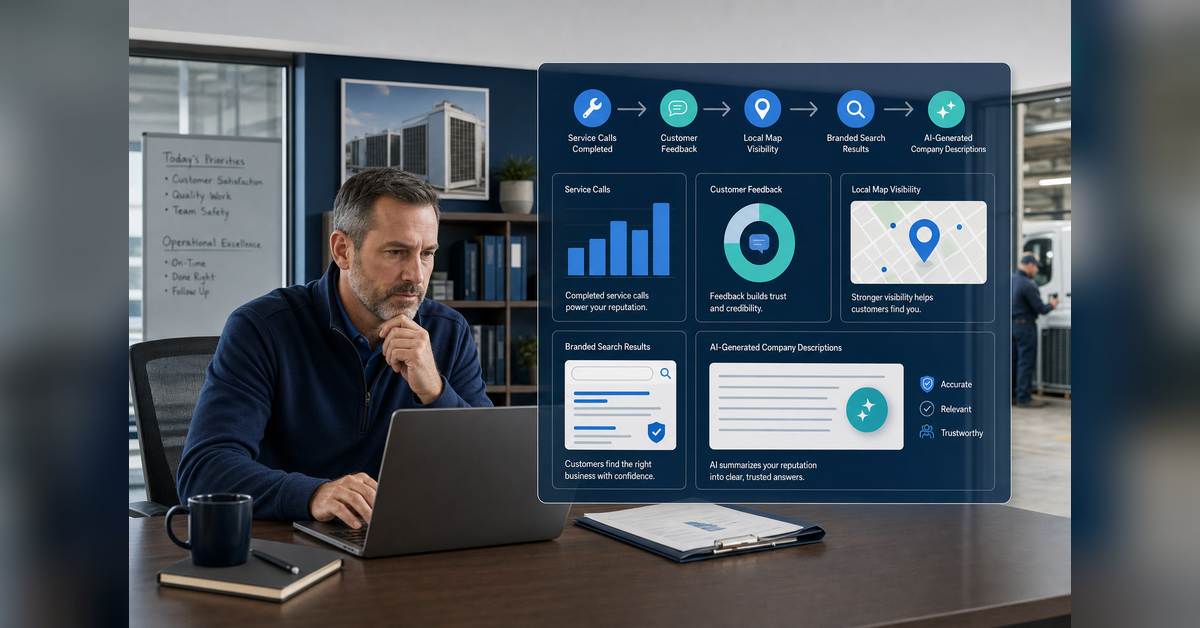

HVAC reputation management improves how a heating and cooling company earns genuine reviews, responds to feedback, recovers unhappy customers, appears in search, and is described by AI systems. The work starts with service quality and a fair process, not a push for a perfect star rating.
This guide is for HVAC owners, executives, marketing leaders, operations teams, and multi-location operators who need a reputation system people can follow and leadership can measure. Fix the experience before you fix the review.





The Broadstaff case study shows how Percepture connected visible authority, credible content, and qualified B2B demand.
What does a strong HVAC reputation system do?
A strong system connects service delivery, ethical review requests, public responses, customer recovery, accurate profiles, branded search, AI-source monitoring, multi-location governance, and crisis escalation. It builds a truthful public record while protecting privacy, following current platform rules, and measuring how trust influences calls, bookings, referrals, retention, and commercial opportunities.
Executive summary
Start in operations
Dispatch updates, arrival windows, diagnosis clarity, pricing, property care, warranty handling, and follow-up shape the review before anyone asks for feedback.
Ask fairly
Use consistent eligibility and neutral wording where the platform permits requests. Do not buy reviews, gate requests, pressure customers for five stars, or dictate keywords.
Recover before debating
Verify the job, assign an owner, contact the customer, and solve what can be solved. A polished public reply cannot replace service recovery.
Protect the whole record
Reviews are one source. The system must also cover location facts, owned pages, branded search, third-party authority, crisis readiness, and AI descriptions.
Who this guide is for
Owners and CEOs
Make the public record reflect the quality, accountability, and operating standards built into the company.
Marketing leaders
Create one review policy, a clear response voice, accurate source material, and proof that strengthens search, sales, and content.
Operations leaders
Connect review requests to completed jobs, assign customer-recovery ownership, and route recurring complaints back to the field.
Multi-location operators
Use central rules, local facts, comparable branch scorecards, controlled access, and a separate escalation path for sensitive cases.
HVAC reputation management compared with related work
Review tools, local search, public relations, and crisis support each solve part of the problem. A full reputation system coordinates them around one truthful, defensible company identity.
| Discipline | Main job | What it does not cover alone |
|---|---|---|
| Review management | Request, monitor, respond to, and analyze customer reviews | Branded search, media authority, AI-source accuracy, and serious escalation |
| Review software | Automate requests, alerts, routing, access, and reporting | Service repair, policy judgment, source correction, and crisis decisions |
| Local and enterprise SEO | Improve location, service, category, hour, and service-area visibility | Customer recovery, public-response quality, and earned authority |
| Public relations | Build expert authority, media visibility, and stakeholder trust | Daily review requests and job-level recovery |
| Crisis communications | Coordinate response to events that threaten people, operations, or trust | Routine feedback and ordinary service complaints |
| Full reputation system | Connect experience, reviews, recovery, search, AI, PR, and escalation | It cannot replace sound service delivery or guarantee platform outcomes |
A mature HVAC reputation management program may combine public relations services, enterprise SEO services, local-profile governance, content, analytics, and an operating recovery process.
Why HVAC trust breaks differently
A no-cool or no-heat customer may be uncomfortable, rushed, and unsure whether the diagnosis or price is fair. A commercial facility manager may be weighing downtime, documentation, site access, safety, and whether the contractor can support several locations.
Small operating failures become highly visible. A missed arrival update, unclear diagnostic fee, messy work area, vague repair-versus-replace explanation, or unresolved warranty question can become the main story in a review.
Strong reputation work treats those comments as operating data. The team separates a marketing symptom from its cause, then assigns the cause to dispatch, service, installation, billing, warranty, or leadership.
What buyers inspect before they call
Recent service evidence
Do current reviews describe the repair, replacement, maintenance, commercial, or indoor-air-quality work the buyer needs?
Human accountability
Do replies sound specific and calm, or copied, defensive, and disconnected from the concern?
Accurate company facts
Do names, locations, service areas, hours, contact details, and capabilities agree across the site and major profiles?
Credible recovery
Do negative reviews show a responsible next step without exposing private customer or job details?
Third-party support
Do search results include credible profiles, coverage, associations, expertise, and useful content beyond the company’s own claims?
AI-description accuracy
Do AI answers repeat current, supportable company facts, or old details copied from weak sources?
Percepture’s content marketing services and digital PR services help build source material beyond review platforms.
Score the trust footprint before adding automation
Review the customer journey, eligibility rules, response backlog, unresolved complaints, profile facts, branded search, AI sources, branch ownership, and escalation controls before sending more requests.
Review My HVAC Trust FootprintThe first step is diagnosis, not a promise to replace your current software or team.
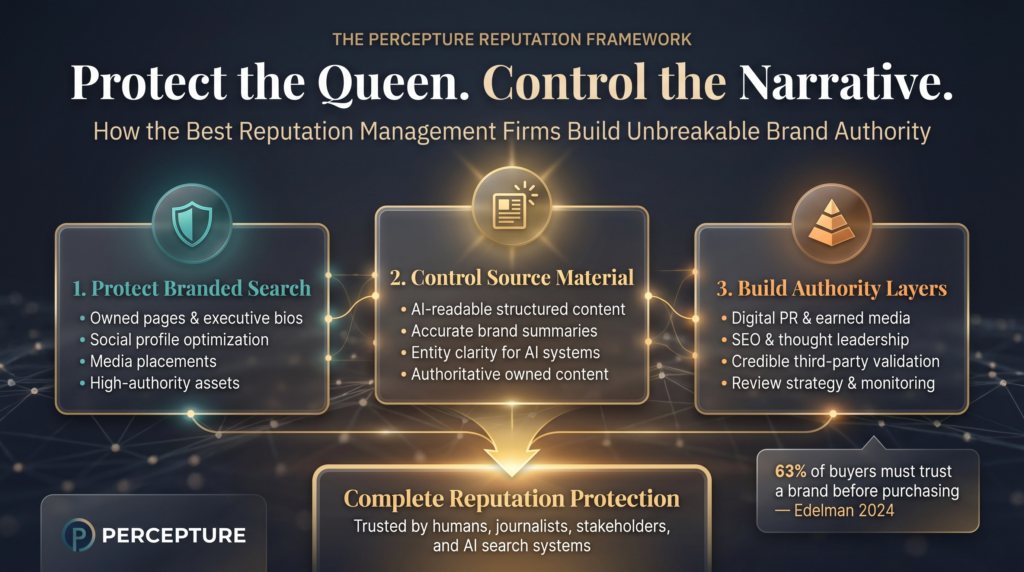
The Percepture Protect the Queen Reputation Framework
The queen is the company’s truthful, defensible identity: who it serves, what it does, where it operates, what customers should expect, and what evidence supports those facts. Reviews are one defense around that identity, not the whole board.
- 1Deliver the experience
Set expectations for confirmation, arrival, technician identity, diagnosis, options, price, financing, property protection, completion, warranty, and follow-up.
- 2Ask ethically
Request feedback only after an eligible completed job, using consistent rules, neutral wording, and the current requirements of the chosen platform.
- 3Recover the customer
Verify the issue, assign one owner, make direct contact, set a realistic remedy, document the outcome, and repair the operating cause.
- 4Respond in public
Acknowledge the concern, protect privacy, avoid arguing, state only verified facts, and provide one clear offline path.
- 5Reinforce the accurate record
Connect reviews with service pages, location facts, experts, policies, earned coverage, structured information, and credible third-party sources.
- 6Protect and escalate
Route safety, injury, discrimination, fraud, employee, regulatory, legal, and media issues to qualified leaders before anyone posts.
Score your HVAC trust footprint
A useful scorecard shows both public outcomes and the operating conditions behind them.
| Area | Healthy operating signal | Warning signal |
|---|---|---|
| Experience | Customers receive clear updates, options, property care, and follow-up | Reviews repeat the same dispatch, price, conduct, or warranty issue |
| Reviews | Recent feedback covers real services and locations | Reviews are old, vague, manipulated, or uneven across branches |
| Responses | Replies are timely, specific, calm, and privacy-safe | Replies are absent, copied, emotional, or defensive |
| Recovery | Each valid complaint has an owner, next step, and recorded outcome | The public reply closes the ticket without solving the problem |
| Search | Profiles, pages, policies, and third-party sources agree | Hours, services, names, contacts, or locations conflict |
| AI | Answers reflect current, supported company facts | AI summaries repeat outdated, ambiguous, or unsupported information |
| Escalation | Sensitive cases have a named decision path | Routine automation responds to safety, legal, employee, or media issues |
A weak score does not call for more review requests. It identifies where the operating system needs attention first.
Build an ethical review request workflow
The safest request begins with an eligible event. The completed job should be accurately recorded, free from a known unresolved issue, and ready for normal follow-up. If the customer is waiting for a callback, warranty decision, invoice correction, or promised documentation, the request should wait.
Use a consistent rule
Do not ask only customers expected to be positive. Do not send happy customers to a public platform while routing unhappy customers into a private channel. Apply the same eligibility rule to comparable customers and use neutral language.
Keep platform and legal rules separate
Google’s current Maps policy prohibits incentivized or biased reviews. Yelp tells businesses not to ask for Yelp reviews. The FTC Consumer Reviews and Testimonials Rule addresses fake reviews and incentives conditioned on a particular sentiment.
Measure review quality, not just review count
A useful review helps the next buyer understand the service, problem, communication, and result. A recent repair review may matter more to a no-cool customer than an old generic compliment. A facility manager may look for maintenance, controls, RTU, chiller, critical-facility, or multi-site experience.
Track recency and velocity without forcing an unnatural pace. Review velocity is the flow of new reviews over time. A steady stream of genuine experiences creates more operating insight than a sudden manipulated burst.
Service and location detail also matter. Multi-location reporting should show whether each branch has current proof for its real service mix rather than hiding weak locations inside one company-wide average.
How to respond, recover, and escalate
The public reply is written for two audiences: the reviewer and every future buyer reading the exchange. It should be short, calm, privacy-safe, and grounded in facts the company can verify.
| Review type | Verify | Public response | Recovery or escalation |
|---|---|---|---|
| Positive repair | Confirm the service detail | Thank the customer and mention one genuine detail | Share the praise and record useful themes |
| Positive installation | Confirm completion | Thank the customer without adding unsupported claims | Share feedback with the crew |
| Neutral | Identify the mixed issue | Acknowledge both the good and the gap | Assign the improvement |
| Verified negative | Review the job record | Acknowledge concern and move details offline | Assign an owner and remedy path |
| Unmatched reviewer | Search records without guessing | State that the record could not be located | Invite direct contact with private identifying details |
| Policy-violating content | Preserve evidence | Clarify publicly only when useful | Use the platform’s reporting process |
| Safety or legal allegation | Preserve records and pause routine automation | Post only after qualified review | Escalate to leadership and counsel |
Short HVAC review-response examples
Positive repair
“Thank you for sharing your experience. We are glad the technician kept you informed during the repair. We will pass your feedback to the service team.”
Positive installation
“Thank you for trusting our installation team. We appreciate your note about the crew’s communication and care for the work area.”
Neutral review
“Thank you for the clear feedback. We are glad the repair was completed, and we understand your concern about the arrival update. Our service manager will review that part of the visit.”
Verified negative
“We are sorry the visit did not meet expectations. We are reviewing the service record and would like to speak with you directly. Please contact the service manager through the number listed on our website.”
Unmatched reviewer
“We have not been able to locate a matching service record from the information shown here. Please contact the office directly so we can identify the visit and review the concern.”
Sensitive allegation
“We take this matter seriously and have routed it to the appropriate company leadership. Please contact the designated representative directly so it can be reviewed through the proper process.”
These are patterns, not copy-and-paste answers. Every response needs verified context, privacy judgment, and the correct authority level.
The customer recovery loop
- Verify the job. Locate the record and preserve the facts.
- Classify the issue. Use service, dispatch, billing, warranty, conduct, safety, or another defined category.
- Assign one owner. Give the issue to a person with authority to coordinate the next step.
- Contact the customer privately. Listen before proposing a remedy.
- Set a realistic next step. Commit only to what the company can deliver.
- Record the outcome. Document the resolution, timing, and remaining risk.
- Correct the cause. Route the lesson to the right operating owner.
Platform governance matrix
| Platform type | Primary role | Operating rule |
|---|---|---|
| Customer reviews connected with Search and Maps | Use genuine experiences and follow current rules on requests, incentives, conflicts, and manipulation | |
| Yelp | Local business discovery and customer feedback | Do not directly ask customers for Yelp reviews |
| BBB | Business profiles, complaints, and trust research | Keep profile facts current and route complaints to an accountable owner |
| Angi or HomeAdvisor | Home-service discovery and platform feedback | Follow current rules and align service facts with work actually offered |
| Community discussion, recommendations, and comments | Monitor comments and move private job details to direct contact | |
| Nextdoor | Neighborhood recommendations and local discussion | Use a local voice without publishing private customer information |
| Trade platforms | Commercial research, partner proof, and industry credibility | Match claims to supported capabilities, markets, and project evidence |
A platform should enter the workflow only when the company has an owner, controlled access, a response rule, and an escalation path.

Monitor branded search and AI descriptions
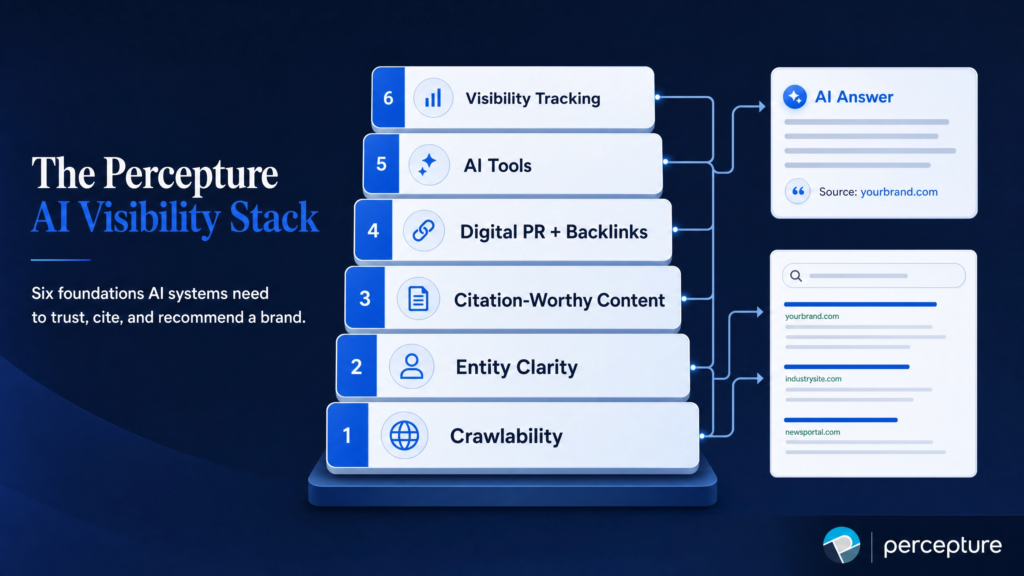
A review dashboard does not show the full public record. Search the company name, location names, executive names, and common reputation questions. Identify which owned pages, profiles, articles, review sites, and news sources appear.
Then test how major AI systems describe the company. Record the prompt, date, answer, factual issues, and cited sources. This lets the team distinguish a source problem from an answer problem.
Correct the source before chasing the answer. When an AI response repeats an old location, find the pages or profiles carrying it. When a service is misunderstood, strengthen the current service page and supporting sources. When there is no credible source for an executive or capability, create one only when the claim can be supported.
Percepture’s generative engine optimization services focus on entity clarity, source quality, and visibility across AI-assisted research. No provider controls AI inclusion, citations, or recommendations.
Govern multiple HVAC locations without losing local facts
Centralize policy, access, templates, reporting, and escalation while keeping each response tied to the facts of the local job. A corporate reply that ignores the branch, service, and customer context sounds copied and may promise a remedy the location cannot provide.
Central controls
Eligibility policy, access management, approved response principles, reporting definitions, source-of-truth records, legal guardrails, and escalation paths.
Local ownership
Review monitoring, job verification, routine response approval, customer contact, remedy coordination, and recurring issue correction.
Comparable scorecards
Use the same rating, recency, response, recovery, source-accuracy, and issue-category definitions across locations.
Exception workflow
Route safety, legal, employee, discrimination, fraud, media, or executive issues out of routine branch automation.
Enterprise governance can connect branch records with enterprise SEO, central analytics, content ownership, and local operating accountability.
Measure trust without claiming false causation
The scorecard should separate activity, customer outcomes, visibility, and influenced business results. A rise in reviews may occur alongside more calls, but that does not prove reviews caused every call.
| Measurement layer | Useful measures | Decision supported |
|---|---|---|
| Review health | Rating by location, review count, velocity, recency, service detail, and location relevance | Where is the public evidence weak or stale? |
| Response and recovery | Response rate, response time, recovery rate, issue categories, flag outcomes, and repeat problems | Is the company solving concerns or only posting replies? |
| Search and AI | Branded results, profile accuracy, source coverage, cited pages, factual errors, and correction status | Which sources need correction or reinforcement? |
| Business influence | Profile actions, calls, bookings, assisted conversions, referrals, retention, and commercial opportunities | Where does trust appear to influence the buying path? |
Omnichannel marketing and attribution should document what can be measured, what remains directional, and which operating decisions the data supports.
HVAC reputation management options: DIY, software, or partner
| Operating model | Best fit | Strength | Common gap |
|---|---|---|---|
| DIY | One location, low review volume, and a trained owner | Direct knowledge of customers and jobs | Inconsistent monitoring, limited coverage, and owner bottlenecks |
| Review software | Teams with a sound process that need automation | Requests, alerts, routing, access, and centralized reporting | Does not fix service causes or make sensitive decisions |
| Reputation agency | Companies needing monitoring, content, search, and response support | Cross-platform coverage and specialist capacity | Can become disconnected from operations without client owners |
| Integrated partner | Multi-location or complex businesses connecting operations, SEO, PR, AI, and crisis readiness | One system across the wider public record | Requires executive sponsorship, access, and clear decision rights |
Readers comparing the market can review Percepture’s guide to reputation management firms and its analysis of best crisis management firms.
What drives HVAC reputation management cost?
There is no responsible flat price without a defined scope. Cost changes with the number of locations, platforms, reviews, integrations, source problems, response volume, crisis coverage, reporting, after-hours needs, and legal review.
| Cost driver | Why it changes the work | Evidence to request |
|---|---|---|
| Locations and brands | More profiles, permissions, local facts, owners, scorecards, and exceptions | Location inventory, access map, and governance model |
| Review and response volume | More verification, drafting, approvals, recovery coordination, and reporting | Coverage window, response standard, and escalation exclusions |
| Search and source repair | Conflicting records require investigation, correction, content, and follow-up | Source inventory, correction priorities, and ownership |
| AI monitoring | Prompt sets, answer logs, factual review, cited-source tracing, and correction work | Testing method, platforms, frequency, and reporting limits |
| Public relations and authority | Expert sourcing, media outreach, assets, approvals, and third-party validation | Authority plan, target audiences, review process, and measurement |
| Crisis readiness | Scenarios, after-hours escalation, leadership, legal coordination, and holding statements | Response plan, decision tree, contacts, and rehearsal scope |
Compare scopes using the same assumptions. Review public relations pricing packages and Percepture pricing for current planning context.

More requests will not fix a broken recovery process
Percepture can review the customer journey, review rules, response quality, unresolved issues, profile facts, branded search, AI descriptions, authority gaps, and crisis controls before recommending the next investment.
- Separate service problems from marketing symptoms
- Find source, response, and escalation risks
- Prioritize the controls that protect trust first
A practical 90-day roadmap
A phased roadmap establishes ownership before adding more requests, automation, or reporting.
Inventory profiles, access, owners, review volume, recency, response backlog, recurring complaints, unresolved issues, branded search, AI answers, cited sources, and escalation risks. Freeze unsafe automation until rules are clear.
Define eligibility, request language, response principles, issue categories, recovery ownership, branch rules, sensitive-case escalation, source correction, training, and measurement definitions.
Correct priority sources, improve useful service and location content, connect public relations and authority, activate approved requests, test response quality, review customer outcomes, and update the scorecard.
The roadmap is a planning model, not a promise that ratings, rankings, citations, or revenue will change within a fixed period.
Ten mistakes that create more risk
- Sending requests before the issue is closed. The request should never outrun the service experience.
- Asking only happy customers. Selective positive solicitation creates policy and trust risk.
- Offering rewards for Google reviews. Do not use payment, discounts, gifts, contests, or free service.
- Copying one reply everywhere. Templates still need job context and privacy judgment.
- Arguing in public. A defensive response often gives the complaint a second life.
- Publishing private details. Move job records, account facts, and personal information to a controlled channel.
- Letting software make sensitive decisions. Safety, legal, employee, fraud, and media issues require qualified review.
- Measuring only rating and count. Track recency, detail, response, recovery, source accuracy, and business influence.
- Ignoring weak locations. A company-wide average can hide branches with stale proof or repeated service failures.
- Chasing an AI answer before correcting the source. Fix the inaccurate page, profile, or record carrying the fact.
Why Percepture treats reputation as more than reviews
Percepture was founded in 2004 and works across public relations, crisis communications, digital PR, organic search, generative search, content, analytics, and conversion. That cross-discipline view matters because a company’s reputation appears across reviews, owned pages, news, profiles, executives, search results, and AI answers.
Ranking screenshots, media placements, and dashboards can verify specific observations. They do not prove that one tactic caused every business outcome or that another company will receive the same result.
For serious events, review crisis communications services and the guide explaining what a crisis communications agency does.
Frequently asked questions
What is HVAC reputation management?
HVAC reputation management is the operating system used to earn genuine reviews, monitor feedback, respond in public, recover unhappy customers, correct search and AI sources, govern locations, and escalate serious issues. It connects customer experience with the company’s full public record.
How does HVAC review management work?
The company defines eligible completed jobs, follows each platform’s current rules, uses neutral request language where permitted, monitors feedback, verifies issues, responds without exposing private details, assigns recovery owners, and sends recurring themes back to operations.
Is it legal to offer incentives for customer reviews?
Rules depend on the law, platform, wording, and offer. The FTC prohibits compensation or incentives conditioned on a particular review sentiment. Google prohibits incentivized or biased reviews. A company should review current rules and obtain legal guidance for its program.
What is review gating?
Review gating means showing a public-review option only to customers expected to leave positive feedback, or routing unhappy customers away from the same public option. It creates policy and trust risk because the process selectively shapes the public record.
Can an HVAC company remove a bad Google review?
A business can report content it believes violates Google’s policies, but disagreement or a low rating alone does not make a review removable. Preserve evidence, use the platform process, respond carefully when appropriate, and focus on customer recovery and source accuracy.
Should every HVAC review receive a response?
Routine positive, neutral, and negative reviews usually benefit from a short, human response. Safety, injury, discrimination, fraud, employee, regulatory, legal, or media allegations require a separate escalation path before anyone posts publicly.
Is review software enough for an HVAC company?
Review software can send requests, create alerts, centralize replies, and report activity. It does not fix service failures, decide sensitive escalations, repair inaccurate search sources, create credible authority, or align local facts across multiple branches.
How long does reputation improvement take?
A company can establish access, ownership, profile, review, response, and source baselines during the first month. Workflow, training, recovery, corrections, and source reinforcement take longer. Results depend on service quality, review volume, location count, backlog, and operating follow-through.
What does HVAC reputation management cost?
Cost depends on locations, platforms, review volume, integrations, response needs, search repair, content, public relations, AI monitoring, reporting, crisis readiness, and legal review. Pricing should be compared using the same scope, response coverage, ownership, and escalation assumptions.
Can reviews affect local search and AI recommendations?
Reviews are part of the public information customers, search engines, and AI systems may evaluate, but no company can guarantee a ranking, citation, or recommendation. Accurate profiles, useful pages, credible third-party sources, current facts, and genuine customer feedback work together.
Request an HVAC reputation and AI-sentiment audit
Use the form below or schedule a call to share the locations, review platforms, recurring complaints, response backlog, source problems, AI-description concerns, or crisis-readiness questions you need reviewed.
Percepture cannot guarantee review removal, ratings, rankings, AI citations, recommendations, or revenue. The audit identifies controllable gaps and the next operating decisions.
Key takeaway: effective HVAC reputation management does not begin with a request link or end with a public reply. It connects the service experience, ethical feedback, customer recovery, accurate sources, authority, search, AI monitoring, and responsible escalation.