


Executive Summary: What a Crisis Communications Agency Does
A crisis communications agency helps organizations prepare for, respond to, and recover from reputation-threatening events. That can include executive misconduct, lawsuits, data breaches, regulatory investigations, product recalls, workplace issues, negative press, social media backlash, or search results that damage trust.
The best crisis communications agencies do five things well:
- Stabilize the message before the story grows.
- Coordinate communications across leadership, legal, HR, investors, employees, media, customers, and regulators.
- Prepare spokespeople to respond clearly and calmly.
- Monitor media, social, search, and AI platforms in real time.
- Rebuild trust after the immediate crisis has passed.
At Percepture, crisis communications includes digital PR, SEO, online reputation management, and AI search visibility. That matters because today’s crisis does not only live in the news cycle. It lives in Google results, AI summaries, social feeds, review platforms, and stakeholder conversations.
The Moment Crisis Communications Becomes Critical
This is the moment most organizations realize they need help. Not generic PR help, but strategic, battle-tested guidance from a crisis communications team that understands media, stakeholders, search, and reputation risk. It starts with a phone call at 6 a.m. Or a text from your head of marketing: “Have you seen Twitter?”
Within hours, a story that began as an internal issue—a product recall, an executive’s misstep, a data breach—has become a public spectacle. Journalists are calling. Customers are posting. Your board wants answers. And suddenly, the reputation you’ve spent years building feels like it’s slipping through your fingers.
This is the moment most organizations realize they need help. Not just any help—but the kind of strategic, battle-tested guidance that only can be given through crisis communications services.
But what exactly does a crisis communications agency do? And how do you know if you need one?
In this guide, we’ll break down the role of a crisis communications partner, the services they provide, and how to choose the right partner to protect your brand when the stakes are highest.
Need Immediate Crisis Support?
When your brand is on the line, hours matter. Our rapid-response team is available 24/7 to manage media, stakeholders, and digital search sentiment.
What Is a Crisis Communications Agency?
A crisis communications agency is not a traditional PR firm that focuses on product launches and media placements. Instead, it’s a specialized partner built for high-pressure, high-stakes moments.
Think of them as the emergency room doctors of the communications world. When your brand is bleeding—whether from a viral social media backlash, a regulatory investigation, or a leadership scandal—a corporate crisis PR team steps in to stabilize the situation, control the narrative, and chart a path to recovery.
According to the Institute for Public Relations, organizations that respond to crises within the first 24 hours experience significantly less long-term reputational damage than those that delay. A strategic communications firm ensures you’re not scrambling to figure out what to say while the clock is ticking.
At Percepture, we have spent more than 20 years helping organizations protect their reputations during sensitive, high-stakes moments. Our experience spans healthcare, financial services, hospitality, telecommunications, energy, manufacturing, consumer brands, and public-facing executives. We use special GEO services to manage these AI channels. This makes sure that when people search for your brand or name, they see positive and fair information.
Why Crisis Communications Requires Experience, Not Just PR
Crisis communications is not the same as normal public relations. A product launch gives you time to plan. A crisis compresses decision-making into hours. That is why experience matters.
Percepture’s crisis and reputation work is built around a simple principle: protect the organization first, then rebuild trust with the audiences that matter most. That requires judgment, speed, media discipline, and an understanding of how stories now spread across traditional media, search engines, social media, and AI platforms.
Percepture’s background includes work across healthcare, financial services, hospitality, telecommunications, energy, manufacturing, consumer brands, and public-facing executives. In many cases, confidentiality prevents naming the client. But the crisis patterns are familiar: regulatory pressure, negative media coverage, social media escalation, litigation-sensitive messaging, leadership issues, search result damage, and stakeholder trust concerns.
That combination of traditional PR, digital reputation management, SEO, and AI search visibility is what makes modern crisis communications different from old-school media relations.
Core Services a Crisis Communications Agency Provides
Not all crises are created equal, and neither are the services required to manage them. Here’s what a comprehensive crisis communications agency typically offers:
Rapid Response & Message Development
When a crisis breaks, the first 24–48 hours are critical. A crisis communications PR agency helps you:
- Assess the situation and identify key risks
- Develop holding statements and initial messaging
- Create a response hierarchy so the right people are saying the right things
- Coordinate across departments (legal, HR, operations) to ensure alignment
The goal is to move from reactive chaos to proactive control as quickly as possible.
Media Relations & Spokesperson Training
Journalists will call. Cameras may show up. A crisis media relations agency prepares your team to handle media inquiries with confidence:
- Media training for executives and designated spokespeople
- Press release drafting and distribution
- Interview preparation and message discipline coaching
- Proactive media outreach to shape the narrative
In our work with clients, we’ve seen how a single well-handled interview can shift public perception—and how a single misstep can make things worse.
Digital Reputation Management
In today’s environment, crises don’t just play out on the evening news. They unfold in real-time on social media, review sites, and search results. A crisis communications agency provides:
- Social media monitoring to track sentiment and emerging threats
- Response protocols for online engagement
- Search engine reputation management to suppress negative content
- Content creation to rebuild positive visibility over time
At Percepture, we integrate corporate SEO and digital PR services into our crisis work because we know that what people find when they Google your name matters long after the headlines fade.
AI Search and Search Result Protection
Modern crises are no longer limited to media coverage. They also shape what Google, ChatGPT, Gemini, Perplexity, and other AI systems can find, summarize, and repeat. That means crisis communications now requires search result protection.
At Percepture, we look at the first page of Google for human perception and the broader search environment for AI perception. If negative, incomplete, or outdated information dominates the results, AI systems may repeat that framing.
If accurate owned content, credible media placements, executive profiles, social channels, and authoritative third-party sources are present, the narrative becomes easier to stabilize. This is where crisis communications, digital PR, SEO, and AI search strategy overlap.
Stakeholder Communications
Your audiences extend far beyond the media. A reputation response team helps you communicate with:
- Employees (often your most important ambassadors—or critics)
- Customers and clients
- Investors and board members
- Regulators and government officials
- Community partners
Each audience requires a tailored message and channel strategy. A one-size-fits-all approach rarely works. Not every brand or person needs complete omnichannel marketing services, but a bespoke campaign for a fresh start.
Is Your Organization Crisis-Ready?
Most companies don’t think about crisis communications until it’s too late. Percepture helps you prepare before the storm hits—and respond decisively when it does.
Schedule a Confidential Consultation →Crisis Communications Case Studies and Real-World Experience
Because crisis communications often involves confidential matters, many client names cannot be shared publicly. But the situations below show how an experienced crisis public relations agency thinks, responds, and protects long-term reputation.
Case Study 1: Healthcare Reputation and Stakeholder Trust
A healthcare organization facing reputational pressure needed clear, coordinated communications for multiple audiences, including patients, employees, leadership, and external stakeholders.
Percepture’s role focused on message discipline, stakeholder sequencing, digital reputation monitoring, and search visibility. The goal was not to overreact publicly. The goal was to stabilize trust, reduce confusion, and ensure that accurate, responsible information could be found by the people who needed it most.
What this shows: In healthcare crisis communications, speed matters, but accuracy matters more. The wrong statement can create legal, reputational, and patient-trust issues.
Case Study 2: B2B and Digital Infrastructure Reputation Protection
Percepture has supported complex B2B organizations where reputation, search visibility, and buyer confidence directly affect sales conversations. In digital infrastructure, telecom, and data center markets, trust is part of the product. Buyers want reliability, clarity, and confidence.
For clients in this category, Percepture has combined PR, SEO, paid media, content strategy, and sales enablement to strengthen brand visibility and protect market positioning. In one documented digital infrastructure engagement, Percepture helped ZenFi Networks increase inbound leads by 188%, increase web traffic by 80%, support a $175M government contract, and position the company ahead of a $1B+ acquisition.
What this shows: Reputation work is not only defensive. Strong visibility, clear messaging, and trusted search results can directly support growth, enterprise sales, and market confidence.
Case Study 3: Executive and High-Visibility Reputation Management
When executives, public figures, financial leaders, or well-known personalities face reputation pressure, the communications strategy must be careful. Over-amplifying the issue can make the problem worse.
Percepture’s approach includes monitoring the story, controlling message timing, strengthening owned assets, elevating favorable third-party signals, and reducing the long-term visibility of damaging narratives where appropriate. The goal is to protect the person, the company, and the broader ecosystem around them.
What this shows: In personal reputation crises, the best move is not always the loudest move. Sometimes the smartest response is controlled, quiet, strategic, and search-aware.
When Should You Hire a Crisis Communications Agency?
Not every negative news story requires outside help. But there are clear signals that indicate you need a crisis communications agency:
- The story is gaining momentum. If media coverage is increasing, social media mentions are spiking, or the issue is trending, you’re in crisis territory.
- Multiple stakeholders are affected. When employees, customers, investors, and regulators are all asking questions, you need coordinated messaging.
- Your internal team is overwhelmed. If your communications staff is stretched thin or lacks crisis experience, outside expertise is essential.
- Legal and reputational risks are intertwined. Crises often involve legal exposure. A crisis communications firm works alongside your legal counsel to ensure messaging is both protective and effective.
- You’re facing a “first of its kind” situation. Novel crises—like a cyberattack or a viral social media incident—require specialized playbooks.
If any of these apply, it’s time to pick up the phone.
Crisis Communications Agency vs. PR Firm vs. Reputation Management Firm
| Partner Type | Best For | Main Role | Limitation |
|---|---|---|---|
| Crisis communications agency | Active or potential reputation threats | Stabilizes messaging, media, stakeholders, search, and public trust | Must move quickly and coordinate with legal, HR, and leadership |
| Traditional PR firm | Positive visibility and media coverage | Builds awareness through press, campaigns, and announcements | May not specialize in urgent crisis response |
| Reputation management firm | Search results, reviews, and online visibility | Repairs or protects what people find online | May not handle media, stakeholders, or executive messaging |
| Legal counsel | Legal risk and liability | Protects the organization legally | May not manage public perception, media, or search visibility |
How a Crisis Communications Agency Works (The Process)
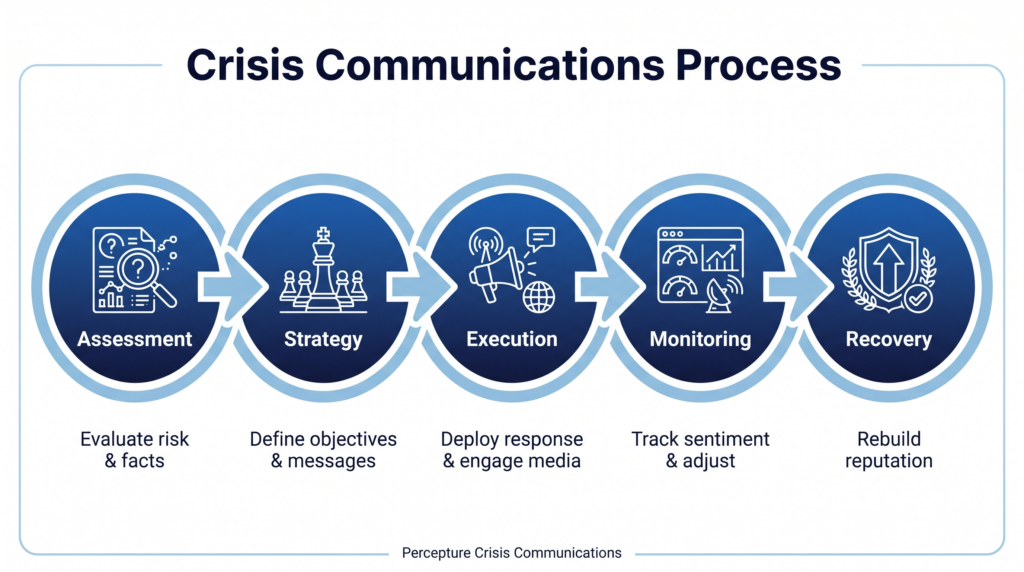
Every agency has its own methodology, but effective crisis communications typically follows a structured process:
The Crisis Communications Process
- Assessment: Understand the facts, identify stakeholders, and evaluate reputational risk.
- Strategy Development: Define objectives, key messages, and communication channels.
- Response Execution: Deploy messaging, engage media, and activate stakeholder communications.
- Monitoring & Adjustment: Track coverage, sentiment, and emerging issues; adjust strategy as needed.
- Recovery & Reputation Rebuilding: Transition from crisis response to long-term reputation repair.
At Percepture, we add a sixth step: Post-Crisis Review. After the dust settles, we conduct a thorough debrief to identify lessons learned and strengthen your crisis preparedness for the future.
What to Look for When Choosing a Crisis Communications Agency
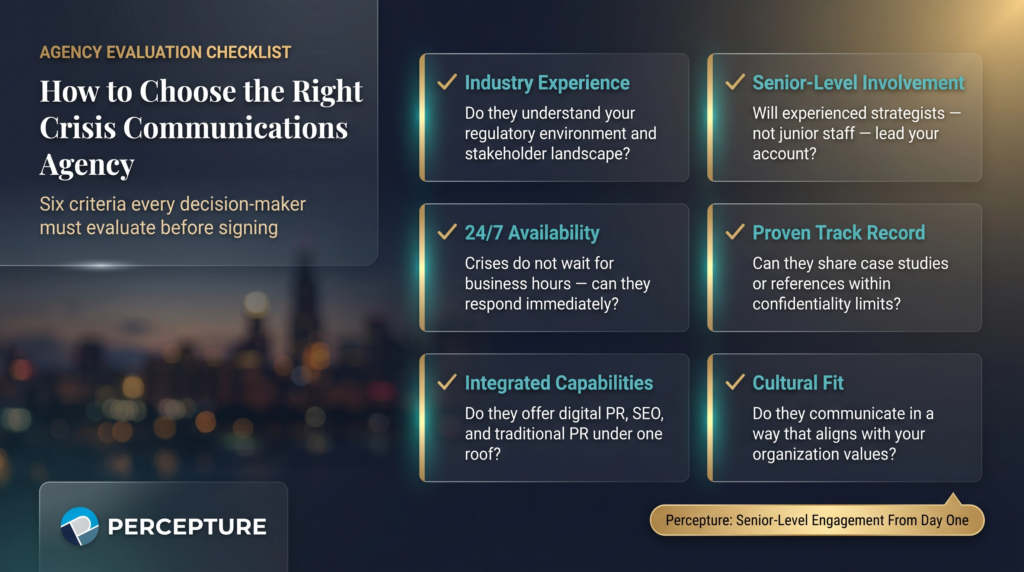
Not all crisis communications agencies are created equal. Here’s what to evaluate:
Crisis Communications Agency Evaluation Checklist
- ✅ Experience in your industry: Do they understand your regulatory environment and stakeholder landscape?
- ✅ 24/7 availability: Crises don’t wait for business hours. Can they respond immediately?
- ✅ Integrated capabilities: Do they offer digital, SEO, and traditional PR under one roof?
- ✅ Senior-level involvement: Will experienced strategists—not just junior staff—lead your account?
- ✅ Proven track record: Can they share case studies or references (within confidentiality limits)?
- ✅ Cultural fit: Do they communicate in a way that aligns with your organization’s values?
At Percepture, we pride ourselves on senior-level engagement from day one. When you work with us, you’re not handed off to a junior team—you’re working directly with seasoned crisis professionals who’ve managed hundreds of high-stakes situations.
The ROI of Professional Crisis Communications

Investing in a crisis pr communications agency isn’t just about damage control—it’s about protecting tangible business value.
Consider these statistics:
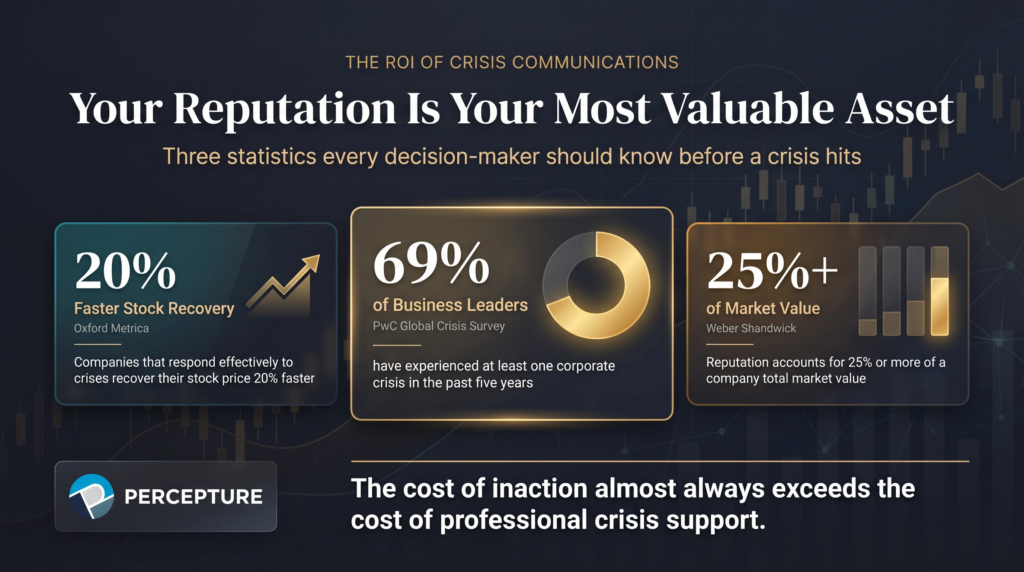
- Companies that respond effectively to crises recover their stock price 20% faster than those that don’t, according to research from Oxford Metrica.
- 69% of business leaders have experienced at least one corporate crisis in the past five years, per PwC’s Global Crisis Survey.
- Reputation accounts for 25% or more of a company’s market value, according to Weber Shandwick.
The cost of inaction—lost customers, regulatory fines, talent attrition, and long-term brand damage—almost always exceeds the cost of professional crisis support.
TRUSTED BY ORGANIZATIONS ACROSS INDUSTRIES
20+ Years of Crisis Communications Experience · Fortune 500 to Mid-Market · Healthcare, Financial Services, Technology, Consumer Brands
Frequently Asked Questions
How much does a crisis communications agency cost?
Pricing varies based on the scope and severity of the crisis. Some agencies offer retainer-based models for ongoing readiness, while others work on a project basis during active crises. At Percepture, we tailor our engagements to your specific needs and budget.
Can a crisis communications agency help before a crisis happens?
Absolutely. In fact, proactive crisis preparedness—including vulnerability assessments, crisis playbooks, and media training—is one of the most valuable services an agency can provide. The best time to prepare is before you need it.
What’s the difference between a crisis communications agency and a traditional PR firm?
Traditional PR firms focus on building positive visibility through media placements, events, and campaigns. Crisis communications agencies specialize in protecting and repairing reputation during high-stakes situations. Some firms, like Percepture, offer both capabilities.
How quickly can a crisis communications agency respond?
Top agencies offer 24/7 availability and can mobilize within hours. At Percepture, we’ve activated crisis response teams within 60 minutes of initial contact.
Do I need a crisis communications agency if I have an in-house PR team?
Even organizations with strong internal teams benefit from outside expertise during major crises. An agency brings fresh perspective, specialized experience, and additional bandwidth when your team is stretched thin.
Take the First Step Toward Crisis Readiness
Whether you’re facing an active crisis or want to prepare for the unexpected, Percepture is here to help. Our team of senior crisis communications professionals is ready to protect what matters most—your reputation.
Request a Confidential Consultation →Or call us directly: 212-500-0121

Bob Generale
About the Author
Bob Generale has been working in new media, digital PR, SEO, and reputation strategy since 2006, when he held the title of New Media Specialist. Early in his career, he developed a blueprint for optimizing and disseminating press releases, identifying high-authority media placements, and helping brands achieve what he now calls landscape domination: owning more of the first page through a combination of organic rankings, press coverage, and unbranded search visibility. Today, that same methodology applies directly to AI search, where authority, placement, and narrative control matter more than ever. Bob has supported healthcare companies, insurance brands, travel and hospitality groups, major hotels, pharmaceutical organizations, telecommunications firms, energy companies, and public figures with crisis communications, reputation management, digital PR, and search visibility strategies