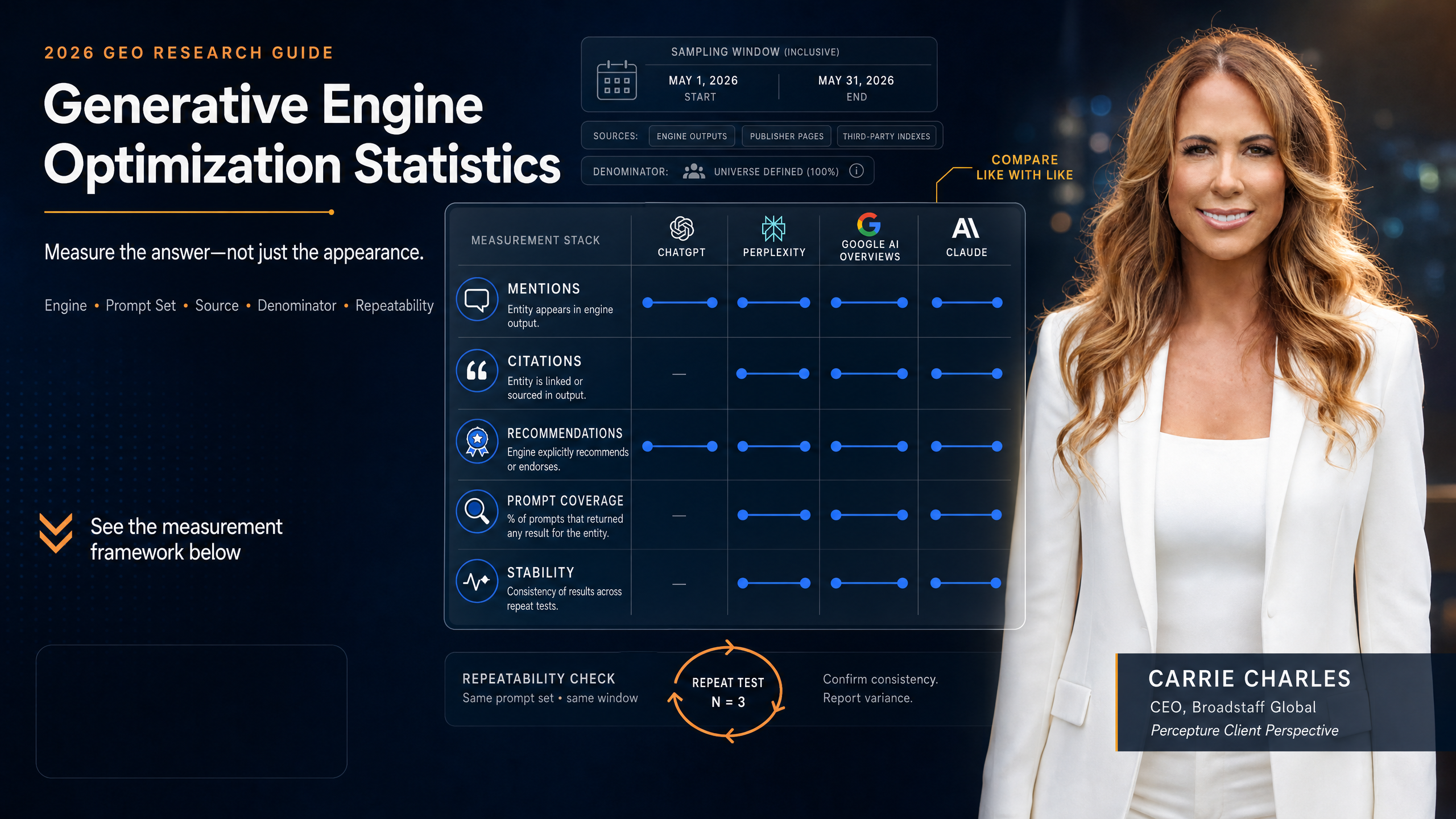

Generative Engine Optimization Statistics can help leaders judge the shift toward AI search, but only when each number has a clear source and denominator. This page compiles defensible 2026 observations while separating platform facts, internal search data, experimental findings, client outcomes, and forecasts.
A GEO number is useful only when the engine, prompt set, sample, date, and measurement rule are visible. A brand can appear often in one engine and remain absent in another, so pooled scores and isolated screenshots can hide the real operating problem.





Which 2026 GEO numbers are worth using?
The most useful Generative Engine Optimization Statistics measure brand mentions, linked citations, recommendations, prompt coverage, competitive share, engine coverage, stability, traffic, and conversion against a defined set of eligible responses. A percentage without that denominator is not a dependable benchmark.
2026 GEO Statistics at a Glance
Use Generative Engine Optimization Statistics to compare like-for-like observations rather than combining incompatible outcomes.
Use comparable samples
Keep prompts, engines, dates, and eligibility rules consistent before comparing results.
Separate the outcomes
A mention is not a linked citation. A citation is not a recommendation. Visibility is not revenue.
Read by engine
Measure the same buyer-question family across platforms instead of relying on a pooled total.
Repeat the test
One run is an observation. Repeated, comparable runs reveal stability and direction.
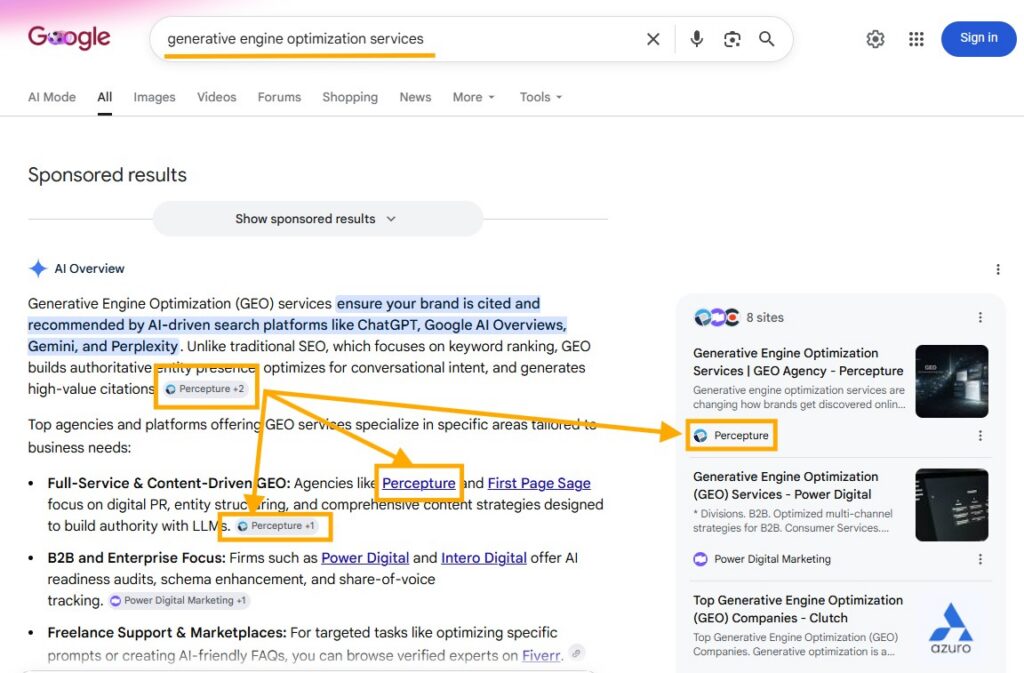
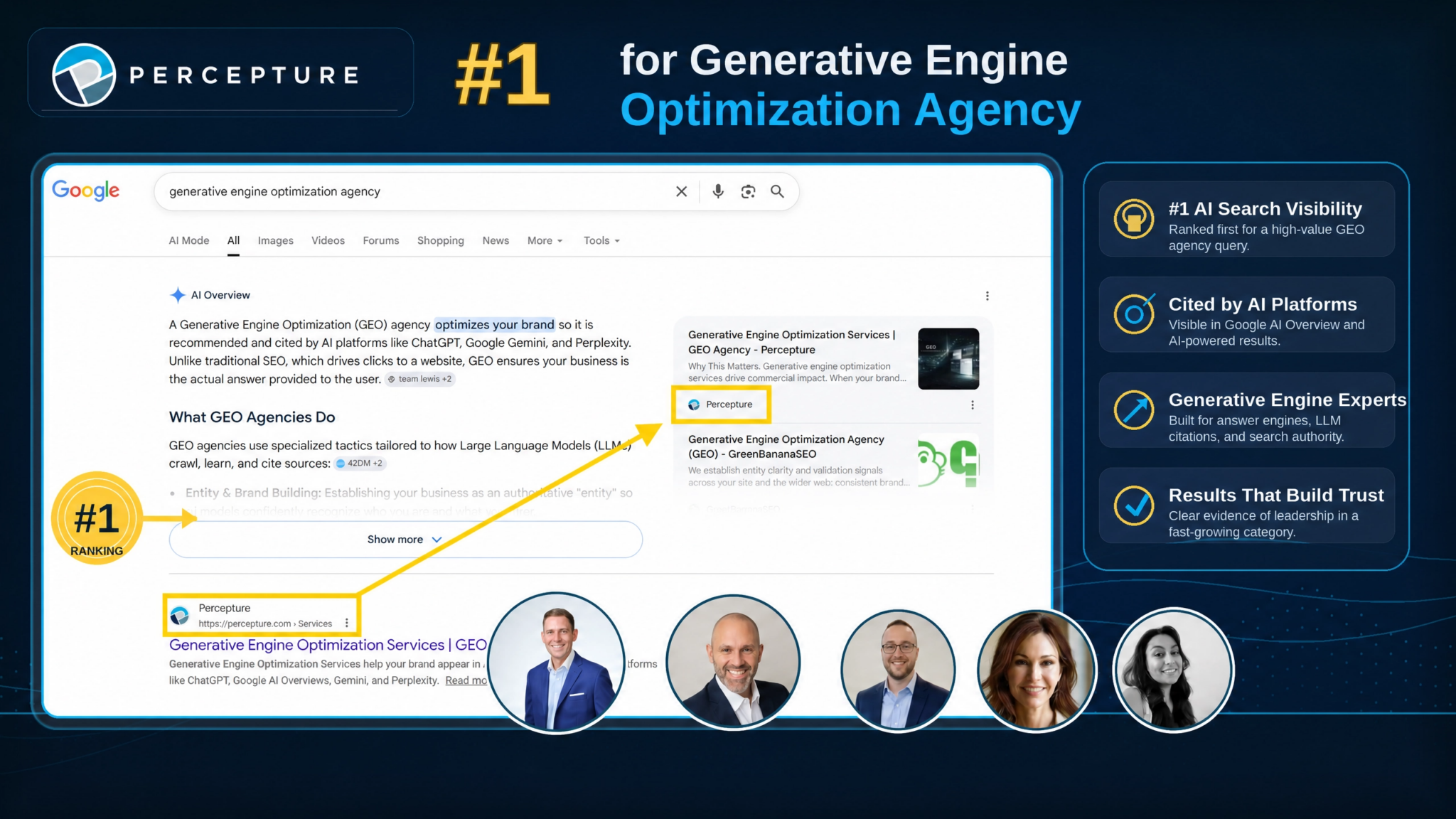
Percepture’s 2026 Search-Demand Snapshot
This first-party snapshot gives Generative Engine Optimization Statistics a search-demand context around commercial GEO terms. It is not an industry-wide AI-visibility benchmark.
| Statistic | 2026 figure | Sample or scope | Source | What it means |
|---|---|---|---|---|
| Impressions for “generative engine optimization services” | 12,912 | One query-page pair, March 24–June 22, 2026 | Percepture Google Search Console | Commercial service demand produced substantial search exposure. |
| Average position for “generative engine optimization services” | 8.39 | Same query and period | Percepture Google Search Console | The page appeared on the first results page on average, with room to improve. |
| Impressions for “generative engine optimization agency” | 12,158 | One query-page pair, March 24–June 22, 2026 | Percepture Google Search Console | Agency-selection intent generated a second large visibility pool. |
| Average position for “generative engine optimization agency” | 5.10 | Same query and period | Percepture Google Search Console | Visibility was stronger than the broader services query. |
| Impressions for “geo agency” | 5,920 | One query-page pair, March 24–June 22, 2026 | Percepture Google Search Console | The short acronym query created reach but weaker average placement. |
| Average position for “geo agency” | 21.82 | Same query and period | Percepture Google Search Console | Query-level visibility must be read separately rather than averaged away. |
| Impressions for “generative engine optimization companies” | 1,108 | One query-page pair, March 24–June 22, 2026 | Percepture Google Search Console | Vendor-comparison demand exists at a smaller scale. |
| Average position for “generative engine optimization companies” | 4.51 | Same query and period | Percepture Google Search Console | The comparison query had the strongest average position in this set. |
| Tracked-keyword page-one share in the Broadstaff case | 90% | Public Percepture case study | Broadstaff case record | This is a client outcome, not a general GEO benchmark. |
| Qualified-lead change in the Broadstaff case | 3× within 12 months | Public Percepture case study | Broadstaff case record | Search visibility can support demand, but the result should not be generalized. |
Source hygiene: these figures use different queries and outcome types. They cannot be added, averaged, or treated as equivalent to AI-engine mentions or citations. The Generative Engine Optimization Statistics below focus on measurement rules that make future comparisons defensible.
Operator context behind this reference
- Percepture was founded in 2004.
- Percepture is a five-time Inc. 5000 company.
- Percepture is NMSDC certified.
- The search-demand figures above come from the Percepture Search Console export.
Client perspective: applying AI-search intelligence
Cody Clegg of OPTK Networks discusses Percepture’s AI-search, SEO, and Hyperscale Kings work in this OPTK client video. The testimony supports operating experience; traffic and revenue still require separate analytics.
The supporting OPTK AI-search case study explains how the opportunity was identified and translated into search work.
Generative Engine Optimization Statistics 2026: Key Takeaways
AI-search measurement needs more than rank
Traditional search often gives a visible ordered position. Generated answers are prompt-dependent and engine-specific. That makes prompt coverage, citations, recommendations, and repeatability part of the measurement set used for Generative Engine Optimization Statistics.
Search visibility no longer guarantees the click
A brand may influence a generated answer without receiving a visit. Teams should retain classic search metrics while adding answer-level visibility, referral traffic, and assisted conversion measures.
Third-party sources can shape representation
Owned pages are only one part of the source environment. Journalism, industry publications, directories, reviews, forums, videos, and institutional sources can affect how a company is retrieved and described.
AI visibility is engine-specific
Generative Engine Optimization Statistics should show results by engine whenever possible. A pooled score can conceal that a brand appears consistently on one platform but rarely on another.
What Is Generative Engine Optimization?
Generative engine optimization is the practice of improving how a brand and its content are discovered, retrieved, represented, cited, and recommended inside AI-generated answers. GEO builds on SEO, but Generative Engine Optimization Statistics track outcomes that classic rank reports cannot fully describe. Useful measures include mention rate, linked-citation rate, recommendation rate, competitive share, prompt coverage, engine coverage, source attribution, and repeated-run stability. Read the full explanation of what generative engine optimization is.
Choose the metric that matches the decision
Select Generative Engine Optimization Statistics according to the business question, then define the eligible observations before calculating a rate.
Brand discovery
Track eligible responses that name the brand across approved buyer questions.
Source authority
Track linked citations, attributed sources, and the mix of owned and third-party evidence.
Commercial preference
Track recommendations only on prompts where a recommendation would make sense.
Business value
Connect Generative Engine Optimization Statistics to analytics, qualified actions, pipeline, and revenue without assuming causation.
Companies that want execution support can review Percepture’s generative engine optimization services.
AI Search Adoption and the Shrinking Click
AI-generated answers expand the number of places where a buyer can receive an answer before visiting a site. That does not make traffic irrelevant. It changes the sequence that teams need to measure.
Generative Engine Optimization Statistics should therefore connect answer exposure to downstream behavior. The clean chain is visibility, referral or search visit, meaningful action, qualified lead, opportunity, and revenue. Each step needs its own data source.
An attribution and analytics setup can connect these steps, while an omnichannel marketing plan accounts for buyers who encounter the brand across search, AI answers, media, email, and paid channels.
Where AI Answers Get Their Citations
AI answers can draw on owned sites and third-party sources. Generative Engine Optimization Statistics should identify which source types appear for the defined buyer questions, engines, and observation window rather than claiming that one source type always wins.
Owned sources versus third-party sources
Owned content gives a company control over definitions, product facts, and evidence. Third-party sources can add independent context and reach. A sound program audits both instead of treating publishing volume as the full solution.
That is why content marketing and digital PR serve different but connected roles. One builds the source of truth; the other can help credible outside sources understand and cover the company.
Earned media and journalism
Earned coverage should be evaluated by relevance, accuracy, authority, and whether it answers a buyer’s question. A raw placement count says little about retrieval or commercial influence.
A mention is not a linked citation
A mention records that the brand name appeared. A linked citation records that the answer exposed or attributed a source. A recommendation records active preference. Generative Engine Optimization Statistics must keep these outcomes separate because each answers a different executive question.
Percepture’s guide to winning visibility in AI answers covers the content and authority work behind those outcomes.

Benchmark Your Brand’s AI Visibility
Use Generative Engine Optimization Statistics to see which buyer questions surface your brand, which competitors appear instead, and which sources shape the answer.
Explore an AI-search visibility diagnosticGEO Benchmarks Differ by AI Engine
Generative Engine Optimization Statistics should not assume that all answer engines retrieve sources, expose links, or construct responses in the same way. Use the same question family and time window, then report each platform separately.
Engine comparison framework
This framework keeps Generative Engine Optimization Statistics aligned to the capabilities and limits of each answer surface.
| Surface | Measure separately | Do not assume |
|---|---|---|
| ChatGPT | Mentions, exposed citations, recommendations, and repeatability | One response represents every user or future run |
| Google AI Overviews and AI Mode | Answer presence, cited sources, organic visibility, and resulting search traffic | A cited source receives the same click behavior as a blue link |
| Gemini | Brand representation, surfaced sources, and prompt-family coverage | Results will match Google’s other answer surfaces |
| Perplexity | Source links, citation share, recommendation language, and run stability | Visible citations automatically produce qualified visits |
| Claude | Retrieval-enabled observations where links and source context are available | Every answer has web retrieval or directly comparable citations |
What GEO Research Shows—and What It Does Not Prove
GEO research can show how defined content changes performed within a study’s own experiment. It cannot establish a permanent rule for every commercial engine, prompt, industry, language, or date.
What an experimental benchmark measures
An experiment begins with a fixed corpus, query set, evaluation method, and system configuration. Its result belongs to that setup. Readers can use it to form a testable hypothesis, not a guaranteed operating outcome.
Why a visibility lift is not a universal citation lift
Visibility, citation, recommendation, and traffic are different outcomes. A percentage attached to one cannot be relabeled as another. The same limit applies when a study result is repeated across many agency roundups.
What newer research adds
New work can improve Generative Engine Optimization Statistics by comparing more engines, real buyer prompts, source types, and repeated observations. The value comes from disclosed samples and measurement rules, not from publishing the largest list of percentages.
Why repeated measurement matters
Generated answers can vary across runs. A screenshot proves that one output occurred. A trend needs comparable prompts, engines, settings, dates, and repeated observations.
Google’s first-party guidance for AI features in Search also warns against unsupported optimization shortcuts and keeps established Search fundamentals at the center of discoverability.
The Percepture D-R-R-C-R Measurement Framework
Percepture organizes Generative Engine Optimization Statistics through five observable stages:
- Discoverability: Can the relevant source be found and crawled?
- Retrieval: Does the engine use or surface the brand’s content or supporting sources?
- Representation: Is the brand described accurately and in the right context?
- Citation: Is a source attributed or linked where the engine exposes citations?
- Recommendation: Is the brand actively suggested on an eligible decision prompt?
This sequence prevents a team from jumping from “we were mentioned” to “the program drove revenue.” Business outcomes still require traffic, conversion, pipeline, and revenue measurement.
How Percepture Measures AI Visibility With Prime
Percepture and its partners built and use Prime AI Visibility as a measurement and intelligence layer. Prime supports prompt tracking, visibility monitoring, citation and source tracking, recommendation tracking, competitive comparison, and fan-out analysis. Prime observations are not presented here as a market-wide benchmark.
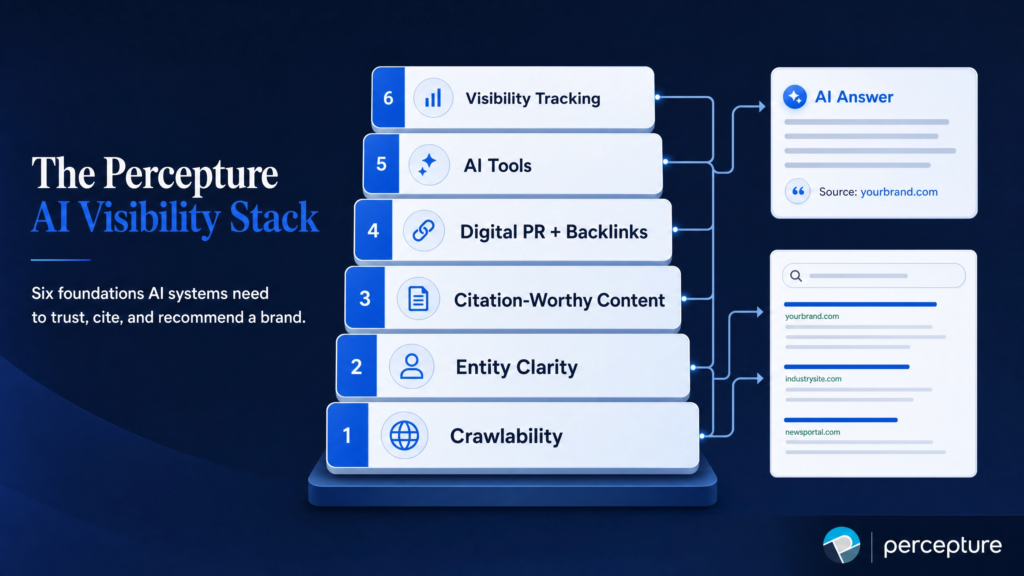
The Prime measurement workflow
The workflow produces Generative Engine Optimization Statistics from an approved, repeatable observation process.
- Identify and approve meaningful buyer questions.
- Run comparable prompts by engine.
- Log brand appearances and representation.
- Separate mentions from linked citations.
- Record cited or upstream sources when visible.
- Compare competitor presence and recommendations.
- Repeat observations over time.
- Map gaps to content, authority, technical, and measurement actions.
- Rerun the same approved prompt set after changes.
Percepture also uses KeywordIQ keyword intelligence to separate broad informational demand from commercially meaningful opportunity. The method considers likely business value, search competition, paid-search cost, and page fit rather than treating raw volume as the only priority.
How Big Is the Generative Engine Optimization Market in 2026?
There is no standardized, audited definition of the GEO market. Vendor forecasts may group together AI-search software, SEO services, content systems, analytics, and consulting in different ways. Without a primary market study that states its category definition and calculation method, publishing one market-size figure among Generative Engine Optimization Statistics would create false precision.
For that reason, this edition does not present a market-size number as settled fact. Buyers should compare forecast definitions, base years, included revenue categories, and currency assumptions before using any estimate in a board plan.
Is SEO Dead in 2026, or Is GEO Replacing It?
No. SEO is not being shut down or replaced; search is expanding into AI-generated answer surfaces, so companies now need strong SEO plus measurement and optimization for AI answers.
Google’s guidance says established Search requirements and best practices remain relevant to its AI features. Technical accessibility, useful content, internal architecture, and authority still support discovery. Generative Engine Optimization Statistics expand the outcome set to include representation, citations, recommendations, prompt coverage, and engine coverage.
There is also no official replacement name for SEO. GEO, answer engine optimization, and AI-search optimization describe adjacent practices. Percepture’s enterprise SEO work addresses search foundations, while GEO measurement examines what happens inside generated answers.
How Should a Company Benchmark AI Visibility?
A company should benchmark AI visibility against its own approved prompt set, defined competitors, selected engines, and repeated time periods. Generative Engine Optimization Statistics become useful when every rate names its eligible population.
Generative Engine Optimization Statistics Measurement Scorecard
Use this scorecard to define Generative Engine Optimization Statistics consistently before comparing periods, engines, or competitors.
| Metric | Definition | Denominator | Why it matters | Common misread |
|---|---|---|---|---|
| Mention rate | Share of eligible AI responses naming the brand | Eligible responses | Shows basic presence | A mention may be neutral, negative, or unlinked |
| Linked-citation rate | Share of eligible responses linking or citing the brand or its source | Eligible responses | Shows source-backed presence | Engines expose citations differently |
| Share of citation | Brand citations divided by citations in a defined competitive set | Same prompt, engine, and time set | Shows relative source visibility | Different prompt sets cannot be compared fairly |
| Recommendation rate | Share of eligible recommendation answers that suggest the brand | Qualifying recommendation prompts | Shows commercial preference | Informational prompts should not always recommend a vendor |
| Prompt coverage | Share of tracked buyer questions with the desired presence | Approved prompt set | Shows breadth across the journey | The score depends on prompt selection |
| Engine coverage | Visibility by platform for the same question family | Same prompts and time window | Reveals platform disagreement | Pooled totals can hide losses |
| Source share | Distribution of source types among captured citations | All captured citations | Shows dependence on owned, earned, or community sources | Source classification must be documented |
| Stability | Consistency across comparable repeated runs | Repeated prompt-engine observations | Prevents one-screenshot conclusions | One successful run is not a stable result |
| Traffic | Sessions attributed to search or AI referrals | Analytics sessions | Shows whether visibility produced visits | Referral data may be incomplete |
| Conversion | Defined actions, meetings, or qualified leads | Defined conversion events | Connects visibility to business value | Visibility alone is not revenue |
From search visibility to qualified demand
Carrie Charles of Broadstaff discusses Percepture’s work in this Broadstaff client video. The public case reports that 90% of tracked keywords reached page one and qualified leads increased threefold within 12 months.
Those are Broadstaff outcomes, not universal Generative Engine Optimization Statistics. Read the full Broadstaff search visibility and qualified leads case study for the proper context.

See the Search-to-Trust Proof
Review how a documented client engagement connected search performance with qualified demand, then assess which Generative Engine Optimization Statistics require separate AI-answer measurement.
View the Broadstaff case studyFrequently Asked Questions
What are Generative Engine Optimization Statistics?
Generative Engine Optimization Statistics measure AI-search adoption, brand mentions, linked citations, source patterns, recommendations, engine differences, prompt coverage, traffic, and conversion. Each metric needs a named engine, sample, timeframe, prompt set, and denominator before it can support a decision.
Is SEO dead in 2026?
No. Google’s AI features continue to rely on established Search systems and practices. SEO remains the foundation for crawlability, useful content, architecture, and authority. Generative Engine Optimization Statistics add measurement for generated-answer outcomes that an ordinary position report does not show.
How big is the GEO market in 2026?
There is no standardized audited GEO market category. Published forecasts can include different combinations of software, agency services, analytics, and content technology. Do not treat a forecast as settled Generative Engine Optimization Statistics without comparing its category definition and method.
What is a good AI-visibility benchmark?
There is no universal good score. Benchmark the brand against an approved buyer-question set, named competitors, selected engines, and repeated periods. Generative Engine Optimization Statistics for mentions, citations, and recommendations should always state their denominators.
What is the best GEO tool?
The right tool depends on engine coverage, prompt tracking, citation and source visibility, competitive comparison, history, export quality, and workflow. Percepture and its partners built and use Prime AI Visibility, but this page does not present a faux-independent tool ranking.
Does GEO replace SEO?
No. GEO builds on technical access, content quality, authority, and site architecture. Generative Engine Optimization Statistics add measures for retrieval, representation, citations, recommendations, prompt coverage, and engine-specific visibility.
See Where Your Brand Is Missing From AI Search
Turn Generative Engine Optimization Statistics into a defined measurement plan for your buyer questions, competitors, and priority engines.
Book a strategy conversation
About Bob Generale
Bob Generale is President of Percepture and works on executive strategy across SEO, GEO, digital marketing, and AI-search visibility. He focuses on practical measurement, source quality, and connecting visibility work to business outcomes.
Connect with Bob Generale on LinkedIn