

How to win visibility in AI answers B2B starts with clear entity signals, search-worthy content, third-party validation, and proof that AI systems can understand. B2B brands need pages that answer buyer questions directly, connect to credible sources, and show consistent expertise across owned, earned, and search channels.
AI answers are changing how business buyers discover vendors. A buyer may ask ChatGPT, Gemini, Claude, Perplexity, or Google before they ever visit your site. If your brand is not clearly understood, cited, and connected to the right problems, you may be left out of the shortlist.
What does AI answer visibility mean for B2B?
AI answer visibility means your brand, expertise, services, proof, and point of view are clear enough for answer engines to retrieve, summarize, and cite when buyers ask business questions. It is not a separate trick from SEO. It depends on crawlable pages, clear language, entity consistency, internal links, useful content, and trusted third-party signals.
Entity clarity
AI systems need to understand who you are, who you serve, what you do, and why your expertise fits the question.
Answer-ready content
Your pages should answer the questions buyers actually ask, not just list services or describe capabilities.
External proof
Digital PR, credible mentions, case studies, and reviews help confirm what your own site claims.
This is why generative engine optimization services, enterprise SEO, content marketing, digital PR services, and omnichannel marketing should not run as separate campaigns. The channels have to teach the same market story.
What B2B leaders need to know
- AI answer visibility is not separate from SEO. It depends on crawlable pages, topical authority, useful content, and clear evidence.
- Brand entities matter. AI systems need to understand who you serve, what you do, what you are known for, and why you are credible.
- Owned content is not enough. Digital PR for AI search, trusted mentions, and third-party validation help reinforce the brand story.
- Measurement must change. Track rankings, citations, branded demand, AI answer inclusion, assisted conversions, and sales feedback.
- How to win visibility in AI answers B2B is a systems problem, not a one-page content trick.
Who this guide is for
This page is built for CEOs, founders, CMOs, revenue leaders, and marketing teams who sell complex B2B products or services. It is especially useful if your buyers research deeply, compare several vendors, and ask AI tools for a quick explanation before speaking with sales.
You may be a good fit for this strategy if you already invest in enterprise SEO, content marketing, digital PR, or omnichannel marketing agency support, but you are not sure whether those channels are helping AI systems understand and recommend your brand.
Want to see where AI visibility is leaking?
Percepture can review your current content, search footprint, entity clarity, internal-link structure, proof layer, and buyer-question coverage. The goal is simple: find the gaps that keep your brand out of AI-generated answers.
How to win visibility in AI answers B2B: the core problem
Traditional SEO asks, can we rank for the query? AI visibility adds harder questions. Can the AI system understand your company as a clear entity? Does your content answer the exact question? Do other trusted pages confirm what your site says?
Most B2B websites fail because they are too vague. They describe services, but not the buyer problem. They publish articles, but not decision-ready answers. They mention outcomes, but not enough proof.
Weak signal
- Generic service copy that could describe ten competitors.
- Blog posts that answer awareness questions but never connect to buyer risk.
- No clear authors, experts, case studies, or proof points.
- Internal links that fail to guide readers toward the service page.
Strong signal
- Specific positioning by audience, service, category, and use case.
- Question-led content with direct answers, tables, and examples.
- Digital PR, expert commentary, and public proof that back up claims.
- Clean next steps for cold, warm, and high-intent buyers.
AI systems compress your public record. If the record is thin, vague, or inconsistent, the answer will be weak.Percepture AI Answer Visibility Framework
Google’s AI features guidance says standard SEO fundamentals remain relevant for AI Overviews and AI Mode, and its helpful-content guidance still points creators toward useful, reliable, people-first content. That is the right baseline for this work. Do not chase AI hacks. Build a source environment worth summarizing.
What you need before AI engines can trust you
AI answer visibility starts with basics that many B2B brands skip. Before you chase mentions, make sure your owned assets are clear, crawlable, and connected.
A clear market position
Your site should explain what you do, who you serve, what problems you solve, and what makes you different. If a page could describe ten other companies, it is not strong enough for AI answers.
A clean entity footprint
Your company name, services, leadership, industries, locations, and proof points should appear consistently across your site and trusted external mentions.
Question-led content
Build around the questions buyers ask when they are trying to understand, compare, budget, shortlist, and justify a vendor decision.
Proof beyond your own site
AI systems and human buyers both need confidence. Use media mentions, case studies, leadership credibility, reviews, and useful external references to support the brand story.
The GSC signal matters
Percepture’s Search Console exports show strong existing visibility for the GEO cluster, including demand around generative engine optimization services and how to improve brand visibility in AI search engines.
That matters because AI visibility is not only a content exercise. It is also an internal-linking, service-page, authority, and conversion exercise. The article should educate. The service page should convert. The supporting pages should reinforce both.
The AI Answer Visibility Framework
How to win visibility in AI answers B2B comes down to four connected layers. If one layer is weak, answer engines have less reason to include your brand.
Entity clarity
Make your company, services, people, industries, and expertise easy to identify.
Answer depth
Build pages that directly answer buyer questions with simple structure and useful detail.
Authority signals
Use search visibility, internal links, leadership pages, and credible mentions to reinforce trust.
Conversion path
Turn visibility into action with clear next steps, proof, pricing clarity, and sales-ready messaging.
SEO still matters because AI needs source material
The idea that AI replaces SEO is too simple. AI systems still need content to understand, summarize, and cite. Search visibility, content quality, crawlability, internal linking, and authority signals still shape what can be found.
This is why organic SEO services, technical SEO audit service work, SEO content writing services, and service-page architecture still matter. The new layer is retrieval: your page has to be easy for humans and machines to summarize without losing the point.
Build the content map around buyer questions
A strong AI visibility program does not start with random keywords. It starts with a buyer-question map. For each high-value topic, document the questions your buyers ask before they trust a vendor.
For example, a B2B marketing leader may ask:
- What is the best way to improve visibility in AI search?
- Which vendors are credible for this problem?
- How does AI search visibility connect to SEO?
- What budget should we plan for?
- How long does it take to see movement?
- What proof should we expect from an agency?
| Buyer question type | Page or module needed | Business purpose |
|---|---|---|
| Definition | Direct-answer card, glossary, FAQ | Help AI and buyers understand the category. |
| Comparison | Decision table, pros/cons, agency-fit guidance | Help buyers evaluate options without leaving the site. |
| Proof | Case study, quote, public result, methodology | Reduce risk and support shortlist inclusion. |
| Pricing | Budget range, scope table, ROI model | Filter buyers and build trust before the sales call. |
| Implementation | Framework, checklist, process map | Show how the work gets done. |
Buyer decision matrix: where should you invest first?
A B2B company should not spend the same amount of energy on every AI visibility task. Start where the weakness creates the biggest revenue risk.
| Problem | Best first move | Why it matters |
|---|---|---|
| AI tools do not mention the brand | Improve entity clarity, service pages, and third-party validation. | The brand may not be understood as a relevant source. |
| AI mentions competitors first | Build comparison content, digital PR, and category authority. | Competitors may have stronger proof or clearer market positioning. |
| Traffic exists but leads are weak | Improve CRO, lead routing, and buyer-fit CTAs. | Visibility without conversion is a reporting win, not a revenue win. |
| Service pages are thin | Rewrite pages around buyer questions, proof, and use cases. | AI systems need source material that can be trusted and summarized. |
| No one owns measurement | Create an AI visibility scorecard and monthly review rhythm. | Teams need a way to track progress beyond rankings. |
Score each item from 0 to 2
- Entity clarity: Your brand, services, leadership, and markets are easy to identify.
- Question coverage: Your site answers the most important buyer questions in direct language.
- Search foundation: Your key pages are crawlable, indexed, internally linked, and structured.
- Proof strength: Your claims are supported by examples, public evidence, or useful expertise.
- Third-party validation: Other credible sources reinforce your category and credibility.
- Conversion path: Every important page gives the buyer a clear next step.
Score guide: 0–4 means fix the foundation. 5–8 means improve depth and proof. 9–12 means move into active GEO testing and optimization.
Strengthen the proof layer
For How to win visibility in AI answers B2B, proof matters because AI systems and human buyers both look for reasons to trust a recommendation. Proof can include author experience, customer stories, measurable results, public mentions, pricing clarity, and a visible process.
Do not make vague claims. Show how your team thinks. Explain your process. Link to pricing when the buyer is ready, such as AI search SEO pricing, and support ROI questions with tools such as the enterprise SEO ROI calculator.
Proof is not decoration
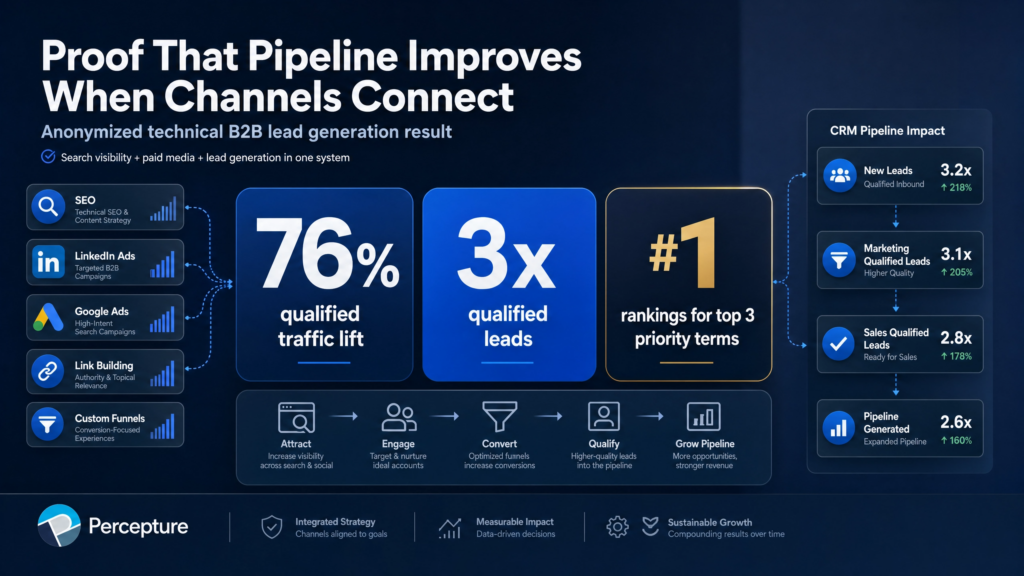
A strong proof layer connects search, PR, content, analytics, and sales. If your team can measure where leads come from, how content assists the funnel, and which questions influence conversions, you can make better decisions.
For broader vendor research, related pages such as best generative AI SEO agencies and best B2B intent data providers help buyers compare the market while keeping Percepture in the research path.
Search visibility and qualified leads in practice
Click the video teaser below to view the Broadstaff case study. It is a practical example of how search visibility, clearer positioning, and qualified lead generation can compound.

A practical 3-step process
Diagnose
Map the important buyer questions, current rankings, service-page gaps, entity issues, competitor answer patterns, and AI answer inclusion.
Build
Create or improve pages that answer the questions, connect to services, show proof, and support the buyer journey.
Reinforce
Use digital PR, internal links, analytics, and ongoing testing to strengthen trust signals around the brand.
Percepture can connect this process to strategy and planning, B2B intent data, conversion rate optimization, and attribution and analytics so the visibility work supports business outcomes.
Mistakes that keep B2B brands out of AI answers
| Mistake | Why it hurts | Better move |
|---|---|---|
| Publishing thin service pages | AI systems need source material with depth and context. | Build service pages around buyer problems, proof, FAQs, and next steps. |
| Using vague positioning | If your category is unclear, your brand is harder to recommend. | State audience, use case, outcomes, and evidence plainly. |
| Separating SEO and PR | Search visibility and external validation should reinforce each other. | Connect what is digital PR education to service pages and proof assets. |
| Ignoring comparison intent | Buyers want to compare options, risks, and fit. | Create comparison tables, buyer guides, pricing explainers, and fit checklists. |
| Measuring traffic only | Traffic misses answer inclusion, brand demand, and lead quality. | Track prompts, citations, rankings, assisted conversions, and sales feedback. |
How to measure progress
AI answer visibility is harder to measure than a normal ranking report, but it can still be tracked. Start with a fixed set of buyer questions. Test those questions in major AI tools. Record whether your brand appears, how it is described, which sources are cited, and which competitors are named.
Then connect those findings to search and business metrics: rankings, impressions, branded search, referral traffic, assisted conversions, demo quality, and sales feedback. A good measurement plan does not ask only, did traffic go up? It asks, are we becoming easier for buyers and AI systems to understand?
What to ask an AI visibility partner
- Can they explain how SEO, GEO, PR, and content connect?
- Can they map buyer questions by funnel stage?
- Can they show how internal links support service-page growth?
- Can they build structured pages that answer, compare, diagnose, and convert?
- Can they measure visibility beyond traffic alone?
Compare your current visibility system
If your team already has SEO, PR, and content in motion, Percepture can compare the current system against AI answer visibility requirements and identify what should be fixed first.
Related Percepture resources
Use these pages to keep building the system. The goal is to move from education to service-page evaluation without forcing the sale too early.
FAQ
What does How to win visibility in AI answers B2B mean?
It means making your B2B brand easier for AI systems to understand, trust, and include when buyers ask business questions. The work usually includes SEO, clear entity signals, buyer-question content, digital PR, proof, internal links, and conversion paths.
Is AI answer visibility different from SEO?
It is different in how the answer is shown, but the foundation overlaps with SEO. Crawlable content, strong rankings, internal links, topical authority, and trusted mentions all help AI systems understand your brand.
How long does it take to improve AI answer visibility?
Timing depends on the strength of your current site, the competition in your category, and the amount of proof already available. Many teams start with a diagnostic, fix entity and content gaps, then reinforce authority over several months.
What should B2B leaders invest in first?
Start with the foundation: clear positioning, strong service pages, technical crawlability, and content that answers the most important buyer questions. After that, strengthen proof, digital PR, and measurement.
Can digital PR help a brand appear in AI answers?
Yes. Digital PR can create credible third-party mentions, expert commentary, and source material that supports the brand’s authority. It works best when PR, SEO, content, and service-page strategy all reinforce the same entity story.
How should we measure AI search progress?
Track a fixed set of buyer prompts, answer inclusion, source citations, branded search, non-branded rankings, referral traffic, assisted conversions, and sales feedback. Traffic alone is not enough.
Do we need new content or a rewrite of existing pages?
Often both. Start by improving high-value service pages and pages that already have impressions. Then create missing buyer-guide, comparison, pricing, FAQ, and proof content where the current site does not answer the buyer’s question.
Ready to build an AI answer visibility system?
Percepture can help your team diagnose the gaps, build the content and proof system, and connect visibility work to pipeline. If you are ready to move from theory to action, start with a practical review of your current search and AI footprint.
- Map the buyer questions. Identify the prompts that matter before buyers create a shortlist.
- Audit the source environment. Review owned pages, PR, leadership signals, reviews, and third-party references.
- Fix the internal architecture. Link education pages to service pages with clear, GSC-informed anchor text.
- Build proof. Add case studies, examples, pricing guidance, expert bios, and methodology.
- Measure answer inclusion. Track AI outputs, citations, brand mentions, and conversion quality.

Bob Generale
Bob Generale is President of Percepture. He leads executive strategy for SEO, GEO, digital marketing, and visibility programs that help organizations connect search, content, PR, AI visibility, and conversion into revenue systems.
Bob’s operator style focuses on practical strategy, fast diagnosis, and proof-driven execution. Clients often describe him as the “magician” because he helps make visibility, authority, and pipeline movement more measurable and more controllable.