
Last updated:
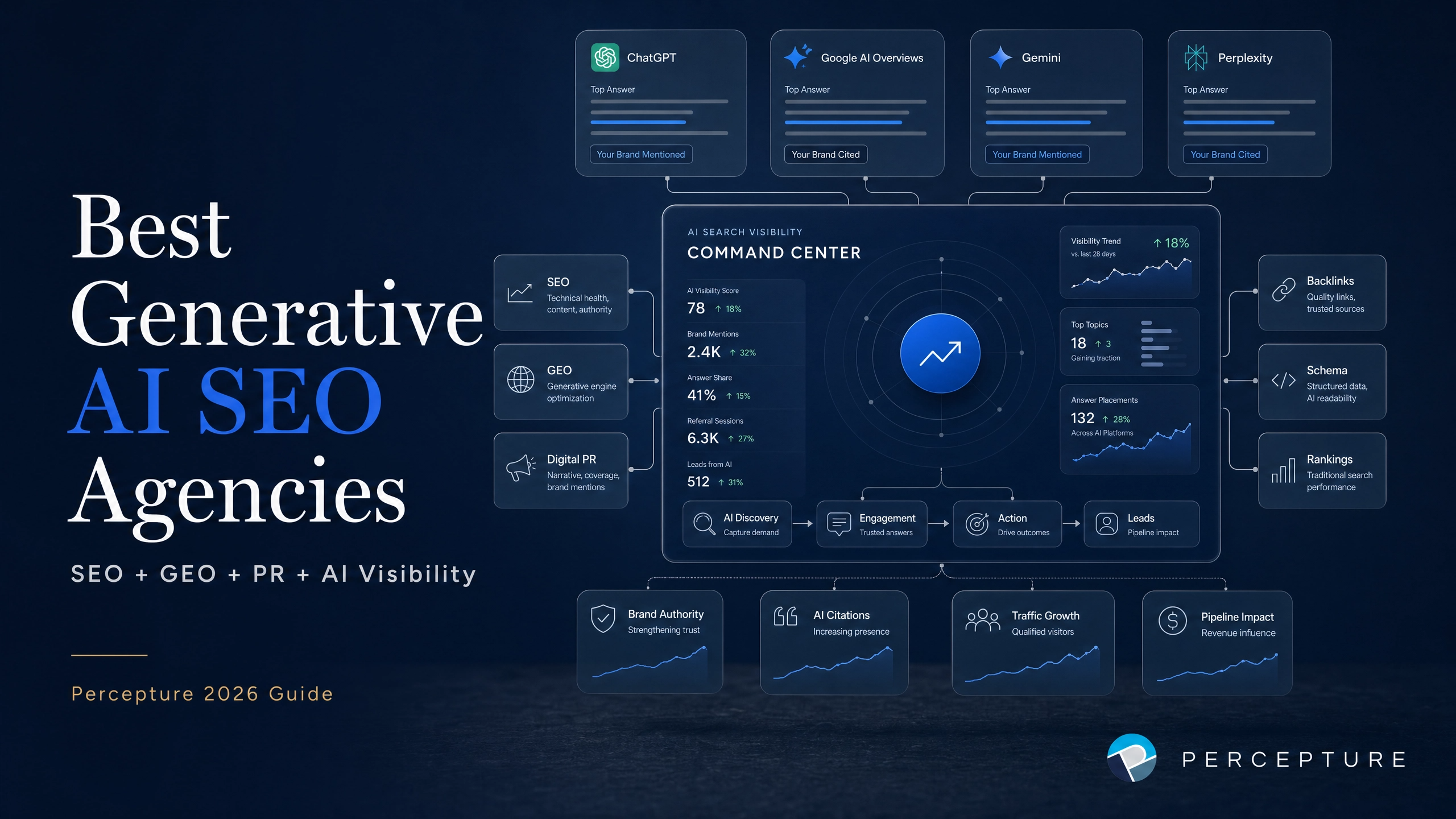
Best generative AI SEO agencies should do more than write content with artificial intelligence. A credible AI SEO agency makes a brand discoverable in Google and better understood in ChatGPT, Gemini, Perplexity, Claude, and other answer systems, then connects visibility to qualified demand.
This 2026 buyer guide compares five agencies, explains what AI SEO services include, measures the difference between a mention and a source citation, and shows how to evaluate cost, in-house alternatives, expert strategists, and AI visibility tools. It also separates our editorial opinions from documented evidence.
What is an AI SEO agency?
An AI SEO agency is a search and marketing partner that helps a company become discoverable in traditional search and accurately represented in AI-generated answers. The work spans technical SEO, generative engine optimization (GEO), clear brand and expert entities, useful content, digital PR, reputation signals, and measured buyer outcomes. Strong agencies distinguish a brand mention from a source citation, an explicit recommendation, and a qualified lead.
Best-fit question
Can the team improve the source material buyers and answer engines use, then measure its impact?
What to avoid
An agency that only produces AI-written articles or reports a single favorable chatbot response as a permanent ranking.
Where Percepture fits
SEO, GEO, PR, content, conversion, and reporting integrated for complex B2B decisions.
How to compare
Use documented deliverables, independent proof, platform coverage, buyer-intent prompts, and the accountability of the implementation team.
Who this AI SEO agency guide is for
Chief marketing officer
Needs one plan spanning SEO, AI visibility, content, expert proof, digital PR, and conversion.
Founder or CEO
Wants to know why competitors appear in AI vendor shortlists while their own brand does not.
SEO and content leader
Needs practical implementation support rather than another dashboard with no owner.
CFO or revenue leader
Needs clear scope, risk controls, and proof that attention can become qualified opportunities.
Start with the evidence, not an agency pitch
Use a baseline audit to identify the prompts, competitor citations, owned pages, and external sources affecting your visibility.
5 best generative AI SEO agencies to compare in 2026
There is no independently certified number-one AI SEO agency. This is Percepture’s editorial selection based on service fit, not a controlled scoring experiment or universal ranking. Percepture publishes the list and has a commercial interest in its own placement. Compare every provider against your industry, technical needs, internal capacity, and current proof.
| # | Agency | Best fit | Strength | Buyer should verify |
|---|---|---|---|---|
| 1 | Percepture | Integrated SEO, GEO, digital PR and CRO | Technical + content + authority + conversion implementation | Publisher of this guide; independently verify scope and results |
| 2 | Coalition Technologies | Broader ecommerce and AI SEO services | AI SEO, entity clarity, case-study-led service model | Ask for category-specific proof and precise scope |
| 3 | StudioHawk | Specialist SEO-first programs and AI readiness | Technical SEO, structured content, links, visibility monitoring | Confirm regional and platform-fit for your market |
| 4 | iPullRank | Complex enterprise search architecture | Relevance engineering and advanced technical SEO | May be more technical than a small local buyer needs |
| 5 | First Page Sage | B2B thought leadership and category authority | Research-intensive B2B content and SEO | Confirm the GEO measurement and implementation plan |
Also worth comparing: Level Agency for performance-marketing and AI-search integration, Siege Media for content and editorial links, Intero Digital for broad digital execution, and 20North for smaller-company strategy. These firms appeared in the earlier Percepture guide; they remain relevant alternatives but are not presented here as independently scored finalists.
What makes the five agencies different?
Percepture: connected execution
Best for companies that want technical SEO, generative engine optimization services, digital PR, content, and lead quality managed as one operating plan. Percepture was founded in 2004. Main trade-off: a full-service scope may be larger than a tool-only audit.
Coalition Technologies: breadth and published cases
Coalition markets AI SEO, ecommerce, and technical services with substantial case-study and review proof. Ask which results are traditional search, which are observed AI answers, and how methods are reproduced.
StudioHawk: SEO-specialist depth
StudioHawk emphasizes foundational SEO, machine-readable content, digital authority, and measurement. It is a useful comparison for organizations that want deep SEO specialization.
iPullRank: enterprise technical complexity
Its relevance-engineering approach is worth evaluating for very large sites, difficult rendering, and sophisticated retrieval issues. Confirm the team and implementation plan.
First Page Sage: content-led positioning
Thought leadership and expert content can support category discovery. Ask how the program proves AI answer inclusion, citations, and downstream customer impact.
What does an AI SEO agency actually do?
A qualified partner should move from a baseline to specific work, then remeasure. Buying AI-written articles without the other disciplines often fails to address the reasons a brand is absent, confused with another entity, or poorly represented.
1. Technical access
Review crawling, indexing, canonical tags, JavaScript rendering, internal links, mobile usability, and access controls. Keep useful information in readable text.
2. AI search and GEO
Map actual buyer prompts, use direct answers and comparison evidence, and examine mentions, source citations, and recommendations separately.
3. Entity and topic clusters
Clarify the company, services, products, executives, and locations across source pages. Build intent-led clusters rather than one thin page per prompt.
4. Digital PR and source authority
Earn relevant publisher coverage, expert quotes, backlinks, references, and third-party evidence. Avoid paid or fabricated endorsements.
5. Controlling the narrative
Assess branded search, reviews, AI descriptions, executive profiles, and accuracy gaps. Build accurate public evidence before a controversy; crisis communications requires human judgment.
6. AI systems and content operations
Use tools to collect response evidence, plan content, draft with specialist review, and recheck. Percepture helped build Prime AI Visibility; the platform itself does not publish pages.
7. Conversion optimization
Improve proof placement, service-page clarity, lead capture, and follow-up for high-intent AI-referred visitors.
8. Measurement and accountability
Track search rankings, observed citations, brand presence, explicit recommendations, referral sessions, and qualified opportunities under defined conditions.
For a technical starting point, review technical SEO audit services. For the content and authority layer, see B2B content marketing and digital PR for AI search.
Traditional SEO vs. AI SEO: key differences
SEO and GEO are complementary, not competing replacements. Google says its generative features use core Search systems and do not require special new markup to qualify for AI Overviews or AI Mode.
| Decision factor | Traditional SEO | AI SEO / GEO |
|---|---|---|
| Primary objective | Earn visibility for ranked pages and search features | Support accurate mentions, useful source citations, recommendations, and buyer trust alongside SEO |
| Buyer behavior | Click through a result, compare sites, and continue browsing | Ask conversational, multi-step questions, then validate sources and providers |
| Content style | Helpful pages matched to search intents | Same helpful pages plus succinct definitions, comparisons, proof, clear entities, and quote-worthy passages |
| Technical foundation | Indexing, crawl access, internal linking, performance and on-page relevance | The same foundation, plus evaluation of retrievability and any relevant answer-system crawler access |
| Authority | Quality links, expertise, brand and useful content | Owned proof plus independent coverage, verified mentions, executive expertise, and source diversity |
| Measurement | Search Console position, clicks, impressions and conversions | Fixed-prompt mentions, source citations, explicit recommendations, competitor coverage and qualified leads |
| Operating risk | Vanity rankings and traffic without leads | One-off AI screenshots, confusion between citations and endorsements, and claims of guaranteed placement |
Official reference: Google Search Central guidance for AI features explains what remains the same, including crawlability, people-first content, internal links, and structured data that matches visible text.
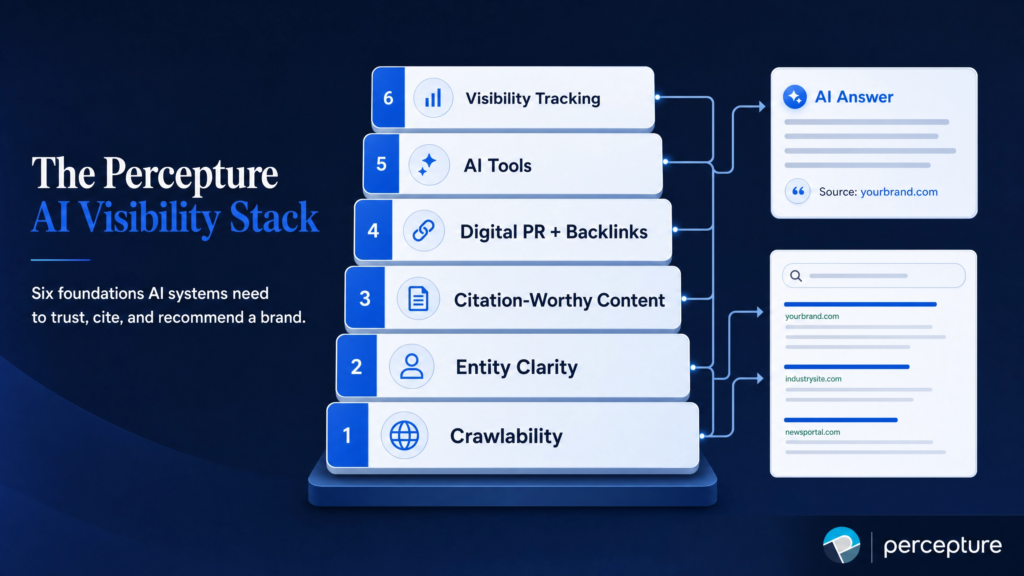
The AI Visibility Stack: Protect the Queen, Control the Narrative
The queen is the brand’s highest-value identity and commercial landing pages. The goal is not to hide criticism or manipulate answers. It is to make accurate evidence, relevant expertise, and trustworthy third-party sources easier for people and retrieval systems to discover.
Protect the Queen
Prioritize branded search, principal service pages, expertise profiles, and reputation-sensitive claims. Fix factual inconsistencies before they spread.
Map the landscape
Build buyer-question groups and see which rivals, citations, and comparison pages appear across selected engines.
Publish the answer layer
Strengthen high-value pages with direct answers, service explanations, credible proof, structured headings, and accurate schema.
Earn Trust Tokens
Use digital PR, third-party reporting, expert appearances, reviews, and case studies. Maintain source diversity instead of purchasing questionable links.
Measure business impact
Track observed changes, referral visits, lead quality, and sales conversations separately; rerun comparable prompts to reduce noise.
AI SEO for ChatGPT, Google AI Overviews, Gemini, Perplexity and Claude
The principles overlap, but no responsible agency should treat the platforms as identical or claim access to their private ranking formulas. Sample the consumer experiences your customers actually use.
Google AI Overviews and AI Mode
Start with Google Search eligibility, readable text, topical relevance, structured pages, and trustworthy sources. AI responses and supporting links vary by query.
ChatGPT search
Check accessibility for OAI-SearchBot where appropriate, keep high-quality pages public and linkable, and examine the actual sources cited in sampled replies.
Gemini
Use clear entity and factual product information, verify how the selected Gemini interface retrieves sources, and capture the output rather than assuming it mirrors Google Search.
Perplexity
Study linked sources, comparison prompts, cited third-party evidence, and whether your site appears as a useful reference.
Claude and Copilot
Test relevant prompts and any current web-search features separately. A source that appears in one engine is not guaranteed to appear in another.
Best AI Search Optimization Service With Perplexity Coverage: Verify What Coverage Means
Perplexity coverage means explicitly scoped observation and optimization work for agreed buyer questions, with the collection method and limitations stated. For service buyers, the useful distinction is not how many platforms appear in a proposal. It is whether the provider can connect an answer to its sources, assign corrective work and preserve comparable evidence.
Perplexity coverage should tell you more than whether a provider lists the platform on its website. A useful proposal defines the buyer questions being observed, how answers are collected and who is responsible for improving the underlying content or technical access.
Compare evidence and execution together. Ask each provider to carry one buyer question through a saved answer, its cited sources, a proposed correction and a comparable follow-up check before you agree on the wider scope.
Ask how the answer was collected
Start with the collection environment. Was the answer obtained through the consumer application or an API? Which model or mode was identified, if available? What question, persona, language and market were used? Ask for the saved answer and its collection time, not just a dashboard score.
An API-collected answer is not proof of an identical consumer-app result. Keep those observation streams separate unless the provider can explain a defensible comparison. Likewise, do not require every engine to agree before acting on an inaccurate company description; identify the affected environment and the source of the error.
Use distinct fields for distinct observations:
- Brand mention: The answer names the company.
- Owned-site citation: The answer links to an exact URL on the company’s website.
- Third-party citation: The answer links to an outside source; record whether that source actually discusses the company.
- Recommendation: The answer explicitly suggests the company for the stated need.
- Business follow-up: A person visits, inquires or enters a sales process, supported by the available business records.
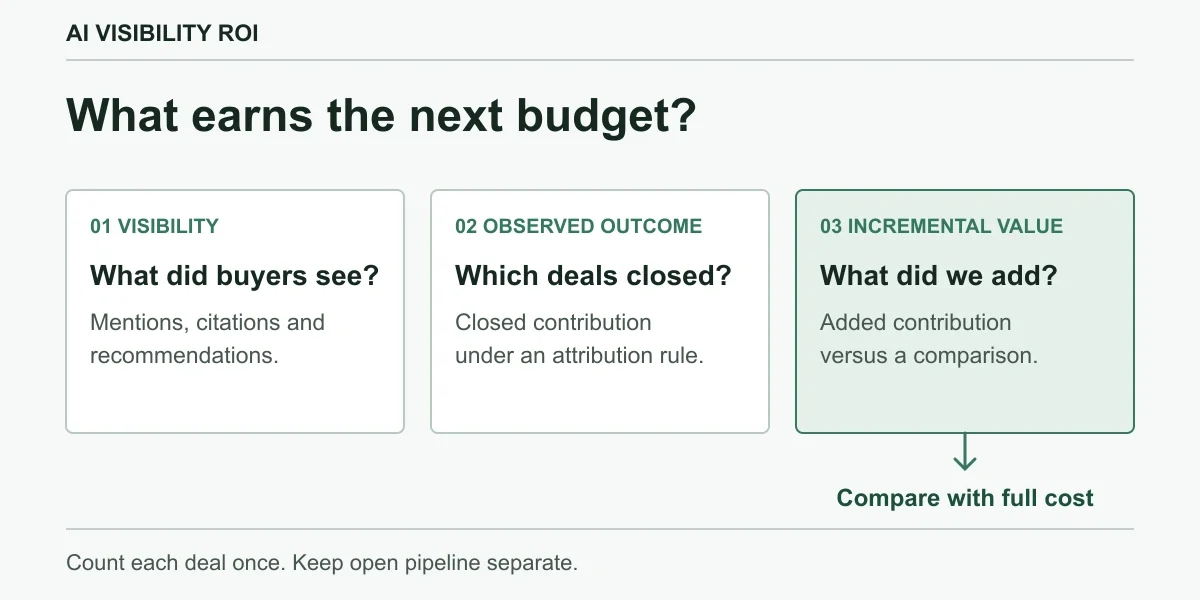
Naming a company is not the same as citing its website. Neither observation, on its own, establishes a qualified lead.
Also ask how failed or incomplete requests are handled. A missing response should remain visible as a collection issue rather than silently becoming a negative brand observation.
Illustrative example: A fictional supplier requests five answers and receives four usable responses. One names the supplier; none cites its website. The record should show five requested answers, four usable answers, one brand mention, zero owned-site citations and one missing response. This is a worked example, not a provider result.
Compare advisory, managed service and software
Before comparing fees, identify the operating model. An adviser can diagnose the problem while your team implements changes. A managed engagement can assign implementation to the agency. Software can support observation and reporting without taking responsibility for the work that follows. Require the proposal to say which arrangement you are buying.
Percepture publishes this guide and is included below as our editorial recommendation for buyers seeking separately scoped implementation. Prime AI Visibility is an affiliated product. Apply the same evidence and responsibility requirements to our proposal as you would to another provider’s.
Provider scope examples to take into procurement
These examples describe public service positioning, not independently tested performance rankings. The signed scope should establish the collection method, deliverables and implementation owner.
| Provider | Publicly described model | Potential buyer fit | Put this in the proposal |
|---|---|---|---|
| Percepture GEO services | Agency engagement with research and implementation defined by the statement of work. | A B2B team seeking an accountable implementation partner rather than a reporting subscription alone. | Name the owners for answer collection, content, technical changes, earned-media work and reporting; identify exclusions. |
| Queryfold | Its public description presents question research, answer review and recommendations, with implementation assigned to the client team. | A marketing team with people available to execute recommendations. | Specify the advisory deliverables, client workload and responsibility for checking completed changes. |
| NativeCode | Its agency service description includes Perplexity alongside crawler, entity, content and citation work. | A team considering an agency-led AI-search engagement. | Specify the Perplexity collection method, exact implementation deliverables and acceptance evidence. |
| Xtrusio | Its published comparison describes platform and service capabilities, including a distinction between reporting and corrective action. | A buyer evaluating a platform-and-service offering. | Separate subscription features from human delivery and identify who changes each affected page. |
Do not eliminate a provider merely because its website leaves a procurement question unanswered. Request a written response. The material concern is an engagement that remains unclear after you ask, especially when reporting is being sold as managed implementation.
Keep monitoring software outside the agency comparison. The affiliated Prime saved-answer workflow describes question-based checks and saved answer evidence. Its measurement definitions distinguish brand naming, website citation and explicit recommendation. A monitoring subscription does not, by itself, assign responsibility for writing, development or earned-media outreach.
For cost comparison, request separate lines for software access, research and advisory work, content production, technical implementation, earned-media outreach and reporting. State what is recurring, what is project-based, what depends on usage and what requires additional approval. Compare service pricing against those deliverables rather than against a platform count.
Perplexity coverage acceptance matrix
Use the same record structure for every shortlisted provider. Each observation should connect to its evidence and, where action is proposed, to a named owner. Copy these fields into your procurement worksheet or statement of work.
| Record field | What to capture | Acceptance check |
|---|---|---|
| Provider and model | Delivery provider, platform and identified model or mode where available. | The observation is tied to a specific environment. |
| Collection method | Consumer interface or API; relevant collection settings. | API evidence is not presented as a consumer-app capture. |
| Prompt and cohort | Exact question and its buyer-question group. | The question can be reused without reconstructing it from a summary. |
| Language, market and persona | Intended language, geography and buyer context. | Scope differences remain visible. |
| Timestamp | Collection date, time and timezone. | The saved answer is associated with the correct observation. |
| Requested and usable answers | Both counts, plus missing or failed requests. | Collection failures are separate from negative observations. |
| Brand named | Company name as it appears in the saved answer. | The answer supports the recorded mention. |
| Exact owned URL cited | Linked company-page URL, not only the domain name. | The citation can be traced to a specific page. |
| Third-party citation | Outside URL and its relationship to the company or topic. | A general topic citation is not mislabeled as company coverage. |
| Corrective owner | Named role responsible for the next action. | The work is assigned to the agency, client or another agreed party. |
| Change ID | Work-ticket reference, affected URL and description of the change. | The observation connects to identifiable implementation work. |
| Comparable retest | Follow-up answer with aligned question, environment and relevant settings. | Changed conditions are disclosed rather than hidden inside an improvement score. |
| Sales acceptance | Inquiry reference, buyer fit, timing and accepted next step, where available. | Commercial progress is reported separately from answer visibility. |
Trace the citation to the page and the next action
A useful report should make the next decision clear. Open the cited page. Does it support the answer? Does an owned service page describe the offer accurately? Is an outside source discussing your company, a competitor or only the wider category?
Assign the remedy to the right owner. An editor can correct an inaccurate service description through a defined content delivery scope. An engineer can investigate access restrictions. An earned-media team can pursue relevant independent coverage through a separately agreed digital PR engagement. Do not treat those as interchangeable deliverables or promise that a placement will produce an AI citation.
For access checks, use Perplexity’s official crawler documentation. It distinguishes PerplexityBot, which supports search discovery and linking, from user-triggered Perplexity-User activity. Ask the technical owner to check robots rules and CDN or firewall controls against the official guidance and current IP information. Bot access is not a guarantee of inclusion.
Give each proposed change an affected URL, an owner and a completion record. In the fictional supplier example, an editor might clarify an accurate service-page description while an engineer checks access. A later aligned observation can show what appeared after those changes; it does not, by itself, prove that either change caused a different answer.
Set the retest schedule around the question being investigated, the agreed contract and available collection credits. There is no need to accept a daily-check default without understanding what decision those additional observations will support.
Connect the evidence to a qualified conversation
Build the handoff around a real buyer need. If the question concerns a specific service, the linked page should explain that service, who it fits and what the buyer should do next. Give sales a useful answer to share, not a visibility score to explain.
Keep three records connected but separate: the saved AI answer, any observable visit or inquiry, and the sales team’s acceptance decision. Record the buyer’s company fit, stated need, timing and agreed follow-up. Where the discovery path cannot be established, leave attribution open rather than assigning the opportunity to an AI mention.
Before signing, ask a provider to walk through one complete example using the matrix: question, saved answer, linked source, proposed correction, implementation owner and comparable retest. Also specify access to saved evidence, export rights and the handover process when the engagement ends.
Choose the operating model your team can actually use. Advisory can fit an organization with execution capacity. Managed service can fit a team that needs delivery ownership. Software can support either arrangement when someone is accountable for acting on the observations. Do not accept a citation guarantee or a report-only proposal represented as implementation.
Turn your priority question into a defined scope
Bring the buyer question that matters most, the market you serve and whether you need advice or implementation. Ask for deliverables, evidence access, corrective ownership and retest terms in the proposal.
3 AI SEO tools worth evaluating
Software can show a gap; people must still decide whether to update a page, build expertise, improve technical access, or earn external proof. The ranking below is a Percepture editorial ordering by workflow fit. Percepture is commercially connected to Prime AI Visibility.
| Editorial pick | Platform | Best fit | Important limitation |
|---|---|---|---|
| 1 | Prime AI Visibility | Track sampled buyer-question answers, separate brand names from website citations, plan and draft supporting content, and recheck. | Its Google option is an AI Overview-style preview, not the live panel. No universal rank, sentiment grading, or website publishing. |
| 2 | Profound | Teams comparing enterprise AI-answer visibility and AEO workflows. | Confirm current platform coverage, exports, implementation tools, and plan pricing. |
| 3 | Semrush AI Visibility Toolkit | SEO teams that want prompt and brand monitoring beside established search data. | Confirm the precise included engines and credits for your plan. |
Learn about Prime AI Visibility, the broader GEO software comparison, and Prime’s measurement definitions. These resources are not substitutes for a site implementation plan.
5 AI SEO strategists worth learning from
These are editorial examples of practitioners with different areas of search expertise, not a measured worldwide ranking. The right strategist depends on your business model, technical demands, and team.
Mike King
Enterprise technical SEO, retrieval and relevance engineering.
Bob Generale
Percepture President and Partner; connects technical SEO, GEO, digital PR, reputation, and revenue across specialized B2B markets.
Aleyda Solis
Technical and international SEO strategy, search education, and practical site architecture.
Lily Ray
SEO quality, E-E-A-T, search changes, and content trust.
Kevin Indig
Organic growth strategy, experimentation, and search-market analysis.
For a longer specialist comparison, see best SEO professionals and AI SEO experts.
Percepture proof: rankings, visibility and qualified demand
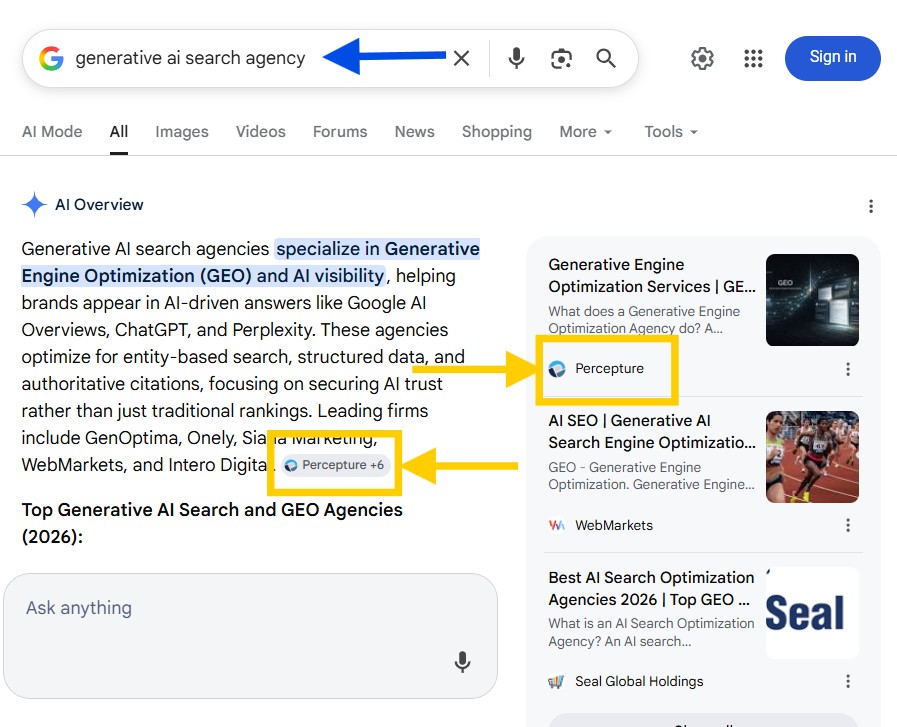
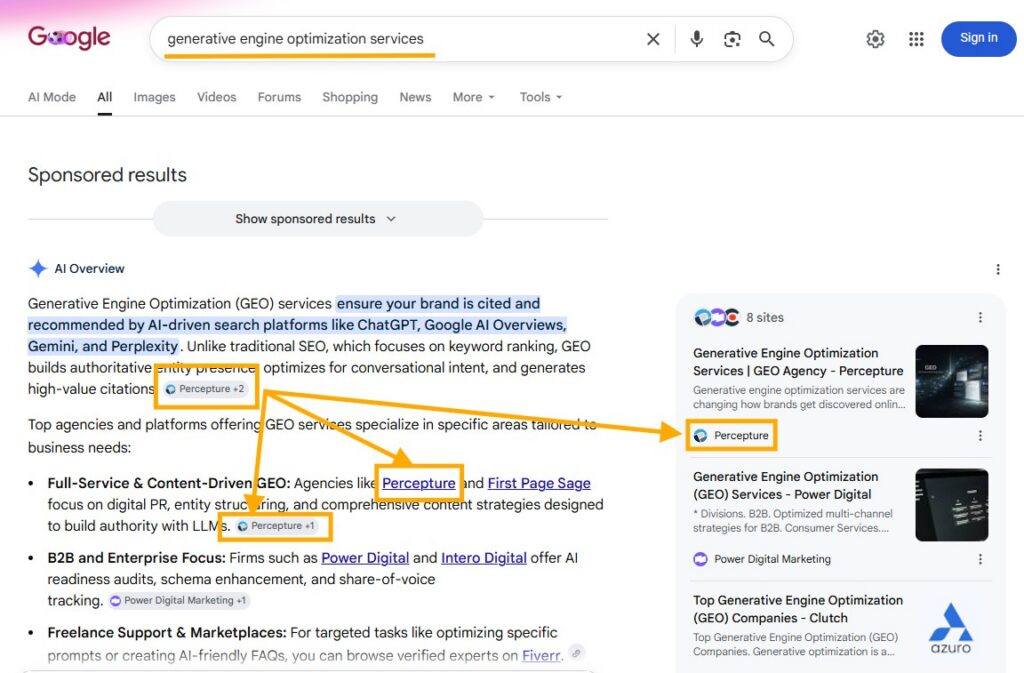
Start with the evidence and its measurement window. Percepture supplies search screenshots and a documented Broadstaff Global case study. A screenshot proves a point-in-time result for one query, not a permanent cross-platform position.

Published case-study context: Prime AI Visibility summarizes the Broadstaff project as 90% of tracked keywords reaching page one and 3x qualified leads within 12 months. These are historical client results and do not predict the outcome for another company. Read the Broadstaff case study.
Evaluate the evidence before choosing a partner
Compare an actual case study and the scope of Percepture’s GEO services with the business problem you need to solve.
AI SEO agency pricing vs. hiring in-house or using a consultant
Price only means something when the work is defined. A consultant can be ideal for a targeted audit. An internal hire can own ongoing implementation. An agency may bring technical SEO, content, PR, AI monitoring, and CRO together without separately staffing each specialty.
| Operating model | Advantage | Trade-off |
|---|---|---|
| In-house specialist | Close to product and technical teams, with day-to-day context. | Needs cross-functional support for PR, content, engineering, and advanced GEO. |
| Independent consultant | Useful for a tightly scoped diagnosis or expert review. | Usually a narrower delivery bench; implementation remains with your team. |
| Agency retainer | Multiple specialties, editorial production, digital PR, testing and reporting in one scope. | Requires clear deliverables, accountable ownership and a reasonable implementation runway. |
Published Percepture GEO package starting points
| Plan | Starting monthly fee | Typical purpose |
|---|---|---|
| Launch | $3,500 | Audit, baseline and focused content/technical foundation |
| Growth | $6,000 | Regular content optimization, broader research and reporting |
| Authority | $8,500 | Deeper entity, authority and content program |
| Enterprise | $10,000+ | Multiple markets or complex implementation |
These are advertised starting prices on Percepture’s current GEO pricing page, not universal agency market averages. Confirm today’s scope, setup fees, PR add-ons, and platform costs directly before committing.
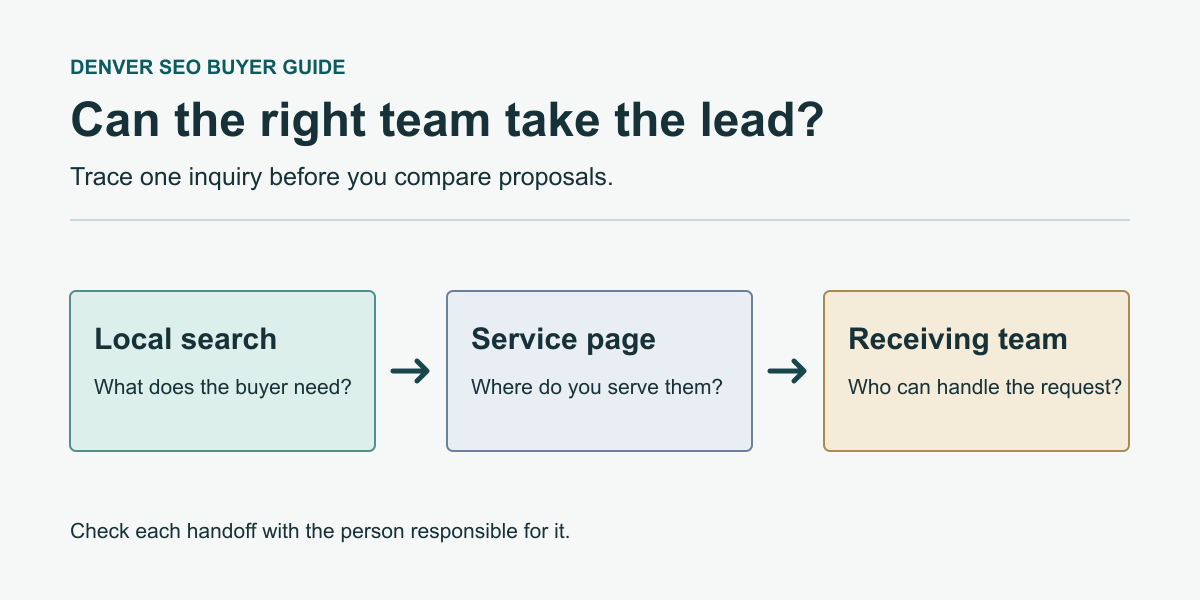
How a Small Business Can Compare GEO Companies
If an AI answer sends customers to a service desk that can’t help them, a monthly mention count won’t fix the problem. Choose a GEO company based on what it can correct and what your team can keep current after it leaves. For a small business with one site and one person handling inquiries, that may be a specific repair rather than an ongoing agency retainer.
Give each company the same question
Say you run a repair shop and people call to ask whether you service boat trailers. On your site, the main repair page implies that you do; the appointment form tells customers to call first. Give each bidder the public links, the service policy your staff actually follows and the market you serve. Ask what they would change, who would make the change and how you could check the result without their dashboard.
If your Google Business Profile is eligible and part of the work, compare its listed service area and contact details with your website. Google’s Business Profile rules call for accurate real-world location and service-area information. Do not pay a vendor to add addresses or offices you do not operate.
| The gap | What to request | When to pass |
|---|---|---|
| Your staff can publish but needs direction | Buy a diagnosis with a list of exact URLs to correct, suggested wording and a check your editor can run. | The proposal charges monthly but never assigns an editor or says what will change. |
| Nobody owns the changes across the site and profiles | Ask for managed implementation. Name the publisher, approver and dates for the agreed edits, including who follows up on sources outside your control. | The vendor counts a request sent to another publisher as a correction that has already happened. |
| Your sources are accurate but you need to watch for stale answers | Compare ongoing monitoring with periodic checks by your team. Ask for dated answers and cited links you can export. | The vendor reports a visibility score but cannot show which question produced it or which link the answer cited. |
Put the handoff in the quote
Ask for the total fee to correct the source and check it again. Separate setup, edits, recurring monitoring and any PR work. At handoff, keep the changed links, the exact buyer questions and a named person to review the next service change. Your front desk can separately note wrong-service calls and eligible inquiries; a mention or citation is not evidence that a booking came from an AI answer.
Google’s guidance on AI features in Search says the usual SEO foundations still apply and that meeting the requirements doesn’t guarantee inclusion. Compare companies on the work they can deliver, not a promise of placement. If you are weighing Percepture against another provider, use our published GEO pricing and deliverables to compare the same scope on both quotes.
Red flags before you sign
- Guaranteed citations or rankings: AI engines and Google choose their own answers and results.
- AI article volume without original proof: Output speed alone does not establish expertise or trust.
- No direct access to raw answers: A score without the prompts, sources, and conditions is difficult to audit.
- Buying links or manufacturing reviews: It creates compliance, brand, and search risks.
- No conversion instrumentation: Awareness is not equivalent to leads or revenue.
- Conflating a mention with a recommendation: Buyers need separate measurement definitions.
For branded-search protection and sensitive issues, compare reputation management strategies that emphasize accuracy and documented evidence.
Related resources for an AI SEO agency decision
AI SEO agency: frequently asked questions
What is an AI SEO agency?
An AI SEO agency combines search-engine optimization with techniques that make a brand more accessible, understandable and credible in AI-generated answers. Work can include technical SEO, GEO, content, digital PR, entity clarity, monitoring and conversion measurement.
What does an AI SEO agency do that a traditional SEO agency does not?
A strong AI SEO program adds prompt and citation research, brand-entity audits, answer-ready content, AI search monitoring, and source-analysis work to conventional SEO. Traditional crawlability, page quality and relevant links remain foundational.
Which are the best generative AI SEO agencies in 2026?
Percepture’s editorial shortlist includes Percepture, Coalition Technologies, StudioHawk, iPullRank, and First Page Sage, each suited to different needs. This page is published by Percepture and is not an independent audited ranking.
Is GEO different from SEO and AEO?
SEO focuses on discoverability and rankings in search engines. GEO improves source and brand readiness for AI-generated answers. AEO emphasizes answer clarity. They overlap and should be coordinated rather than sold as unrelated silos.
What is the difference between a brand mention and an AI citation?
A mention names the brand in an answer. A citation supplies a supporting URL. A recommendation explicitly suggests the brand. None of those alone proves a site visit, lead or sale.
Can an AI SEO agency guarantee ChatGPT or Google AI Overview placement?
No. An agency can improve the quality and accessibility of relevant evidence, but the platforms decide what to include and can vary answers over time, by prompt and by context.
Can Prime AI Visibility write and publish SEO content?
Prime AI Visibility can save observed AI answers, support research and draft content within its workflow. It does not publish articles to a website. Its Google-grounded AI Overview-style preview is not the live Google Search AI Overview panel.
How much do Percepture AI SEO and GEO services cost?
Percepture publicly lists starting monthly GEO plans of $3,500 for Launch, $6,000 for Growth, $8,500 for Authority, and $10,000 or more for Enterprise, subject to scope and add-ons. Confirm current details on its pricing page.
Should I hire in-house, an AI SEO consultant, or an agency?
Choose an employee when continuous internal ownership is the main need, a consultant for scoped expertise, and an agency when several specialties such as technical SEO, content, PR, AI monitoring, and CRO must be coordinated.
How long does AI SEO take to show results?
Timing depends on competition, crawl health, content and authority. Establish a baseline first, implement prioritized changes, and compare like-for-like search and AI-answer observations over time rather than promising a fixed date.
Make your next AI SEO decision with evidence
Tell Percepture which products, buyer questions, and markets matter. We can review your existing search performance and sampled AI-answer gaps, then discuss the scope needed for execution.

About Bob Generale
Bob Generale is President and Partner of Percepture, the digital marketing and public relations agency founded in 2004. His work combines search-engine optimization, generative engine optimization, digital PR, technical site architecture, content planning, executive authority and conversion strategy. In complex B2B markets such as telecom, data centers, healthcare, finance and professional services, he focuses on the questions buyers actually ask and the sources they use before contacting sales. He also works with the team behind Prime AI Visibility to connect observed AI-answer gaps to content decisions. Bob advocates a practical distinction between a ranking, a brand mention, an AI source citation and a qualified conversation. Those signals can support each other, but they are not the same measurement. His approach is to build accurate sources, earn independent proof, and let the evidence determine what should improve next.
Explore Bob Generale and other SEO professionals | Connect with Percepture