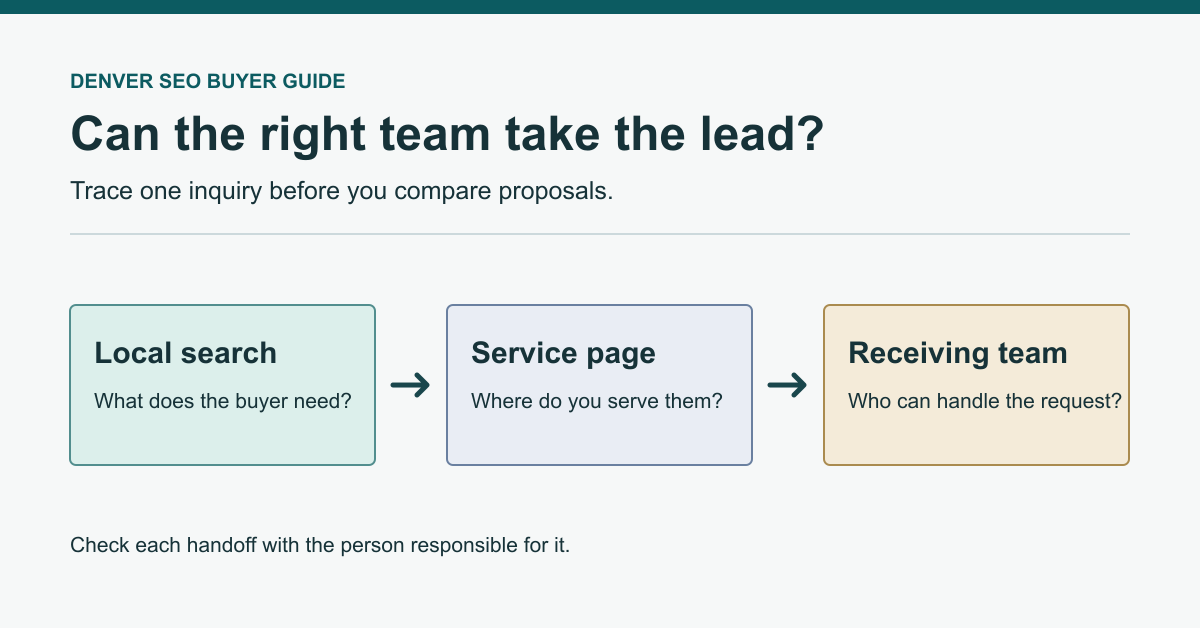

Choose a Denver SEO agency that can explain how a local search becomes an inquiry your team can serve. Ask the agency to test one location page, one Business Profile and one lead handoff before comparing retainers. That shows whether your problem is visibility, confusing service coverage or the wrong branch getting the call.
Suppose an industrial maintenance company takes quote requests at a Denver office and sends technicians across parts of the metro. A national product team also uses the site for larger contracts. Each group wants more inquiries, but they do not want the same ones. If every page sends a visitor to the same sales inbox, more clicks can mean more time spent rerouting leads.
The useful first question is not whether an agency can rank a page for Denver. It's which request the company wants to receive, who can handle it and what a buyer needs to know before getting in touch. A shortlist exercise built around one real service can show you who understands that job.
Match the Denver search to the way you serve customers
A company that receives customers at a facility has different obligations from one that sends teams to customer sites. So does an employer with genuinely separate locations. Before asking for an SEO proposal, put one service and its delivery model in writing.
| What customers can actually do | What the agency should check | Where the inquiry should land |
|---|---|---|
| Visit a staffed Denver office or shop | Show the correct address, hours, appointment rules and services the location handles. Review the site's location page against the Business Profile if the location is eligible. | A local phone, appointment or quote workflow that the location actually monitors. |
| Request a technician at their own location | Confirm the areas the team covers, what exceptions apply and whether an address should appear publicly under Google's rules. Do not present a mailbox as an office. | The team that can check the job address and dispatch capacity. |
| Choose among multiple staffed locations | Distinguish each location's services and business hours. Verify which profile and location page belong to each operation. | The branch that can fulfill the request, with a fallback when capacity or coverage changes. |
| Buy a national B2B service from a Denver-headquartered company | Decide whether a product page or a regional service page answers the commercial search. Ask how national demand is kept separate from local inquiries. | The team responsible for the product, contract size or territory, not automatically the local office. |
Google's Business Profile guidelines distinguish storefronts, service-area businesses and businesses that do both. They also explain why a mailing address or unstaffed virtual office is not a substitute for an eligible location. Use the rules for the actual business; don't rely on a proposal that treats each suburb as a new profile opportunity.
Give every agency the same one-service assignment
Send candidates the public URL for one service and a short description of who handles its inquiries. Tell them whether the service is delivered at a storefront, at the customer's site or remotely. Ask them to return a one-page plan rather than asking for a free rebuild or handing over administrator access.
| Ask for | A useful answer | A reason to ask a follow-up |
|---|---|---|
| One search and the page it should reach | The proposal names a real buyer need, the corresponding page and one missing detail that would change a buyer's decision. | The plan starts by creating a page for every city, without describing a difference in service, availability or buyer need. |
| One profile or location check | The proposal identifies the location and compares its public hours, address and service details with the actual delivery model. | It recommends a new listing before asking whether customers can visit the address or the business qualifies for a profile. |
| One inquiry test | It follows a hypothetical call or form from the chosen page to a named receiving team, with an explicit decision about what counts as qualified. | It counts form submissions as success without asking whether the recipient can serve the customer. |
| One planned change and its owner | It shows the proposed change, who implements it and how you will check that the result works after release. | It lists findings but leaves page edits, tracking and verification outside the quote. |
| One measure that would change the plan | It separates search visibility, inquiries, routed requests and sales acceptance. It says what the team would investigate if those measures move in different directions. | It guarantees a position or uses a traffic projection as proof of sales value. |
A candidate might point out that a page aimed at all of Colorado leaves out the actual service boundary. Another might say the page is fine but every quote request goes to a national inbox. Those are different jobs. A useful proposal tells you which to fix first and why, instead of selling the same set of deliverables in either case.
Google's guidance on hiring an SEO recommends asking how a provider works and starting with read-only Search Console access for an audit. It also warns against ranking guarantees. Keep the business's own accounts and permissions under its control and grant the access needed for the agreed work.
Work through a sample Denver-area inquiry
In a hypothetical example, an Aurora facility manager needs an on-site equipment inspection. The company's Denver service page says technicians travel to customer locations, but it does not explain which equipment they inspect. The form sends the request to an enterprise sales team, which handles national contracts rather than local service calls.
An agency can improve that handoff without creating a new Aurora page. It might clarify the equipment handled on the existing service page, ask for the job address on the form, and route the request to dispatch when it meets the service criteria. The site owner and dispatch lead decide the rules together. A separate page would make sense only if it answers a materially different need with information the company can maintain.
Check the proposed fix with the right people. Can marketing find the page and its call to action? Can dispatch tell whether the job is in scope? Can someone correct the routing when a territory changes? A higher number of form submissions doesn't answer any of those questions on its own.
Compare the cost of implementation, not just the retainer
Put each proposal on the same term and separate diagnosis, implementation and reporting. An audit that leaves all fixes with your web team can be a reasonable choice when you have engineering capacity. It will cost more internal time than a proposal that includes implementation. Require both firms to identify what changes are included, who reviews them and what counts as acceptance.
Compare the resources you'll have to supply as well. A regional service page may need input from dispatch and legal. A national product page may need a subject-matter reviewer. Analytics work can require the person who manages forms or CRM routing. If those people cannot review in the proposed period, adjust the schedule rather than assuming the agency can make sound decisions for them.
Use Percepture's SEO pricing and scope guide to separate the phases in a quote. For a longer sales cycle with demos and RFPs, the B2B SEO agency guide covers the wider program. If you already know which service page and handoff need work, bring those two examples to an SEO sprint scope discussion.
Questions to ask before hiring
Does a Denver SEO agency need a local office?
Not for every job. Ask for evidence the team can assess the way you serve customers, work with the people who take inquiries and implement the changes you need. If regular site visits are part of the scope, spell that out.
Do we need a location page for every city we serve?
No. A page earns its place when it answers a distinct customer question with useful, accurate information. If the service and handoff are the same, improving the existing service page may be more useful than publishing multiple near-identical pages.
What's the first result to track?
Start with the outcome tied to the problem. For a branch routing issue, check whether eligible requests reach the right team. Track search impressions and visits separately so you can see whether the remaining weakness is visibility, conversion or handoff.
What should we bring to the first call?
Bring one service URL, the locations or areas that service actually covers, and the name of the person who takes the request. Those three details give an agency enough context to propose a useful first change.