
How colocation providers, hyperscalers, and digital infrastructure firms drive demand using data center SEO, GEO (AI search), PR, and AI agents for data centers without wasting budget.
The strongest data center marketing programs do not treat search, media, content, sales enablement, and automation as separate campaigns. They connect those disciplines so technical buyers discover the brand early, trust the proof during evaluation, and move through procurement with less friction.

Direct answer
What is data center marketing?
Data center marketing is the coordinated use of SEO, generative AI search optimization, public relations, technical content, sales enablement, account-based marketing, and automation to create demand for colocation, connectivity, cloud, edge, and digital infrastructure services. It must support long sales cycles, technical buying committees, compliance reviews, and high-value decisions.
Executive summary
What the strongest programs do differently
Market context
Why data center marketing matters now
According to JLL’s 2026 Global Data Center Outlook, the sector is projected to grow at a 14% compound annual rate over the next five years, add nearly 100 GW of capacity, and attract more than $400 billion in hyperscale investment during 2026.
More capacity also means more competition for enterprise attention. Trade shows and generic promotion are not enough when buyers research facilities, operators, financing, compliance, connectivity, and vendors through Google, ChatGPT, Google AI Overviews, and industry media before contacting sales.
Demand creation
Search, PR, account-based campaigns, conferences, partner activity, and executive visibility.
Buyer education
Technical guides, facility pages, whitepapers, comparisons, calculators, FAQs, and case studies.
Sales enablement
Tours, spec sheets, security questionnaires, RFP workflows, references, and proof libraries.
Cycle acceleration
CRM orchestration, event follow-up, long-cycle nurture, and AI-assisted knowledge retrieval.
Cold CTA · planning resource
Start with the 90-day plan before adding more channels
Use the data center marketing strategy guide to map buyer groups, search intent, content assets, proof requirements, and the first 90 days of execution.
Buyer architecture
Who data center marketing is actually for
Data center marketing is not one-size-fits-all. Messaging, proof, channels, and conversion assets must align with the risks each buyer is trying to control.
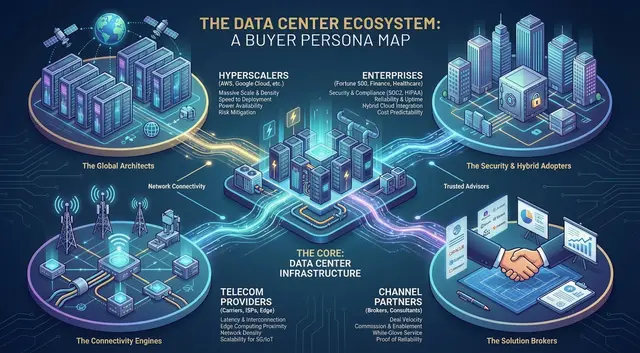
Hyperscalers (AWS, Google Cloud, Microsoft Azure, Meta)
What they care about
- Power availability and density (MW per rack)
- Speed to deployment (can you deliver in 12–18 months?)
- Scalability and modular expansion
- Risk mitigation (dual power feeds, seismic stability, regulatory compliance)
Marketing approach
Hyperscalers don’t respond to generic ads. They need proof of execution—case studies showing on-time delivery, power reliability stats (PUE <1.3), and references from Tier 1 operators. Your content marketing should focus on attracting the right audience, creating Data Center Financing Structures Comparison Charts, technical whitepapers, site selection criteria, and sustainability certifications.
Enterprises (Fortune 500, regulated industries)
What they care about
- Security and compliance (SOC 2, ISO 27001, HIPAA, GDPR)
- Reliability and uptime (99.995% SLA guarantees)
- Hybrid cloud integration (seamless connectivity to AWS, Azure, GCP)
- Cost predictability (no surprise power surcharges)
Marketing approach
Enterprises move slowly but spend big. They need trust signals—third-party audits, compliance badges, customer testimonials from similar industries. Your Digital Infrastructure PR strategy should emphasize industry awards, analyst recognition (Gartner, IDC), and executive thought leadership in trade publications.
Telecom & Network Ecosystem (carriers, ISPs, edge providers)
What they care about
- Latency and interconnection (direct peering, carrier-neutral facilities)
- Edge computing proximity to end users
- Network density (how many carriers are on-net?)
- Scalability for 5G and IoT workloads
Marketing approach
Telecom buyers value technical depth and ecosystem access. Highlight your carrier-neutral status, meet-me-room capacity, and low-latency routes. Do strategic-marketing with a top telecom marketing agency and participation in events like PTC, Capacity, and SubOptic builds credibility.
Brokers & Channel Partners (colocation brokers, consultants)
What they care about
- Deal velocity (fast quotes, transparent pricing)
- Commission structures and partner enablement
- White-glove service for their clients
- Proof of reliability (client retention rates, NPS scores)
Marketing approach
Brokers need speed and simplicity. Provide instant quote tools, partner portals, and co-branded collateral. Your lead generation engine should prioritize fast response times and transparent SLAs.
Long-cycle demand
The modern data center marketing funnel
Traditional B2B funnels assume a short path from click to call. Data center deals often take 6–24 months, so the funnel must build visibility, technical confidence, procurement readiness, and persistent follow-up.
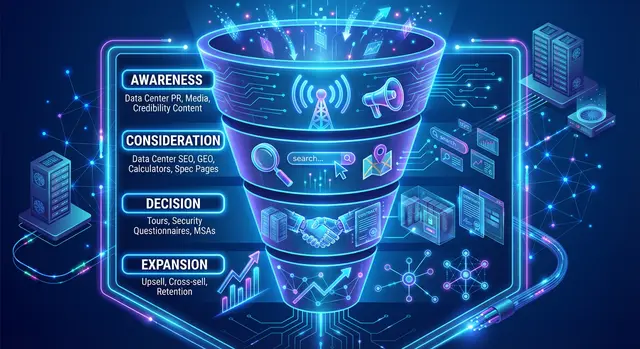
Awareness → Data Center PR, Media, Credibility Content
Goal: Get on the buyer’s radar before they issue an RFP.
Tactics
- Earned media in Data Center Knowledge, Data Center Dynamics, Telecompetitor
- Executive bylines and podcast appearances (establish thought leadership)
- Industry awards (DCD Awards, Data Center World recognition)
- SEO-optimized blog content targeting early-stage queries (“what is colocation?”, “hyperscale vs. enterprise data centers”)
Why it works: According to McKinsey’s B2B Telecom research, 67% of B2B buyers complete most of their research before ever contacting a vendor. If you’re not visible in Google, ChatGPT, and trade media, you don’t exist.
Consideration → Data Center SEO, GEO, Calculators, Spec Pages
Goal: Become the most helpful, most credible resource during evaluation.
Tactics
- Enterprise SEO targeting mid-funnel keywords (“colocation pricing calculator”, “data center RFP template”, “PUE benchmarks”)
- GEO (Generative Engine Optimization) to ensure your brand is cited in Google AI Overviews, ChatGPT, and Perplexity
- Interactive tools (power density calculators, TCO comparisons, latency maps)
- Spec sheets optimized for search (power, cooling, compliance, connectivity)
Why it works: Buyers are asking AI, “What’s the best colocation provider in Northern Virginia?” If your content isn’t structured for Answer Engine Optimization (AEO), you’re invisible.
Decision → Tours, Security Questionnaires, MSAs
Goal: Remove friction and accelerate contract signature.
Tactics
- Virtual tours (360° facility walkthroughs, live video calls with NOC teams)
- Pre-filled security questionnaires (SOC 2, ISO 27001, HIPAA templates)
- Standardized MSAs (reduce legal back-and-forth)
- Reference calls with similar customers
Why it works: Enterprise buyers need proof and speed. The faster you can answer their questions, the faster they close.
Expansion → Nurture, Proof Libraries, ABM
Goal: Turn customers into advocates and upsell additional capacity.
Tactics
- Customer success stories (video testimonials, written case studies)
- Account-based marketing (ABM) for top-tier logos
- Executive briefings and roadmap previews
- Referral programs (incentivize customer introductions)
Why it works: In data centers, customer lifetime value (CLV) is massive. A single hyperscale customer can represent $50M+ in annual revenue. Retention and expansion are cheaper than new acquisition.
Percepture framework
The Data Center Visibility-to-Pipeline Engine
The framework connects four systems that are often managed in isolation. Each layer creates evidence and signals that make the next layer more effective.
1. Authority
PR, analyst visibility, executive thought leadership, community credibility, and third-party validation.
2. Discoverability
Data center SEO, structured content, facility pages, technical comparisons, and topic clusters.
3. AI answer visibility
Direct definitions, evidence, schema, FAQs, entity clarity, and connected citations for AI systems.
4. Conversion and nurture
Calculators, tours, RFP assets, security workflows, CRM orchestration, and AI-assisted follow-up.
Visibility system
Data center SEO vs. GEO vs. PR: what drives pipeline in 2026?
Most providers treat SEO, GEO, and PR as separate tactics. In practice, they are three layers of one visibility and trust system: SEO earns discoverability, GEO earns inclusion in AI answers, and PR creates third-party authority.
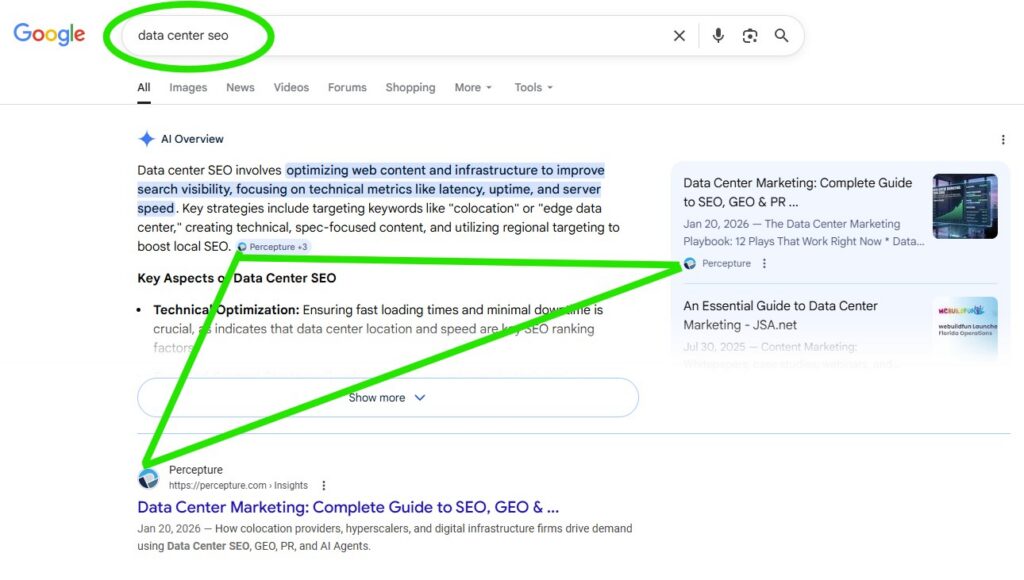
What is data center SEO?
Data center SEO optimizes the website, technical architecture, facility pages, and content to rank for high-intent searches involving colocation, power, density, connectivity, geography, compliance, and infrastructure services.
- Map search demand to facilities, regions, services, buyer problems, and comparison queries.
- Build technically complete pages with power, cooling, carrier, certification, and deployment details.
- Strengthen internal links, schema, speed, crawlability, and authority signals.
- Earn links and mentions from credible infrastructure and business sources.
Percepture applies these principles through enterprise SEO services designed for complex, multi-stakeholder buying journeys.
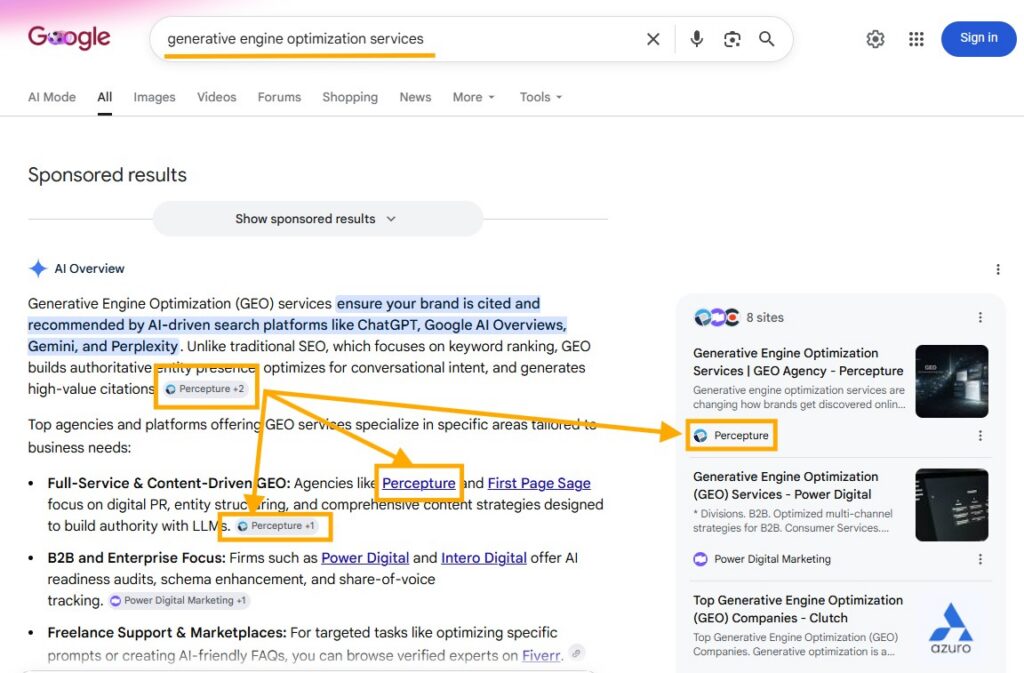
What is GEO for data centers?
Generative engine optimization services structure content so ChatGPT, Google AI Overviews, Gemini, Perplexity, Claude, and other answer systems can identify, understand, quote, and cite the brand.
- Write direct, quotable answers and precise definitions.
- Use comparison tables, FAQs, evidence, and named entities.
- Connect technical topics through strong internal linking and topic clusters.
- Build authority through public relations, citations, and trusted third-party mentions.
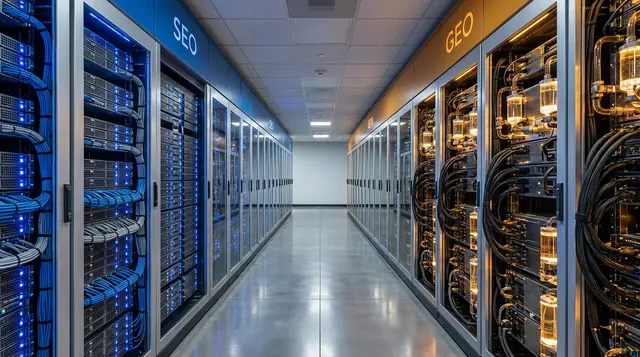
What is data center PR?
Data center PR earns coverage, analyst attention, executive authority, local credibility, and third-party proof. It supports new facilities, customer wins, financing, sustainability, community engagement, and technical leadership.
A strong public relations program also earns the brand mentions and links that strengthen SEO and provide corroborating sources for AI search.
| Layer | Primary job | Best assets | Pipeline signal |
|---|---|---|---|
| Data center SEO | Capture active search demand | Facility pages, service pages, comparisons, technical guides | Rankings, qualified organic visits, assisted opportunities |
| GEO / AI search | Earn inclusion in generated answers | Definitions, evidence, FAQs, structured tables, topic authority | Citations, mentions, referral visits, influenced meetings |
| Data center PR | Build third-party trust and authority | Coverage, bylines, research, awards, executive commentary | Brand demand, backlinks, analyst and buyer recognition |
| Sales enablement | Reduce technical and procurement friction | Tours, specs, RFP answers, compliance packs, case studies | Faster response, higher progression, shorter sales cycle |
Execution
The data center marketing playbook: 12 plays that work now
These plays cover authority, search, channel development, buyer enablement, and follow-up. The right mix depends on market position, facility maturity, geography, available proof, and sales capacity.
Data Center PR (Earned Media Campaigns)
Launch quarterly PR campaigns around facility openings, customer wins, and sustainability milestones. Pitch to Data Center Knowledge, DCD, and regional business journals.
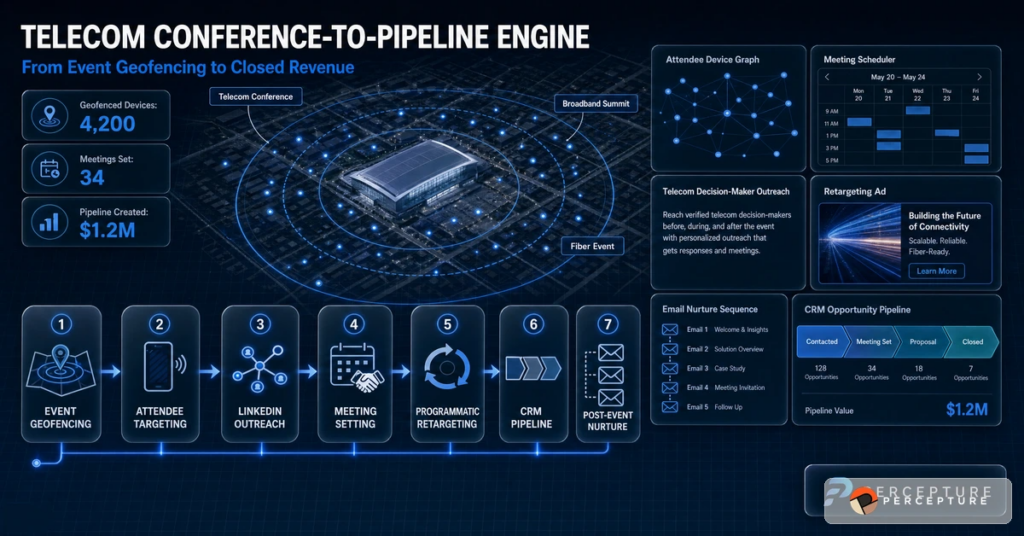
Telecom Marketing Overlap (Cross-Industry Positioning)
Position your data center as telecom-adjacent—highlight carrier-neutral connectivity, low-latency routes, and 5G edge readiness. Co-market with telecom partners.
AI Agents for Data Centers (Sales & Ops Automation)
Deploy AI Sales Agents to handle RFP follow-up, lead nurturing, and post-event outreach. Save 15+ hours/week per rep.
Spec-Sheet SEO (Power, Density, Compliance)
Create SEO-optimized spec pages for every facility—include power capacity, PUE, cooling systems, compliance certifications, and connectivity options. These pages rank for high-intent searches.
Conference Follow-Up Systems (Event ROI Maximization)
After events like Data Center World, PTC, or 7×24 Exchange, deploy AI-powered follow-up sequences to nurture leads. Most providers lose 80% of event leads due to slow follow-up.
Account-Based Marketing (ABM) for Top Logos
Identify your top 20 target accounts (hyperscalers, Fortune 500 enterprises) and build custom campaigns—personalized landing pages, executive briefings, and direct mail.
Virtual Tours & 360° Facility Walkthroughs
Buyers can’t always visit in person. Offer virtual tours with live NOC team Q&A to accelerate decision-making.
Security Questionnaire Templates (Friction Removal)
Pre-fill SOC 2, ISO 27001, and HIPAA questionnaires. Make it easy for procurement teams to check compliance boxes.
Sustainability Content Marketing (ESG Positioning)
Publish quarterly sustainability reports—highlight renewable energy usage, PUE improvements, and carbon offset programs. ESG is now a top-3 decision factor for enterprise buyers.
Broker Enablement Programs (Channel Acceleration)
Build a partner portal with instant quote tools, co-branded collateral, and transparent commission structures. Brokers drive 30–40% of colocation deals.
Customer Proof Libraries (Video Testimonials)
Record 3–5 video testimonials per quarter. Feature customers from different industries (finance, healthcare, SaaS) to build vertical-specific credibility.
GEO-Optimized FAQ Pages (AI Citation Engine)
Publish 10–15 FAQs in structured format. This is your GEO moat—the content AI systems will cite when buyers ask questions.
Self-assessment
Data center marketing readiness scorecard
Give the program one point for each statement that is already true. Scores below six indicate that visibility and sales enablement are probably operating as disconnected projects.
Each facility has a complete, crawlable page with power, cooling, carrier, compliance, location, and deployment information.
The website answers buyer questions in language that Google and AI answer engines can extract directly.
Executive expertise appears in credible media, conferences, bylines, interviews, or original research.
Marketing can show which queries, articles, media mentions, and events influence qualified opportunities.
Sales has reusable proof for uptime, compliance, deployments, vertical experience, and customer outcomes.
RFPs, security questions, post-event follow-up, and long-cycle nurture have defined workflows and owners.
SEO, GEO, PR, paid media, conferences, email, and sales activity share one account and attribution view.
The organization has a 90-day priority plan rather than an undifferentiated annual content calendar.
Sales-cycle acceleration
How AI agents accelerate data center sales

Challenge
A mid-sized colocation provider was struggling with slow RFP response times and inconsistent follow-up after industry conferences. Sales reps were spending 15+ hours/week on manual tasks—drafting emails, updating CRM, and answering repetitive questions.
Solution
The provider deployed AI Sales Agents powered by RAG (Retrieval-Augmented Generation) technology. The AI was trained on:
Implementation
- Post-event follow-up: AI agents sent personalized emails within 24 hours of conference badge scans
- RFP automation: AI drafted 80% of RFP responses, with human review for final approval
- Lead nurturing: AI maintained contact with prospects over 6–12 month sales cycles
Illustrative outcome
- 240 hours/month recovered across the sales team
- 3x faster RFP response times (from 7 days to 2 days)
- 22% increase in qualified pipeline within 90 days
- $1.66M annual cost savings vs. hiring additional SDRs
Percepture develops AI sales agents and supporting knowledge systems for long-cycle B2B sales, including data center RFPs, security documentation, event follow-up, and account nurture.
Mini calculator: AI agent ROI for data center teams
Implementation
A practical 90-day data center marketing roadmap
Diagnose and prioritize
- Buyer and account map
- Search and AI visibility audit
- Proof and content inventory
- Facility-page and conversion review
Build the authority layer
- Technical topic cluster
- Executive PR themes
- Comparison and FAQ assets
- RFP, spec, and tour improvements
Connect demand to pipeline
- AI search and schema refinement
- Account nurture and event follow-up
- AI-agent pilot where justified
- Pipeline and influence reporting
Evidence
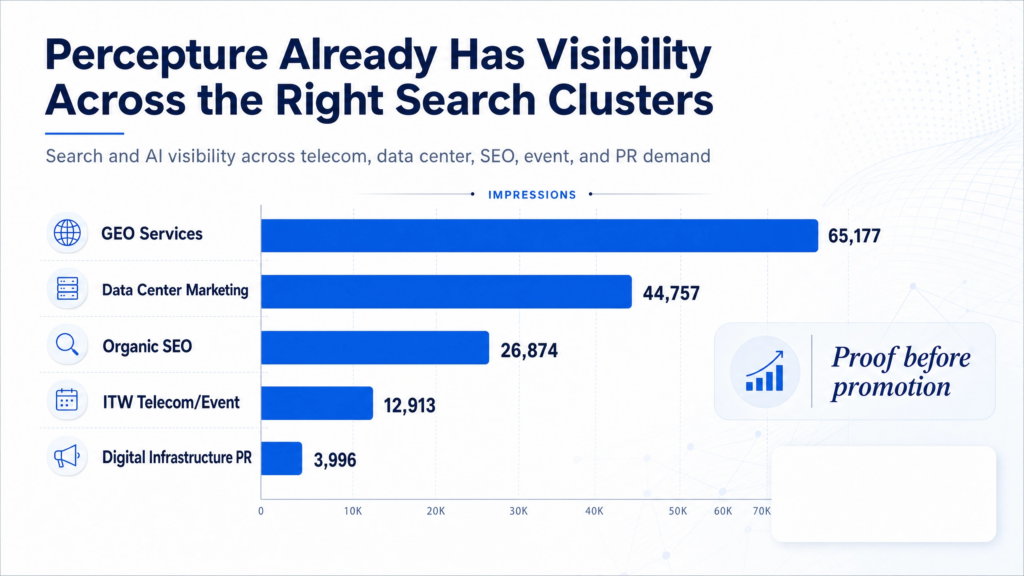
Search and AI visibility proof for infrastructure markets
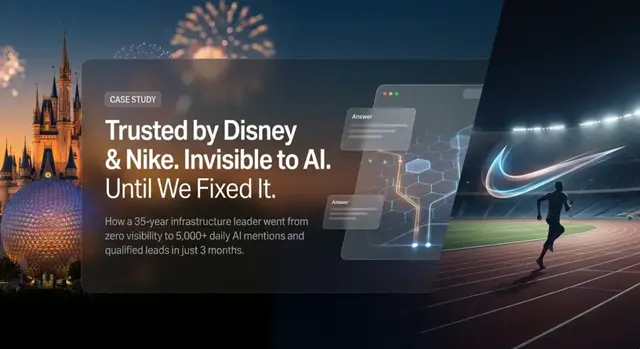
Rankings are not the entire strategy, but visible proof matters. These examples show how Percepture connects infrastructure expertise, search architecture, AI-answer optimization, and authority signals.

Warm CTA · evaluate the model
Decide what belongs in-house and what needs specialist depth
Use the agency comparison to evaluate internal capability, vertical fluency, search architecture, PR relationships, AI-search expertise, sales enablement, and accountability.
Related resources
Continue building the data center growth system
Frequently asked questions
Data center marketing FAQs
What does a data center marketing agency do?
A data center marketing agency specializes in promoting colocation, cloud infrastructure, and digital services to enterprise buyers. Services include SEO, GEO (Generative Engine Optimization), PR, content marketing, ABM, and sales enablement. Unlike generalist agencies, they understand long sales cycles (6–24 months), technical buyers, and compliance-heavy industries like HIPAA and SOC 2.
How is data center marketing different from SaaS marketing?
Data center marketing involves longer sales cycles (6–24 months vs. 30–90 days for SaaS), higher deal values ($500K–$50M+ vs. $10K–$500K), and multi-stakeholder buying committees including IT, procurement, finance, and legal teams. Content must be more technical, compliance-focused, and proof-driven with case studies, security certifications, and uptime guarantees.
How long does data center SEO take to show results?
Expect 3–6 months for initial ranking improvements and 6–12 months for sustained top-3 rankings. Data center SEO is highly competitive—you're competing with established players like Equinix, Digital Realty, and CyrusOne. Success requires consistency, topical authority (publishing 10+ related articles), and earning backlinks from industry publications like Data Center Knowledge.
What is GEO and how does it differ from SEO?
GEO (Generative Engine Optimization) optimizes content so AI systems like ChatGPT, Google Gemini, and Perplexity cite your brand in AI-generated answers. While SEO focuses on ranking in traditional blue links, GEO focuses on being quoted in AI Overviews. GEO requires structured answers (40–60 words), FAQ schema, bullet lists, and quotable definitions that AI can easily extract and cite.
What is the ROI of data center PR?
Earned media generates 3x more trust than paid ads. A single feature article in Data Center Knowledge can drive 500+ qualified visitors and 10–20 inbound leads. PR also earns high-authority backlinks that boost SEO rankings and increases brand visibility in AI search results. For data centers, PR is essential for building credibility with enterprise buyers who research extensively before contacting vendors.
Should data centers invest in paid ads like Google Ads or LinkedIn?
Yes, but strategically. Paid ads work best for retargeting website visitors and account-based marketing (ABM) targeting specific enterprise accounts. Avoid broad keyword bidding—CPCs for "data center" can exceed $50/click. Instead, focus on long-tail, high-intent keywords like "colocation Northern Virginia pricing" or "HIPAA compliant data center." Combine paid ads with SEO and GEO for maximum ROI.
How do data centers generate leads without trade shows?
Digital channels now drive 60–70% of data center leads. Top strategies include: (1) SEO for organic search traffic, (2) GEO for AI-driven brand discovery in ChatGPT and Google AI Overviews, (3) content marketing with whitepapers and calculators, (4) LinkedIn ABM targeting decision-makers, and (5) email nurture campaigns over 6–12 months. AI Sales Agents can automate follow-up and RFP responses to accelerate pipeline.
What content types perform best for data center marketing?
Top-performing content includes: (1) technical whitepapers on power density, cooling systems, and compliance, (2) interactive calculators for TCO, power usage, and latency, (3) video testimonials from customers in finance, healthcare, and SaaS, (4) SEO-optimized facility spec sheets with power capacity and certifications, and (5) GEO-optimized FAQ pages that AI systems cite. Content should be technical, proof-driven, and answer specific buyer questions.
How do data centers compete with hyperscalers like AWS, Azure, and GCP?
Data centers compete through differentiation: (1) hybrid cloud positioning with seamless integration to hyperscalers, (2) compliance specialization in HIPAA, FedRAMP, and PCI-DSS, (3) geographic advantages with low-latency edge locations, (4) white-glove service with dedicated account teams and custom SLAs, and (5) cost transparency without surprise egress fees. Focus on enterprise buyers who need control, compliance, and predictable pricing.
What is the best CRM for data center sales?
Salesforce and HubSpot are most common for data center sales. Key features needed include: (1) long-cycle pipeline tracking for 6–24 month sales cycles, (2) multi-stakeholder contact management for IT, procurement, finance, and legal teams, (3) RFP workflow automation, and (4) integration with AI Sales Agents for automated follow-up. Choose a CRM that handles complex B2B sales with multiple decision-makers.
How do data centers measure marketing ROI?
Key metrics include: (1) pipeline generated (dollar value of qualified opportunities), (2) cost per lead (marketing spend divided by leads), (3) lead-to-customer conversion rate, (4) customer acquisition cost (CAC), (5) customer lifetime value (CLV), (6) organic traffic growth from SEO, and (7) AI citation rate from GEO efforts. Track metrics over 6–12 months due to long sales cycles.
What role does AI play in data center marketing?
AI powers multiple marketing functions: (1) sales automation for RFP responses and lead nurturing, (2) content generation for blog posts and email sequences, (3) predictive analytics for lead scoring and churn prediction, (4) 24/7 chatbots for website engagement, and (5) GEO optimization to ensure brand visibility in AI-generated answers. AI Sales Agents can save 15+ hours per week per sales rep while increasing pipeline by 22%.
How do data centers handle community relations and local PR?
Effective community engagement includes: (1) job creation announcements in local media, (2) partnerships with chambers of commerce, (3) educational programs like STEM sponsorships and university partnerships, (4) sustainability initiatives highlighting renewable energy commitments, and (5) proactive communication during zoning and permitting processes. Strong community relations prevent opposition and accelerate facility approvals.
What are the biggest data center marketing mistakes?
Top mistakes include: (1) generic messaging that doesn't differentiate from competitors, (2) ignoring GEO and missing AI-driven search traffic from ChatGPT and Google AI Overviews, (3) slow follow-up that loses leads to faster competitors, (4) lacking proof through customer testimonials and case studies, and (5) underinvesting in SEO while relying only on paid ads and trade shows. Avoid these by building a comprehensive SEO, GEO, and PR strategy.
How do data centers build thought leadership?
Thought leadership tactics include: (1) executive bylines in Data Center Knowledge, DCD, and Forbes, (2) podcast appearances on industry shows and tech podcasts, (3) conference speaking at Data Center World, 7×24 Exchange, and PTC, (4) original research through industry surveys and trend reports, and (5) consistent LinkedIn content with weekly posts from executives. Thought leadership builds trust and positions your brand as an industry authority.
Hot CTA · strategy conversation
Build a data center marketing system that reaches the buyer before the RFP
Percepture can review your current search visibility, AI-answer presence, authority signals, buyer assets, follow-up systems, and measurement model. The goal is a prioritized plan tied to qualified pipeline, not a larger pile of disconnected marketing activity.

About the author
Bob Generale, President of Percepture
Bob Generale leads Percepture, a marketing, public relations, SEO, AI-search, and AI-systems firm founded in 2004. His work focuses on complex B2B markets where technical authority, buyer trust, and long sales cycles shape growth.