
Data center lead generation is the system that turns a short list of high-fit accounts into meetings—by showing up in the research phase, building trust fast, and staying present across the channels buyers actually use. In 2026, most decisions will happen before a buyer ever fills out a form. Data Center marketing and PR is simple: be the answer in search, be credible in the press, and be visible to the exact people who matter.
As a telecom marketing and PR agency, we are also seeing what the data tells us: Gartner found 61% of B2B buyers prefer a rep-free buying experience, and 73% actively avoid suppliers who send irrelevant outreach. Meanwhile, Demand Gen Report found that buyers are nearly 70% through the journey before engaging with sellers, and 80% of the time, buyers initiate first contact. That means lead gen isn’t “more outreach.” It’s more proof—delivered earlier.
Definition
“What is data center lead generation?”
Data center lead generation is the system that turns a shortlist of high-fit accounts into qualified meetings by building trust and visibility across search, AI engines, press, and targeted advertising. In 2026, most buying decisions happen before a prospect fills out a form, so effective lead gen focuses on being the answer during the research phase.
Process
“How does data center lead generation work in 2026?”
Modern data center lead gen works through five integrated channels: SEO captures demand when buyers search, GEO ensures AI engines recommend you, digital PR builds credibility, programmatic ABM targets exact accounts, and LinkedIn reinforces your message. The system creates repetition and trust across every surface buyers use to research vendors.
The Revenue Engine (5 Channels)
If you can’t explain lead gen in a CFO meeting, it’s not a system yet.
Most data center operators and data center marketing agencies treat lead generation like a collection of tactics—some Enterprise SEO here, a few LinkedIn ads there, maybe a press release when something big happens. But high-value accounts don’t respond to scattered efforts. They respond to systems that create trust, visibility, and repetition across every channel they use to research vendors. Which channels do they use, and how can I turn them into a revenue engine?
The Revenue Engine is a five-channel framework designed to control the shortlist before the RFP ever gets written. It’s built for CFOs and VPs who need pipeline math, not marketing theater.
Channel 1 — SEO (Trusted Demand Capture)
SEO wins because the buyer chose the click. (In reality, GEO will win in 2026)
When someone searches “data center colocation pricing” or “hyperscale infrastructure providers,” they’re raising their hand. Your job is to answer what they’re asking—clearly—and show proof. That means creating pages that directly address buyer questions, not generic service descriptions.
As a leading enterprise SEO agency, we’ve seen that the data centers ranking in the top three spots for buyer-intent keywords capture 60%+ of qualified traffic. The ones on page two? Less than 3% will go to page two..
The fix: Build “money pages” around the exact questions buyers ask Google. Structure them with tables, FAQs, and schema markup so AI engines can extract and quote your answers.
Channel 2 — GEO (AI Search = The New “Word of Mouth”)
AI search is a digital version of asking a smart colleague, “Who’s legit?” That’s why 27 out of every 100 people who find you via AI will book a meeting, versus only 2 out of 100 from traditional marketing.
Here’s the nuance most agencies won’t tell you: LLM traffic is still small compared to Google in many datasets, and conversion findings are mixed. One e-commerce study summarized by Search Engine Land found ChatGPT referrals were a tiny share of sessions and often converted worse than organic search.
At the same time, other datasets show AI referrals can be more engaged in some contexts. Adobe reported lower bounce rates for AI referrals versus non-AI referrals, and conversion differences narrowed in early 2025.
The takeaway: Don’t bet the company on AI traffic volume yet. Do bet on AI visibility because it influences who makes the shortlist.
When a VP asks ChatGPT or Perplexity, “Which data center providers have the best uptime SLAs?” you want to be in that answer. That requires structured content, authority citations, and telecom AI search services and strategies that make your expertise extractable.
Lead generation for data centers (without paying LinkedIn to do all the work)
Most data center providers aren’t trying to “get more leads.” They’re trying to get the right accounts: hyperscalers, AI infrastructure teams, network-heavy enterprises, and the partners that unlock power, land, and build speed. We build a revenue engine that makes your company show up early (SEO + AI search), look credible (digital PR), and stay present to the exact people who matter (programmatic ABM + LinkedIn retargeting).
Channel 3 — Digital PR (Trust + Authority + “Citation Gravity”)
Major media placements aren’t “vanity.” They’re modern trust assets.
In 2026, big publications function like the new version of backlinks. Not because Google has a “DA” switch—but because high-authority domains get repeated, referenced, and surfaced across search, news, and AI answers.
When your data center gets featured in Data Center Dynamics, TechCrunch, or The Wall Street Journal, three things happen:
- Google sees authority signals that boost your domain’s trust score
- AI engines cite you as a credible source in synthesized answers
- Buyers recognize your name before they ever visit your website
We’ve seen this firsthand with our digital PR services. A single placement in a tier-one publication can generate 10-15 secondary pickups, creating a “citation gravity” effect that compounds over months.
Channel 4 — Programmatic ABM (Reach the Exact People)
Instead of buying “roles,” you buy reach to named accounts.
Here’s the problem with most B2B advertising: you’re paying LinkedIn $15-$30 per click to reach “VP of IT” at “companies with 500+ employees.” That’s expensive guesswork.
Programmatic ABM flips the model. You use verified business datasets to target the exact companies and decision-makers across trusted sites and apps—then you retarget on LinkedIn. That’s how you reduce wasted impressions and stop paying LinkedIn to do all the heavy lifting.
In practice, this looks like:
- Weeks 1-2: Upload your target account list (50-200 companies)
- Weeks 3-6: Serve display ads across 500M+ websites and apps where your buyers actually spend time
- Weeks 7-12: Retarget engaged accounts on LinkedIn with proof-based content (case studies, ROI calculators, technical whitepapers)
The result? You’re visible to the right people, in the right context, at a fraction of LinkedIn’s cold-reach cost.
Channel 5 — LinkedIn (Proof + Consensus + Retargeting)
LinkedIn is expensive for cold reach, but powerful for reinforcement.
Once someone has seen your brand three or four times—through search, press, or programmatic ads—LinkedIn becomes the place to close the loop. That’s where you share executive POV, customer success stories, and social proof that builds consensus within buying committees.
The key is using LinkedIn for retargeting, not prospecting. When you combine programmatic media buying with LinkedIn retargeting, your cost per qualified meeting drops by 40-60% compared to LinkedIn-only campaigns.
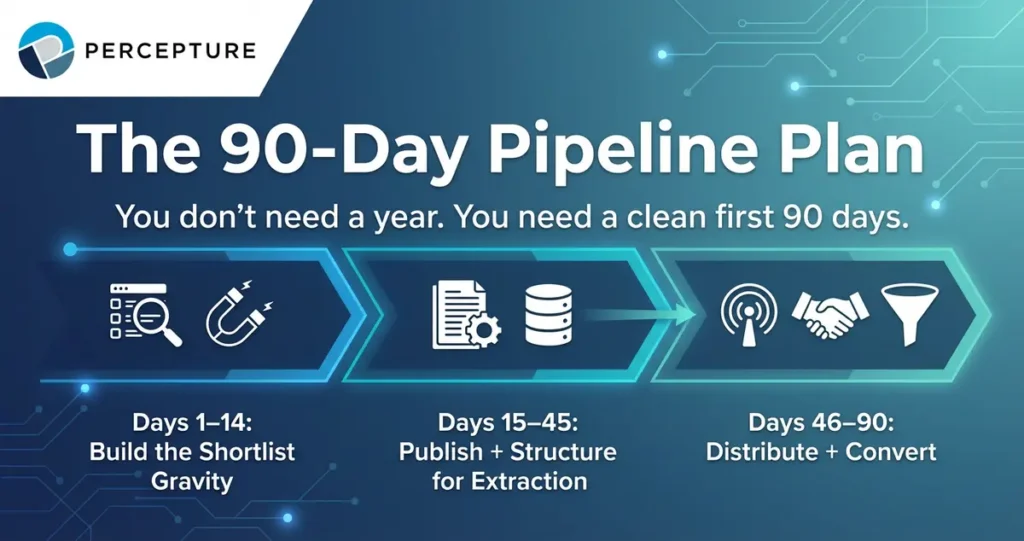
The 90-Day Pipeline Plan (Built for High-Value Accounts)
You don’t need a year. You need a clean first 90 days.
Most data center marketing plans are built for “brand awareness” or “thought leadership”—vague goals that don’t move pipeline. The 90-day plan is different. It’s designed to generate qualified meetings from a shortlist of high-fit accounts in three months or less.
Days 1–14: Build the “Shortlist Gravity”
Deliverables:
- ICP + target account list: Identify 50-200 companies that match your ideal customer profile (revenue, industry, growth stage, infrastructure needs)
- Proof library: Compile your SLA guarantees, security certifications, customer outcomes, and expansion stories into shareable assets
- “Buyer question map”: Document 50 questions buyers ask AI and Google (e.g., “What’s the average cost per rack in a Tier III facility?” or “How do I evaluate colocation vs. hyperscale?”)
This phase is about clarity. You can’t dominate a shortlist if you don’t know who’s on it or what they’re asking.
Days 15–45: Publish + Structure for Extraction
Deliverables:
- 3–5 “money pages”: Each page answers a high-intent buyer question with depth, proof, and clear CTAs
- Tables, checklists, FAQs: Structure content so AI engines can quote you directly in synthesized answers
- Internal linking: Route visitors from educational content to conversion pages (“book a tour,” “request a quote,” “download our infrastructure guide”)
This is where b2b content marketing services meet technical SEO. Every page should be optimized for both human readers and machine extraction.
Days 46–90: Distribute + Convert
Deliverables:
- Digital PR placements: Secure 2-3 industry or major media placements with backlinks to your core pages
- Programmatic ABM flight: Launch targeted display campaigns to your named account list
- LinkedIn retargeting + exec posts: Amplify reach with retargeting ads and executive thought leadership
- Auto-nurture sequences: Deploy AutoNURTURE™ or similar AI-driven systems to follow up with engaged accounts automatically
By day 90, you should have:
- 10-20 qualified meetings booked
- 3-5 active RFPs or technical evaluations
- Measurable pipeline created per dollar spent
Landscape Domination = Controlling the Shortlist Across Google + AI + Press
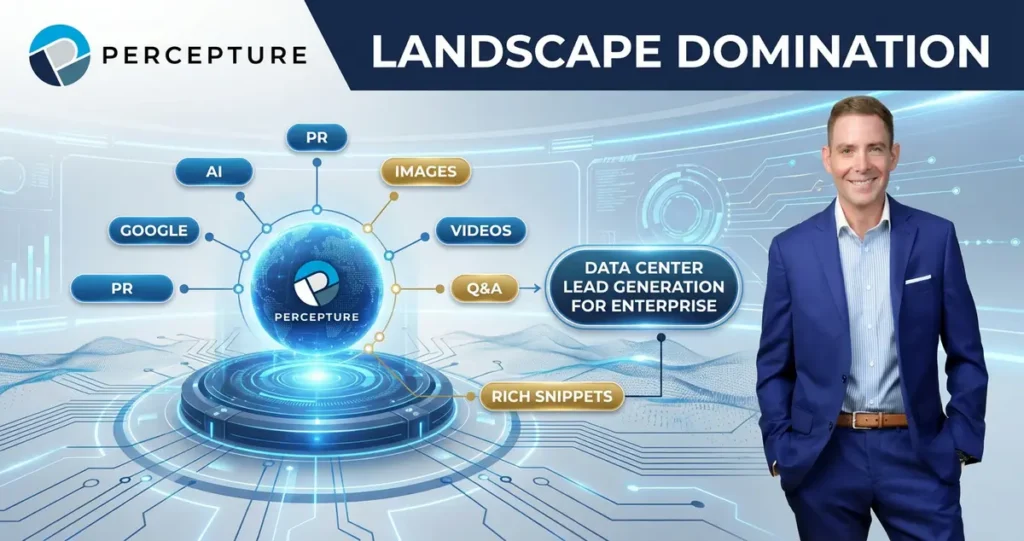
The goal isn’t more traffic. It’s more “yes, I’ve heard of you.”
Landscape domination means owning the research phase across every surface where buyers make decisions. Here’s what that looks like in practice:
| Surface | What Buyers See | What We Build |
|---|---|---|
| Rankings + snippets | Buyer question pages + schema | |
| AI Search | Synthesized recommendations | Structured answers + authority citations |
| Press | Credibility cues | Industry + major placements |
| Social proof | Exec POV + retargeting | |
| Retargeting | Repetition | Programmatic + LinkedIn |
When a buyer sees your name in a Data Center Knowledge article, then finds your page ranking #1 for their search query, then sees your ad on LinkedIn, then gets a personalized follow-up email—that’s not luck. That’s a system.
Lead Seeker: $1/contact — with the context your reps wish they had
Most prospecting tools give you names. Lead Seeker gives you the person + the play. For about $1 per contact, we build a high-fit list and enrich each target with role context, a quick “dossier” summary, and positioning guidance your team can use immediately — so outreach sounds like you actually understand the job, not like you bought a list.
Proof That Optimization + Distribution Saves Money
Most “lead gen problems” are budget allocation problems.
Here’s a real example from our work: Percepture’s client campaign was able to 3x an ISP’s leads in 30 days with the same ad spend budget, north of $100,000 a month in ad spend. We generated nearly 5 million impressions, 22,000+ clicks, and achieved 60% improved cost efficiency over prior campaigns within the first ~100 days. The other telecom marketing agency has a stronger PR discipline and not a lot of online lead generation experience.
The difference? We didn’t just “run ads.” We built a system:
- SEO-optimized landing pages that converted at 3x the industry average
- Programmatic ABM that targeted only high-fit accounts
- LinkedIn retargeting that reinforced brand presence without wasting cold-reach budget
- Auto-nurture sequences that followed up with engaged prospects automatically
The result: more pipeline, lower cost per meeting, and a repeatable playbook the client could scale.
Auto-Nurture + AI Agents (Your “Capacity Multiplier”)
People don’t ignore follow-up because they don’t care. They ignore it because they’re buried.
The average data center buyer is evaluating 3-5 vendors simultaneously, fielding dozens of emails per week, and juggling internal stakeholders with conflicting priorities. Your follow-up email isn’t ignored because it’s bad—it’s ignored because it’s email #47 that day.
That’s where AI agents and auto-nurture systems come in. Here’s how they work:
- Auto-nurture for warm accounts: Behavior-based follow-up triggered by specific actions (e.g., downloaded a whitepaper, visited pricing page, attended a webinar)
- AI outreach agent for scale: Automated email and LinkedIn touchpoints that feel personalized because they’re based on real engagement data
- Human approval loop: Every message is reviewed and approved by your team before it goes out, keeping it safe and on-brand
In our work with lead generation services, we’ve seen auto-nurture systems increase meeting conversion rates by 40-60% compared to manual follow-up alone.
AutoNurture: show up where your buyers already spend time
Most data center deals aren’t lost because you didn’t reach enough people — they’re lost because the right people didn’t see you often enough in the places they already trust. AutoNurture combines buyer-question content, programmatic account targeting using verified business profiles, and smart follow-up so your brand stays present across industry sites, finance environments, and the channels your buyers naturally visit — then we reinforce it with LinkedIn retargeting.
The One Tool You Should Ship on This Page
Tool: Data Center Lead Gen ROI + “Shortlist Probability” Calculator
A simple interactive tool that makes the post “sticky” and earns shares.
Inputs (fast):
- Average deal size (ARR or total contract value)
- Close rate
- Sales cycle length
- Target accounts per quarter
- Current CPL / CPA (or spend + leads)
- Current share of voice (Google + AI + press mentions)—even if self-estimated
Outputs (what CFOs care about):
- Pipeline ROI model: Expected pipeline created per $1 spent
- Payback window: Estimated months to recover spend
- Shortlist Probability score (0–100): Based on whether you have:
- Top 10 Google visibility on buyer-intent terms
- Structured “AI-answerable” pages
- Authority placements
- ABM reach to named accounts
- Retargeting + nurture in place
- Action checklist: The 10 fixes that move the score fastest
Why this tool helps SEO + GEO: It makes your page a destination, not a blog post. People link to tools. AI engines cite tools. And CFOs share tools that help them justify budget.
Data Center Growth Model
Adjust inputs to see how “Shortlist Visibility” impacts pipeline velocity.
Build Your Shortlist Probability
- Select items on the left to see gaps.
The Only Lead Gen KPIs That Matter
If it doesn’t move pipeline, it’s a distraction.
Here’s the scoreboard we use with every data center client:
| KPI | What It Measures | Target Benchmark |
|---|---|---|
| Cost per qualified meeting | Total spend ÷ meetings booked | $500–$1,500 (varies by deal size) |
| Cost per tour / technical deep dive | Spend ÷ on-site evaluations | $2,000–$5,000 |
| Time-to-first meeting | Days from first touch to meeting | 14–45 days |
| Pipeline created per $1 spent | Total pipeline value ÷ marketing spend | 3:1 to 6:1 |
| Share of voice (Google + AI + press) | % of top 10 rankings + citations | 20%+ in your category |
| Nurture conversion rate (engaged → meeting) | Meetings ÷ engaged accounts | 10–20% |
These are the numbers that matter in a CFO meeting. Everything else is noise.
Frequently Asked Questions: Data Center Lead Generation (2026)
What is data center lead generation?
Data center lead generation is the system used to turn a small list of high-fit enterprise accounts into qualified meetings by building visibility, credibility, and repetition across search, AI engines, press, and account-based channels. It focuses on influencing buyers before an RFP is issued.
How is data center lead generation different from traditional B2B lead generation?
Traditional B2B lead generation prioritizes volume and form fills. Data center lead generation prioritizes shortlist visibility, technical trust, and buying-committee alignment—often months before a prospect engages with sales.
Why don’t forms work for enterprise data center deals anymore?
Enterprise buyers now complete most of their research before contacting vendors. Gartner reports that a majority of B2B buyers prefer a rep-free buying experience, meaning lead generation must happen during the research phase—not at the point of conversion.
What channels drive the best data center leads in 2026?
The most effective channels are SEO for buyer-intent searches, AI Search (GEO) for shortlist influence, digital PR for credibility, programmatic ABM for precise reach, and LinkedIn for retargeting and consensus building.
How does AI search impact data center lead generation?
AI search acts as a modern version of word-of-mouth. When buyers ask tools like ChatGPT or Perplexity which providers are credible, companies with structured content, authority citations, and consistent visibility are recommended more often.
What is GEO and why does it matter for data centers?
GEO (Generative Engine Optimization) ensures your expertise can be extracted, summarized, and cited by AI systems. In high-value data center deals, GEO influences who makes the shortlist—even if AI traffic volume is still smaller than Google.
How long does it take to generate pipeline from data center SEO?
When buyer-question pages are structured correctly, SEO can begin influencing pipeline within 60–120 days. The impact compounds as authority, press citations, and AI visibility increase.
What content converts enterprise data center buyers best?
High-performing content includes pricing explanations, technical comparisons, SLAs, security certifications, latency data, case studies, and ROI calculators—especially when structured for both humans and AI engines.
What is programmatic ABM and why is it better than LinkedIn alone?
Programmatic ABM targets exact companies across trusted sites and apps using verified datasets. LinkedIn is then used for retargeting. This approach reduces wasted spend and lowers cost per qualified meeting compared to LinkedIn-only campaigns.
How many target accounts should a data center focus on?
Most high-value data center campaigns perform best with 50–200 named accounts. Fewer accounts allow for deeper personalization, better proof alignment, and stronger shortlist control.
What metrics matter most for data center lead generation?
The most important metrics are cost per qualified meeting, pipeline created per dollar spent, time-to-first meeting, shortlist visibility, and nurture-to-meeting conversion rate. Traffic alone is not a meaningful KPI.
How do digital PR placements impact lead generation?
Digital PR placements act as trust multipliers. They improve domain credibility, increase AI citation likelihood, and make buyers recognize your name before they ever visit your website or book a meeting.
How does lead generation support RFP and procurement success?
Effective lead generation ensures your brand is already trusted before procurement engages. When evaluators recognize your name, pricing and technical reviews move faster and with less friction.
Can data center lead generation work without cold outreach?
Yes. In many enterprise campaigns, inbound research visibility plus ABM retargeting generates meetings without traditional cold outreach. Outreach becomes warmer, more contextual, and better received.
What is the biggest mistake data centers make with lead generation?
The biggest mistake is treating lead generation as a collection of tactics instead of a system. Scattered SEO, ads, or PR without coordination rarely influence enterprise buying decisions.
What does a strong 90-day data center lead generation plan look like?
A strong 90-day plan includes shortlist definition, proof asset creation, buyer-question content, AI-optimized structure, targeted ABM distribution, digital PR, and automated nurture—measured by meetings booked and pipeline created.
Video Transcript
Data Center Lead Generation: The 2026 Framework
Data center lead generation is not about running ads.
It is about influencing the research phase before the RFP ever drops.
Enterprise buyers research for months before they talk to sales. They compare uptime history, latency, interconnection density, compliance certifications, and ecosystem partnerships.
If your data center is not showing up in search, AI Overviews, industry media, and analyst mentions, you are invisible.
Most providers waste budget on brand awareness. But infrastructure buyers do not buy based on impressions. They buy based on proof.
A modern data center marketing strategy has four parts.
- First: Presence. Be visible where network engineers and executives validate expertise.
- Second: Proof. Publish technical content that shows performance, not slogans.
- Third: Precision. Structure your content for Google and AI search engines so it gets cited.
- Fourth: Propagation. Turn customers and partners into distribution channels.
This is how you build trust before procurement starts. Because in digital infrastructure, the company that educates first earns trust first.
And the company that earns trust first wins the shortlist.