

SEO for construction companies works best when technical performance, buyer-focused content, internal linking, digital PR, and conversion design work as one system. The goal is not traffic for its own sake. The goal is to help owners, developers, engineers, procurement teams, and private equity sponsors find and trust your firm before a bid begins.
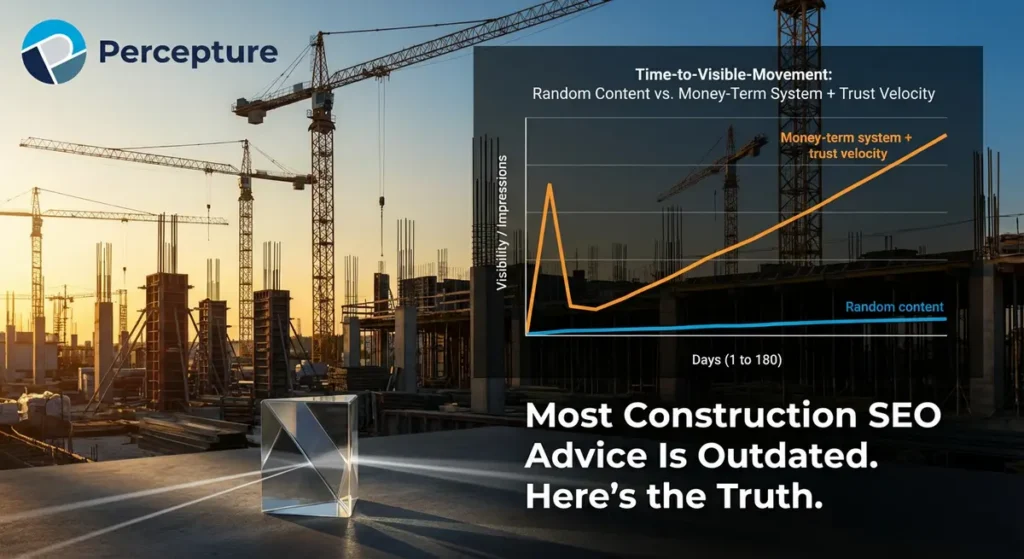
Most construction firms are told to wait six months before expecting progress. That is too broad. A technically sound site with relevant authority can show movement within days on lower-difficulty terms, while harder commercial terms usually require deeper content, proof, and outside trust signals. Percepture uses forecasting to separate quick wins from long-term targets.




Direct answer
What is SEO for construction companies?
SEO for construction companies is the process of making a contractor, design-build firm, EPC company, architect, engineer, or specialty trade easier to find and trust in Google and AI search. It combines technical SEO, service pages, project proof, local relevance, internal links, digital PR, structured data, and conversion design.
Executive summary
What construction leaders should know
Who this guide is for
Built for firms selling complex construction work
This guide is designed for commercial general contractors, design-build firms, EPC companies, specialty contractors, prefabrication and modular firms, data center builders, life sciences construction teams, architects, engineers, and construction technology companies.
It is also useful for marketing leaders at private equity-backed construction businesses that need a repeatable growth system across several markets or portfolio companies.
Most construction SEO advice is incomplete
Traditional advice says to publish often and wait. That is not wrong, but it leaves out the factors that decide whether a page can rank, whether the right buyer sees it, and whether the visit creates a real opportunity.
Construction SEO should start with commercial intent. A ranking for a broad informational phrase may produce attention, but a ranking for a service, location, facility type, compliance need, or delivery model can produce a bid conversation.
Cold CTA
Get a construction SEO forecast before you commit budget
Choose three commercial terms you want to win. Percepture can review the search results, authority gap, content coverage, and conversion path, then show the likely work required.
Construction SEO is different because the buyer is not one person
A construction project is often approved by a committee. Each person searches differently and needs different evidence. Your content architecture should mirror that buying process.
| Buyer | Main concern | Typical search intent | Content that builds trust |
|---|---|---|---|
| Owner or developer | Cost overruns, schedule delays, reputation | Design-build contractor, EPC firm, project delivery partner | Case studies, schedule proof, risk controls, leadership credibility |
| GC or EPC team | Capacity, safety, coordination, delivery certainty | MEP prefabrication, specialty contractor, modular partner | Technical service pages, safety record, workforce and capacity proof |
| Engineer or architect | Specification mismatch, technical failure, compliance | DFMA methods, standards, commissioning, engineering support | Detailed methods, standards, drawings, technical FAQs |
| Procurement or compliance | Vendor risk, paperwork gaps, audit exposure | Certified contractor, bonding, OSHA record, insurance | Certifications, documentation, governance and vendor-readiness pages |
| Private equity sponsor | Growth, governance, reporting, exit readiness | Construction platform growth, contractor risk, regional expansion | Market visibility, reporting, pipeline quality, repeatable growth systems |
The content plan should include role-specific service pages, proof pages, and technical resources. Percepture’s content marketing services help organize that information around the buyer, while the guide to content marketing for construction shows how to turn field expertise into useful search assets.
The Percepture Construction Search Forecast Engine
SEO is not perfectly predictable, but it is not random. A useful forecast starts with four inputs that can be measured and improved.
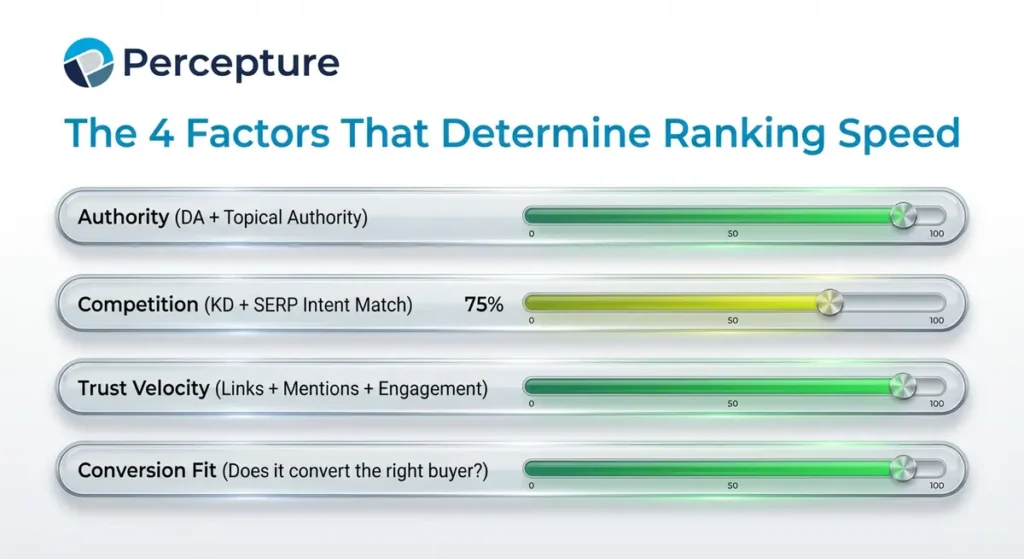
The DA and keyword-difficulty planning rule
As a starting heuristic, a site can often compete more efficiently when keyword difficulty is near or below its authority level. A site with a Domain Authority of 24 may have a better early opportunity at KD 18 than at KD 48.
Percepture sometimes uses a “DA + 2” planning range for well-matched terms with strong content and support. This is a prioritization rule, not a ranking promise. Search intent, the actual competitors, links, local relevance, and page quality can change the outcome.
| Starting condition | Recommended build | Directional timing | Main risk |
|---|---|---|---|
| Strong site, low-difficulty term, clear service fit | One primary page, 3 to 5 supporting assets, internal links | Days to 8 weeks | Weak conversion or poor local fit |
| Moderate authority, term near site strength | One primary page, 5 to 10 supporting assets, PR and proof | 30 to 90 days | Thin topical coverage |
| Low authority or difficult national term | Full cluster, technical repair, proof pages, outside authority | 90 to 180+ days | Underfunded authority building |
A deeper enterprise SEO strategy is useful when the company has several markets, business units, locations, or product lines. A focused SEO sprint can be a better first step when the goal is to test a narrow cluster and create early proof.
The Construction Search Ladder
The fastest sustainable gains usually come from publishing pages in the right order. Percepture uses a four-tier structure that moves from clarity to commercial proof.
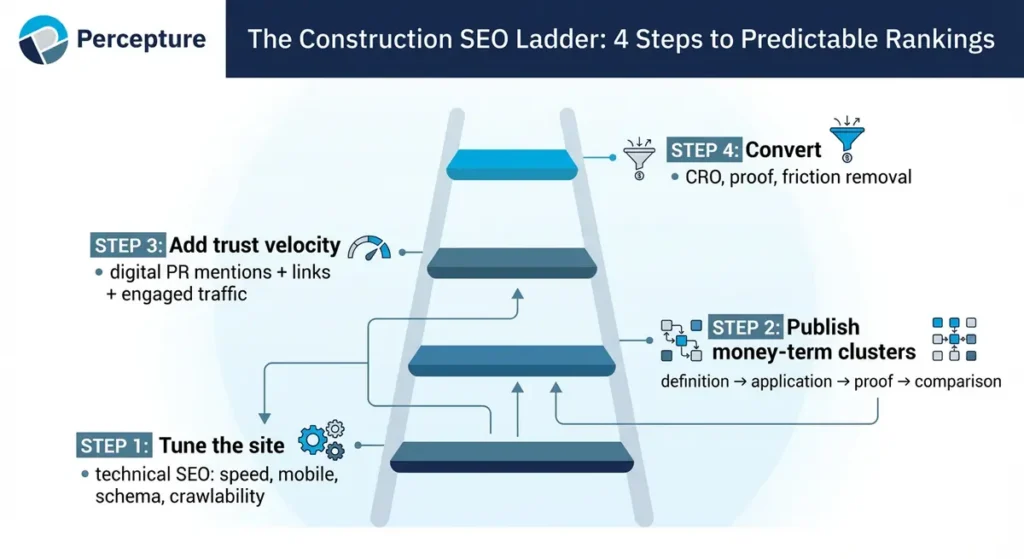
The race-car model for construction SEO
A technical SEO audit service identifies the structural issues that limit the car. Conversion rate optimization makes sure added speed creates business value rather than empty traffic.
Construction SEO now includes AI search visibility
Google AI Overviews, ChatGPT search, Perplexity, Gemini, and other answer engines change how buyers form a shortlist. The basic SEO work still matters, but the content also needs to be easy to understand, extract, verify, and cite.
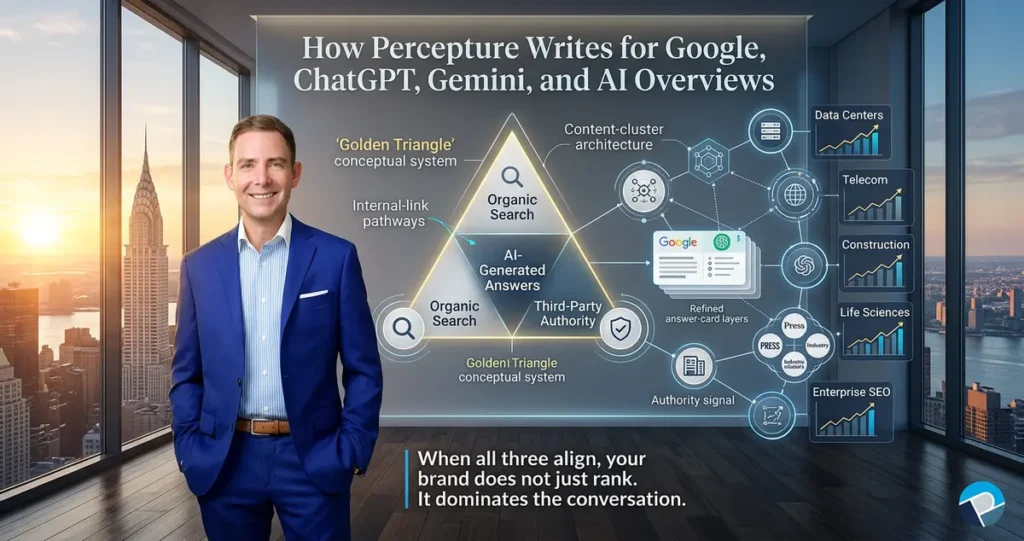
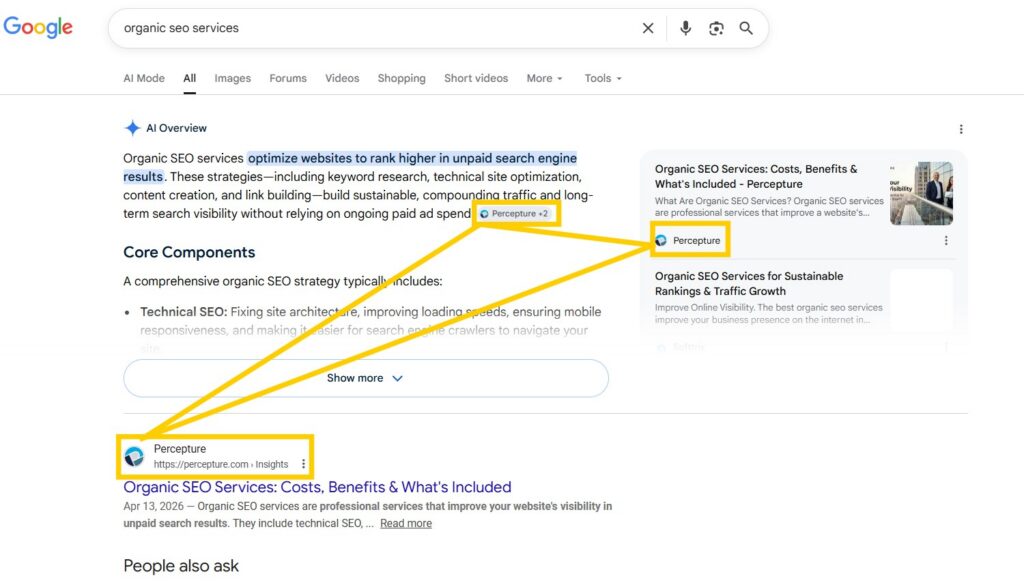
Percepture’s generative engine optimization services connect this citation work to technical SEO and content. The firm’s omnichannel marketing approach then reinforces the same message through search, PR, social, paid media, and executive visibility.
Why digital PR accelerates trust
Search engines and AI systems do not rely only on what a company says about itself. Reputable third-party mentions, expert quotes, useful data, partner links, and industry coverage can strengthen the confidence around a brand or claim.
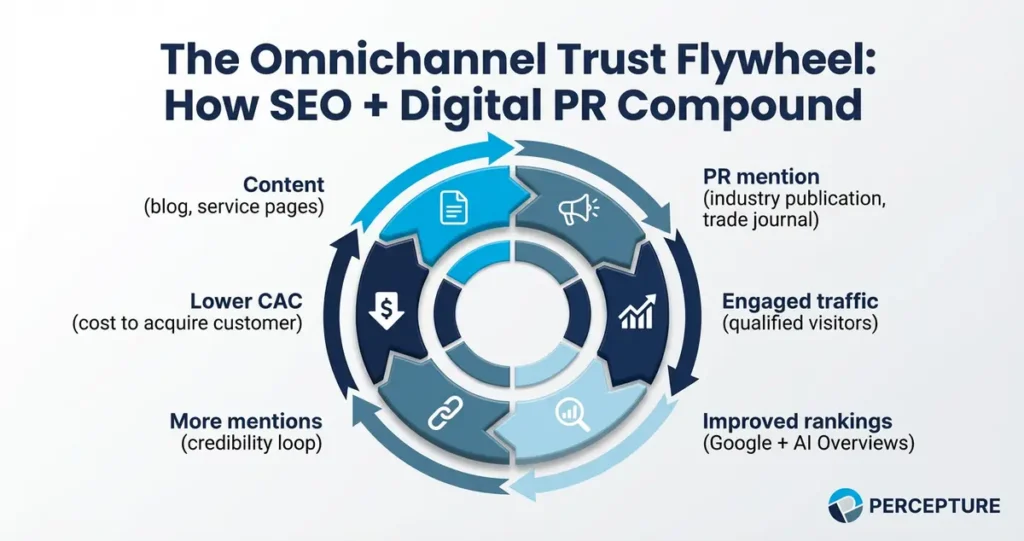
Construction firms can use digital PR services to earn relevant authority, while the guide to PR for construction companies explains how media, reputation, and search support one another.
What the system looks like in real work
First-party search performance
Percepture’s construction SEO page is already producing measurable visibility
These figures come from the Google Search Console exports supplied for this update. They describe the existing page before this layout and content refresh.
Case study: enterprise construction thought leadership
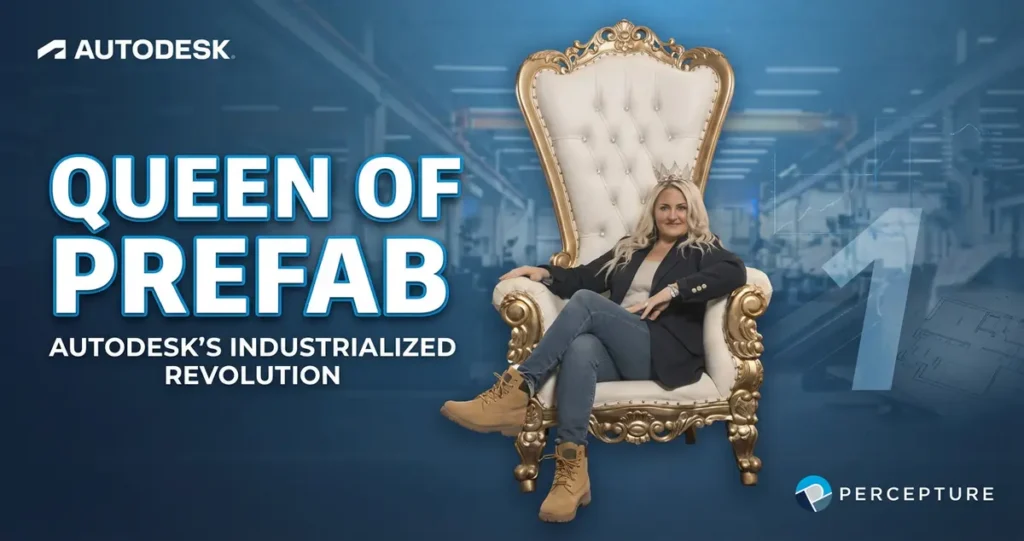
Percepture worked with Amy Marks before she became widely known as the “Queen of Prefab,” beginning during her X-Site Modular years and continuing as her authority expanded across construction, manufacturing, technology, conferences, and media.
The growth system combined useful expertise, repeatable content, media visibility, speaking, social distribution, and category language. That is the same model construction firms can use to help technical leaders become trusted search entities.
Case study: infrastructure expertise and qualified demand
Construction SEO becomes more valuable when a company sells complex, high-ticket infrastructure work. Service pages, project proof, technical answers, and AI visibility can help buyers discover expertise before a formal RFP or referral reaches the team.

Warm CTA
Build the pages that make your firm easier to shortlist
Percepture can map the buyer committee, commercial search terms, content gaps, technical barriers, proof assets, and authority plan into a 90-day construction SEO roadmap.
Construction SEO keyword opportunities
The uploaded U.S. keyword file shows a mix of broad educational demand and lower-volume commercial terms. The best plan uses broad terms to build authority and specific service terms to create opportunities.
| Keyword | Monthly volume | Difficulty | Intent | Best page type |
|---|---|---|---|---|
| SEO for construction companies | 2,400 | 25 | Informational | Comprehensive pillar guide |
| Construction SEO | 1,600 | 18 | Informational | Pillar or service-led guide |
| Construction company SEO services | 590 | 21 | Commercial | Service or agency page |
| Construction SEO services | 260 | 11 | Commercial | Focused service page |
| Local SEO for construction companies | 110 | 10 | Informational | Local framework and location pages |
Five commercial clusters for construction firms

Use the broader digital marketing for construction companies framework to connect SEO with paid media, social, PR, email, and sales enablement. The construction social media marketing guide can help distribute proof after it is published.
Construction SEO readiness scorecard
Give the company one point for each statement that is true.
- Priority pages are crawlable and indexed.
- The site is fast and usable on mobile.
- Service, location, and project pages have unique intent.
- Each priority service has a strong primary page.
- The site answers buyer and technical questions.
- Case studies prove scope, process, and outcomes.
- Industry publications and partners mention the firm.
- Leaders have complete expert profiles and bylines.
- Internal links connect related expertise.
- Each page has a relevant next step.
- Forms and calls are measured as conversions.
- Marketing reports qualified pipeline, not only traffic.
Construction SEO mistakes to avoid
- Target terms tied to profitable work.
- Build pages for each buyer role.
- Use project proof and technical depth.
- Connect SEO, PR, GEO, and CRO.
- Publish generic blogs with no buyer intent.
- Create dozens of thin location pages.
- Promise fixed ranking dates.
- Measure success only by traffic.
Construction SEO time-to-rank and ROI calculator
Use this directional model to compare a keyword’s difficulty with the site’s authority, content coverage, trust budget, and business value. It is a planning tool, not a guarantee.
Inputs
Directional results
The model assumes the page matches intent and the site can support the target with useful content and real authority.
Related construction marketing resources
Construction SEO FAQs
How long does construction SEO take?
Lower-difficulty terms on a sound site can show movement within days or weeks. Moderate commercial terms often need 30 to 90 days. Difficult national terms may require 90 to 180 days or more. The forecast should account for authority, intent, content depth, links, and competition.
What makes SEO for construction companies different?
Construction firms sell to a committee. Owners, engineers, procurement teams, general contractors, and investors search for different information. The site needs technical depth, project proof, safety and compliance signals, and pages that match each role.
How do construction firms rank for design-build or EPC terms?
Build one strong primary service page, then support it with definitions, industry applications, project proof, cost and timeline answers, comparison pages, internal links, and relevant third-party authority.
Does digital PR help construction SEO?
Yes. Relevant coverage and links can strengthen authority, brand recognition, and the confidence around technical claims. Digital PR is most effective when it supports the same service topics and entities used on the website.
What should a construction company publish first?
Start with the services and markets most likely to produce profitable work. Build the primary service pages first, then add applications, proof, FAQs, comparisons, local context, and technical resources.
How can a contractor show proof without naming confidential clients?
Describe the facility type, challenge, scope, delivery method, schedule, safety, coordination, and measurable outcome. Remove identifying details while preserving the evidence that shows capability.
How do AI Overviews affect construction SEO?
AI Overviews increase the value of clear answers, structured pages, strong entities, useful tables, expert authorship, and third-party trust. Traditional SEO still matters because the content must be discovered, indexed, and judged relevant before it can influence an AI answer.
What should construction firms track besides rankings?
Track impressions, click-through rate, non-branded visibility, engaged visits, qualified form submissions, phone calls, assisted conversions, project type, estimated pipeline, close rate, and the time from first visit to opportunity.
How much do construction SEO services cost?
Cost depends on the number of markets, service lines, technical problems, content gaps, authority needs, and conversion work. A narrow sprint costs less than a national program covering many services, locations, and buyer groups. The budget should be tied to the value of the work being targeted.
Hot CTA
The firms that show up first get researched first
Percepture can turn your services, projects, experts, locations, and proof into a construction SEO system built for Google, AI search, and real buying committees.

About the author
Bob Generale
Bob Generale is President of Percepture, a digital marketing, public relations, SEO, and AI search agency founded in 2004. He works with construction, telecom, data center, enterprise technology, and other complex B2B companies where visibility must lead to trust and qualified pipeline.
His approach combines forecasting, technical SEO, buyer-intent content, digital PR, GEO, conversion design, and measurement. Connect with Bob on LinkedIn.