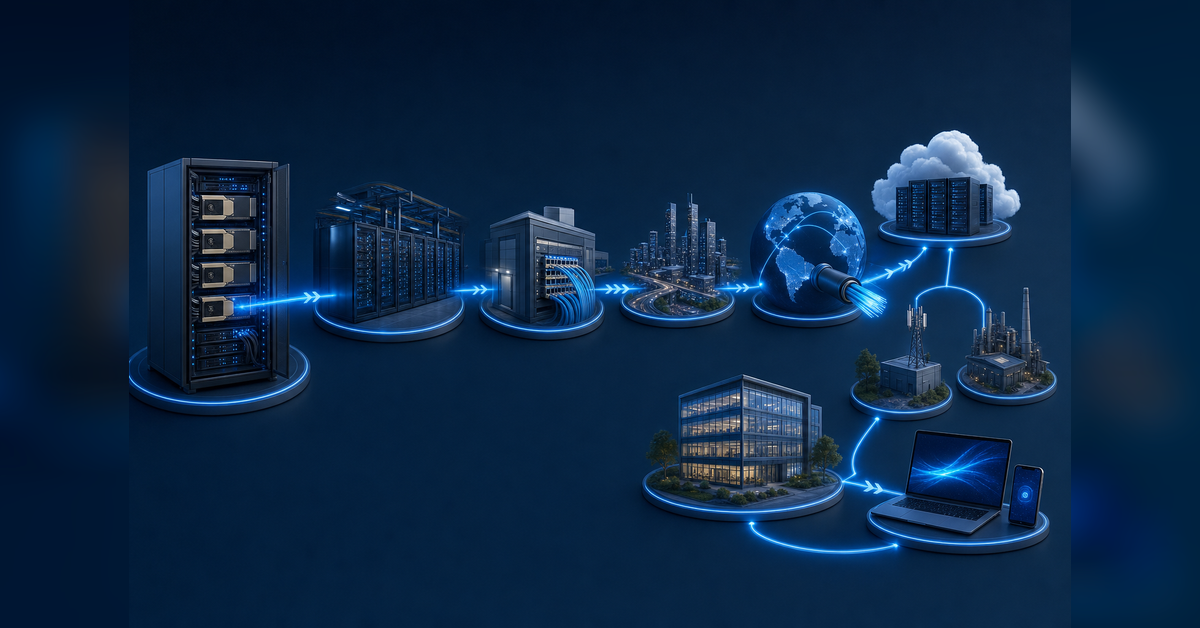

AI Network Infrastructure is the complete network path that moves data among accelerators, storage systems, data centers, clouds, edge locations, enterprises and users. It includes the local fabrics inside a facility and the physical interconnection and transport systems beyond it.
Most architecture diagrams stop at the accelerator cluster. The workload does not. A useful plan follows traffic from GPU to rack, facility, interconnection point, metro or long-haul network, cloud or edge environment, and the final application or user.






What is AI Network Infrastructure?
AI Network Infrastructure is the end-to-end architecture that carries AI workload data between compute, storage, facilities, clouds, edge nodes and users at the performance, resilience and cost level the workload requires. It joins accelerator fabrics with front-end networks, interconnection, optical transport, delivery and operational control.
Executive summary
Start with the workload
Training, inference, storage and physical or agentic applications create different traffic patterns. AI Network Infrastructure choices should follow those patterns.
Map both directions
East-west traffic moves among systems and accelerators. The complete map must also show north-south connections to data sources, clouds, other facilities and users.
Include geography
Cloud regions, carrier routes, interconnection facilities and edge sites are physical locations. Distance and route choices remain part of the design.
Test the failure state
A topology that performs well during normal operation may behave differently during failover. Recovery paths belong in the original plan.
Who should use this guide?
Business and infrastructure leaders
Use it to connect AI Network Infrastructure choices to location, risk, growth and customer experience.
Data center and telecom teams
Use it to explain where facility, carrier, cloud and interconnection responsibilities meet within the end-to-end architecture.
Marketing leaders
Use it to organize technical expertise into clear topics that buyers and search systems can understand.
Buyers evaluating AI readiness
Use the decision matrix and scorecard to expose missing assumptions before a vendor or architecture review.
What is the key design goal of AI Network Infrastructure?
The key design goal is to move the required data between accelerators, storage, facilities, clouds, edge locations and users at the required performance and resilience level without creating unnecessary bottlenecks, failure domains or cost.
That answer is broader than “get the lowest latency.” Some workloads need tightly controlled latency. Others need throughput, predictable completion time, geographic reach, data-location controls or economical capacity. The AI Network Infrastructure target must be defined by the workload and the business consequence of delay or failure.
Why AI traffic is different
AI traffic is not one traffic pattern. Distributed training can create sustained, synchronized communication among accelerators. Inference may combine model access, retrieval, application calls and user-facing responses. Storage pipelines must feed data into the environment and preserve outputs, checkpoints or logs.
Burst behavior also matters. A network may look comfortable at average utilization while queues form during synchronized transfers or demand spikes. Physical and agentic applications add another concern: the result may need to reach a device, enterprise site or operational system within a useful response window.
This is why an AI-ready label applied to a single switch or link says little about the full path. The end-to-end network must be reviewed as a chain of connected layers, each with its own owner, constraints and failure behavior.
Build your architecture question list
Use the GPU-to-user layers below as an architecture question list. If your technical story is clear but buyers cannot see where your company fits, use the diagnostic to connect network expertise with the right accounts and questions.
Run a Lead Quality DiagnosticAI training vs. AI inference networking
Training and inference can share AI Network Infrastructure facilities and services, but they should not be treated as identical. The table is a planning framework, not a universal equipment prescription.
Training and inference comparison
| Decision area | Training network | Inference network |
|---|---|---|
| Primary traffic | Accelerator communication, data ingestion, storage and checkpoints | Requests, model access, retrieval, application services and responses |
| Performance priority | High throughput, predictable collective operations and low congestion | Response consistency, reach, availability and workload-specific latency |
| Geographic pattern | Often concentrated around compute, with external data and storage paths | May be centralized, regional, edge-distributed or hybrid |
| Compute placement | Commonly organized around large accelerator clusters | Placed according to users, data, economics and response requirements |
| Network pattern | Heavy east-west communication can dominate | North-south delivery often becomes more visible |
| Failure sensitivity | Disruption may delay or interrupt an expensive distributed job | Disruption may affect an application, process, device or customer session |
| Interconnection need | Data sources, storage, cloud services and additional facilities | Clouds, enterprises, networks, edge sites and end users |
East-west vs. north-south AI traffic
East-west traffic moves laterally among accelerators, servers, storage systems and services. North-south traffic enters or leaves that environment. Both directions can exist inside a facility, but the north-south path eventually reaches interconnection, carrier transport, cloud, enterprise or user networks.
The ownership boundary matters. A data center team may control the local fabric while carriers, cloud providers, colocation operators and enterprise teams control other segments. Effective planning records those handoffs instead of treating the external path as a generic cloud.
Interconnection begins at physical locations where networks can meet. Hunter Newby’s research explains why the internet is physical and why network presence attracts additional network presence. AI demand changes scale and traffic, but it does not remove geography.
The Percepture GPU-to-User Network Stack
The Percepture GPU-to-User Network Stack divides AI Network Infrastructure into eight layers. It gives business and technical teams a shared map for identifying traffic, ownership, location, risk and unanswered questions.
Accelerator fabric
Communication within a tightly coupled accelerator system. Ask what operations must stay local and what delay or contention the workload can tolerate.
Cluster and rack fabric
Scale-out communication across systems and racks. Ask how topology, congestion management and operational choices support the cluster.
Facility, storage and front-end network
Application, management, ingestion and storage traffic. Ask whether separate traffic classes compete for the same resources.
Interconnection
Cross-connects, carrier-neutral facilities, exchanges, cloud edges and peering relationships. Ask which networks and services are physically available.
Metro and data center interconnection
Links between facilities using services such as Ethernet, wavelengths or dark fiber. Ask who controls capacity, optics, routes and recovery.
Long-haul and global transport
Carrier and optical systems connecting metros and regions. Ask about route diversity, handoffs and geographic dependencies.
Edge and enterprise delivery
Regional edge sites, enterprise locations, devices and users. Ask where inference should run and how the result reaches its destination.
Control, security and observability
Routing, telemetry, automation, policy, security and failure detection across every other layer. Ask whether teams can see and operate the complete path.

Inside the AI facility network
Scale-up and scale-out networking
Scale-up networking
Scale-up networking connects accelerators within a tightly integrated computing system. The design focus is the communication required for those accelerators to work together as one larger resource. It belongs at the first layer of the stack and should be evaluated against the selected compute platform and workload.
Scale-out networking
Scale-out networking connects multiple systems or racks so work can be distributed across a larger cluster. Leaf-spine designs, Ethernet and InfiniBand may appear in this layer. The meaningful questions concern traffic patterns, congestion, operations, compatibility and the cost of disruption—not the popularity of a label.
Front-end, back-end and storage networks
The back-end network supports accelerator and cluster communication. The front-end network carries application access and traffic to other environments. Storage paths feed datasets, models and supporting data into the system while carrying outputs and checkpoints away from it.
These functions may be separated physically or logically. The decision depends on scale, isolation requirements, operational practice and workload behavior. Teams should document where traffic classes meet, which resources they share and what happens when one class spikes.
Ethernet vs. InfiniBand for AI networking
Ethernet and InfiniBand should be compared in context. Neither is a universal winner, and both terms cover implementations whose results depend on architecture, configuration, operations and workload.
Ethernet and InfiniBand comparison
| Factor | Ethernet | InfiniBand |
|---|---|---|
| Typical use | Enterprise, cloud, storage, front-end and AI cluster networks | High-performance computing and tightly coupled accelerator clusters |
| Strengths | Broad ecosystem, familiar operations and flexible integration | Purpose-built high-performance communication capabilities |
| Tradeoffs | AI cluster performance depends on disciplined design and congestion handling | Requires skills, tooling and operational alignment with its ecosystem |
| Operational ecosystem | Large multi-vendor networking and automation environment | More specialized high-performance environment |
| Where it fits | Where interoperability, existing skills and converged operations matter | Where tightly coupled workload performance justifies specialization |
The network path beyond the data center
The local fabric is only part of the system. Once data, compute or users span locations, transport and interconnection become architecture decisions.
Data center interconnection for AI
Once compute, storage or users span facilities, data center interconnection becomes part of the end-to-end architecture rather than a procurement detail. Capacity, distance, route, service demarcation and recovery all affect the end-to-end outcome.
Use Percepture’s guide to data center interconnect options to compare service categories. The data center interconnect design guide covers the questions behind a multi-site plan, while the comparison of dark fiber vs. wavelength helps separate operational control from managed capacity.
Metro and long-haul optical transport
Metro transport connects facilities, carrier hotels, cloud edges and enterprise locations within a market. Long-haul transport connects metros and regions. The architecture should record actual endpoints and handoffs rather than drawing one undifferentiated line between cities.
Route diversity also needs physical scrutiny. Two services can look separate commercially while sharing a conduit, building entrance, facility or upstream dependency. A useful review traces the path far enough to identify shared failure domains. Where regional access depends on aggregation routes, the guide to middle-mile fiber adds context.
Cloud on-ramps and interconnection
A cloud on-ramp creates private connectivity into a cloud environment from supported interconnection locations. It does not erase the physical path between the workload, on-ramp, cloud service and user. Port capacity, facility presence, carrier access and redundancy remain planning inputs.
The right model may combine direct connectivity, carrier services and internet paths according to workload and recovery needs. Review the practical choices in Percepture’s guide to cloud on-ramp connectivity.
Edge and distributed inference
Inference can run in a central data center, cloud region, metro edge, enterprise site or device. Placement should follow users, data, response requirements, economics, security and the ability to operate the environment. Moving compute closer can shorten one segment while adding distributed management and synchronization work.
The deeper workload analysis belongs in the guide to AI inference infrastructure. For broader geographic planning, the AI corridor framework connects facilities, power, fiber, interconnection and regional ecosystems.

Performance, resilience and control
Low-latency networking without tunnel vision
Latency is one performance dimension. Throughput, jitter, packet loss, availability, queue behavior and application processing can also shape the result. Optimizing one local segment does not guarantee a good end-to-end experience.
Teams should define where latency matters, how it will be measured and what tradeoffs are acceptable. Percepture’s focused guide to low-latency networking for AI addresses that performance problem without turning every architecture decision into a race for the smallest possible number.
Route diversity, resilience and recovery
Resilience begins with the business effect of failure. Ask which workloads can pause, which must degrade gracefully and which require rapid recovery. Then map power, equipment, facility, carrier, conduit, cloud and operational dependencies.
Failover must be tested as a traffic event. A backup path may have less capacity, a different latency profile or a new interconnection bottleneck. The end-to-end architecture is resilient only when the alternate state can carry the required workload, not merely when a second circuit exists.
Security, sovereignty and data location
Security controls span identity, segmentation, encryption, access, monitoring and response. The architecture map should show where policy changes hands between internal teams, facilities, carriers and cloud providers.
Data location requirements can influence compute placement, storage, transport and the jurisdictions crossed by a route. These questions should enter the design before services are selected. A region name alone does not explain where every copy, log, retrieval source or network path resides.
Observability and automation
Operators need visibility across fabrics, storage paths, interconnection ports, transport services, clouds and delivery networks. No single tool necessarily owns the full view, so teams need clear event correlation and escalation boundaries.
Automation should act on known policy and reliable telemetry. It should also leave an auditable record of what changed. The most useful operating model connects technical signals to workload impact: which job, service, enterprise site or user experience is affected?
AI Network Infrastructure decision matrix
Questions to answer before selecting architecture
Use these questions to define the workload, geography, capacity and recovery requirements that the AI Network Infrastructure design must satisfy.
| Question | Why it matters | Decision output |
|---|---|---|
| What workload is being supported? | Training, inference, storage and physical applications stress different AI Network Infrastructure paths. | Traffic model and service objectives |
| Where are users and data? | Location shapes transport, interconnection and sovereignty. | Endpoint and geography map |
| How much traffic is east-west and north-south? | The balance affects cluster, front-end and WAN planning. | Capacity by layer |
| Is compute in one facility or distributed? | Distribution introduces DCI, transport and additional handoffs. | Facility and interconnection plan |
| How dependent is the workload on cloud services? | Cloud access can become a performance and recovery dependency. | On-ramp and fallback design |
| What are the data-location constraints? | Storage, processing and routes may need geographic controls. | Approved location policy |
| What growth is expected? | Ports, fibers, facilities and operations have different expansion paths. | Capacity milestones |
| What DCI or optical assets already exist? | Existing assets can create options or hidden constraints. | Reuse, upgrade or replace decision |
| What recovery behavior is required? | Recovery time and degraded-state capacity shape redundancy. | Failure and restoration plan |
How to evaluate whether a network is AI-ready
AI readiness scorecard
Apply the scorecard to the complete AI Network Infrastructure path rather than rating only the accelerator cluster or local fabric.
| Readiness test | Ready when | Warning sign |
|---|---|---|
| Workload definition | Traffic patterns and service objectives are documented. | The plan begins with a product label. |
| Layer map | All eight AI Network Infrastructure layers have owners and dependencies. | The diagram ends at the rack or cloud region. |
| Capacity | Normal, burst and failover demand are modeled. | Only average utilization is reviewed. |
| Interconnection | Facilities, networks, ports and handoffs are identified. | External connectivity is shown as a generic cloud. |
| Resilience | Shared physical risks and alternate-state capacity are tested. | Two contracts are assumed to mean diverse routes. |
| Security and location | Policy boundaries and data locations are recorded. | Jurisdiction and route questions arrive after procurement. |
| Operations | Telemetry, escalation and change ownership cross layers. | Each team can see only its local segment. |
A low score does not automatically mean a full rebuild. It shows where the next investigation belongs. AI Network Infrastructure becomes actionable when each gap has an owner, a business consequence and a decision date.
Common architecture mistakes
- Starting with hardware instead of workload: Product selection begins before traffic, geography and failure objectives are clear.
- Confusing bandwidth with latency: A high-capacity path is assumed to solve queueing, distance, loss or application delay.
- Ignoring the carrier and WAN path: The local fabric is optimized while the user-facing path remains unmapped.
- Treating training and inference alike: One reference design is applied to different traffic and delivery models.
- Assuming cloud removes geography: Regions, on-ramps and data sources are treated as abstract services with no physical path.
- Using one AI-ready label across every layer: Readiness at the rack is mistaken for readiness across facilities and users.
- Ignoring failover behavior: Backup services exist, but degraded-state capacity and routing have not been tested.
- Ignoring interconnection: Network availability at the required physical location is considered too late.
Why Percepture publishes this guide
Percepture works across telecom, data centers and digital infrastructure. Its role is not to configure accelerator fabrics. It translates complex technical expertise into market positioning, search visibility, public relations and AI-search authority.
That work can combine a telecom marketing agency perspective with enterprise SEO services, generative engine optimization services and digital PR services. The objective is to make technical distinctions clear without presenting marketing expertise as network engineering proof.


Turn the network stack into an authority plan
Complex infrastructure companies often have strong technical knowledge but fragmented market language. Percepture connects content marketing services, search, PR and AI visibility around the AI Network Infrastructure topics a buyer must understand.
Review Pricing Options
Frequently asked questions
What is AI Network Infrastructure?
It is the complete architecture that carries AI workload data among accelerators, racks, storage, facilities, interconnection points, transport networks, clouds, edge locations and users. It includes local fabrics and the external physical path needed to deliver the workload or result.
What is a key design goal of AI network infrastructure?
The AI Network Infrastructure goal is to move required data at the performance and resilience level the workload needs without creating avoidable bottlenecks, failure domains or cost. The right target may emphasize throughput, latency, consistency, reach, sovereignty or recovery rather than one universal metric.
Does every AI workload require the lowest possible latency?
No. Latency matters when delay changes workload completion, application behavior, safety or user experience. Other workloads may place greater weight on throughput, availability, geographic reach or cost. Teams should define a useful latency target instead of buying toward the smallest possible number.
How do training and inference networks differ?
Training can create intensive accelerator-to-accelerator and storage traffic around large compute clusters. Inference often adds application requests, retrieval, cloud services and delivery to users or devices. The actual design depends on placement, model behavior, data sources and response requirements.
Is Ethernet or InfiniBand better for AI?
Neither is universally better. Ethernet offers a broad operational and vendor ecosystem. InfiniBand is associated with specialized high-performance environments. The choice should follow workload behavior, platform compatibility, team skills, congestion requirements, operating model and lifecycle cost.
Why does interconnection matter for AI?
Interconnection determines where AI Network Infrastructure facilities, carriers, clouds, exchanges and enterprise networks can physically meet. It affects available routes, handoffs, capacity and recovery options. Once data, compute or users span locations, interconnection becomes part of the architecture rather than a secondary carrier purchase.
How can a company tell whether its network is AI-ready?
Document the workload, map all AI Network Infrastructure layers from GPU to user, identify owners and handoffs, model normal and failover demand, test route diversity, record data-location controls and confirm end-to-end observability. Gaps should have named owners and decision dates.
How long does an AI network assessment take?
The timeline depends on the number of workloads, facilities, providers, clouds, routes and operating teams involved. A focused assessment can begin with one workload and one end-to-end path. A distributed environment requires more discovery because ownership and physical dependencies cross organizations.
Map the AI infrastructure topics your company needs to own
Percepture helps infrastructure companies turn technical credibility into clear market positioning, search visibility, AI-search authority, PR coverage and qualified demand. If AI Network Infrastructure is central to your offer, the public story should make the complete path and your role in it easy to understand.
Book a Strategy Conversation