

B2B Intent Data Is Changing How Revenue Teams Work
B2B intent data is changing how sales and marketing teams decide where to spend time. The question is not whether buyer signals matter. The question is whether your team can turn those signals into better targeting, better timing, and better conversations.
This is a huge opportunity.
Companies using B2B buyer intent data correctly can create three immediate advantages:
- Sharper account prioritization because the team can focus on companies showing real market movement, not just names sitting in a database
- Stronger first-touch outreach because sellers can understand the account, the contact, and the reason to reach out before they send a message
- Better campaign performance because marketing, PR, SEO, GEO, paid media, and sales can all work from the same buyer intelligence
However, using B2B intent data well requires more than buying another platform. It requires clean ICP logic, fresh signals, source-backed research, sales context, and a team that knows how to turn data into action.
“B2B intent data should not stop at the signal. The value is knowing who fits, why now, and what message may earn the first conversation.”
Percepture combines digital PR, SEO, GEO, paid media, sales strategy, and AI systems to help teams turn buyer intent data into usable sales intelligence. We do not just hand over another dashboard. We help build the workflow that points your team toward the right accounts.
How it works:
- 20% Strategy (Percepture): We define ICP, target industries, buyer signals, messaging, guardrails, and approval paths
- 60% AI + Data Execution (LeadSeeker/Pyra): AI-assisted systems help find signals, verify contacts, build dossiers, and prepare outreach context
- 20% Human Operator (Percepture): Your strategy team reviews fit, sharpens positioning, and helps turn intelligence into campaigns and sales action
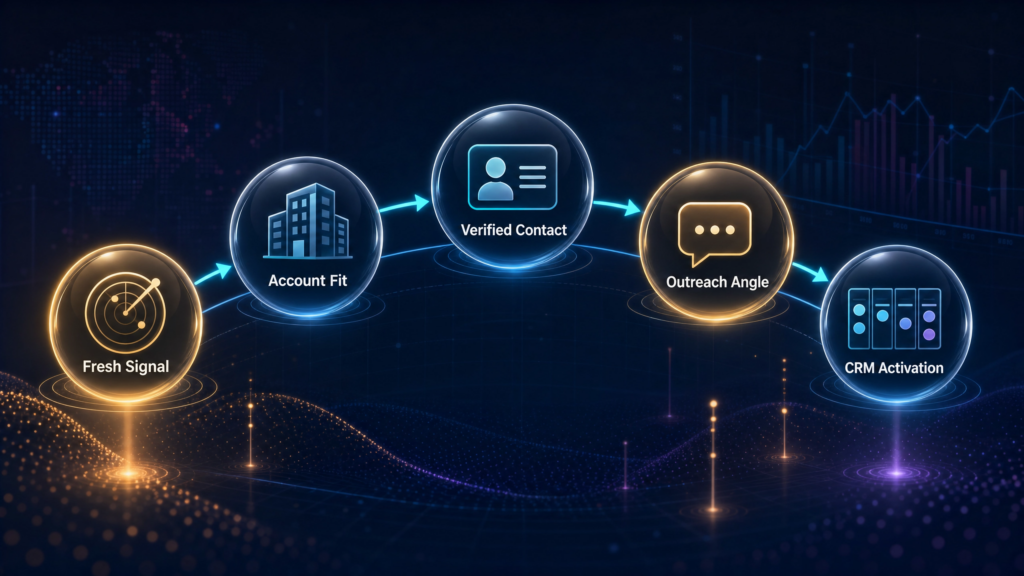
What You Get with B2B Intent Data Services
- A clearer way to identify in-market B2B accounts, public buying signals, account triggers, and decision-makers worth pursuing
- A practical bridge from buyer signals to LeadSeeker, CRM workflows, outreach strategy, digital PR, and campaign activation
- Transparent reporting and optimization, so your team can see which signals, segments, prompts, and messages create better opportunities over time
Data Quality, Security and Control
- Percepture’s B2B intent data services are built for teams that need useful intelligence, responsible data handling, and human control.
- Source Transparency: We prioritize explainable signals, public context, and clear reasoning so teams know why an account surfaced.
- Data Hygiene: LeadSeeker can verify contacts when searches run and show the timing behind the contact intelligence.
- Access Control: Workspaces, approvals, CRM rules, and role-based access can be structured around your team’s process.
- Auditability: Saved searches, exports, dossiers, and CRM pushes make prospecting easier to review and improve.
- Compliance Posture: We use practical guardrails, human review, and responsible workflows for regulated or enterprise environments.
- Phased Rollout: We start with one audience, one signal map, and one workflow before expanding into broader sales or marketing activation.
B2B Intent Data Services We Build

Intent Signal Mapping
Intent signal mapping helps your team identify the account movements that may matter most. We look at ICP, market timing, hiring activity, funding, content themes, events, technology changes, and other public signals that may show business need.
Example: A data center provider wants to find companies expanding AI infrastructure. We map public signals around new facilities, cloud demand, power needs, hiring, and funding so the sales team starts with better-fit accounts.

ICP + Account Fit Strategy
ICP strategy turns broad b2b buyer intent data into a focused account filter. We define the industries, company sizes, roles, regions, pain points, and triggers that make an account worth pursuing now.
Example: A life sciences vendor wants CDMOs and CROs showing growth signals. We define the buyer universe, remove weak-fit segments, and build a search pattern around decision-makers and commercial movement.

LeadSeeker Prospect Intelligence
LeadSeeker helps turn B2B intent data into verified leads, source-backed dossiers, contact context, and suggested first lines. It is the action layer that helps your team move from signal to outreach faster.
Example: A marketing team uses LeadSeeker to search a target ICP, review public triggers, verify contacts, export dossiers, and send stronger first-touch messages to the right people.

Buyer Dossiers + Outreach Angles
Buyer dossiers summarize why an account surfaced, who the right contact may be, what changed in the market, and which message angle may be most useful. This gives sellers a reason to reach out with confidence.
Example: A revenue team sees a company hiring for AI operations. The dossier connects the hiring signal to a possible need, identifies the relevant leader, and suggests an opening line for outreach.
Campaign Activation Workflow
Campaign activation connects B2B marketing intent data to email, LinkedIn, ABM, SEO, GEO, digital PR, programmatic, and event follow-up. The goal is to turn intelligence into coordinated market presence.
Example: A telecom company targets conference attendees after ITW. We use event signals, company fit, public context, and outreach angles to prioritize follow-up and support the sales team.
CRM + Reporting Workflow
CRM workflows push qualified prospects, saved context, and useful notes into systems like Salesforce, HubSpot, spreadsheets, PDFs, or Word exports. This helps teams avoid rework and measure which signals lead to action.
Example: A B2B sales team reviews saved LeadSeeker prospects, syncs the best accounts into HubSpot, tracks replies, and improves the next search based on the segments that produced meetings.
For telecom, data centers, life sciences, healthcare, SaaS, infrastructure, staffing, and professional services, one strong meeting can matter more than hundreds of weak names. That is why buyer intent should be tied to context, fit, and action.
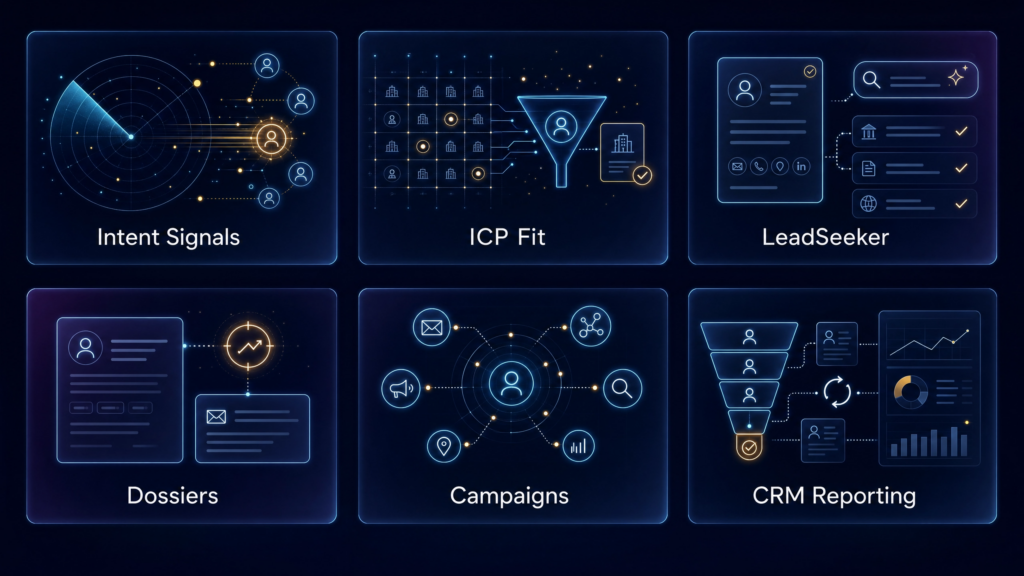
Results Snapshot
Companies using Percepture’s B2B intent data workflow can create measurable focus:
- Faster prospect research because reps begin with public buying signals and source-backed context
- Cleaner account prioritization because ICP, fit, timing, and contact relevance are reviewed together
- Stronger first-touch messages because outreach starts with a reason to reach out, not a generic pitch
- Better sales and marketing alignment because campaigns, PR, SEO, GEO, and outreach share the same intelligence
- More useful CRM records because dossiers, notes, and context can move with the prospect into the workflow
- Less wasted sales energy because the team spends more time with accounts that deserve a real conversation
Why This Matters
B2B intent data drives revenue when it helps people make better decisions. A topic surge, website visit, event list, hiring signal, or company update only matters if your team can connect it to the right account, the right person, and the right message.
This is not about replacing sellers or marketers. It is about helping them spend time where their skill matters most. We have seen in telecom, digital infrastructure, life sciences, and professional services that experts want to talk to people when there is a real reason, not because they were pulled from a stale list.
The teams that win do not chase every signal. They build a system for deciding which signals matter, which accounts fit, which contacts are relevant, and which outreach angle gives the conversation a chance.

Future Prediction
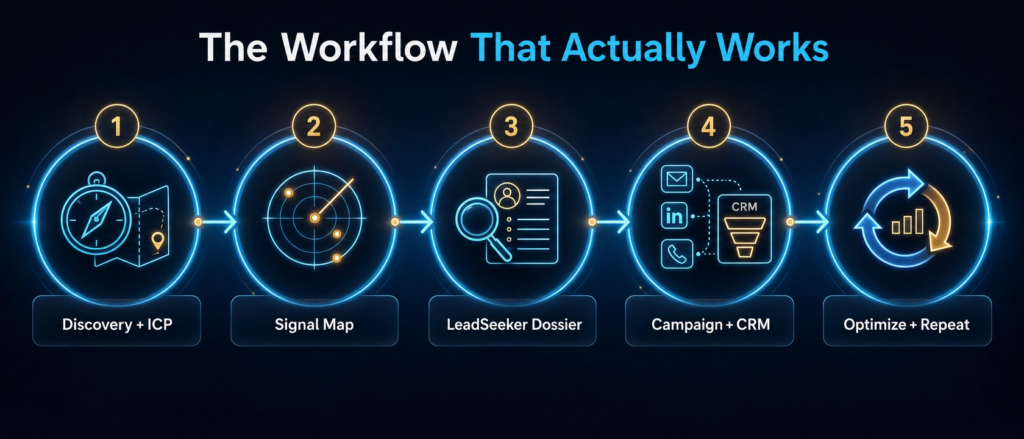
By 2027, more B2B sales teams will expect intent data to be fresh, explainable, source-backed, and connected to outreach. The teams that act on buyer signals with speed and human judgment will have a major advantage.
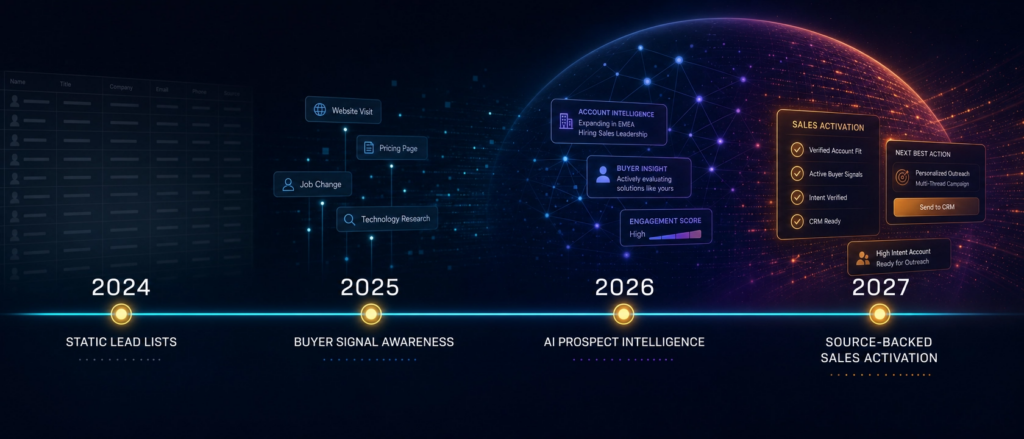
The workflow that actually works (step by step)
1) Discovery and ICP mapping
We audit your current sales process, target accounts, buyer roles, industry focus, and current lead quality. You will see which signals matter and which ones create noise.
2) Signal and intent map
We identify the hiring moves, funding events, role posts, technology changes, event activity, search themes, and public business triggers that may show B2B purchase intent.
3) LeadSeeker search and dossier build
We turn the ICP and signal map into plain-English searches. LeadSeeker helps find prospects, verify useful contact data, and create source-backed dossiers your team can review.
4) Campaign and CRM activation
We connect the intelligence to email, LinkedIn, sales enablement, ABM, digital PR, SEO, GEO, paid media, Salesforce, HubSpot, spreadsheets, or other workflow tools.
5) Monitor, optimize, repeat
We track which signals produce better accounts, which dossiers support replies, and which segments deserve more focus. The workflow improves as your team learns.
B2B Intent Data vs. Static Lead Databases
| Factor | Static Lead Databases | Intent Data Workflow |
|---|---|---|
| Decision Making | Starts with stored records | Uses signal, fit, and timing |
| Personalization | Often template-based | Built from buyer context |
| Learning | Lists age unless refreshed | Improves with prompt and reply data |
| Complexity | Filters and exports | Connects signals, contacts, CRM, campaigns |
| Setup Time | Fast access, slower trust | 2-6 weeks for a focused pilot |
| Maintenance | Manual cleanup | Ongoing signal and data review |
| Cost | Database subscription | Pilot, platform, and strategy support |
| Best For | Broad list building | Strategic prospecting, ABM, PR, sales timing |
What is B2B Intent Data?
B2B intent data is information that helps sales and marketing teams understand which companies or buyers may be researching a problem, solution, product, vendor, or category. It can include content behavior, search themes, account activity, public business movement, and other buyer signals.
The real value is not the data by itself. The value is how the data helps your team prioritize accounts, personalize outreach, plan campaigns, and decide where to spend the next sales hour.
What is Buyer Intent Data?
Buyer intent data is a broader term for signals that suggest a person or company may be exploring a need. In B2B, buyer intent data becomes more useful when it is paired with ICP fit, contact relevance, public context, and a clear next step.
LeadSeeker: Percepture’s Action Layer for B2B Intent Data
LeadSeeker is Percepture’s AI-powered prospect intelligence platform. It helps teams describe the audience they need, search for fresh public signals, verify contacts, build source-backed dossiers, and export sales-ready context.
We do not position LeadSeeker as a magic button. It is a practical way to turn intent intelligence into better prospecting, stronger first lines, cleaner CRM workflows, and more focused sales and marketing activity.
Is a B2B Intent Data Workflow Right for You?
✅ Your team spends hours researching accounts before outreach
✅ Your current B2B intent data feels broad, stale, or hard to act on
✅ Your sales team needs stronger reasons to contact decision-makers
✅ Your marketing team wants better account lists for ABM or paid media
✅ Your events, PR, SEO, or content programs need sharper follow-up lists
✅ You need better CRM data hygiene and more useful account context
✅ You sell a complex product where one qualified meeting can change the quarter
If you check 3 or more, B2B intent data services can help.
Who Uses Intent Data Services?
- B2B services companies that need better timing, cleaner prospect lists, and more qualified sales conversations
- Enterprise teams managing complex products, long buying cycles, multiple stakeholders, and high-value accounts
- Marketing and PR teams that need to connect search demand, account signals, media strategy, and campaign targeting
- SaaS, telecom, life sciences, data center, healthcare, staffing, and professional services teams that need sharper prospect intelligence
Risk Reversal: How We Reduce Your Risk
Pilot Program: We start with one ICP, one signal map, and one workflow. You see the quality before scaling.
Approval Gates: You approve the target market, search logic, outreach direction, and activation path before anything goes live.
Review by Exception: Your Percepture strategy team reviews fit, flags weak signals, and helps improve the process.
Phased Rollout: We start with research, dossiers, and sales enablement. CRM sync, campaigns, and broader activation can follow after review.
ROI Focus: We look for measurable improvement in prospecting yield, meeting quality, time saved, and campaign focus.
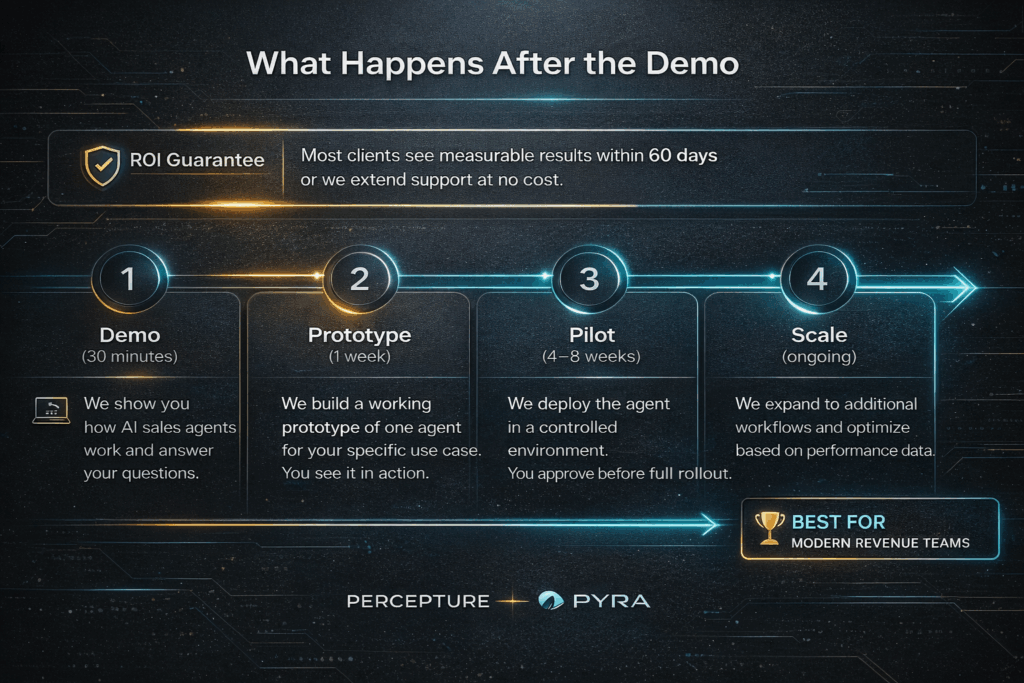
What Happens After the Demo
1) Demo (30 minutes)
We show you how this workflow can turn signals into prospect intelligence and better outreach.
2) Signal Prototype (1 week)
We build a working signal map and sample LeadSeeker search around one ICP, industry, or buyer group.
3) Pilot (4-8 weeks)
We test the workflow in a controlled environment. You review the leads, dossiers, signals, and outreach angles.
4) Scale (ongoing)
We expand to additional audiences, campaigns, CRM workflows, events, SEO/GEO programs, or sales motions.
Connect with Us to Learn More
We have been building digital PR, SEO, GEO, paid media, and AI-powered sales systems for B2B companies for years. Now we are helping teams turn buyer signals into source-backed prospect intelligence and better sales timing.
Let’s talk about your intent data strategy.
People Also Ask About Buyer Intent Data
How does B2B intent data work?
Intent data works by identifying signals that may show a company or buyer is researching a topic, problem, solution, or vendor. Those signals can come from content behavior, search themes, public company movement, event activity, hiring, funding, or technology changes. The strongest workflows connect those signals to ICP fit, relevant contacts, and a next sales action.
What is the difference between B2B intent data and CRM automation?
CRM automation usually follows fixed rules inside your existing database. Buyer intent signals help you decide which accounts may deserve attention before or during outreach. CRM automation can send reminders and sequences. Intent intelligence helps inform who should be in the sequence, why the account matters, and what message may make sense.
Can B2B intent data replace salespeople?
No. Intent data supports salespeople by helping them prioritize accounts, prepare stronger messages, and understand market timing. Sellers still make the judgment calls, run discovery, build trust, negotiate, and close. The best use of buyer signals is to remove low-value scouting work so people can spend more time on real conversations.
How much do B2B intent data services cost?
Intent data services can vary based on the number of audiences, data sources, CRM workflows, campaign channels, and level of strategy needed. A focused pilot may start with one ICP and one sales motion. Larger programs can include LeadSeeker, CRM enrichment, ABM, digital PR, SEO, GEO, paid media, and reporting support.
How long does it take to build an intent data workflow?
Most focused workflows can begin with a signal map and pilot in a few weeks. The timeline depends on ICP clarity, CRM needs, data quality, approval steps, and the number of sales or marketing channels involved. Percepture usually recommends starting narrow, proving signal quality, then scaling into more audiences and campaigns.
What tools can buyer intent data connect with?
Buyer intent data can connect with Salesforce, HubSpot, spreadsheets, email platforms, LinkedIn workflows, paid media platforms, analytics tools, and content planning systems. LeadSeeker can support exports and CRM-ready workflows so your team can move prospect context into the systems they already use.
Can intent data work in regulated industries?
Yes. Intent data can support regulated industries when the workflow uses appropriate guardrails, source transparency, approval steps, and human review. Percepture can help teams in healthcare, life sciences, finance, telecom, infrastructure, and other complex sectors design responsible sales intelligence workflows.
“Prospecting tools have become powerful, but often too mechanical. The next step is helping teams understand who fits, why now, and what message may earn attention.”
— Percepture LeadSeeker Team
Frequently Asked Questions
What are B2B intent data services?
Intent data services help companies identify, interpret, and act on buyer signals. These services can include ICP mapping, signal research, account prioritization, buyer dossier development, CRM enrichment, campaign activation, reporting, and sales enablement. Percepture specializes in connecting buyer signals with SEO, GEO, digital PR, paid media, LeadSeeker, and sales strategy. The goal is to help teams spend less time guessing and more time working the right accounts.
What does a B2B intent data agency do?
An intent data agency helps turn scattered buyer signals into a usable revenue workflow. This includes defining your ideal customer profile, identifying signal sources, separating useful movement from noise, building target account lists, preparing outreach context, and connecting data to CRM or campaign systems. Percepture brings the agency layer: strategy, messaging, content, PR, paid media, SEO, GEO, and AI-powered prospect intelligence.
How is B2B intent data different from a lead list?
A lead list is usually a set of stored contacts. Intent data is a way to understand timing, context, and possible need. A list may tell you who someone is. Intent signals help explain why a company may matter now. The strongest workflow combines verified contacts, public source context, account fit, and a message angle your team can use.
What is LeadSeeker?
LeadSeeker is Percepture’s AI-powered prospect intelligence platform. It helps users describe an audience in plain English, search for fresh public buying signals, verify useful contact data, build source-backed dossiers, and export CRM-ready context. On this page, LeadSeeker is the activation layer for buyer intent data. It helps teams move from signal to better prospecting, not just more records.
Can B2B intent data improve ABM campaigns?
Yes. Intent data can improve ABM campaigns by helping teams choose better-fit accounts, segment messages by need, identify timing signals, and coordinate sales and marketing follow-up. Percepture can connect those signals to paid media, LinkedIn, landing pages, PR, SEO, GEO, and sales outreach so the campaign feels more relevant to each account.
Does B2B intent data replace human judgment?
No. Intent data should improve human judgment, not replace it. A signal can suggest that an account deserves a closer look, but people still need to evaluate fit, tone, timing, relationship context, and business value. Percepture builds workflows that keep strategy and human review in the process so sellers are supported, not replaced.
How do you measure B2B intent data performance?
We measure performance by looking at signal quality, qualified accounts found, contacts verified, dossiers reviewed, CRM exports, reply rates, meetings booked, pipeline influenced, and time saved. Useful programs also track which ICP prompts, buying signals, industries, and outreach angles produce the strongest results. The goal is not only more leads. The goal is better prospecting yield.
What happens if the data is wrong or stale?
No data workflow is perfect, which is why Percepture emphasizes source transparency, verification timing, human review, and continuous optimization. If a signal is weak, we refine the ICP, improve the search prompt, change the source logic, or adjust the activation path. The point is to build a workflow that gets smarter instead of trusting a static list forever.
Can I customize the intent data workflow?
Yes. The workflow should be customized around your market, sales motion, target roles, industries, regions, approval needs, and CRM process. You can adjust the ICP, signal map, search prompts, export fields, lead scoring logic, campaign channels, and reporting cadence. Percepture helps build the process around how your team actually sells.
How do I get started with B2B intent data services?
Schedule a free demo. We will review your ICP, current sales motion, existing data tools, target industries, and lead quality challenges. If there is a fit, we can build a signal prototype and sample LeadSeeker workflow around one audience so you can see how buyer intent becomes practical sales intelligence.