
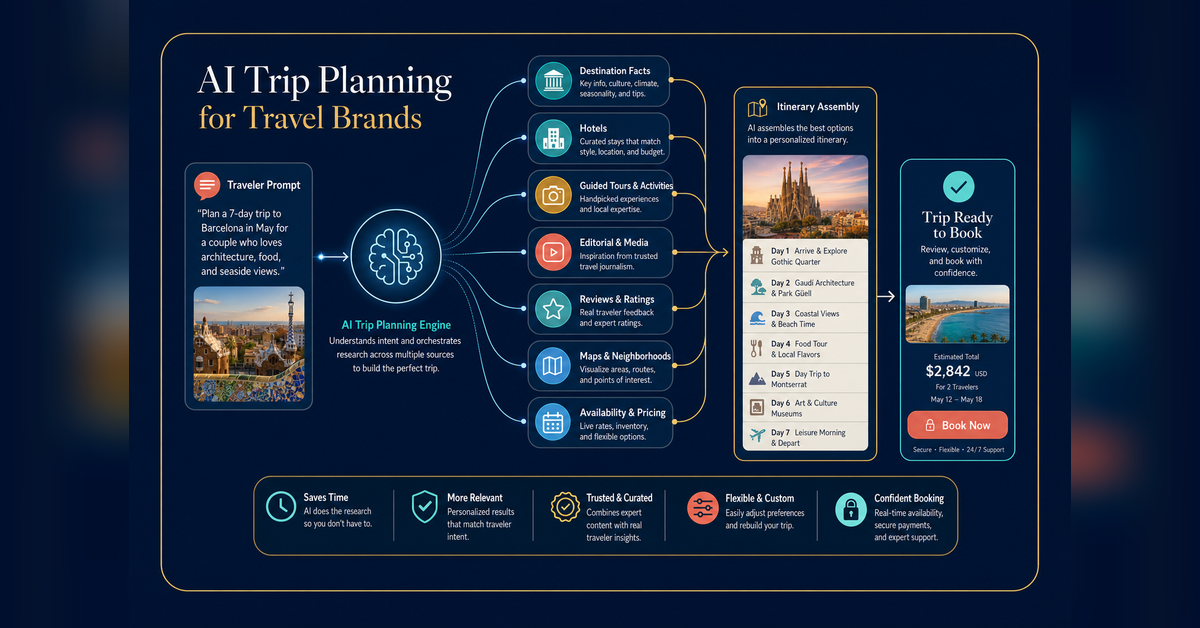

Travel brands optimize for AI trip planning by mapping traveler questions, publishing current decision-ready facts, proving experiences through first-hand and third-party sources, making pages crawlable and easy to retrieve, and connecting every recommendation to a transparent booking or partner action. That is the operating goal of AI search optimization for travel brands.
AI trip planning changes discovery from a list of links into recommendations, comparisons and follow-up questions. A travel brand needs a source system that remains useful as the traveler narrows dates, budget, location, party type, accessibility and booking constraints.
AI-trip-planning strategy backed by travel SEO, PR and measurable destination work
Percepture has worked across destination marketing, hospitality, tourism, search, public relations and analytics since 2004. The goal is not simply to earn an AI mention. It is to help travelers find accurate information, trust the recommendation and reach a usable booking or partner action.
How can a travel brand appear in AI trip-planning recommendations?
AI search optimization for travel brands makes a brand’s facts, experiences, proof and booking paths easier for AI search systems to retrieve and recommend. Publish current decision content, support it with independent evidence, keep it crawlable and connect it to a usable next step.
What leaders should take from this guide
Treat prompts as decisions
Map the questions a traveler asks while dreaming, comparing, planning, selecting and acting. The useful unit is the decision, not a single keyword.
Build a source of truth
In AI search optimization for travel brands, owners and review dates should be assigned to hours, prices, policies, access details, availability and other facts that can change.
Prove the experience
Official content establishes facts; independent content establishes credibility. Strong recommendations need both when the claim calls for corroboration.
Connect visibility to action
A recommendation without a usable next step creates awareness, not revenue. Booking, inquiry and partner paths must be clear and measurable.
For executives, AI search optimization for travel brands is therefore a source-governance, content, authority, technical and conversion program—not a chatbot copy project.
How AI trip planning assembles recommendations
AI travel planning is a constraint-solving problem. For AI search optimization for travel brands, a request such as “plan a five-day family trip to Costa Rica” may lead to related questions about season, cost, transport, hotels, wildlife, beaches, entry rules, safety, accessibility and the order of the trip.
Google’s guidance for AI features says AI experiences may use query fan-out across related searches. Google also says normal SEO fundamentals still apply: a page must be indexed and eligible to appear with a snippet, important information should be available as text, and structured data should match visible content. Google does not require special AI markup, so AI search optimization for travel brands still depends on those search fundamentals.
OpenAI’s ChatGPT search guidance says a prompt may be rewritten into one or more targeted searches. Its publisher guidance also distinguishes OAI-SearchBot, used for search discovery, from GPTBot training controls.
Those descriptions do not mean every platform uses the same sources or weighs them the same way. Potential inputs can include official travel sites, ordinary search results, maps, business listings, government information, media, creators, reviews, forums, images, videos and booking systems.
The brand must remain relevant as the prompt narrows, not only when the destination is named broadly. This is why AI search optimization for travel brands must cover fit, trade-offs and constraints rather than repeat promotional claims.
Eligibility is not the same as AI revenue
Percepture’s 28-day export records 884 impressions and an average position of 5.66 for its AI Search for Tourism Marketing page. The same export also contains sitewide queries using travel and tourism AI-visibility language, providing an eligibility baseline for AI search optimization for travel brands.
Rankings and impressions show eligibility and relevance. They do not prove that an AI system cited the page, recommended a client or generated a booking. Measurement for AI search optimization for travel brands must keep those evidence levels separate.
The Prompt-to-Trip Recommendation System
Percepture’s Prompt-to-Trip Recommendation System is an eight-stage method for turning traveler questions into retrievable, credible and actionable recommendations. It gives AI search optimization for travel brands an operating structure that content, PR, web, analytics, revenue and operations teams can share.
| Stage | Question | Operating output |
|---|---|---|
| 1. Prompt Territory | Which traveler decisions should the brand influence? | Prompt and Constraint Map |
| 2. Source Truth | Which facts are authoritative and current? | Travel Source Ledger |
| 3. Decision Content | Which pages resolve the choice? | Recommendation Page System |
| 4. Experience Proof | What demonstrates the real experience? | First-Hand Proof Library |
| 5. Corroboration | Which independent sources support it? | Authority Graph |
| 6. Retrieval | Can search and AI systems access it? | Retrieval Readiness Map |
| 7. Itinerary and Action Fit | Can the experience fit a plan and next step? | Itinerary and Booking Path |
| 8. Learning and Correction | What appeared, converted or became inaccurate? | Decision Log |
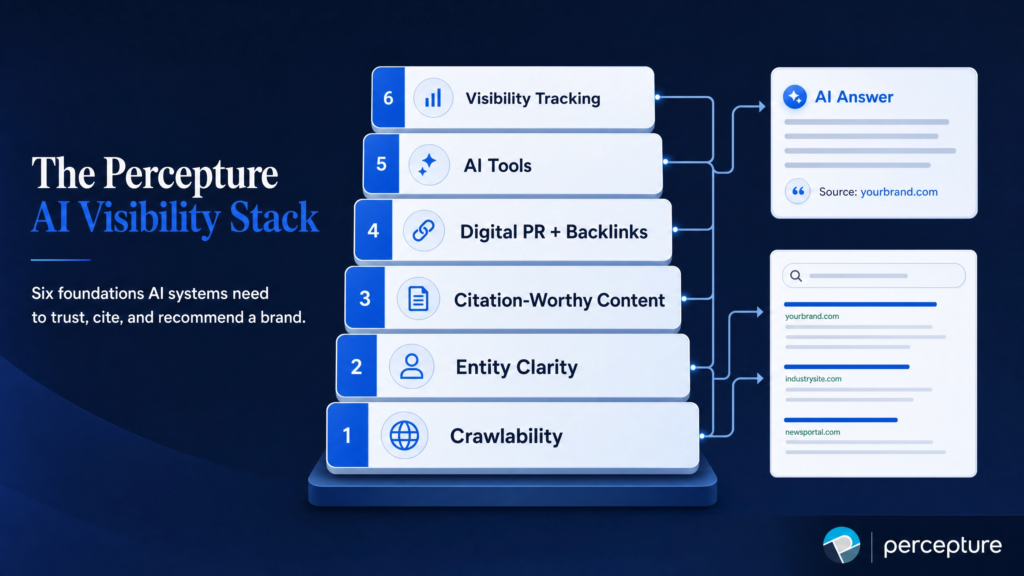
The framework rule for AI search optimization for travel brands is simple: do not pursue more AI mentions until the facts, proof and next-step experience can support the recommendation. Weak source truth can spread inaccurate information, while a poor transaction path can waste qualified discovery.
Score your trip-planning visibility
Use the AI Trip-Planning Visibility Scorecard to review prompt coverage, facts, proof, retrieval, booking readiness, measurement and correction ownership before expanding AI search optimization for travel brands.
Download the AI Trip-Planning Visibility ScorecardMap traveler prompts and constraints
Start AI search optimization for travel brands with the journey rather than a list of platforms. Customer journey mapping can organize the questions people ask as they move from inspiration to a transaction.
| Stage | Example prompt | Content opportunity |
|---|---|---|
| Dream | Where should we go for food and nature? | Destination and experience authority |
| Compare | Peru or Costa Rica for ten days? | Transparent comparisons and trade-offs |
| Plan | Build a seven-day itinerary | Itinerary-compatible routes and timing |
| Select | Which family hotel fits this area? | Traveler-fit, location and amenity proof |
| Act | Check rooms, tickets or advisor availability | Booking, referral or inquiry action |
Score each prompt territory from one to five for traveler value, brand fit, source authority, content gap, conversion path, inventory readiness, market relevance, freshness burden, competition and measurement confidence. AI search optimization for travel brands should prioritize questions the organization can answer credibly and act on—not questions selected only for apparent volume.
Build a current source ledger
AI systems can amplify stale information quickly. In AI search optimization for travel brands, travel facts need an owner and expiration date. A source ledger gives operations, revenue, editorial and PR teams one place to identify who owns a claim and when it must be reviewed.
| Claim | Primary source | Independent support | Owner | Review rule |
|---|---|---|---|---|
| Hours or operating date | Operations record | Map or partner listing | Operations | Review on schedule change |
| Price or fee | Booking system | Authorized partner | Revenue | Review when inventory changes |
| Accessibility | Audited property data | Relevant specialist source | Operations | Review after facility changes |
| Award | Awarding body | Media coverage | PR | Keep date and category visible |
| Traveler fit | First-hand experience evidence | Editorial or review evidence | Content | Review the stated method |
| Entry or safety information | Government source | Embassy or official source | Editorial | Use a short review cycle |
AI search optimization for travel brands requires teams to separate facts from interpretation, opinion, promotion and third-party statements. Avoid unsupported claims such as “best,” “safest” or “hidden gem.” For larger portfolios, enterprise SEO services can connect this governance to templates, regional pages and distributed content owners.
Create recommendation and itinerary pages
For AI search optimization for travel brands, strong recommendation pages disclose who the option fits, who it may not fit, the method used, current facts, trade-offs, logistics, value, alternatives and the next action. Strong itinerary pages add duration, sequence, realistic travel time, operating days, reservations, season, location, accessibility and contingencies.
A generic itinerary that ignores distance, opening days or availability is not decision-ready. AI search optimization for travel brands works better when every page can answer a bounded traveler question and link upward to context and downward to action.
AI search optimization for travel brands by business model
| Brand type | Pages AI planners need | Facts that matter | Action |
|---|---|---|---|
| Destination or DMO | Region, season, comparison and itinerary pages | Access, geography, events and partner inventory | Partner referral or saved trip |
| Hotel or resort | Fit, neighborhood, amenity and package pages | Rooms, location, policies and availability | Booking |
| Tour operator | Route, activity, difficulty and departure pages | Duration, inclusions, guide, safety and inventory | Booking or inquiry |
| Cruise brand | Itinerary, ship, port and audience pages | Embarkation, dates, shore time and inclusions | Availability or agent path |
| Travel agency | Expertise, sample-trip and comparison pages | Advisor, specialty, process and fees | Qualified trip brief |
| Attraction | Itinerary-role and nearby-experience pages | Hours, duration, tickets and accessibility | Ticket or directions |
| Vacation rental | Property, area and group-fit pages | Capacity, rules, fees and availability | Booking |
| Marketplace | Category and comparison pages | Freshness, filters, duplicates and trust | Transaction |
The broader AI search for tourism marketing page explains why discovery is changing. This guide explains how AI search optimization for travel brands rebuilds an individual brand’s sources, pages, proof and conversion path. Related implementation disciplines include travel SEO and SEO for travel websites.
Prove the experience beyond the brand website
AI search optimization for travel brands needs direct proof from named experts, original photography, route details, operating knowledge and documented first-hand experience. Media, creators, tourism organizations, institutions, awards, public data and reviews can provide independent corroboration.
Recommendation visibility is stronger when the official claim is independently supported elsewhere. That is why digital PR, public relations services and durable owned content should work as one source system.


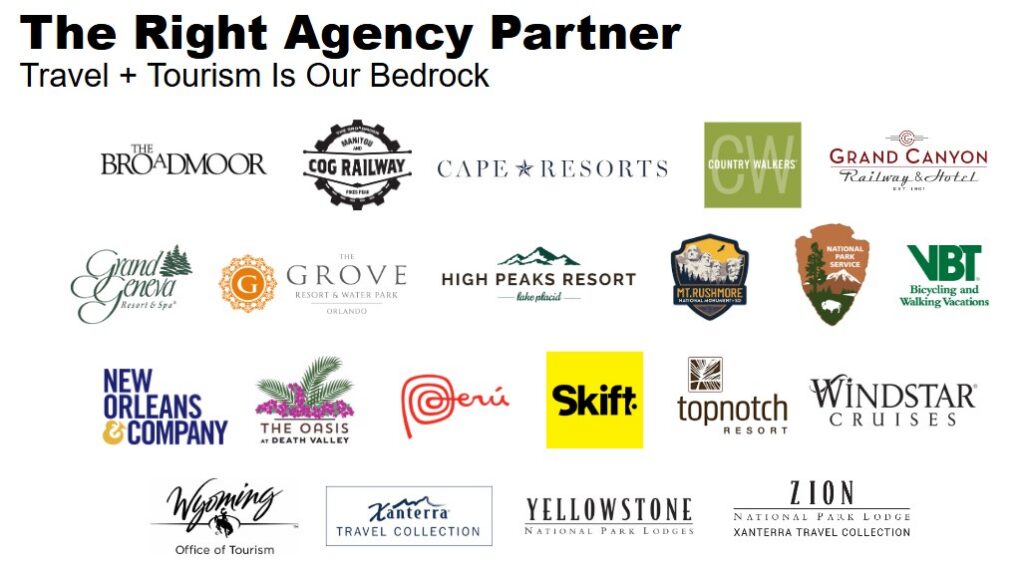
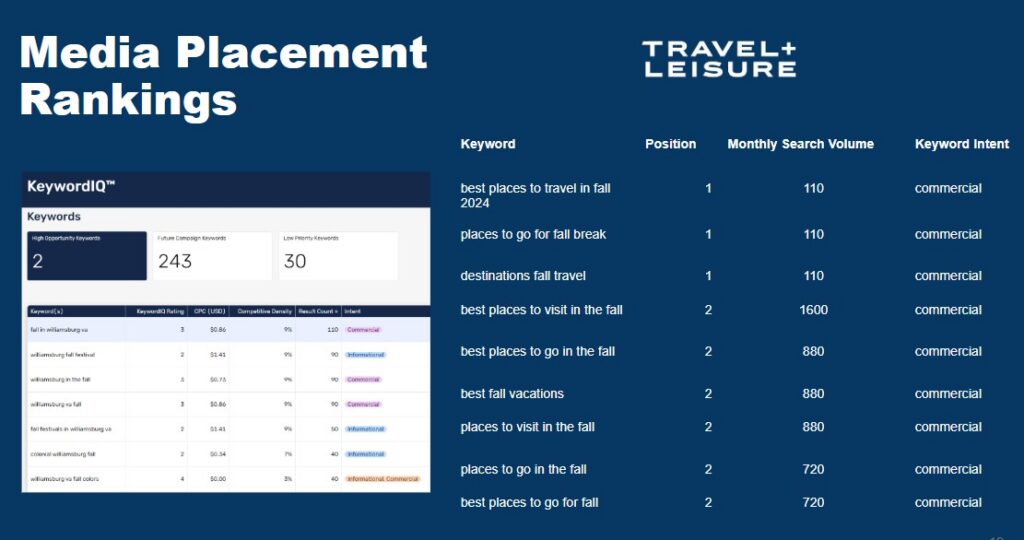
The proof bank records 55 major placements in five months for SKIFT, 17 creator trips for New Orleans, and 378 stories, more than 70 million viewers and an HSMAI Silver award for Amazon and Phantom Ranch. These examples show different ways original information, first-person experience and a provable travel story can create third-party source material.
Make travel content retrievable
Technical readiness for AI search optimization for travel brands begins with ordinary search eligibility. Keep essential facts in crawlable text, allow the appropriate search crawlers, use descriptive internal links, maintain a sound page experience and ensure visible structured data matches the page.
For AI search optimization for travel brands, technical SEO should test indexation, canonical signals, rendered content, JavaScript dependencies, booking-engine boundaries and crawler access. When discovery in ChatGPT search is desired, review OAI-SearchBot access separately from GPTBot training controls.
Schema can clarify visible entities and relationships, but it is not an AI recommendation switch. Use only types supported by the page, such as Organization, Article, BreadcrumbList, Hotel or LodgingBusiness, VacationRental, TouristAttraction, Event and LocalBusiness where the visible content qualifies.
AI search optimization for travel brands also depends on internal context. A hotel page should connect to its neighborhood, relevant itineraries, access information, policies and live action path rather than sit as an isolated product page.
Optimize images, maps and reviews
Because travel decisions are visual and spatial, AI search optimization for travel brands should use current original media, descriptive filenames, accurate alternative text, captions, room or product distinctions, location context and accessibility details. Videos should explain what the experience is, who it fits and what a traveler should expect, with a transcript when published.
AI search optimization for travel brands also relies on consistent local information, including addresses, coordinates, entrances, service areas, neighborhoods, transport options, hours and directions. Reviews can reveal traveler language and fit, but brands should not copy long passages, manufacture themes or create fake mentions.
These practices connect AI search optimization for travel brands to the broader travel and tourism marketing program. They also help human travelers verify whether a recommendation makes sense.
Prepare booking and inquiry paths
AI search optimization for travel brands must extend into booking paths that make dates, current availability, total price, policies, inclusions, capacity, accessibility, payment and confirmation clear. Agency and group paths should use a progressive trip brief that asks only for information needed at each stage.
Agent readiness in AI search optimization for travel brands begins with the same accessibility and transaction clarity that helps human travelers. Date pickers, filters, guest selectors, availability controls and forms need visible labels, understandable states, predictable errors and accessible confirmation.
A recommendation without a usable next step creates awareness, not revenue. Conversion rate optimization can test whether qualified visitors reach the correct booking, inquiry or partner action without promising automated booking.
Platform priorities for AI search optimization for travel brands
| Environment | Practical priority | Evidence to record |
|---|---|---|
| Google AI Overviews | Search eligibility, concise answers, corroboration and useful visual proof | Search Console Web data and analytics |
| Google AI Mode | Comparisons, query-fan-out coverage and decision content | Web performance data and dated prompt observations |
| ChatGPT search | OAI-SearchBot access, source clarity and authoritative public pages | Citations, links and documented referral parameters |
| Gemini | Current public sources and consistent entities | Dated prompt observations and visible referrals |
| Perplexity | Clear source passages and independent authority | Citations and referrals |
| Copilot | Bing eligibility, entity clarity and authority | Search and referral observations |
Measure AI travel visibility
Measurement for AI search optimization for travel brands should use a stable prompt set. Record the platform, country, language, persona, exact prompt, date, mention, recommendation, citation, link, sentiment, factual accuracy, competitor set, referral, conversion evidence and correction status.
Do not collapse all evidence into one visibility number. Use labels such as observed mention, observed citation or link, tracked referral, assisted conversion, direct conversion, platform-attributed, inferred influence and unknown. Mentions, citations, referrals and bookings are different evidence levels.
Google reports activity from its AI search features within Search Console’s Web performance reporting rather than a separate isolated AI report. A documented referral can show a visit, but an answer may produce no click. Attribution and analytics can connect those observations to assisted and direct outcomes without overstating causation.
For AI search optimization for travel brands, scale when both visibility and useful traveler actions improve. Add proof when a brand appears without a source, correct stale facts, consolidate competing weak pages, strengthen authority when competitors have better corroboration and fix conversion when discovery rises without action.
Correct inaccurate AI answers
- Capture the platform, prompt, date and exact inaccurate claim.
- Identify the likely public source or source conflict.
- Correct the official page and its visible structured facts.
- Update authoritative partners, listings and feeds where feasible.
- Request recrawling where supported, then repeat the same test.
Prioritize errors involving safety, closures, hours, price, availability, accessibility, location, entry rules and cancellation. In AI search optimization for travel brands, the durable correction strategy is a stronger public source graph, not a louder unsupported claim.
Score readiness
| Readiness area | Points | Evidence to inspect |
|---|---|---|
| Prompt coverage | 10 | Mapped traveler decisions and constraints |
| Entity and fact consistency | 10 | Owned source ledger and review dates |
| Decision pages | 10 | Fit, logistics, trade-offs and action |
| First-hand proof | 10 | Original media, experts and operating detail |
| Third-party corroboration | 10 | Relevant independent sources |
| Technical retrieval | 10 | Indexation, crawlability and visible text |
| Visual and local clarity | 10 | Accurate images, maps and local data |
| Booking or inquiry readiness | 10 | Transparent, accessible action path |
| Measurement | 10 | Stable prompts and evidence labels |
| Correction governance | 10 | Owner, response process and retest log |
Interpretation: For AI search optimization for travel brands, 85–100 is recommendation-ready; 70–84 is visible with gaps; 55–69 is source-fragile; below 55 indicates promotion without retrieval readiness. Each scorecard row should name the question, evidence, owner, score, risk and action.
Run a 90-day pilot
Establish the baseline
Test 30–50 stable prompts, record visible brands and sources, audit crawlability and facts, map existing pages and establish referral baselines.
Build one territory
Select one recommendation territory. Create its source ledger, primary decision page, supporting pages, original proof, authority plan, conversion path and analytics.
Publish, retest and decide
Add internal links, brief relevant partners, update local sources, request indexing, retest weekly and correct errors. Then decide whether to scale, revise, consolidate or stop.
A 90-day pilot establishes a working system and baseline; it does not guarantee material AI visibility. Keep the scope narrow enough to show whether AI search optimization for travel brands is improving source quality, retrieval and traveler action.
Avoid mistakes in AI search optimization for travel brands
- Publishing one generic “AI-friendly” page.
- Stuffing ChatGPT, “best” or destination phrases into copy.
- Creating one thin page for every prompt variation.
- Inventing awards, statistics, reviews or traveler claims.
- Relying on schema without useful visible content.
- Treating llms.txt as a ranking requirement.
- Blocking desired search crawlers without reviewing the effect.
- Confusing OAI-SearchBot discovery with GPTBot training controls.
- Publishing official claims without appropriate corroboration.
- Running PR without a matching evergreen destination page.
- Letting creator material disappear without a durable source URL.
- Leaving inventory, prices, hours or policies stale.
- Publishing itineraries that ignore distance or operating days.
- Omitting who an experience is not a good fit for.
- Using inaccessible booking controls.
- Sending international readers into an unlocalized booking path.
- Treating Search Console as a dedicated AI attribution report.
- Changing every prompt between tests.
- Measuring only branded questions.
- Using fake forum posts or manufactured mentions.
- Leaving corrections without an owner.
- Guaranteeing an AI recommendation.
Why Percepture has a point of view
Percepture connects search, content, public relations, analytics and transaction paths rather than treating AI visibility as a stand-alone writing exercise. That integrated view matters because AI search optimization for travel brands moves through multiple teams and public sources.
SKIFT source authority
The proof bank records 55 major placements in five months, illustrating how original information and expert interpretation can become source material for AI search optimization for travel brands.
Greater Williamsburg
The case study connects destination discovery with partner pathways, showing why destination content must lead to a usable visitor action.
New Orleans creator discovery
The proof records 17 creator trips, illustrating how first-person travel material can support lasting topic discovery when connected to evergreen pages.
Amazon and Phantom Ranch
The proof records earned travel authority and an HSMAI Silver award for a documented campaign story.

Connect AI visibility to the full travel journey
Place AI search optimization for travel brands in context by reviewing how AI discovery fits with travel SEO, travel PR, international markets and the booking experience.
Frequently asked questions
What is AI search optimization for travel brands?
AI search optimization for travel brands is the work of making a brand’s facts, experiences, proof and action paths easier for AI-enabled search systems to retrieve and use. It combines traveler-question mapping, current source data, decision-ready pages, independent authority, technical search eligibility, accessible conversion paths and evidence-based measurement.
How does ChatGPT choose travel recommendations?
OpenAI says ChatGPT search may rewrite a request into one or more targeted searches. The sources and resulting answer can vary by prompt and available information. AI search optimization for travel brands should therefore provide clear public facts, useful decision content and appropriate corroboration rather than assume one fixed ranking formula.
How does Google AI Mode plan trips?
Google describes query fan-out, which can run related searches across parts of a complex question. For a trip, those parts may include timing, destination fit, price, access, lodging, experiences and availability. Google says ordinary search eligibility and useful, crawlable content remain relevant.
Does schema help hotels appear in AI results?
Valid schema can clarify visible information about an organization, lodging business, article, event or breadcrumb path. It can support search understanding and eligible search features, but it does not guarantee an AI recommendation. Markup must match the content travelers can see on the page.
Should a travel brand create one page for every prompt?
No. Group prompts by traveler decision, intent and constraint. One strong comparison, itinerary or fit page can answer several closely related questions. Creating many thin pages can fragment authority, duplicate content and make fact maintenance harder.
Which pages help AI itineraries?
Useful pages explain duration, route order, travel time, operating days, reservations, season, accessibility, location and contingencies. They should also show who the itinerary fits, relevant trade-offs and a current booking, inquiry or partner action.
How do reviews and PR affect AI visibility?
Reviews, media, creators and institutions can corroborate experience claims made by a brand. Their value depends on relevance, accuracy and accessibility. They should complement an authoritative official source rather than replace current operating facts.
Should a site allow OAI-SearchBot?
OpenAI’s publisher guidance says sites that want public pages surfaced in ChatGPT search should allow OAI-SearchBot. That discovery control is separate from GPTBot training controls. Review crawler access with technical and legal stakeholders before changing robots directives.
How can AI visibility be tied to bookings?
Track mentions, citations, referral visits, assisted conversions and direct conversions as separate evidence levels. Use consistent analytics and dated prompt observations. A ranking or impression alone does not prove an AI citation or booking.
How long does AI travel optimization take?
Timing varies with crawlability, content gaps, source freshness, authority, publishing capacity and platform behavior. A 90-day pilot can establish a baseline, repair priority sources and test one recommendation territory. It should not be presented as a guarantee of material visibility.
Build a recommendation system your travel brand can support
Request a focused review of prompts, facts, decision pages, authority, retrieval, booking readiness and measurement. The goal of AI search optimization for travel brands is a public source system that helps travelers move from a broad request to a confident, usable decision.

About Bob Generale
Bob Generale wrote and authored this guide. He is President of Percepture and advises destination, hospitality and travel leaders on SEO, GEO, public relations, content, analytics and search-to-booking strategy. His work turns traveler questions, destination facts and public-source evidence into clearer market authority and more useful buyer journeys.
Bob has led integrated growth programs since 2004, including work recognized by the travel industry. He focuses on the questions owners and revenue teams need answered: where a brand is visible, which sources shape trust, what travelers still cannot verify and how discovery reaches a measurable partner, inquiry or booking action. Connect with Bob Generale on LinkedIn.