
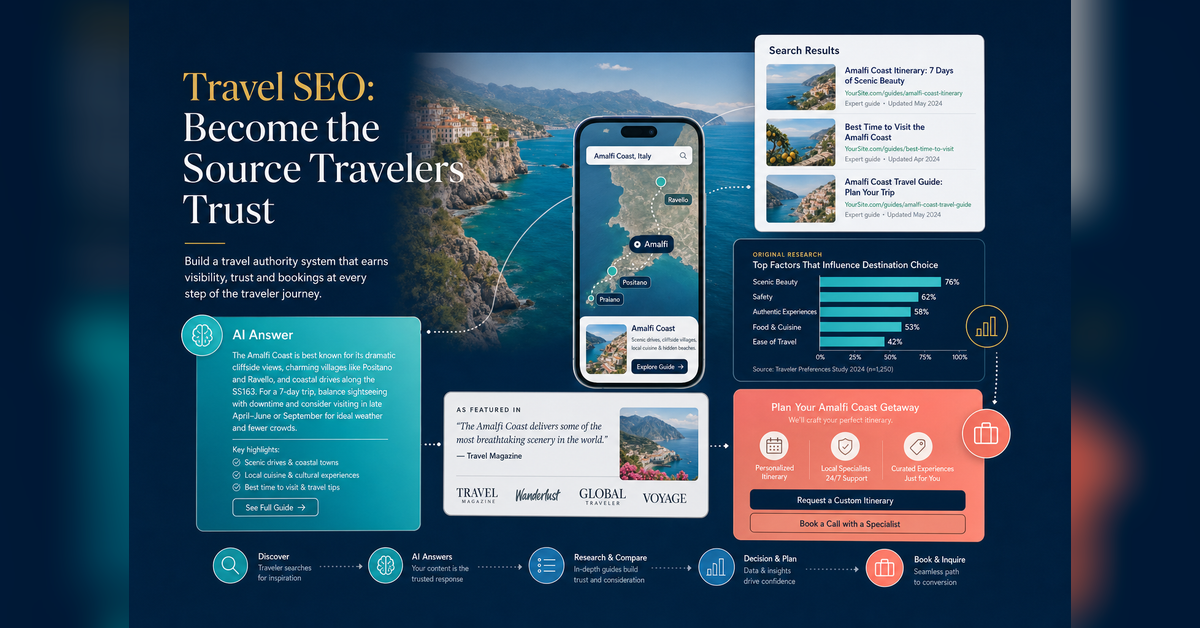

Travel SEO makes a travel brand discoverable and credible across Google, Maps, images, video and AI-generated answers. A complete strategy connects technical eligibility, traveler intent, original information, outside corroboration and clear paths to bookings, inquiries, referrals or visits.
The strongest programs do more than publish destination pages or collect links. They create information travelers, journalists and search systems can use, then support that information with expert interpretation and trusted third-party evidence.
What is travel SEO?
Travel SEO improves discoverability and credibility across Google, Maps, images, video and AI-generated answers through technical eligibility, traveler-intent content, original information, authority and clear conversion paths.
It coordinates the pages a brand controls with the local profiles, visual assets, expert identities, media coverage and external references that help people understand and trust the organization.
The executive view
A travel SEO operating model aligns technical, editorial, authority and conversion priorities around the traveler decisions that matter to the business.
Eligibility comes first
Search systems must be able to crawl, interpret and connect important pages before those pages can compete.
Intent shapes architecture
Each URL should help a traveler make one dominant decision instead of targeting every spelling variation.
Original information creates leverage
Data, field knowledge, comparisons and expert interpretation give other publishers a reason to reference the brand.
Authority needs evidence
Relevant citations, interviews, reviews, partners and editorial mentions can corroborate what the brand says about itself.
Who this strategy is built for
Destination leaders
Use travel SEO to connect official destination information with local evidence, partner value and trusted corroboration.
Hotels and resorts
Apply travel SEO to build nonbrand discovery around destinations, experiences and traveler needs while creating direct conversion paths.
Tour operators
Focus travel SEO on qualified trip inquiries, inventory fit and decision-stage content instead of undifferentiated traffic.
Travel platforms and publishers
Use travel SEO to turn proprietary market knowledge and expert commentary into reusable industry intelligence.
A provider can understand SEO and still misunderstand how a traveler chooses. Effective travel SEO accounts for booking windows, party composition, seasonality, local conditions, visual expectations, reviews, international markets and itinerary complexity.
The five surfaces of travel search
Travel SEO is not one blue-link ranking project. It coordinates discoverability and trust across the surfaces travelers use to make a decision.
| Surface | Traveler behavior | What the brand must provide |
|---|---|---|
| Google Search | Research, compare and plan | Useful pages, clear architecture, authority and internal pathways |
| Maps and local | Find nearby, open and trusted options | Accurate profiles, reviews, location relevance and operating details |
| Images and video | Visualize the experience | Original media, descriptive context, captions and demonstrations |
| News and editorial | Validate quality, relevance and timeliness | Source-worthy stories, evidence and expert commentary |
| AI-generated answers | Ask complex, multi-step questions | Clear entities, direct answers, current facts and crawlable supporting text |
One evidence system can serve several surfaces. Within travel SEO, a seasonal demand study might support a search guide, a journalist briefing, a chart, an executive interview and a concise answer about when different traveler groups should book.
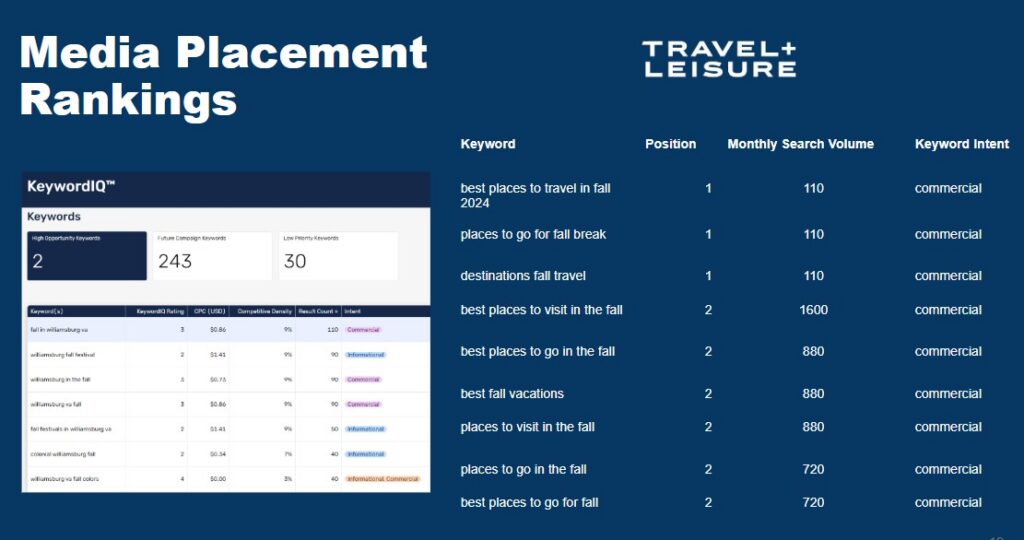
When the market starts saying “according to SKIFT,” authority has changed hands
Percepture helped SKIFT turn original travel intelligence, expert commentary and timely analysis into a media-relations program that supported repeated source status. The public case study documents 55 placements in the first five months.




The Travel Source-Worth-Citing travel SEO framework
Percepture’s Travel Source-Worth-Citing Model is a seven-part travel SEO method for turning first-party travel knowledge into information that travelers, publishers, search engines and AI systems can understand, verify and use.
| Stage | Requirement | Working output |
|---|---|---|
| 1. Search eligibility | Crawlable, indexable, fast and internally connected pages | Technical access |
| 2. Traveler intent | Dreaming, planning, comparing, booking, risk and in-destination needs | One dominant decision per URL |
| 3. Original information | Data, surveys, field knowledge, maps, visuals and case evidence | Information competitors cannot easily copy |
| 4. Expert interpretation | Meaning, limits, impact and a recommended decision | Credible analysis |
| 5. Timely distribution | News, seasonality, events, policy, weather and research cycles | Current relevance |
| 6. Corroboration | Editorial citations, links, mentions, interviews, reviews and partners | External validation |
| 7. Retrieval | Direct answers, clear entities, captions, sources, authors and schema | Search and AI usability |
A page becomes more valuable when it answers the traveler. A brand becomes more authoritative when other trusted sources use its information to answer the market. Within travel SEO, technical work earns eligibility while useful information and authority earn preference.
Would another trusted source cite what your brand publishes?
Use the Travel Source-Worth-Citing Scorecard to assess whether your travel SEO program covers eligibility, intent, original information, expertise, timeliness, corroboration, entity clarity, visual evidence, direct answers and conversion.
Map traveler intent before choosing keywords
A keyword list records language. An intent model records the decision behind that language. Strong travel SEO architecture begins with the decision and then groups related wording around it.
| Intent | Typical question | Useful page role |
|---|---|---|
| Inspiration | Where could we go? | Theme, season or traveler-type guide |
| Destination | Is this place right for us? | Destination decision page |
| Experience | What can we do there? | Experience or itinerary hub |
| Comparison | Which option fits our needs? | Criteria-led comparison |
| Local | What is nearby and available? | Location page and map profile |
| Booking | What should we reserve? | Offer, inventory or inquiry page |
| Risk | What could disrupt the trip? | Policy, protection or advisory content |
| Preparation | What should we know before arrival? | Practical planning guide |
| In-destination | What do we need right now? | Mobile-friendly operational information |
| Repeat or referral | What should we do next? | Loyalty, follow-up or recommendation path |
One URL should satisfy one decision, not one keyword spelling. Hotel marketers can apply this travel SEO intent model with the patterns in SEO keywords for hotels, while operators can use the segment guidance in SEO for tour operators.
Technical foundations earn eligibility
Travel sites often connect a content system, booking engine, inventory feed, map experience, media library and regional pages. Travel SEO must account for the resulting duplicate URLs, weak canonicals, broken internal paths, inaccessible content and seasonal pages that disappear when their authority should remain.
The technical travel SEO layer should address crawlability, indexation, canonical signals, mobile performance, internal links, media context, structured data, language and regional signals, and stable URLs for recurring demand. Enterprise SEO services can coordinate that work across complex sites, while omnichannel marketing connects search discovery with the rest of the customer experience.
Schema can clarify content and relationships, but no schema type guarantees inclusion in an AI answer. Important information should remain available as crawlable text rather than depending on a script or visual alone.
Create information the market can use
The goal is not to publish more than competitors. It is to publish information competitors need to reference. Source-worthy travel SEO content usually comes from six categories.
| Information type | Traveler question | Source opportunity | Conversion path |
|---|---|---|---|
| Proprietary data | What is changing? | Research finding or demand pattern | Report, briefing or inquiry |
| Expert interpretation | What does this mean for my trip? | Named analysis with limits and context | Consultation or specialist page |
| Field-based knowledge | What is it actually like? | Operational detail from people on location | Experience or booking page |
| Original visual evidence | Can I see the difference? | Map, photograph, demonstration or chart | Gallery, itinerary or property path |
| Decision tools | Which option fits me? | Transparent comparison criteria | Recommendation or quote request |
| Current operational facts | What is open, available or restricted? | Dated and maintained practical information | Reservation or next-step page |
Raw data needs interpretation. A chart without context may attract attention but leave the traveler unsure what to do. Effective travel SEO pairs the evidence with a decision. Content marketing services can turn evidence into decision-focused assets, while customer journey mapping connects those assets to the next useful action.
How PR and search reinforce each other
Digital PR should not be reduced to buying links. In travel SEO, its strongest role is creating relevant evidence around the same entities and questions the brand wants to own.
- Identify a real search or traveler question.
- Develop an original insight, dataset or informed point of view.
- Prepare a qualified expert who can explain the finding.
- Distribute the story to relevant journalists and publishers.
- Earn appropriate citations, links, mentions or interviews.
- Strengthen the public evidence around the topic and entity.
- Use response data to improve the next search asset.
Not every placement will change rankings, and placement count alone does not establish relevance. A travel SEO authority loop depends on the quality and topical fit of the evidence. Digital PR services support that loop, public relations services support expert and media relationships, and the travel PR guide explains the travel-specific operating model.
Entity authority makes relationships clear
An entity is a distinct person, place, organization or concept that can be identified consistently. For a travel brand, important entities may include the organization, destination, property, attraction, expert, event, trip type and geography.
Entity clarity comes from consistent names, accurate descriptions, stable relationships, named authors, official profiles and independent references. A citation attributes information to a source. Corroboration adds outside evidence that supports or confirms a material point.
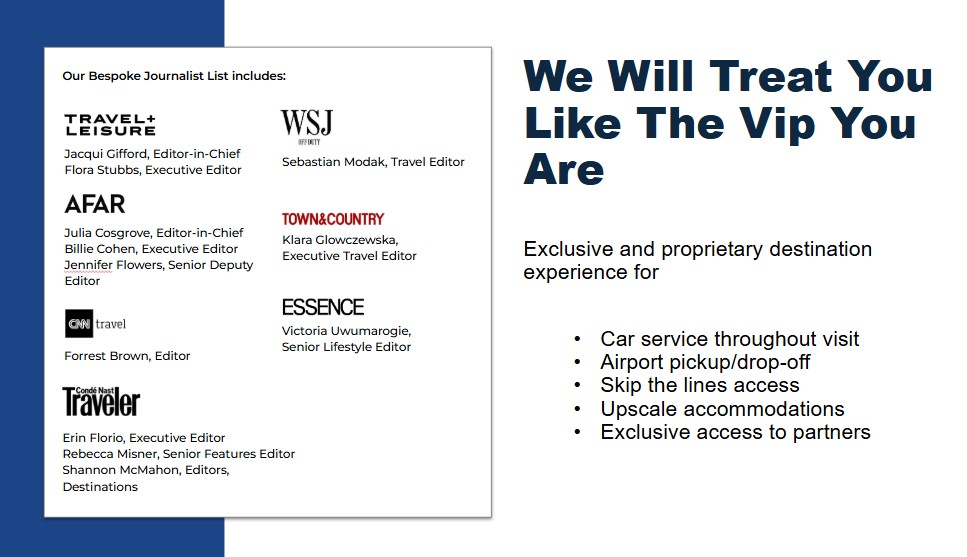
TravelInsurance.com illustrates the expert-entity approach described in Percepture’s internal case materials. The strategy connected the commercial platform and its leadership with useful commentary about traveler risk, financial protection, weather and disruptions. The travel SEO lesson is simple: a commercial brand can earn authority by helping answer a real traveler decision instead of pitching its product in every response.
See how repeated source status is built
The SKIFT case shows how original intelligence, expert availability and timely distribution can support travel SEO as an authority program rather than a one-time link campaign.
Prepare for AI-assisted trip planning
AI-search optimization is not a replacement for travel SEO. It is a stricter test of whether a brand’s information is accessible, useful, specific and externally supported.
Travel brands should publish crawlable text, concise answers, clear entity relationships, current facts, source labels, traveler-type distinctions, transparent comparison criteria and original evidence. Authors, dates, captions and descriptive links help readers and retrieval systems understand the context.
Google states that established search fundamentals remain relevant to its AI search features. OpenAI documents OAI-SearchBot separately from GPTBot. These systems should not be treated as identical, and a backlink, mention, schema property or llms.txt file does not guarantee citation.
- Confirm that important information can be crawled without executing an application.
- Check access rules for Googlebot and OAI-SearchBot.
- State who the information is for and when it applies.
- Separate stable facts from changing prices, availability and operating conditions.
- Track cited pages, referral activity and the questions that trigger brand visibility.
For travel SEO implementation support, compare generative engine optimization services with the travel examples in AI search for tourism marketing.
Official guidance: Google Search guidance for AI features and OpenAI crawler documentation.
Travel SEO should be visible in the places buyers actually search
Percepture tests its own methods in competitive search categories. These are documented snapshots, not permanent ranking guarantees.
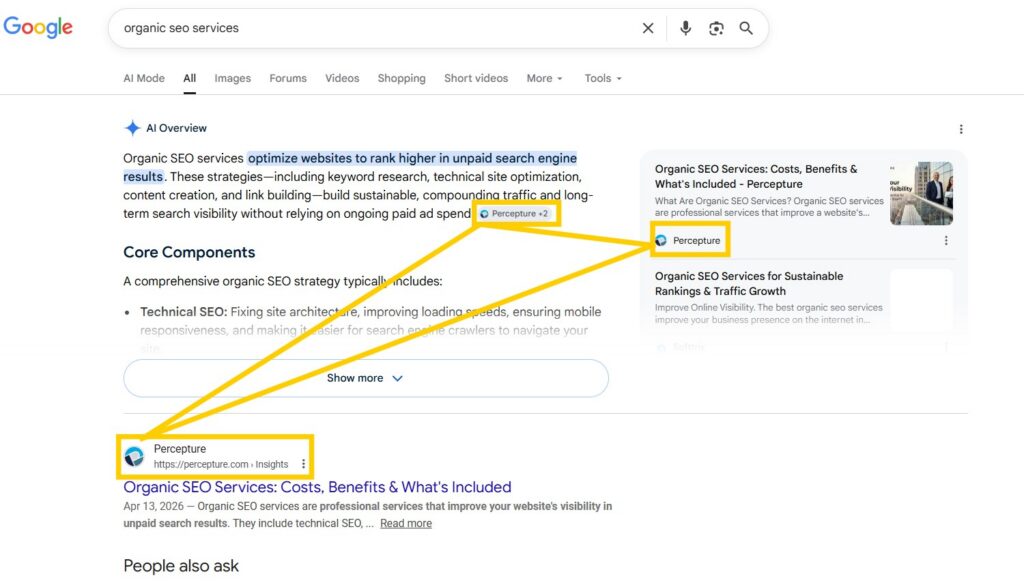
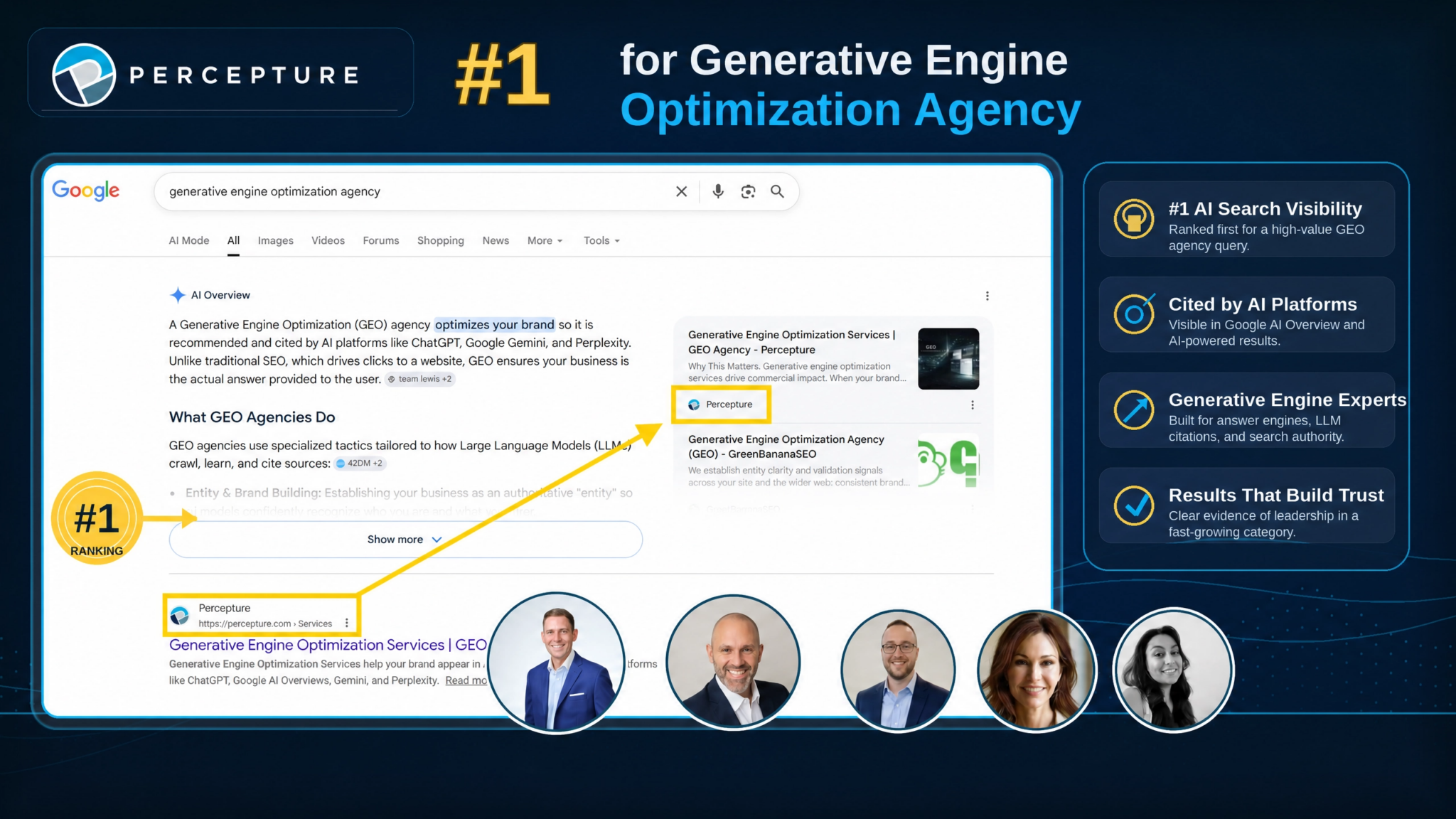
Organic search visibility
A strong SEO program can influence the classic result, recommendation modules and AI summaries around the same buyer question.
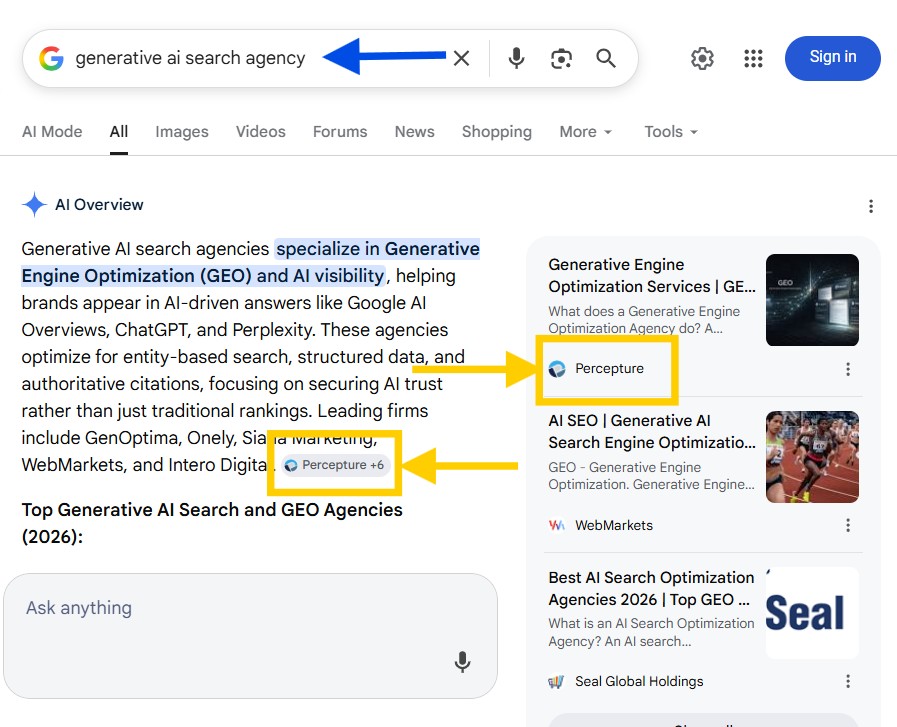
AI-search and GEO visibility
Entity clarity, direct answers, third-party evidence and technical access work together across search surfaces.
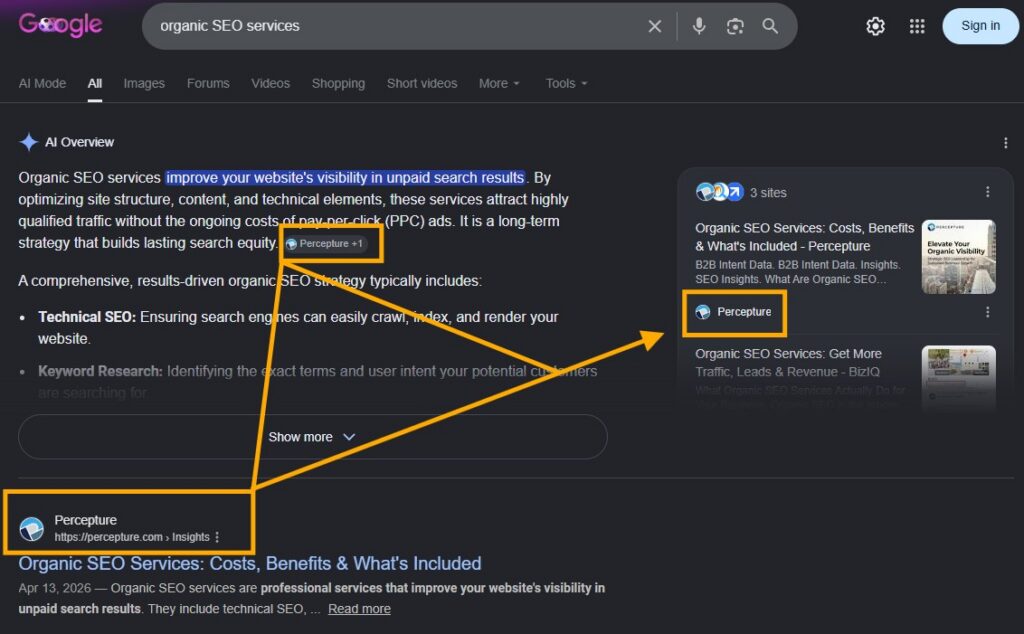
Emerging-category leadership
Winning a new category requires defining it clearly enough for buyers and retrieval systems to understand.
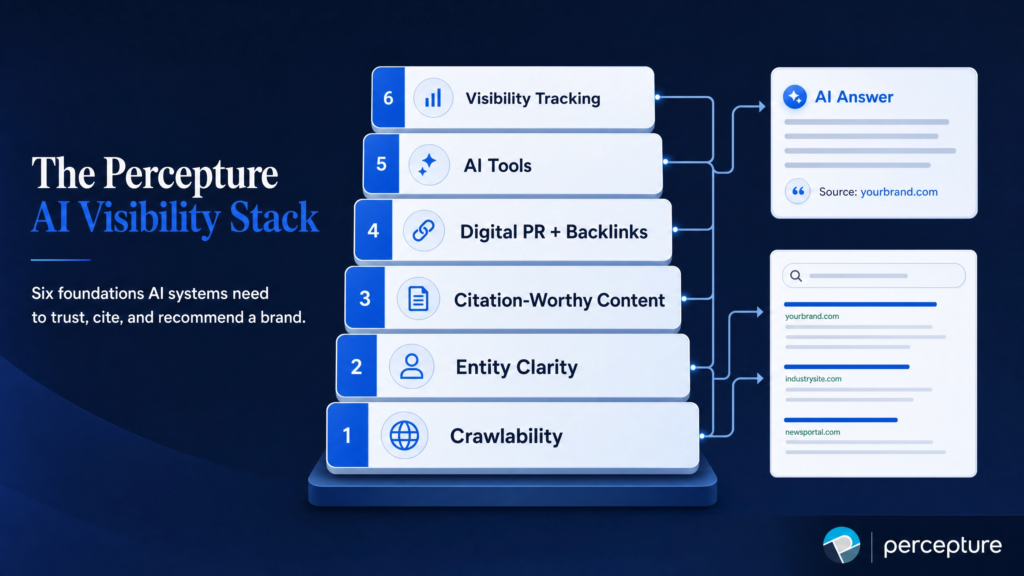
Multi-surface search proof
Visibility compounds when the same brand is credible across organic search, AI answers, editorial mentions and conversion pages.
Local, visual and international considerations
Local
Keep map profiles, reviews, location pages and operating details aligned. A closed facility, wrong entrance or stale opening time can erase the value of a ranking.
Visual
Use original images and video with useful captions, nearby text and transcripts. Decorative media may look attractive without answering a decision.
International
Localize language, currency, cultural assumptions and booking information. Use regional architecture and language signals that reflect the actual market served.
Different segments require different travel SEO operating choices. A hotel SEO agency must understand property and destination demand, while a destination marketing agency must account for partner ecosystems and official destination responsibilities.
How travel SEO should be measured
Rankings diagnose visibility. Bookings, inquiries, referrals and citations diagnose whether that visibility is becoming useful.
| Level | Questions | Example measures |
|---|---|---|
| Eligibility | Can priority information be found and interpreted? | Indexed priority pages, crawl issues, internal-link depth |
| Visibility | Where does the brand appear? | Nonbrand rankings, Maps presence, image and video visibility |
| Authority | Who references the brand? | Relevant citations, editorial mentions, interviews, branded search |
| Qualified action | What do useful visitors do? | Partner clicks, itinerary views, inquiries and booking starts |
| Business value | What outcomes did search assist? | Bookings, visits, referrals, pipeline and assisted revenue |
A complete travel SEO measurement plan connects these levels instead of reporting each in isolation. Attribution and analytics can connect discovery with later actions, while conversion rate optimization services improve the path from useful information to a measurable next step.
A practical 90-day authority roadmap
Days 1–30: establish the baseline
Audit crawlability, priority URLs, intent coverage, entity consistency, conversion paths, existing citations and the inventory of usable proof.
Days 31–60: fix and build
Resolve priority technical barriers, improve direct answers, strengthen authorship and internal links, and produce the first source-worthy asset.
Days 61–90: publish and distribute
Release the asset, brief relevant publishers, monitor search and AI answers, review qualified actions and set the next quarter’s priorities.
A 90-day travel SEO plan creates a controlled operating cycle; it does not promise a ranking date. Investment should reflect site complexity, research needs, media scope and the number of markets involved. Buyers comparing execution models can review SEO pricing packages.
The 100-point travel SEO authority scorecard
Score each area from zero to ten. Use evidence, not confidence, to determine where the travel SEO program is strong and where ownership is missing.
| Area | What a strong score requires | Points |
|---|---|---|
| Technical eligibility | Priority content is crawlable, indexable and internally connected | 0–10 |
| Intent coverage | Important traveler decisions have clear URL ownership | 0–10 |
| Original information | The brand publishes useful evidence competitors cannot easily copy | 0–10 |
| Expert interpretation | Named specialists explain meaning, limits and action | 0–10 |
| Timeliness | Changing information has owners, dates and update routines | 0–10 |
| Corroboration | Relevant third parties reference the brand and its expertise | 0–10 |
| Entity clarity | People, places, properties and relationships are consistent | 0–10 |
| Visual and local evidence | Media, reviews, profiles and operational facts support decisions | 0–10 |
| AI extraction | Answers are specific, accessible, current and well contextualized | 0–10 |
| Conversion | Priority pages lead to measurable traveler or partner actions | 0–10 |
- 85–100: source-worthy authority system
- 70–84: strong foundation with defined gaps
- 55–69: conventional optimization without a complete authority system
- Below 55: fragmented visibility and evidence
Compare conventional optimization with an authority system
| Decision area | Conventional approach | Source-worthy approach |
|---|---|---|
| Keyword strategy | Build pages around wording variations | Build one strong page for each traveler decision |
| Content | Summarize common destination information | Publish original evidence and informed interpretation |
| Links | Pursue placement volume | Earn relevant corroboration around priority entities |
| PR | Run separate publicity campaigns | Distribute evidence tied to search demand |
| AI visibility | Add FAQs or schema and wait | Improve access, specificity, entity clarity and support |
| Measurement | Report rankings and sessions | Connect visibility, citations and qualified action |
This guide explains the strategic travel SEO system. Commercial provider evaluation should separately examine deliverables, staffing, research scope, reporting, costs and implementation ownership.
Common mistakes that weaken authority
- Publishing generic destination articles without firsthand value.
- Creating one page for every close keyword variation.
- Measuring traffic without defining booking or inquiry pathways.
- Treating a technical audit as the full strategy.
- Buying links instead of earning relevant editorial context.
- Running PR without connecting stories to search questions.
- Hiding experts behind anonymous brand copy.
- Leaving seasonal facts, policies and operating details undated.
- Duplicating itinerary or inventory pages without clear canonical ownership.
- Using decorative images that provide no decision value.
- Assuming schema or crawler files guarantee AI visibility.
- Reporting only rankings when citations and qualified actions matter.
Strong travel SEO avoids these errors by assigning ownership: every priority page, entity, fact, conversion event and update cycle has a responsible team.
Why Percepture approaches the work differently
Source-authority proof
The SKIFT program connected original travel intelligence and expert commentary with focused media relations.
Expert-entity strategy
TravelInsurance.com shows how useful consumer expertise can support authority around real traveler risk decisions.
Integrated disciplines
Search, GEO, content, public relations and analytics can operate around one intent and entity model.
Travel specialization
Percepture maintains a dedicated travel and tourism marketing practice and publishes segment-specific guidance.
The travel SEO operating question is not only, “What can rank?” It is also, “What can the organization know, prove and publish that the market will use?” The answer determines whether the program produces commodity pages or durable authority.
Frequently asked questions
What is travel SEO?
Travel SEO is the practice of improving a travel brand’s discoverability and credibility across search results, maps, images, video, editorial sources and AI-generated answers. It combines technical access, traveler-intent pages, useful information, entity clarity, outside corroboration and conversion paths.
Is travel SEO different from tourism SEO?
The terms often overlap. Tourism SEO commonly emphasizes destinations, attractions and visitor economies, while the broader travel category can also include hotels, resorts, operators, booking platforms, publishers, insurance and transportation. The right travel SEO strategy follows the traveler’s decision and the organization’s business model.
Why does travel require specialized search strategy?
Travel decisions involve seasonality, booking windows, local intent, visual evidence, reviews, multiple travelers, changing conditions and international markets. Specialized travel SEO must account for those variables because a technically sound page can still fail if it does not reflect how people compare destinations, properties, experiences and risk.
How do SEO and digital PR work together?
Search data identifies questions the market asks. Original information and experts provide an answer worth distributing. Relevant media coverage can then add citations, mentions, links and outside context around the same entities. In travel SEO, the two disciplines should share priorities without assuming every placement changes rankings.
How can a travel brand appear in AI-generated answers?
Travel SEO for AI visibility starts with accurate, crawlable and specific information; clear entities; real traveler questions; audience and condition distinctions; visible sources and dates; and relevant outside corroboration. No individual tactic guarantees inclusion, so visibility should be monitored across representative questions over time.
Does schema guarantee an AI citation?
No. Structured data can help systems understand a page and its relationships, but it does not guarantee ranking or citation. The visible page still needs accessible text, useful answers, clear entities, accurate facts and evidence that supports material claims.
What makes travel content worth citing?
A source-worthy travel SEO asset contains information or interpretation another credible publisher would reasonably reference instead of rewriting from common knowledge. Examples include proprietary data, field observations, expert analysis, current operational facts, original maps and transparent comparison tools.
How long does a travel search program take?
Travel SEO timing depends on the site’s condition, competition, implementation speed, research scope and existing authority. A 90-day operating cycle is useful for establishing a baseline, fixing priority barriers, publishing an initial authority asset and measuring early movement without promising a ranking date.
How should results be measured?
Measure travel SEO across eligibility, visibility, authority, qualified action and business value. Useful indicators include indexed priority pages, nonbrand rankings, local and visual visibility, relevant citations, branded demand, AI references, booking starts, inquiries, referrals and assisted revenue.
Can a travel brand compete with large OTAs?
A travel brand does not need to copy an OTA’s inventory model. Travel SEO can compete where the brand has stronger local knowledge, firsthand experience, distinctive inventory, expert guidance or direct operational facts. The best opportunity is often a focused traveler decision where the brand has information an aggregator cannot reproduce.
Find the travel questions your brand should help define
A Travel Authority and AI Visibility Review examines technical eligibility, traveler intent, original information, expert entities, media corroboration, search visibility, AI presence and conversion paths. Use it to identify where travel SEO can create useful demand rather than another reporting dashboard.