
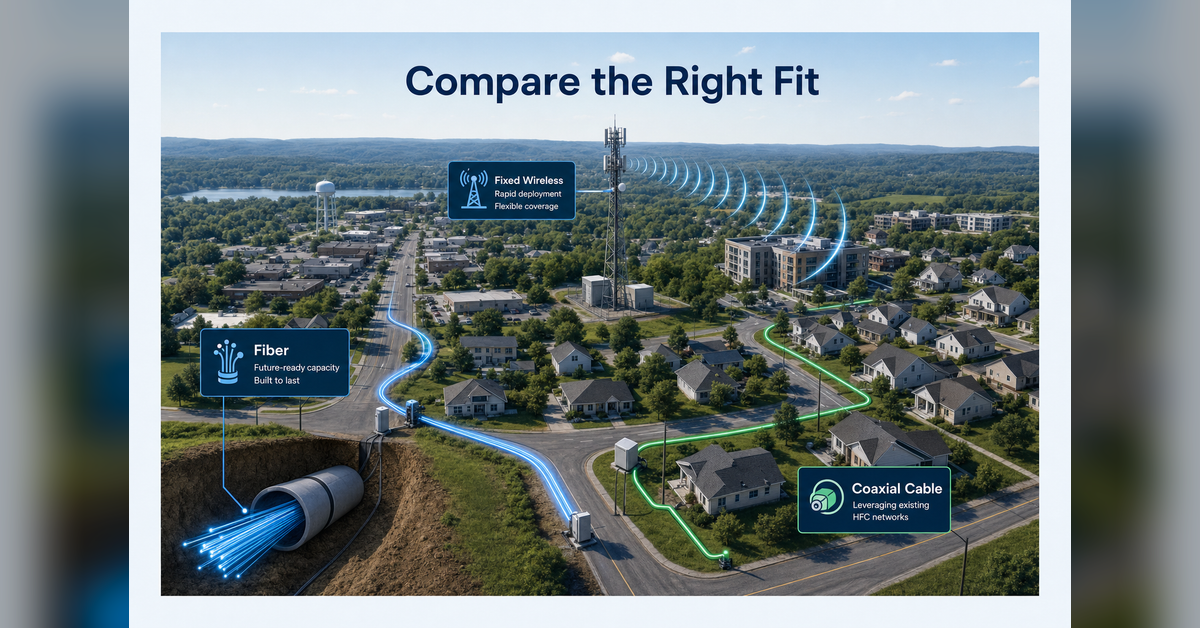

Fiber vs. Fixed Wireless vs. Cable is not just a speed comparison. For an ISP, the choice affects where service can be sold, what buyers expect, how deployment is explained, and whether marketing creates qualified demand or avoidable frustration.
Percepture treats this as serviceability-aware market conditioning, not generic channel marketing. ISP marketing starts with the network: where it can sell, what each location can receive, what proof buyers need, and how interest moves into an address check, conversation, installation, or subscriber relationship.





Which broadband technology is the right fit?
Fiber vs. Fixed Wireless vs. Cable has no universal winner. Fiber can be a strong long-term infrastructure choice, fixed wireless can extend service without a wired connection to every premise, and cable can remain competitive where coaxial infrastructure already exists. The right answer depends on serviceability, location, use case, network design, buyer expectations, deployment constraints, and the proof behind each offer.
Executive summary
Start with serviceability
Do not create demand for an address the network cannot serve. Connect targeting, landing pages, address checks, CRM routing, and sales follow-up.
Compare fit, not slogans
A useful Fiber vs. Fixed Wireless vs. Cable comparison explains the buyer, location, operating need, constraints, and upgrade path behind each option.
Use proof before pitch
Coverage language, installation expectations, plan terms, local availability, support information, and credible third-party proof should do the heavy lifting.
Measure business movement
Track address checks, qualified leads, pre-registrations, meetings, installations, subscriber conversion, response time, and retention where applicable.
Make answers retrievable
Clear definitions, tables, FAQs, entity language, internal links, and visible proof help people and answer systems understand the offer.
Who this guide is for
CEO and CFO
Use Fiber vs. Fixed Wireless vs. Cable to connect network limits, expansion logic, market trust, spending discipline, and subscriber outcomes.
Product and marketing
Use Fiber vs. Fixed Wireless vs. Cable to build accurate offers, comparison pages, FAQs, campaigns, and proof assets around serviceable markets.
Public affairs and outreach
Use Fiber vs. Fixed Wireless vs. Cable to explain deployment choices without turning a community conversation into a technology contest.
Sales and operations
Use Fiber vs. Fixed Wireless vs. Cable to define qualification fields, routing rules, response expectations, and the information passed into the CRM.
Technical buyer educators
Use Fiber vs. Fixed Wireless vs. Cable to translate network differences into plain language while preserving the conditions and limits behind each claim.
This guide is not for companies seeking generic social posts, broad untargeted media buying, or a channel-first campaign detached from network reality. Percepture’s broader ISP marketing agency framework explains how serviceability, trust, search visibility, and sales routing work together.
Audit your technology comparison and buyer FAQs
Check whether your current Fiber vs. Fixed Wireless vs. Cable page identifies serviceable locations, explains buyer fit, answers operational objections, and routes qualified interest to the right team.
Review strategy and planning supportFiber vs. Fixed Wireless vs. Cable: the plain-English answer
Fiber carries data through fiber-optic infrastructure. Fixed wireless uses a radio connection between network infrastructure and the customer location. Cable internet commonly uses existing coaxial infrastructure and associated network systems. Those descriptions identify the delivery method, but they do not settle the commercial decision.
In a Fiber vs. Fixed Wireless vs. Cable evaluation, buyers usually ask a different set of questions: Is it available here? Will the service support my household or business use? What should I expect during installation? How is reliability explained? Are upload and download needs different? What happens when my needs grow? How quickly can I get support?
An ISP should answer those questions before declaring one technology superior. Fiber can be the strongest message when long-term infrastructure, capacity, upload needs, and upgrade planning lead the decision. Fixed wireless can make sense where radio-based delivery fits the location and deployment model. Cable can remain a viable choice where infrastructure is present and the offer meets the buyer’s actual requirements.
That is why Fiber vs. Fixed Wireless vs. Cable should be presented as a buyer-fit decision. Marketing should state what is available, who it fits, what conditions matter, and what the buyer should do next.
Why the comparison matters for ISP marketing and community trust
A Fiber vs. Fixed Wireless vs. Cable campaign aimed where the network cannot sell wastes spend and breaks trust. A campaign may generate traffic and form fills, but those numbers are weak business signals if the addresses are outside the footprint or cannot receive the advertised plan.
Intent data without serviceability is expensive curiosity. Before media, content, or outreach goes live, the ISP should define serviceable geography, eligible products, exceptions, installation status, and the routing logic for addresses that are live, under construction, planned, or unavailable.
This is where omnichannel marketing must follow network truth. Search, paid media, email, public relations, community outreach, landing pages, and sales scripts should communicate the same availability and offer logic.
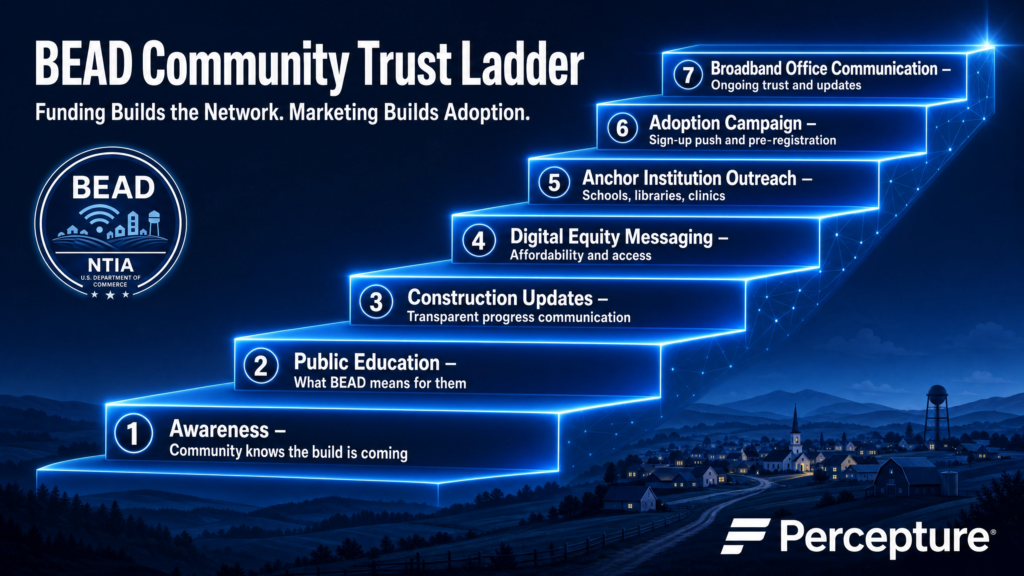
Community communication matters before construction as well as after launch. Percepture’s guide to community trust before broadband construction explains why expectations, local proof, and clear next steps should be established before asking residents or businesses to act.
“The mistake is treating ISP marketing like normal demand generation. It is not. The first question is not what channel to use. The first question is where the network can sell, what the market already believes, and what proof is needed before a buyer takes the next step.”
— Bob Generale, President, Percepture
The Broadband Technology Communication Matrix
The Broadband Technology Communication Matrix is Percepture’s method for turning Fiber vs. Fixed Wireless vs. Cable from a technical debate into a serviceability-aware buyer system. It connects five decisions: where the network can serve, which use cases fit, what claims can be supported, how the offer should be found, and how qualified interest reaches sales or operations.
The five-part communication matrix
- Map serviceability. Network operations owns the source data. Marketing uses it to control Fiber vs. Fixed Wireless vs. Cable geography, offer eligibility, and address-level next steps.
- Define buyer fit. Product, sales, and customer teams identify the Fiber vs. Fixed Wireless vs. Cable use cases, objections, installation questions, and plan details that matter in each market.
- Build the proof layer. Marketing and public affairs organize Fiber vs. Fixed Wireless vs. Cable coverage explanations, technical documentation, local information, testimonials, third-party validation, and support expectations.
- Create retrievable answers. Content, SEO, GEO, and PR teams publish direct Fiber vs. Fixed Wireless vs. Cable answers, comparison tables, FAQs, and consistent entity language across owned and earned channels.
- Route and measure demand. Sales operations defines CRM fields, qualification rules, response ownership, pipeline stages, and outcome reporting for Fiber vs. Fixed Wireless vs. Cable interest.
Consider a Fiber vs. Fixed Wireless vs. Cable market with live addresses, construction-stage addresses, and nearby addresses outside the current plan. A weak campaign sends every visitor to the same offer. A strong campaign checks the address first, shows an available-plan path for live locations, a pre-registration path for planned locations, and an honest alternative for locations outside the footprint.
The matrix also keeps teams aligned. The CEO sees market and revenue logic. The CFO sees where waste is controlled. Marketing sees the content and channel plan. Sales sees lead quality and response rules. Operations sees whether public promises match delivery reality.
How to compare speed, upload, latency, reliability, cost, and deployment
A useful Fiber vs. Fixed Wireless vs. Cable framework does not publish a single winner across every market. It defines the questions buyers should ask and the conditions the ISP should disclose.
Broadband technology comparison
The Fiber vs. Fixed Wireless vs. Cable scorecard below keeps each decision area tied to available plans, local conditions, and claims the operator can support.
| Decision area | Fiber | Fixed wireless | Cable | What marketing should explain |
|---|---|---|---|---|
| Availability | Depends on the fiber footprint and connection status. | Depends on network coverage, location, equipment, and radio conditions. | Depends on the existing cable footprint and eligible service. | Use an address-level check and state whether service is live, planned, or unavailable. |
| Speed and upload needs | Present the available plan, not a category-wide promise. | Explain the offered plan and relevant location conditions. | Explain the offered tier and how upload and download needs fit the buyer. | Use plan-level facts and define which workloads the offer is designed to support. |
| Latency | Explain the service design and buyer use case. | Explain how the wireless path and network design relate to the offer. | Explain the service design and buyer use case. | Avoid universal claims; answer gaming, voice, cloud, remote work, and business application questions directly. |
| Reliability | Describe the network, installation, support, and restoration expectations. | Describe network conditions, equipment, support, and any relevant environmental considerations. | Describe infrastructure, support, and restoration expectations. | Support reliability language with documentation and location-specific information. |
| Deployment | May require construction and premise connection work. | Can avoid a wired connection to every premise when the network and location support service. | Can use existing coaxial infrastructure where available. | Explain installation timing, construction status, equipment, and customer responsibilities. |
| Upgrade path | Connect current plans to the operator’s documented network roadmap. | Explain how network, spectrum, equipment, and capacity planning affect future offers. | Explain how network and equipment upgrades relate to future tiers. | Do not sell an undocumented future state. Describe current service and published plans. |
When fiber is strongest
Within a Fiber vs. Fixed Wireless vs. Cable decision, fiber is strongest when the service is available, the operator can support the claim, and the buyer values the plan characteristics delivered over that network. Business buyers may focus on cloud applications, large file movement, video collaboration, continuity planning, and growth. Households may focus on simultaneous use, remote work, streaming, gaming, and future needs.
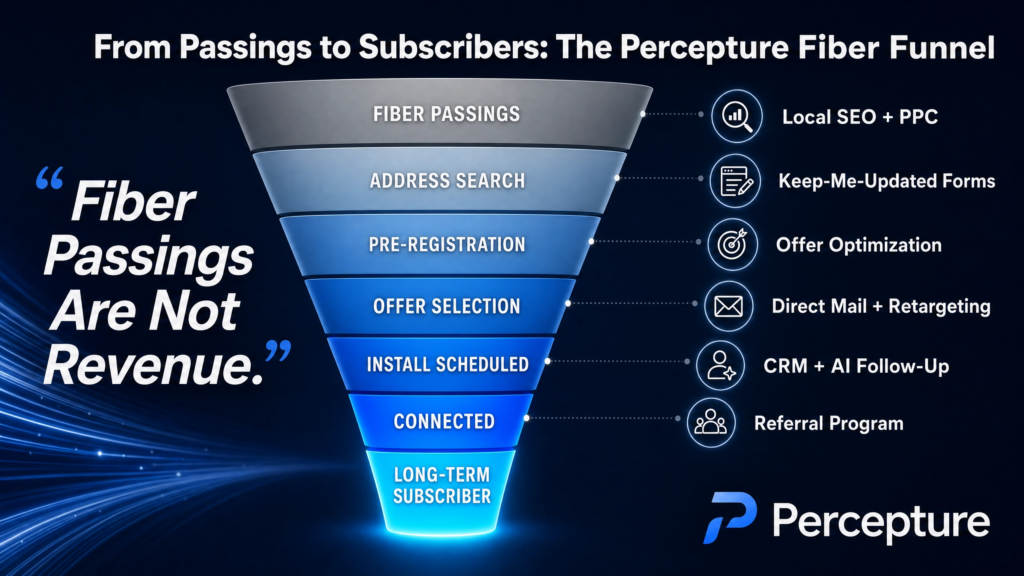
The marketing mistake is assuming that infrastructure alone creates adoption. Fiber passings are not revenue. The ISP still needs awareness, local credibility, address checks, offer clarity, installation follow-up, and a path from interest to subscriber.
A focused FTTH marketing strategy should answer construction, installation, timing, equipment, plan, support, and switching questions. It should also separate live addresses from pre-registration markets so sales and community teams do not make conflicting promises.
When fixed wireless makes sense
In a Fiber vs. Fixed Wireless vs. Cable comparison, fixed wireless makes sense when the radio-based service model fits the location, the network can support the offer, and deployment objectives favor that approach. It may be relevant where wired construction is difficult, where the operator is extending coverage, or where the available plan meets the buyer’s practical requirements.
The page should explain more than “wireless.” Buyers need to understand availability, equipment, installation, plan terms, support, and any location conditions that affect eligibility. Technical teams should define the boundaries of each claim before marketing turns it into a headline.
For rural buyers, the best technology is the service that is actually available, suitable for the use case, supportable by the operator, and communicated honestly. A theoretical advantage has little value at an unserviceable address.
When public funding or community planning is part of the conversation, BEAD technology neutrality explained provides adjacent context for discussing technology choices without reducing the decision to a slogan.
When cable remains competitive
In a Fiber vs. Fixed Wireless vs. Cable evaluation, cable remains competitive where the infrastructure exists, the available plans fit buyer requirements, and the operator can provide a clear installation and support path. Buyers do not choose from abstract network categories. They choose from the plans, prices, service terms, and providers available at their address.
A cable comparison should therefore avoid defending the category in broad terms. It should show what the offered service supports, where it is available, what the installation involves, and why the plan fits the intended household or business.
Existing customer relationships also matter. When affordability programs, market conditions, or offers change, the operator needs a retention plan rather than a one-time acquisition message. Percepture’s Post-ACP broadband retention strategies guide covers that adjacent challenge.
How should an ISP explain the choice?
An ISP should frame Fiber vs. Fixed Wireless vs. Cable around serviceability, buyer use, supported claims, installation expectations, and a realistic next step.
| What weak programs do | What strong ISP programs do | What Percepture would check |
|---|---|---|
| Lead with a universal technology claim. | Define location, use case, available plan, and decision conditions. | Whether every major claim maps to an eligible offer and serviceable geography. |
| Target an entire region without footprint controls. | Connect campaigns and landing pages to serviceability data. | Suppression rules, address-check logic, construction status, and geographic exclusions. |
| Publish technical jargon without buyer context. | Translate network facts into installation, support, application, and growth questions. | Whether CEO, CFO, marketing, sales, technical, and community questions are answered. |
| Rely on promotional claims alone. | Use proof before pitch and trust before take-rate. | Plan documentation, local information, third-party proof, FAQs, and sales consistency. |
| Treat SEO and AI visibility as separate projects. | Build direct answers, structured pages, authority, and consistent entity signals. | Organic search foundations, GEO structure, internal links, schema, and retrievable proof. |
| Send every lead into one queue. | Route by address, product, readiness, buyer type, and market stage. | CRM fields, ownership, response time, disposition data, and feedback to marketing. |
| Report clicks and impressions as the result. | Measure movement toward qualified demand and subscriber value. | Address checks, qualified leads, meetings, installations, pipeline, and retention signals. |
Percepture calls the supporting visibility model the Golden Triangle: organic search, AI answers, and third-party proof working together. Organic SEO services establish the searchable foundation, generative engine optimization services improve answer structure and entity clarity, and digital PR services help build authority beyond the ISP’s own page.
AI visibility is not a replacement for SEO, PR, or proof. It is the compounding result of all three. Pages should use plain definitions, concise answers, comparison tables, visible evidence, descriptive headings, and consistent terminology. Percepture’s guide to improving brand visibility in AI search engines explains the broader approach.
Connect technology neutrality to broadband offer strategy
Use the policy and adoption resources to align Fiber vs. Fixed Wireless vs. Cable choices, community communication, buyer education, and the path from awareness to a qualified next step.
Review BEAD marketing and subscriber adoptionWhat should this cost, and how should it be measured?
The cost of a Fiber vs. Fixed Wireless vs. Cable communication program depends on scope. A single comparison page is different from a multi-market system that includes serviceability integration, research, messaging, search content, public relations, paid media, conversion paths, CRM routing, reporting, and ongoing optimization.
Budget and measurement framework
| Workstream | What the budget should cover | What to measure |
|---|---|---|
| Research and positioning | Fiber vs. Fixed Wireless vs. Cable buyer questions, serviceability logic, offer review, competitive context, and claim support. | Approved message architecture and fewer gaps between technical, marketing, and sales language. |
| Content and conversion | Fiber vs. Fixed Wireless vs. Cable pages, local pages, FAQs, proof modules, address checks, and conversion paths. | Qualified visits, address checks, pre-registrations, form completion, and meeting requests. |
| Search and AI visibility | Technical SEO, entity clarity, internal linking, Fiber vs. Fixed Wireless vs. Cable answer structure, schema, and content maintenance. | Branded and non-branded visibility, qualified organic traffic, indexed content, and documented AI-answer checks. |
| Authority and outreach | Digital PR, community information, stakeholder communication, and reusable Trust Tokens. | Relevant coverage, referral activity, proof usage, stakeholder response, and assisted conversions. |
| Sales and analytics | CRM fields, routing, attribution, dashboards, response standards, and disposition feedback. | Cost per qualified lead, response time, meetings, install conversion, pipeline value, and retention where relevant. |
A CFO should look for waste in unserviceable targeting, duplicated tools, low-quality leads, unsupported claims, slow response, and reporting that stops at traffic. An attribution and analytics plan should connect channel activity to qualification and commercial outcomes without pretending every influence can be reduced to one click.
A VP of Marketing should own Fiber vs. Fixed Wireless vs. Cable message consistency, content, proof, and campaign orchestration. A VP of Sales should own lead acceptance, response, disposition, and feedback. Operations should own serviceability truth. Leadership should agree on the outcome definitions before approving spend.
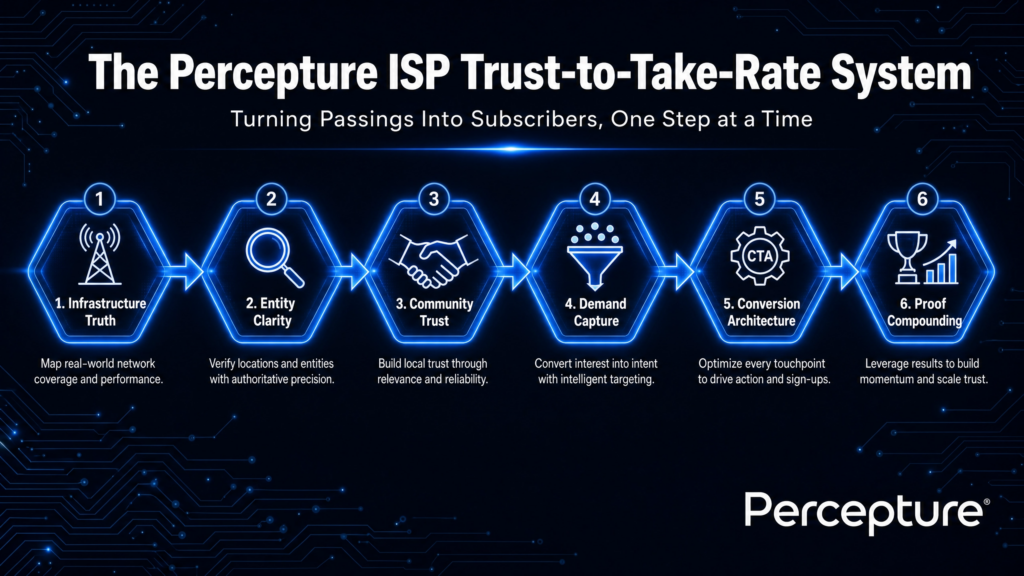
Messaging readiness scorecard
Use this Fiber vs. Fixed Wireless vs. Cable scorecard before launching a comparison page or campaign. Answer yes or no. A “no” identifies an operating gap, not merely a copy edit.
Ten questions for ISP leadership
| Readiness question | Yes | No | Owner |
|---|---|---|---|
| Can the buyer check serviceability before seeing an address-specific Fiber vs. Fixed Wireless vs. Cable offer? | □ | □ | Operations and digital |
| Are live, construction-stage, planned, and unavailable addresses routed differently? | □ | □ | Operations and sales |
| Does every speed, reliability, installation, and availability claim have supporting information? | □ | □ | Product and legal |
| Does the Fiber vs. Fixed Wireless vs. Cable page explain which buyer or use case fits each available option? | □ | □ | Product marketing |
| Are upload, latency, equipment, support, and upgrade questions addressed plainly? | □ | □ | Technical and support |
| Do search, paid, email, PR, outreach, and sales use consistent offer language? | □ | □ | Marketing leadership |
| Does the CRM receive address, product, market stage, source, and buyer-intent data? | □ | □ | Sales operations |
| Is response ownership defined for every qualified conversion path? | □ | □ | Sales leadership |
| Are direct answers, tables, FAQs, internal links, and schema aligned? | □ | □ | SEO and GEO |
| Does reporting connect visibility to address checks, qualified leads, meetings, installs, or retention? | □ | □ | Analytics and leadership |
Mistakes ISPs should avoid
These Fiber vs. Fixed Wireless vs. Cable mistakes usually appear when category messaging is separated from network, product, sales, and serviceability decisions.
- Declaring one technology best everywhere. Location, network design, available plans, use case, economics, and operating constraints change the answer.
- Hiding serviceability until late in the funnel. The address check should guide the experience before media spend and sales time are wasted.
- Using category claims as plan claims. Market the service the buyer can actually order, not every theoretical characteristic associated with the technology.
- Ignoring upload, latency, installation, and support questions. Buyers want operational answers, not only a download-speed headline.
- Sending construction-stage demand to a live-service sales queue. Pre-registration and nurture require different expectations and follow-up.
- Publishing proof only as an image. Important claims and explanations should also appear as visible HTML text that people and answer systems can retrieve.
- Separating marketing from CRM design. Lead quality depends on the fields, rules, ownership, and response process after conversion.
- Measuring traffic without subscriber movement. Search visibility matters when it contributes to address checks, qualified leads, meetings, installs, subscribers, or retention.
A conversion rate optimization review can identify friction between the comparison, address check, proof, form, and next step. A separate lead generation plan can then define qualification, routing, follow-up, and feedback without treating every inquiry as equal.
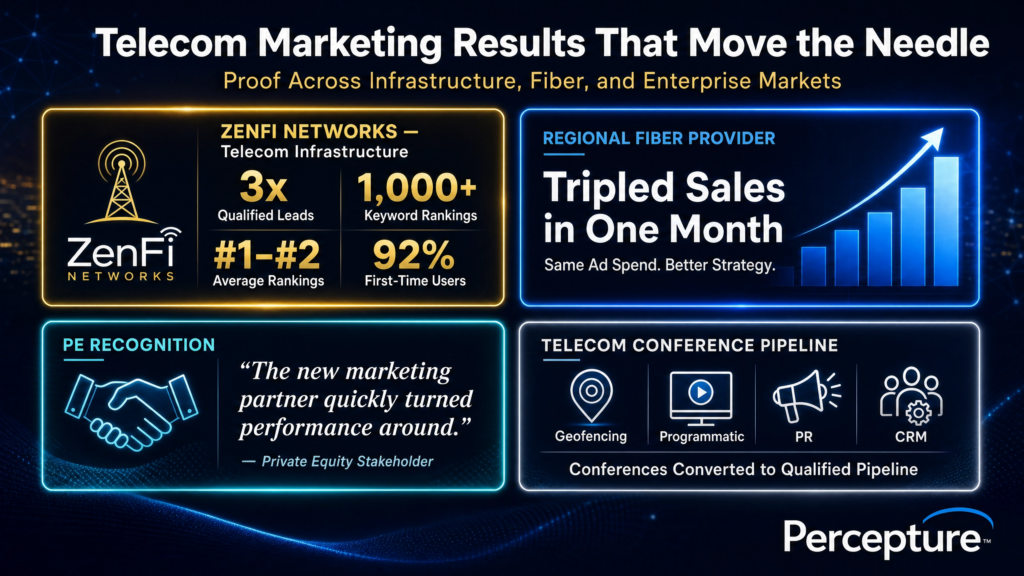
Proof should connect visibility to qualified action
Trust Tokens are proof assets that help buyers and answer systems understand why a brand is credible. They can include documented expertise, case studies, clear technical explanations, third-party recognition, customer evidence, and consistent executive commentary.
See how Percepture connected search visibility, B2B credibility, and qualified lead generation in the Broadstaff Global case study. The relevant lesson for an ISP is structural: visibility, proof, conversion, and sales qualification should be designed as one system.
Frequently asked questions
What is Fiber vs. Fixed Wireless vs. Cable?
Fiber uses fiber-optic infrastructure, fixed wireless uses a radio connection to the customer location, and cable commonly uses coaxial infrastructure. The practical comparison should cover local availability, offered plans, use case, installation, reliability expectations, support, deployment constraints, and upgrade planning.
Why must the comparison start with serviceability?
Fiber vs. Fixed Wireless vs. Cable must start with serviceability because an ISP cannot sell every plan at every address. Serviceability determines which offer, conversion path, campaign, and sales response should apply. Starting there reduces wasted targeting and prevents buyers from receiving promises the network cannot fulfill.
Which broadband technology is best for rural areas?
For rural Fiber vs. Fixed Wireless vs. Cable decisions, the best option is the service that is available at the address, fits the buyer’s needs, can be supported by the operator, and has clear installation and plan terms. Rural conditions vary, so a category-wide answer can be misleading.
What should a CEO know before investing in the message?
The message must connect network reality to expansion, trust, acquisition, and retention. Leadership should require serviceability controls, supported claims, clear buyer fit, sales routing, and reporting tied to qualified demand or subscriber outcomes.
What should the page include for technical buyers?
Include the delivery method, available plans, upload and download considerations, latency questions, equipment, installation, serviceability, support, operational constraints, and upgrade information. State conditions plainly rather than hiding them in promotional language.
How should Fiber vs. Fixed Wireless vs. Cable support AI search visibility?
Use a concise definition, descriptive headings, visible comparison tables, short factual answers, consistent entity language, contextual internal links, proof, FAQ content, and matching schema. These elements improve clarity without guaranteeing inclusion in any answer system.
What proof should an ISP show before asking for a conversation?
Show accurate availability information, plan documentation, installation expectations, support details, relevant customer evidence, technical explanations, and credible third-party validation. The proof should answer a buyer objection and support the specific offer.
What CTA should a broadband comparison page use?
Use an address check when the buyer is selecting service, a pre-registration path for planned markets, a diagnostic for marketing leaders, and a strategy conversation for teams with a defined messaging or pipeline problem. Match the CTA to readiness.
How should keyword density be handled?
Use the primary phrase in places that help the reader identify the topic, including the opening, a heading, the comparison framework, an FAQ, and the final action section. Variations should support readability rather than replace clear topical language.
How should marketing and sales coordinate?
Marketing should pass serviceability, market stage, product interest, source, and buyer-intent data. Sales should return response time, qualification, disposition, meeting, installation, and outcome data so targeting and content can improve.
Clarify your Fiber vs. Fixed Wireless vs. Cable message
Percepture can review how your Fiber vs. Fixed Wireless vs. Cable serviceability data, buyer education, proof, search visibility, AI retrievability, conversion paths, and sales routing work together. The goal is a broadband message that respects network limits and moves qualified buyers toward the right next step.
Talk with Percepture about broadband messagingVisual proof used in this guide

About Bob Generale
Bob Generale is President of Percepture, a PR, SEO, GEO, AI-search visibility, and digital marketing agency founded in 2004. He works with B2B, telecom, infrastructure, private equity, healthcare, life sciences, and complex service companies to connect search visibility, credibility, market conditioning, and qualified lead generation.