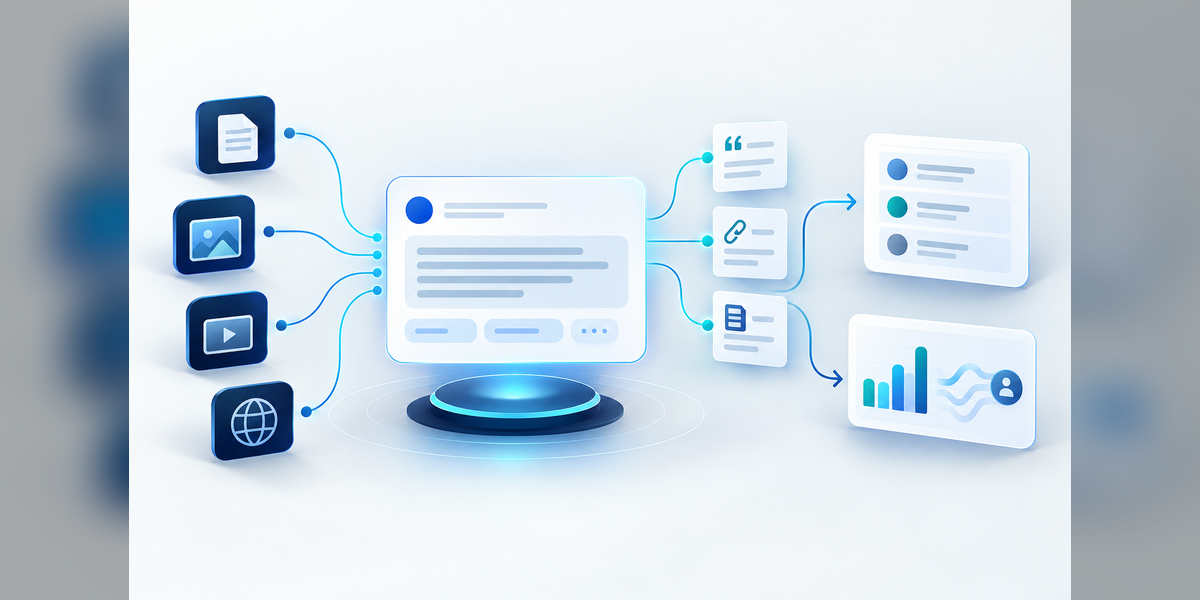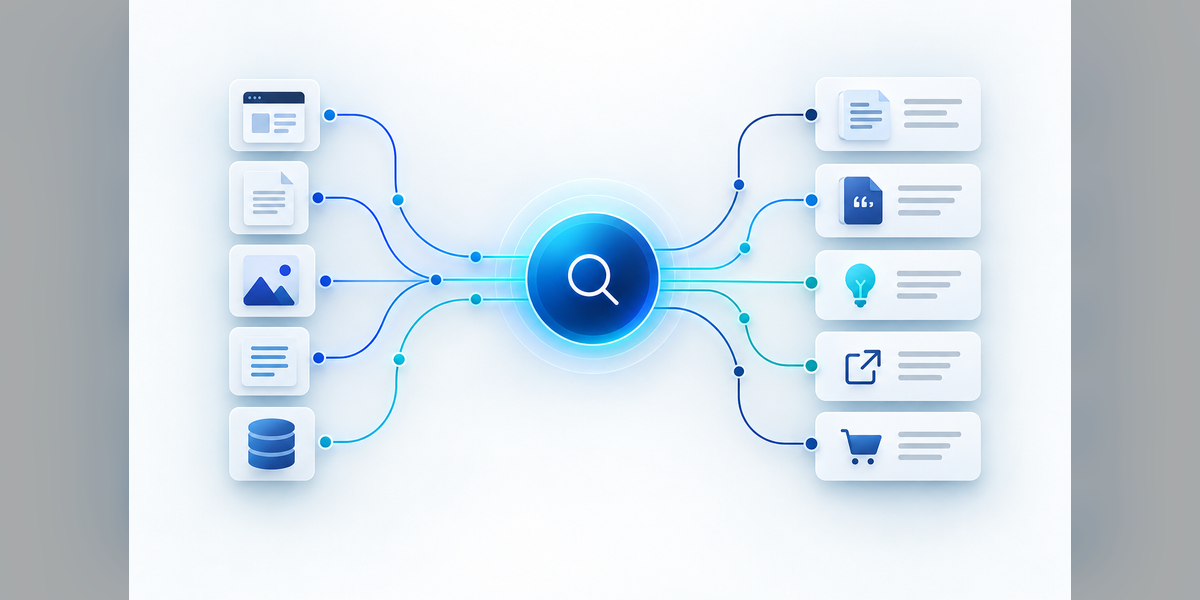


An ISP marketing agency helps internet service providers, broadband operators, fiber networks, and telecom infrastructure companies turn service areas, passings, grant-funded builds, MDUs, enterprise buildings, and community relationships into measurable subscribers, qualified leads, revenue, and trust.
Percepture combines telecom PR, SEO, AI search visibility, paid media, programmatic targeting, sales automation, conversion tracking, and executive strategy to help ISPs condition the market before buyers search, capture demand when they do search, and convert demand into sales.
Telecom, B2B, PR, SEO, GEO, and Conference-to-Pipeline Credibility
ISP and dark fiber buyers are not only evaluating creative. They are evaluating whether the agency understands telecom infrastructure, public trust, executive visibility, AI search, lead quality, and sales follow-up.
Percepture brings two decades of operator-led marketing experience into that decision, supported by telecom proof, conference visibility, B2B client work, and search systems built for complex infrastructure markets.

PTC Conference Ecosystem
Telecom conference visibility, networking, positioning, and event-to-pipeline strategy for infrastructure buyers.

PTC DC + Digital Infrastructure
Separate visibility for the DC market, carrier-neutral infrastructure, data centers, AI infrastructure, and enterprise connectivity.
Client, Partner, and Telecom Ecosystem Signals
For ISP growth, credibility comes from more than one badge. Percepture uses PR, conference campaigns, SEO, GEO, retargeting, and follow-up systems to turn telecom visibility into sales conversations.










What Does an ISP Marketing Agency Do?
An ISP marketing agency helps broadband providers build demand, earn trust, capture local searches, generate qualified leads, improve take-rate, support sales teams, and convert serviceable locations into subscribers. The best ISP marketing programs connect SEO, GEO, PR, paid media, programmatic, direct mail, CRM follow-up, and conversion tracking.
Executive Summary for ISP Leaders
The market changed
BEAD execution, the end of ACP funding, cable and FWA competition, MDU deal pressure, and AI search have made broadband marketing more complex. A broadband growth partner now has to connect policy context, local trust, search behavior, and sales operations.
Serviceability is the filter
The difference between generic marketing and ISP marketing is serviceability. If the campaign ignores where the network can sell, when the build is live, who can buy, and how sales follows up, marketing creates noise instead of revenue.
Percepture’s role
Percepture is not a generalist SEO shop trying to learn broadband. Percepture brings PR, SEO, GEO, paid media, AI-search, and lead-generation depth across telecom, fiber, digital infrastructure, data centers, AI infrastructure, and B2B demand generation.
The operating goal
Percepture helps ISPs condition the market before buyers search, capture demand when buyers are ready, and convert that demand into subscribers, DIA leads, MDU deals, and AI-search visibility.
Run the ISP Growth Diagnostic
If you are not sure where the funnel is leaking, start with serviceability, search visibility, paid media, conversion tracking, and lead follow-up. A useful agency should diagnose the growth system before it sells a tactic.
Why ISP Marketing Has Changed
Most ISPs know how to build networks. Fewer know how to condition the market before buyers search, before construction is complete, and before competitors lock in the customer. BEAD adds public funding, public scrutiny, construction updates, broadband office coordination, and adoption pressure. The end of the Affordable Connectivity Program also changed the affordability conversation for many households. See the NTIA BEAD program and the FCC Affordable Connectivity Program for program context.
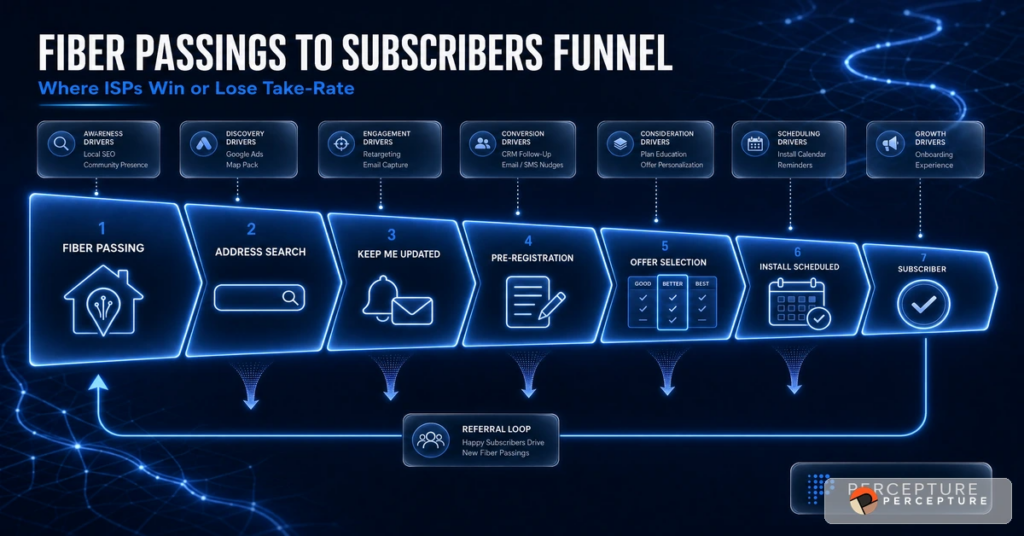
Fiber-to-the-home growth creates a second issue: take-rate pressure. Passings are expensive, but passings do not pay bills. A household has to trust the provider, confirm serviceability, compare the offer, schedule installation, and stay connected. That path requires fiber take-rate marketing, address-level campaigns, local pages, paid search, retargeting, direct mail, referrals, and fast sales follow-up. The program has to organize those channels around live and near-live service areas, not broad impressions.
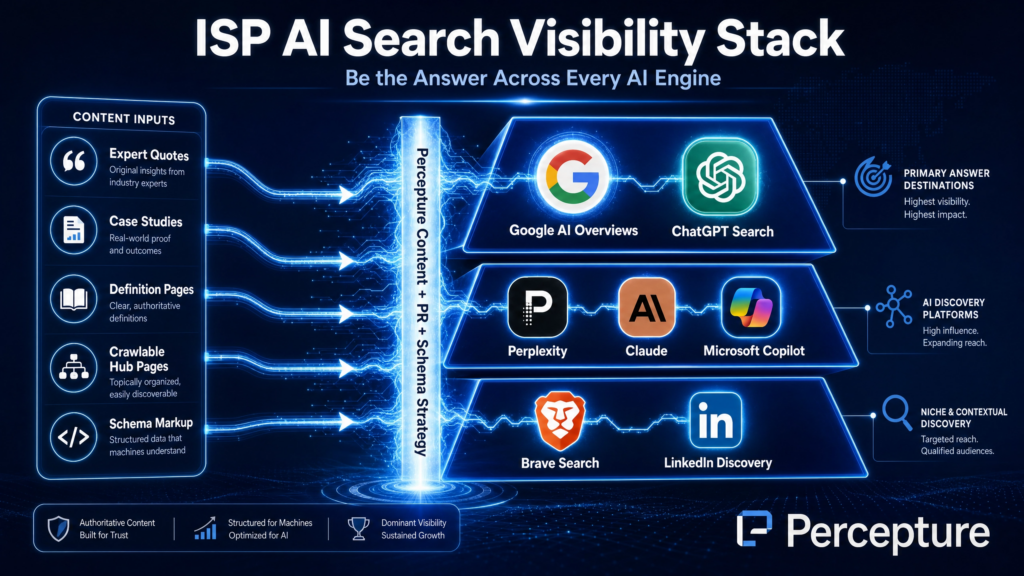
AI search is changing discovery at the same time. A CEO, IT director, property owner, or broadband office can ask ChatGPT Search, Perplexity, Claude, Microsoft Copilot, Brave Search, or Google AI Overviews for vendor shortlists and definitions. ISP content has to be crawlable, answer-ready, entity clear, supported by proof, and connected to internal authority through generative engine optimization services. A modern broadband growth team also has to make the provider understandable to AI systems that summarize markets and vendors.
ISP Marketing Function-to-Outcome Scorecard
This scorecard shows how channel work should connect to subscriber, pipeline, and trust outcomes.
| Function | ISP Outcome |
|---|---|
| SEO | Capture high-intent searches for fiber, broadband, DIA, and local service areas through organic SEO services. |
| GEO / AI Search | Make the provider easier for ChatGPT, Perplexity, Claude, Copilot, Brave, and Google AI Overviews to retrieve. |
| Digital PR | Build trust with communities, regulators, investors, and enterprise buyers through digital PR services. |
| PPC | Capture buyers searching for service now with paid search. |
| Programmatic | Target households, buildings, events, and business buyers through media buying and audience strategy. |
| CRO | Turn traffic into form fills, calls, pre-registrations, and sales using conversion rate optimization. |
| AI Sales Agents | Qualify leads and improve speed-to-lead with AI sales agents. |
| Reporting | Tie marketing spend to leads, subscribers, and pipeline through attribution and analytics. |
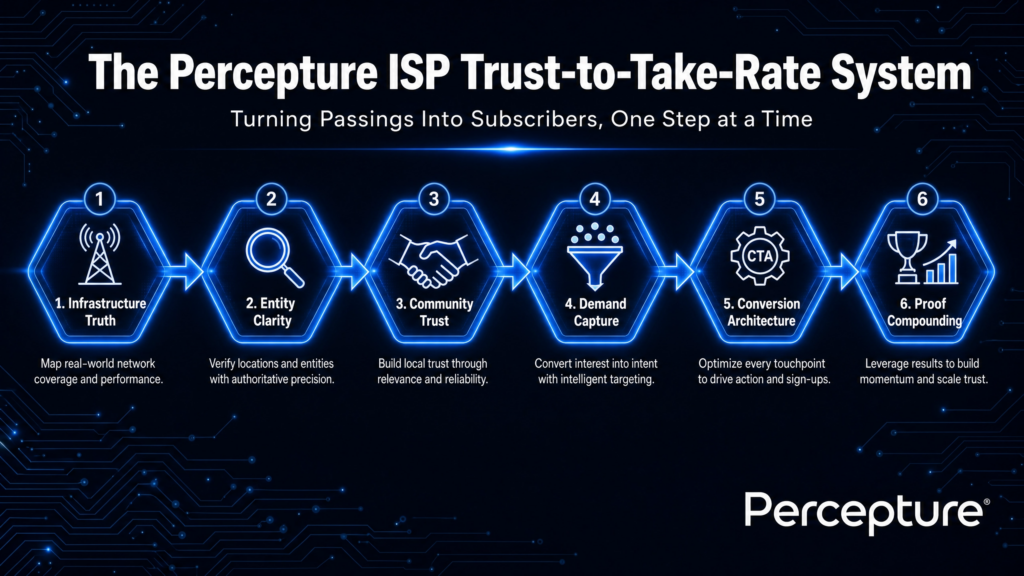
The Percepture ISP Trust-to-Take-Rate System
The Percepture ISP Trust-to-Take-Rate System connects physical network truth, public trust, search visibility, address-level demand, conversion tracking, and sales follow-up into one growth system for broadband providers. A strong ISP growth program starts with what can actually be sold and then builds demand around that truth.
Six Parts of the System
Infrastructure Truth
Define active, pre-sale, future-serviceable, MDU, DIA, middle-mile, and route-sensitive opportunities before campaigns launch. The team should not spend before this map is clear.
Entity Clarity
Make the provider, markets, services, leadership, service areas, and proof easy for Google and AI engines to understand.
Community Trust
Use PR, education, construction updates, local content, and public communication to reduce doubt before demand capture begins.
Demand Capture
Use SEO, PPC, programmatic, retargeting, direct mail, events, and local pages to reach buyers when intent appears.
Conversion Architecture
Connect address search, pre-registration, keep-me-updated forms, offer pages, CRM routing, and install scheduling.
Proof Compounding
Turn case studies, rankings, earned media, community wins, and customer stories into reusable search and sales assets.
Who Percepture Helps
Regional fiber providers
Pain: Passings are not converting into subscribers fast enough.
Percepture solution: local SEO, paid search, serviceability mapping, PR, retargeting, and sales follow-up from a partner that understands take-rate pressure.
BEAD-funded broadband operators
Pain: The build is funded, but community trust and adoption still have to be earned.
Percepture solution: outreach messaging, PR, construction updates, adoption campaigns, and stakeholder content shaped by a team familiar with public-facing broadband rollouts.
Residential ISPs
Pain: Households check serviceability but do not always choose, schedule, or install.
Percepture solution: address-search optimization, offer testing, PPC, retargeting, referral content, and CRM follow-up.
MDU and multifamily broadband providers
Pain: Property owners weigh resident experience, NOI, install disruption, and building readiness.
Percepture solution: property-owner targeting, resident launch content, managed Wi-Fi positioning, and sales enablement from a team that separates owner, manager, and resident messaging.
DIA and metro Ethernet providers
Pain: IT buyers need confidence in uptime, route diversity, SLAs, latency, and escalation.
Percepture solution: account-based targeting, serviceable-building pages, sales engineering content, and pipeline tracking.
Telecom infrastructure and neutral-host providers
Pain: Complex infrastructure value is hard to explain to buyers, investors, and partners.
Percepture solution: telecom PR, SEO, conference campaigns, digital infrastructure content, and executive visibility supported by Percepture’s infrastructure-category experience.
ISP Marketing for Residential Fiber Providers
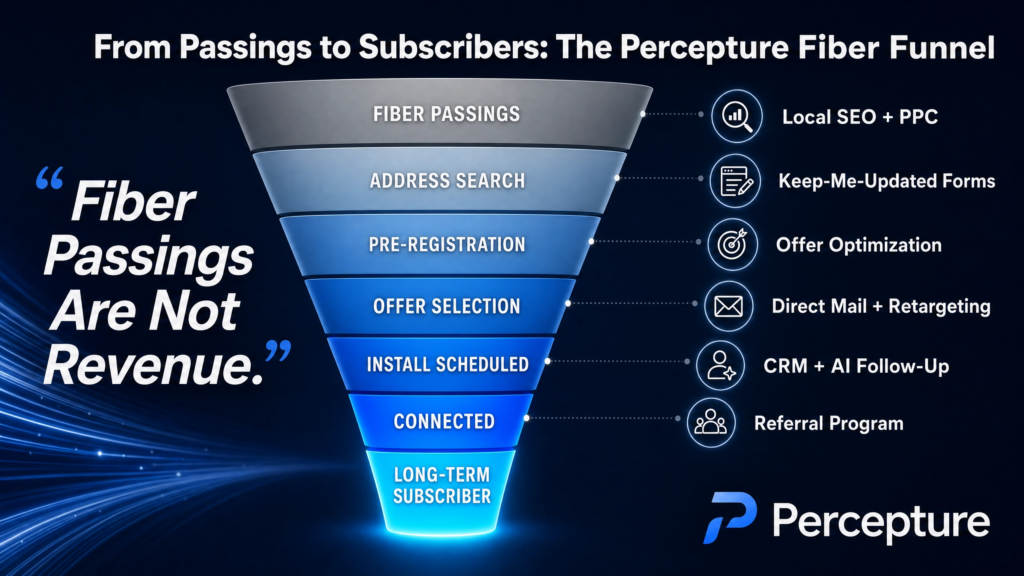
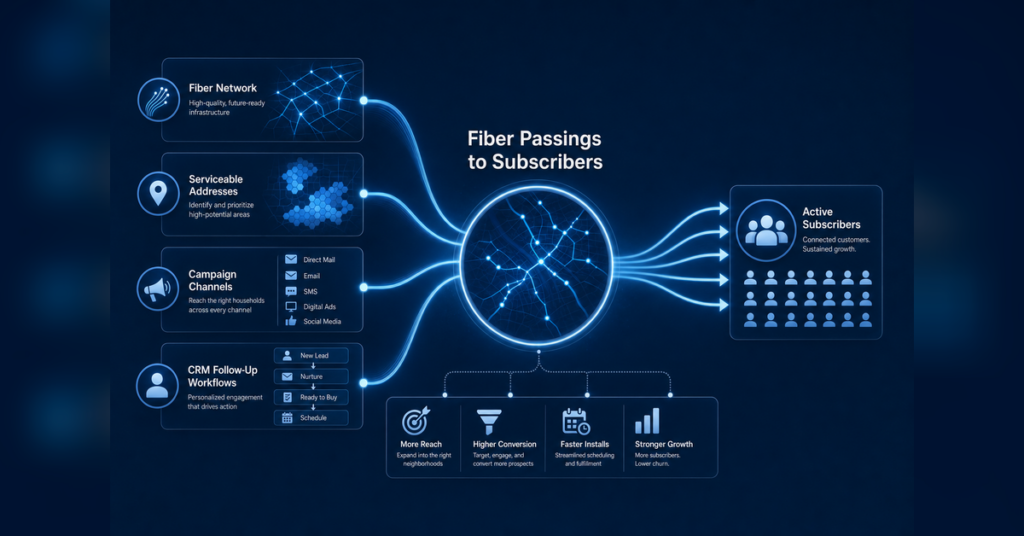
Fiber passings are not revenue. A passing becomes valuable when a household trusts the provider, confirms serviceability, chooses an offer, schedules installation, and stays connected. That is why residential fiber growth needs a plan to convert fiber passings into subscribers, not just a launch announcement. The marketing system should make each step visible in the funnel.
Percepture builds the residential funnel around address search, pre-registration, keep-me-updated forms, PPC, local SEO for fiber internet providers, retargeting, direct mail, installation scheduling, referrals, and reporting. When a new service area opens, the campaign should segment pre-sale addresses, live addresses, and future-serviceable locations so spend and promises stay aligned.
A practical 90-day plan includes local service pages, serviceability messaging, paid search for high-intent terms, retargeting for address checkers, direct mail in ready zones, referral offers, and CRM follow-up. Percepture can also support teams that need to market fiber internet in a new service area.
ISP Marketing for BEAD-Funded Broadband Providers
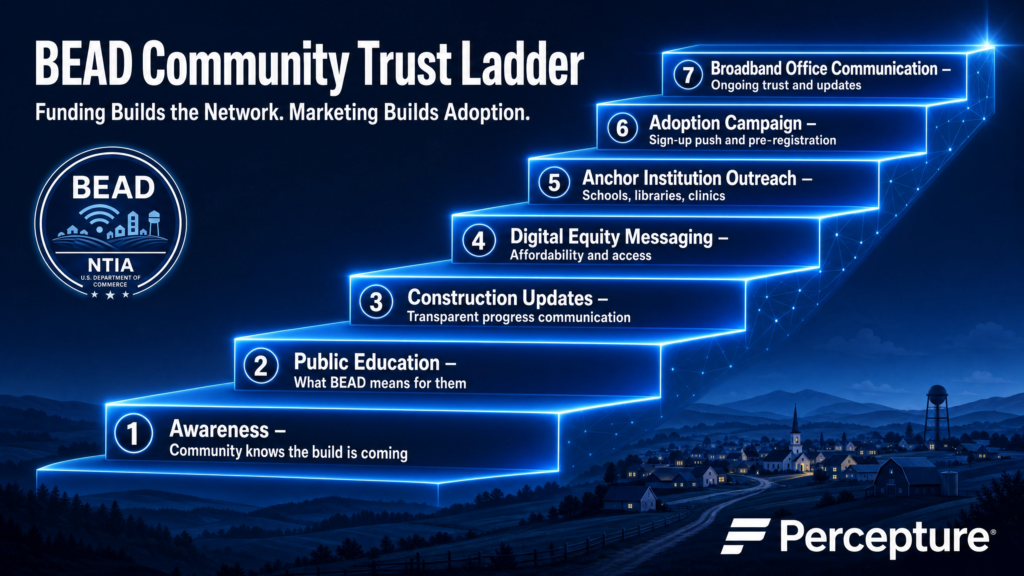
BEAD funding can support the build, but marketing and PR help turn the build into adoption. BEAD-funded operators need public education, community trust, construction updates, digital equity messaging, affordability communication, anchor institution outreach, broadband office coordination, and clear adoption campaigns. The team should translate the build plan into clear public communication without getting ahead of construction reality.
The risk is not only low awareness. It is mistrust, confusion, missed expectations, and weak handoff from public communication to subscriber action. Percepture supports BEAD marketing and subscriber adoption with message architecture, PR, local content, community questions, and funnel tracking.
For rural builds, Percepture’s BEAD PR strategy connects what is being built, why it matters, where service will arrive, and how residents can stay informed. The campaign has to respect construction timing and avoid overpromising before addresses are truly ready.
ISP Marketing for MDU and Multifamily Broadband
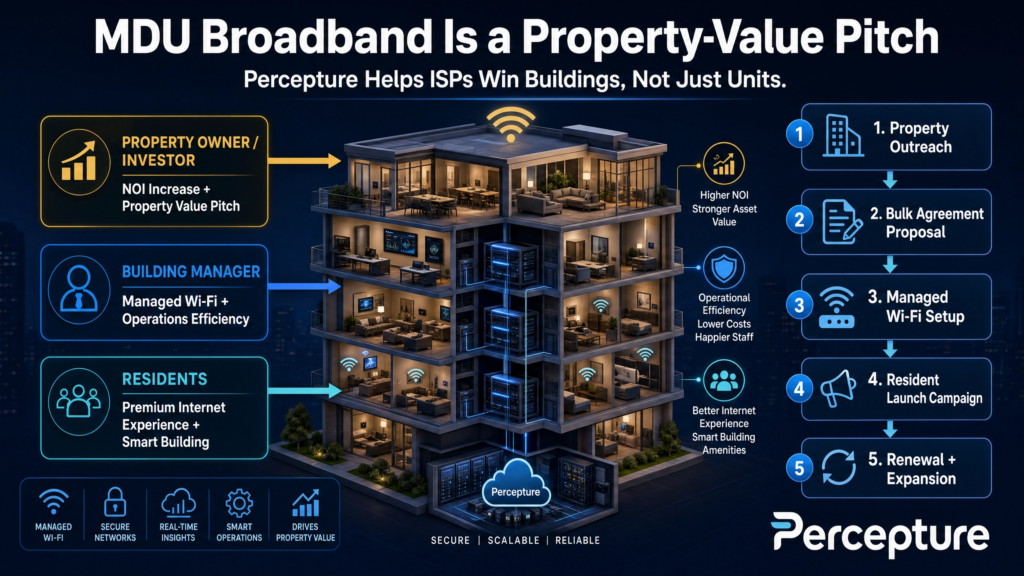
MDU broadband is not just an internet pitch. It is a property-value, resident-experience, and building-operations pitch. Property owners care about bulk agreements, managed Wi-Fi, resident satisfaction, NOI, smart building readiness, installation disruption, and launch support. The campaign should make those buying criteria clearer before the sales conversation starts.
A focused MDU campaign targets owners, asset managers, property managers, and developers with different proof. Percepture’s MDU broadband marketing approach connects property-owner outreach, resident experience content, building-readiness messaging, local proof, and sales enablement.
The offer should show how the provider reduces friction. That means clean launch communications, install coordination, resident FAQs, managed Wi-Fi education, and a sales story that connects broadband to resident retention and operational simplicity.
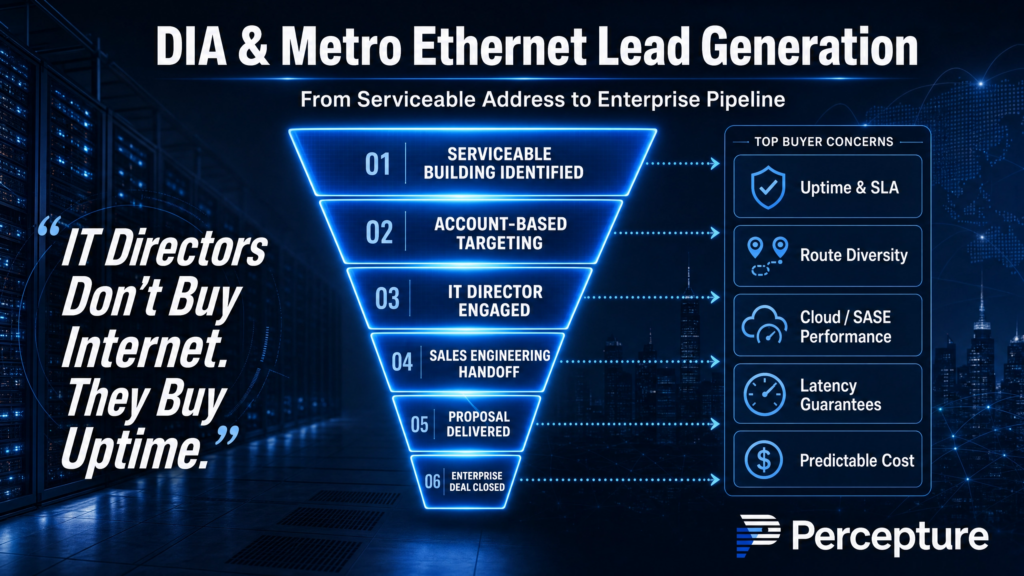
ISP Marketing for DIA, Metro Ethernet, and Business Fiber
IT directors do not buy “internet.” They buy uptime, escalation, path diversity, cloud performance, and predictable cost. DIA and metro Ethernet campaigns need to speak to technical credibility while still giving sales teams usable leads. The partner should turn network strengths into pages, proof points, and follow-up paths that match how IT buyers evaluate risk.
Percepture supports DIA lead generation for ISPs by mapping serviceable buildings, building account-based targeting lists, creating route and SLA content, and improving sales engineering handoff. The buyer wants confidence that the provider understands latency, route diversity, cloud and SASE performance, and escalation paths.
Hunter Newby’s infrastructure work reinforces a core truth for ISP marketing: marketing cannot be disconnected from the physical network. The campaign must match what is serviceable, defensible, connected, and scalable. That matters for DIA, middle mile, carrier-neutrality, dark fiber, IXPs, and AI infrastructure conversations.
ISP AI Search Visibility and Digital PR
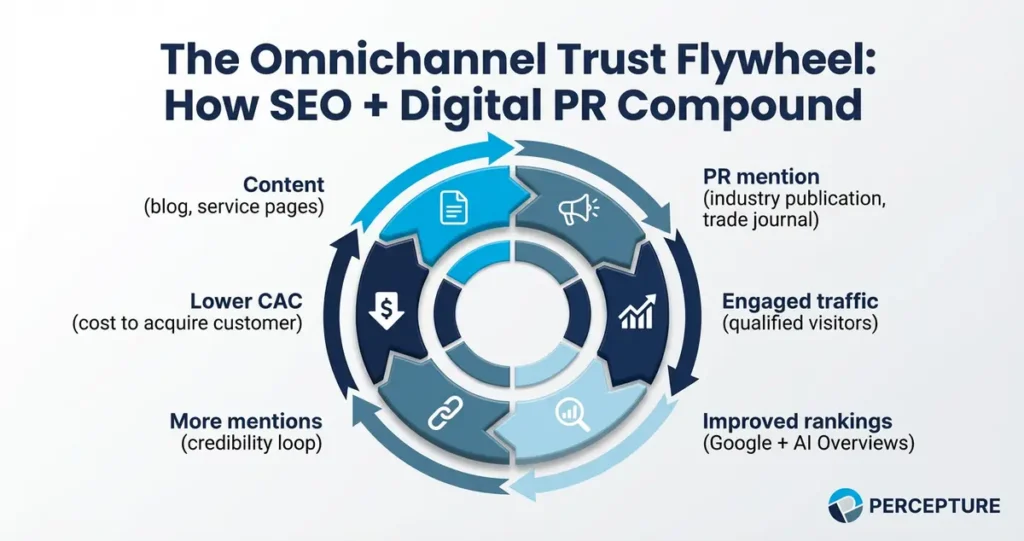
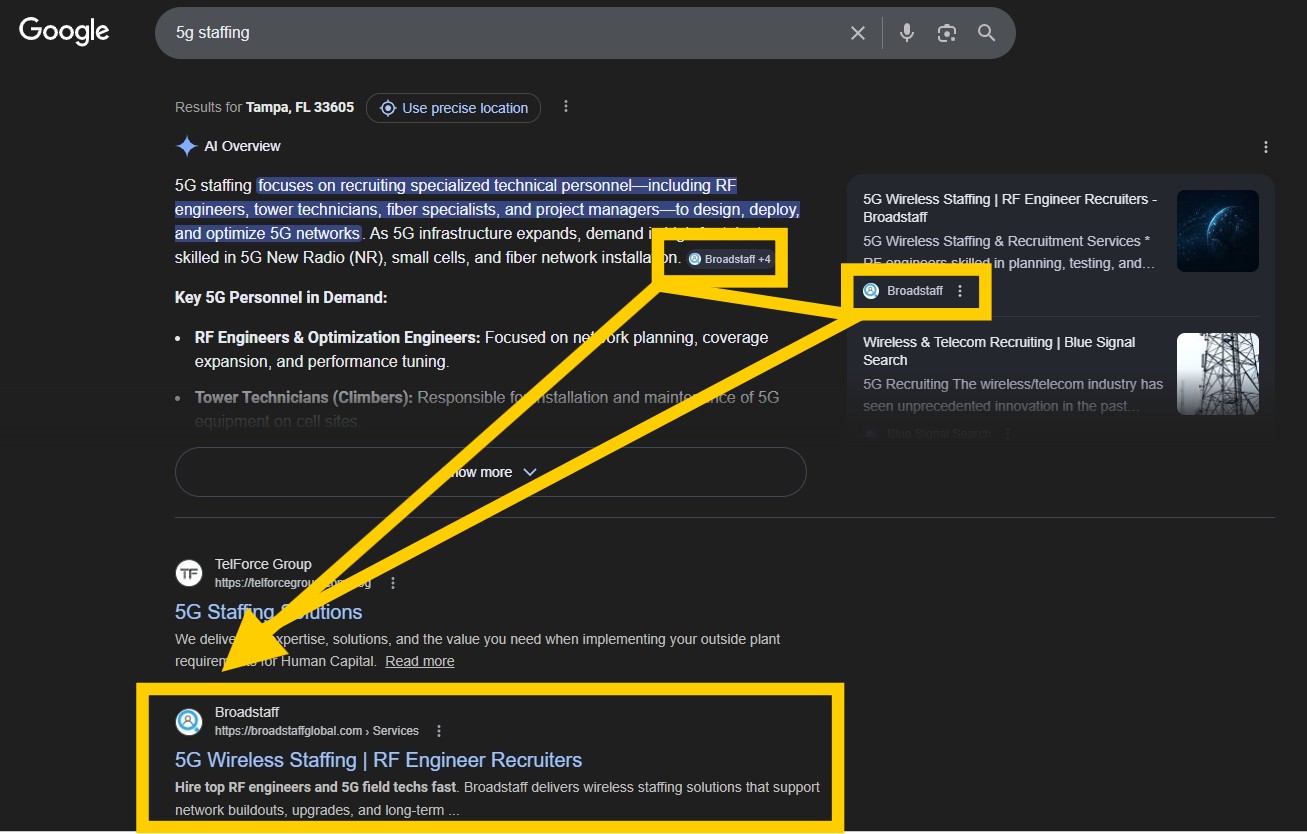
AI search visibility is not a separate magic trick. It depends on crawlable pages, clear definitions, prompt-ready answers, proof, schema, third-party co-citations, and authority. Percepture connects ISP public relations and AI search visibility so broadband buyers, analysts, journalists, and AI engines can understand the provider.
Google AI Overviews, ChatGPT Search, Claude, Perplexity, Microsoft Copilot, and Brave Search reward clarity. The team should build hub pages, definition pages, service-area pages, comparison pages, case studies, expert quotes, and FAQs that answer the core query and the fan-out questions around it.
That work also needs technical SEO. Crawlable HTML, indexable content, internal links, schema, performance, and clean service-area architecture help search engines and answer engines retrieve the right information. Percepture uses enterprise SEO, content marketing, PR, and GEO together instead of treating them as isolated channels. For ISP marketing, the goal is not only ranking; it is retrievable, trusted, sales-ready information.
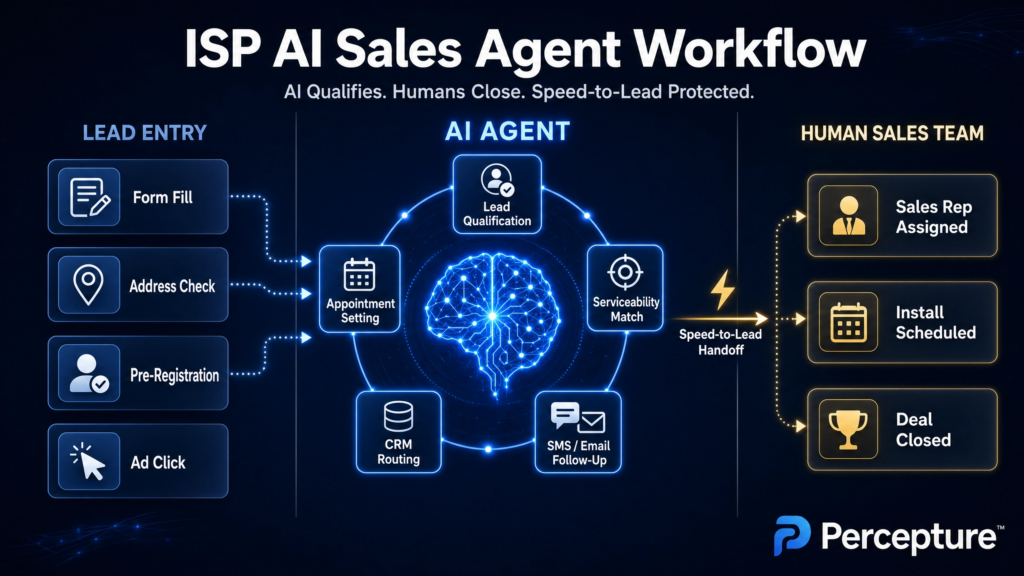
ISP Sales Automation and AI Sales Agents
AI sales agents should not replace the ISP sales team. They should protect speed-to-lead and route the right prospect to the right human faster. That matters when a launch produces address checks, form fills, pre-registrations, calls, event leads, and business fiber inquiries at the same time. The team should treat automation as part of the revenue handoff, not a disconnected tool.
Percepture connects forms, CRM routing, lead qualification, SMS and email follow-up, serviceability match logic, install scheduling, and B2B qualification. The goal is simple: do not let a qualified prospect die after the first click. For legal and operational questions around outbound workflows, see Percepture’s guide to AI outbound calling agents.
Proof: Telecom Marketing Results
ZenFi Networks
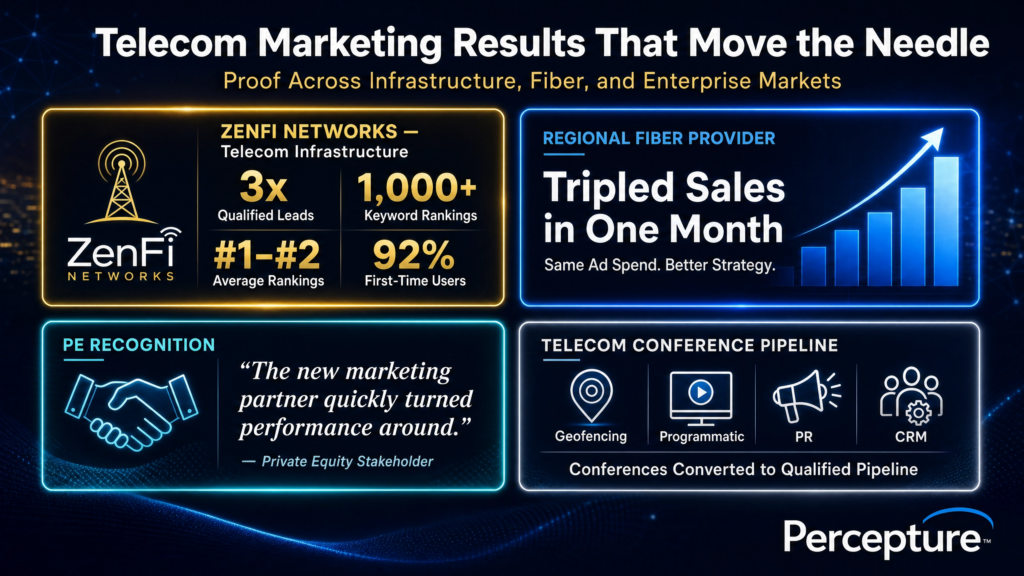
Percepture’s telecom infrastructure work with ZenFi Networks shows how SEO, digital PR, paid media, and retargeting can support visibility, qualified lead growth, and enterprise-value positioning for a digital infrastructure company. That is the kind of integrated proof the agency should be able to discuss with leadership.
Approved proof includes 3x qualified leads, 1,000+ focused key terms, #1–#2 average rankings, 92% first-time users, LinkNYC contract context, and BAI acquisition context.
Regional residential fiber provider
A regional residential fiber provider tripled sales in one month with the same ad spend after Percepture helped identify campaign allocation, offer, tracking, and conversion issues.
Private equity visibility
In one telecom engagement, Bob Generale later met a private equity stakeholder connected to the company. The stakeholder described how a new marketing partner had quickly helped turn performance around.
Conference-to-pipeline engine
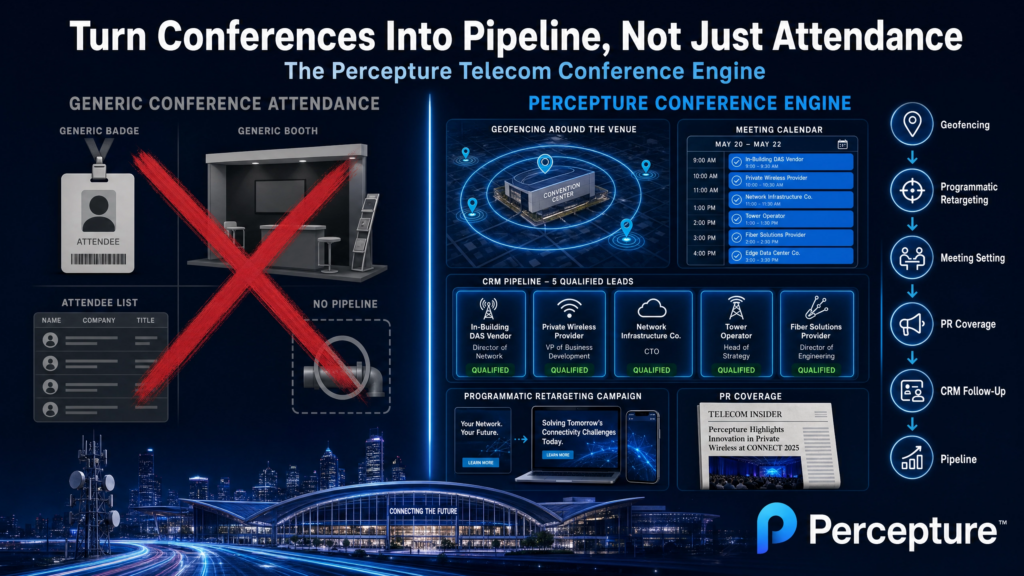
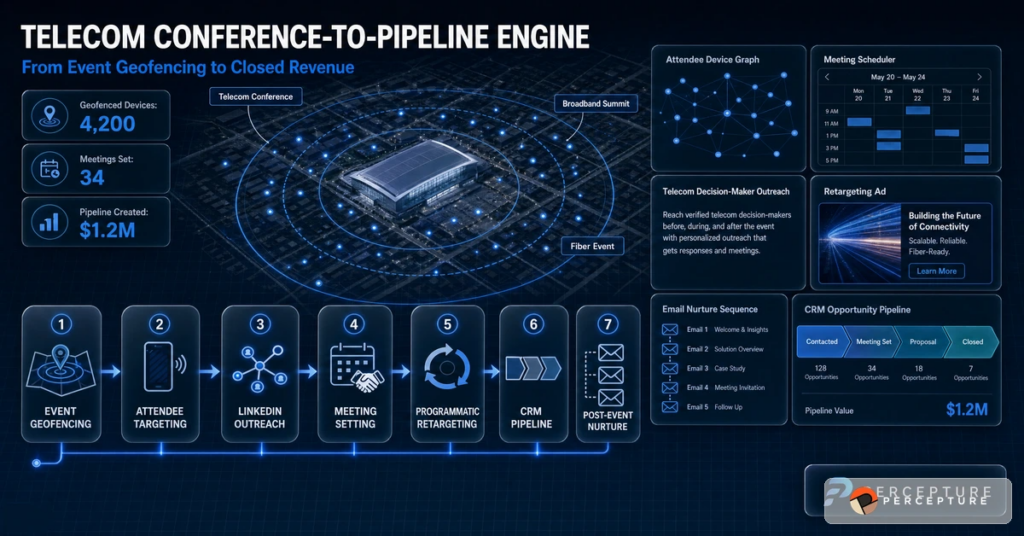
Percepture uses event strategy, geofencing, programmatic retargeting, PR, meeting setting, and CRM follow-up to turn telecom conferences into pipeline, not just attendance.
The Percepture ISP Growth Team
A serious ISP growth program needs senior strategy, PR judgment, AI systems, implementation, and sales alignment. Percepture brings those roles together for telecom and infrastructure growth programs.

Bob Generale
Strategy, SEO, GEO, ISP growth, and revenue positioning.

Thor Harris
PR, executive positioning, trust, and media strategy.

Alex Mannine
AI systems, automation, data strategy, and sales workflows.

Amanda Pacheco
Client success, implementation, campaign delivery, and reporting.

Christine Rodi
Sales, growth advisory, client relationships, and revenue strategy.
Percepture Credentials
Percepture was founded in 2004 and combines PR, SEO, GEO, paid media, AI search, analytics, CRO, content, and lead generation into one trust-and-demand system.
The 90-Day ISP Marketing Operating Plan
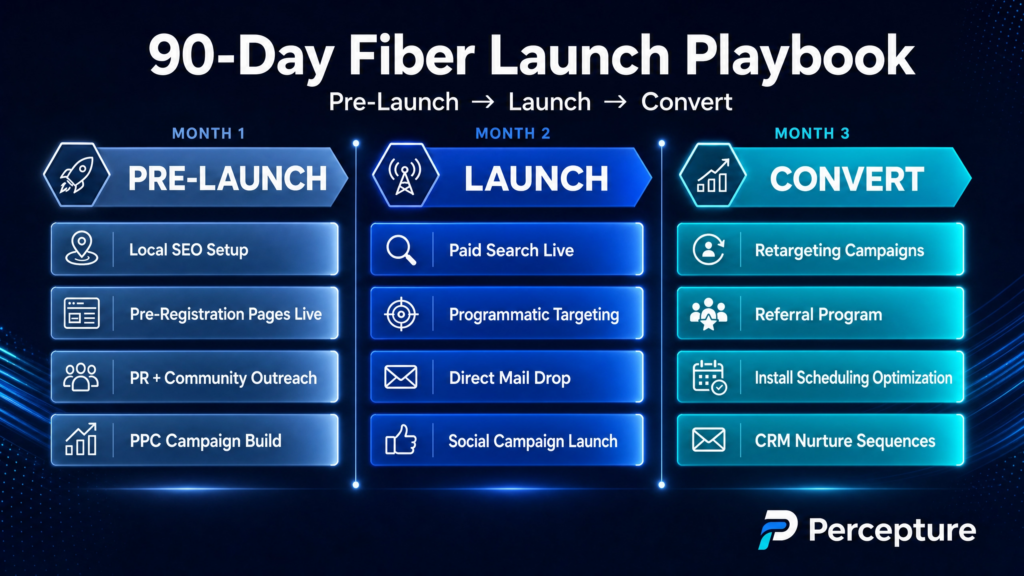
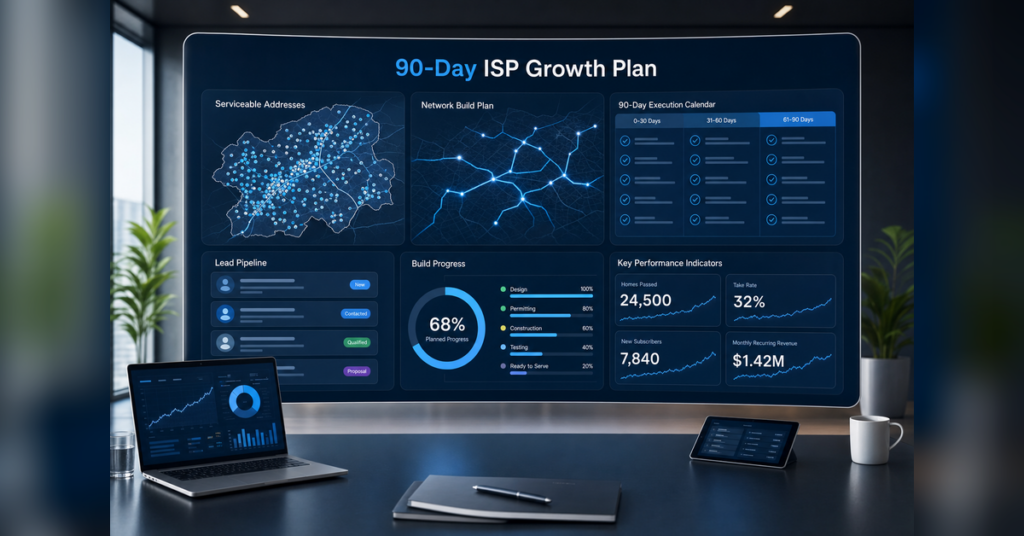
A strong partner should be able to explain what happens in the first 90 days without hiding behind vague strategy language. The first month should clarify serviceability, buyer segments, local trust gaps, search demand, paid media waste, CRM routing, and tracking. The second month should turn that diagnosis into service-area pages, campaign assets, PR angles, landing pages, retargeting audiences, and sales follow-up paths. The third month should shift from setup to optimization: better offers, better routing, better reporting, stronger content, and tighter conversion paths.
This is where most generic digital agencies lose the plot. They build campaigns around impressions, clicks, and channel tasks. ISPs need a sequence that respects construction timing, address readiness, installation capacity, local competition, and the difference between a household, a property owner, an IT director, and a broadband office stakeholder.
Days 1–30: Diagnose
Map live, pre-sale, future-serviceable, MDU, DIA, and dark fiber opportunities. Review search visibility, paid media structure, landing pages, address-check flow, CRM speed, PR signals, and local competitor messaging.
Days 31–60: Build
Create service-area pages, answer-ready content, BEAD messaging, MDU pitch assets, DIA proof pages, retargeting audiences, direct mail logic, AI-search structure, and lead routing rules.
Days 61–90: Optimize
Measure which markets, offers, pages, audiences, and lead types create qualified opportunities. Improve conversion, reduce wasted spend, build more proof, and align reporting to installs, subscribers, and pipeline.
Dark Fiber, Interconnection, and Digital Infrastructure Marketing
This article is not only about residential broadband. Dark fiber, interconnection, DIA, metro Ethernet, carrier-neutral infrastructure, wireless backhaul, and AI infrastructure buyers evaluate a different set of risks. They care about route diversity, meet-me-room access, latency, redundancy, uptime, peering, cloud access, escalation paths, contracts, and whether the provider can support complex deployment needs.
That means the marketing cannot read like a consumer internet promotion. A serious partner must translate network advantages into buyer-ready language without oversimplifying the technical story. Dark fiber buyers need confidence that the provider understands the route, the SLA, the use case, and the cost of failure. Interconnection buyers need to understand where the network creates leverage, not just where the company has logos on a map.
Percepture approaches this work by building a clearer infrastructure narrative first. The campaign should identify the buyer type, the asset advantage, the geography, the proof, the sales handoff, and the follow-up motion. That makes the content more useful for human buyers and easier for AI systems to retrieve when someone asks for providers, definitions, shortlists, or technical comparisons.

Service-Area Content Architecture for ISP Growth
Service-area architecture is one of the biggest differences between ordinary SEO and ISP SEO. A broadband provider should not build a generic page for every town and hope Google sorts it out. The page system has to match what can be sold, what is coming soon, what is not ready, what is residential, what is business fiber, what is MDU, and what needs a different conversion path.
The best architecture usually includes a hub page, service-area pages, neighborhood or community pages where appropriate, business fiber pages, MDU pages, BEAD education pages, and support content that answers buyer objections. Each page should have a clear next step: check availability, pre-register, request a business fiber quote, schedule a consultation, join updates, or speak with the team.
For AI search and Google AI Overviews, the page must also answer the obvious follow-up questions. What is available? Where is it available? Who is the provider? What makes the network credible? How does the installation process work? What should a property owner know? What should an IT director ask? The more clearly the site answers these questions, the easier it becomes for search engines and answer engines to understand the provider.
Measurement, Sales Handoff, and CRO
ISP marketing breaks when the handoff breaks. A campaign can generate traffic, address checks, pre-registrations, event leads, and quote requests, but revenue depends on how quickly those signals reach the right person with the right context. The lead source, address, serviceability status, buyer type, offer, and next action all matter.
Percepture treats conversion rate optimization as a revenue operations issue, not just a landing-page issue. The work includes cleaner forms, faster pages, stronger calls to action, lead scoring, CRM routing, call tracking, SMS and email follow-up, audience retargeting, and reporting that separates interest from qualified pipeline. For ISP leadership, that means the dashboard should show more than traffic. It should show where the funnel is leaking.
Useful reporting connects spend, search visibility, PR signals, AI visibility, lead quality, address checks, installs, MDU opportunities, DIA opportunities, and sales activity. That gives leadership a better view of which markets deserve more investment and which campaigns need to be rebuilt.
ISP Marketing Packages and Pricing
ISP marketing programs vary based on market size, service area, competition, sales cycle, content depth, PR support, paid media spend, reporting needs, and AI/search visibility goals. A qualified partner should show pricing ranges, explain what is separate, and connect scope to the growth problem.
| Package | Best For | Starting Range |
|---|---|---|
| ISP Growth Audit | Operators that need a fast diagnosis | Starting at $2,500–$5,000 |
| ISP SEO + GEO Sprint | Providers that need search and AI visibility | Starting at $5,000–$10,000/month |
| Fiber Take-Rate Program | Residential fiber launches | Starting at $7,500–$15,000/month |
| BEAD Trust + Outreach Program | Funded broadband builds | Starting at $7,500–$20,000/month |
| DIA / MDU Lead Generation | B2B fiber and property-owner pipeline | Starting at $7,500–$25,000/month |
| Full ISP Growth Engine | SEO, GEO, PR, paid, CRO, AI follow-up | Custom scope |
Paid media spend, production, PR distribution, direct mail, and software costs may be separate. You can also review Percepture’s pricing options, SEO pricing packages, and GEO pricing. The agency should make those separate costs explicit before launch.
How to Choose an ISP Marketing Agency
The right partner should understand broadband economics, not just campaigns. Percepture helps ISP leadership connect marketing to subscriber growth, local trust, and company value—not just clicks. Fiber passings become valuable when marketing helps convert them into paying subscribers and measurable pipeline.
| Criteria | Generic Agency | ISP Marketing Agency |
|---|---|---|
| Understands serviceability | Usually no | Yes |
| Understands passings and take-rate | Rarely | Yes |
| Understands BEAD outreach | Rarely | Yes |
| Understands DIA and MDU sales | Rarely | Yes |
| Connects PR + SEO + GEO | Sometimes | Required |
| Builds address-level campaigns | Rarely | Required |
| Tracks leads to installs | Sometimes | Required |
| Uses AI search strategy | Rarely | Required |
What Not to Do
Do not market unserviceable addresses. Do not launch BEAD messaging without community education. Do not treat MDU owners like residential buyers. Do not sell DIA with consumer internet language. Do not build SEO pages that answer nothing. Do not let form fills sit in the CRM without follow-up. Your agency should catch those issues before media spend scales.
Also do not treat your agency as a vendor that only makes ads. The useful partner connects strategy, search, PR, paid media, conversion tracking, sales automation, and proof to the actual network.
Review the ISP Growth Framework Pack
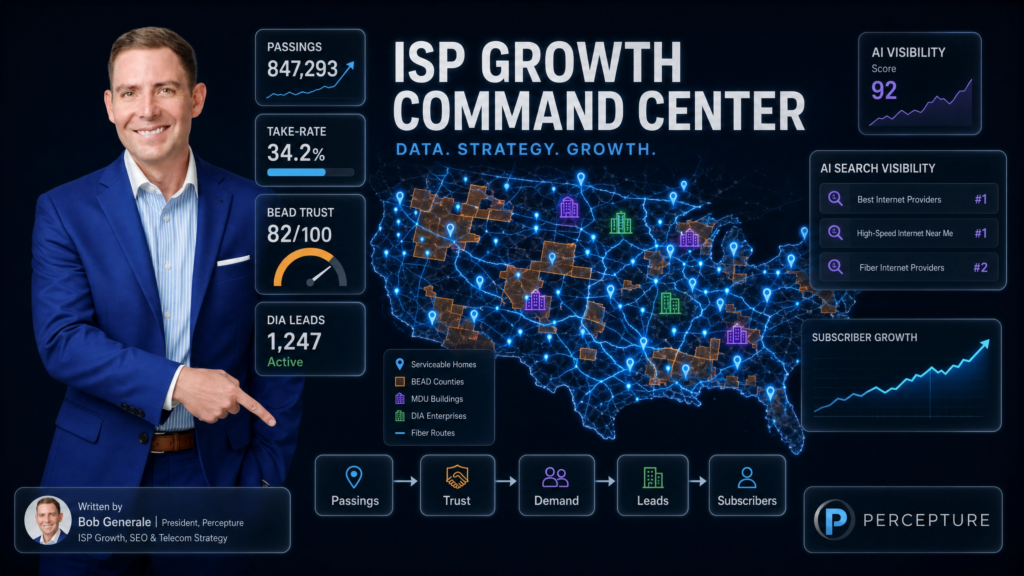
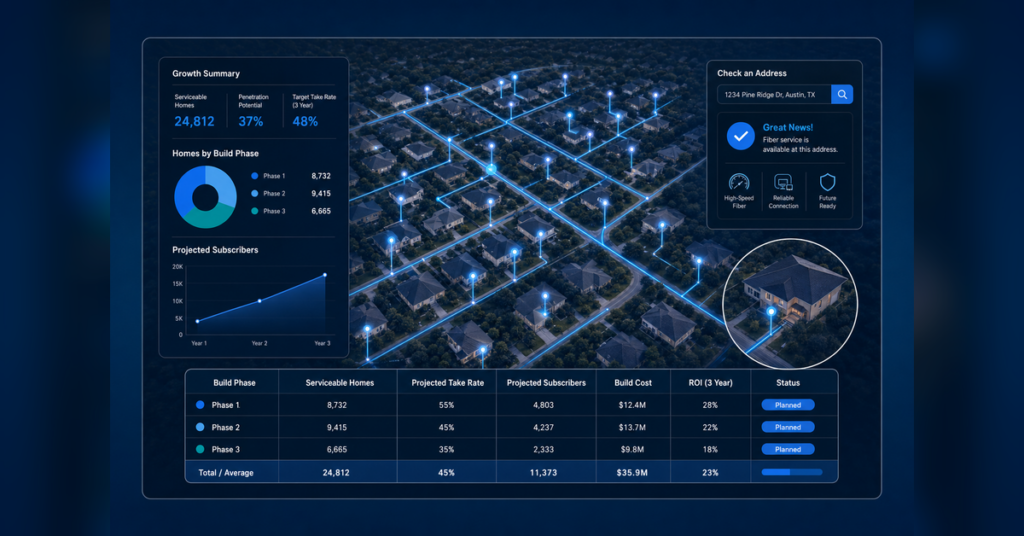
The ISP Growth Framework Pack includes the Growth Command Center, Trust-to-Take-Rate System, Fiber Passings to Subscribers Funnel, BEAD Community Trust Ladder, Address-Level Demand Map, DIA Lead Funnel, and AI Search Visibility Stack. It shows how Percepture can organize strategy around serviceability, trust, demand, and conversion.
ISP Growth Framework Image Library
The visuals below are the ISP image set for this article and the related telecom cluster. They are coded directly from the WordPress media-library paths, wrapped in premium <figure class="isp-figure"> blocks, and captioned for SEO, GEO, and buyer trust.





ISP Marketing FAQs
What does an ISP marketing agency do?
An ISP marketing agency helps broadband providers build trust, improve search visibility, generate qualified residential and business leads, increase take-rate, support sales teams, and connect serviceability data to campaigns. The best programs combine SEO, GEO, PR, PPC, programmatic, CRO, CRM follow-up, and reporting.
What is ISP marketing?
ISP marketing is the growth system internet service providers use to turn network availability into demand, leads, installs, subscribers, and enterprise value. It includes local SEO, paid media, PR, service-area content, address search, direct mail, community outreach, retargeting, sales automation, and conversion tracking. A specialized partner helps connect those activities to the network footprint.
How do ISPs increase fiber take-rate?
ISPs increase fiber take-rate by marketing only where service can be sold, building trust before launch, making address search easy, using local pages, running paid search, retargeting address checkers, testing offers, routing leads quickly, and measuring the path from passing to install.
How do ISPs convert fiber passings into subscribers?
ISPs convert passings into subscribers by moving households through a clear path: awareness, trust, address confirmation, offer selection, installation scheduling, onboarding, and retention. Each step needs the right message, landing page, follow-up, and measurement.
How should BEAD-funded broadband providers market new networks?
BEAD-funded providers should use public education, construction updates, affordability messaging, anchor institution outreach, broadband office coordination, PR, and adoption campaigns. The campaign should explain what is being built, when service is expected, who benefits, and how residents can stay informed.
How do ISPs generate residential leads?
Residential ISP leads usually come from service-area SEO pages, local search, paid search, social and programmatic campaigns, direct mail, community outreach, referral offers, address-check forms, keep-me-updated forms, and retargeting. The key is tying every lead to serviceability and follow-up.
How do ISPs generate DIA and metro Ethernet leads?
DIA and metro Ethernet leads come from serviceable-building targeting, IT director content, account-based advertising, search pages for business fiber and dedicated internet, route and SLA proof, conference campaigns, LinkedIn targeting, and sales engineering handoff. The program should keep that work aligned with real routes, buildings, and escalation promises.
How do ISPs win MDU bulk internet deals?
ISPs win MDU deals by speaking to property value, resident experience, managed Wi-Fi, NOI, smart building readiness, installation disruption, launch support, and owner risk. The sales story should be built for owners and property managers, not only residents.
How can ISPs show up in ChatGPT and Google AI Overviews?
ISPs improve AI-search visibility by publishing crawlable hub pages, definitions, local pages, FAQs, case studies, executive quotes, schema, and third-party PR signals. The content team should make content clear enough to answer the main query and the related fan-out questions in quotable language.
What makes Percepture different from a general digital marketing agency?
Percepture brings PR, SEO, GEO, paid media, AI-search visibility, sales automation, conversion tracking, and telecom infrastructure experience together. The work starts with serviceability, network truth, buyer intent, proof, and sales follow-up rather than isolated campaign activity.
Meet With Percepture
If your ISP needs more subscribers, better take-rate, stronger local trust, more DIA leads, better MDU outreach, or stronger AI-search visibility, meet with Percepture. We will review your market, serviceability, search visibility, content gaps, paid media, PR signals, lead funnel, and follow-up system.
A serious ISP marketing agency should help you condition the market before buyers search, capture demand when buyers are ready, and convert that demand into measurable growth.