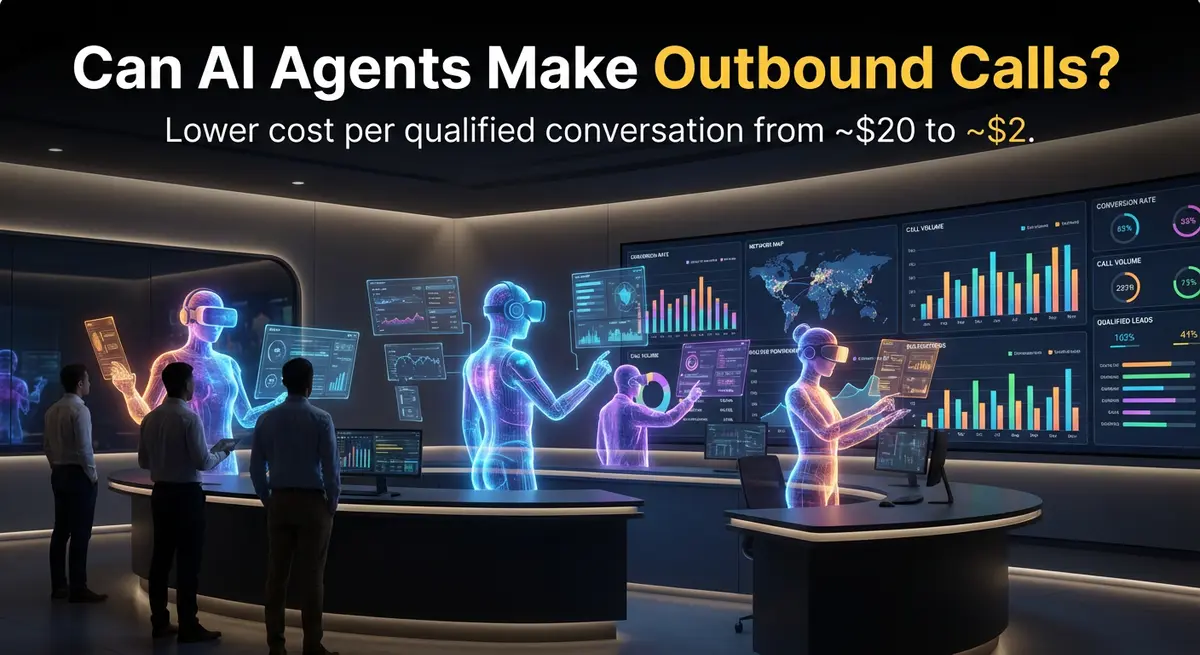

Yes, AI agents can make outbound calls. The harder question is whether your company can do it legally, safely, and without damaging trust. A workable program needs the right audience, consent logic, disclosures, recording controls, suppression lists, CRM logging, and human oversight.
This 2026 guide explains how AI outbound calling works, where B2B use cases fit, what the FCC and FTC rules mean, which tools belong in the stack, and how Percepture AI sales agents and Pyra support controlled pilots designed to book qualified meetings rather than generate spam.




Direct answer
Can AI agents make outbound calls?
Yes. AI agents can place calls, hold conversations, qualify prospects, route high-intent leads, and book meetings. In the United States, AI-generated voices are treated as artificial or prerecorded voices under the TCPA. The legal path depends on the number called, call purpose, consent, disclosures, recording rules, and jurisdiction.
Who this guide is for
Teams evaluating AI voice outreach without risking the brand
Cold CTA · Readiness check
Before you buy software, map the call you are actually allowed to make
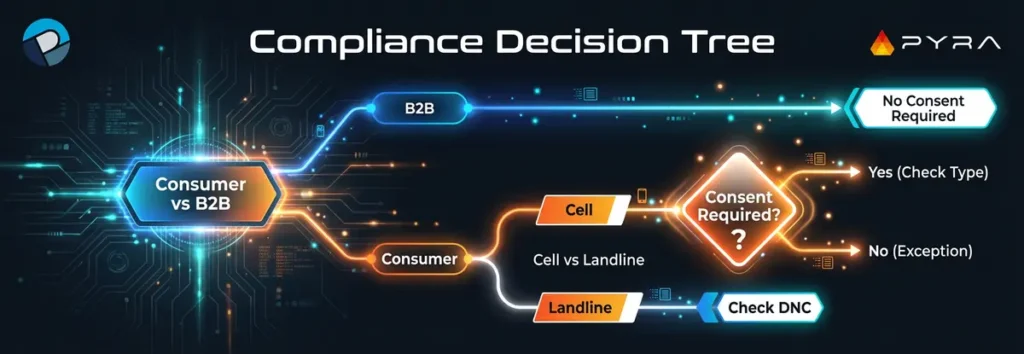
Start with the compliance decision tree and readiness scorecard. They help separate a controlled B2B pilot from a high-risk consumer telemarketing program.
Definition
What are AI outbound calling agents?
AI outbound calling agents are software systems that use artificial intelligence to initiate phone calls, conduct conversations, qualify leads, book meetings, or deliver information without a human dialing or speaking. They combine voice synthesis, natural-language understanding, workflow automation, and integrations with sales systems.
In February 2024, the Federal Communications Commission clarified that AI-generated voices are treated as an “artificial or prerecorded voice” under the Telephone Consumer Protection Act. That means conversational capability does not remove the rules that apply to artificial-voice calls.
Commercial use case
Can AI agents make outbound calls in B2B?
Yes, and B2B can be a practical use case when the program is narrow, relevant, transparent, and reviewed for the numbers and jurisdictions involved.
Most fear-based coverage focuses on consumer robocalls, spam, and scams. B2B outreach has different exemptions and expectations, but “business call” is not a universal safe harbor.
Many calls to businesses are exempt from federal Do Not Call provisions, but TCPA, state law, personal wireless numbers, recording rules, and internal opt-outs still matter.
Gartner’s 2025 release, based on a 2024 survey, found 61% of B2B buyers prefer a rep-free experience and 73% actively avoid suppliers that send irrelevant outreach.
A controlled agent can deliver approved disclosures, log activity, recognize opt-outs, and route exceptions. Review the 2026 comparison of AI SDRs versus human BDRs.
A safe B2B workflow still needs clear identification, approved call windows, suppression-list controls, recording logic, natural-language opt-outs, CRM logging, and human escalation.
Legal and compliance overview
Are AI outbound calls legal?
AI outbound calls can be legal, but the analysis is fact-specific. The safest program distinguishes consumer telemarketing from B2B outreach, business lines from wireless or residential numbers, informational calls from sales calls, and live calls from artificial-voice calls.
FCC: AI-generated voices are artificial voices under the TCPA
The FCC’s 2024 declaratory ruling confirmed that AI-generated voices fall within the TCPA’s artificial or prerecorded voice rules. Consumer telemarketing using that technology generally requires prior express written consent. The FCC source is available in FCC-24-17.
FTC Telemarketing Sales Rule
The Telemarketing Sales Rule requires specific disclosures, prohibits misrepresentations and abusive conduct, limits consumer calling hours, and requires sellers and telemarketers to honor applicable Do Not Call requests.
- Identify the seller and the purpose of the call.
- Do not mislead the recipient or omit material information.
- Honor company-specific opt-outs and applicable suppression lists.
- Apply the correct calling windows and jurisdictional rules.
- Maintain the records required for the program and its vendors.
B2B exemption, with caveats
Most calls to a business are exempt from the federal TSR’s Do Not Call provisions. That exemption does not automatically resolve TCPA restrictions, state mini-TCPA laws, personal wireless numbers, internal opt-outs, or recording requirements. Percepture uses telecom marketing and other B2B programs as narrow, role-based use cases rather than permission for indiscriminate volume.
| Call Type | Consent Required? | Risk Level |
|---|---|---|
| B2B to business line (informational) | Fact-specific; federal DNC exemptions may apply, but review TCPA and state law | Low–Medium |
| B2B to business line (sales) | Fact-specific; number type, technology, purpose, and state law matter | Medium |
| B2C to cell phone (sales) | Yes—prior express written consent | 🔴 High |
| B2C to landline (sales) | Yes—prior express consent | 🟠 Medium-High |
| Inbound (customer calls you) | No | 🟢 Low |
Technology architecture
Tools that power AI outbound calling agents
AI outbound calling is not one tool. It is a controlled stack with separate layers for conversation, permission, data, logging, and human action.
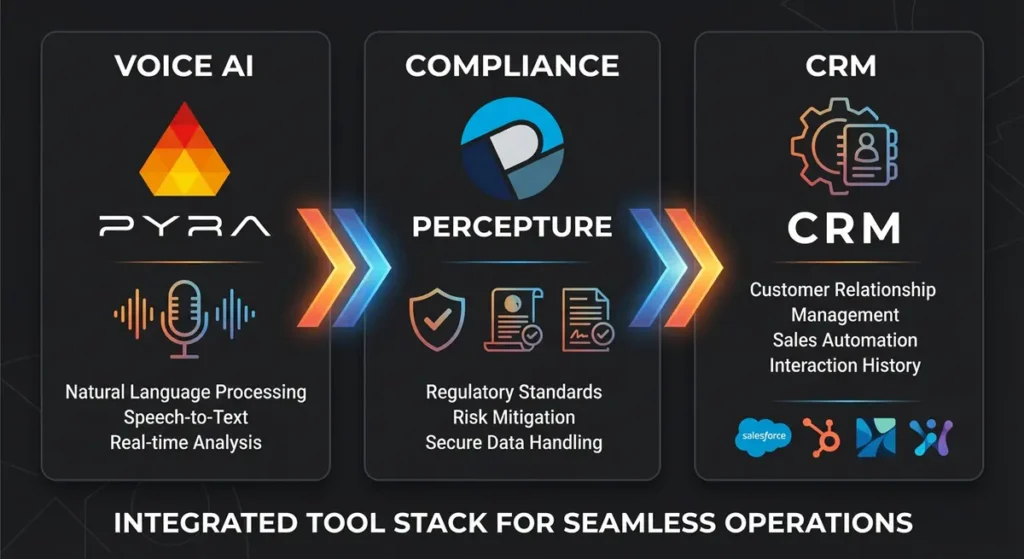
Percepture also connects AI calling to B2B lead generation services, conversion rate optimization, and the broader Percepture AI systems stack so the agent is measured by meetings and pipeline, not call volume alone.
Percepture framework
The Consent-to-Conversation Framework
The framework separates permission, transparency, operational control, and human judgment. The technology only earns a larger role after each layer performs correctly.
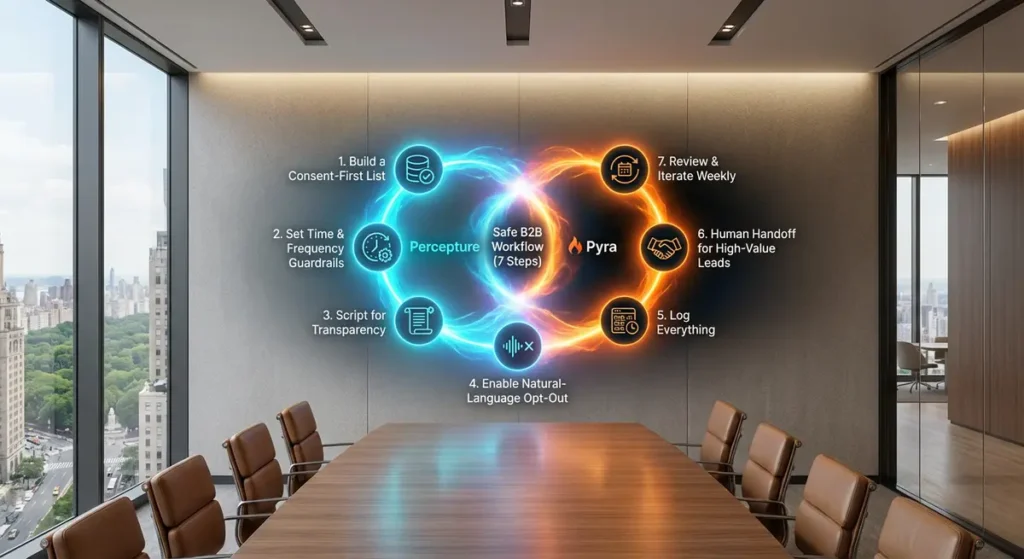
The safe B2B workflow in seven steps
Percepture and Pyra use this operating sequence for controlled AI outbound programs in telecom, life sciences, technology, and healthcare.
Build a consent-aware list
- Start with opt-in forms, inbound inquiries, existing relationships, or relevant business engagement.
- For colder B2B outreach, prioritize business lines and document the legitimate business purpose.
- Apply national, state, internal, and vendor suppression checks as required.
Set time and frequency guardrails
- Use approved calling windows based on the recipient’s local time and applicable law.
- Set daily and weekly frequency caps.
- Exclude weekends unless the recipient requested contact.
Script for transparency
An opening can be structured like this:
“Hi, this is an AI voice agent calling on behalf of [Company]. I am a virtual assistant. I am calling to [purpose]. You can reach us at [number] or visit [website]. This call may be recorded for quality and training. Is now a good time?”
Qualified counsel should approve the final disclosure language for the program.
Enable natural-language opt-out
The agent should recognize phrases such as “Do not call me again,” “Remove me,” “Stop calling,” and “I am not interested.” It should confirm the request, update the suppression record, and end the call.
Log every material event
- Timestamp, duration, outcome, number source, and applicable consent record.
- Transcript or recording information when lawfully captured.
- Opt-out status, compliance flags, and the next approved action.
Hand high-value leads to a human
AI qualifies. Humans close. When a prospect expresses serious interest, the agent should book a meeting, offer a live transfer, or route the conversation to the correct expert.
Review and improve every week
Monitor connect rate, opt-out rate, meeting-booked rate, complaint signals, script failures, missed disclosures, blocked calls, and human-handoff outcomes.
Operating model
What Percepture and Pyra actually do
Percepture does not treat AI outbound calling as a stand-alone dialer. The program sits inside a coordinated revenue workflow with approved messaging, data, follow-up, routing, and human review.
- 13 touchpoints over 30 days: email, LinkedIn, and phone, with voice introduced after earlier outreach where appropriate.
- Voice choices: a clearly synthetic voice for transparency or a more natural voice where approved and appropriate.
- Sales alerts: every qualified lead can trigger a Slack or CRM notification.
- Tighter call windows: Percepture may use 9 a.m.–6 p.m. local time even where broader hours are legally available.
- Short voicemail strategy: identify the company, state the purpose, provide callback information, and avoid a long pitch.
- Human escalation: high-intent leads transfer live or enter the correct calendar.
- Privacy controls: opt-outs, retention, access, and deletion rules are defined before launch.
“AI as teammate, not replacement. We use AI to handle the first 80% of qualification so human representatives can focus on the 20% that closes deals.”
— Percepture client, life sciences
Warm CTA · See the operating model
Build the agent around your sales process, not the other way around
Percepture sets the ICP, messaging, compliance guardrails, routing, and performance model. Pyra supports the agent workflows and integrations. Your team approves the program before voice goes live.
Measurement
What to measure in an AI outbound calling pilot
Track the smallest set of numbers that reveal relevance, trust, compliance, and commercial value.
| Metric | Target | Why It Matters |
|---|---|---|
| Connect rate | 5–10% | Are you reaching real people? |
| Opt-out rate | <2% | Are you annoying prospects? |
| Meeting-booked rate | 1–3% | Is AI qualifying effectively? |
| Compliance flags | 0 | Are you staying legal? |
| Cost per meeting | <$50 | Is AI cheaper than SDRs? |
AI outbound calling readiness scorecard
Decision rule: If several of these controls are missing, do not scale call volume. Fix the operating system first.
Why this matters now
The opportunity is efficiency, not automated noise
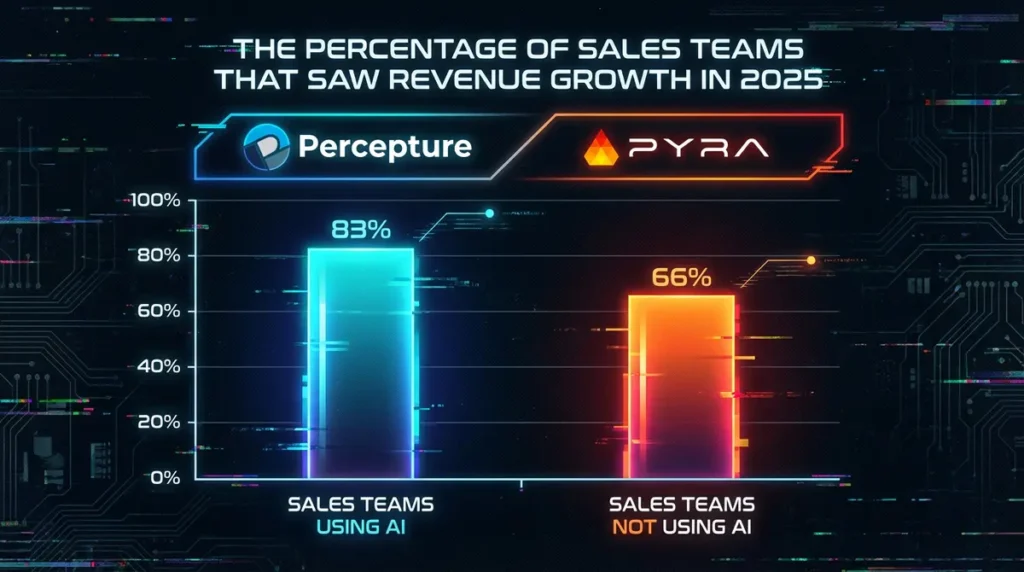
- 83% of sales teams using AI reported revenue growth, compared with 66% of teams without AI, according to Salesforce’s State of Sales research.
- Sales representatives spend 71% of their time on non-selling work, creating room for automation around research, logging, routing, scheduling, and follow-up.
- 61% of B2B buyers prefer an overall rep-free buying experience, while 73% avoid suppliers that send irrelevant outreach, according to Gartner’s 2025 release based on a 2024 buyer survey.
AI outbound calling is not about replacing people. It is about removing repetitive qualification and administrative work so people can build relationships, solve difficult problems, and close complex deals.
Controlled rollout
What happens next in an AI calling pilot
- Pilot program: run a two-week test with a limited, approved audience and a defined call range.
- Human approvals: your team reviews every script, disclosure, workflow, escalation path, and reporting field.
- Review by exception: operators focus on edge cases, qualified opportunities, and compliance signals.
- Risk terms: pilot success criteria, stop conditions, and any risk-reversal terms are documented before launch.
Frequently asked questions
Can AI Agents Make Outbound Calls? FAQ
Can AI agents make outbound calls?
Yes. AI agents can make outbound calls using voice synthesis and natural-language processing. The program must still comply with the TCPA, the FTC Telemarketing Sales Rule, applicable state laws, internal suppression lists, recording rules, and any consent requirements that apply to the number and purpose.
Are AI outbound calls legal in the U.S.?
Yes, but legality depends on the audience, phone number, call purpose, technology, consent, jurisdiction, and disclosures. Consumer telemarketing using an artificial or prerecorded voice generally requires prior express written consent. B2B context can differ, but it is not a blanket exemption.
Do I need consent for AI outbound calls?
Often, yes. Consumer telemarketing using an artificial or prerecorded voice generally requires prior express written consent. For B2B calls, the answer depends on the number called, the purpose, the technology used, and state law. Legal review is recommended before launch.
What do I have to say at the start of an AI call?
At minimum, clearly identify the company and the purpose of the call. Disclosing that the caller is an AI agent is a strong trust practice and may be required by applicable rules or policies. Recording disclosures must match the laws of the jurisdictions involved.
Can AI leave voicemails? Should it?
AI can leave voicemails. Keep them short, identify the company, explain the reason for the call, provide a callback method, and honor any opt-out. Long or vague messages can hurt trust and future response rates.
Can AI record and transcribe calls legally?
Yes, when the program follows federal and state recording laws. Some jurisdictions require consent from every party. The safest approach is to determine the applicable rules before recording and provide a clear disclosure when required.
What tools are used to run AI outbound calling?
AI outbound calling requires a stack: voice AI platforms (Bland, Vapi, Pyra), compliance tools (PossibleNOW, Gryphon), and CRM systems (HubSpot, Salesforce). Learn more about AI Systems at Percepture.
Are B2B outbound calls exempt from Do Not Call rules?
Many calls to a business are exempt from federal Do Not Call provisions under the FTC's Telemarketing Sales Rule. That does not erase TCPA restrictions, state mini-TCPA laws, internal opt-outs, recording rules, or obligations that can apply when a personal wireless number is called.
How do you run AI calls without hurting brand trust?
Transparency is key. Always disclose that the caller is AI, explain the purpose clearly, offer an easy opt-out, and ensure the AI is helpful—not pushy. AI should feel like a helpful assistant, not a spam bot.
What's the difference between AI outbound calls and robocalls?
Under the TCPA, an AI-generated voice is treated as an artificial or prerecorded voice. Operationally, a conversational AI agent can listen, respond, qualify, and route a call, but its interactivity does not remove the legal rules that apply.
Legal disclaimer
This article is for informational purposes only and does not constitute legal advice. Telemarketing, artificial-voice, consent, privacy, and call-recording laws vary by jurisdiction and change frequently. Consult qualified legal counsel before launching an AI outbound calling program.
Continue your evaluation
Related AI, sales, and enterprise guides
Hot CTA · Book a working session
See whether AI outbound calling can book qualified meetings for your team
Bring your target audience, current workflow, CRM, outreach sequence, and compliance questions. Percepture will map where AI can help, where a human must stay involved, and what a controlled pilot should measure.