
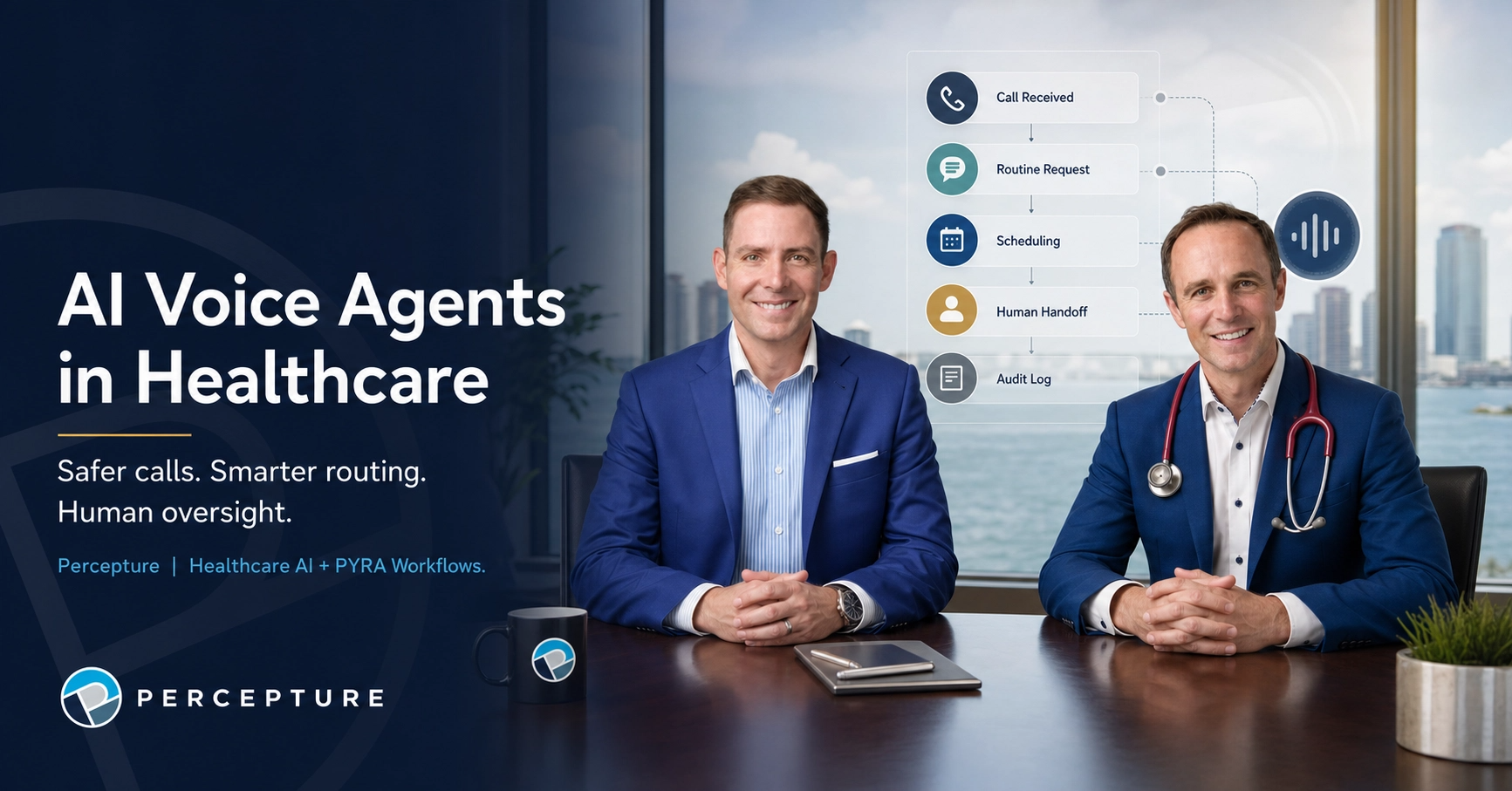

An AI voice agent in healthcare is a voice-based AI system that can answer routine calls, route patients, support scheduling, collect approved intake information, and escalate sensitive issues to staff. The best healthcare voice agents do not replace doctors. They reduce administrative friction while protecting privacy, patient trust, and human oversight.
This guide explains what AI voice agents can do, what they should not do, how HIPAA-conscious guardrails apply, and how PYRA powers governed AI agent workflows for healthcare practices.
Who This Guide Is For
This article is for:
- Medical practice owners and founders
- CEOs and CFOs evaluating AI for patient access
- VP Marketing and patient acquisition leaders
- Practice administrators and operations leads
- Technical buyers evaluating AI voice vendors
If you are asking whether an AI voice agent can help your front desk, reduce missed calls, or support scheduling without creating compliance risk, this guide is for you.
Definition: What Is an AI Voice Agent in Healthcare?
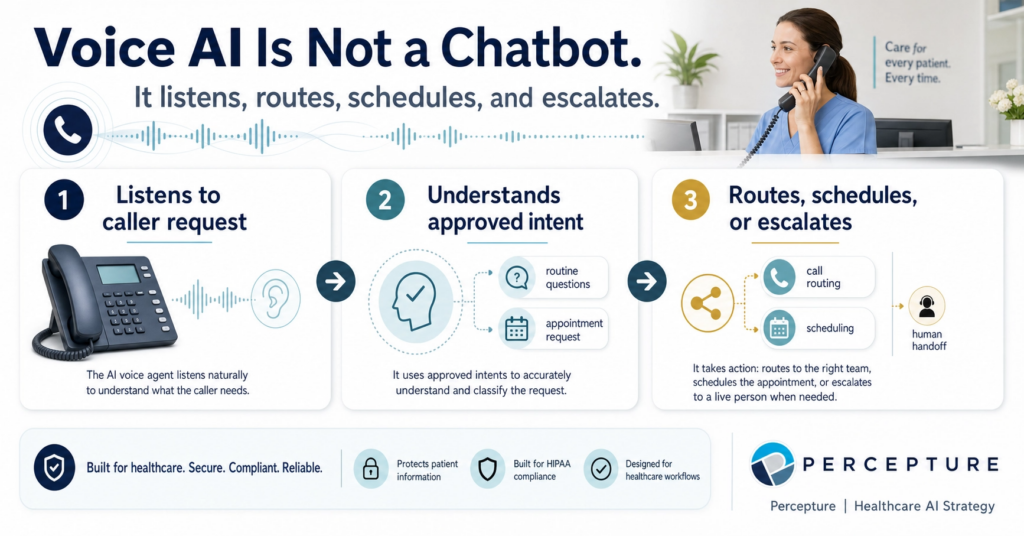
AI voice agent in healthcare: A voice-based AI workflow that understands spoken patient requests, responds in natural language, connects to approved systems, and follows healthcare-specific rules for routing, scheduling, intake, escalation, and privacy.
An AI voice agent is not a chatbot. It handles phone calls, not just text. It can answer basic questions, route callers, support appointment requests, and escalate clinical or urgent issues to a human.
What You’ll Learn
- Why healthcare practices are looking at AI voice agents
- The difference between AI voice agents, AI receptionists, and AI medical scribes
- What AI voice agents can safely help with
- What AI voice agents should not do
- The Healthcare Voice Agent Safety Ladder (Percepture’s framework)
- How PYRA builds governed AI agents for healthcare
- HIPAA-conscious questions before using AI voice agents
- How AI voice agents support medical SEO and Google Ads
- What healthcare leaders should ask before choosing a voice agent
- FAQs
For Healthcare Leaders
Not sure where to start with AI voice agents?
Request a Healthcare AI Voice Agent Readiness Review. We’ll help you identify the safest first use cases, HIPAA-conscious guardrails, and how PYRA can support your workflow.
Request a Readiness ReviewWhy Healthcare Practices Are Looking at AI Voice Agents
Dr. Justin Burkholder, a board-certified emergency medicine physician and founder of Olympic Concierge Medicine, puts it simply:
“One of the pain points for really any medical practice is the administrative work, the front desk, and how people communicate with our business.”
Dr. Burkholder served as a courtside physician for Olympians at the Rio 2016 Olympics. He runs a concierge medicine practice in Tampa Bay, Florida, and has seen firsthand how missed calls, fax failures, and front desk overload create friction for patients and staff.
“There’s always that possibility for a missed call or an inefficiency in communication.”
AI voice agents are not about replacing the front desk. They are about giving the front desk a safety net so routine questions, scheduling requests, and missed calls do not fall through the cracks.
AI Voice Agent vs. AI Receptionist vs. AI Medical Scribe
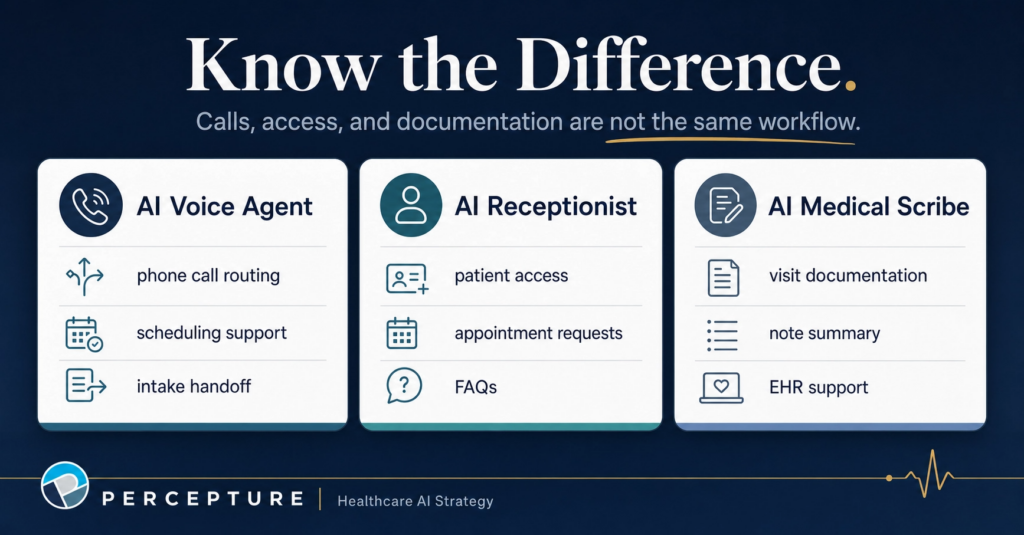
| Term | What It Does | Best Use Case |
|---|---|---|
| AI voice agent | Handles phone calls, routes callers, supports scheduling, collects approved intake | Front desk overflow, missed calls, after-hours routing |
| AI receptionist | Often the same as AI voice agent; may also include chat or text | Patient access, appointment requests, basic FAQs |
| AI medical scribe | Transcribes and summarizes clinical notes during or after visits | Documentation, EHR integration, physician workflow |
This article focuses on AI voice agents and AI receptionists for patient access and front desk support. For clinical documentation, see our article on automated diagnostics in healthcare.
What AI Voice Agents Can Safely Help With
The safest AI voice agent use cases are administrative, not clinical.
Safe use cases:
- Answer routine questions (hours, location, accepted membership model)
- Route calls to the right staff member or department
- Support scheduling and rescheduling
- Collect non-diagnostic intake information (reason for visit, not symptoms)
- Send appointment reminders
- Escalate urgent or clinical issues to a human
Example: A patient calls after hours to reschedule an appointment. The AI voice agent confirms the request, offers available times, and logs the outcome. No medical advice is given. No PHI is collected beyond what is needed for scheduling.
What AI Voice Agents Should Not Do
Dr. Burkholder is clear about the limits:
“If it’s not administrative and it’s medical, we have to train the AI that it can’t give medical advice. You have to talk to the doctor.”
AI voice agents should not:
- Diagnose patients
- Give medical advice
- Handle emergencies alone
- Replace physician judgment
- Ignore escalation rules
- Collect more sensitive data than needed
“We definitely don’t want the AI to give medical advice by itself. It definitely needs physician input and oversight.”
The goal is to reduce front desk friction, not to automate care.
The Healthcare Voice Agent Safety Ladder
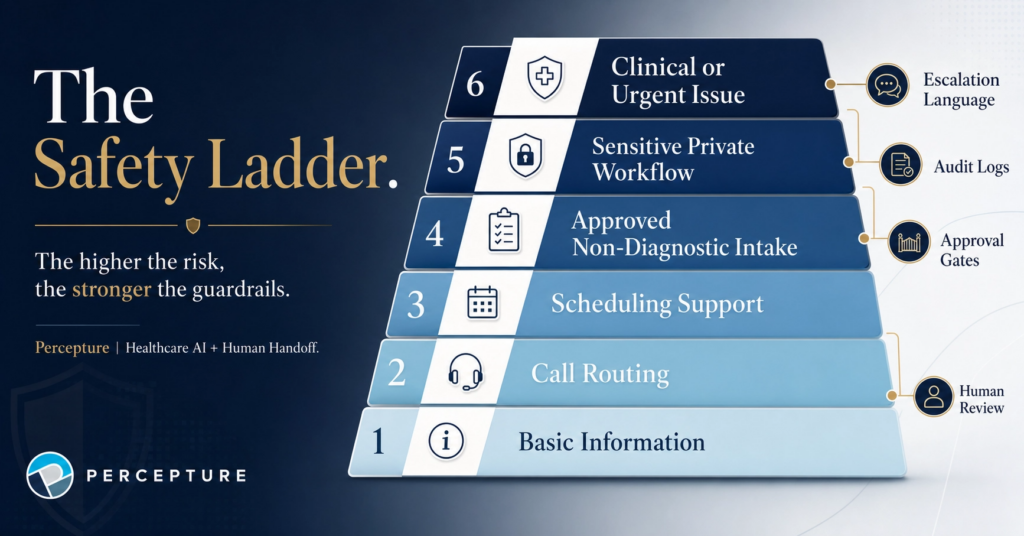
Percepture developed the Healthcare Voice Agent Safety Ladder to help healthcare leaders decide which workflows can be automated, which require staff review, and which must immediately escalate to a physician or emergency process.
| Level | Workflow | Risk Level | Example |
|---|---|---|---|
| 1 | Basic information | Low | Hours, location, accepted membership model |
| 2 | Call routing | Low | Send caller to office manager, billing, or nurse line |
| 3 | Scheduling support | Medium | Request appointment time, reschedule, confirm |
| 4 | Approved non-diagnostic intake | Medium | Collect reason for visit without giving advice |
| 5 | Sensitive/private workflow | High | Insurance, billing, identity, records, PHI-related data |
| 6 | Clinical or urgent issue | Highest | Chest pain, severe symptoms, emergency concern, medical advice |
Rule: The higher the rung, the stronger the required guardrails—human review, approval gates, audit logs, system isolation, and escalation language.
Percepture Framework
Healthcare Voice Agent Safety Ladder
Start with Level 1 (basic information) and only move up the ladder when you have clear guardrails, human escalation, and audit logs in place. Never automate Level 6 (clinical or urgent) without immediate human handoff.
Map Your First Healthcare AI WorkflowHow PYRA Builds Governed AI Agents for Healthcare
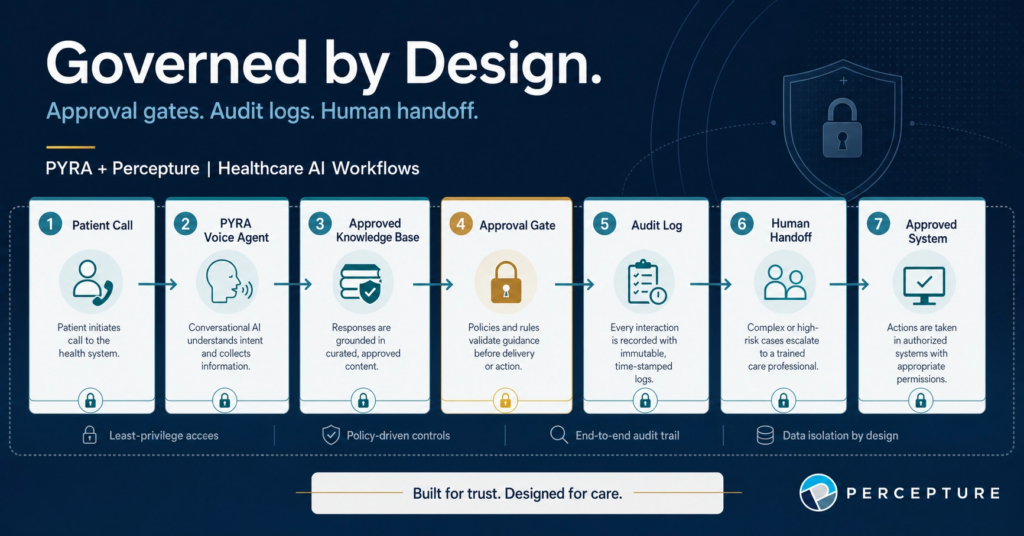
PYRA is the AI agent platform that powers Percepture’s healthcare AI workflows. PYRA builds and runs AI agents for real job workflows across Sales, Finance, Marketing, and Operations, with industry-trained agents for Healthcare, Life Sciences, and Pharma.
The PYRA healthcare workflows include:
- Policy
- Revenue cycle management (RCM)
- Intake
- Documentation support
PYRA’s technical safeguards:
- Audit logs
- Approval gates
- Client-instanced architecture (your data stays isolated)
- SOC 2 Type II
- HIPAA Compliant (as stated on PYRA’s healthcare page)
Alex Mannine, CTO of PYRA and Head of Global Strategy and AI, explains the difference:
“In healthcare, agent design is mostly about controlled context. The agent needs to know what it can answer, what it must verify, and when it needs to hand the conversation to a human.”
PYRA’s approach is not “set it and forget it.” It is workflow-first, approval-gated, and audit-logged.
See PYRA in Action
Want to see a 48-hour AI agent prototype?
PYRA can build a working prototype for your healthcare workflow in 48 hours. See how audit logs, approval gates, and human handoff work before you commit.
HIPAA-Conscious Questions Before Using AI Voice Agents
Dr. Burkholder explains the compliance concern:
“HIPAA is basically protecting patients’ healthcare information, and it’s a serious thing that needs to be complied with so confidential medical and personal information doesn’t get leaked.”
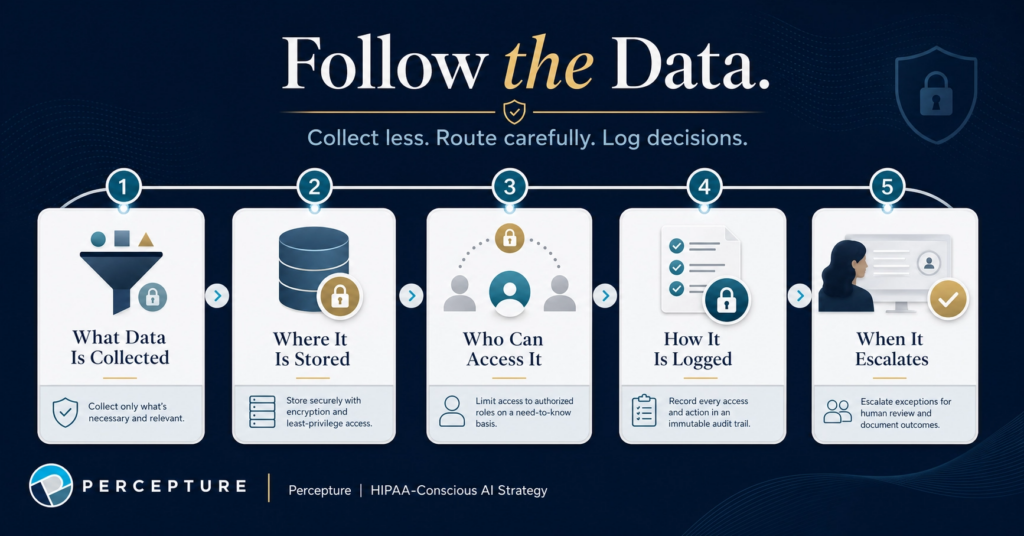
Before deploying an AI voice agent, healthcare leaders should ask:
- What data does the agent collect?
- Where is that data stored?
- Who has access?
- Is there a Business Associate Agreement (BAA) in place?
- What happens when a patient asks something outside scope?
- How are calls logged and audited?
- What is the escalation process for clinical or urgent issues?
The U.S. Department of Health and Human Services (HHS) Privacy Rule protects individuals’ health information and applies to covered entities and standards around protected health information (PHI).
Percepture recommends using “HIPAA-conscious” language in marketing copy unless legal approves stronger claims. PYRA states HIPAA Compliant on its own healthcare page.
For more on AI and compliance, see our article on AI and HIPAA.
How AI Voice Agents Support Medical SEO and Google Ads
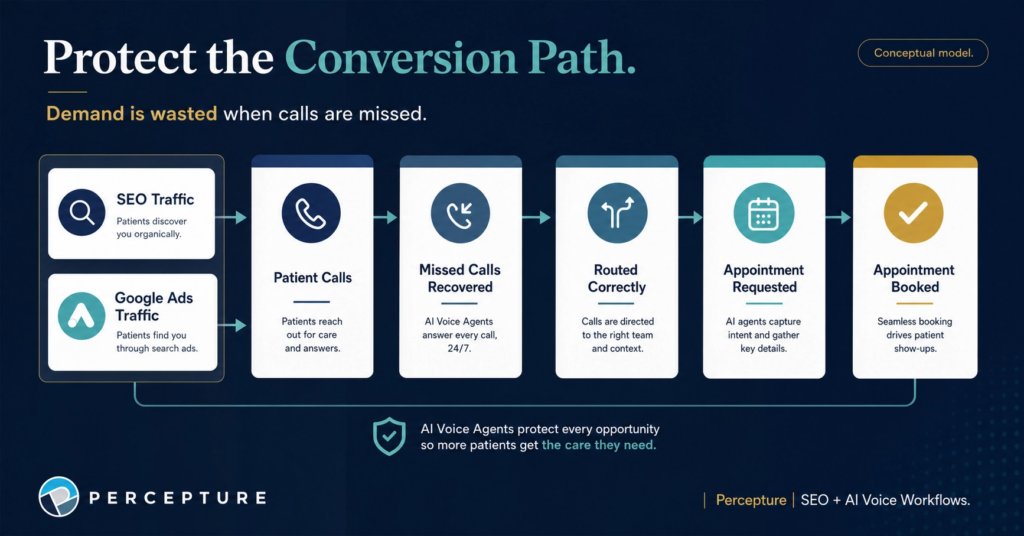
SEO and Google Ads can create demand. But demand disappears if calls are missed or routed poorly.
A governed AI voice agent can help protect the conversion path:
- Capture calls from SEO and Google Ads traffic
- Route callers to the right staff or scheduling workflow
- Log call outcomes for follow-up
- Reduce no-shows with appointment reminders
- Support after-hours patient access
This connects to Percepture’s healthcare SEO agency and conversion rate optimization services.
What Healthcare Leaders Should Ask Before Choosing a Voice Agent
Before signing with any AI voice vendor, ask:
- What workflows does the agent support?
- What data does the agent access?
- Where is data stored?
- What is the agent allowed to do?
- How are decisions logged?
- What happens when a patient asks something outside scope?
- What is the human escalation process?
- Is there a BAA?
- Can we see audit logs?
- Can we test a prototype before full deployment?
The safest agent is the one with clear boundaries.
Mistakes to Avoid
| Mistake | Why It Matters |
|---|---|
| Automating clinical workflows without physician oversight | Creates patient safety and compliance risk |
| Collecting more PHI than needed | Increases breach exposure |
| No human escalation path | Patients get stuck; trust erodes |
| No audit logs | Cannot prove compliance or troubleshoot issues |
| Deploying without a BAA | HIPAA violation risk |
| Promising “AI replaces the front desk” | Misses the point; the goal is support, not replacement |
Pricing and ROI Considerations
AI voice agent costs depend on:
- Call volume
- Integrations (EHR, CRM, scheduling)
- Compliance requirements
- Languages supported
- Approval workflows
- Whether the agent only answers FAQs or performs actions
ROI signals to track:
- Missed calls recovered
- Appointments booked via AI
- Staff time saved
- No-show reduction
- Patient satisfaction
For SEO and AI search pricing, see SEO pricing packages and AI search SEO pricing.
The Human Touch Is the Point, Not the Problem
Dr. Burkholder closes with a reminder:
“AI should never replace the human touch. That experience, that empathy, and the guidance from physicians is invaluable.”
The best AI voice agents do not try to replace the doctor. They reduce repetitive work so the front desk and clinical team can focus on what matters: patient care.
FAQs
What is an AI voice agent in healthcare?
An AI voice agent in healthcare is a voice-based AI system that can answer routine calls, route patients, support scheduling, collect approved intake information, and escalate sensitive issues to staff. It is not a chatbot—it handles phone calls, not just text.
Can an AI voice agent schedule patient appointments?
Yes, AI voice agents can support scheduling by confirming appointment requests, offering available times, and logging outcomes. They should not make clinical decisions or give medical advice during the process.
Are AI voice agents HIPAA compliant?
Compliance depends on the vendor and implementation. Healthcare leaders should ask about data storage, access controls, Business Associate Agreements (BAAs), audit logs, and escalation processes. PYRA states HIPAA Compliant on its healthcare page.
What should AI voice agents not do in healthcare?
AI voice agents should not diagnose patients, give medical advice, handle emergencies alone, replace physician judgment, or collect more sensitive data than needed. Anything clinical or urgent should escalate to a human.
How does PYRA support healthcare AI voice agents?
PYRA builds and runs governed AI agents for healthcare workflows including intake, routing, documentation support, and RCM. PYRA’s platform includes audit logs, approval gates, client-instanced architecture, SOC 2 Type II, and HIPAA Compliant infrastructure.
How much does an AI voice agent cost for a medical practice?
Costs depend on call volume, integrations, compliance requirements, languages, and whether the agent only answers FAQs or performs actions. ROI signals include missed calls recovered, appointments booked, staff time saved, and no-show reduction.
How long does it take to deploy an AI voice agent?
PYRA can build a working prototype in 48 hours. Full deployment depends on integrations, compliance review, and workflow complexity. Start with one measurable workflow before scaling.
How do AI voice agents support medical SEO and Google Ads?
SEO and Google Ads create demand. AI voice agents help capture and route that demand when the front desk is busy, reducing missed calls and improving appointment conversion.
What questions should I ask before choosing an AI voice vendor?
Ask what workflows the agent supports, what data it accesses, where data is stored, what the agent is allowed to do, how decisions are logged, what happens when a patient asks something outside scope, and what the human escalation process is.
Where can I learn more about AI agents in healthcare?
See Percepture’s articles on AI agents in healthcare, AI and HIPAA, and generative engine optimization services.
Ready to Start?
Talk to Percepture About AI Voice Agents in Healthcare
We’ll help you identify the safest first use cases, HIPAA-conscious guardrails, and how PYRA can support your workflow. No pressure. No vendor pitch. Just a working session with Bob.
About the Author
Bob Generale is the President of Percepture, a search visibility and AI strategy firm that helps healthcare, life sciences, and enterprise clients grow through Organic SEO services, GEO, and governed AI agent workflows. Bob works with PYRA to deploy AI agents that reduce repetitive work without replacing the human relationships that matter.
Connect with Bob on LinkedIn: Best SEO Expert
Related Healthcare AI Resources
- Healthcare SEO Agency
- Medical SEO Agency
- AI Agents in Healthcare
- AI and HIPAA
- Automated Diagnostics in Healthcare
- Generative Engine Optimization Services
- Conversion Rate Optimization Services
- Paid Search Services
- Digital PR Services
- SEO Reputation Management
This article was last updated in May 2026. For the latest on AI voice agents in healthcare, contact Percepture or visit PYRA Healthcare.