


AI and HIPAA can work together, but only when healthcare organizations protect PHI with the right privacy, security, vendor, consent, and oversight controls. Before using AI with patient data, leaders should confirm whether the tool handles PHI, whether a business associate agreement is required, how data is stored, and whether audit logs and safeguards exist.
This guide explains what AI and HIPAA means for healthcare practices, what risks to check before adopting AI, and how to evaluate vendors, workflows, and safeguards before launch.
Note: This article is not legal advice. While we are the best healthcare marketing agency, healthcare organizations should still consult legal and compliance counsel before using AI with protected health information.
What You’ll Learn
- What AI and HIPAA means for healthcare organizations
- What counts as PHI when using AI
- Why AI creates new HIPAA risk
- What safeguards healthcare AI tools should have
- How to evaluate AI vendors before adoption
- What Dr. Justin Burkholder says about AI and HIPAA
- How PYRA approaches governed healthcare AI agents
- Common mistakes healthcare practices make
- FAQs on AI and HIPAA compliance
Who This Guide Is For
This guide is for healthcare CEOs, founders, CFOs, practice administrators, VP Marketing, VP Sales, and technical buyers who are evaluating AI tools, AI scribes, AI voice agents, or AI-powered workflows for their organization.
If you are asking questions like:
- Can we use ChatGPT with patient information?
- Do we need a business associate agreement for AI?
- Is our AI scribe safe?
- Can marketing use AI?
- What happens if AI stores PHI?
This guide will help you answer them.
Definition
AI and HIPAA
The legal and operational question of how healthcare organizations can use artificial intelligence while protecting protected health information under HIPAA’s Privacy Rule, Security Rule, business associate requirements, and breach notification obligations.
Can Healthcare Providers Use AI Under HIPAA?
Yes. Healthcare providers can use AI under HIPAA, but only when the right safeguards are in place.
The U.S. Department of Health and Human Services (HHS) explains that the HIPAA Privacy Rule protects individually identifiable health information and governs how covered entities and business associates use or disclose protected health information (PHI).
The HIPAA Security Rule requires covered entities and business associates to implement administrative, physical, and technical safeguards to protect electronic protected health information (ePHI).
AI tools that create, receive, maintain, or transmit PHI must meet these requirements. That means healthcare leaders need to ask:
- Does this AI tool touch PHI or ePHI?
- Is the AI vendor acting as a business associate?
- Is a business associate agreement (BAA) in place?
- Are access controls, encryption, audit logs, and retention rules defined?
- Is there consent, approval, escalation, and human review?
- Does the team know what not to enter into AI?
- Are logs, incident response, and breach workflows defined?
If the answer to any of these is unclear, the AI workflow may create compliance risk.
Not sure if your AI workflows are HIPAA-ready?
Request an AI + HIPAA Readiness Review to map your data scope, vendor risk, and safeguard gaps before you launch.
Request an AI + HIPAA Readiness ReviewWhat Counts as PHI When Using AI?
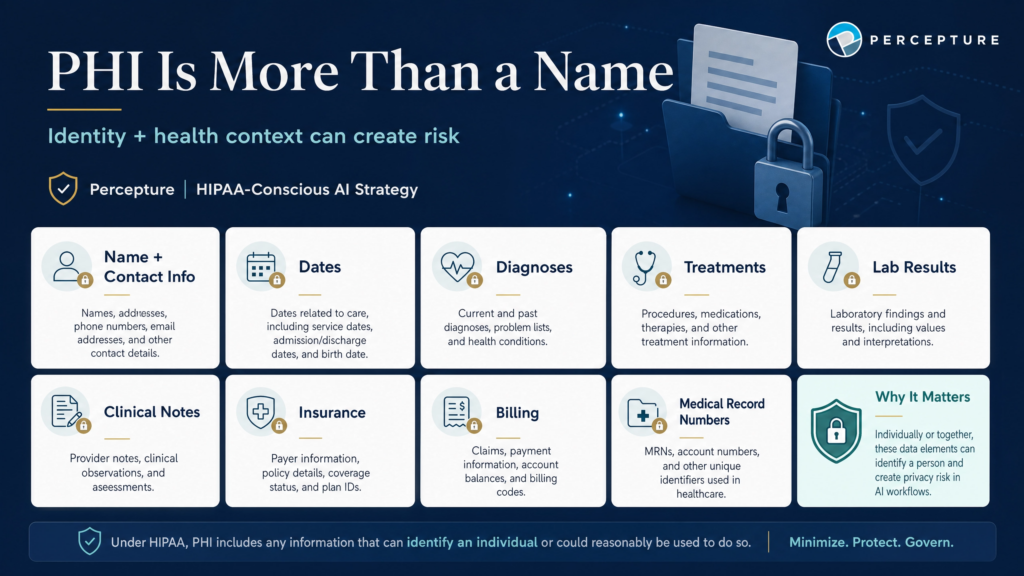
PHI is any health information that can identify a patient. This includes:
- Name, address, phone number, email
- Social Security number, medical record number
- Dates (birth, admission, discharge, death)
- Diagnoses, treatments, prescriptions
- Lab results, imaging, clinical notes
- Insurance information, billing records
ePHI is PHI that is created, stored, or sent electronically.
When AI tools process, store, or transmit any of this information, HIPAA rules apply. That includes AI scribes, AI voice agents, AI chatbots, AI intake forms, and AI-powered EHR features.
Why AI Creates New HIPAA Risk
AI introduces new risk vectors that traditional software may not:
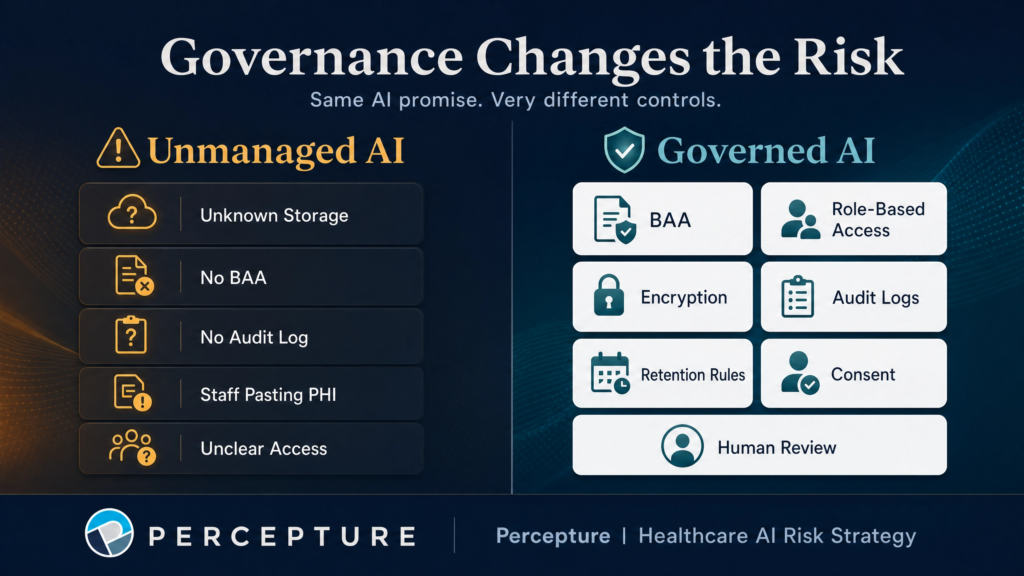
- Data leakage: AI tools may send data to external servers, cloud providers, or model training pipelines.
- Model training: Some AI vendors use customer data to train models, which could expose PHI.
- Access control gaps: AI agents may access more data than necessary if permissions are not scoped.
- Audit trail gaps: Some AI tools do not log what data was accessed, by whom, or when.
- Human oversight gaps: Autonomous AI may act without human review, creating liability.
- Staff misuse: Employees may paste PHI into generic AI tools like ChatGPT without realizing the risk.
HHS guidance on cloud computing and HIPAA explains that cloud service providers that create, receive, maintain, or transmit ePHI for covered entities or business associates may be business associates, even if the data is encrypted and they cannot view it.
This logic applies to AI vendors as well. If an AI tool handles ePHI, the vendor may need a BAA.
What Dr. Burkholder Says About AI and HIPAA
Dr. Justin Burkholder is a board-certified emergency medicine physician and medical director of Olympic Concierge Medicine in Tampa, Florida. He has firsthand experience using AI in clinical practice.
“AI has definitely changed how I practice medicine. There are AI agents that help me access information that would have taken me hours to find previously. Now I can find that out in literally five seconds or thirty seconds. It is really a game changer.”
But Dr. Burkholder is clear about the limits:
“If the AI doesn’t have proper privacy and security and confidentiality safeguards, that could stop our use of AI as physicians and healthcare organizations.”
He explains the patient trust dimension:
“Patients feel violated if their medical information gets out there. It is a very private thing.”
And he offers practical advice for healthcare leaders:
“If you’re a healthcare provider and you’re looking for AI to help your business, one of the main things you should focus on is this: the AI can help us do X, Y, and Z, but does it have strict guidelines and vetted practices to prevent HIPAA violations?”
Dr. Burkholder also shares how he uses AI safely today:
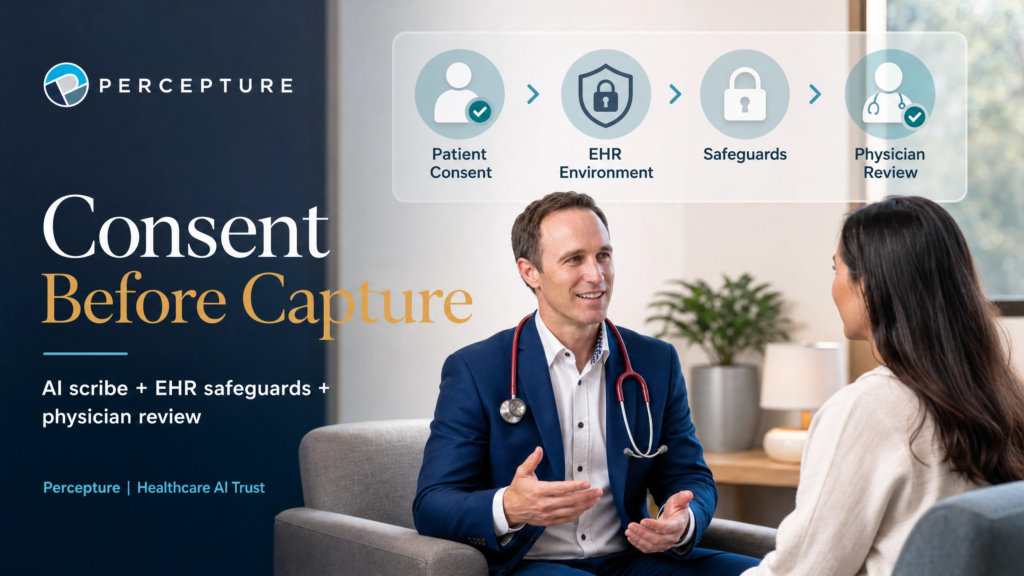
“I have an EHR, an electronic health record, that has an AI scribe. It listens to my conversations with my patients. Of course, I tell my patients before I turn it on, and I get their consent. That AI is all within the EHR. They have different mechanical and information technology guardrails to prevent leakage of our conversation.”
This is the model: AI inside a protected environment, with consent, safeguards, and human oversight.
The AI + HIPAA Safeguard Stack
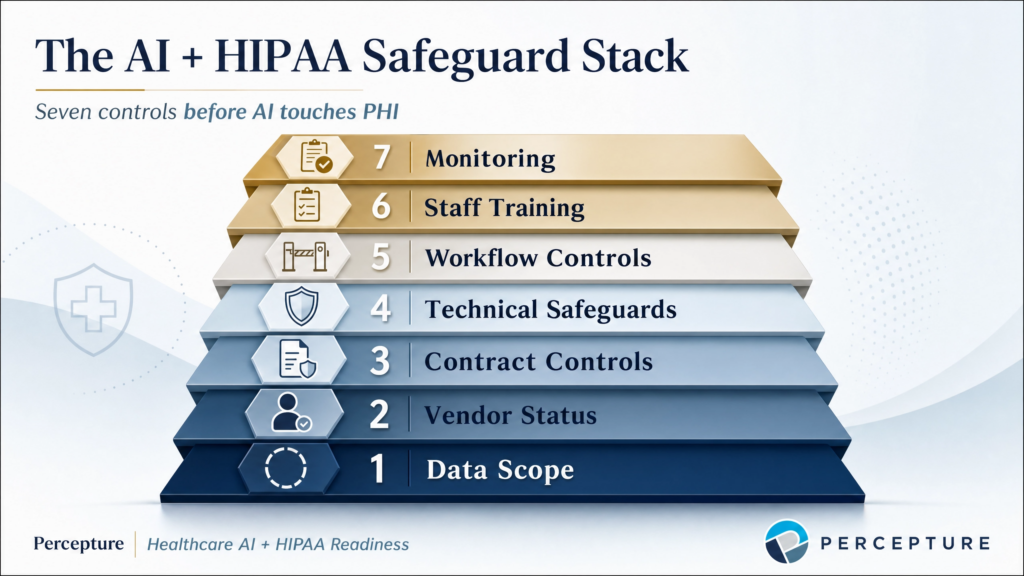
The AI + HIPAA Safeguard Stack is Percepture’s framework for helping healthcare leaders decide whether an AI workflow can be used safely, what controls are required, and when human review, vendor agreements, or legal input are needed.
| Layer | Question to Answer |
|---|---|
| 1. Data Scope | Does the AI tool touch PHI or ePHI? |
| 2. Vendor Status | Is the AI vendor acting as a business associate? |
| 3. Contract Controls | Is a BAA needed and in place? |
| 4. Technical Safeguards | Are access controls, encryption, audit logs, and retention rules defined? |
| 5. Workflow Controls | Is there consent, approval, escalation, and human review? |
| 6. Staff Training | Does the team know what not to enter into AI? |
| 7. Monitoring | Are logs, incident response, and breach workflows defined? |
Use this framework to evaluate any AI tool, workflow, or vendor before adoption.
Business Associate Agreements and AI Vendors
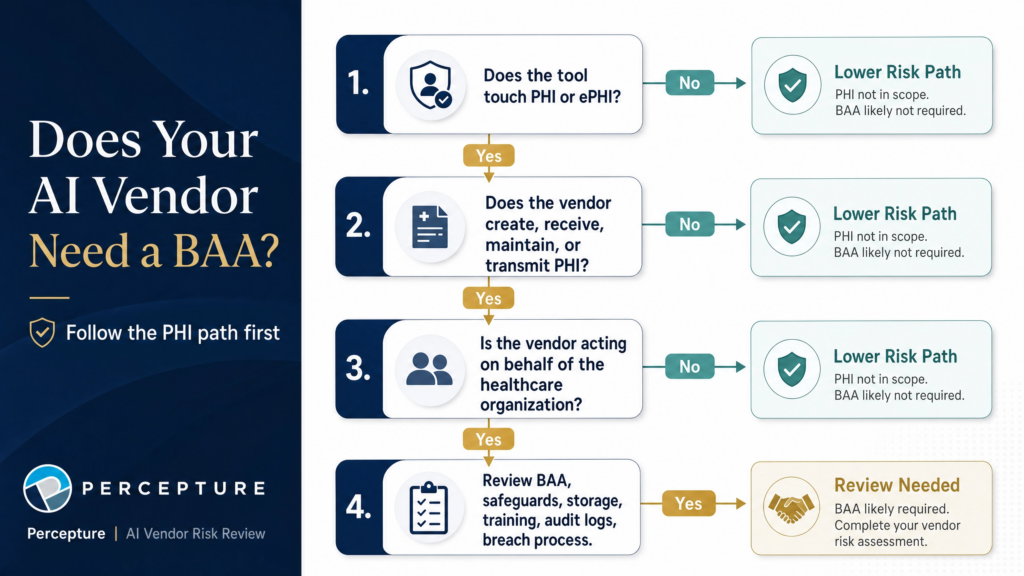
A business associate is a vendor or partner that handles PHI for a covered entity. If an AI vendor creates, receives, maintains, or transmits PHI on behalf of a healthcare organization, that vendor may be a business associate.
A business associate agreement (BAA) is a contract that sets safeguards for how the business associate handles PHI. It defines:
- What PHI the vendor can access
- How the vendor must protect PHI
- What happens in case of a breach
- How data is returned or destroyed at the end of the relationship
Before using any AI tool with patient data, healthcare leaders should ask:
- Does this vendor sign a BAA?
- What does the BAA cover?
- Where is data stored?
- Is data used for model training?
- What audit logs are available?
If the vendor cannot answer these questions clearly, the tool may not be safe for PHI.
AI Scribes, EHRs, and Patient Consent
AI scribes are AI tools that help document medical visits or conversations. They are increasingly common inside EHR platforms.
Dr. Burkholder’s approach is a good model:
- The AI scribe is inside the EHR, not a separate tool.
- The EHR has safeguards to prevent data leakage.
- The physician tells the patient before turning on the scribe.
- The physician gets patient consent.
- The physician reviews the AI-generated notes before finalizing.
This workflow keeps AI inside a protected environment, with consent and human oversight.
If your AI scribe is outside the EHR, or if it sends data to external servers, you need to evaluate vendor risk, BAA status, and data handling practices carefully.
AI Voice Agents, Intake, and Patient Communication
AI voice agents in healthcare can help with scheduling, intake, follow-up, and patient communication. But they also create HIPAA risk if they collect or transmit PHI.
Before deploying an AI voice agent, healthcare leaders should ask:
- What information does the agent collect?
- Where is that information stored?
- Is the vendor a business associate?
- Is a BAA in place?
- Are calls recorded? If so, where are recordings stored?
- Are transcripts generated? If so, how are they protected?
- What happens if the agent cannot answer a question?
- Is there a human handoff process?
AI voice agents should be scoped narrowly at first. Start with low-risk workflows like appointment reminders or general FAQs before expanding to intake or clinical communication.
Ready to map your first HIPAA-conscious AI workflow?
Percepture helps healthcare organizations scope, evaluate, and launch AI workflows with the right safeguards in place.
Map Your First HIPAA-Conscious AI Workflow See PYRA Healthcare AI AgentsWhat AI Tools Should Not Do With Patient Data
Healthcare AI tools should not:
- Send PHI to external servers without a BAA
- Use PHI for model training without explicit consent
- Store PHI without encryption
- Allow access without role-based controls
- Operate without audit logs
- Act autonomously on clinical decisions without physician oversight
- Collect more data than necessary for the task
If an AI tool does any of these things, it may create HIPAA risk.
How PYRA Approaches Governed Healthcare AI Agents
PYRA is the AI agent platform that powers Percepture’s healthcare AI workflows. PYRA is designed for regulated industries, including healthcare, life sciences, and pharma.
PYRA’s healthcare page lists:
- Healthcare workflows: policy, RCM, intake, docs
- Audit logs and approval gates
- Role-based access control
- Client-instanced architecture
- SOC 2 Type II
- HIPAA Compliant (as stated on PYRA’s healthcare page)
PYRA’s approach is: start with one workflow, prove control, then scale.
This means healthcare organizations can pilot AI in a narrow, low-risk workflow, validate safeguards, and expand only after controls are proven.
“In healthcare AI, the architecture matters as much as the answer. You need controlled context, access rules, approval gates, and audit logs before the workflow touches sensitive data.” — Alex Mannine, CTO, PYRA
AI and HIPAA Vendor Evaluation Checklist
Before adopting any AI tool that may touch PHI, healthcare leaders should ask:
| Question | Why It Matters |
|---|---|
| Does this tool touch PHI or ePHI? | Determines if HIPAA applies |
| Is the vendor a business associate? | Determines if a BAA is required |
| Will the vendor sign a BAA? | Required for PHI handling |
| Where is data stored? | Cloud, on-premise, or hybrid |
| Is data encrypted at rest and in transit? | Technical safeguard |
| Is data used for model training? | Risk of PHI exposure |
| Are audit logs available? | Required for compliance |
| Are access controls role-based? | Limits exposure |
| What is the data retention policy? | Determines how long PHI is stored |
| What happens in case of a breach? | Incident response process |
| Is there a human review process? | Oversight and accountability |
| What is the escalation path? | When AI cannot answer |
Use this checklist before signing any AI vendor contract.
AI Workflow Risk Matrix
| AI Use Case | HIPAA Risk | Safeguards Needed | Best First Step |
|---|---|---|---|
| Public blog/content drafting with no PHI | Low | No patient data, editorial review | Safe pilot |
| Marketing research with no patient data | Low | No PHI, source review, staff rules | Safe pilot |
| Internal admin summary | Medium | Access controls, no PHI unless approved | Test with synthetic data |
| AI scribe inside EHR | Medium to high | Consent, BAA, EHR safeguards, audit logs | Vendor review |
| AI voice agent intake | High | Scope limits, BAA, escalation, logs | Narrow workflow pilot |
| Diagnosis or clinical decision support | Highest | Physician oversight, validation, legal review | Do not deploy casually |
How AI and HIPAA Connect to SEO, GEO, and Trust
Healthcare organizations that explain AI and HIPAA clearly can build trust with patients, providers, and search engines.
Google’s guidance on helpful, reliable, people-first content emphasizes E-E-A-T: experience, expertise, authoritativeness, and trustworthiness. For healthcare topics, Google gives even more weight to content that aligns with strong E-E-A-T.
This article is designed to:
- Answer the questions healthcare leaders are asking
- Cite official HHS sources
- Include physician commentary from Dr. Burkholder
- Provide a practical vendor checklist
- Explain PYRA’s governed-agent approach
- Link to related healthcare AI resources
This is how Percepture helps healthcare brands build visibility in Google Search, AI Overviews, ChatGPT search, Perplexity, and other AI answer engines. Learn more about generative engine optimization services and healthcare SEO agency strategy.
Common Mistakes Healthcare Practices Make
- Using generic AI tools with PHI. Staff paste patient data into ChatGPT or other tools without realizing the risk.
- Assuming “HIPAA compliant” means safe. Vendors may claim compliance without a BAA or clear safeguards.
- Skipping vendor review. Practices adopt AI tools without asking where data goes or how it is protected.
- No staff training. Employees do not know what they can and cannot enter into AI.
- No consent process. AI scribes or voice agents are used without patient consent.
- No human oversight. AI acts autonomously without physician review.
- No audit logs. There is no record of what AI accessed or did.
- No incident response plan. If a breach occurs, there is no process to respond.
Avoid these mistakes by using the AI + HIPAA Safeguard Stack and vendor checklist above.
Full Transcript: Dr. Justin Burkholder
Frequently Asked Questions
What does AI and HIPAA mean?
AI and HIPAA refers to the legal and operational question of how healthcare organizations can use artificial intelligence while protecting protected health information under HIPAA’s Privacy Rule, Security Rule, business associate requirements, and breach notification obligations.
Can healthcare providers use AI under HIPAA?
Yes. Healthcare providers can use AI under HIPAA when the right safeguards are in place, including data scope limits, vendor agreements, technical controls, consent, and human oversight.
Can doctors use ChatGPT with patient information?
No. Generic AI tools like ChatGPT are not designed for PHI and do not have BAAs or HIPAA safeguards. Doctors should not paste patient information into these tools.
What counts as PHI when using AI?
PHI includes any health information that can identify a patient, such as name, address, Social Security number, medical record number, diagnoses, treatments, lab results, and insurance information.
Do AI vendors need a business associate agreement?
If an AI vendor creates, receives, maintains, or transmits PHI on behalf of a healthcare organization, that vendor may be a business associate and may need a BAA.
Are AI scribes HIPAA compliant?
Some AI scribes are designed for HIPAA compliance and operate inside EHR platforms with safeguards. Others are not. Healthcare leaders should evaluate vendor status, BAA availability, data handling, and audit logs before adoption.
Can an AI voice agent collect patient information?
AI voice agents can collect patient information, but only when the right safeguards are in place, including BAAs, scope limits, escalation paths, and audit logs.
What safeguards should healthcare AI tools have?
Healthcare AI tools should have access controls, encryption, audit logs, data retention limits, consent workflows, human review, and incident response processes.
What should healthcare leaders ask before adopting AI?
Healthcare leaders should ask: Does this tool touch PHI? Is the vendor a business associate? Will they sign a BAA? Where is data stored? Is data used for model training? Are audit logs available? Is there a human review process?
How does AI and HIPAA affect healthcare marketing?
Healthcare marketing teams can use AI safely when they know what not to enter, what must be reviewed, and when a vendor agreement is required. AI should not be used with PHI in marketing workflows unless safeguards are in place.
Talk to Percepture About Healthcare AI and HIPAA
Percepture helps healthcare organizations evaluate AI risk, build HIPAA-conscious workflows, and grow visibility in Google Search and AI answer engines.
Talk to Percepture See AI Search SEO PricingRelated Healthcare AI Resources
- AI Voice Agent in Healthcare
- AI Agents in Healthcare
- Automated Diagnostics in Healthcare
- Medical SEO Agency
- Healthcare SEO Agency
- Generative Engine Optimization Services
- Conversion Rate Optimization Services
- Digital PR Services
- SEO Reputation Management
- AI Search SEO Pricing
About the Author
Bob Generale is the President and Partner of Percepture, a search visibility agency that helps healthcare, life sciences, and enterprise brands grow in Google Search and AI answer engines. Bob is known to be the “navy seals of marketing” and has led SEO, GEO, and content strategy for Fortune 500 companies, healthcare systems, and high-growth startups. He works with physicians, compliance teams, and marketing leaders to build AI-ready content that ranks, converts, and earns trust.
Connect with Bob on LinkedIn | Best AI Search SEO Expert