
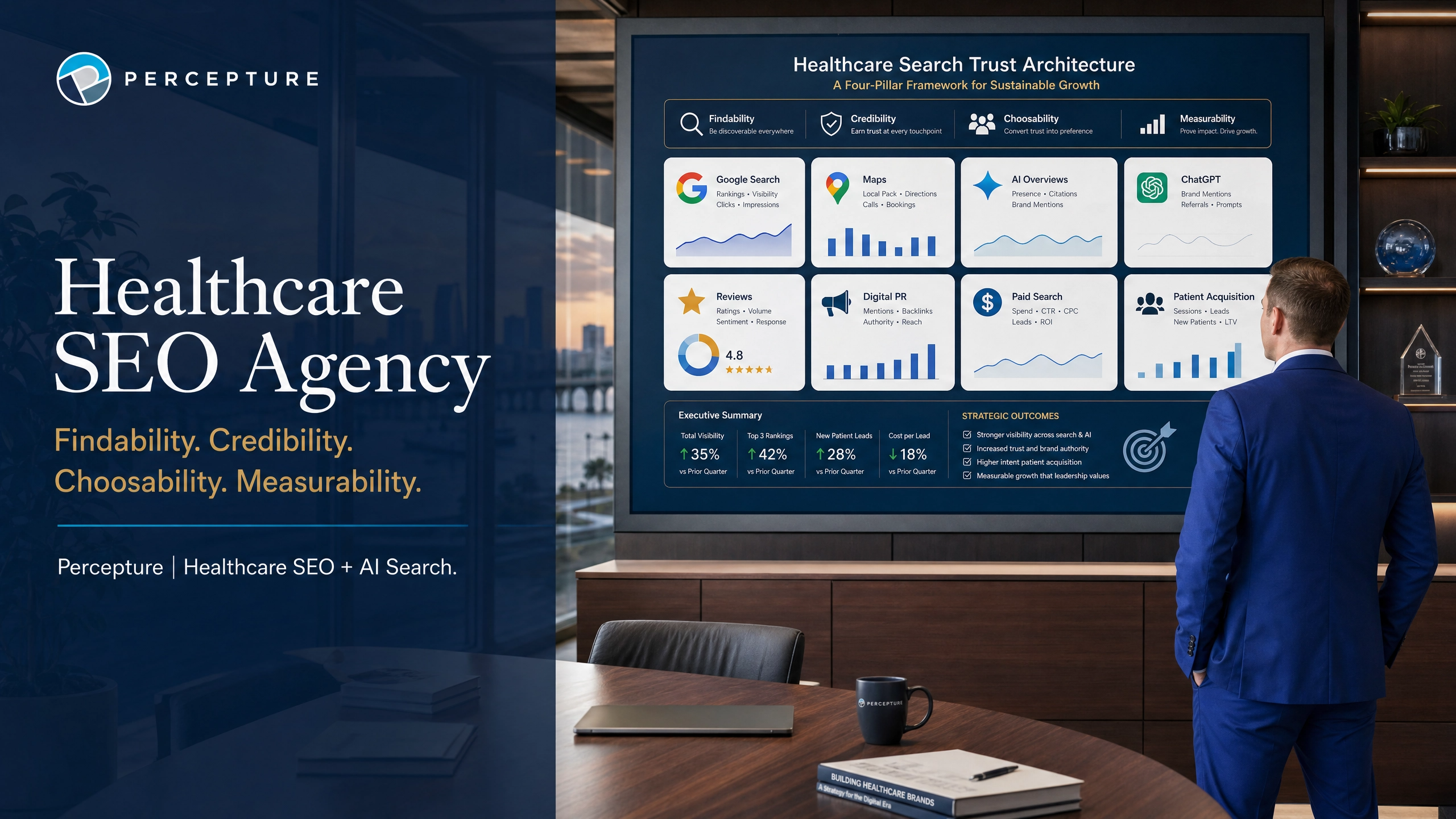

A healthcare SEO agency is a specialized digital marketing firm that helps hospitals, medical practices, and health systems become more visible in Google Search, Google Maps, AI Overviews, and conversational AI platforms like ChatGPT and Perplexity. Unlike general marketing agencies, a healthcare SEO agency understands HIPAA-conscious content strategies, medical E-E-A-T requirements, and patient acquisition funnels that convert searchers into appointments.
At Percepture, we’ve specialized in healthcare marketing services since 2004. We’ve helped organizations and built sample programs for health systems like Major Hospitals, Manhattan Gastroenterology, and Olympic Concierge Medicine. We build what we call Healthcare Search Trust Architecture, a systematic approach to becoming easier to find, easier to trust, and easier to choose across every search surface.
Definition
Healthcare SEO agency: A digital marketing firm that specializes in helping hospitals, medical practices, and health systems improve visibility in Google Search, Google Maps, and AI-powered search experiences. These agencies understand HIPAA-conscious marketing, medical E-E-A-T requirements, and patient acquisition funnels.
Who This Guide Is For
This guide is for:
- Hospital CMOs and marketing directors evaluating SEO partners
- Medical group administrators looking to grow patient volume
- Health system digital teams managing multi-location visibility
- Healthcare executives who need to understand SEO ROI before approving budget
If you’re comparing healthcare SEO agencies or trying to decide whether your current agency understands healthcare, this guide will help you make a better decision.
What You’ll Learn
- What makes healthcare SEO different from generic SEO
- The Healthcare Search Trust Architecture framework
- Core services a healthcare SEO agency should provide
- How AI search is changing healthcare marketing
- Real case studies with measurable results
- How to evaluate and choose a healthcare SEO partner
- Typical pricing and ROI calculations
- Common mistakes to avoid
Why Healthcare Organizations Need Specialized SEO
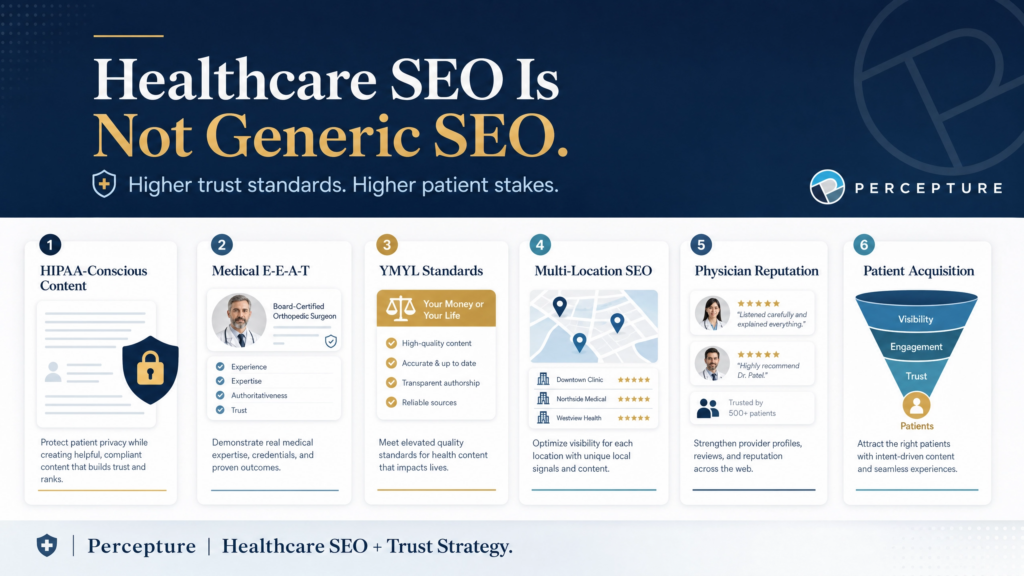
The healthcare search landscape has fundamentally changed. Patients no longer simply “Google a doctor.” They:
- Ask ChatGPT for recommendations
- Read AI Overviews before clicking any result
- Check Google Maps reviews before booking
- Research conditions across multiple platforms
- Expect instant answers to complex medical questions
The Stakes Are Higher in Healthcare
When someone searches for “best cardiologist near me” or “symptoms of appendicitis,” they’re making decisions that affect their health—and potentially their life. Google knows this, which is why healthcare content faces the strictest quality standards of any industry.
Consider these statistics:
- 77% of patients use search engines before booking a healthcare appointment (Pew Research Center)
- Healthcare organizations with optimized Google Business Profiles receive 5x more calls than those without
- AI Overviews now appear in 40%+ of health-related searches, fundamentally changing click behavior
The Problem with Generic SEO Agencies
Most SEO agencies treat healthcare like any other vertical. They apply the same keyword strategies, the same link-building tactics, and the same content templates they use for e-commerce or SaaS clients.
This approach fails in healthcare because:
- Medical content requires clinical accuracy — Generic agencies lack medical review processes
- HIPAA creates marketing constraints — Patient testimonials, case studies, and data usage require careful handling
- Physician E-E-A-T matters — Google evaluates whether content is created or reviewed by qualified medical professionals
- Local search is hyper-competitive — Multi-location health systems need sophisticated local SEO strategies
- AI search requires new optimization approaches — Traditional SEO alone won’t get you cited in ChatGPT or AI Overviews
Key Insight: Healthcare is one of Google’s most scrutinized verticals. According to Google’s Search Quality Rater Guidelines, health content falls under YMYL topics where “low quality pages could potentially negatively impact a person’s health.”
The Healthcare Search Trust Architecture Framework
At Percepture, we developed the Healthcare Search Trust Architecture framework after two decades of working with hospitals, medical groups, and health technology companies. This framework recognizes that healthcare SEO isn’t just about rankings—it’s about building systematic trust across every patient touchpoint.
The Four Pillars of Healthcare Search Trust
1. Findability — Can patients discover you?
- Google Search rankings for condition and treatment keywords
- Google Maps visibility for “near me” searches
- AI Overview citations for health questions
- ChatGPT and Perplexity mentions for recommendation queries
2. Credibility — Do patients trust what they find?
- Physician E-E-A-T signals (credentials, publications, affiliations)
- Patient reviews and reputation management
- Medical content accuracy and clinical review processes
- HIPAA-conscious marketing practices
3. Choosability — Do patients select you over competitors?
- Conversion-optimized landing pages
- Clear calls-to-action and appointment booking
- Competitive differentiation in search results
- Trust signals (awards, accreditations, outcomes data)
4. Measurability — Can you prove ROI?
- Patient acquisition attribution
- Call tracking and form analytics
- Search visibility dashboards
- AI search citation monitoring
“Healthcare SEO is trust architecture. We help healthcare brands become easier to find, easier to trust, and easier to choose across Google, Maps, AI Overviews, ChatGPT, digital PR, paid search, reviews, and conversion paths.”
— Bob Generale, President, Percepture
This framework guides every engagement we take on, from hospital marketing to medical SEO services.
Percepture Framework
Build your Healthcare Search Trust Architecture.
We’ll map how patients find you, what they see, why they trust you, and what makes them take action.
Core Services of a Healthcare SEO Agency
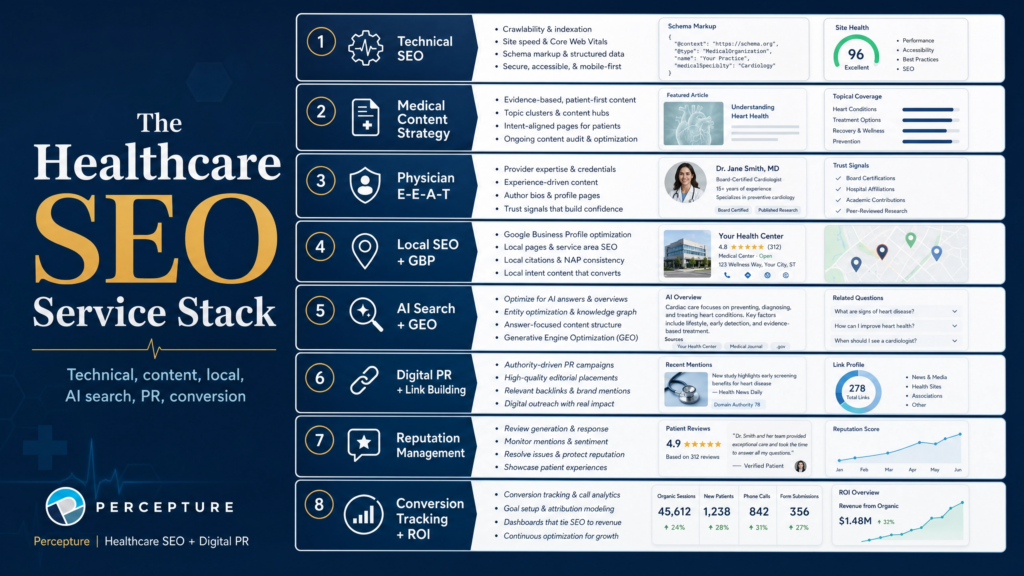
A comprehensive healthcare SEO agency provides services across the entire patient acquisition funnel. Here’s what to expect:
Technical SEO for Healthcare Websites
Healthcare websites often suffer from technical debt—slow load times, poor mobile experience, and crawlability issues that prevent Google from properly indexing content.
Technical SEO services include:
- Site speed optimization (Core Web Vitals)
- Mobile responsiveness audits
- Schema markup implementation (MedicalOrganization, Physician, MedicalCondition)
- XML sitemap optimization
- Crawl error resolution
- HTTPS security and accessibility compliance
Content Strategy and Medical SEO Writing
Content is the foundation of healthcare SEO. But medical content must balance search optimization with clinical accuracy and patient accessibility.
Content services include:
- Condition and treatment page optimization
- Physician bio optimization for E-E-A-T
- Blog content strategy for patient education
- FAQ schema implementation
- Medical review and fact-checking processes
- Content marketing for thought leadership
Local SEO and Google Business Profile Optimization
For healthcare organizations, local search is often the highest-converting channel. Patients search for “urgent care near me,” “pediatrician in Tampa,” or “best orthopedic surgeon in Manhattan.”
Local SEO services include:
- Google Business Profile optimization and management
- Multi-location SEO for health systems
- Review generation and reputation management
- Local citation building and NAP consistency
- Service area optimization
AI Search Optimization (GEO)
The rise of AI Overviews, ChatGPT, and Perplexity has created a new optimization discipline. Healthcare organizations must now optimize for both traditional search and AI-powered experiences.
AI search services include:
- AI Overview citation optimization
- ChatGPT and Perplexity visibility monitoring
- Structured content for AI extraction
- Entity optimization for knowledge graphs
- AI search strategy development
Link Building and Digital PR
Healthcare organizations need authoritative backlinks to compete in YMYL verticals. But link building in healthcare requires a different approach than other industries.
Link building services include:
- Medical publication outreach
- Healthcare association partnerships
- Digital PR and media placements
- Expert commentary opportunities
- Research and data-driven content for links
How AI Search Is Changing Healthcare Marketing
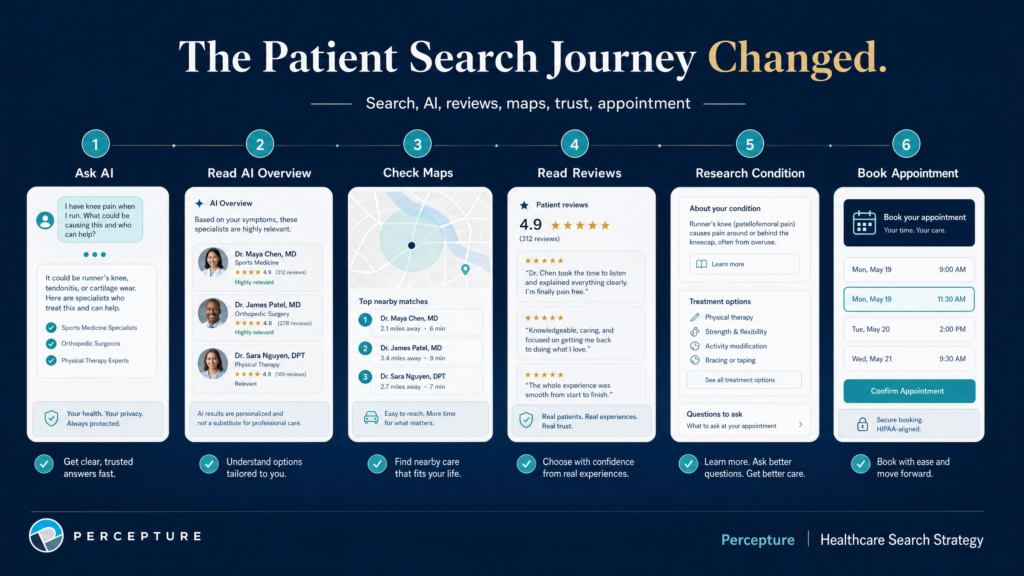
The emergence of AI-powered search represents the biggest shift in healthcare marketing since the rise of mobile. Here’s what healthcare organizations need to understand:
AI Overviews Are Reshaping Click Behavior
Google’s AI Overviews now appear in a significant percentage of health-related searches. These AI-generated summaries pull information from multiple sources and display it directly in search results—often reducing clicks to individual websites.
What this means for healthcare organizations:
- Being cited in AI Overviews is now as important as ranking #1
- Content must be structured for AI extraction (clear definitions, step-by-step processes, FAQ formats)
- E-E-A-T signals matter more than ever for AI citation selection
ChatGPT and Perplexity Are Becoming Patient Research Tools
Patients increasingly use conversational AI to research health conditions, compare treatment options, and find providers. When someone asks ChatGPT “What’s the best hospital for cardiac surgery in Florida?”, your organization needs to be part of that answer.
Optimization strategies include:
- Building entity recognition through consistent brand mentions
- Creating citable content with clear, quotable statements
- Earning mentions in authoritative sources that AI models reference
- Monitoring AI search visibility with specialized tools
The Integration of Search and AI
As Google’s official guidance on AI search states: “The best practices for SEO continue to be relevant because our generative AI features on Google Search are rooted in our core Search ranking and quality systems.”
This means healthcare organizations don’t need to choose between traditional SEO and AI optimization—they need both, working together as part of an integrated strategy.
AI Search Check
Can AI find and cite your healthcare brand?
Patients now use AI answers before they click. We’ll test how your brand appears in Google AI results, ChatGPT, Perplexity, and search.
Case Studies: Concepts from Healthcare SEO
Hospitals: Building Search Authority for a Regional Health System
When some of a Public Hospital’s executive leadership approached Percepture, they faced a common challenge: despite being one of Florida’s leading academic medical centers, their search visibility didn’t match their clinical reputation, especially in Oncology We built a sample program for them, sharing with the hiring manager and marketing team.
The Challenge:
- Competing against national health systems with larger marketing budgets
- Fragmented digital presence across multiple service lines
- Limited visibility for high-value service lines like transplant and cardiac care
Our Sample Approach:
If we implemented the Healthcare Search Trust Architecture framework, we would focus on:
- Technical SEO improvements across 500+ pages
- Physician E-E-A-T optimization for key specialists
- Local SEO strategy for the Tampa Bay market
- Content strategy aligned with patient search intent
Manhattan Gastroenterology: Dominating Local Search in NYC
Manhattan Gastroenterology operates multiple locations across New York City, one of the most competitive healthcare markets in the country.
The Challenge:
- Competing against major health systems with massive marketing budgets
- Managing SEO across multiple locations with different competitive dynamics
- Converting search visibility into actual patient appointments
Our Approach:
- Comprehensive local SEO strategy for each location
- Review generation and reputation management program
- Condition-specific content strategy targeting high-intent keywords
- Conversion rate optimization for appointment booking
The Results:
- 215% increase in organic appointment requests
- Top 3 local pack rankings for “gastroenterologist NYC” and related terms
- 4.8+ star rating maintained across all locations
- Measurable ROI from organic search investment
Olympic Concierge Medicine: Concierge Practice Growth Through Search
Olympic Concierge Medicine in Tampa represents a different healthcare SEO challenge: a concierge medicine practice competing for high-value patients in a niche market.
The Challenge:
- Limited search volume for “concierge medicine” keywords
- Need to differentiate from traditional primary care
- Building trust with affluent patients researching premium healthcare options
Our Approach:
- Long-tail keyword strategy targeting specific patient concerns
- Physician E-E-A-T optimization highlighting Dr. Burkholder’s credentials
- Content strategy addressing concierge medicine questions and objections
- Local SEO optimization for the Tampa Bay market
The Results:
- First page rankings for “concierge medicine Tampa” and related terms
- Consistent patient acquisition from organic search
- Strong AI search visibility for concierge medicine queries
Rehab Centers: Specialized Healthcare Vertical Success
Through our working with multiple rehabs over the years, we’ve developed specialized expertise in addiction treatment SEO and Veterans Rehab SEO, one of the most competitive and regulated healthcare verticals.
Key Learnings:
- Healthcare verticals with advertising restrictions rely heavily on organic search
- E-E-A-T signals are critical for treatment facility credibility
- Local SEO drives the majority of patient inquiries
- Content must balance SEO optimization with clinical accuracy and compliance
What to Look for in a Healthcare SEO Partner
Choosing the right healthcare SEO agency is a critical decision. Here’s what to evaluate:
Healthcare-Specific Experience
Questions to ask:
- How many healthcare clients have you worked with?
- Do you have experience with my specific healthcare vertical (hospitals, medical groups, health tech)?
- Can you share healthcare-specific case studies with measurable results?
- Do you understand HIPAA implications for marketing?
E-E-A-T and YMYL Understanding
Questions to ask:
- How do you approach E-E-A-T optimization for healthcare content?
- What’s your process for ensuring medical content accuracy?
- How do you handle physician credentialing and bio optimization?
- Do you have medical review processes in place?
AI Search Capabilities
Questions to ask:
- How are you adapting strategies for AI Overviews and ChatGPT?
- Can you monitor AI search visibility?
- What’s your approach to optimizing for conversational AI platforms?
- How do you balance traditional SEO with AI search optimization?
Measurement and Attribution
Questions to ask:
- How do you measure healthcare SEO ROI?
- Can you track patient acquisition from organic search?
- What reporting and dashboards do you provide?
- How do you attribute conversions across the patient journey?
Cultural Fit and Communication
Questions to ask:
- Who will be working on my account day-to-day?
- How often will we meet to review progress?
- What’s your approach to collaboration with internal marketing teams?
- How do you handle strategy pivots when results aren’t meeting expectations?
Healthcare SEO vs. Generic SEO: Comparison
| Factor | Generic SEO Agency | Healthcare SEO Agency |
|---|---|---|
| HIPAA awareness | Limited or none | Built into process |
| Medical E-E-A-T | Not prioritized | Core focus |
| YMYL understanding | Basic | Deep expertise |
| Clinical review | Not available | Standard practice |
| Local SEO for multi-location | Basic | Specialized |
| AI search optimization | Emerging | Integrated |
| Patient acquisition tracking | Generic leads | Healthcare-specific |
| Compliance guardrails | None | Built-in |
Healthcare SEO Pricing and ROI
When making a Healthcare SEO investment, it varies significantly based on organization size, competitive landscape, and scope of services. Here’s what to expect:
Typical Investment Ranges
| Organization Type | Monthly Investment | Typical Scope |
|---|---|---|
| Single-location practice | $2,500 – $7,500 | Local SEO, content, technical |
| Multi-location medical group | $7,500 – $25,000 | Multi-location local SEO, content strategy, link building |
| Regional health system | $25,000 – $75,000+ | Enterprise SEO, multiple service lines, AI search |
| National healthcare brand | $75,000 – $200,000+ | Full-service digital marketing, PR, paid media integration |
Calculating Healthcare SEO ROI
The ROI calculation for healthcare SEO depends on your patient lifetime value and conversion rates:
Example ROI Calculation:
- Average patient lifetime value: $5,000
- Monthly organic patient acquisitions: 50
- Monthly SEO investment: $15,000
- Monthly revenue from SEO: $250,000
- ROI: 1,567%
Key metrics to track:
- Organic traffic to service line pages
- Organic appointment requests and calls
- Cost per patient acquisition from organic search
- Revenue attributed to organic search patients
ROI Review
What would better search visibility be worth?
We’ll help you estimate the value of more calls, forms, and patient requests from organic search and AI search.
Common Healthcare SEO Mistakes to Avoid
After two decades in healthcare marketing, we’ve seen organizations make the same mistakes repeatedly. Here’s what to avoid:
Mistake #1: Treating Healthcare SEO Like Generic SEO
Healthcare has unique requirements—HIPAA considerations, E-E-A-T standards, YMYL scrutiny—that generic SEO approaches don’t address. Working with an agency that doesn’t understand healthcare-specific challenges leads to wasted investment and potential compliance issues.
Mistake #2: Ignoring Local SEO
For most healthcare organizations, local search drives the majority of patient acquisition. Yet many organizations focus exclusively on national rankings while neglecting Google Business Profile optimization, review management, and local content.
Mistake #3: Creating Content Without Medical Review
Google’s quality raters specifically evaluate whether health content is created or reviewed by qualified medical professionals. Publishing medical content without clinical review undermines E-E-A-T signals and can lead to ranking penalties.
Mistake #4: Neglecting AI Search Optimization
AI Overviews and conversational AI platforms are rapidly changing how patients research healthcare. Organizations that ignore AI search optimization will lose visibility to competitors who adapt.
Mistake #5: Failing to Measure Patient Acquisition
SEO investment without proper attribution is a recipe for budget cuts. Healthcare organizations must implement tracking that connects organic search visibility to actual patient appointments and revenue.
Mistake #6: Inconsistent NAP Information
For multi-location healthcare organizations, inconsistent Name, Address, and Phone (NAP) information across directories destroys local search rankings. Every location needs consistent, accurate information across Google, Yelp, Healthgrades, and other platforms.
Frequently Asked Questions
What is a healthcare SEO agency?
A healthcare SEO agency is a specialized digital marketing firm that helps hospitals, medical practices, and health systems improve their visibility in Google Search, Google Maps, and AI-powered search experiences. These agencies understand HIPAA-conscious marketing, medical E-E-A-T requirements, and patient acquisition funnels.
How much does healthcare SEO cost?
Healthcare SEO investment typically ranges from $2,500–$7,500/month for single-location practices to $25,000–$75,000+/month for regional health systems. Investment depends on competitive landscape, number of locations, and scope of services.
How long does healthcare SEO take to show results?
Most healthcare organizations see measurable improvements within 3–6 months, with significant results in 6–12 months. Healthcare SEO is a long-term investment—the organizations that commit to sustained effort see compounding returns over time.
Is healthcare SEO different from regular SEO?
Yes. Healthcare SEO requires understanding of HIPAA-conscious marketing, medical E-E-A-T requirements, YMYL content standards, physician credentialing, and healthcare-specific competitive dynamics. Generic SEO approaches often fail in healthcare.
How do I measure healthcare SEO ROI?
Healthcare SEO ROI is measured by tracking organic traffic, appointment requests, phone calls, and patient acquisition attributed to organic search. The calculation compares patient lifetime value against SEO investment.
What is E-E-A-T and why does it matter for healthcare?
E-E-A-T stands for Experience, Expertise, Authoritativeness, and Trustworthiness. Google uses these signals to evaluate content quality, especially for YMYL (Your Money or Your Life) topics like healthcare. Strong E-E-A-T signals are essential for healthcare SEO success.
How does AI search affect healthcare SEO?
AI Overviews, ChatGPT, and Perplexity are changing how patients research healthcare. Organizations must now optimize for both traditional search rankings and AI citation. This requires structured content, strong E-E-A-T signals, and entity optimization.
Should I hire an in-house SEO team or an agency?
Most healthcare organizations benefit from agency partnerships because healthcare SEO requires specialized expertise that’s difficult to build in-house. Agencies bring cross-client learnings, established processes, and scalable resources.
How do I choose a healthcare SEO agency?
Evaluate healthcare-specific experience, E-E-A-T understanding, AI search capabilities, measurement approaches, and cultural fit. Ask for healthcare case studies with measurable results and references from similar organizations.
What’s the difference between healthcare SEO and healthcare PPC?
Healthcare SEO focuses on organic (unpaid) search visibility, while PPC (pay-per-click) involves paid advertising. Most healthcare organizations benefit from both—SEO for long-term patient acquisition and PPC for immediate visibility and testing.
What to Do Next
If you’re evaluating healthcare SEO agencies or trying to improve your current search visibility, here’s what we recommend:
- Audit your current visibility — Check your rankings for key service line terms, review your Google Business Profile, and test whether AI can cite your brand.
- Identify your biggest gaps — Is it technical SEO? Content? Local search? AI visibility? Knowing where you’re weakest helps prioritize investment.
- Talk to specialists — Generic agencies won’t understand healthcare. Find partners with proven healthcare experience and measurable results.
- Set realistic timelines — Healthcare SEO takes 6–12 months to show significant results. Plan accordingly.
- Connect SEO to patient acquisition — Make sure you can track the ROI of your investment.
About the Author
Bob Generale is the President of Percepture, a healthcare marketing agency he founded in 2004. With over 20 years of experience in healthcare digital marketing, Bob has helped hospitals, health systems, and medical practices build search visibility that drives patient acquisition. His Healthcare Search Trust Architecture framework has been implemented by organizations ranging from single-physician practices to multi-billion-dollar health systems. Percepture is a minority-owned business headquartered in Tampa, Florida.
Connect with Bob on LinkedIn → Best SEO Expert
Related Resources
This article was last updated on May 28, 2026. Healthcare SEO best practices evolve as search algorithms and AI capabilities change. Contact us for the latest strategies.