


A medical SEO agency helps doctors, clinics, specialty practices, and medical groups improve visibility in Google, Google Maps, AI search, and local patient searches. The best medical SEO agencies combine technical SEO, provider pages, service-line content, Google Business Profile optimization, reviews, digital PR, conversion tracking, and HIPAA-conscious messaging.
If you run a medical practice and patients cannot find you when they search for a doctor, a condition, or a service in your area, you are losing appointments to competitors, directories, and hospitals that show up first.
This guide explains what a medical SEO agency does, how medical SEO differs from general healthcare SEO, what services should be included, and how to choose the right partner.
Quick Answer: A medical SEO agency helps doctors, clinics, and specialty practices rank higher in Google, Google Maps, and AI search results. Services typically include technical SEO, provider page optimization, service-line content, local SEO, reviews, digital PR, and conversion tracking—all built around HIPAA-conscious messaging.
Who This Guide Is For
This guide is for:
- Doctors and practice owners who want more qualified patient inquiries
- Concierge physicians building a local and national reputation
- Specialty practices (gastroenterology, dermatology, orthopedics, etc.) competing against hospitals and directories
- Multi-location medical groups managing SEO across several offices
- Practice administrators and marketing leads evaluating SEO vendors
- CFOs comparing SEO costs to Google Ads spend
If you are responsible for patient acquisition, this guide will help you understand what medical SEO should include and what to ask before hiring an agency.
Definition: Medical SEO Agency
A medical SEO agency is a search marketing firm that specializes in helping doctors, clinics, and medical practices improve their visibility in Google, Google Maps, and AI-powered search engines. Unlike general SEO agencies, medical SEO agencies understand provider pages, service-line content, local search, reviews, and HIPAA-conscious content rules.
What You Will Learn
- What a medical SEO agency does
- How medical SEO differs from healthcare SEO
- What services medical SEO should include
- How Google Maps and reviews fit into medical SEO
- How AI search changes doctor discovery
- What medical SEO should cost
- How to choose the right agency
- Common mistakes doctors make with SEO
Not sure where your practice stands in search?
Request a Medical SEO + AI Search Gap AnalysisWhat Is a Medical SEO Agency?
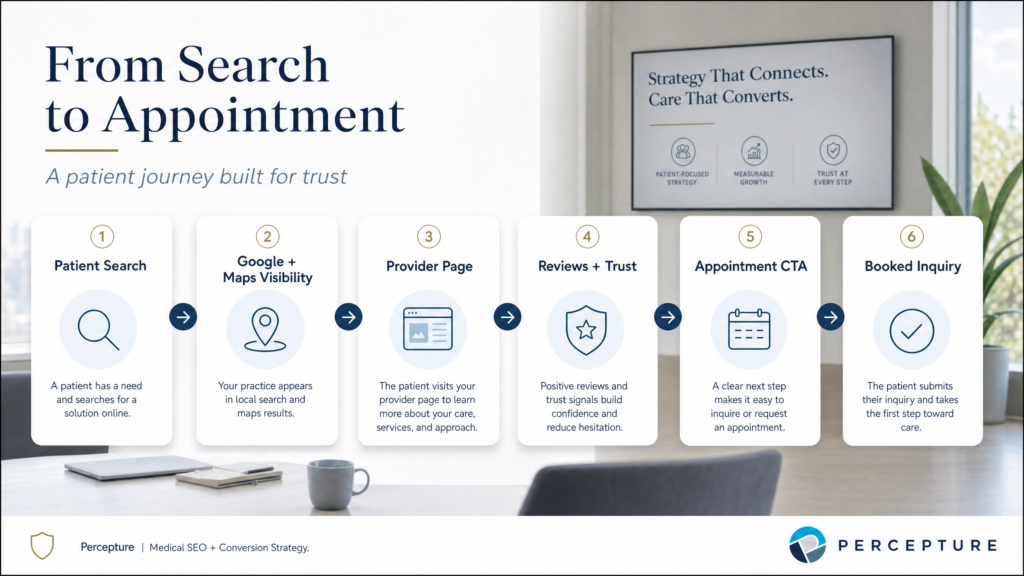
A medical SEO agency is a search marketing firm that helps doctors, clinics, and medical practices become easier to find in Google, Google Maps, and AI search results.
Unlike general SEO agencies, a medical SEO agency understands:
- Provider pages: How to structure doctor bios for search and trust
- Service-line pages: How to create pages for conditions, treatments, and procedures
- Local SEO: How to optimize Google Business Profile, location pages, and “near me” searches
- Reviews: How to use patient reviews to support local rankings
- HIPAA-conscious content: How to write about health topics without making compliance mistakes
- AI search: How to structure content so AI systems can understand and cite it
The goal is not just traffic. The goal is qualified patient inquiries—calls, forms, and booked appointments.
Medical SEO vs. Healthcare SEO
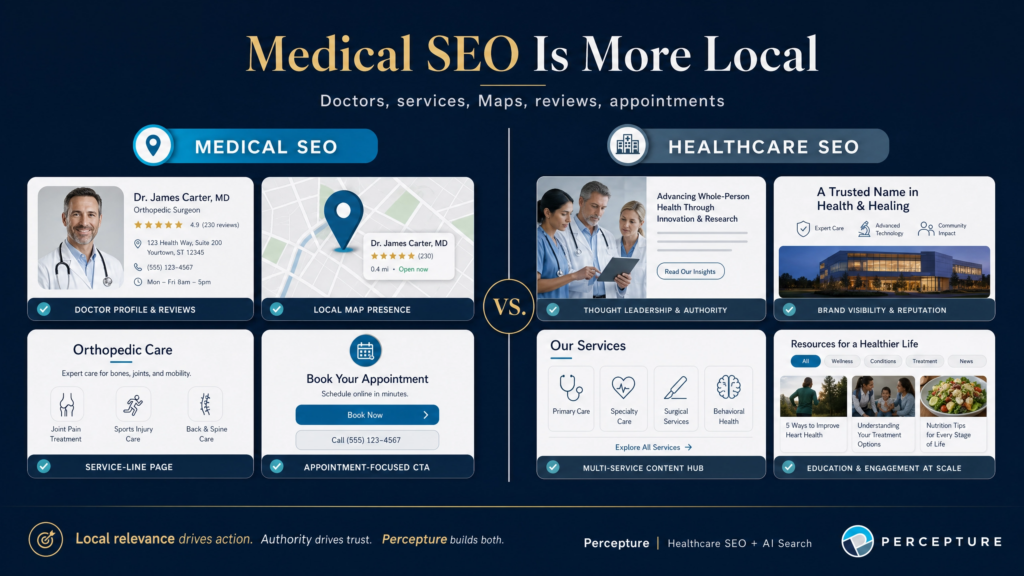
Medical SEO and healthcare SEO are related, but they serve different audiences.
| Factor | Medical SEO | Healthcare SEO |
|---|---|---|
| Primary audience | Doctors, clinics, specialty practices | Hospitals, health systems, healthcare brands, life sciences |
| Focus | Provider pages, service-line pages, local SEO, reviews, appointment conversion | Brand visibility, thought leadership, multi-service marketing |
| Local emphasis | High (Google Maps, “near me,” city-specific) | Varies (often regional or national) |
| Content style | Physician-led, condition-specific, patient-facing | Broader, often B2B or B2C brand content |
| Conversion goal | Calls, forms, appointments | Leads, awareness, referrals |
If you are a doctor or practice owner, you need a medical SEO agency that understands the patient journey from search to appointment—not just broad healthcare marketing.
For broader healthcare marketing strategy, see Percepture’s healthcare SEO agency guide.
Why Medical SEO Is Different From General SEO
General SEO agencies know how to optimize websites. But medical SEO requires more.
1. Patients search differently.
Patients search by symptom, condition, service, doctor name, and location. A general SEO agency may not understand how to build pages for each of these entry points.
2. Trust matters more.
Healthcare is a “Your Money or Your Life” (YMYL) category. Google gives extra weight to content that demonstrates experience, expertise, authoritativeness, and trustworthiness (E-E-A-T). A medical SEO agency should know how to build trust signals into every page.
3. Local search is critical.
Most medical decisions are local. Google Business Profile, Google Maps, reviews, and location pages are not optional—they are core to medical SEO.
4. HIPAA-conscious content is required.
Medical content must avoid making claims that could create compliance risk. A medical SEO agency should understand how to write about health topics without crossing lines.
5. AI search is changing discovery.
Patients are starting to use AI tools like Google AI Overviews, ChatGPT, and Perplexity to find doctors. A medical SEO agency should structure content so AI systems can understand and cite it.
The Medical Practice Search Operating System
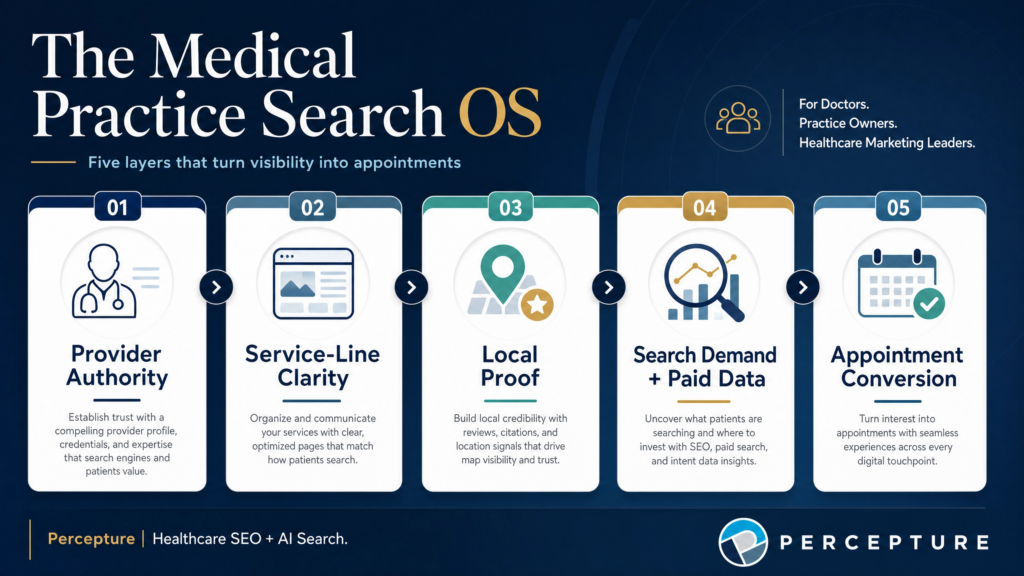
Percepture uses a framework called The Medical Practice Search Operating System to help doctors and practices become easier to find, easier to trust, and easier to choose.
The Medical Practice Search Operating System
Percepture’s framework for turning doctor expertise, service-line pages, local search, reviews, Google Maps, paid search data, AI search, and conversion tracking into a practical patient acquisition system.
| Layer | What It Means |
|---|---|
| Provider Authority | Doctor bios, credentials, quotes, videos, expertise, authorship |
| Service-Line Clarity | Pages for services, conditions, procedures, memberships, FAQs |
| Local Proof | Google Business Profile, Maps, location pages, reviews, NAP, local media |
| Search Demand + Paid Data | GSC, keyword research, Google Ads search terms, CPC, “near me” trends |
| Appointment Conversion | Calls, forms, booking CTAs, intake routing, CRM, tracking, remarketing rules |
This framework connects search visibility to real patient actions—not just rankings.
What Medical SEO Services Should Include
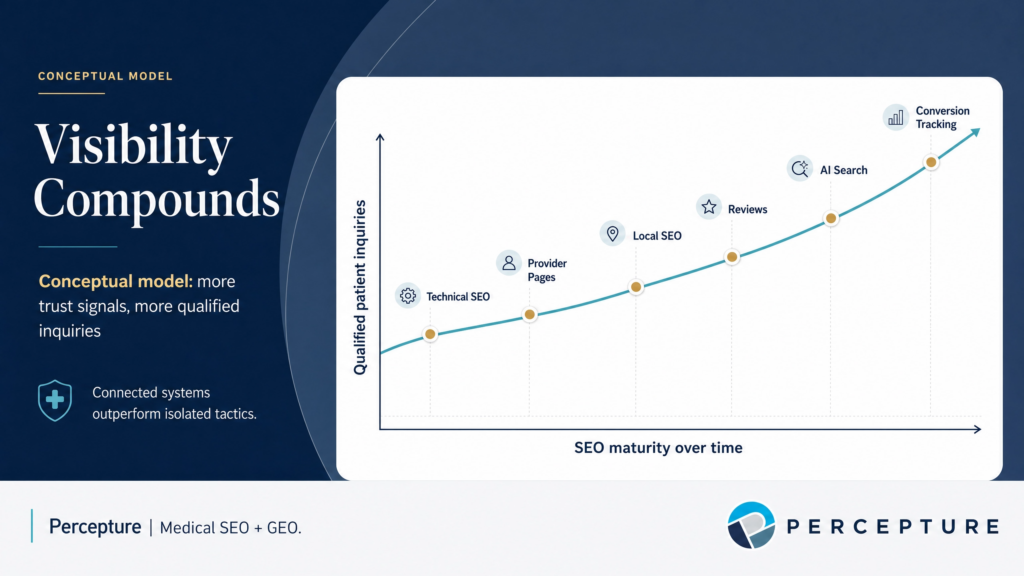
A complete medical SEO program should include:
Technical SEO
- Site speed and Core Web Vitals
- Mobile responsiveness
- Crawlability and indexing
- Schema markup (LocalBusiness, Physician, MedicalOrganization, FAQPage)
- HTTPS and security
For a deeper look, see Percepture’s technical SEO audit service.
Provider Pages
- Doctor bios with credentials, specialties, and locations
- Professional headshots
- Patient-facing language
- Schema markup for Person and Physician
Service-Line Pages
- Pages for each service, condition, treatment, or procedure
- Clear explanations of what the service includes
- FAQs and patient expectations
- Internal links to related providers and locations
Local SEO
- Google Business Profile optimization
- Location pages for each office
- NAP (name, address, phone) consistency
- Local citations and directories
Google Maps
- Accurate business information
- Categories and attributes
- Photos and posts
- Review management
Reviews
- Review generation strategy
- Review response process
- Reputation monitoring
For more on reviews and reputation, see Percepture’s SEO reputation management guide.
Digital PR
- Earned media and backlinks
- Authority building
- Local and industry press
For more, see Percepture’s digital PR services.
AI Search / GEO
- Content structured for AI Overviews, ChatGPT, Perplexity, and other AI search tools
- Clear entities (providers, services, locations)
- FAQ and definition blocks
For more, see Percepture’s generative engine optimization services.
CRO and Tracking
- Call tracking
- Form tracking
- Appointment request tracking
- Landing page optimization
For more, see Percepture’s conversion rate optimization services.
Medical SEO by Practice Type
Different practice types have different SEO needs.
Concierge Doctors
Concierge physicians often serve a local market but want to build a national reputation. SEO should focus on:
- Provider authority and thought leadership
- Local keywords (“concierge doctor Tampa,” “concierge medicine near me”)
- Service pages for memberships, preventive care, and direct access
- Reviews and testimonials
Example: A concierge doctor in Tampa may have early visibility for geo-targeted terms like “concierge doctor Tampa” and “Tampa concierge medicine,” but those terms may still be sitting around positions 25–77 in Google. A medical SEO agency can help move those keywords to page one through provider content, local optimization, and authority building.
Primary Care
Primary care practices compete with urgent care, telehealth, and hospital systems. SEO should focus on:
- Location pages for each office
- Service pages for common visits (physicals, sick visits, vaccinations)
- Google Maps and reviews
- Appointment conversion
Specialty Practices
Specialty practices (gastroenterology, dermatology, orthopedics, etc.) often compete against hospitals, directories, and other specialists. SEO should focus on:
- Condition and procedure pages
- Provider pages with specialty credentials
- Local SEO for each location
- Digital PR for authority
Example: In specialty-practice planning work, Percepture has mapped SEO, Google Business Profile optimization, Google Ads, Digital PR, and remarketing around competitive medical categories such as gastroenterology—targeting positions 1–3 for all Google Business Profile locations and ranking above competitors, directories, and hospitals.
Multi-Location Practices
Multi-location practices need a scalable SEO architecture. SEO should focus on:
- Location pages for each office
- Provider pages linked to locations
- Centralized and local Google Business Profiles
- Internal linking between locations and services
For complex multi-location SEO, see Percepture’s enterprise SEO services.
Want to see which medical keywords your practice can win?
We use Search Console, keyword research, and paid search data to find your best opportunities.
View SEO PricingHow Medical SEO and Google Ads Work Together
Medical SEO and Google Ads are not competitors. They work together.
- Google Ads provides immediate visibility and fast data on which keywords convert.
- SEO builds long-term visibility and reduces cost per acquisition over time.
A medical SEO agency should use Google Ads data to inform SEO strategy:
- Which keywords drive calls and appointments?
- Which landing pages convert best?
- Which locations or services have the highest demand?
For more on paid search, see Percepture’s paid search services.
How Google Maps and Reviews Fit Into Medical SEO
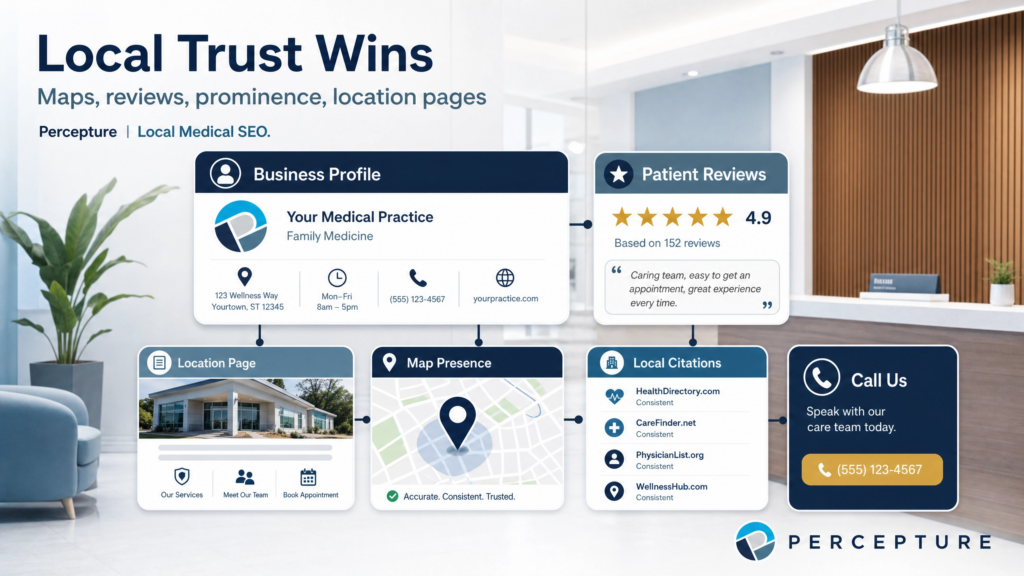
Google says local results are based mainly on relevance, distance, and prominence. Prominence can be informed by information Google has about a business from across the web, including links, articles, directories, and reviews (Google Business Profile Help).
For medical practices, this means:
- Google Business Profile must be accurate and complete
- Reviews matter for local rankings and patient trust
- Local links and citations support prominence
- Location pages on your website reinforce local relevance
A medical SEO agency should treat Google Maps and reviews as core to the strategy—not an afterthought.
How AI Search Changes Medical SEO
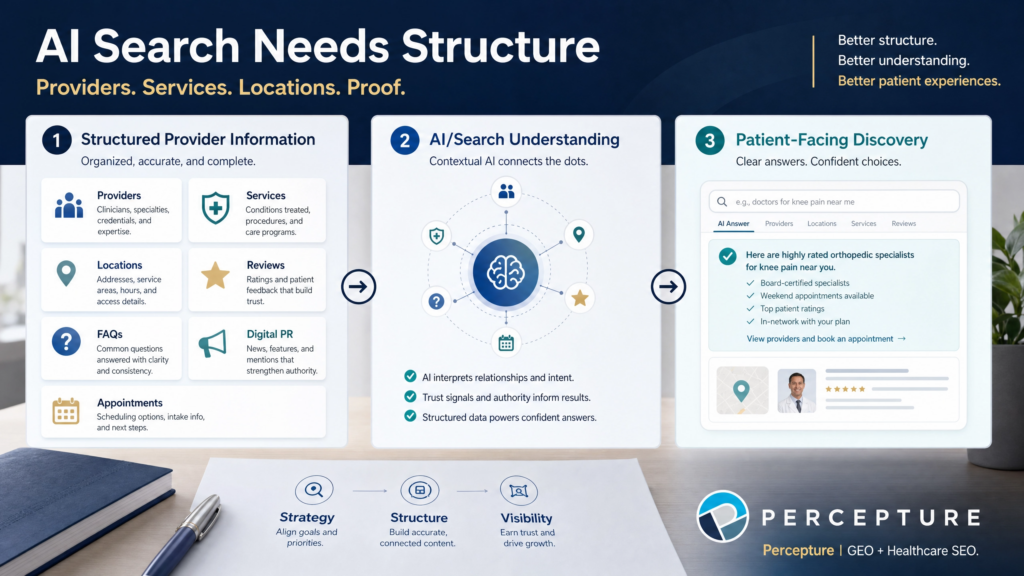
Patients are starting to use AI tools to find doctors. Google AI Overviews, ChatGPT search, Perplexity, and other AI systems are changing how people discover healthcare providers.
Google’s own guidance says SEO fundamentals still matter for AI search because AI Overviews and AI Mode are rooted in core Search ranking and quality systems (Google Search Central).
A medical SEO agency should:
- Structure content so AI systems can understand providers, services, and locations
- Use clear definitions, FAQs, and answer blocks
- Build authority through digital PR and backlinks
- Avoid generic, commodity content that AI systems will ignore
For more on AI search, see Percepture’s generative engine optimization services.
What Medical SEO Should Cost
Medical SEO pricing varies based on practice size, competition, and scope.
| Practice Type | Typical Monthly Range |
|---|---|
| Solo practice | $2,000–$5,000/month |
| Small group (2–5 providers) | $4,000–$8,000/month |
| Multi-location practice | $6,000–$15,000+/month |
| Specialty practice in competitive market | $5,000–$12,000/month |
These ranges include strategy, technical SEO, content, local SEO, and reporting. They do not include paid media spend.
For Percepture’s pricing, see SEO pricing packages and AI search SEO pricing.
How to Choose a Medical SEO Agency
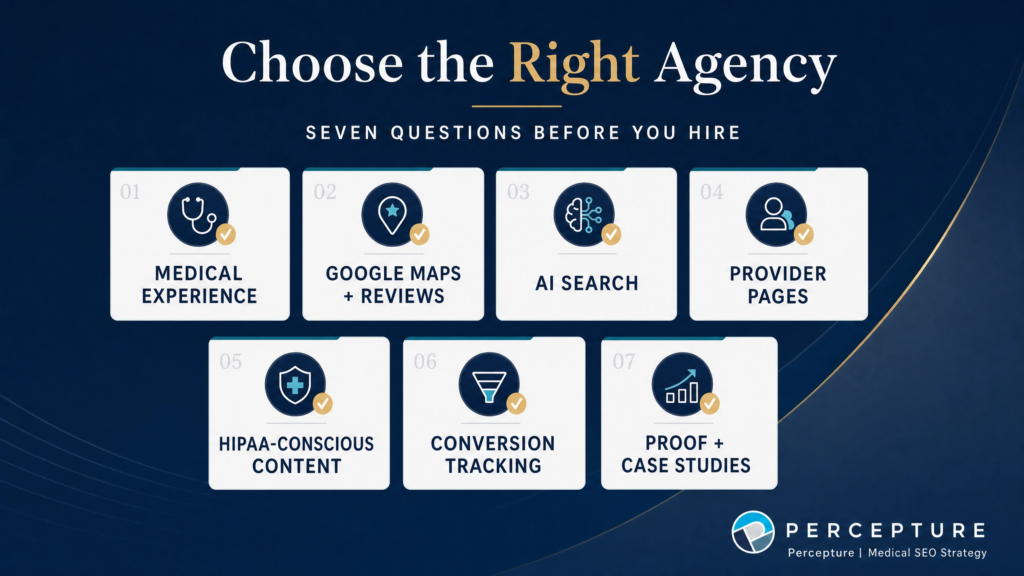
Before hiring a medical SEO agency, ask:
- Do they specialize in medical or healthcare SEO?General agencies may not understand provider pages, HIPAA-conscious content, or local medical search.
- Can they show examples of medical practice SEO work?Ask for case studies or anonymized examples.
- Do they include Google Maps and reviews in their strategy?Local SEO is not optional for medical practices.
- Do they understand AI search?AI Overviews and ChatGPT search are changing how patients find doctors.
- How do they measure success?Rankings matter, but calls, forms, and appointments matter more.
- What access do they need?A serious agency will ask for access to Google Search Console, Google Analytics, Google Tag Manager, CMS, and Google Business Profile.
- How do they handle HIPAA-conscious content?They should know how to write about health topics without making compliance mistakes.
Why Percepture
Percepture is a medical SEO agency that combines SEO, GEO (generative engine optimization), digital PR, paid search, and conversion strategy for doctors, clinics, and specialty practices.
What makes Percepture different:
- Founded in 2004. Over 20 years of search marketing experience.
- Healthcare and life sciences focus. We work with medical practices, healthcare brands, pharma, and life sciences companies.
- SEO + GEO + PR. We combine organic search, AI search, and digital PR into one strategy.
- Physician-led content. We turn doctor expertise into search-ready content.
- Conversion focus. We measure success by calls, forms, and appointments—not just rankings.
- Senior-led. You work with experienced strategists, not junior account managers.
“Medical SEO is not just about ranking a practice. It is about helping the right patient find the right doctor, trust the provider, and know exactly what to do next.”
— Bob Generale, Founder, Percepture
For more on Percepture’s approach, see organic SEO services and healthcare marketing agency.
Common Mistakes Doctors Make With SEO
1. Treating SEO as a one-time project.
SEO is ongoing. Competitors, algorithms, and patient behavior change.
2. Ignoring Google Maps and reviews.
Local search is critical for medical practices. Google Business Profile is not optional.
3. Publishing generic content.
Commodity content (“7 Tips for Better Health”) does not build authority. Physician-led, condition-specific content does.
4. Not tracking calls and appointments.
If you do not know which pages drive appointments, you cannot optimize.
5. Hiring a general SEO agency.
General agencies may not understand provider pages, HIPAA-conscious content, or local medical search.
6. Ignoring AI search.
AI Overviews and ChatGPT search are changing how patients find doctors. Your content needs to be structured for AI systems.
7. Not connecting SEO to paid search.
Google Ads data can inform SEO strategy. SEO and paid search should work together.
For a faster start, see Percepture’s SEO sprint approach.
Ready to talk about medical SEO for your practice?
Get a gap analysis, see pricing, or book a working session with Bob.
Talk to Percepture See PricingFrequently Asked Questions
What is a medical SEO agency?
A medical SEO agency is a search marketing firm that helps doctors, clinics, and medical practices improve visibility in Google, Google Maps, and AI search. Services typically include technical SEO, provider pages, service-line content, local SEO, reviews, digital PR, and conversion tracking.
What does a medical SEO agency do?
A medical SEO agency optimizes your website, Google Business Profile, and content so patients can find you when they search for a doctor, condition, service, or location. The goal is more qualified patient inquiries—calls, forms, and appointments.
How is medical SEO different from healthcare SEO?
Medical SEO focuses on doctors, clinics, and specialty practices. Healthcare SEO is broader and may include hospitals, health systems, healthcare brands, and life sciences companies. Medical SEO has a stronger emphasis on local search, provider pages, and appointment conversion.
Can medical SEO help doctors get more patients?
Yes. Medical SEO helps patients find your practice when they search for a doctor, condition, or service in your area. When done well, it increases qualified patient inquiries and reduces reliance on paid advertising.
Does medical SEO include Google Maps?
Yes. Google Maps and Google Business Profile are core to medical SEO. Most medical decisions are local, and Google Maps is often the first place patients look for a doctor.
Should medical SEO include reviews?
Yes. Reviews support local rankings and patient trust. A medical SEO agency should help you generate reviews, respond to reviews, and monitor your reputation.
How much does medical SEO cost?
Medical SEO typically costs $2,000–$15,000+ per month depending on practice size, competition, and scope. This includes strategy, technical SEO, content, local SEO, and reporting.
How long does medical SEO take?
SEO is a long-term strategy. Most practices see meaningful progress in 3–6 months, with stronger results over 6–12 months. Competitive markets may take longer.
What should a doctor’s website include for SEO?
A doctor’s website should include provider pages, service-line pages, location pages, a blog or resource section, clear calls to action, and schema markup. Content should be physician-led and patient-facing.
How does AI search affect medical SEO?
AI search tools like Google AI Overviews and ChatGPT are changing how patients find doctors. A medical SEO agency should structure content so AI systems can understand and cite it.
What should I ask before hiring a medical SEO agency?
Ask about their experience with medical practices, their approach to local SEO and reviews, how they measure success, and how they handle HIPAA-conscious content. Ask for case studies or examples.
Why choose Percepture as a medical SEO agency?
Percepture combines SEO, GEO, digital PR, paid search, and conversion strategy for doctors, clinics, and specialty practices. We focus on physician-led content, local search, AI search, and appointment conversion—not just rankings.
What to Do Next
If you are a doctor, practice owner, or marketing lead looking for a medical SEO agency, here are your options:
- Request a Medical SEO + AI Search Gap Analysis — Contact Percepture
- See SEO Pricing — View SEO Pricing Packages
- Learn More About Healthcare SEO — Read the Healthcare SEO Agency Guide
About the Author
Bob Generale is the President and Partner of Percepture, a search marketing agency founded in 2004. Bob has led SEO, GEO, digital PR, and paid search programs for healthcare, life sciences, and B2B clients. He specializes in helping medical practices and healthcare brands become easier to find, easier to trust, and easier to choose.

Connect with Bob on LinkedIn: SEO Expert and AI Search Professional