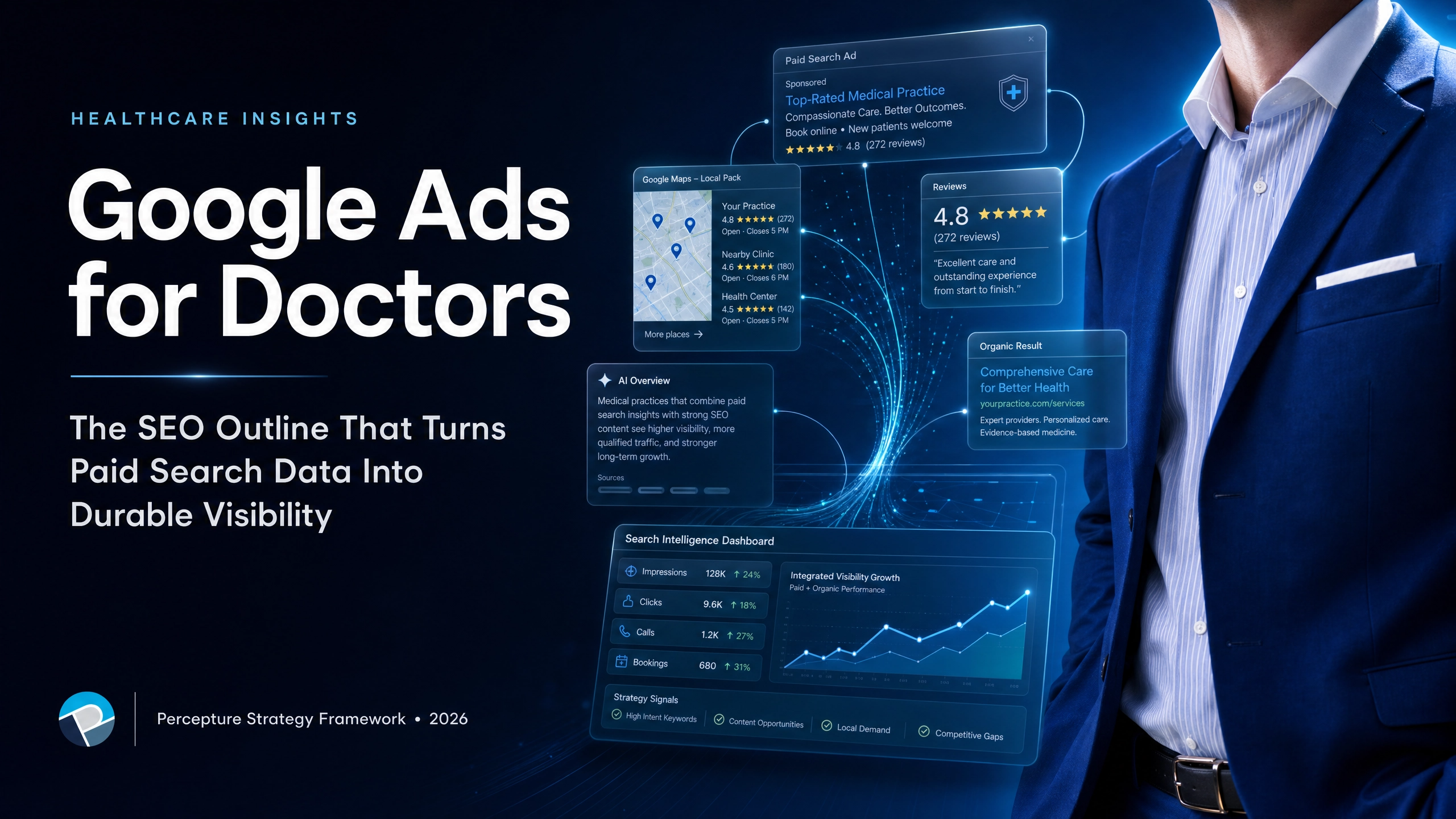

What Is a Google Ads for Doctors SEO Outline?
A Google Ads for doctors SEO outline is a search strategy that uses paid search data, organic SEO, Google Maps, reviews, landing pages, and conversion tracking together. Google Ads does not directly improve organic rankings, but it can reveal which keywords, locations, and patient-intent pages deserve SEO investment.
Definition Box
| Term | Definition |
|---|---|
| Google Ads for Doctors SEO Outline | A strategic framework that combines paid search campaign data with organic SEO planning to help medical practices identify high-value keywords, optimize landing pages, and build durable search visibility across Google, Maps, and AI search. |
A Google Ads for doctors SEO outline is not just a campaign checklist. It is a system for turning paid search intelligence into organic assets, local trust signals, and AI-search readiness.
Most agencies treat Google Ads and SEO as separate departments. That approach wastes money. The smarter play is to use Google Ads as a data lab that informs SEO, CRO, Maps, reviews, digital PR, and AI-search strategy.
This guide explains how to do that.
Who This Guide Is For
This guide is for:
- Practice owners and healthcare CEOs who want to reduce wasted ad spend and build durable search visibility.
- CFOs who want to understand the relationship between cost per click, keyword difficulty, and long-term marketing ROI.
- VP Marketing and patient acquisition leads who need a roadmap for integrating paid search, SEO, Maps, reviews, and AI search.
- Technical operators who need a checklist for tracking, compliance, landing pages, and schema.
If you are paying $20–$50 per click for patient-intent keywords and wondering whether there is a smarter way to build visibility, this guide is for you.
Important Reality Check: Do Google Ads Directly Improve SEO?
No. Google’s official documentation is clear: advertising with Google does not affect organic search ranking or inclusion (Google Ads Help).
So why does this guide exist?
Because Google Ads can make your SEO strategy smarter, faster, and more profitable—even though it does not directly buy organic rankings.
What Google Ads Can Actually Improve
| What Google Ads Reveals | How It Helps SEO |
|---|---|
| High-converting search terms | Identifies which keywords deserve organic pages |
| Geographic demand | Shows which locations to target with local SEO and Maps |
| Time-of-day patterns | Informs content publishing and remarketing timing |
| Landing page performance | Reveals which pages need CRO improvements |
| Cost per click benchmarks | Helps prioritize SEO for high-CPC, low-difficulty keywords |
Bob Generale, Founder & CEO, Percepture:
“Google Ads does not need to magically boost SEO to make SEO better. The data alone is worth it. Paid search tells you which keywords cost money, which searches convert, and which pages deserve to be built next.”
Field Observation
In our work with clients, we have observed that practices running well-structured Google Ads campaigns alongside SEO programs often see faster keyword discovery, better landing page performance, and stronger local visibility. This is not because Google Ads “boosts” SEO. It is because the data from paid search informs smarter SEO decisions.
Smart Budget Move
Do not just buy the click. Build the asset.
Google Ads gives you speed. SEO gives you durability. The opportunity is finding the keywords where you are paying for clicks today but could build organic visibility tomorrow.
Best next step:
Have Percepture review which paid keywords should become SEO pages.
Talk to PerceptureThe Doctor Search Landscape Domination Matrix
Most agencies focus on one channel at a time. That is a mistake.
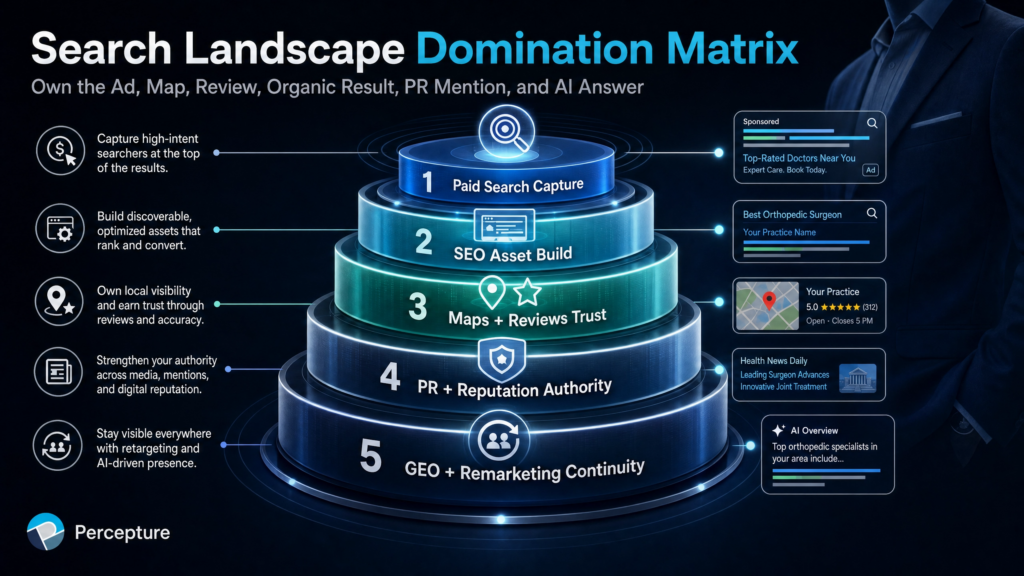
The real win for doctors is not one blue link. The real win is owning the entire search landscape: the ad, the map result, the review profile, the organic page, the PR mention, and the AI answer.
We call this the Doctor Search Landscape Domination Matrix.
The 5 Layers of the Matrix
| Layer | What It Does | Why It Matters |
|---|---|---|
| 1. Paid Search Capture | Uses Google Ads to capture immediate patient intent and discover converting search terms. | Generates leads now while building data for SEO. |
| 2. SEO Asset Build | Turns high-CPC and high-intent paid search data into organic pages, service pages, FAQs, and local content. | Reduces long-term dependency on paid clicks. |
| 3. Maps + Reviews Trust Layer | Aligns Google Business Profile, reviews, location pages, and local proof with the same search intent. | Builds local trust and visibility in Maps. |
| 4. PR + Reputation Authority Layer | Uses digital PR services and SEO reputation management to strengthen third-party trust signals. | Improves brand search and AI-search credibility. |
| 5. GEO + Remarketing Continuity Layer | Structures content for AI-search retrievability while using compliant retargeting to stay visible after interrupted patient journeys. | Prepares the practice for ChatGPT, Google AI Overviews, and future discovery. |
This framework turns Google Ads from a temporary traffic expense into a source of SEO, CRO, local, and AI-search intelligence.
Keyword and CPC Opportunity Map
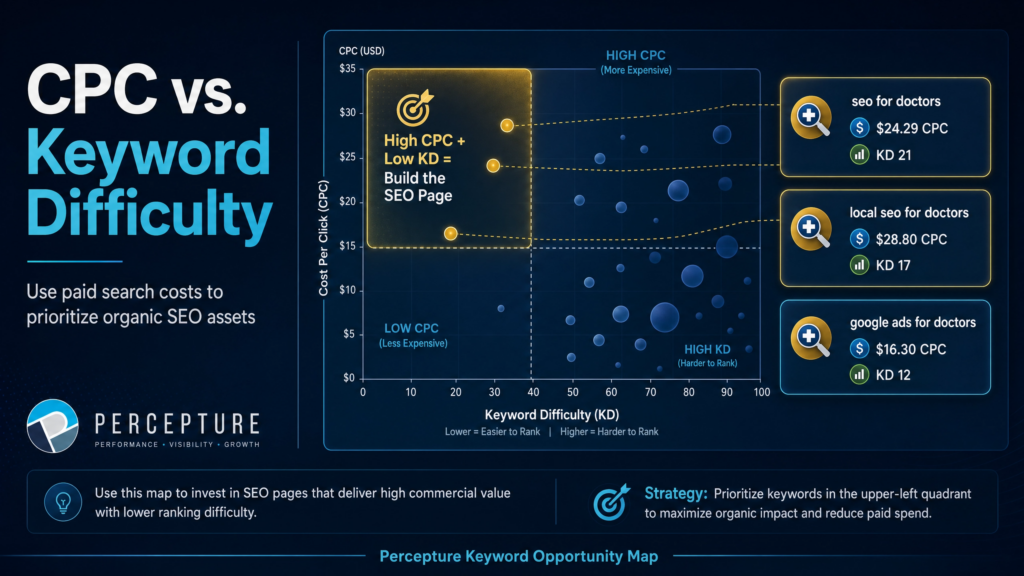
One of the most valuable outputs of a Google Ads program is keyword and CPC data.
Here is how to use it:
The CPC vs. Keyword Difficulty Logic
| Keyword | Volume | CPC | Keyword Difficulty | Opportunity |
|---|---|---|---|---|
| seo for doctors | 2,900 | $24.29 | 21 | High-CPC, low-KD: strong SEO candidate |
| seo services for doctors | 1,300 | $27.29 | 16 | High-CPC, low-KD: strong SEO candidate |
| local seo for doctors | 1,000 | $28.80 | 17 | High-CPC, low-KD: strong SEO candidate |
| google ads for doctors | 590 | $16.30 | 12 | Moderate CPC, low-KD: strong SEO candidate |
| google ads for doctors seo outline | 27,100 | $0.00 | 0 | Exact-match opportunity: build the page |
Key insight: When a keyword costs $25 per click but has low SEO difficulty, the smarter long-term play is to use paid search for immediate visibility while building the organic page that reduces dependency over time.
Tip: If your domain authority is close to or above the keyword difficulty, you have a strong chance of ranking organically. Use Google Ads to capture traffic now, then build the SEO asset to own the keyword long-term.
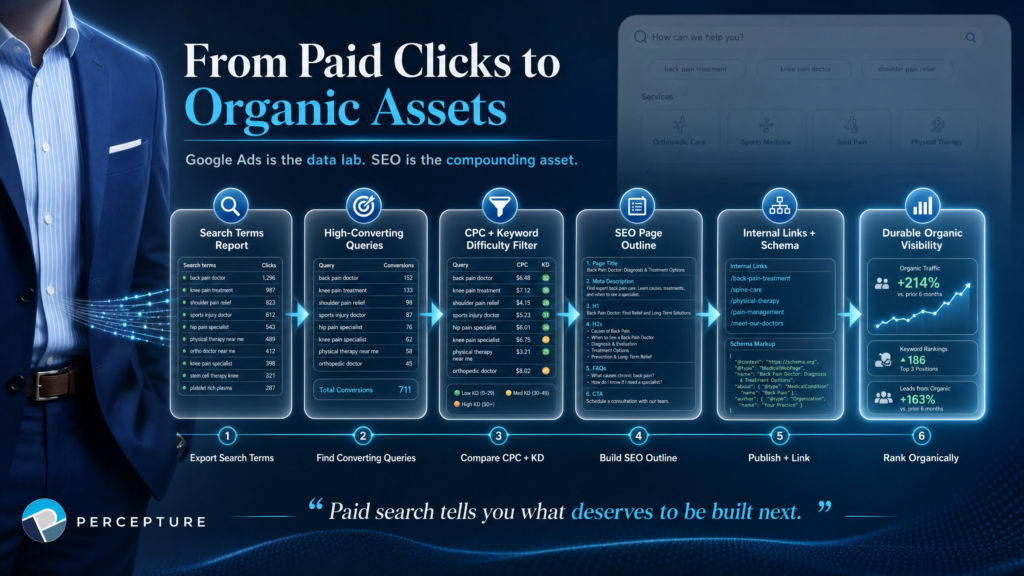
How to Use Google Ads Data to Build SEO Outlines
Google Ads is not just a traffic source. It is a research tool.
Step-by-Step Process
- Export your Search Terms Report from Google Ads.
- Identify high-converting queries that are not yet covered by organic pages.
- Check keyword difficulty and CPC for each query.
- Prioritize queries where CPC is high and keyword difficulty is low.
- Build SEO pages around those queries, using the same language patients use.
- Add internal links from the new pages to your core service pages.
This process turns paid search data into organic assets.
Example
A dermatology practice running Google Ads discovers that “laser skin resurfacing cost” converts well but costs $35 per click. The keyword difficulty is only 18. The practice builds an SEO page targeting that query, ranks organically, and reduces paid spend on that term by 60% within six months.
How to Use Google Search Console to Find Striking-Distance Keywords
Google Search Console (GSC) shows which queries your site is already gaining impressions for—even if you are not yet ranking in the top positions.
The Striking-Distance Workflow
- Open GSC > Performance > Search Results.
- Filter by position 8–20. These are “striking-distance” keywords.
- Sort by impressions. High impressions + low position = opportunity.
- Identify pages that are close to ranking but need optimization.
- Improve those pages: add content, update headings, add internal links, improve page speed.
- Consider Google Ads support: run paid campaigns on striking-distance keywords to increase visibility while SEO catches up.
This workflow is part of what we call an SEO sprint—a focused effort to move pages from striking distance into top positions.
How Landing Pages Improve Paid Search and SEO Performance
Landing pages are the bridge between paid search and SEO.
Google Ads Quality Score is a diagnostic based on three factors (Google Ads Help):
- Expected clickthrough rate
- Ad relevance
- Landing page experience
A well-structured landing page improves Quality Score, which can lower cost per click and improve ad position.
What a Doctor’s Landing Page Should Include
| Element | Why It Matters |
|---|---|
| Clear headline matching patient intent | Improves relevance and reduces bounce |
| Trust signals (reviews, credentials, logos) | Builds confidence |
| Click-to-call and form options | Captures leads |
| Fast load time | Improves Quality Score and SEO |
| Schema markup | Helps search engines understand the page |
| Internal links to related services | Passes SEO value |
For deeper guidance, see our conversion rate optimization services page.
Google Maps, Reviews, and Local SEO for Doctors
For most medical practices, local search is where patients are found.
Google Business Profiles appear across Search and Maps, and reviews can help a business stand out (Google Business Profile Help).
Local SEO Checklist for Doctors
- Claim and verify your Google Business Profile.
- Ensure NAP (name, address, phone) consistency across all directories.
- Add high-quality photos of your practice.
- Respond to all reviews—positive and negative.
- Use Google Posts to share updates and offers.
- Build local citations on healthcare directories.
- Create location-specific landing pages if you have multiple offices.
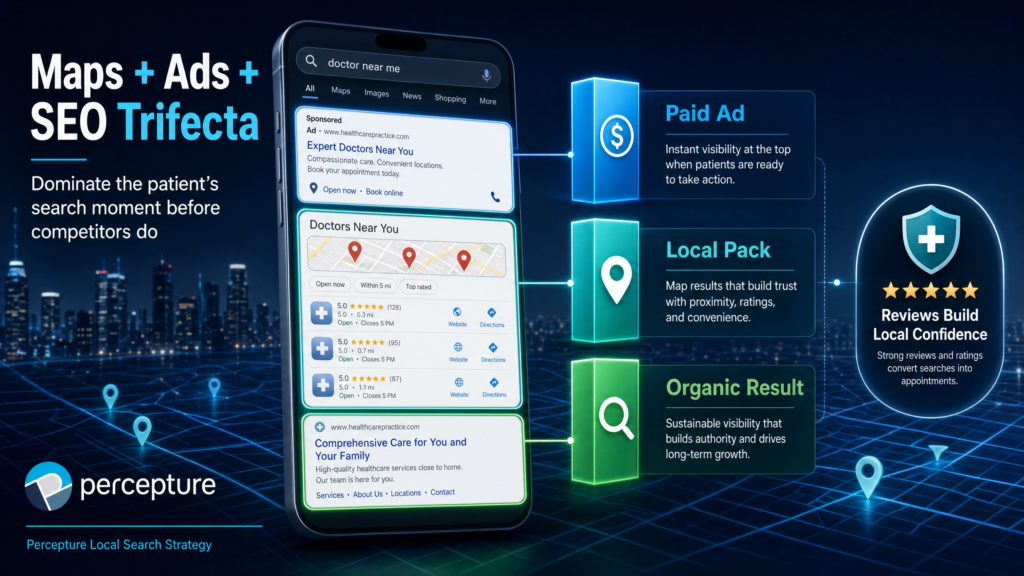
The Maps + Ads + SEO Trifecta
When a patient searches for “dermatologist near me,” the ideal outcome is:
- Your Google Ads listing appears at the top.
- Your Google Maps listing appears in the local pack.
- Your organic SEO listing appears in the main results.
This is landscape domination. It builds trust, increases click share, and reduces the chance that a competitor captures the patient.
Remarketing, Paid Social, and Interrupted Patient Journeys
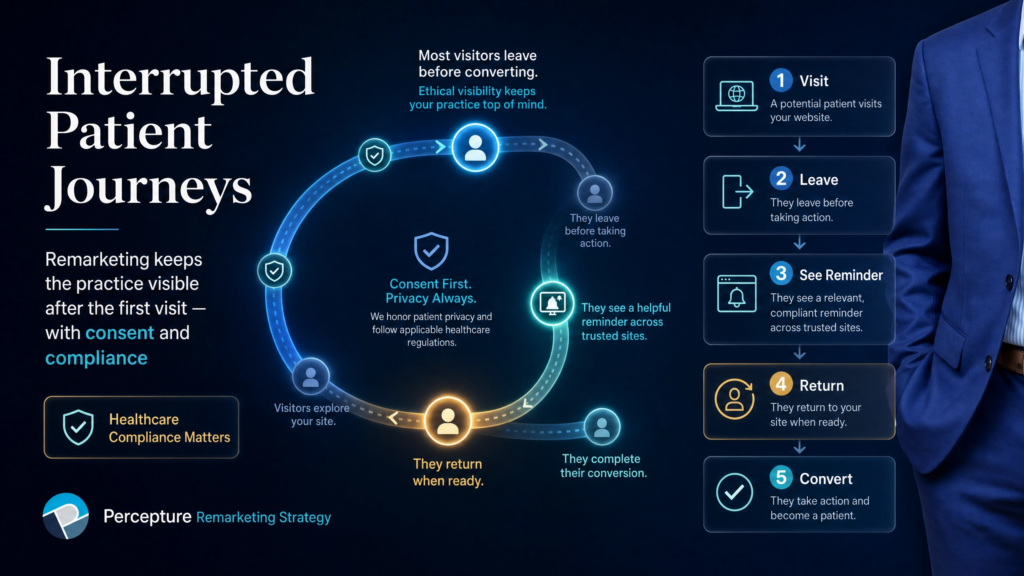
The average website conversion rate is around 2%. That means 98% of visitors leave without converting.
Remarketing allows you to stay visible to those visitors as they continue browsing the web.
How Remarketing Works
- A patient visits your SEO landing page.
- A remarketing pixel tracks the visit (with consent).
- The patient sees your ads on other sites or social platforms.
- The patient returns and converts.
Healthcare Remarketing Caution
Google restricts personalized advertising around sensitive health interests (Google Ads Policy). Customer Match cannot use sensitive interest categories for targeting.
Best practice: Work with an agency experienced in healthcare marketing to ensure compliance. See our healthcare marketing agency page for more.
Digital PR and Reputation Management for Doctors
Search visibility is not just about your own website. It is also about what appears when patients search your name or your practice.
Why Digital PR Matters
- Third-party mentions build authority and trust.
- PR placements can rank for brand and service keywords.
- Backlinks from credible sources improve domain authority.
- AI search systems often cite third-party sources.
Reputation Management for Doctors
If negative content appears in search results, SEO reputation management can help push it down by building positive, authoritative content.
For practices seeking to control the narrative around their brand, digital PR services are essential.
GEO, AI Search, and ChatGPT Ads Readiness
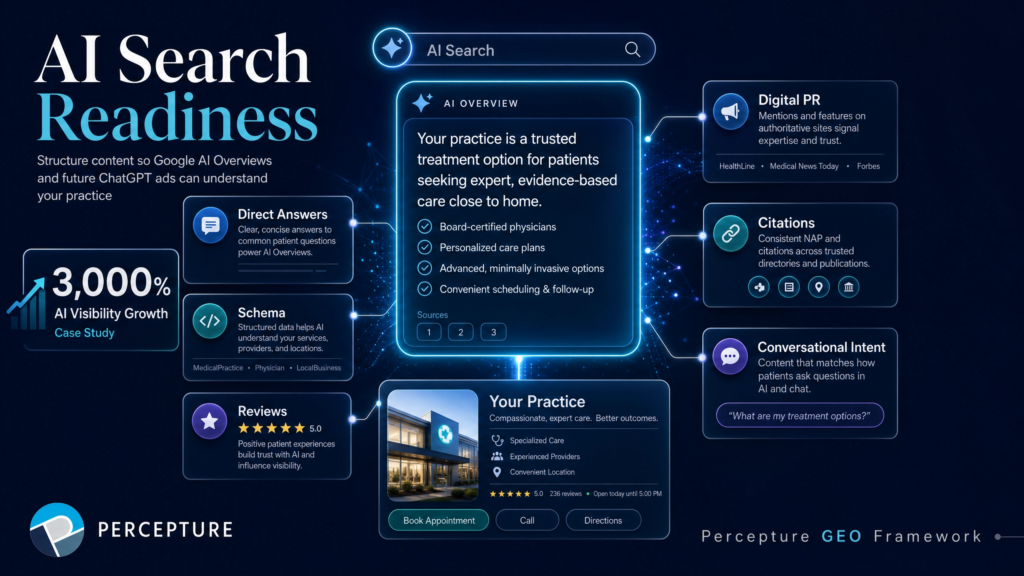
AI search is changing how patients discover healthcare providers.
Google’s AI Overviews and AI Mode are rooted in Google’s core Search ranking and quality systems (Google Search Central). OpenAI is testing ads in ChatGPT, with ad matching based on conversational intent rather than simple keywords (OpenAI).
What This Means for Doctors
- SEO still matters. AI search features rely on indexed, crawlable, helpful content.
- Structured content helps. Clear headings, definitions, and direct answers make it easier for AI systems to cite your page.
- Third-party mentions matter. AI systems often cite sources beyond your own website.
- ChatGPT Ads are coming. Practices that prepare now will have an advantage.
For practices seeking AI-search visibility, see our generative engine optimization services page.
Percepture proof: We helped a tech client achieve 3,000% AI visibility growth in 90 days through a combination of technical SEO, content strategy, PR, structured data, and authoritative citations.
Budget, CPC, and ROI Planning
How Much Should Doctors Budget for Google Ads and SEO?
| Channel | Typical Monthly Investment | What You Get |
|---|---|---|
| Google Ads | $2,000–$10,000+ | Immediate visibility, lead generation, keyword data |
| SEO | $2,500–$10,000+ | Durable rankings, reduced long-term CPC dependency |
| Local SEO / Maps | $1,000–$3,000 | Local visibility, reviews, Maps presence |
| Digital PR | $3,000–$10,000+ | Authority, backlinks, AI-search credibility |
| GEO / AI Search | $2,500–$7,500+ | AI Overviews, ChatGPT visibility, future-proofing |
For detailed pricing, see our paid ads pricing packages and AI search SEO pricing pages.
ROI Logic
If a new patient is worth $3,000 in lifetime value and your cost per lead is $150, your ROI is 20x. The goal is to reduce cost per lead over time by building organic assets that reduce paid dependency.
Common Mistakes Doctors Make
| Mistake | Why It Hurts | What to Do Instead |
|---|---|---|
| Running Google Ads without SEO | Pays for every click forever | Build organic pages for high-CPC keywords |
| Ignoring Google Maps and reviews | Loses local trust and visibility | Claim, optimize, and respond to reviews |
| No conversion tracking | Cannot measure ROI | Set up call tracking, form tracking, and attribution |
| Generic landing pages | Low Quality Score, high CPC | Build intent-matched, fast, mobile-friendly pages |
| No remarketing | Loses 98% of visitors | Use compliant remarketing to stay visible |
| Ignoring AI search | Misses future discovery | Structure content for AI retrievability |
How to Choose the Right Integrated Agency
The best results come from agencies that integrate Google Ads, SEO, Maps, reviews, PR, CRO, and AI search—not agencies that treat each channel as a silo.
Questions to Ask
- Do you integrate paid search data into SEO planning?
- How do you handle Google Maps and reviews?
- What is your approach to landing page optimization?
- Do you offer digital PR and reputation management?
- How do you prepare for AI search and ChatGPT?
- What does your reporting and attribution look like?
Percepture has been helping brands build integrated search visibility since 2004. Our paid search agency and enterprise SEO services teams work together to deliver results across Google, Maps, and AI search.
Percepture proof: We helped a leading telecom company achieve 3x conversions while reducing spend by 42% through integrated paid search and landing page optimization.
FAQs
What is a Google Ads for doctors SEO outline?
A Google Ads for doctors SEO outline is a search strategy that uses paid search data, organic SEO, Google Maps, reviews, landing pages, and conversion tracking together to help medical practices build durable search visibility.
Do Google Ads help SEO for doctors?
Google Ads do not directly improve organic rankings. However, Google Ads data can inform smarter SEO decisions by revealing high-converting keywords, geographic demand, and landing page performance.
Should doctors invest in Google Ads or SEO first?
Both. Google Ads provides immediate visibility and data. SEO builds durable rankings that reduce long-term paid dependency. The best approach is to run both together and use paid data to inform organic strategy.
How can Google Ads data improve SEO content?
Export your Search Terms Report, identify high-converting queries not yet covered by organic pages, check keyword difficulty, and build SEO pages around those queries.
How does Google Search Console help doctors find SEO keywords?
GSC shows which queries your site is gaining impressions for. Filter by position 8–20 to find “striking-distance” keywords that are close to ranking and can be improved with optimization.
How do Google Maps and reviews fit into the strategy?
Google Business Profiles appear across Search and Maps. Reviews build local trust. Optimizing Maps and reviews is essential for local patient acquisition.
Can doctors use remarketing?
Yes, but with caution. Google restricts personalized advertising around sensitive health interests. Work with an agency experienced in healthcare compliance.
How does this help with AI search and ChatGPT?
AI search features rely on indexed, crawlable, helpful content. Structured pages with clear headings, definitions, and direct answers are easier for AI systems to cite. Third-party mentions also matter.
What should a doctor’s landing page include?
Clear headline, trust signals, click-to-call and form options, fast load time, schema markup, and internal links to related services.
How much should doctors budget for Google Ads and SEO?
Google Ads: $2,000–$10,000+/month. SEO: $2,500–$10,000+/month. Local SEO: $1,000–$3,000/month. Digital PR: $3,000–$10,000+/month. GEO/AI Search: $2,500–$7,500+/month.
Ready to Build Your Google Ads for Doctors SEO Outline?
If you want to reduce wasted ad spend, build durable search visibility, and prepare for AI search, Percepture can help.
Physician-Led AI Healthcare Series
Related AI healthcare resources
Google Ads, SEO, and AI search are now connected to a bigger question for healthcare leaders: how should practices use AI without losing trust, privacy, compliance, or clinical judgment?