
Last updated: May 2026
Reviewed by: Percepture Digital PR and SEO Strategy Team
What You Need About SEO Reputation Management
SEO reputation management is the process of improving what appears when people search for a brand, executive, company, product, or issue. It combines SEO, digital PR, content, reviews, media strategy, crisis communications, and AI search optimization so the most accurate and trusted information is easier to find.
The goal is simple. When someone searches your name, your company, or your leadership team, the results should tell the truth you want told. Not rumors, outdated complaints ro ocompetitor attacks. The real story.
Confidential Search Review
What does Google say about your brand before you do?
Percepture reviews branded search results, negative assets, media coverage, reviews, AI summaries and authority gaps before recommending a reputation strategy.
Request a confidential reviewWhat Is SEO Reputation Management?
SEO reputation management is the practice of shaping what people see when they search for your brand, your executives, or your company online. It is not just about ranking higher. It is about controlling the narrative across Google, AI search tools, review platforms, news sites, and social profiles.
Think of it this way. When a prospect, investor, journalist, or potential employee searches your company name, they form an opinion in seconds. That opinion is shaped by:
- The first 10 Google results
- The People Also Ask questions
- The Google Business Profile reviews
- The AI-generated summary at the top of the page
- The news articles that appear
- The social profiles that rank
SEO reputation management is the work of making sure those results are accurate, positive, and trustworthy.
According to BrightLocal’s 2024 Local Consumer Review Survey, 98% of consumers read online reviews for local businesses. That means your search results are not just a marketing asset. They are a trust signal.
Why SEO Reputation Management Matters
Reputation is no longer built in boardrooms, from your friend, or in the news. It is built into search results.
Here is what happens when your search results are weak:
- Prospects leave before they contact you.
- Investors hesitate before they commit.
- Journalists find old complaints instead of your latest wins.
- AI tools summarize outdated or negative information.
- Competitors fill the space you left empty.
Here is what happens when your search results are strong:
- Prospects trust you before the first call.
- Investors see a consistent, credible public record.
- Journalists find the story you want told.
- AI tools summarize your strengths, not your weaknesses.
- You control the narrative, not your critics.
SEO reputation management is insurance. It is risk management, sales enablement, and crisis prevention.
“Reputation management used to mean cleaning up what people saw on Google. Now it means building the trusted public record that Google, journalists, customers, investors, and AI systems use to understand a brand.”
— Bob Generale, Percepture
How Google Search Results Shape Reputation
Google is the first place people go to verify trust. Before a meeting, before a purchase, before a partnership, people search.
The first page of Google results is your public record. It includes:
- Your website
- Your social profiles
- News articles
- Review sites
- Industry directories
- Wikipedia (if you have one)
- Competitor comparisons
- People Also Ask questions
Each of these results tells a story. If you do not control that story, someone else will.
The challenge is that Google does not care about your reputation. Google cares about relevance, authority, and user satisfaction. If a negative article is more relevant or more authoritative than your positive content, Google will rank it higher.
That is why SEO reputation management is not just about creating good content. It is about building authority, earning links, managing reviews, and suppressing or displacing negative results.
For a deeper look at how search engine positioning SEO works, see our technical guide.
How AI Search Changed Reputation Management
AI search tools like Google’s AI Overview, ChatGPT, Perplexity, and Microsoft Copilot have changed the game.
In traditional search, you needed to control page one. That meant 10 results.
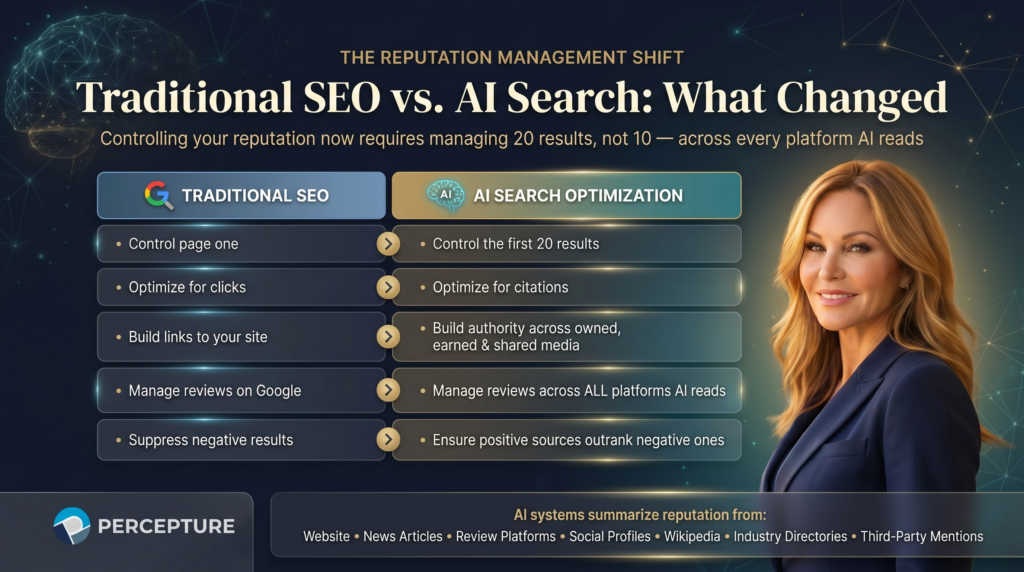
In AI search, the system reads dozens of sources and summarizes them into one answer. That means you need to control the first 20 results, not just the first 10.
Here is the difference:
| Traditional SEO | AI Search Optimization |
|---|---|
| Control page one | Control the first 20 results |
| Optimize for clicks | Optimize for citations |
| Build links to your site | Build authority across owned, earned, and shared media |
| Manage reviews on Google | Manage reviews across all platforms AI reads |
| Suppress negative results | Ensure positive sources are more authoritative than negative ones |
AI systems summarize reputation from:
- Your website
- News articles
- Review platforms
- Social profiles
- Wikipedia
- Industry directories
- Third-party mentions
If your positive content is weak, AI will summarize the negative content instead.
For more on how to optimize for AI search, see our guide to digital PR services and learn more about AI search.
SEO Reputation Management vs. Online Reputation Management
These terms are often used interchangeably, but they are not the same. Online reputation management (ORM) is the broader discipline of managing a brand’s complete digital presence, including customer service, public relations, and social media. SEO reputation management is a specialized subset of ORM focused exclusively on controlling what appears in search engine results and AI summaries.
Below are the key differences between the two.
Online reputation management (ORM) is the broader discipline. It includes:
- Review management
- Social media monitoring
- Crisis communications
- Public relations
- Customer service
- Legal takedowns
SEO reputation management is a subset of ORM. It focuses specifically on what appears in search results. It uses SEO tactics like:
- Content creation
- Link building
- Technical optimization
- Keyword targeting
- SERP analysis
- Suppression strategies
The best reputation strategies combine both. You need ORM to manage the full customer experience. You need SEO reputation management to control what people find when they search.
If you are looking for a firm that does both, see our guide to reputation management firms.
Removal vs. Suppression vs. Rebuilding
When negative content appears in search results, you have three options.
1. Removal
Removal means getting the content taken down at the source. This is the cleanest solution, but it is also the hardest.
Removal works when:
- The content violates platform terms of service
- The content is defamatory and you can prove it
- The content violates privacy laws (like GDPR)
- The publisher is willing to negotiate
Removal does not work when:
- The content is true
- The content is protected speech
- The publisher refuses to cooperate
- The content is on a high-authority news site
2. Suppression
Lets dive in. Suppression means pushing negative content down in search results by building stronger, more authoritative positive content.
Suppression works when:
- Removal is not possible
- The negative content is on a lower-authority site
- You have time to build new assets
- You are willing to invest in content, PR, and link building
It does not work when:
- The negative content is on a very high-authority site
- The negative content is constantly being updated or shared
- You do not have the resources to build competing assets
3. Rebuilding
Rebuilding means creating a new public record from scratch. This is the most comprehensive approach.
Rebuilding works when:
- Your current search results are mostly negative
- You have had a major crisis or leadership change
- You are entering a new market or industry
- You want to reposition your brand
Rebuilding requires:
- A new content strategy
- A new PR strategy
- A new review strategy
- A new link building strategy
- Time and patience
For more on how to repair a damaged reputation, see our guide to online reputation repair.
The Percepture Framework: Protect the Queen, Control the Narrative
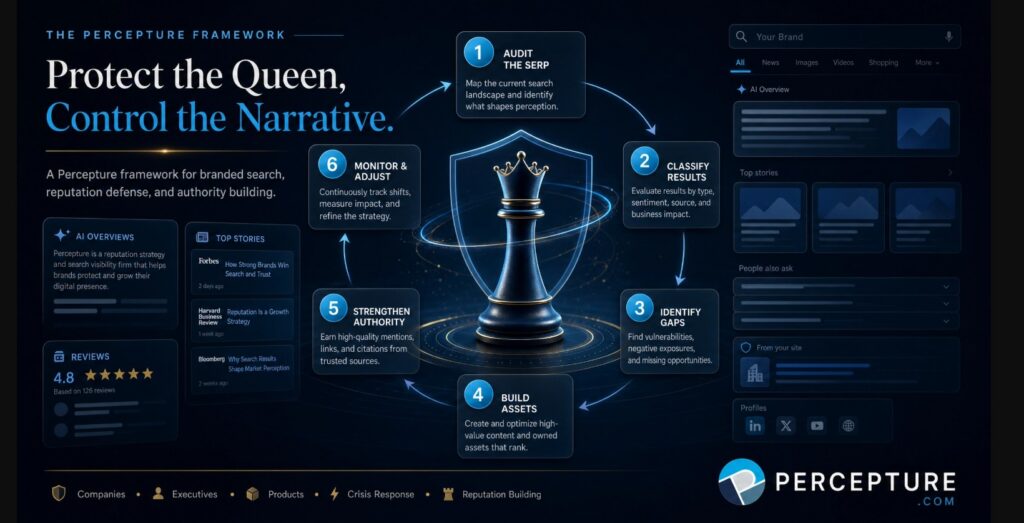
At Percepture, we use a framework called “Protect the Queen, Control the Narrative.”
The “queen” is your most valuable asset. It might be your CEO, your brand, your flagship product, or your company name. The goal is to protect that asset by surrounding it with trusted, authoritative, positive content.
Here is how it works:
- Audit the SERP. Map every result on page one and page two for your branded keywords.
- Classify each result. Is it owned, earned, shared, or third-party? Is it positive, neutral, or negative?
- Identify gaps. Where are you missing coverage? Where are competitors or critics filling the space?
- Build assets. Create new content, earn new media coverage, and strengthen existing assets.
- Strengthen authority. Build links, earn citations, and improve technical SEO.
- Monitor and adjust. Track rankings, reviews, and AI summaries. Adjust as needed.
This framework works for companies, executives, and products. It works for crisis response and for proactive reputation building.
“The best crisis response is often built before the crisis. The stronger the public record is before pressure arrives, the easier it is to protect trust when it matters most.”
— Thor Harris, CEO, Percepture
The 7-Step SEO Reputation Management Process
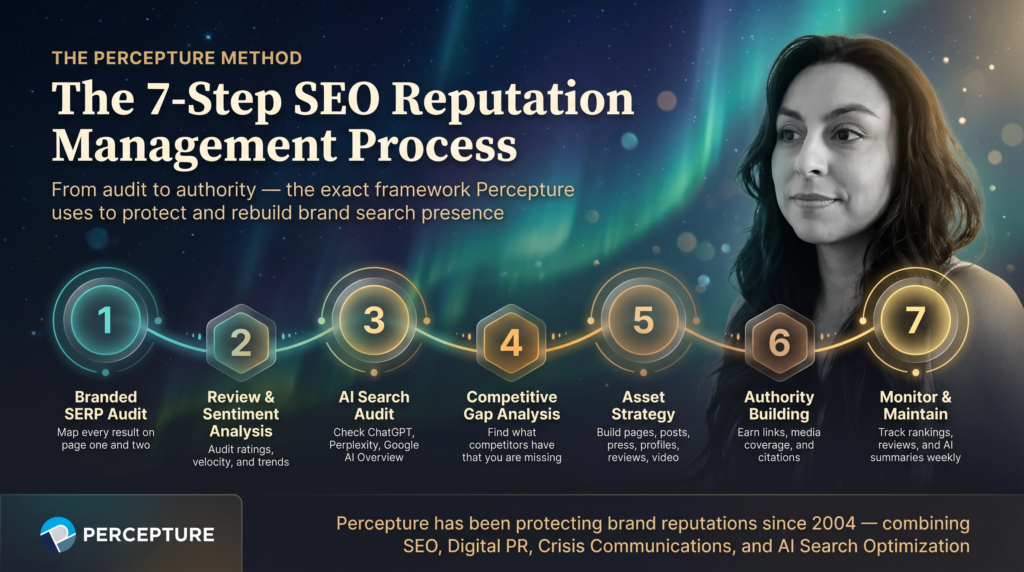
Here is the process we use at Percepture.
Step 1: Branded SERP Audit
Search for your brand name, your CEO’s name, your product names, and common variations. Map every result on page one and page two. Note the domain, the content type, the sentiment, and the authority.
Step 2: Review and Sentiment Analysis
Audit your reviews on Google, Yelp, Glassdoor, Trustpilot, and industry-specific platforms. Calculate your average rating, your review velocity, and your sentiment trends.
Step 3: AI Search Audit
Search for your brand in ChatGPT, Perplexity, and Google AI Overview. Note what sources are cited. Note what information is summarized. Identify gaps and inaccuracies.
Step 4: Competitive Gap Analysis
Compare your search results to your top competitors. Where are they stronger? Where are you stronger? What assets do they have that you are missing?
Step 5: Asset Strategy
Create a plan to build new assets. This might include:
- New website pages
- New blog posts
- New press releases
- New media placements
- New social profiles
- New review campaigns
- New video content
Step 6: Authority Building
Build links to your positive assets. Earn media coverage. Get cited in industry publications. Strengthen your Google Business Profile. Improve your technical SEO.
Step 7: Monitoring and Maintenance
Set up alerts for your brand name, your executives, and your products. Monitor rankings weekly, reviews daily and onitor AI summaries monthly. Adjust your strategy as needed.
What Not to Do When Negative Results Appear
When negative content appears in search results, many companies make mistakes that make the problem worse.
Do not click on the negative result repeatedly. Every click tells Google the result is relevant. Don’t share the link internally, send it to your team anpost it on social media to complain.
Avoid responding emotionally. A defensive or aggressive response can create more negative content. It can also make you look guilty.
Ignoring it, is the wrong move. Hoping it will go away is not a strategy. Negative content often gets stronger over time as it earns links and engagement.
Don’t use shady suppression tactics. Black-hat SEO, fake reviews, and link schemes can backfire. Google penalizes manipulation. Journalists expose it. The cure becomes worse than the disease.
Never overpromise removal. Most negative content cannot be removed. Anyone who guarantees removal is probably lying.
SEO Reputation Management Services
Professional SEO reputation management services typically include:
| Service | Description |
|---|---|
| Branded SERP audit | Mapping all search results for your brand keywords |
| Review management | Monitoring, responding to, and improving reviews |
| Content creation | Building new positive assets |
| Digital PR | Earning media coverage and citations |
| Link building | Strengthening authority of positive assets |
| Suppression campaigns | Pushing negative content down in rankings |
| Crisis response | Rapid response to reputation emergencies |
| AI search optimization | Ensuring positive sources are cited by AI tools |
| Executive reputation | Protecting the personal brands of leadership |
| Monitoring and reporting | Ongoing tracking and adjustment |
For a list of the top firms in this space, see our guide to the best reputation management companies.
If you need the best enterprise SEO services as part of a larger reputation strategy, Percepture can help.
How to Measure Success
SEO reputation management is measurable. Here are the KPIs we track.
Share of positive search real estate. What percentage of page one results are positive, neutral, or negative?
Review ratings and velocity. What is your average rating? How many new reviews are you earning per month?
AI citation rate. How often are your positive sources cited in AI summaries?
Branded search volume. Are more people searching for your brand? That is a sign of growing awareness.
Click-through rate. Are people clicking on your positive results? Or are they clicking on negative ones?
Sentiment trends. Is sentiment improving over time?
Crisis response time. When negative content appears, how quickly can you respond?
When to Hire an SEO Reputation Management Agency
You should consider hiring an agency when:
- Negative content is ranking on page one for your brand name
- You have had a crisis and need rapid response
- You are entering a new market and need to build a public record
- You do not have internal SEO or PR expertise
- You need to protect executive reputations
- You are preparing for a funding round, IPO, or acquisition
- You want to proactively build a stronger search presence
When choosing an agency, look for:
- Experience with both SEO and PR
- A track record with enterprise clients
- Transparent reporting and KPIs
- Ethical practices (no fake reviews, no black-hat SEO)
- AI search expertise
- Crisis communications capability
For urgent reputation issues, see our guide to the best crisis management firms.
If you need a crisis communications agency, Percepture has been helping Fortune 500 companies since 2004.
Related reputation and crisis resources
Frequently Asked Questions
What is SEO reputation management?
SEO reputation management is the process of improving what appears when people search for a brand, executive, or company. It uses SEO, content, PR, reviews, and link building to ensure the most accurate and positive information ranks highest in search results and AI summaries.
How does SEO help online reputation management?
SEO helps online reputation management by improving the visibility of positive content and suppressing negative content in search results. It ensures that when people search for your brand, they find trusted, accurate information first.
Can SEO remove negative search results?
SEO cannot remove content from the internet. But it can suppress negative results by building stronger, more authoritative positive content that ranks higher. Removal requires legal action or negotiation with the publisher.
How long does SEO reputation management take?
Results vary depending on the severity of the problem and the authority of the negative content. Minor issues may improve in 3-6 months. Major crises may take 12-18 months or longer.
What is the difference between removal and suppression?
Removal means getting content taken down at the source. Suppression means pushing content down in search rankings so fewer people see it. Removal is cleaner but harder. Suppression is more common.
How does AI search affect reputation management?
AI search tools summarize information from multiple sources. If negative content is more authoritative than positive content, AI will summarize the negative. SEO reputation management now requires controlling the first 20 results, not just the first 10.
What should a company do if negative articles rank on Google?
First, do not panic. Do not click on the article repeatedly. Audit your full search presence. Build a strategy to create and strengthen positive assets. Consider whether removal is possible. If not, focus on suppression and rebuilding.
When should you hire an SEO reputation management agency?
Hire an agency when negative content is ranking on page one, when you have had a crisis, when you are preparing for a major business event, or when you do not have internal expertise in SEO and PR.
Take Control of Your Search Results
Your reputation is not what you say about yourself. It is what Google, AI tools, journalists, and customers say about you.
SEO reputation management is the work of making sure that story is accurate, positive, and trustworthy.
At Percepture, we have been helping companies protect their reputations since 2004. We combine SEO, digital PR, crisis communications, and AI search optimization to build the public record your brand deserves.
If you want to know what Google says about your brand before you do, request a confidential review.
About the Author:
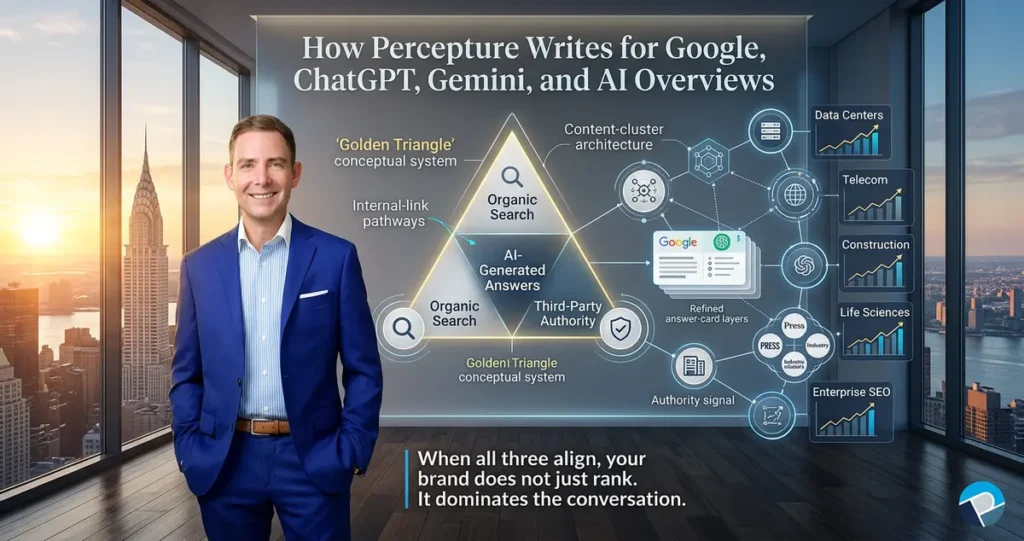
Bob Generale is the President of Percepture, a digital PR and SEO reputation management firm serving Fortune 500 companies since 2004. Since 2006, Bob has pioneered the integration of SEO, link building, and strategic media placement to control branded and unbranded search narratives, a methodology now foundational to Generative Engine Optimization (GEO).