
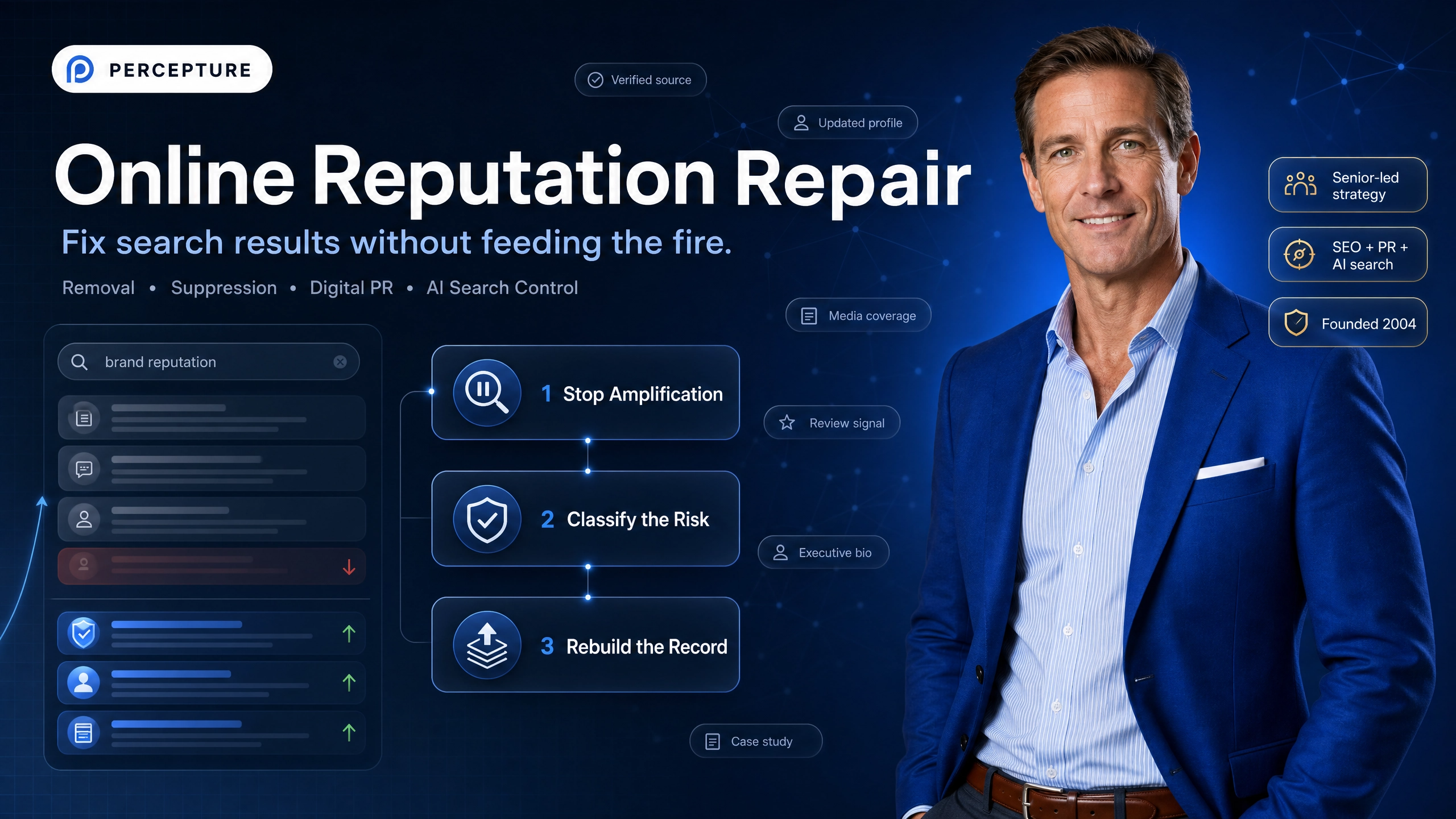

Online reputation repair is the process of fixing damaging search results, reviews, articles, social posts, and AI summaries that hurt trust. The safest path is to stop amplifying the negative result, classify what can be removed or corrected, and build stronger sources that help Google and AI systems show a fairer public record.
Most online reputation repair problems get worse because people panic. They search the negative result, click it, share it, debate it, and accidentally teach the algorithm that the result matters.
What is online reputation repair?
Online reputation repair is the strategic process of improving or restoring how a person, brand, or organization appears in search results, review platforms, news articles, social posts, and AI-generated answers.
It can include removal requests, corrections, suppression, review response, digital PR, content strategy, technical SEO, AI search optimization, and authority building. The goal of online reputation repair is not to hide truth. The goal is to make the full, accurate, current record easier to find.
Remove what can be removed.
False, defamatory, private, outdated, or policy-violating content may qualify for removal, correction, update, or deindexing.
Suppress what must stay live.
Some content cannot be removed. The job becomes building stronger, more relevant assets that deserve to rank higher.
Rebuild the public record.
Google and AI systems need better source material: profiles, media, bios, expert content, reviews, and entity consistency.
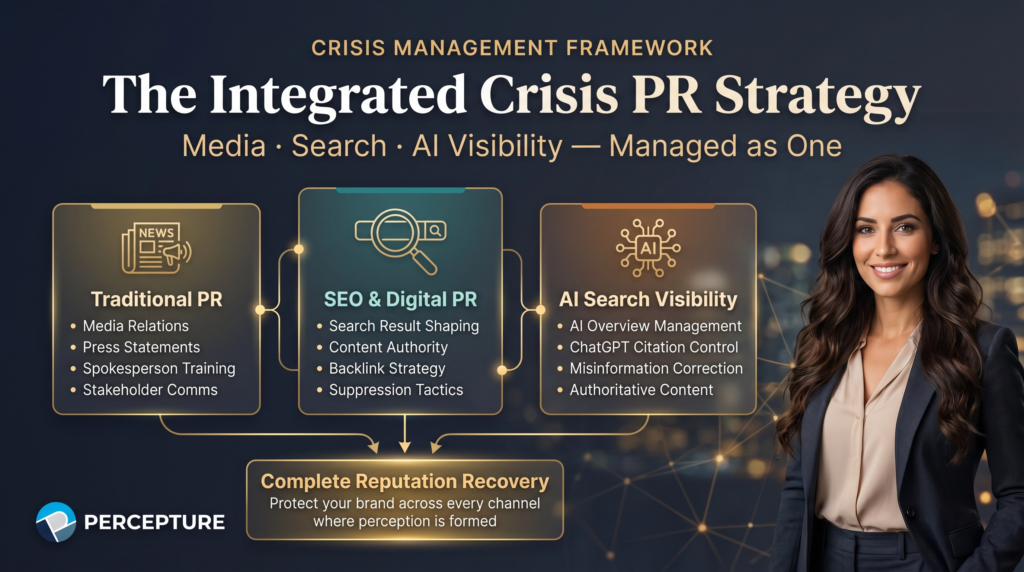
SEO reputation management handles the search layer. Crisis communications services handle the public-response layer. Digital PR services build the third-party authority layer. Generative engine optimization services help AI systems understand the corrected record.
When do you need online reputation repair?
Not every negative result needs a major campaign. Some issues fade with time. Others need fast, careful action because they affect hiring, sales, valuation, financing, media coverage, or personal safety.
| Situation | Do you need repair? | Priority | Best first move |
|---|---|---|---|
| Negative result on page one of Google | Yes. This needs review. | High | Stop clicking it. Capture the result. Classify it. |
| Outdated article from 3+ years ago | Often yes. Updates may be possible. | Medium-high | Check facts, resolution, publisher policy, and deindexing path. |
| Single bad review among many good reviews | Usually no major campaign. | Low | Respond calmly. Improve review volume and response rhythm. |
| False or defamatory content | Yes. Legal and reputation strategy should align. | High | Preserve evidence. Avoid public arguments. Assess removal paths. |
| Negative result on page two or beyond | Monitor first. | Low-medium | Track movement before creating attention. |
| AI-generated answer repeats negative information | Yes. Source control is needed. | High | Map sources cited by AI tools and build better source material. |
Not sure how bad the issue is?
Percepture can review branded search results, negative assets, review platforms, news coverage, AI summaries, and authority gaps before recommending a plan.
The biggest mistake in online reputation repair: feeding the negative result
Here is the counterintuitive truth. The more you search for, click on, forward, or discuss a negative result, the more you can strengthen it.
Search systems measure behavior. When people keep clicking a result for a name or brand query, that behavior can reinforce relevance. The algorithm sees attention, not context.
The first rule of reputation repair is simple: do not feed the negative result. Percepture Reputation Repair Triage Model
Search your name all day.
This creates repeated query and click behavior around the very result you want to reduce.
Send the link to everyone.
Every new click can send another signal. Sharing also expands the human audience.
Track, classify, then build.
Use monitoring tools, screenshots, and a controlled review process. Then build better assets.
Instead of feeding the result, do this
- Use incognito or rank tracking tools for occasional checks.
- Ask one trusted person or partner to monitor the search environment.
- Preserve screenshots, dates, URLs, titles, snippets, and AI outputs.
- Spend energy building positive source material, not refreshing the negative result.
Online reputation repair language can make the issue better or worse
Reputation work is not only about rankings. It is also about the words that get repeated. A bad phrase can become the searchable label for the entire situation.
The fix is not spin. The fix is precision. Use accurate language that reflects the facts, status, and outcome without repeating the harshest label unless it is legally required.
Risky language
- Repeating charged labels in headlines, bios, or internal emails.
- Using words that imply guilt before facts are settled.
- Letting a resolved inquiry sound like an active finding.
- Making an employee’s independent conduct sound like the company’s intent.
Better framing
- “A misunderstanding that was later clarified.”
- “A resolved inquiry with no further action.”
- “An embarrassing moment that does not reflect the full record.”
- “Liability tied to independent employee conduct, not company policy.”
Operator rule: never create a false record. But do not help the wrong record become the main record. This is where legal counsel, a crisis communications agency, and search strategy should work from the same fact base.
Removal vs. suppression vs. rebuilding in online reputation repair
Not all negative content can be removed. A disciplined online reputation repair plan starts by choosing the right path for each result.
| Approach | What it means | When it works | Typical timeline |
|---|---|---|---|
| Removal | Content is deleted, deindexed, corrected, or taken down at the source. | Defamation, false information, privacy issues, policy violations, outdated posts, negotiated updates. | Days to months. Legal paths take longer. |
| Suppression | Negative results are pushed lower by stronger positive or neutral assets. | Persistent results that cannot be removed, low-to-mid authority negatives, comparison pages, old reviews. | Months to 12+ months. |
| Rebuilding | New, accurate, authoritative source material becomes the dominant record. | Long-term executive branding, company repositioning, investor trust, category authority, AI search protection. | Ongoing. Six to 24 months for full effect. |
The strongest programs use all three. Remove what can be removed. Suppress what cannot. Rebuild the record so Google, journalists, buyers, investors, and AI systems have better sources to trust.
The online reputation repair triage model
After 20 years of reputation work across industries, Percepture uses a five-step model to prevent the common mistake of rushing to “do something” before knowing what will work.
Stop the amplification
Stop searching, clicking, forwarding, arguing, or sending extra attention to the negative asset.
Classify the result
Decide whether it is removable, suppressible, correctable, outdated, misleading, or unfavorable.
Repair what can be repaired
Request corrections, removals, deindexing, platform action, publisher updates, or legal review.
Build better sources
Create owned content, executive profiles, press assets, expert pages, reviews, and media mentions.
Rebuild the public record
Use SEO, digital PR, internal links, external authority, and AI-readable content to support the fuller story.
Why the order matters
If you build content before stopping amplification, the negative result may keep gaining behavioral signals. If you request removal before classifying the result, you may alert the publisher and create a new article.
Good repair work feels slow at the beginning because the team is reducing risk. Then the work accelerates because every action has a purpose.
How digital PR supports online reputation repair
SEO alone has limits. You cannot optimize your way out of a major news story, a viral social post, or a weak public record.
Digital PR creates newsworthy stories, expert commentary, authoritative mentions, and trusted third-party assets. Those assets can rank, earn links, and give AI systems better sources to cite.
New ranking assets
A strong media placement or expert profile can occupy a valuable page-one position for a name or brand query.
Narrative balance
Negative results often tell one side. PR introduces context, current work, leadership, values, and proof.
Authority signals
Coverage can create trusted links, citations, entity signals, and human proof that strengthen the broader search estate.
SEO optimizes what exists. Digital PR creates what should exist. Together, they rebuild the public record.
That is why Percepture connects public relations services, SEO, digital PR, and GEO instead of treating reputation as a narrow link-building project.
How AI search changes online reputation repair
Traditional reputation work focused on page one of Google. AI search changes that. ChatGPT, Gemini, Perplexity, Copilot, and Google AI Overviews do not only show links. They summarize what they can retrieve.
If the public source environment is thin, outdated, or one-sided, an AI system may repeat the wrong story with confidence. Online reputation repair now has to manage sources, not just rankings.
The new approach: AI-ready reputation repair
- Create content that answer engines can parse and cite.
- Build entity authority across owned, earned, and shared sources.
- Monitor AI-generated summaries for accuracy and source patterns.
- Use digital PR to create trusted third-party validation.
- Structure facts, timelines, and outcomes in clear, current language.
For a deeper AI visibility strategy, see Percepture’s guide to brand visibility in AI search engines.

AI search visibility check
Before launching a repair campaign, test the brand or executive across Google, Google AI Overviews, ChatGPT, Perplexity, Gemini, and Copilot. Capture the answer, sources, dates, sentiment, missing context, and incorrect claims.
Online reputation repair case study: wealth management executive
The following example shows how the Reputation Repair Triage Model works in practice. Details are anonymized to protect client confidentiality while showing the strategic pattern.
Page-one results were creating interview friction
A mid-to-senior wealth management executive discovered that searches for their name returned several problematic results on page one: a negative review from a previous employer, an outdated article about a resolved regulatory inquiry, and an unfavorable competitor comparison page.
The executive was interviewing for a new role. Recruiters and hiring managers were searching their name before calls. The search results were creating questions before the executive had a chance to explain the full record.
Classified each asset
- Review: suppressible.
- Outdated article: potentially correctable.
- Comparison page: suppressible.
Created stronger source material
- Updated LinkedIn and executive bios.
- Built a professional website and schema.
- Published thought leadership in industry outlets.
- Earned speaking assets and directory profiles.
The results after 12 months
The lesson: speed matters, but sequence matters more. Removal was only one part of the work. The real repair came from building enough trusted source material to replace the old story with a fuller, current record.
Proof beyond one case
Percepture has applied this approach across wealth management, travel and hospitality, manufacturing, telecom, healthcare, life sciences, and complex B2B services.
The visible tactics change by industry. The operating system stays the same: stop amplification, classify the issue, repair what can be repaired, build stronger source material, and monitor the public record.
See more work on the Percepture case studies page.
What not to do during online reputation repair
Knowing what to avoid is just as important as knowing what to build. These moves can make the issue more visible, more expensive, or harder to fix.
| Mistake | Why it backfires | Better move |
|---|---|---|
| Clicking the negative result repeatedly | It can reinforce relevance and attention signals. | Use controlled monitoring and screenshots. |
| Buying fake reviews or fake social proof | The FTC’s rule on reviews and testimonials targets fake or deceptive reviews and related conduct. | Build real reviews and disclose relationships clearly. |
| Ignoring the underlying issue | If the real problem continues, search repair will not hold. | Fix the business issue before scaling the visibility plan. |
| Expecting overnight results | Legitimate suppression and rebuilding take time. | Set a 90-day, six-month, and 12-month roadmap. |
| Using a vendor that will not explain tactics | Hidden methods may create new risk. | Ask for the classification model, link strategy, content plan, and reporting method. |
Read the FTC’s official guidance on the Consumer Reviews and Testimonials Rule before using any review-generation or testimonial strategy.
How to choose an online reputation repair partner
The wrong firm can waste money, overpromise, trigger new attention, or use tactics that do not survive scrutiny. Choose the online reputation repair partner that can explain its method in plain English.
Ethical framework
The right answer: “We do not use fake reviews, fake content, or manipulation. We build real authority.”
Instant-result promises
No one can guarantee Google rankings, removals, or AI answers. Good firms set ranges and explain variables.
Integrated capability
Reputation work crosses SEO, PR, crisis counsel, content, reviews, technical cleanup, and AI visibility.
One-tactic shops
If the pitch is only links, only content, or only legal letters, the program may miss the real issue.
When Percepture is the right fit
Percepture is a fit when the issue touches search, media, AI summaries, reviews, executive visibility, public trust, or buyer confidence. The work is best for high-stakes situations where a generic ORM package is not enough.
For active public issues, start with crisis communications. For ongoing search and AI protection, review SEO reputation management. For public figures, compare celebrity reputation repair and celebrity online reputation management.
Online reputation repair pricing: what does it cost?
Online reputation repair cost depends on the number of negative assets, the authority of those assets, whether legal review is needed, the competitiveness of the name or brand query, and how much source material already exists.
For serious online reputation management work that combines SEO, GEO, digital PR, content, monitoring, and senior strategy, Percepture reputation programs may start around $7,500 per month. High-stakes or fast-moving issues may require a larger scope.
| Scope | Best for | Common work | Budget signal |
|---|---|---|---|
| Diagnostic review | Unsure whether the issue needs action | Search review, AI review, source map, risk classification | Custom |
| Reputation repair retainer | Page-one negatives or AI summary problems | Content, technical SEO, digital PR, profiles, monitoring, reporting | May start around $7,500/mo |
| Crisis + reputation program | Active media, legal, social, stakeholder, or executive risk | Crisis counsel, messaging, search repair, PR, monitoring, approvals | Custom senior-led scope |
| AI search visibility support | Brands with weak or inaccurate AI answers | GEO strategy, answer-ready content, entity clarity, citations, tracking | See AI search SEO pricing |
Budget clarity builds trust
If a reputation issue is affecting sales, hiring, financing, partnerships, or personal credibility, the cost of waiting can exceed the cost of repair. The right question is not only “What does this cost?” It is “What does the current search result cost us every month?”
Related online reputation repair and crisis resources
Use these Percepture resources to choose the correct page for the job. This prevents one article from trying to own every reputation query.
FAQs about online reputation repair
What is online reputation repair?
Online reputation repair is the work of improving what appears when people search for a person, company, brand, or issue. It can include removal, correction, suppression, content strategy, reviews, media coverage, SEO, and AI search optimization.
How long does online reputation repair take?
Meaningful improvement often takes six to 12 months. Some quick wins, such as profile optimization or publisher updates, can happen faster. Suppression and rebuilding usually take longer because stronger assets need time to earn trust.
Can negative search results be completely removed?
Sometimes. Removal may work when content is false, defamatory, private, outdated, or against platform policy. Many negative results cannot be removed, so the strategy shifts to suppression and rebuilding.
What is the difference between removal and suppression?
Removal means the content is deleted, corrected, or deindexed. Suppression means the content remains online but is pushed lower by stronger, more relevant assets. Removal is cleaner. Suppression is more common.
How much does online reputation repair cost?
Costs vary by scope, urgency, risk, and competition. Serious online reputation management programs that include SEO, GEO, digital PR, content, monitoring, and senior strategy may start around $7,500 per month. Active crisis work is usually custom.
Can I repair my online reputation myself?
For minor issues, yes. You can respond to reviews, update profiles, publish helpful content, and stop clicking negative results. For page-one negatives, legal exposure, press attention, executive risk, or AI summary problems, professional help is safer.
How do I stop negative results from ranking higher?
First, stop clicking and sharing the negative result. Second, classify whether it can be removed, corrected, or suppressed. Third, build better source material that is more current, accurate, trusted, and useful than the negative result.
How does AI search change reputation repair?
AI systems summarize information from many sources. That means reputation repair must improve the broader source environment, not only one website or one Google result. Strong programs now monitor ChatGPT, Gemini, Perplexity, Copilot, and Google AI Overviews.
What should I avoid during a reputation issue?
Avoid repeated searching, public arguments, fake reviews, rushed statements, vague denials, low-quality content, hidden tactics, and vendors promising guaranteed results. Slow down, capture facts, classify the issue, and act from a shared strategy.

Bob Generale
Bob Generale is President and Partner at Percepture, where he leads high-stakes SEO, GEO, digital PR, AI search visibility, and online reputation strategy for clients who need speed, discretion, and control.
Bob works like a Navy SEAL-style operator for reputation and search: small team, tight mission, clean execution, no wasted motion. Hunter Newby has called Bob “the magician” because the work can make visibility appear, disappear, or move within 24 to 48 hours when the search environment allows it.
Bob also worked with Hunter Newby on AI-search positioning and book strategy, including the idea of using an AI interview format to make complex digital infrastructure thinking easier to understand.
Ready to start online reputation repair without making it worse?
If you are dealing with a reputation issue, do not panic-click the problem into more visibility. Capture the search environment, classify the risk, and build the right plan.
- Stop feeding the result. Do not keep searching, clicking, or sharing it.
- Map the public record. Review Google, reviews, news, social, video, and AI answers.
- Classify each asset. Removal, correction, suppression, rebuilding, or monitoring.
- Build better source material. Make the accurate record easier to find and easier to cite.
- Monitor and maintain. Reputation repair is a system, not a one-time cleanup.