


Direct Answer
What Is Generative Engine Optimization? It is the practice of making your brand, content, experts, and proof easier for AI search systems to understand, trust, and cite. It connects SEO, content strategy, digital PR, entity clarity, and conversion paths so buyers can find reliable answers and take the next step.
Generative engine optimization is not a separate trick layered on top of SEO. It is a sharper way to organize your search footprint for how buyers now research: Google, AI Overviews, ChatGPT, Perplexity, Gemini, and other answer engines.
For healthcare leaders, what is generative engine optimization? should connect technical content, buyer intent, search visibility, and sales follow-up into one operating plan.
For healthcare companies, the bar is higher. Buyers need clear information, credible expertise, careful claims, and a path to trust before they speak with sales. GEO helps your best answers become easier to discover and easier to verify.
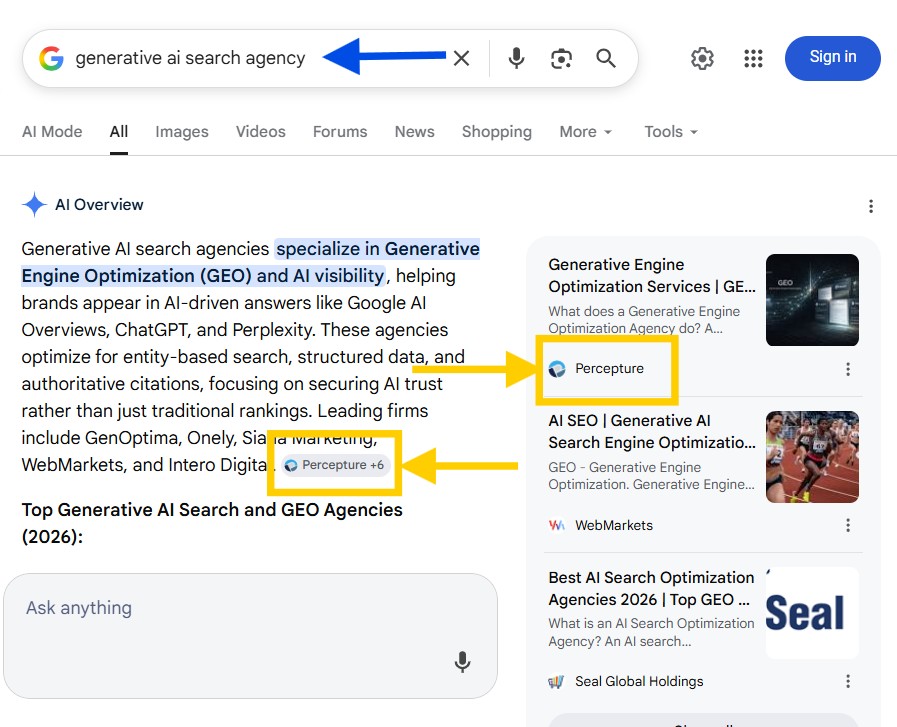
This guide explains the topic in plain English, then shows how Percepture thinks about GEO as part of a larger visibility, trust, and lead generation system.
Who this guide is for
This page is built for:
- CEOs and founders who want to protect brand visibility as search behavior changes.
- CMOs and VP Marketing leaders who need a practical SEO and GEO plan.
- Healthcare marketers who must balance visibility, trust, and careful messaging.
- Revenue leaders who want search traffic to support qualified conversations.
- B2B teams comparing internal execution with an agency-led system.
If your buyers ask complex questions before they convert, GEO should be part of your strategy.
When What Is Generative Engine Optimization? is built this way, every channel supports the same revenue goal instead of acting like a separate campaign.
Start With Visibility
See where your SEO and AI search gaps are hiding.
A strong GEO program starts with a clean view of your search footprint, proof gaps, buyer-intent pages, and AI citation readiness.
What Is Generative Engine Optimization? The Simple Definition
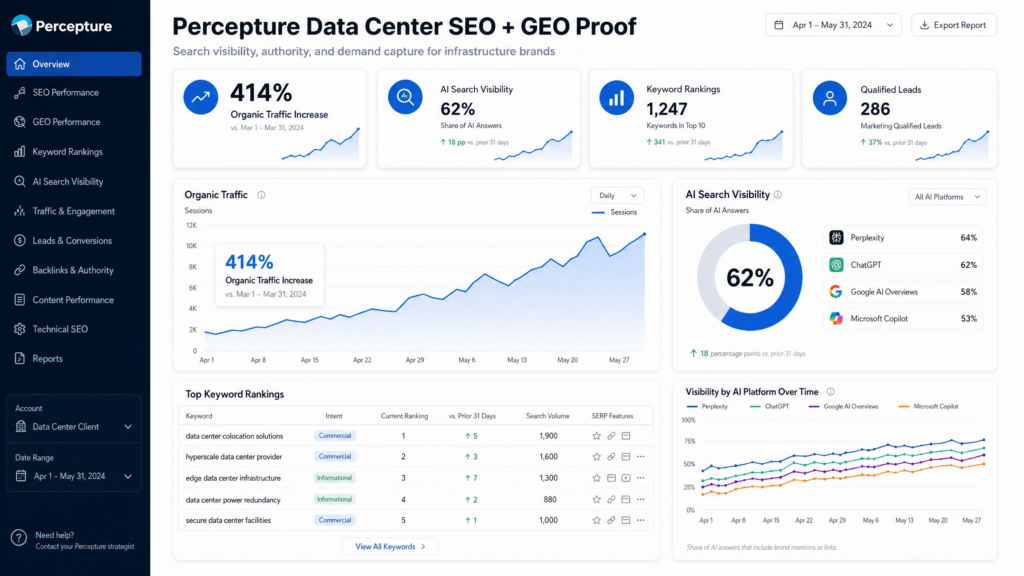
That is why What Is Generative Engine Optimization? needs both category-level execution and executive-level reporting.
Generative engine optimization is the work of improving how your company appears in AI-generated answers. It helps answer engines understand who you are, what you do, what you are qualified to explain, and why your content should be trusted.
Traditional SEO still matters. Google’s own guidance for AI features points back to many long-standing search fundamentals: helpful content, technical accessibility, clear structure, and unique value. See Google’s guidance on AI search optimization at Google Search Central.
For healthcare leaders, What Is Generative Engine Optimization? should connect technical content, buyer intent, search visibility, and sales follow-up into one operating plan.
GEO builds on that base. It asks a more specific question: if an AI system summarizes the market, would your brand be clear enough, credible enough, and well-connected enough to be included?
Definition Box
Generative engine optimization in plain English
GEO is the process of shaping your website, content, authority signals, and proof so AI answer engines can identify your expertise and include your brand in useful answers. Good GEO does not replace SEO. It makes SEO clearer, more evidence-based, and more useful to buyers.
The best What Is Generative Engine Optimization? programs measure qualified conversations and sales opportunities, not just impressions, clicks, or rankings.
What you will learn
By the end of this guide, you will understand:
A practical What Is Generative Engine Optimization? strategy also has to reflect buyer committees, proof needs, comparison searches, and long sales cycles.
- How GEO differs from traditional SEO.
- Why healthcare companies need proof-led content.
- What AI systems look for when building answers.
- How to audit your current AI visibility.
- What mistakes weaken GEO programs.
- How Percepture connects GEO with omnichannel marketing, search, PR, analytics, and lead generation.
Why GEO matters for healthcare companies
When What Is Generative Engine Optimization? is built this way, every channel supports the same revenue goal instead of acting like a separate campaign.
Healthcare buyers often research before they talk to a vendor. They compare providers, review claims, look for authority, and ask increasingly specific questions.
That creates a visibility problem. Your brand may rank for a few keywords but still be missing from the answer paths that shape buyer opinion.
That is why What Is Generative Engine Optimization? needs both category-level execution and executive-level reporting.
A strong GEO program helps you:
- Answer buyer questions clearly.
- Connect claims to visible proof.
- Make expert topics easier to parse.
- Strengthen internal links between service pages and educational pages.
- Support both organic search and AI search visibility.
- Move interested buyers toward the right next action.
For healthcare leaders, What Is Generative Engine Optimization? should connect technical content, buyer intent, search visibility, and sales follow-up into one operating plan.
Percepture treats GEO as part of a larger search and trust system. That system may include GEO services, enterprise SEO, digital PR, content marketing, attribution and analytics, and conversion rate optimization.
Percepture Framework
The Percepture AI Visibility System
Percepture uses a practical five-part model to connect search visibility, AI visibility, buyer trust, and lead flow.
1. Entity clarity
Your brand, people, services, and topics must be easy to identify. Clear entities help SEO, GEO, and buyer trust.
2. Answer architecture
Pages should answer real buyer questions in direct, structured sections that search engines and AI systems can parse.
3. Proof tokens
Claims need support. Proof can include case studies, expert bios, published resources, service depth, and consistent messaging.
4. Search footprint
A single page rarely wins alone. GEO improves when service pages, insights, PR, and comparison content support each other.
5. Conversion paths
Visibility should lead to useful next steps: audits, pricing pages, case studies, diagnostics, and senior strategy conversations.
SEO vs GEO: what changes and what stays the same
SEO vs GEO comparison
| Area | Traditional SEO | GEO |
|---|---|---|
| Goal | Rank pages for search queries. | Earn visibility in AI-generated answers and buyer research paths. |
| Content focus | Keywords, pages, metadata, links, and technical health. | Questions, entities, summaries, proof, topical coverage, and citation readiness. |
| Trust signal | Authority, relevance, and user experience. | Clear expertise, consistent facts, named authors, and proof before promises. |
| Best use | Capturing demand from known search behavior. | Shaping how AI systems and buyers understand the brand. |
The practical answer is not SEO or GEO. It is SEO plus GEO. Strong technical SEO helps search engines crawl the site. Strong GEO helps answer engines understand the brand. Strong CRO helps turn attention into action.
When What Is Generative Engine Optimization? is built this way, every channel supports the same revenue goal instead of acting like a separate campaign.
For more background, Percepture’s guides on corporate SEO, organic SEO services, and technical SEO audit service show how the SEO base supports AI visibility.
How generative engine optimization works
That is why What Is Generative Engine Optimization? needs both category-level execution and executive-level reporting.
GEO works by improving the signals that help AI systems summarize your company accurately.

A practical program includes five steps:
For healthcare leaders, What Is Generative Engine Optimization? should connect technical content, buyer intent, search visibility, and sales follow-up into one operating plan.
- Audit the current search footprint. Review rankings, crawlability, top pages, branded search, service pages, author signals, and content gaps.
- Map buyer questions. Identify what CEOs, CMOs, clinicians, procurement teams, and operators ask before they buy.
- Build answer-ready content. Create pages with clear definitions, summaries, comparisons, FAQs, and evidence.
- Strengthen authority signals. Connect expert bios, service depth, digital PR, case studies, and internal links.
- Measure the path to revenue. Use analytics and conversion tracking to see which pages support real conversations.
Percepture connects this work with strategy and planning, lead generation, and buyer journey work, not isolated content production.
AI Visibility Scorecard
A quick GEO readiness check
Score each item from 0 to 2. A low score means your brand may be hard for AI systems and buyers to understand.
- Your top service pages answer buyer questions directly.
- Your authors and experts are clearly identified.
- Your proof is visible before a buyer reaches a sales page.
- Your healthcare claims are careful, specific, and supportable.
- Your content links naturally to service, pricing, analytics, and case study pages.
- Your pages include summaries, definitions, comparisons, and FAQs.
- Your conversion paths match buyer stage instead of pushing every reader to the same CTA.
What buyers should look for in a GEO partner
What Is Generative Engine Optimization? It is also a vendor selection question. A good partner should not sell GEO as a shortcut.
Look for a team that can show:
- SEO fundamentals, including technical health and internal linking.
- Clear content architecture for buyer questions.
- Digital PR thinking that builds authority beyond the website.
- Analytics that connect visibility with lead quality.
- Careful healthcare messaging that avoids loose claims.
- A process for updating content as search behavior changes.
If you are evaluating budget, Percepture’s enterprise SEO ROI calculator can help frame the business case before you compare agencies.
That is why What Is Generative Engine Optimization? needs both category-level execution and executive-level reporting.
Mistakes to avoid
The most common GEO mistakes are simple, but costly:
- Writing for keywords but not questions. AI systems summarize answers, not keyword lists.
- Publishing generic AI copy. Generic content gives buyers little reason to trust you.
- Treating GEO as separate from SEO. If the site cannot be crawled, structured, or understood, GEO is weak.
- Making claims without proof. This is especially risky in healthcare.
- Ignoring internal links. Your strongest pages should support each other.
- Skipping conversion paths. Visibility without next steps does not help revenue.
- Failing to refresh content. GEO work should be maintained as buyer questions and search features change.
Pricing, ROI, and buyer risk
The best What Is Generative Engine Optimization? programs measure qualified conversations and sales opportunities, not just impressions, clicks, or rankings.
GEO pricing depends on the scope of the work. A simple content refresh costs less than a full program that includes technical SEO, content strategy, digital PR, analytics, conversion optimization, and ongoing reporting.
The better question is not only cost. It is risk.
A practical What Is Generative Engine Optimization? strategy also has to reflect buyer committees, proof needs, comparison searches, and long sales cycles.
Ask:
- Are our best services visible in search and AI answers?
- Can buyers find proof before they speak to sales?
- Do our pages explain complex healthcare topics clearly?
- Do we know which content supports qualified leads?
- Are we building assets that compound over time?
When What Is Generative Engine Optimization? is built this way, every channel supports the same revenue goal instead of acting like a separate campaign.
For package direction, review Percepture’s AI search and SEO pricing page.
What affects GEO investment?
Content depth
More services, markets, and buyer questions require more structured pages.
Technical health
Crawl, indexation, schema, speed, and page structure affect visibility work.
Proof assets
Case studies, expert bios, PR, and trust tokens improve buyer confidence.
Measurement
Better tracking helps leaders see which pages support pipeline conversations.
That is why What Is Generative Engine Optimization? needs both category-level execution and executive-level reporting.
Proof before promises
Percepture does not need to turn GEO into a mystery. The work is visible in the assets a company builds: stronger service pages, clearer insights, better internal links, proof-led CTAs, and buyer-intent content.
For healthcare leaders, What Is Generative Engine Optimization? should connect technical content, buyer intent, search visibility, and sales follow-up into one operating plan.
For healthcare-specific context, see Percepture’s resources on the healthcare industry, healthcare SEO company selection, and medical SEO companies. For life sciences teams, Percepture’s CDMO marketing guide shows how specialized buyer language matters.

When should a company start GEO?
Start when any of these are true:
A practical What Is Generative Engine Optimization? strategy also has to reflect buyer committees, proof needs, comparison searches, and long sales cycles.
- You rank in Google but are not confident your brand appears in AI answers.
- Buyers ask detailed questions your website does not answer clearly.
- Your service pages are thin or disconnected from proof.
- Your content gets traffic but does not support qualified leads.
- Your competitors are creating better educational assets.
- Your healthcare messaging needs more structure and trust.
What Is Generative Engine Optimization? In practice, it is a way to reduce buyer confusion before the first sales call.
When What Is Generative Engine Optimization? is built this way, every channel supports the same revenue goal instead of acting like a separate campaign.
Final next step
If your company depends on executive trust, complex buying committees, or healthcare buyers who research deeply before they convert, GEO should not be treated as an experiment. It should be built into your search, content, PR, analytics, and conversion strategy.
That is why What Is Generative Engine Optimization? needs both category-level execution and executive-level reporting.
Start with a visibility audit. Find the pages that already earn attention. Then build the missing answers, proof, and links that help buyers and AI systems understand your value.
Related Percepture Resources
Keep building the search footprint
For healthcare leaders, What Is Generative Engine Optimization? should connect technical content, buyer intent, search visibility, and sales follow-up into one operating plan.
FAQ
What Is Generative Engine Optimization?
What Is Generative Engine Optimization? It is the practice of improving how your brand, experts, services, and proof appear in AI-generated answers. It builds on SEO by making your content clearer, more structured, and easier for answer engines to understand and cite.
How is GEO different from SEO?
SEO focuses on helping pages rank in search results. GEO focuses on helping AI systems summarize and cite your brand accurately. The two should work together because AI visibility still depends on crawlable, useful, well-structured content.
Can GEO help a healthcare company show up in AI search?
GEO can improve a healthcare company’s readiness for AI search by clarifying expertise, service topics, author signals, and proof. It does not guarantee inclusion in AI answers, but it can make the brand easier to understand and evaluate.
How long does GEO take to work?
Timing depends on your current site health, content depth, authority, and competition. Some improvements, like clearer page structure, can be made quickly. Broader gains usually require consistent work across SEO, content, PR, analytics, and conversion paths.
How much does generative engine optimization cost?
Cost depends on scope. A focused audit or content refresh is different from a full program that includes technical SEO, content creation, digital PR, analytics, and CRO. Buyers should compare scope, proof, reporting, and strategy depth before choosing a partner.
What should I look for in a GEO agency?
Look for a team that understands SEO fundamentals, AI search behavior, content architecture, digital PR, analytics, and conversion strategy. For healthcare, also look for careful messaging, strong proof discipline, and the ability to explain complex topics clearly.
Is GEO only for large companies?
No. GEO matters for any company whose buyers research before making a decision. Larger companies may need more governance and technical structure, but smaller companies can still benefit from clearer answers, stronger proof, and better internal linking.
What is the first step in a GEO program?
The first step is a search and AI visibility audit. Review your current rankings, top pages, technical health, buyer questions, proof assets, authors, schema, internal links, and conversion paths. That audit shows where to focus first.
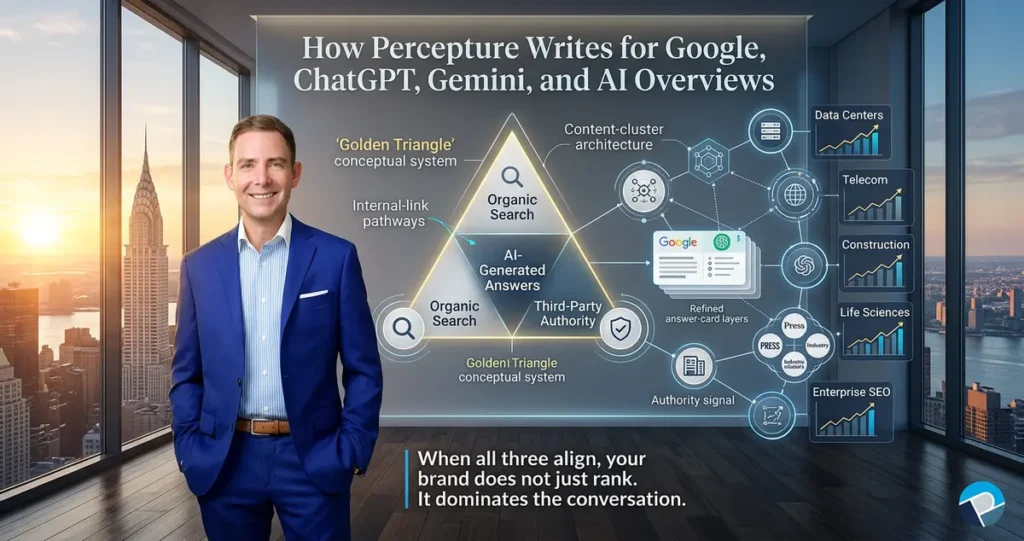

Work Directly With Percepture
Want to know where your search and AI visibility stands?
Book a short working session with Percepture to review your search footprint, AI visibility, buyer-intent pages, and the fastest opportunities to improve trust and qualified lead flow.
Connect with us today!
About the Author
Bob Generale
President, Percepture
Bob Generale leads Percepture’s strategy for SEO, GEO, digital PR, AI search visibility, and executive lead generation. His work helps B2B and healthcare brands become easier to find, easier to trust, and easier for buyers and AI systems to understand.