


Industrial Lead Generation for Manufacturers should not be treated like a generic contact-list campaign. Manufacturing buyers research specs, tolerances, certifications, lead times, procurement risk, and supplier fit before they talk to sales. The goal is not more names in a spreadsheet. The goal is more qualified conversations with accounts that have a real reason to move.
Manufacturers do not sell impulse purchases. An engineer may start the research. A plant manager may compare fit. Procurement may control the shortlist. Leadership may approve the final supplier. If your content only speaks to one person, or your lead process only captures a form fill, the pipeline can look busy while sales still waits for serious buyers.
What is industrial lead generation?
Industrial Lead Generation for Manufacturers is the process of attracting, identifying, qualifying, and routing manufacturing buyers who are researching products, services, or suppliers. A strong program combines technical search visibility, intent data, verified contacts, lead scoring, and a clean sales handoff so marketing activity turns into quote-ready conversations.
Show up for technical demand
Buyers search by application, process, problem, material, tolerance, and supplier fit. Your site should match that language.
Separate activity from intent
Intent signals, verified contacts, and lead scoring protect sales time and improve timing.
Route leads with context
A lead should arrive with source, fit, behavior, and the next-best action, not just a name and email.
For manufacturing leaders, Industrial Lead Generation for Manufacturers should connect technical content, buyer intent, search visibility, and sales follow-up into one operating plan. That is where lead generation services, enterprise SEO, content marketing, B2B intent data, and omnichannel marketing start working together instead of behaving like separate campaigns.
What manufacturing leaders should care about
- Traffic is not the win. Better RFQs, better-fit accounts, and better timing are the win.
- Technical content matters. Category, application, comparison, and use-case pages help buyers judge fit before they contact you.
- Intent signals protect sales time. They help separate active accounts from casual researchers.
- Verified contacts matter. Bad data creates bounce risk, wasted follow-up, and weak sales confidence.
- The handoff is part of lead generation. Sales needs context, source, fit, and next-step logic.
Who this guide is for
This guide is for owners, CEOs, CMOs, sales leaders, and marketing teams at manufacturing companies that need more qualified sales conversations. It is especially useful if you sell engineered products, components, equipment, technical services, contract manufacturing, specialty materials, or solutions with a longer buying cycle.
If you are evaluating lead generation services, enterprise SEO, content marketing, B2B intent data, or a broader omnichannel marketing program, the right question is not “How many leads?” The right question is “How many better-fit conversations move toward revenue?”
Want to see where industrial lead flow is getting stuck?
Run a practical lead-quality diagnostic before you spend more on clicks, lists, or content. Look at the full path: search visibility, AI visibility, contact quality, lead scoring, and sales handoff.
What Industrial Lead Generation for Manufacturers should include
A lot of vendors sell one piece of the system. Some sell contact data. Some sell paid media. Some sell SEO packages. Some sell meetings. Manufacturers usually need a more connected model because buyer trust builds in stages.
Search visibility tied to technical buyer intent
Manufacturing buyers search with specific questions around fit, process, materials, tolerances, certifications, applications, and supplier risk. Your site needs category pages, application pages, comparison pages, FAQ pages, and insight articles that answer those questions.
Relevant support: organic SEO services, B2B SEO agency strategy, and technical SEO audit service.
Intent data that improves timing
Not every visitor is ready for sales. Some are learning. Some are comparing. Some are building a shortlist. Intent data helps your team spot accounts that are showing stronger buying behavior and connect activity to fit.
Verified contacts you can trust
A lead is not useful if the email bounces, the job title is wrong, or the contact has no role in the buying group. Verified contacts help connect the account signal to the right people. Tools such as Lead Seeker can support this when paired with strategy.
Lead scoring that protects sales time
A strong scoring model weighs company fit, technical interest, engagement depth, source quality, and readiness signals. It should not treat every download, form fill, or contact as equally urgent.
Clean CRM handoff and follow-up
Even good leads get wasted when the handoff is weak. Sales needs to know what the account researched, which page or campaign created the signal, why the lead looks relevant, and what next step makes sense.
Conversion paths built for RFQs
Your forms, quote paths, consultations, and technical review pages should match how manufacturing buyers ask questions and move toward supplier selection.
The Technical Buyer Trust Ladder
Industrial buyers move when your visibility system reduces risk and builds confidence in stages. Traffic alone is not enough. Visibility has to connect to trust, and trust has to connect to action.
- Technical proof: Explain process fit, requirements, specs, and constraints in plain language.
- Use-case pages: Map products and services to industries, applications, buyer problems, and procurement questions.
- Channel support: Help distributors, reps, partners, and direct buyers find the right proof and contact path.
- SEO plus digital PR: Build discoverability and authority across Google, AI search, and industry visibility channels.
- Quote-ready conversion paths: Move the right buyer into an RFQ, consultation, or direct sales conversation without friction.
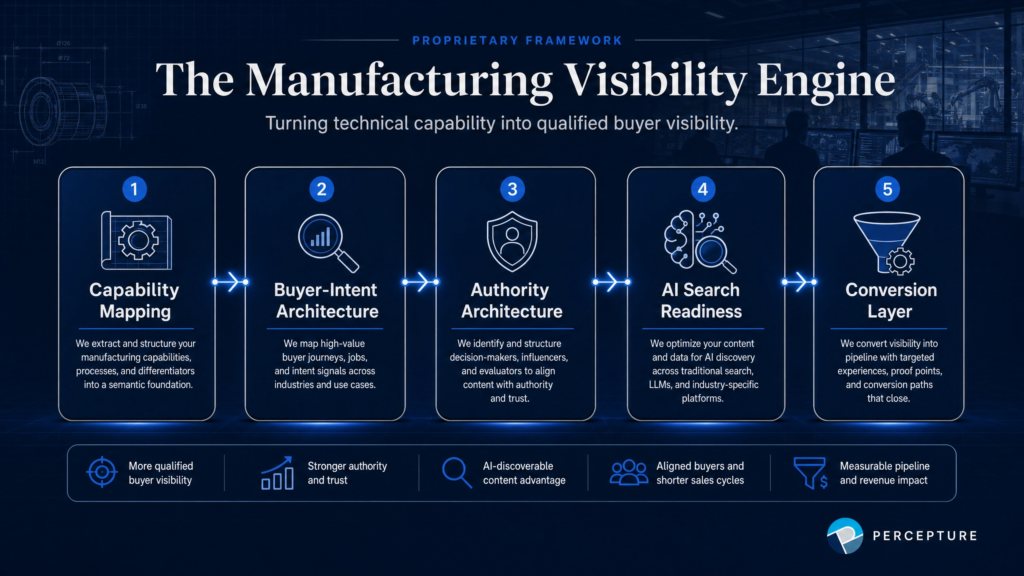
Why this framework holds up
The ladder gives leadership a practical way to judge whether a program is building real pipeline support or just activity. It also makes it easier to connect digital PR, GEO services, conversion rate optimization, and attribution and analytics into one revenue system.
Manufacturing lead generation is not a list problem. It is a commercial visibility system.Percepture operating principle
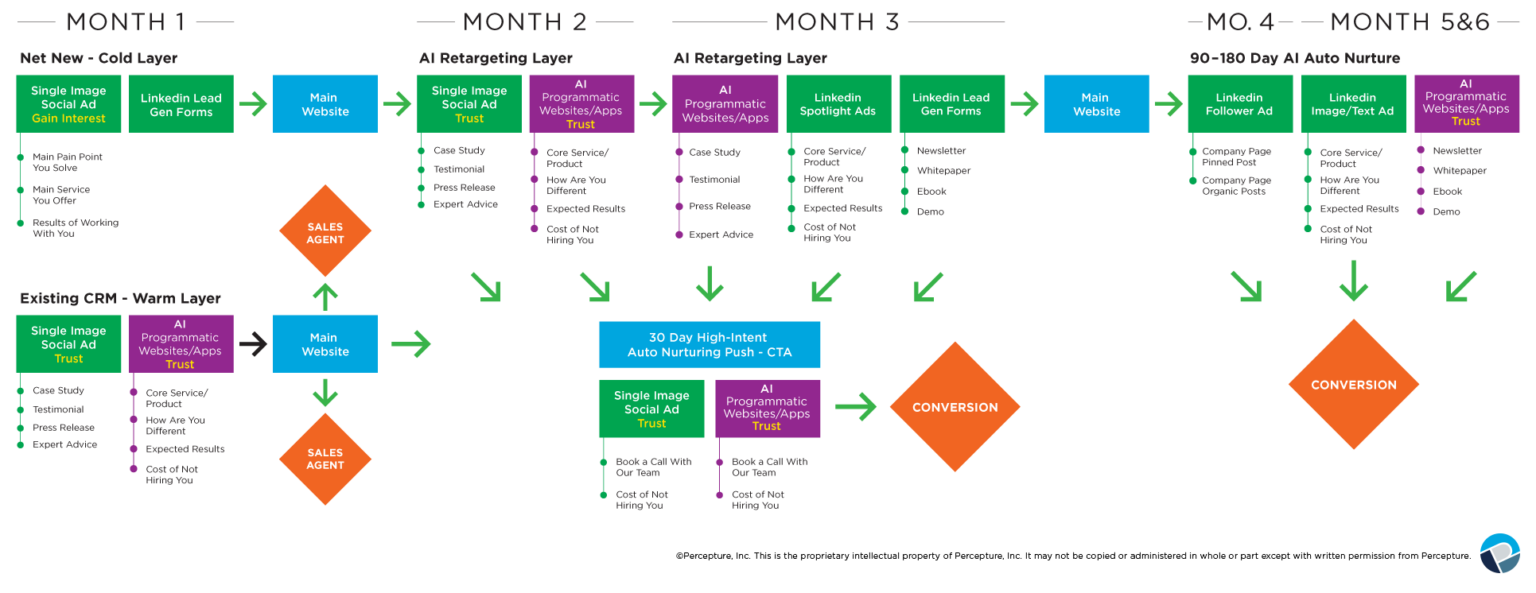
From signal to sales conversation
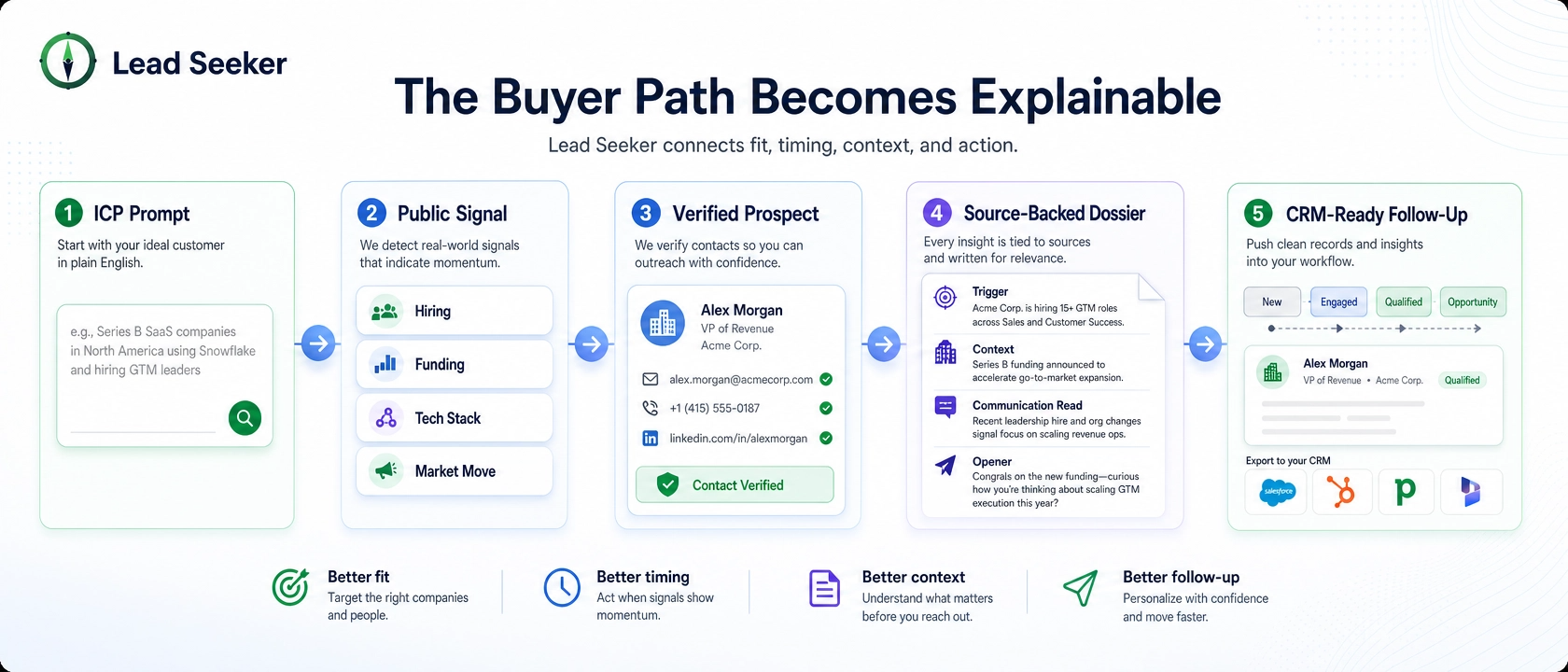
The best industrial sales teams do not wait for a perfect inbound form. They build a system that spots demand earlier, then routes the right signal to the right person.
Watch for account-level behavior
A target company visits product pages, comparison pages, or deep technical content.
Match the signal to fit
The account fits your vertical, geography, capacity, margin profile, or sales territory.
Find verified contacts
The system maps the account to real decision-makers and influencers.
Score the opportunity
Buying behavior, content depth, and company fit determine priority.
Route with context
The rep gets a reason to act, not just a name and email address.
Nurture what is early
Accounts that are not ready still need relevant follow-up, education, and reminders.
Buyer decision matrix
A manufacturer should evaluate lead generation the same way it evaluates an important supplier: by process quality, data quality, operating fit, and commercial value.
| Evaluation area | What good looks like | Warning sign |
|---|---|---|
| Buyer fit | Targets the right industries, applications, and buying roles. | Broad lists with weak relevance. |
| Data quality | Verified contacts and clear account matching. | High bounce risk or outdated records. |
| Intent signals | Shows why the account may be active now. | No timing insight. |
| Lead scoring | Clear prioritization model tied to sales workflow. | Everything gets treated as a hot lead. |
| Conversion path | Built for RFQs, demos, consultations, or spec review. | Generic contact form only. |
| Reporting | Tracks conversations, quality, and pipeline movement. | Reports on clicks only. |
Industrial lead quality scorecard
Score each area from 1 to 5. A total below 20 means the system may create activity without enough sales value. A total above 25 means the program is more likely to support serious conversations.
- Buyer fit: Do the leads match your ideal industries, roles, and applications?
- Technical relevance: Did the buyer engage with pages that show real product or service interest?
- Contact confidence: Are the names, roles, and emails verified?
- Timing signal: Is there a reason to believe the account is active now?
- Sales context: Does the rep know why the lead matters?
- Conversion path: Can the buyer move into an RFQ, consultation, or spec review easily?
Pricing, ROI, and realistic timeline
Pricing varies because a contact-data tool is not the same as a full visibility and pipeline system. A narrow outbound program may cost less up front, but it can create more waste if contacts are weak or sales gets no context. A broader program may include SEO, GEO, paid media, digital PR, analytics, conversion work, and sales enablement.
| Option | Best fit | Risk to watch |
|---|---|---|
| Contact-data tool | Teams that already have strong messaging, targeting, and sales process. | Names without enough buying context. |
| Paid media campaign | Teams that need faster demand capture and clear landing pages. | Clicks without qualification or follow-up logic. |
| SEO and content program | Manufacturers that need durable search visibility for technical buyers. | Thin content that ranks poorly or fails to convert. |
| Integrated visibility system | Companies that need search, AI visibility, PR, conversion, data, and sales handoff working together. | Requires alignment between marketing, sales, and leadership. |
The smarter ROI question is simple: how much does one qualified sales conversation matter? For many manufacturers, one serious opportunity can justify meaningful investment if the deal size, lifetime value, or channel value is strong enough.
Use enterprise SEO ROI calculator thinking to model the value of better-fit traffic, higher conversion rates, and improved sales follow-up. If your team is debating speed, scope, or cost, compare options against SEO pricing packages, content marketing pricing, and GEO pricing benchmarks.
Google’s guidance on helpful, people-first content and AI features in Search supports the same conclusion: industrial buyers want useful answers, not thin pages written only to rank.
Budget clarity beats vague lead promises
If you are weighing SEO, content, GEO, paid media, PR, or lead generation scope, start with budget clarity. Use pricing as a planning tool, not just a procurement step.
Mistakes that weaken Industrial Lead Generation for Manufacturers
- Chasing volume over fit. More leads do not help if the buyers are wrong.
- Using generic copy. Industrial buyers can spot shallow content quickly.
- Separating marketing from sales. Weak handoff rules reduce confidence and follow-up speed.
- Skipping verification. Bad contacts waste time and hurt outreach performance.
- Ignoring AI discovery. Buyers increasingly use AI systems to research categories, suppliers, and shortlists.
- Using one-channel thinking. Stronger systems connect SEO, GEO, PR, content, paid media, analytics, and sales activation.
That integrated model is where Percepture approaches the problem differently. Industrial Lead Generation for Manufacturers is not only a list problem. It is a commercial visibility system built to help buyers discover you, trust you, and contact you with clearer intent.
Proof: connected visibility beats isolated tactics
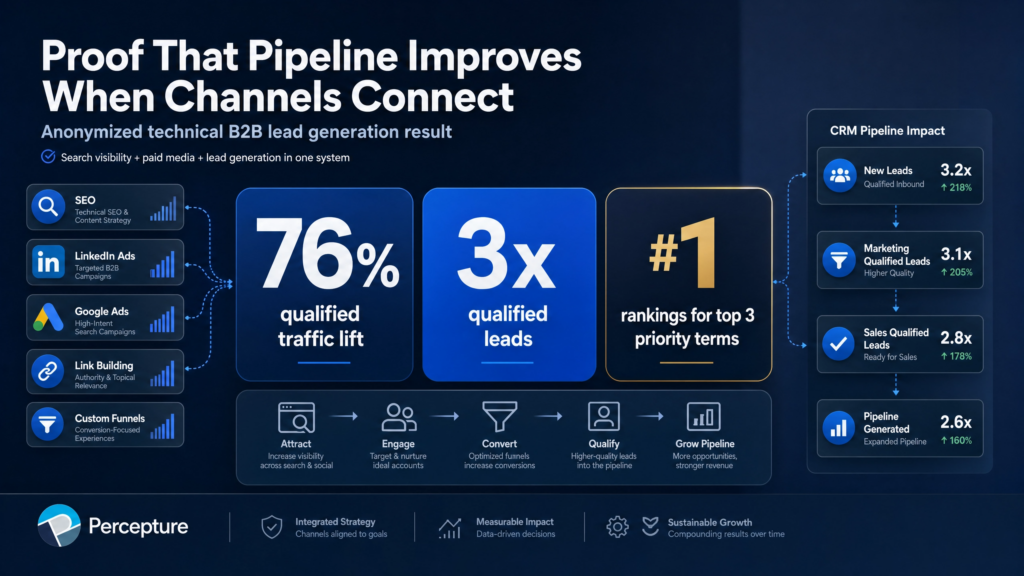
A public Percepture case study describes a leading pharma CDMO program that combined SEO, paid search, LinkedIn, AI-driven programmatic, digital-experience redesign, personalized content, and end-to-end analytics. The reported outcomes included 3x inbound leads, 435% website traffic growth, sold-out capacity by 2023, and major product-line growth over the partnership.
The lesson for manufacturers is direct: buyers do not only need visibility. They need proof, timing, and a clear path from discovery to conversation. See more work in the Percepture case studies section and related life sciences strategy in CDMO marketing.
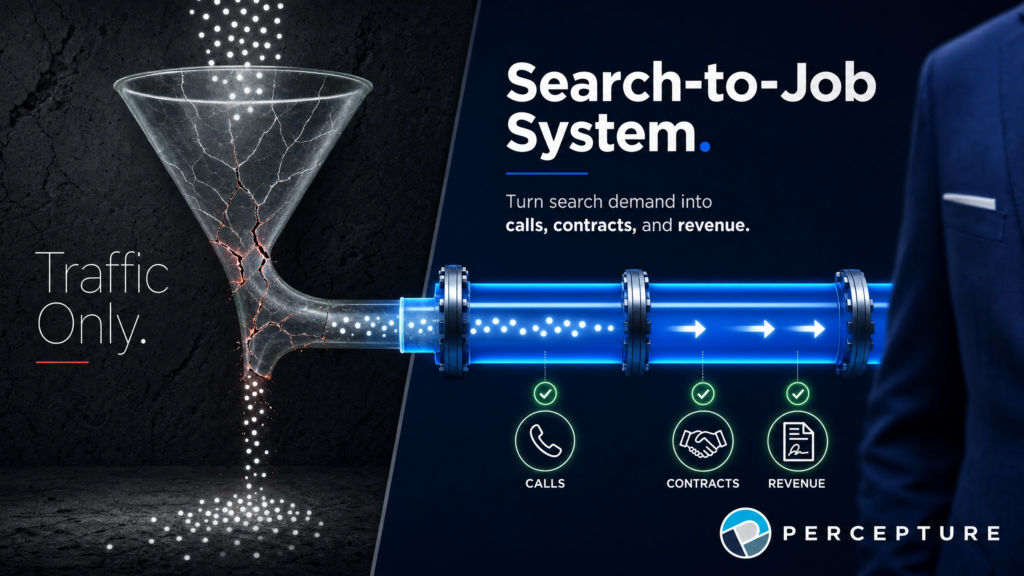
See a client story tied to search visibility and qualified leads
Click the video teaser below to view the Broadstaff case study. It is a useful example of how search visibility, stronger positioning, and clearer demand capture can compound.

Questions to ask an industrial lead generation provider
- How do you define a qualified industrial lead?
- How do you verify contacts and reduce bad data?
- What buying signals do you use?
- How do you score and route leads into CRM?
- How do you support both Google and AI-search visibility?
- How will this improve RFQ quality, not just lead volume?
- How will reporting separate activity from real sales opportunity?
If the answers stay vague, the program may create noise. If the answers connect targeting, content, data, scoring, and follow-up, you are closer to a system that sales can trust.
Related Percepture resources
FAQs
How can industrial manufacturers generate more qualified sales conversations?
They can combine technical SEO, buyer-intent content, intent data, verified contacts, lead scoring, and a clean CRM handoff. The goal is to help sales engage accounts that fit, show buying signals, and have a clear reason to talk now.
What should I look for in Industrial Lead Generation for Manufacturers before buying?
Look for buyer fit, verified contacts, intent signals, lead scoring, conversion paths, and reporting tied to conversation quality. If a provider only promises more names, but not better timing or better fit, the ROI will be harder to defend.
How do great sales teams use intent data, lead scoring, and verified contacts?
They use intent data to find active accounts, match those signals to verified contacts, score the opportunity, and route the best prospects into sales with context. That lets reps spend more time on likely buyers and less time sorting weak leads.
What is the difference between manufacturing lead generation and generic B2B lead generation?
Manufacturing buyers usually need more technical proof, longer education, and stronger buying-context signals. The process often involves engineers, operations, procurement, and leadership, so the content and qualification model must support a more complex journey.
How long does industrial lead generation take?
Some paid or outbound programs can produce early signals quickly, while SEO and authority-building typically take longer. The best programs balance short-term opportunity capture with long-term search and AI visibility.
Does industrial lead generation only depend on Google rankings?
No. Google still matters, but buyers also use AI tools, peer recommendations, trade publications, partner networks, and direct outreach. Strong programs make your company easier to discover, trust, and contact across multiple channels.
Can industrial lead generation improve RFQ quality?
Yes, when it is built around buyer fit, better technical content, verified contact data, and a stronger quote path. The goal is not just more RFQs. It is more RFQs from companies that are more likely to buy and move forward.
Why does AI-search visibility matter in industrial lead generation?
More buyers now ask AI systems for supplier options, explanations, and shortlists. If your technical content is clear, structured, and trusted, it has a better chance to be surfaced, summarized, and cited during those research moments.
Ready to build a lead generation plan for technical buyers?
Industrial Lead Generation for Manufacturers works best when it is built as a system: technical pages, search and AI visibility, verified contacts, scoring, analytics, and sales handoff all pointing toward better-fit conversations.
Bring your market, offer, sales process, and buyer questions. Percepture can help turn search, AI visibility, content, PR, and conversion paths into a clearer pipeline system.


Bob Generale
Bob Generale is President of Percepture. He leads executive strategy across SEO, GEO, digital PR, lead generation, and integrated visibility programs for complex B2B companies.
Bob’s work focuses on turning market expertise, buyer intent, content, and analytics into measurable sales conversations. Clients often describe him as the “magician” because he helps make visibility, authority, and pipeline movement more measurable and more controllable.