
AI Business Context Strategic Visibility starts with a simple executive problem: search engines, AI answer systems, prospects, and referral sources can only work with the public information they can find. If that information is vague, conflicting, or incomplete, visibility may produce the wrong understanding.
The answer is not more content by default. Leaders first need a clear account of the company, its category, buyers, use cases, proof, relationships, and current language. That context can then guide SEO, GEO, digital PR, reputation, conversion, and measurement.




What is AI business context for strategic visibility?
AI Business Context Strategic Visibility is the practice of making a company’s identity, category, buyer fit, use cases, proof, relationships, and terminology clear enough to support accurate representation in search and AI-assisted answers. It connects business strategy to the public sources that buyers and answer systems may encounter.
Executive summary
Clarify the business
Define what the company is, who it serves, which problems it solves, and where it is not a fit. A broad mission statement is not a usable market definition.
Align the evidence
Check the website, leadership pages, service descriptions, sales materials, profiles, reviews, media coverage, and structured information for agreement.
Test buyer questions
Measure questions tied to real buyers and decisions. Record whether the company is cited, mentioned, absent, or described incorrectly, then inspect the sources behind the result.
Fix before scaling
Use this framework to prioritize category gaps, missing answers, weak proof, conflicting language, and conversion breaks before increasing production.
Who this guide is for
CEOs and owners
Use this framework when the market may be forming an incomplete view of the company before a prospect reaches the sales team.
CMOs and communications leaders
Use this framework to connect positioning, content, search, media, reputation, and buyer education under one source-of-truth process.
Healthcare marketing leaders
Use this framework when service descriptions, locations, professional profiles, patient-facing language, reviews, and organizational claims must stay consistent across many public surfaces.
SEO, GEO, and technical teams
Use this framework when rankings or visibility reports expose a problem but do not explain which business fact, source, page, or buyer question should be corrected.
AI Business Context Strategic Visibility comes before optimization
Optimization can improve the retrieval and presentation of information. It cannot repair an undecided business position. the discipline requires the team to resolve that position: if one page calls the company a platform, another calls it a consultancy, and sales describes it as a managed service, the public record contains three possible categories.
The same context-and-visibility problem appears in healthcare when a practice, network, specialty group, technology provider, or service organization uses overlapping language without explaining the relationship. The issue is not merely semantic. Category, buyer, location, service, and proof affect which comparison set the organization enters.
This is why strategy and planning should inform the visibility program. The team needs an agreed business definition before it decides what to publish, promote, structure, or measure.
AI-search context is not the same as AI governance
The phrase “AI business context” can describe two different jobs. Governance teams may use context to decide how an AI system should operate, what controls apply, and who owns risk. This guide addresses a different question: how clearly the external market can understand a business through search, content, profiles, media, and AI-assisted discovery.
| Meaning | Primary question | Typical owner | Typical output |
|---|---|---|---|
| AI governance context | How should an AI system be controlled in this operating situation? | Risk, legal, security, data, and technology leaders | Policies, controls, permissions, monitoring, and accountability |
| AI-search business context | Does the public information explain when this company belongs in a buyer’s answer? | Executive, marketing, communications, search, and revenue teams | Business definition, source alignment, buyer-question map, proof plan, and correction backlog |
Both disciplines value accuracy and ownership, but their deliverables differ. This market-representation discipline is a market-representation discipline. It asks whether the business has made its strategy understandable through reliable, consistent, and useful public information.
Score the questions that shape your pipeline
Start with a low-friction diagnostic of the audiences and accounts showing signs of demand. Use the result to decide which buyer questions and the highest-priority context and visibility gaps deserve attention first.
The Percepture CONTEXT Map
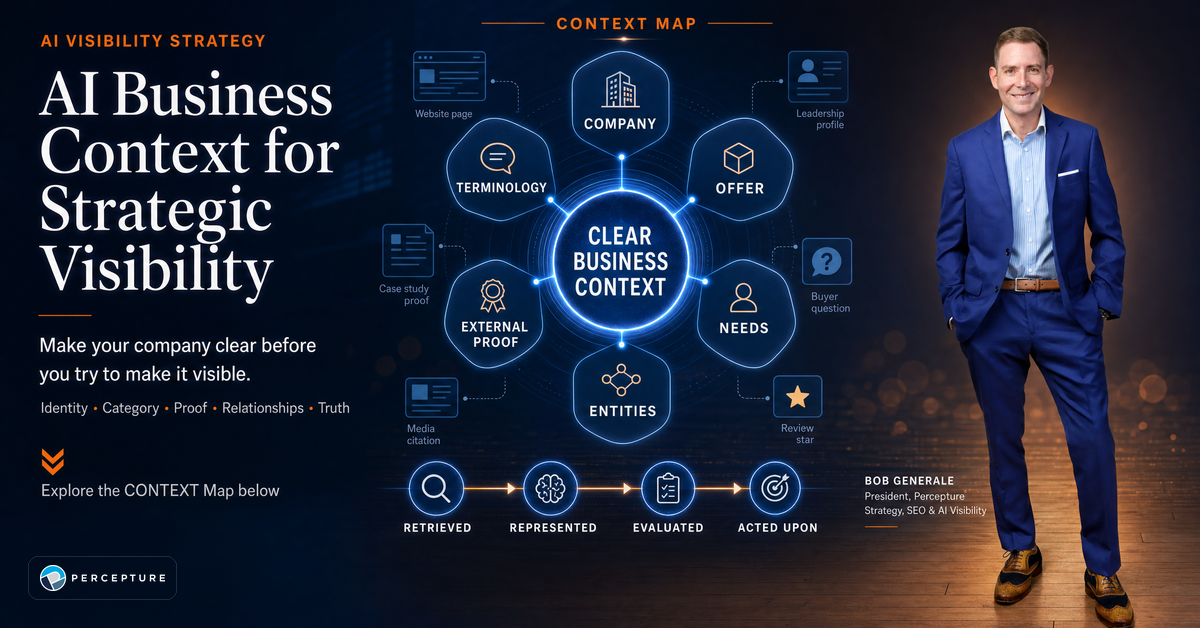
The CONTEXT Map is Percepture’s framework for turning business strategy into an auditable public information layer. It prevents the team from treating AI Business Context Strategic Visibility as a prompt-tracking project detached from the real buyer journey.
- C — Company Identity: State the organization’s name, business type, leadership, locations, operating relationships, and plain-language definition. Resolve old names, duplicate profiles, and unclear parent-product relationships.
- O — Offer and Category Clarity: Define the services, products, category, differentiators, delivery model, and boundaries. Explain what the offer includes without forcing buyers to infer it from slogans.
- N — Needs, ICP, and Use Cases: Identify the buyers, problems, situations, and decision triggers that matter. Separate a good-fit use case from a merely possible use case.
- T — Trust and Proof: Connect claims to evidence such as leadership expertise, case studies, reviews, certifications, published methodology, and current supporting material.
- E — Entity Relationships: Show how the company, people, locations, services, products, partners, and industries relate. Visible copy and structured information should tell the same basic story.
- X — eXternal Corroboration: Identify independent sources that reinforce the organization’s role, expertise, and claims. This is where digital PR services and earned authority support the owned source of truth.
- T — Terminology and Truth Controls: Maintain approved language, update dates, owners, contradiction logs, and review cycles so old claims do not remain active by accident.

An operator’s view of the framework
Bob Generale, President and Partner at Percepture, has worked hands-on in SEO for roughly two decades, including link building as far back as 2006. He designed Percepture’s three-stage research-to-publication workflow to connect competitive intelligence, internal proof, expert knowledge, page production, and buyer action.
“The articles should not just talk. They should give the reader a useful tool or decision aid.”
Bob Generale
The CONTEXT Map serves that purpose. It gives executives a shared the CONTEXT Map checklist while giving search, content, PR, analytics, and conversion teams a practical work queue.
Build the Context-to-Choice Chain
The CONTEXT Map defines the information the business must control. The Context-to-Choice Chain explains how that information supports a buyer decision. The chain has four stages: retrieved, represented, evaluated, and acted upon.
1. Retrieved
A relevant page, profile, citation, review, media reference, or structured record is available for discovery. Strong enterprise SEO helps organize crawlable pages and internal relationships, but retrieval alone does not prove that the company is represented correctly.
2. Represented
The returned description places the company in a category, associates it with a buyer need, or summarizes an offer. This framework distinguishes a name appearance from an accurate representation because a brand can appear and still be presented as the wrong type of provider. This is one reason mention counts should not stand alone.
3. Evaluated
The buyer compares fit, proof, authority, risk, and alternatives. At this stage, At this stage, strategic visibility depends on third-party support, useful service detail, transparent limitations, and consistent expertise. The organization’s earned and owned media should reinforce rather than contradict each other.
4. Acted upon
The buyer visits, calls, requests information, checks a location, reads a case study, or leaves. That behavior belongs in strategic-visibility measurement. Conversion rate optimization helps determine whether the page gives a qualified visitor enough clarity to take the next step.
The process is strongest when all four stages are measured as a connected journey. A cited answer with no qualified action may expose a conversion problem. Strong traffic paired with inaccurate expectations may expose a positioning problem.
AI Business Context Strategic Visibility framework and investment choices
The right starting point depends on the type of uncertainty. This comparison uses workstreams rather than unsupported package prices because scope depends on the number of services, audiences, locations, sources, and buyer questions involved.
| Starting option | Best fit | Core work | Primary deliverable | Investment pattern |
|---|---|---|---|---|
| Context audit | A company that suspects inconsistent positioning | Review identity, category, buyers, proof, entities, sources, and terminology | Contradiction log and priority map | Focused diagnostic engagement |
| Buyer-question diagnostic | A company already monitoring AI answers | Select decision-linked questions, record current representation, inspect cited sources, and classify gaps | Question-level visibility baseline | Defined question set with scheduled rechecks |
| Source and authority program | A company with clear owned content but weak corroboration | Coordinate expert content, media relations, profiles, proof, and source alignment | Authority and source-development plan | Ongoing publishing and communications program |
| Integrated visibility program | A company with several channels, locations, or buyer groups | Connect SEO, GEO, PR, content, analytics, reputation, and conversion | Managed roadmap with measurement cadence | Broader ongoing engagement |
Buyers comparing commercial approaches can review Percepture’s published GEO pricing and package considerations. The useful comparison is not the lowest activity count. It is whether the scope covers diagnosis, correction, corroboration, measurement, and conversion.

Measure buyer questions, not an abstract idea of visibility
Alex Mannine, Global Head of Strategy & AI at Percepture, works on buyer-question selection, current AI visibility checks, persona concepts, multi-model analysis, and gap identification. His operating view keeps measurement connected to the business decision.
“It’s about the business. It’s about the fix.”
Alex Mannine, Global Head of Strategy & AI, Percepture
Prime AI Visibility is a measurement and intelligence platform developed to monitor buyer questions across AI search experiences, identify where a brand is cited, mentioned, or missing, and surface strategic-visibility gaps in content and positioning for action. It is evidence of an applied method, not a promise that a platform can force a citation.
Five questions from Bob and Alex’s documented working sessions
This Q&A summarizes sourced working-session statements and documented methodology. It is not presented as a recorded interview.
1. What must be clear before visibility matters?
The starting point is the business case. The team should define the intended category, buyer, problem, use case, and questions the company should reasonably answer. The approach fails when a visibility metric is separated from those commercial choices.
2. Why start with buyer questions?
A buyer question creates a testable unit for A buyer question creates a testable unit for the program. The team can record the wording, intended persona, platform, date, result, sources, and observed gap. It can then improve the supporting information and test the same question again.
“We’re identifying these questions we want to be the answer to.”
Alex Mannine
3. How does the buyer change the required context?
A CEO, patient, procurement leader, technical operator, clinician, investor, and channel partner may evaluate the same organization for different reasons. Within this framework, persona context helps the team decide which questions matter and which proof belongs in each answer path.
4. Why is one AI visibility score insufficient?
A blended score can hide the reason behind a strategic-visibility result. Operators need to see which question was tested, how the company appeared, whether it was cited or mentioned, which sources were visible, and whether the gap concerns content, authority, category, proof, or buyer fit.
“Look at these as a diagnostic, not a scorecard.”
Alex Mannine
5. What should the company fix first?
For For this program, start with high-risk contradictions and high-value missing answers. Correct owned information, align leadership and service pages, document proof, strengthen independent corroboration where warranted, and recheck the same buyer questions. Do not begin with attempts to manipulate an answer system.
Context, authority, and visibility scorecard
Score each row from zero to two: zero means absent or contradictory, one means partial, and two means clear and supported. This scorecard does not predict placement. It helps leaders identify the work blocking a coherent strategic-visibility program.
| Dimension | 0 points | 1 point | 2 points |
|---|---|---|---|
| Company identity | Names, roles, or relationships conflict | Core facts exist but are scattered | Identity and relationships are consistent |
| Category clarity | The category changes by source | A category is implied | The category and boundaries are explicit |
| Buyer fit | The business claims to serve everyone | Some audiences are named | Priority buyers, needs, and fit are defined |
| Use cases | Capabilities replace use cases | Examples lack decision context | Use cases connect buyer, problem, and result |
| Proof | Claims lack support | Proof exists without clear claim alignment | Material claims connect to current evidence |
| Entity relationships | People, services, products, or locations conflict | Relationships are partly explained | Visible and structured relationships agree |
| External corroboration | Only self-published claims exist | Third-party references are limited or dated | Relevant independent sources support key facts |
| Terminology control | Old and new language coexist without control | Preferred language exists informally | Owners, approved terms, and review dates are documented |
| Buyer-question testing | No controlled question set exists | Questions are checked inconsistently | Questions, personas, dates, and results are recorded |
| Buyer action | Visibility is disconnected from outcomes | Traffic is measured without decision quality | Visibility connects to qualified actions and pipeline evidence |
Interpretation: A low context-and-visibility score points to foundational context work. A middle score suggests targeted correction and source development. A high score supports broader testing, production, and measurement, but it does not guarantee how an external system will answer.
Run a contradiction audit before publishing more
A strategic-visibility contradiction audit compares the claims that already exist. The goal is not to make every page identical. It is to ensure that important facts remain compatible across the buyer journey.
| Issue type | What to inspect | Business risk | Correction |
|---|---|---|---|
| Wrong | Old leadership, location, service, or category information | A buyer receives a false description | Correct the source and identify copies of the same claim |
| Incomplete | A service page names capabilities but not buyer fit | The company appears generic or irrelevant | Add audience, need, use case, boundary, and proof |
| Conflicting | Website, profiles, PR, and sales use different categories | The company enters the wrong comparison set | Choose approved language and align priority sources |
| Outdated | Old offers, biographies, statistics, or partner references | Past information competes with the current position | Update, consolidate, redirect, or retire the material |
| Missing | No page answers a high-value buyer question | Another source defines the decision without the company | Create a useful answer connected to proof and next steps |
A technical SEO audit can expose crawl, indexation, template, and structured-data issues that keep corrected information from working as intended. It should complement the business audit rather than replace it.
Create a source hierarchy
Not every source should control every fact. Assign an owner and primary source for each information class. The system becomes easier to manage when the team knows where a fact originates and which pages should inherit it.
- Corporate source of truth: Legal or operating name, leadership, locations, ownership relationships, and approved organizational definition.
- Commercial source of truth: Category, offers, delivery model, buyer fit, exclusions, and current positioning.
- Proof source: Case studies, credentials, reviews, methodologies, expert biographies, and evidence supporting specific claims.
- External corroboration: Relevant media, associations, professional profiles, partner pages, directories, and other independent references.
- Measurement record: Buyer questions, personas, platforms, dates, observed descriptions, cited sources, actions taken, and retest results.
Percepture’s content marketing services can turn an approved source hierarchy into pages and decision tools. Its omnichannel marketing approach helps keep the resulting message connected across search, media, email, paid programs, and conversion paths.
Write a one-page Business Context Brief
The brief should be short enough for executives, sales, communications, search, and technical teams to use. It is not ad copy. It is an operating reference for the visibility program and the decisions behind it.
- Business definition: One plain-language sentence explaining what the organization is.
- Category: The primary category and any secondary category that requires explanation.
- Priority buyers: The people, organizations, or committees the business is built to serve.
- Buyer needs: The problems, decision triggers, and desired outcomes tied to each priority buyer.
- Offers and use cases: What is provided, how it is delivered, when it fits, and when it does not.
- Differentiation: Specific operating, expertise, service, or proof distinctions that can be supported.
- Proof: The evidence available for each material claim.
- Relationships: How brands, products, people, services, locations, and partners connect.
- Approved terminology: Preferred terms, retired terms, restricted claims, and current dates.
- Priority questions: The buyer questions the company should answer through useful public material.
The brief can also guide updates to an organization’s customer journey. Percepture’s customer journey service examines how buyers move between discovery, evaluation, proof, and action rather than treating each channel as an isolated campaign.
How to test strategic AI visibility
Testing should use a controlled set of questions tied to buyer decisions. Start with a baseline, document the output, inspect the sources, classify the problem, apply a correction, and test the same question again.
- Select the buyer: Record the persona, market, need, and decision stage.
- Select the question: Use a natural question the buyer may ask, not a prompt written only to trigger the company name.
- Record the conditions: Note the wording, platform, date, and any relevant location or language context.
- Classify the result: Record whether the company is cited, mentioned, missing, miscategorized, weakly described, or presented without useful proof.
- Inspect sources: Identify which owned or independent pages appear to support the answer.
- Assign the gap: Label it as identity, category, buyer fit, use case, proof, relationship, corroboration, terminology, retrieval, or conversion.
- Make the correction: Update the most authoritative relevant source instead of publishing several overlapping pages.
- Retest: Check the same buyer question over time and retain the record.
This method makes strategic visibility observable without pretending that every answer system behaves the same way. It also gives attribution and analytics teams a clearer way to connect discovery signals with site behavior, qualified actions, and pipeline evidence.
A 30-day context plan
Days 1–7: Define and collect
Approve the business definition, category, priority buyers, core use cases, and proof inventory. Gather the pages, profiles, sales materials, media references, reviews, and structured records that contain material claims.
Days 8–14: Audit and prioritize
Run the CONTEXT Map, contradiction matrix, and scorecard. Build a backlog ranked by buyer impact, factual risk, source authority, and effort. Protect pages already serving a distinct search intent.
Days 15–21: Correct and connect
Update priority sources, strengthen internal links, clarify entity relationships, add missing proof, and retire obsolete language. Use an SEO sprint when the work benefits from a defined technical and content window.
Days 22–30: Test and assign ownership
Run the controlled buyer-question set, save the baseline, and classify each gap. Assign owners and review dates. The process should become a managed operating process rather than a one-time document.
Mistakes that weaken strategic visibility
Tracking prompts before defining the business
A long prompt list can create activity without direction. The discipline starts by defining the buyers, decisions, category, and proof before deciding which questions deserve ongoing measurement.
Treating every mention as success
A mention may be incomplete, negative, irrelevant, or tied to the wrong category. The framework requires operators to read the description and source context instead of reporting the occurrence alone.
Publishing overlapping pages for every wording variation
Near-duplicate pages divide authority and create contradictory explanations. Use cannibalization analysis and a clear page role before adding another URL. Percepture’s guide to corporate SEO explains why governance and cross-team coordination matter at scale.
Assuming schema repairs weak positioning
Structured data can help describe visible entities and relationships. It does not make an unsupported claim true, decide the commercial category, or replace useful page content.
Separating PR from search
Owned content may state the position, while independent sources help corroborate expertise and relevance. Search and communications teams should share a proof map and approved terminology.
Ignoring the action after discovery
Visibility can attract the wrong buyer or set the wrong expectation. Review landing-page clarity, proof, navigation, and next steps alongside search and answer-system results.
Why Percepture approaches this as an operating system
Percepture is a digital marketing and PR agency founded in 2004. Its work connects SEO, GEO, AI search, digital PR, media relations, content, analytics, conversion, and lead generation. The agency is NMSDC Certified and Inc. 5000-recognized.

Bob Generale designed Percepture’s three-stage production workflow:
- Stage 1: Competitive research, keyword research, search and AI-search analysis, cannibalization, internal linking, and gap analysis.
- Stage 2: Internal proof, quotes, frameworks, buyer psychology, E-E-A-T, and applicable examples.
- Stage 3: Publish-ready page production, conversion modules, links, schema, and WordPress QA.
The same operating logic supports this work: research the environment, establish defensible context and proof, publish the right assets, and measure the buyer journey. Leaders can also review Percepture’s broader generative engine optimization services for the commercial implementation path.
Compare the diagnostic with the investment
Review Percepture’s published pricing paths after a strategic-visibility diagnostic shows whether the priority is context, search, authority, measurement, conversion, or an integrated program. Scope should follow the diagnosed gap.
Frequently asked questions
What is AI Business Context Strategic Visibility?
AI Business Context Strategic Visibility is a discipline for making a company’s identity, category, buyers, use cases, proof, relationships, external support, and terminology clear across public sources. It provides the foundation for testing whether search and AI-assisted answers represent the business accurately and usefully.
How is business context different from AI visibility?
Within this framework, business context is the information that explains when and why the company belongs in an answer. Visibility is the observed result: whether the company appears, how it is described, and which sources are associated with that description. Context is an input to improve; visibility is an outcome to diagnose.
How is authority different from business context?
Context explains the company, buyer fit, offer, and relationships. Authority supports confidence in those explanations through expertise, proof, reputation, and independent corroboration. A company can have authority in a broad field while remaining unclear about a specific service or use case.
How long does a business-context audit take?
The timing depends on the number of services, locations, brands, buyer groups, profiles, and public sources involved. A focused 30-day plan can establish definitions, identify contradictions, correct priority sources, create a baseline question set, and assign ownership without claiming the entire footprint is finished.
How much should a strategic visibility program cost?
Cost should follow scope. A focused context audit requires less ongoing work than a program covering multiple buyer groups, markets, platforms, content systems, PR, analytics, and conversion. Buyers should ask whether the proposal includes diagnosis, correction, corroboration, retesting, and clear ownership.
Can schema make an AI system trust a company?
No. Structured data can help describe visible facts and relationships, but it cannot make unsupported claims reliable or force an external system to cite the company. Schema should match the visible page, approved business facts, and the wider source hierarchy.
Which buyer questions should a healthcare organization test?
Start with questions tied to real decisions, such as service fit, specialty, location, access, organizational relationships, professional expertise, and evidence. The exact set depends on the organization’s role and approved claims. Avoid prompts designed only to produce a brand mention.
How should leaders measure progress?
Measure Measure strategic visibility by tracking a stable set of buyer questions, the company’s representation, cited or associated sources, identified context gaps, corrections completed, and qualified actions after discovery. Use the output as a diagnostic record rather than treating one blended visibility score as the business result.
Build an AI Business Context Strategic Visibility plan
Percepture can help your team turn this discipline into an actionable plan by defining the business context, mapping buyer questions, auditing contradictions, aligning owned and earned sources, and converting the findings into a measured search and conversion roadmap.
About Bob Generale
Bob Generale is President and Partner at Percepture, a digital marketing and PR agency founded in 2004. He has worked hands-on in SEO for roughly two decades, including link building as far back as 2006, and now focuses on the intersection of SEO, generative engine optimization, digital PR, AI-search visibility, conversion, and demand generation.
Bob developed Percepture’s three-stage content and optimization workflow. His approach treats visibility as part of the full buyer journey rather than a standalone ranking or score.
At Percepture, Bob works with Alex Mannine and the broader senior team to connect what buyers ask, how a company is represented, which sources support that representation, and what happens after discovery. Percepture is NMSDC Certified and Inc. 5000-recognized.