


Reputation management firms help brands, executives, and organizations protect how they appear in Google, media coverage, review platforms, social channels, and AI search results.
In the past, online reputation management was often treated as cleanup—burying negative links and hoping the problem would fade. Today, it is search architecture. The firms that win are the ones that combine PR, enterprise SEO, content marketing, digital authority, media strategy, review systems, and AI-readable trust signals into a coordinated strategy.
If you are comparing reputation management firms, this guide explains what they do, how to evaluate them, and why the best partners now integrate the best public relations firm with search visibility and AI search optimization.
Confidential Reputation Review
Before you react, pressure-test the search results.
Percepture reviews branded Google results, media coverage, AI summaries, social profiles, review signals, and authority gaps before recommending a reputation repair plan.
Request a confidential reviewWhat Are Reputation Management Firms?
Reputation management firms are specialized agencies that help companies, executives, and individuals monitor, repair, protect, and improve their public reputation across search engines, news coverage, review sites, social media, and AI-powered answer engines.
The scope of work typically includes:
- Monitoring branded search results, media mentions, reviews, and social conversations
- Repairing damaged search visibility caused by negative articles, reviews, or outdated content
- Suppressing unfavorable search results by building stronger, more authoritative assets
- Creating owned content, executive profiles, thought leadership, and media placements
- Managing online reviews and responding to customer feedback
- Preparing crisis response messaging and stakeholder communications
- Shaping the source material that AI systems use to summarize brands and executives
The best reputation management firms do not just bury negative links. They build a stronger, more accurate public record across Google, media, social platforms, review ecosystems, and AI search systems.
What Do Reputation Management Firms Do?
Reputation management firms provide a range of services designed to protect and improve how a brand, executive, or organization is perceived online. Core services include:
- Monitor branded search results — Track what appears when someone searches your name, company, or key executives.
- Identify negative or risky content — Flag articles, reviews, forum posts, or social mentions that could damage trust.
- Suppress unfavorable search results — Build stronger, more authoritative assets that outrank negative content.
- Create and optimize owned content — Develop websites, executive bios, LinkedIn profiles, and thought leadership.
- Build positive earned media — Secure press coverage, bylines, and third-party validation.
- Manage online reviews — Respond to reviews, encourage positive feedback, and address complaints.
- Strengthen executive profiles — Ensure leadership bios, social profiles, and industry listings are accurate and visible.
- Prepare crisis response messaging — Develop holding statements, stakeholder communications, and media responses.
- Improve Google Business Profile visibility — Optimize local listings and review signals.
- Shape AI search source material — Create structured, authoritative content that AI systems can cite accurately.
Why Reputation Management Now Includes Google and AI Search
Reputation management has always been about controlling the narrative. What has changed is where that narrative lives.
Google is still the first trust layer. When a prospect, investor, journalist, or partner wants to learn about your company or leadership, they search. What they find in the first ten results shapes their perception before you ever speak to them.
AI tools now summarize brands, people, and companies. ChatGPT, Google AI Overviews, Perplexity, and other AI-powered search tools pull from the same public record—news articles, company websites, LinkedIn profiles, reviews, and structured data. If that record is incomplete, outdated, or negative, the AI summary will reflect it.
Page-one cleanup matters for humans. Page-one and page-two control matters for AI. AI systems do not just look at the top three results. They scan deeper, looking for consistent, authoritative, easy-to-parse sources. Negative or unclear results on page two can still influence what AI systems summarize.
According to Edelman’s 2024 Trust Barometer, 63% of people say they need to trust a brand before they will buy from it. That trust is increasingly shaped by what search engines and AI systems surface.
Reputation management must now include digital PR, SEO, structured content, and entity clarity. The firms that understand this shift are the ones that can protect brands in both traditional search and the emerging AI search landscape.
Percepture Reputation Framework
Protect the queen. Control the narrative.
In reputation management, the “queen” is the brand, executive, or entity that must be protected. The job is to make sure the most accurate, favorable, and authoritative assets are the ones people and AI systems find first.
1. Protect branded search
Strengthen owned pages, executive bios, social profiles, media placements, and high-authority assets around the brand name.
2. Control source material
Create accurate, useful, AI-readable content that gives search engines better sources to understand and summarize the brand.
3. Build authority layers
Use digital PR, SEO, thought leadership, reviews, and credible third-party validation to make the true story easier to find.
The Percepture Approach: Protect the Queen, Control the Narrative
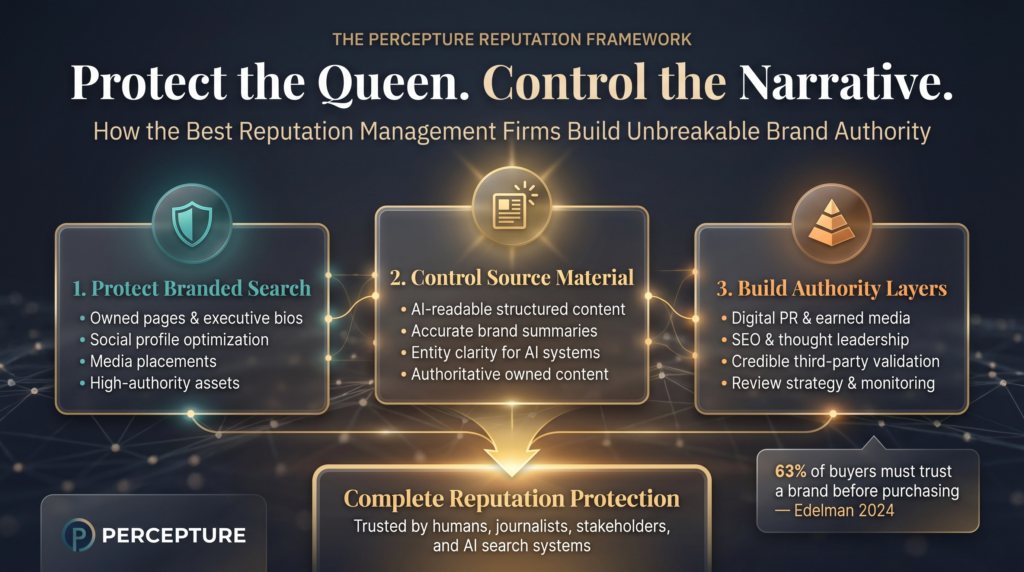
At Percepture, we approach reputation management as search architecture, not just cleanup.
“Protect the queen” means protecting the brand or executive’s core search identity. We strengthen the assets that rank for the name—owned pages, executive bios, media placements, social profiles, industry profiles, and authoritative content.
“Control the narrative” means creating enough accurate, trustworthy, high-authority content that Google and AI systems understand the story correctly. When the public record is strong, negative or outdated content has less room to rank.
“Reputation management used to mean cleaning up what people found on Google. Today, it means shaping the trusted record that humans, journalists, stakeholders, and AI systems use to understand a brand.”
— Bob Generale, Percepture
Percepture has worked across public relations, digital marketing, enterprise SEO, and online reputation management since 2004. Our team has handled high-stakes communications involving travel, airlines, public issues, operational events, corporate transitions, and media-sensitive situations for B2B companies, travel brands, telecom, energy, healthcare, manufacturing, wealth management, and public-facing executives.
Reputation Management Services Percepture Provides
Percepture offers a full suite of reputation management services designed for enterprises, executives, and organizations that need more than basic monitoring:
- Online reputation audit — Comprehensive review of branded search results, media coverage, reviews, and AI summaries
- Branded SERP analysis — Detailed assessment of what ranks for your name and how to improve it
- GEO services — Evaluation of how AI systems summarize your brand and where gaps exist
- Digital PR strategy — Earned media, bylines, and third-party validation to build authority
- Search result suppression — Strategic content creation to outrank negative or outdated results
- Executive reputation management — Profile optimization, thought leadership, and media positioning for leadership
- Crisis communications — Messaging, stakeholder communications, and media response
- Review strategy — Review monitoring, response, and reputation improvement
- Content creation — Website copy, executive bios, blog content, and structured data
- Media Buying services — Securing coverage in relevant publications and industry outlets
- Social profile optimization — LinkedIn, Twitter, and other platform optimization
- Google Business Profile support — Local listing optimization and review management
- Stakeholder messaging — Internal and external communications during sensitive situations
- Ongoing monitoring — Continuous tracking of search results, media, reviews, and AI summaries
Resource
Reputation Repair Readiness Checklist
Before engaging a reputation management firm, assess your current exposure. Percepture’s checklist helps you identify gaps in branded search, media coverage, executive profiles, review signals, and AI visibility.
Request the checklistReputation Management Firms vs PR Firms vs SEO Agencies
Not all partners are built the same. Here is how reputation management firms compare to traditional PR firms and SEO agencies:
| Partner Type | What They Do Well | What They May Miss | Best Use Case |
|---|---|---|---|
| Reputation management firms | Search cleanup, monitoring, review repair, and suppression strategy | May lack traditional media strategy or crisis counsel | Negative search results or review problems |
| PR firms | Messaging, media relations, executive positioning, and public trust | May not understand search result suppression or AI visibility | Public-facing media issues or stakeholder communication |
| SEO agencies | Organic rankings, content, technical SEO, and search visibility | May lack crisis sensitivity, media judgment, or legal coordination | Long-term content visibility and authority building |
| Integrated PR + SEO + AI search partner | Combines reputation repair, media strategy, SEO, content, crisis communications, and AI visibility | Requires a coordinated strategy instead of one-off tactics | Executives, enterprises, B2B brands, and high-stakes reputation issues |
Percepture is a reputation management firm for organizations that need PR, SEO, crisis communications, online reputation repair, and AI search visibility working together instead of in separate silos.
When Should You Hire a Reputation Management Firm?
Consider engaging a reputation management firm if you are facing any of these situations:
- Negative articles ranking for your brand or executive name
- Executive name issues — outdated, inaccurate, or damaging content appearing in search
- Lawsuit or controversy — legal matters, regulatory issues, or public disputes affecting perception
- Review problems — negative reviews on Google, Glassdoor, Yelp, or industry platforms
- Acquisition or fundraising — due diligence concerns about what investors or acquirers will find
- Public company scrutiny — shareholder, analyst, or media attention on leadership or operations
- Crisis preparation — proactive reputation building before a potential issue surfaces
- AI search inaccuracies — incorrect or incomplete summaries in ChatGPT, Google AI Overviews, or Perplexity
- Brand SERP weakness — competitors, directories, or third parties outranking your own story
- Competitors outranking your own story — losing control of the narrative to others
What Not to Do During a Reputation Issue
When a reputation problem surfaces, the instinct is often to react quickly. But some common responses can make the situation worse:
- Do not repeatedly search and click the negative result. This can signal to Google that the content is relevant and valuable.
- Do not share the negative link internally unless necessary. Every click and share can reinforce the content’s visibility.
- Do not respond emotionally. Public statements made in frustration can escalate the issue.
- Do not threaten journalists or reviewers. This rarely works and often backfires.
- Do not create thin, fake positive content. Google’s algorithms are designed to detect and penalize low-quality manipulation.
- Do not over-optimize with exact-match spam. Keyword stuffing and unnatural content can hurt more than help.
- Do not ignore Reddit, forums, or discussion results. These often rank highly and influence AI summaries.
- Do not wait until the crisis has already spread. Early intervention is almost always more effective than late-stage repair.
How to Choose the Right Reputation Management Firm
When evaluating reputation management firms, ask these questions:
- Do they understand both PR and SEO? Reputation management requires media strategy and search visibility working together.
- Can they show anonymized examples? Look for case studies or proof of past success without revealing client names.
- Do they understand AI search? Ask how they approach AI Overviews, ChatGPT, and other AI-powered search tools.
- Do they have crisis communications experience? Reputation issues often overlap with crisis situations.
- Do they create real authority assets? Beware of firms that rely on low-quality content farms or link schemes.
- Do they use ethical strategies? Avoid firms that promise guaranteed removals or use black-hat tactics.
- Do they understand legal sensitivity? Some reputation issues involve litigation, regulatory matters, or confidentiality.
- Do they know how to monitor Google, media, reviews, and social? Ongoing monitoring is essential for long-term protection.
- Can they explain what can and cannot be removed? Honest firms will set realistic expectations.
- Do they have a plan for both immediate repair and long-term protection? The best strategies address both.
Reputation Management for Enterprises, Executives, and Law Firms
Different audiences have different reputation management needs. Here is how Percepture approaches key segments:
Enterprise Reputation Management Firm
Large organizations face complex reputation challenges—multiple executives, business units, geographies, and stakeholder groups. Enterprise reputation management requires coordinated strategy across PR, SEO, legal, HR, and communications teams.
Executive Reputation Management
Executives are increasingly visible in search results. A CEO’s personal reputation can affect stock price, recruiting, partnerships, and customer trust. Executive reputation management focuses on LinkedIn optimization, thought leadership, media positioning, and search result control.
Reputation Management for Law Firms
Law firms face unique challenges—client confidentiality, bar association rules, and competitive pressure. Reputation management for law firms requires sensitivity to legal ethics and an understanding of how attorneys are evaluated by prospective clients.
Reputation Management for B2B Companies
B2B brands often underestimate the importance of search visibility. But procurement teams, partners, and investors all search before making decisions. B2B reputation management focuses on thought leadership, case studies, and industry authority.
Reputation Management for Travel, Telecom, Energy, Finance, Healthcare, and Manufacturing
Percepture also has experience as a crisis management agency and across regulated and high-visibility industries where reputation issues can have operational, legal, and financial consequences. We understand the stakeholder dynamics, media landscape, and crisis sensitivities unique to each sector.
Your reputation is already being summarized.
Google, journalists, prospects, investors, clients, and AI systems are all pulling from the same public record. Percepture helps make that record stronger, clearer, and more accurate.
Explore Percepture crisis communications services →FAQs About Reputation Management Firms
What are reputation management firms?
Reputation management firms are specialized agencies that help companies, executives, and individuals monitor, repair, protect, and improve their public reputation across search engines, news coverage, review sites, social media, and AI-powered answer engines.
What do reputation management firms do?
Reputation management firms monitor branded search results, identify negative content, suppress unfavorable results, create positive content, manage reviews, strengthen executive profiles, prepare crisis messaging, and shape the source material that AI systems use to summarize brands.
How do reputation management firms remove negative results?
Most negative content cannot be “removed” from the internet. Instead, reputation management firms suppress negative results by building stronger, more authoritative assets that outrank the damaging content. In some cases, legal action or platform policies may allow for actual removal.
Can a reputation management firm delete bad articles?
In most cases, no. Reputation management firms cannot force publishers to delete articles. However, they can work to suppress negative content in search results, request corrections, or pursue legal remedies when content is defamatory or violates platform policies.
How long does online reputation repair take?
Timelines vary depending on the severity of the issue, the authority of the negative content, and the competitive landscape. Minor issues may improve in weeks. Serious reputation damage can take six to twelve months or longer to address effectively.
What is the difference between reputation management and crisis management?
Reputation management is ongoing work to protect and improve how a brand is perceived. Crisis management is the immediate response to a specific event or threat. The two often overlap—some of the best crisis management firms, can create reputation damage, and reputation management can help prevent or mitigate crises.
Why does SEO matter for reputation management?
SEO determines what appears when someone searches your name. Without search visibility, even the best content will not rank. Reputation management firms use SEO to ensure positive, accurate content outranks negative or outdated results.
How does AI search affect reputation management?
AI search tools like ChatGPT, Google AI Overviews, and Perplexity summarize brands based on the public record. If that record includes negative, outdated, or incomplete information, the AI summary will reflect it. Reputation management now includes shaping the source material that AI systems cite.
What should executives do if negative search results appear?
Do not panic, click repeatedly, or share the link. Contact a reputation management firm for a confidential assessment. Early intervention is almost always more effective than waiting for the problem to grow.
How do I choose the best reputation management firm?
Look for a firm that understands both PR and SEO, has crisis communications experience, uses ethical strategies, can explain what can and cannot be removed, and has a plan for both immediate repair and long-term protection.
Connect with us today!
Featured Snippet Answers
What are reputation management firms?
Reputation management firms are agencies that help companies, executives, and individuals monitor, repair, protect, and improve their public reputation across search engines, news coverage, review sites, social media, and AI search results. They combine PR, SEO, content, and crisis communications to control the narrative.
How do reputation management firms work?
Reputation management firms work by monitoring branded search results, identifying negative content, suppressing unfavorable results with stronger assets, creating positive content, managing reviews, and shaping the source material that AI systems use to summarize brands and executives.