


AI agents in healthcare are systems that can reason, plan, and take action across healthcare workflows such as scheduling, intake, documentation, billing, claims, and data review. The safest healthcare AI agents do not operate without boundaries. They use human oversight, approval gates, audit logs, access controls, and clear escalation rules before touching sensitive or clinical workflows.
Quick Answer
AI agents in healthcare are AI systems that can plan, reason, and take action inside defined workflows—such as scheduling, intake, documentation, billing, and claims. The safest healthcare AI agents use human oversight, approval gates, audit logs, and escalation rules before acting on sensitive or clinical tasks.
Who This Guide Is For
This guide is for healthcare CEOs, CFOs, practice administrators, VP Marketing, VP Sales, technical buyers, and operators evaluating AI agents for their organization.
If you are asking any of these questions, this guide is for you:
- What can AI agents actually do in healthcare?
- How are AI agents different from chatbots, voice agents, or AI scribes?
- Can AI agents act independently, or do they need human oversight?
- What workflows are safe to automate?
- What should AI agents never do without physician review?
- How do AI agents affect HIPAA and patient privacy?
- How do we start safely?
Definition
What Are AI Agents in Healthcare?
An AI agent is an AI system that can reason, plan, and take action inside a defined workflow. In healthcare, AI agents can support scheduling, intake, documentation, billing, claims, and data review. Unlike chatbots, AI agents can coordinate multiple steps, tools, or decisions toward a goal—but the safest agents operate with human oversight, approval gates, and audit logs.
What You’ll Learn
- What AI agents are and how they differ from chatbots, voice agents, and AI scribes
- Why healthcare leaders are exploring agentic AI
- What workflows AI agents can safely support
- What AI agents should not do without human oversight
- The Healthcare AI Agent Autonomy Ladder (Percepture’s proprietary framework)
- A physician’s perspective on where AI helps and where doctors must lead
- How PYRA supports governed healthcare AI workflows
- AI agents, HIPAA, PHI, and patient trust
- Use cases by department
- Vendor evaluation checklist
- Common mistakes to avoid
- FAQs
Free Workflow Audit
Not sure where AI agents fit in your healthcare workflows?
Percepture maps your current processes, identifies where AI agents add value, and shows you where human oversight is required—before you deploy anything.
Request a Healthcare AI Agent Workflow AuditAI Agents vs. Chatbots vs. AI Voice Agents vs. AI Scribes
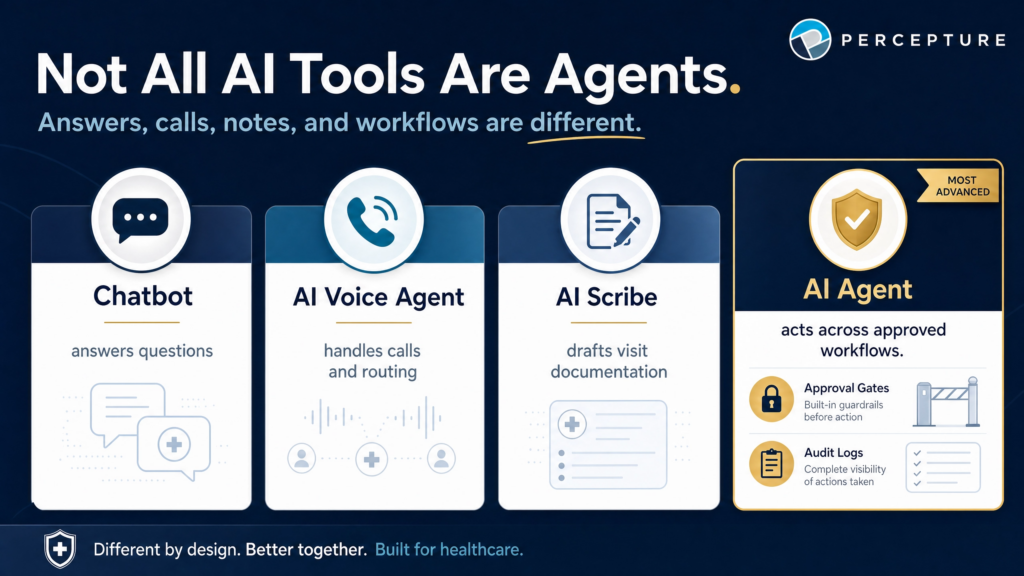
Healthcare leaders often confuse AI agents with chatbots, voice agents, or AI scribes. Here is how they differ:
| Tool Type | What It Does | Best Use | Risk Level | Human Oversight Needed |
|---|---|---|---|---|
| Chatbot | Answers questions | Basic FAQs | Low/medium | Content review |
| AI Voice Agent | Handles calls | Scheduling/routing | Medium | Escalation rules |
| AI Scribe | Documents visits | Notes/EHR support | Medium/high | Physician review |
| AI Agent | Acts across workflows | Intake, RCM, docs | Medium/high | Approval gates |
| Agentic AI System | Plans and executes tasks | Complex workflow automation | High | Governance + logs |
For a deeper look at voice-specific use cases, see our guide to AI voice agent in healthcare.
Why Healthcare Leaders Are Looking at Agentic AI
Healthcare organizations face real operational pressure:
- Front-desk overload and missed calls
- Delayed follow-up and slow intake
- Documentation burden on physicians
- Billing friction and slow claims
- Staff burnout and expensive admin work
- Inconsistent patient communication
AI agents offer a way to remove repetitive work from these workflows—without replacing physicians or clinical judgment.
But the risk is real. If an AI agent acts without boundaries, it can delay urgent care, mishandle PHI, or create compliance exposure.
That is why the question is not “Should we use AI agents?” The question is: “Where can AI agents help, and where must humans stay in control?”
What AI Agents Can Safely Help With
AI agents in healthcare can support workflows where the risk is low to medium and the task is well-defined:
- Scheduling: Booking, rescheduling, reminders
- Intake: Collecting patient information before visits
- Documentation: Drafting notes for physician review
- Billing and RCM: Claims submission, denial follow-up, payment reminders
- Data review: Summarizing records, flagging missing information
- Patient communication: Appointment confirmations, post-visit instructions
Dr. Justin Burkholder, a board-certified emergency medicine physician and medical director of Olympic Concierge Medicine in Tampa Bay, describes it this way:
“AI agents are basically helping to schedule patients, billing patients, and often working together across a medical or healthcare platform to make it easier for the staff, not only the doctors, but also the administrative staff.”
— Dr. Justin Burkholder, MD, Olympic Concierge Medicine
What AI Agents Should Not Do Without Human Oversight
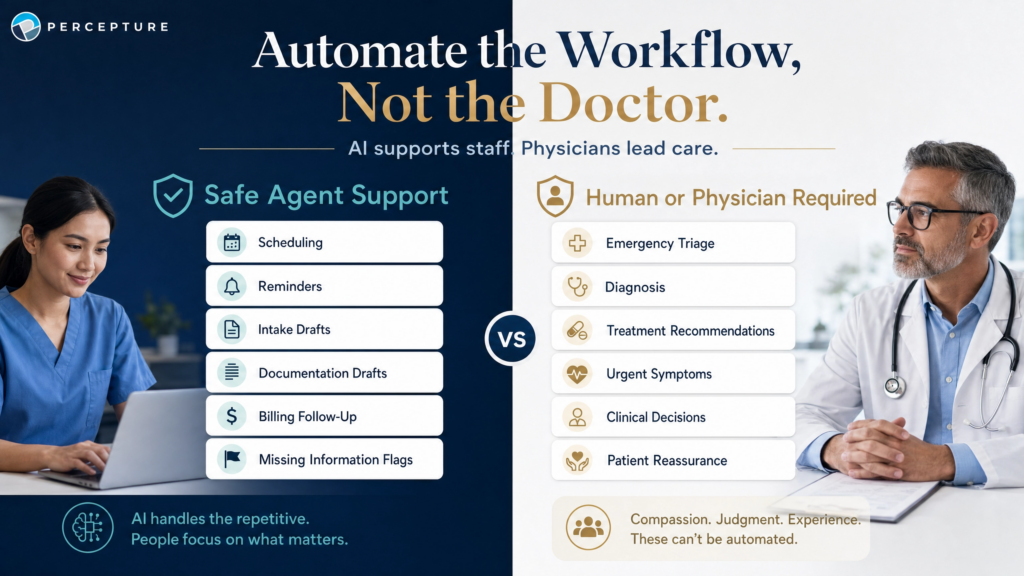
AI agents should not act independently on tasks where urgency, clinical judgment, or patient safety are at stake.
Dr. Burkholder warns:
“For specific situations and emergencies, the conversational AI could actually delay somebody from getting the proper care.”
— Dr. Justin Burkholder, MD
Examples of workflows that require human oversight:
- Emergency triage: Chest pain, shortness of breath, stroke symptoms, sepsis
- Clinical decision-making: Diagnosis, treatment recommendations
- PHI-connected tasks: Anything that accesses or modifies protected health information
- Patient reassurance: Moments where a human voice matters
The safest approach: AI agents should route and escalate, not diagnose or triage independently.
For more on compliance boundaries, see our guide to AI and HIPAA.
The Healthcare AI Agent Autonomy Ladder
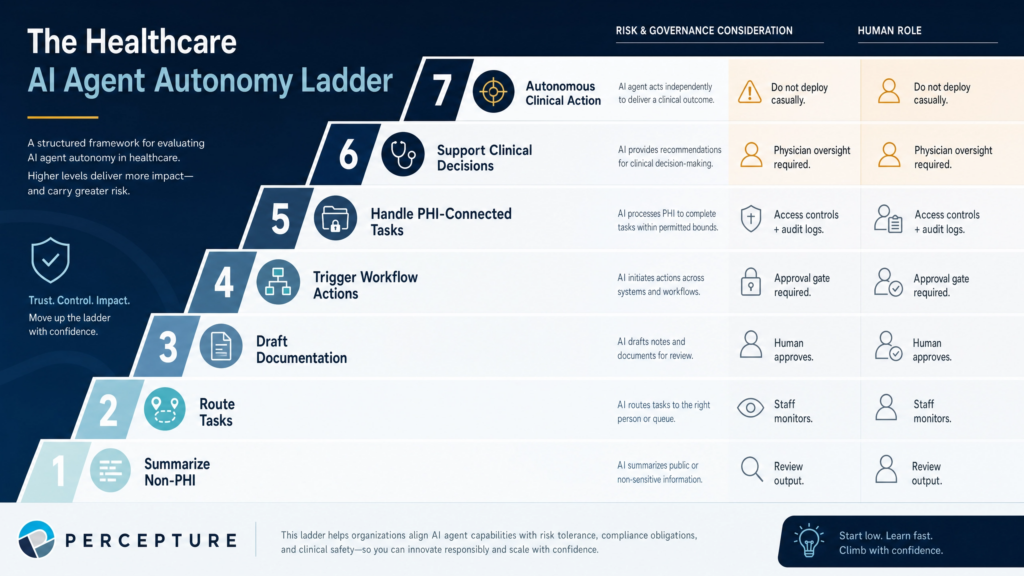
Percepture developed the Healthcare AI Agent Autonomy Ladder to help healthcare leaders decide which workflows AI agents can support, which require human approval, and which should never operate without physician oversight.
Percepture Framework
The Healthcare AI Agent Autonomy Ladder
Use this framework to decide where AI agents can act, where they need approval, and where physicians must stay in control.
| Level | Workflow | Risk | Human Role |
|---|---|---|---|
| 1 | Summarize public or non-PHI information | Low | Review output |
| 2 | Route tasks or messages | Low/medium | Staff monitors |
| 3 | Draft documentation or responses | Medium | Human approves |
| 4 | Trigger workflow actions | Medium/high | Approval gate required |
| 5 | Handle PHI-connected tasks | High | Access controls + audit logs |
| 6 | Support clinical decision-making | Highest | Physician oversight required |
| 7 | Autonomous clinical action | Not recommended | Do not deploy casually |
This framework gives leaders a simple way to avoid the biggest mistake in healthcare AI: treating all workflows as equal.
Physician Perspective: Dr. Justin Burkholder on AI Agents in Healthcare
Physician Perspective
Dr. Justin Burkholder on where AI agents help, and where doctors still need to lead
Dr. Justin Burkholder is a board-certified emergency medicine physician and the founder and medical director of Olympic Concierge Medicine in Tampa, Florida. His experience includes emergency medicine, concierge care, preventive medicine, and serving as a courtside physician for Olympians at the Rio 2016 Olympics.
“Medicine is the most humanistic business that there is.”
Dr. Burkholder uses AI for documentation: “I do my notes with AI… generally I look over the note to make sure that there weren’t things that were missed and things that I may want to add.”
But he warns that conversational AI can delay care in emergencies: “Minutes, seconds, minutes, hours is very important critical time for patients.”
How PYRA Turns Physician Guardrails Into Governed AI Workflows
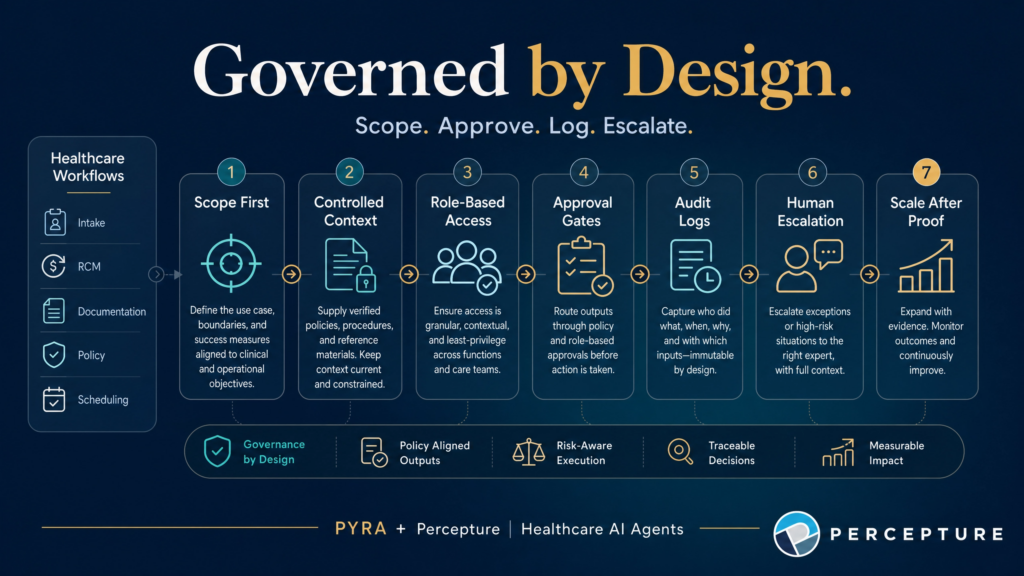
Dr. Burkholder explains where the clinical and human boundaries are. PYRA is the workflow engine that can help enforce those boundaries through scope approval, audit logs, role-based access, client-instanced architecture, and approval gates.
PYRA Implementation Layer
Percepture defines the healthcare AI strategy. PYRA helps govern the workflow.
PYRA builds and runs AI agents for real job workflows. Its healthcare page lists workflows such as policy, RCM, intake, and documentation, with audit logs and approval gates by design.
PYRA states that its platform includes SOC 2 Type II, HIPAA Compliant architecture, role-based access control, full audit logs, and client-instanced architecture. Phrase this as “PYRA states…” unless legal approves stronger Percepture-side language.
AI Agents, HIPAA, PHI, and Patient Trust

The U.S. Department of Health and Human Services (HHS) states that the HIPAA Privacy Rule protects individually identifiable health information held or transmitted by covered entities and business associates, and the Security Rule requires safeguards for electronic protected health information (HHS.gov).
Healthcare AI agents that access or modify PHI must operate within these boundaries:
- Access controls: Only authorized users and systems can access PHI
- Audit logs: Every action is recorded
- Approval gates: Sensitive actions require human review
- Escalation rules: Urgent or clinical situations route to staff or physicians
For a deeper look at compliance, see our guide to AI and HIPAA.
Proof-Driven Approach
Ready to map your first governed healthcare AI workflow?
Percepture helps healthcare organizations identify where AI agents add value, where human oversight is required, and how to deploy governed workflows without creating compliance risk.
Map Your First Governed AI WorkflowAI Agents in Healthcare Use Cases by Department
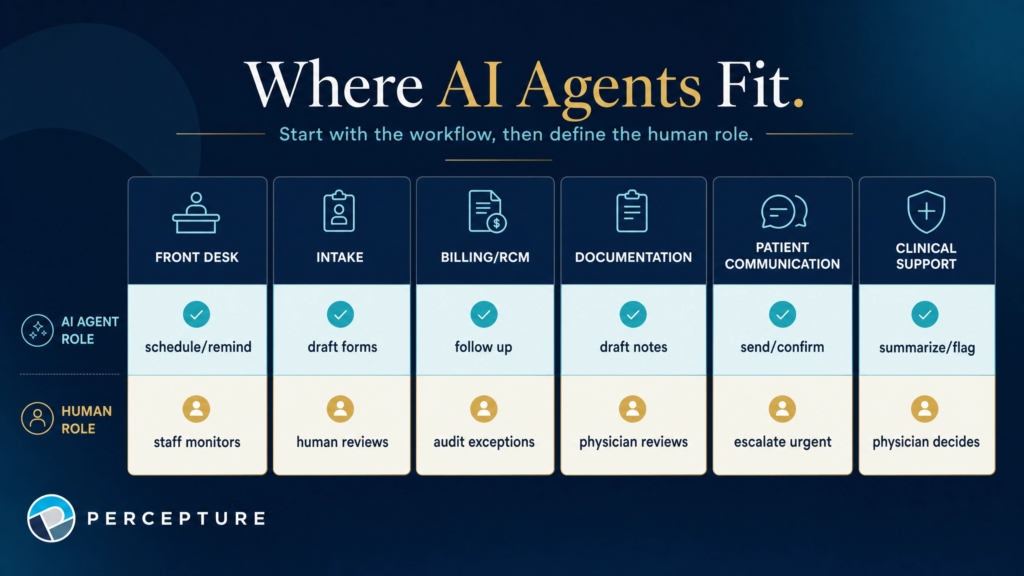
| Department | Use Case | AI Agent Role | Human Role |
|---|---|---|---|
| Front desk | Scheduling, reminders | Book, reschedule, confirm | Monitor, escalate |
| Intake | Patient information collection | Draft forms, flag missing data | Review, approve |
| Billing/RCM | Claims, denials, payments | Submit, follow up, remind | Audit, resolve exceptions |
| Documentation | Visit notes, summaries | Draft notes | Physician review |
| Patient communication | Post-visit instructions | Send, confirm | Escalate urgent issues |
| Clinical support | Decision support | Summarize, flag | Physician decides |
AI Agent Vendor Evaluation Checklist
Before deploying AI agents in healthcare, ask these questions:
- Scope: What workflows will the agent support?
- Access controls: Who can access PHI through the agent?
- Approval gates: Which actions require human review?
- Audit logs: Can you see what the agent did, when, and why?
- Escalation rules: How does the agent route urgent or clinical situations?
- Integration: Does the agent connect to your EHR, scheduling, and billing systems?
- Compliance: Does the vendor support HIPAA-conscious architecture?
- Testing: Can you pilot the agent on one workflow before expanding?
- Support: Who helps if something goes wrong?
- Exit: Can you turn off the agent without losing data or access?
How AI Agents Connect to Healthcare SEO, GEO, and Patient Acquisition
AI agents do not replace marketing. They support the operational layer that captures demand created by SEO, GEO, and paid search.
- SEO and GEO create visibility in Google, AI Overviews, ChatGPT, Perplexity, and other search systems
- Paid search drives calls and form fills
- AI agents help route, summarize, draft, and execute approved workflows so demand does not die inside slow administration
For more on healthcare search visibility, see our guides to healthcare SEO agency and generative engine optimization services.
Common Mistakes Healthcare Leaders Make with AI Agents
- Treating all workflows as equal: Not all tasks are safe to automate. Use the Autonomy Ladder.
- Skipping the pilot: Start with one workflow, prove control, then scale.
- Ignoring escalation rules: AI agents should never become a bottleneck when a patient needs urgent care.
- Forgetting audit logs: If you cannot see what the agent did, you cannot defend it.
- Overpromising to patients: Do not claim AI replaces doctors. It does not.
- Underestimating integration: AI agents need to connect to your existing systems.
- Ignoring staff training: Staff need to know when to trust the agent and when to intervene.
Pricing, ROI, and Buyer Risk
AI agent pricing varies by vendor, scope, and integration complexity. Most healthcare AI agent projects involve:
- Discovery and workflow mapping: Understanding where agents fit
- Prototype or pilot: Testing on one workflow before expanding
- Integration: Connecting to EHR, scheduling, billing, and communication systems
- Ongoing optimization: Monitoring, adjusting, and improving agent performance
For Percepture’s approach to AI search and agent strategy pricing, see our AI search SEO pricing page.
The ROI case for AI agents is strongest when:
- Staff are overloaded with repetitive tasks
- Missed calls or slow follow-up are costing revenue
- Documentation burden is burning out physicians
- Billing friction is delaying claims
The risk is highest when:
- Workflows are not well-defined
- Escalation rules are unclear
- Audit logs are missing
- Staff are not trained
Interview with Doctor of the US Olympic Team
Full Dr. Burkholder Transcript
FAQs
What are AI agents in healthcare?
AI agents in healthcare are AI systems that can reason, plan, and take action inside defined workflows such as scheduling, intake, documentation, billing, and claims. The safest agents use human oversight, approval gates, audit logs, and escalation rules before acting on sensitive or clinical tasks.
What is agentic AI in healthcare?
Agentic AI refers to AI systems that can coordinate multiple steps, tools, or decisions toward a goal. In healthcare, agentic AI can support complex workflows like revenue cycle management, patient intake, and documentation—but it should operate with governance and human oversight.
How are AI agents different from chatbots?
Chatbots answer questions. AI agents can plan, reason, and take action across workflows. AI agents can coordinate multiple steps, access tools, and trigger actions—while chatbots are limited to conversation.
What are examples of AI agents in healthcare?
Examples include scheduling agents, intake agents, documentation agents, billing and RCM agents, and patient communication agents. Each supports a specific workflow with defined boundaries and human oversight.
Can AI agents act independently in healthcare?
AI agents can act independently on low-risk, well-defined tasks like scheduling and reminders. For higher-risk tasks—especially those involving PHI, clinical judgment, or patient safety—AI agents should require human approval or physician oversight.
What healthcare workflows can AI agents support?
AI agents can support scheduling, intake, documentation, billing, claims, data review, and patient communication. The safest approach is to start with one workflow, prove control, then scale.
What should AI agents not do without physician oversight?
AI agents should not independently handle emergency triage, clinical decision-making, diagnosis, treatment recommendations, or any task where urgency or patient safety is at stake.
How do AI agents affect HIPAA and patient privacy?
AI agents that access or modify PHI must operate within HIPAA boundaries. This means access controls, audit logs, approval gates, and escalation rules. HHS states that the HIPAA Privacy Rule protects individually identifiable health information, and the Security Rule requires safeguards for electronic protected health information.
How can PYRA help healthcare organizations build AI agents?
PYRA builds and runs AI agents for real job workflows. Its healthcare page lists workflows such as policy, RCM, intake, and documentation, with audit logs and approval gates by design. PYRA states that its platform includes SOC 2 Type II, HIPAA Compliant architecture, role-based access control, full audit logs, and client-instanced architecture.
What should healthcare leaders ask before deploying AI agents?
Ask about scope, access controls, approval gates, audit logs, escalation rules, integration, compliance, testing, support, and exit. Use the vendor evaluation checklist in this guide.
Next Step
Ready to deploy AI agents in healthcare the right way?
Percepture helps healthcare organizations map workflows, identify where AI agents add value, and deploy governed AI without creating clinical or compliance risk.
Talk to Percepture About AI Agents in HealthcareWhat to Do Next
- Audit your workflows: Identify where AI agents could remove repetitive work.
- Use the Autonomy Ladder: Decide which workflows are safe to automate and which require human oversight.
- Start with one workflow: Prove control before scaling.
- Talk to Percepture: Get a healthcare AI agent workflow audit.
Related Healthcare AI Resources
- AI Voice Agent in Healthcare
- AI and HIPAA
- Automated Diagnostics in Healthcare
- Medical SEO Agency
- Healthcare SEO Agency
- Generative Engine Optimization Services
- Conversion Rate Optimization Services
- Paid Search Services
- Digital PR Services
- SEO Reputation Management
Specialty Focus: Behavioral Health
AI Agents in High-Trust Sectors Like Addiction Treatment
While general medical practices can rely on broad search visibility, high-trust and vulnerable sectors require a highly targeted approach. Integrating AI agents into an intake workflow is only effective if your facility is actually being found by the right patients.
Facilities specializing in addiction and mental health must adapt to Generative Engine Optimization (GEO). By executing specialized SEO for Rehab and focusing on a comprehensive Holistic Rehab SEO strategy, treatment centers can rank higher in AI overviews, build critical patient trust early, and ensure their AI agents are fielding high-quality inquiries.
About the Author
Bob Generale
Founder & CEO, Percepture
Bob Generale is the President of Percepture, a healthcare SEO, GEO, and AI agent strategy agency. He is often referred to as the “Navy Seals of SEO” and leads digital growth for healthcare, life sciences, and technology organizations, and advises on AI search visibility, patient acquisition, and governed AI workflows. Bob works with PYRA to help healthcare organizations deploy AI agents with the right boundaries.
This article is not medical or legal advice. Consult qualified professionals for guidance on healthcare AI, HIPAA, and clinical workflows.