
IMPR Promotions appears in the public search listings as a provider associated with custom printed promotional products and web services. For a marketing leader, the useful question is not simply what can be ordered. It is how merchandise, landing experiences and follow-up will work together as one accountable campaign.
A sound evaluation of IMPR Promotions should separate confirmed capabilities from assumptions, then test execution details such as item selection, artwork control, fulfillment, destination pages and measurement. It should also distinguish promotional products from earned media, digital PR and broader communications strategy.
What should a buyer know before choosing this provider?
IMPR Promotions can be evaluated as a potential source for promotional merchandise and web-related support based on its public listing. Buyers should confirm the exact scope, pricing, production process, fulfillment responsibilities, web deliverables and reporting directly with the provider before committing to a campaign.
Services to evaluate
The search listing title for IMPR Promotions presents the business around custom printed promotional products and web services. Its public listing says the company uses creative and unique marketing ideas tailored to a business and connects that work with communication efforts. Those descriptions provide a starting point, but they do not establish every service a buyer might associate with the name.
The available evidence does not establish hosting terms, public relations services, media relations, digital PR capabilities, client relationships, industry specialization or campaign outcomes. Those subjects should not be inferred from a company name, a search snippet or the availability of branded merchandise. Buyers should request a written scope for the specific work under consideration.
The executive view
- Confirmed starting point: The official result references custom printed promotional products and web services.
- Primary buyer task: Convert a broad marketing description into a precise scope, timeline, ownership map and acceptance standard.
- Campaign requirement: Connect each physical item to a defined audience, message, destination and follow-up path.
- Evaluation boundary: Ask IMPR Promotions to document any communications capability separately from promotional or web work.
Evaluate the campaign, not just the catalog
A buyer assessing IMPR Promotions should begin with the job the merchandise must perform. A conference giveaway, customer appreciation package, employee kit and direct-mail item serve different audiences and require different decisions. Choosing an object before defining its role often leaves the campaign with attractive inventory but no clear next action.
Start with five operating questions:
- Who should receive the item, and in what setting?
- What should the recipient remember after the interaction?
- Is there a useful next step, such as a dedicated URL, QR destination or event follow-up?
- Who owns artwork approval, production checks, shipping and exception handling?
- What evidence will indicate whether the campaign reached the intended audience?
These questions make IMPR marketing more concrete. They also expose dependencies that a product catalog cannot answer. For example, a QR code is only useful when its destination is mobile-friendly, relevant to the recipient and maintained for the expected life of the printed item. A memorable URL needs the same discipline.
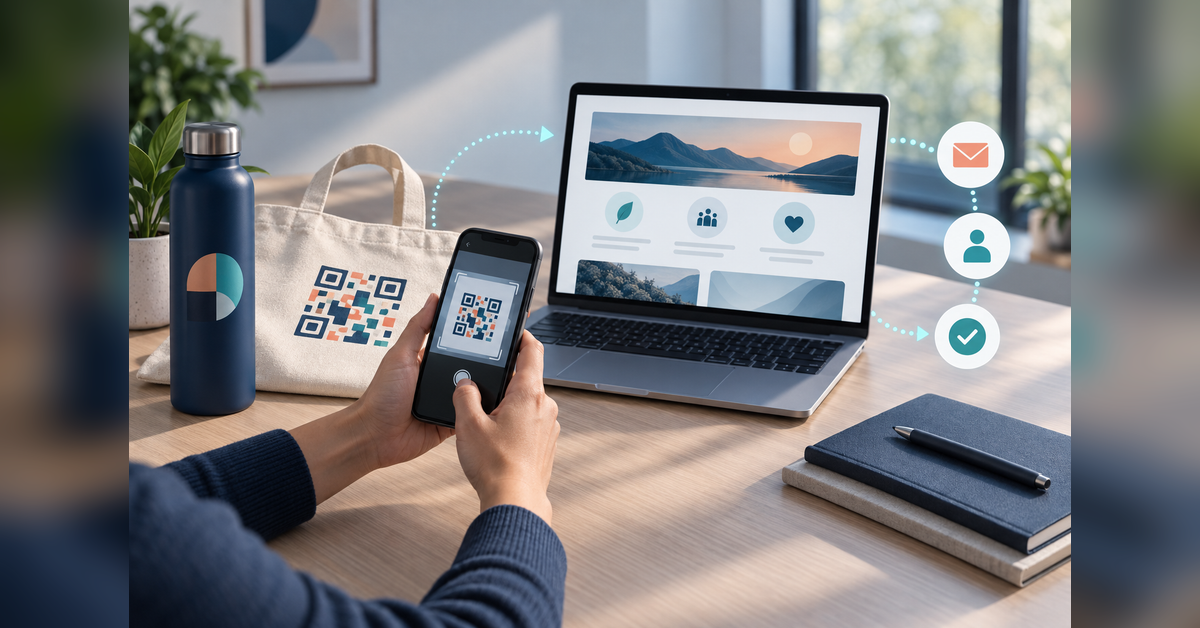
Build the handoff from physical item to digital journey
If IMPR Promotions is being considered for an event or outreach program, map the journey before approving artwork. The physical item may create a reminder, but the destination page carries the explanation, offer or next action. Email and sales follow-up then determine whether the initial interaction becomes an ongoing conversation.
A practical campaign sequence is:
- Define the audience and moment. Document where the item will be received and what the recipient is likely to be doing.
- Choose one useful action. Avoid sending every recipient to a generic home page when a focused resource, event page or contact path would be clearer.
- Create message continuity. The item, destination page and follow-up should use compatible language and expectations.
- Assign operational ownership. Name the people responsible for inventory, distribution, destination-page maintenance and follow-up.
- Review observable signals. Use campaign-specific visits, scans, requested meetings, responses or other appropriate indicators without treating any single metric as proof of influence.
This is where an omnichannel marketing plan becomes relevant. The merchandise is one touchpoint. The campaign still needs coordination across the web experience, email, sales activity, paid distribution or other channels selected for the audience.
Promotional products and public relations are different tools
Promotional products can place a branded object in a recipient's hands. They may support event continuity, direct outreach, appreciation programs or post-event reminders. They do not, by themselves, create independent editorial coverage, third-party validation or a strategic communications program.
For IMPR Promotions, the buyer should therefore keep merchandise and web deliverables separate from any assumptions about PR. Earned media work generally requires a newsworthy premise, audience analysis, message development, media targeting, outreach and response management. Digital PR can also involve creating and promoting authoritative assets that earn attention and references online. Those are distinct workstreams from sourcing and printing promotional items.
Which capability belongs where?
| Campaign need | Relevant workstream | What to verify |
|---|---|---|
| Branded event item or mailed package | Promotional merchandise | Materials, samples, artwork, quantities, production schedule, shipping and replacement policy |
| QR or memorable-URL destination | Web design and campaign operations | Page scope, mobile behavior, analytics access, maintenance and ownership |
| Coordinated post-event contact | Email, sales and customer-journey planning | Consent, audience segments, timing, message ownership and handoff rules |
| Editorial coverage or authority building | Strategic PR and digital PR | Strategy, story development, media process, deliverables and reporting definitions |
In the scope document, assign merchandise and communications expectations to their respective workstreams. Percepture's earned and owned media approach provides additional context for separating channels while coordinating their messages.
Decide how measurement will work before production
For IMPR Promotions or any promotional-products vendor, measurement should be proportional to the campaign. Not every item needs a complex attribution model. A small executive mailing may call for account-level follow-up, while a large event distribution may use a dedicated landing page and aggregate engagement signals.
Avoid claiming that a scan, page visit or reply proves the merchandise caused a later business result. Instead, define what each signal can reasonably show. A scan can show that someone used the printed path. A form submission can show that a visitor completed the form. Sales and marketing teams can then evaluate those interactions alongside the rest of the customer journey. Percepture's guidance on customer-journey planning and attribution and analytics can help establish that structure.
Questions to take into a vendor conversation
Ask IMPR Promotions for answers tied to the actual campaign rather than a generic capability list:
- Which requested products can be sourced in the required quantity and timeframe?
- Are physical or production-representative samples available before the full run?
- What artwork formats, color specifications and approval steps are required?
- Who is responsible for freight, split shipments, storage and damaged items?
- What web deliverable is included, and who owns the resulting files, domain, analytics and credentials?
- Does the web scope include maintenance or hosting, and under what written terms?
- How will changes be handled after approval?
- Which costs are fixed, and which may change with quantity, shipping or production choices?
- What reporting is provided, and what does each reported metric actually represent?
Use the same questions to compare an IMPR Promotions proposal with alternatives. The answers should be reflected in the proposal or statement of work. If different suppliers own merchandise, web production and communications, create one shared schedule with named handoffs. That simple operating document can expose missing dependencies before an event date or distribution deadline makes them expensive to correct.
Connect brand recall to the rest of the campaign
Percepture can review how promotional merchandise, destination pages, follow-up and strategic PR fit within one channel plan without treating those disciplines as interchangeable.
A disciplined buying decision
The right way to assess IMPR Promotions is to compare the proposed scope with the campaign's real operational requirements. Confirm products and web deliverables directly, document ownership, test the destination journey and keep PR expectations attached to a qualified PR workstream.
That approach gives business owners and marketing leaders a clearer decision than a catalog comparison alone. It also creates a fair basis for evaluating proposals: each provider is judged on the work it has actually offered, while the campaign is managed as a connected system.
About the author

Bob Generale leads strategy at Percepture, helping organizations coordinate marketing, communications and digital visibility around clear business objectives.