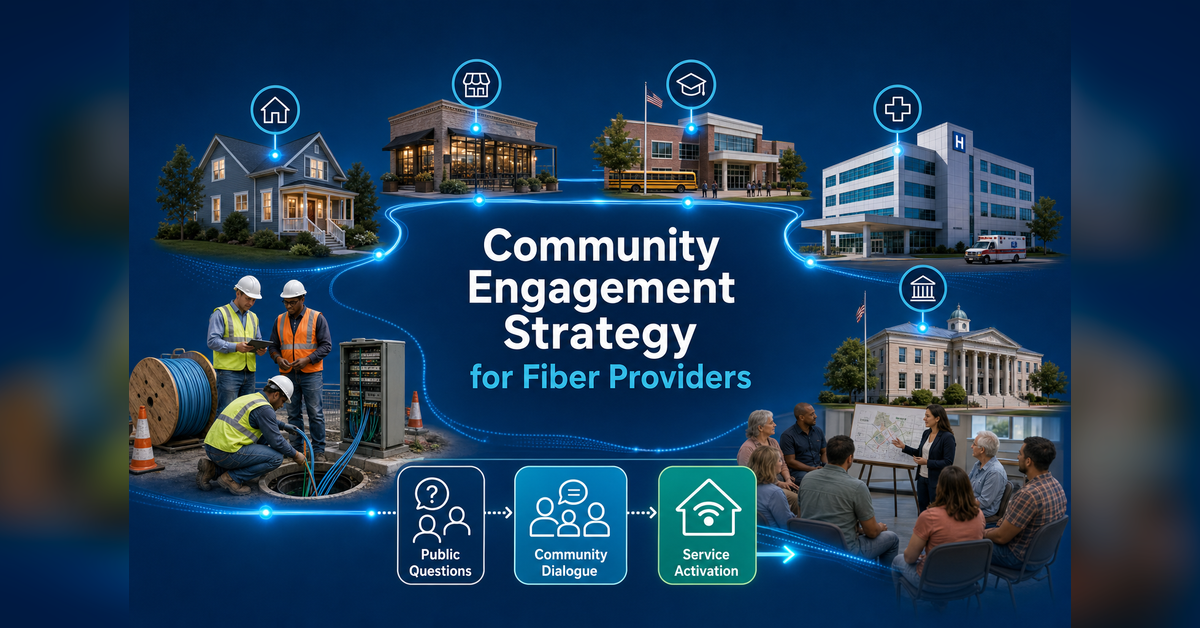

A strong community engagement strategy for fiber providers begins before residents see utility markings, construction crews, or promotional mail. It connects verified project facts with local listening, clear updates, issue ownership, and a practical path to service activation.
The work is not a public-relations layer added after engineering. It is an operating discipline shared by leadership, construction, municipal relations, communications, sales, customer experience, and every team allowed to make a public promise.




The Broadstaff case study shows how Percepture connected industry authority, search visibility, credible content, and qualified B2B demand.
What is a community engagement strategy for fiber providers?
It is a two-way operating plan that identifies stakeholders, controls project facts, explains construction, gathers feedback, resolves issues, and keeps communities informed through activation. The plan should connect public trust to verified address checks, qualified preregistration, completed installations, retained subscribers, and measurable community and business outcomes.
What should leaders take away?
Project truth
Engineering, construction, product, legal, and leadership establish what is known, unknown, restricted, and subject to change.
Stakeholder coverage
The provider maps affected, influential, underserved, and operational groups instead of speaking only with officials or supporters.
Issue closure
Questions and complaints move through intake, assignment, investigation, response, remedy, and confirmed closure.
Activation handoff
Eligible residents receive a clear next action without turning listening sessions into surprise sales events.
Who this guide is for
Fiber and broadband executives
Align growth commitments, construction reality, municipal relationships, community trust, serviceability, and adoption.
Construction and engineering leaders
Control route, method, timing, restoration, safety, dependency, and readiness facts before they become public promises.
Municipal and community relations
Map stakeholders, coordinate local partners, manage questions, and keep public communication tied to approved facts.
Marketing, sales, and customer experience
Separate engagement from promotion, manage consent, publish useful information, and hand eligible addresses into the correct activation path.
Why is fiber community engagement different?
Residents often experience the physical effects of a network build before they can use the service. Utility markings, equipment, traffic changes, access questions, noise, boring, trenching, and restoration can shape the community’s view of the provider long before installation.
That sequence changes the communications job. Launch advertising cannot replace location-specific information, a visible contact path, and a way to acknowledge uncertainty without making vague promises.
The provider must also separate engagement from adjacent functions. Public relations strategy can shape the public narrative. Omnichannel marketing can coordinate paid, earned, owned, email, and field communication. Customer service can resolve individual cases. Engagement connects those functions through listening, accountability, and feedback closure.
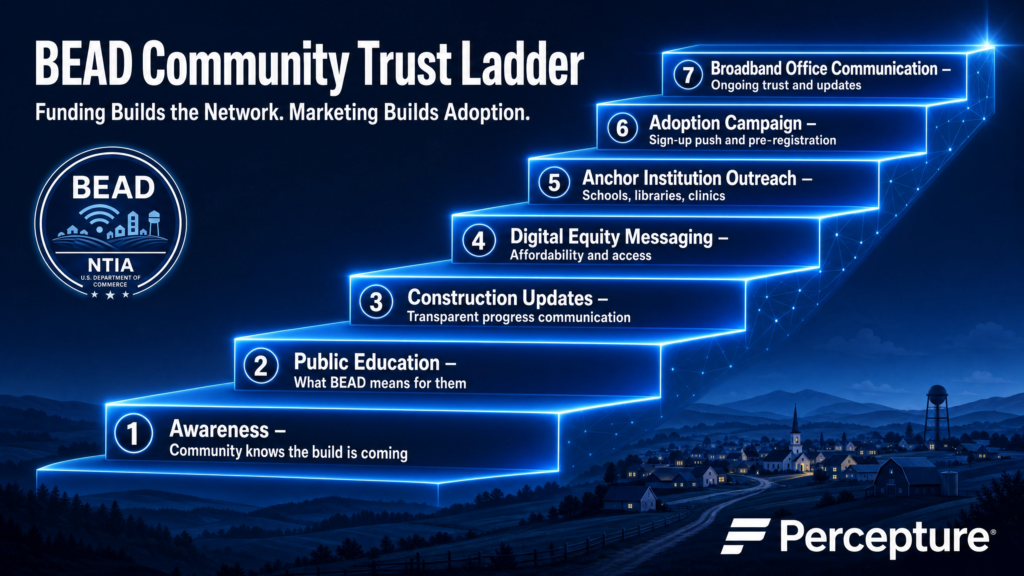
Outreach, consultation, engagement, and customer service
A town hall, sponsorship, door hanger, survey, or social post is only a channel. The operating behavior determines whether the activity becomes engagement.
| Model | Provider action | Community role | Completion test |
|---|---|---|---|
| Outreach | Publishes or distributes information | Receives the message | The intended audience received the information |
| Consultation | Requests feedback on needs or impacts | Shares concerns and preferences | The provider reports what it heard |
| Engagement | Shares facts, listens, responds, and follows through | Participates through accessible channels | The provider explains what changed, what did not, and why |
| Customer service | Handles a specific account or service case | Reports an individual problem | The case reaches a documented outcome |
Fixed safety requirements may need clear information. Restoration concerns, meeting access, notification preferences, and local coordination may support consultation or deeper involvement.
Score the quality of your stakeholder map
Test whether every affected group has an internal owner, known concern, accessible contact option, communication preference, open-question status, and next action before public communication begins.
Review My Stakeholder MapThe first conversation can focus on one market, one construction phase, or one issue path.
Who should fiber providers engage?
Map people affected by the build, organizations that influence local understanding, and teams responsible for delivery. Include critics and people with limited digital access, not only customers, officials, or vocal supporters.
Local government
Elected leaders, public works, permitting, transportation, emergency services, and communications staff need current facts and named owners.
Residents and property groups
Homeowners, renters, landlords, property managers, and associations may have different access, restoration, installation, and channel concerns.
Anchor institutions
Schools, libraries, hospitals, public-safety agencies, and other institutions can identify operational needs and communication barriers.
Business organizations
Businesses, chambers, and economic-development groups may need construction coordination and service-availability guidance.
Community organizations
Nonprofits, Tribal entities where relevant, digital-equity groups, and neighborhood leaders can identify missing voices and access barriers.
Delivery teams
Utilities, contractors, field teams, sales, support, engineering, legal, and communications must work from the same approved facts.
For each stakeholder, record role, influence, likely concerns, preferred contact method, accessibility requirements, internal owner, contact history, open questions, and next action. Providers entering a new market should also review how ISPs build community trust before construction and the wider rural broadband marketing strategy.
Stakeholder map scorecard
| Control | Ready | Warning sign |
|---|---|---|
| Representation | Affected, influential, underserved, critical, and operational groups are documented | The map contains only officials, customers, or supporters |
| Ownership | Every priority relationship and open question has a named internal owner | Questions sit in shared inboxes without authority |
| Accessibility | Language, disability, timing, transportation, phone, mail, and web options are planned | Every activity assumes reliable digital access |
| History | Contact, commitments, questions, changes, and next actions are recorded | Relationships depend on individual memory |
| Closure | Feedback receives a response and an explanation of what changed | Meetings and surveys produce no visible follow-through |
| Activation separation | Listening consent and marketing consent remain distinct | Community contact lists move directly into promotion |
The Fiber Community Engagement Control Loop
The seven-stage loop keeps public messaging tied to physical project truth, stakeholder input, controlled commitments, construction communication, issue closure, and post-launch accountability.
- 1Establish physical truth
Confirm phase, route, method, dependencies, serviceability limits, timing, risks, and unknowns. Assign a source, approver, owner, and update date to public facts.
- 2Map the community
Identify affected and influential groups, validate representation, record accessibility requirements, and assign internal relationship owners.
- 3Listen and diagnose
Use interviews, surveys, meetings, calls, partner briefings, and field observations to document concerns without turning the session into a sales presentation.
- 4Set the community compact
Define update practices, public commitments, operating limits, issue handling, accessibility, and the actions available to residents.
- 5Communicate and coordinate
Maintain one approved source of truth across the website, mail, email, SMS, media, meetings, signs, field teams, sales, and support.
- 6Resolve and close
Classify each issue, assign an owner, investigate, respond, remedy where appropriate, confirm the outcome, and publish recurring answers.
- 7Activate and remain accountable
Connect eligible residents to address checks, preregistration, ordering, installation, onboarding, support, and ongoing updates.
What should the written plan include?
The plan must be specific enough for a field supervisor, municipal liaison, communications lead, support manager, and executive approver to use. A slide deck describing trust or awareness is not an operating plan.
- Objective and project phase: state the decision, risk, or outcome the work supports.
- Approved project facts: record what is known, unknown, restricted, and scheduled for review.
- Stakeholder register: document groups, concerns, channels, owners, representation, and next actions.
- Promise register: control public statements about timing, routes, restoration, eligibility, pricing, support, jobs, and community value.
- Roles and authority: define who approves facts, speaks publicly, responds to issues, and authorizes remedies.
- Engagement methods: match interviews, meetings, surveys, mail, web, phone, partner outreach, and field contact to a purpose.
- Accessibility: account for language, disability access, meeting time, transportation, digital access, phone, mail, and accessible web options.
- Construction updates: define notice triggers for upcoming work, active work, changed facts, restoration, readiness, and activation.
- Issue mechanism: establish intake, classification, assignment, escalation, response, evidence, remedy, and closure.
- Data handling: collect only useful data, disclose its purpose, separate project updates from marketing consent, and restrict access.
- Activation handoff: define when an address can move to checking, preregistration, ordering, installation, or support.
- Measurement and refresh: set reporting owners, review dates, definitions, denominators, and corrective actions.
Content marketing services can turn approved facts into project updates and FAQs. Enterprise SEO can organize location and project information. Generative engine optimization services can improve entity clarity and direct-answer structure without replacing operational accuracy.
How should providers communicate fiber construction?
Answer the questions an affected person is likely to ask: Where will work occur? What type of work is planned? When is the next update? Could access or traffic change? How will restoration be handled? Where can someone report a safety, property, or access concern?
Every answer must come from the current operational source. Marketing should not infer service dates from construction progress. Field teams should not create independent promises. Municipal partners should receive the same approved facts used by customer-facing teams.
Before crews arrive
Explain utility markings, visible equipment, expected work, contact options, accessibility, and the next update date.
During active work
Publish location-specific notices, changed facts, access impacts, safety information, and issue-routing instructions.
After construction
Separate restoration status from network readiness and state who owns unresolved property or access concerns.
During activation
Route each address according to verified serviceability, product availability, order status, installation capacity, and support ownership.
“Silence creates frustration. Communication creates patience.” — Cody Clegg
Providers facing a fast-moving dispute should maintain a separate escalation path informed by crisis communications planning.
Which engagement methods work best?
Select methods by purpose, audience, project stage, accessibility, owner, and the behavior being measured. No single channel reaches every stakeholder or solves every problem.
| Method | Best use | Owner and access | Measure | Common failure |
|---|---|---|---|---|
| Stakeholder interviews | Early concerns and local context | Community lead; phone or in person | Groups covered and themes recorded | Interviewing only supporters |
| Advisory group | Recurring feedback during a long build | Named facilitator; transparent participation | Issues advanced and responses published | Treating the group as the whole community |
| Town hall or open house | Project explanation and live questions | Local lead; accessible venue and remote option | Questions answered and follow-ups closed | Long presentations with little listening |
| Survey | Needs, channel preferences, and broad themes | Research owner; web, phone, or paper | Coverage and usable responses | Collecting opinions without a response plan |
| Partner briefing | Coordination with institutions and local groups | Relationship owner; written follow-up | Actions, owners, and open questions | Using partners to repeat unapproved claims |
| Mail, email, or SMS | Location-specific notices and reminders | Communications owner; consent and access controls | Delivery, comprehension, and next actions | Sending general messages to affected addresses |
| Project web hub | Current facts, FAQs, contacts, and updates | Digital owner; accessible HTML | Task completion and recurring questions | Leaving old dates or claims online |
| Field outreach and signage | Immediate construction context | Construction lead; visible phone alternative | Issues routed and resolved | Giving field staff no escalation path |
Digital PR services can support credible milestone communication, while email marketing can manage consented updates. Neither replaces local accountability.
How should questions, complaints, and misinformation be handled?
Give the community one visible intake path, even when cases route to different internal teams. Every case should receive an identifier, category, owner, evidence record, next-update commitment, and closure status.
- Receive. Capture the question through web, phone, email, mail, meeting notes, field staff, or a partner.
- Classify. Tag safety, property, access, restoration, schedule, eligibility, billing, media, legal, or general-information issues.
- Assign. Route the case to a named owner with authority to investigate or escalate.
- Investigate. Compare the report with construction records, approved facts, photographs, call notes, and field findings.
- Respond. Give a useful answer, explain uncertainty, and state the next update.
- Remedy. Record the corrective action when one is appropriate and authorized.
- Confirm closure. Verify the outcome or document the remaining next step. A reply alone does not close a case.
- Learn. Publish recurring answers and use patterns to improve notices, training, routing, and planning.
Correct misinformation with a clear statement tied to the current source of truth. Avoid arguing with residents or repeating a false claim more than necessary. When an earlier message was incomplete or outdated, correct the record directly.
This mechanism gives customer journey planning a documented bridge between community questions, service eligibility, installation, and support.
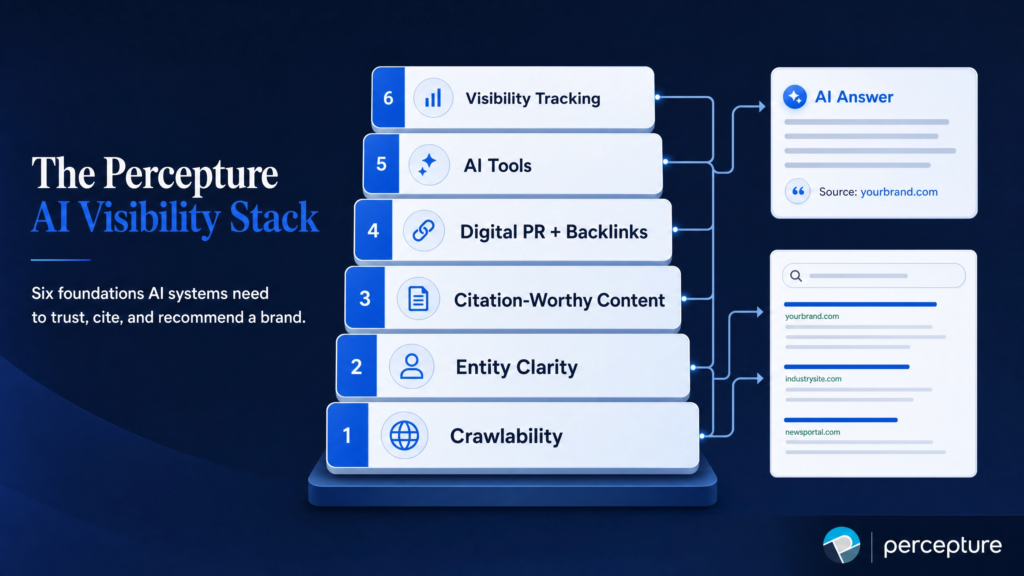
Publish one source of truth for search and AI
The project web hub should state current phase, applicable geography, construction information, restoration guidance, contact paths, update dates, serviceability boundaries, and the next approved action. Old pages, partner notices, social posts, and profiles should not carry competing facts.
Structured headings, direct answers, descriptive links, accessible HTML, and current organization details help people and answer systems interpret the project. Local SEO for fiber providers can make approved market information easier to find. The ISP PR and AI visibility guide addresses authority beyond the local construction process.
How does engagement support fiber adoption?
Engagement reduces confusion and creates realistic anticipation. It cannot compensate for inaccurate serviceability, a weak offer, limited installation capacity, or poor customer experience.
The activation handoff moves eligible residents through awareness, understanding, address checking, qualified preregistration, ordering, scheduled installation, completed installation, onboarding, early support, retention, reviews, and referrals. Each transition needs a defined system owner.
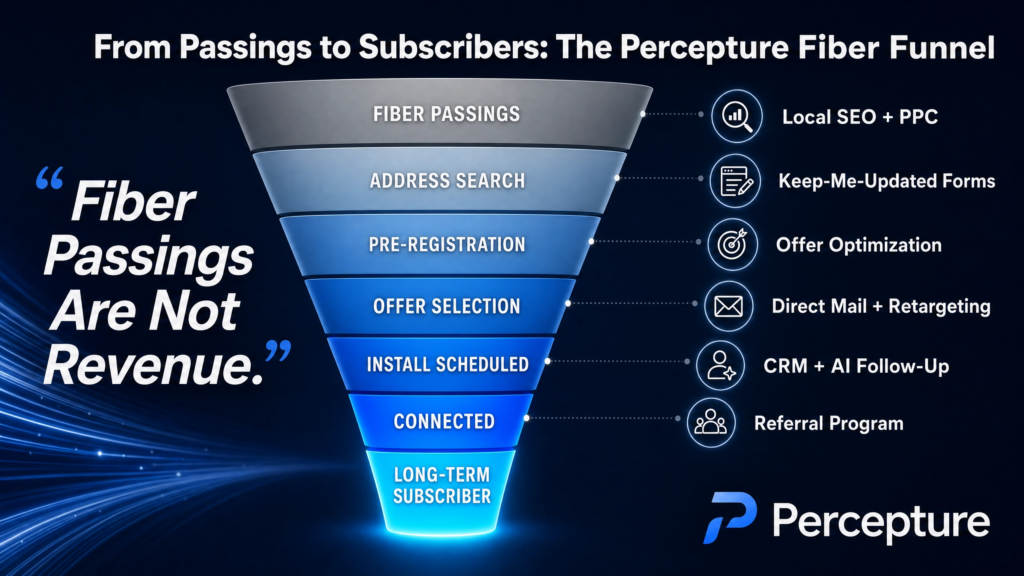
The commercial measure should use an approved serviceable-location denominator. The guide to fiber take-rate measurement covers that calculation. Keep listening separate from broadband offer strategy, even though both influence adoption.
The cleanest signal appears when engagement records, consent, serviceability, campaign activity, orders, and installations can be connected without overstating attribution. Conversion-rate optimization can then improve address-check and order paths using real task data.
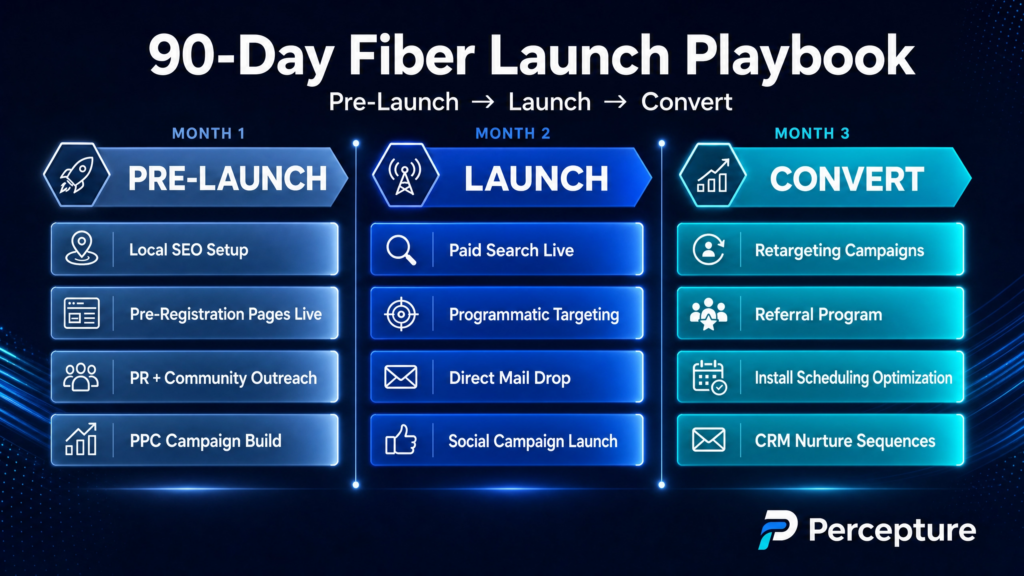
What should the first 90 days include?
Establish controls before increasing communication volume. The timing can change with the project phase, but the operating gates should remain.
Establish truth. Confirm route, phase, method, dependencies, risks, serviceability, products, dates, and unknowns. Audit public pages, notices, relationships, complaints, CRM records, and issue handling.
Map stakeholders. Interview municipal teams, residents, institutions, businesses, nonprofits, property groups, contractors, support, sales, and field staff.
Set the compact. Approve the promise register, engagement levels, calendar, construction templates, intake path, escalation model, accessibility plan, partner roles, and feedback report.
Begin preconstruction engagement. Publish the project hub, brief partners, hold targeted sessions, provide contacts, explain construction, collect concerns, and correct inaccurate information.
Control active-build issues. Send location-specific notices, log cases, publish recurring answers, address access or restoration concerns, and adjust channels based on response patterns.
Activate and report back. Connect eligible residents to ordering and installation, publish what was heard, explain changes, and continue post-activation communication.
Community engagement cost and value framework
Budget for the operating system, not only media or events. Cost categories may include strategy, research, facilitation, staff time, meetings, accessibility, translation, mail, email or SMS, a project hub, field materials, surveys, issue tracking, CRM work, analytics, legal review, construction coordination, reporting, and post-launch support.
| Measure | Calculation | Management use |
|---|---|---|
| Cost per stakeholder group | Planning cost divided by stakeholder groups with an owner and plan | Tests whether planning resources cover the full map |
| Cost per engaged serviceable location | Attributable engagement cost divided by verified serviceable locations receiving an approved touch | Connects spend to address-level reach |
| Response time | Issue receipt to first useful response | Shows intake and routing performance |
| Resolution time | Issue receipt to confirmed closure | Shows operating follow-through |
| Issue reopen rate | Reopened issues divided by closed issues, multiplied by 100 | Tests closure quality |
| Engagement-to-preregistration | Qualified preregistrations from engaged eligible locations divided by engaged eligible locations, multiplied by 100 | Measures a defined adoption handoff |
| Install completion | Completed installations divided by scheduled installations, multiplied by 100 | Tracks the transition from order to service |
| Engagement ROI | Attributable gross profit plus verified avoided cost, minus engagement cost, divided by engagement cost | Combines commercial and documented operating value |
Attendance, impressions, clicks, and social reactions can diagnose channel performance, but they do not prove trust or adoption. Attribution and analytics should define the measurement chain before revenue credit is assigned.
Review Pricing OptionsWhat does operator experience add?

Percepture President Bob Generale interviewed Cody Clegg, Director of Sales and Marketing at OPTK Networks, about community trust, construction communication, permitting, municipal relationships, and broadband adoption.
“Infrastructure can be duplicated. Relationships are much harder to duplicate.” — Cody Clegg
Local relationships depend on reliable facts, consistent follow-through, and the provider’s behavior when plans change or concerns surface. Engineering and construction control physical facts. Municipal and community leads manage local coordination. Communications teams translate approved facts. Support and field teams route issues. Leadership controls commitments and escalation.
Learn about OPTK Networks and the operating perspective behind this fiber community engagement discussion.

Audit construction communication and issue control
Percepture can review whether project truth, stakeholder ownership, public commitments, construction notices, issue closure, search information, and activation handoffs operate as one controlled system.
- Find gaps before public communication begins
- Separate engagement, service, PR, and promotion
- Connect community trust to accountable next steps
What mistakes weaken the plan?
- Announcing before facts are controlled. Do not publish dates, routes, availability, restoration terms, jobs, or partnerships that operating teams cannot support.
- Inviting feedback without a response process. A survey or meeting can increase frustration when questions disappear into email or receive no visible follow-through.
- Calling one-way promotion engagement. Reach is useful, but it does not prove listening, response, or accountability.
- Speaking only with officials or supporters. Include affected groups, critics, renters, people with limited digital access, and front-line delivery teams.
- Using one message for every address. Construction status and serviceability may vary within the same market.
- Stopping after construction. Activation, installation, onboarding, support, and retention remain part of the community experience.
- Confusing engagement with sales. Use consented information appropriately, but do not turn listening sessions into hidden acquisition events.
- Closing a case after sending a reply. Closure requires a verified outcome or a documented remaining next step.
Community engagement strategy FAQs
When should a community engagement strategy for fiber providers begin?
Begin during planning, before residents encounter utility markings, crews, permits, or broad announcements. Early work should establish approved facts, identify affected groups, assign contact paths, document uncertainty, and coordinate with local officials and institutions. Engagement should continue through construction, activation, installation, and post-launch support.
What is the difference between outreach and engagement?
Outreach distributes information through mail, media, events, partners, websites, signs, or direct contact. Engagement adds listening, documentation, response, and an explanation of what changed or why a request could not be adopted. A communication channel alone does not make a process participatory.
Who belongs on a fiber stakeholder map?
Include residents, renters, property owners, businesses, municipal leaders, public works, schools, libraries, hospitals, emergency services, chambers, nonprofits, Tribal entities where relevant, digital-equity groups, utilities, contractors, field teams, sales, support, legal, and communications. Include critics and people with limited digital access.
How should a provider explain fiber construction disruption?
Communicate early and specifically using approved operational facts. Explain the location, construction method, schedule status, utility marking, possible access or traffic effects, restoration process, working expectations, and contact path. Publish changed facts promptly and do not minimize an impact before affected people experience it.
How should fiber providers handle questions and complaints?
Create one visible intake path, assign a case identifier, classify the issue, attach relevant evidence, route it to an accountable owner, communicate the next update, document the response, and confirm closure. Safety, legal, property, or media issues should follow the provider’s escalation process.
Can community engagement improve fiber take rate?
Engagement can reduce confusion, create realistic anticipation, support qualified preregistration, and help eligible residents understand how to order. It supports take rate only when the provider also has accurate serviceability, a clear offer, installation capacity, reliable onboarding, and a customer experience that supports retention.
What should fiber providers measure?
Track stakeholder coverage, participation, unanswered questions, update timeliness, response time, resolution time, reopened issues, recurring concerns, address checks, qualified preregistration, orders, completed installations, take rate, retention, and attributable gross profit. Define each denominator and system owner before reporting results.
How much does fiber community engagement cost?
Cost depends on project scale, geography, construction phase, stakeholder complexity, accessibility, communication channels, issue volume, and internal capacity. Build the budget from defined work categories such as research, staff time, facilitation, meetings, translation, mail, digital systems, field materials, issue tracking, legal review, analytics, and reporting.
How should fiber providers communicate uncertain dates?
State what is known, what is still being confirmed, who owns the next update, and when the public record will be refreshed. Do not infer service dates from construction progress or allow field, sales, and municipal teams to create separate promises.
How should community feedback connect to fiber adoption?
Keep listening and sales consent separate. After serviceability is verified, eligible residents can move from awareness to address checking, qualified preregistration, ordering, installation, onboarding, support, retention, reviews, and referrals. Each handoff needs an owner and a measurable status.
Build a community engagement strategy for fiber providers
Use the form below or schedule a call to share the market, project phase, stakeholder groups, construction concerns, issue volume, accessibility needs, serviceability process, and activation handoffs you need reviewed.
The conversation can begin with one community, one construction phase, or one unresolved operating gap.
Key takeaway: a defensible community engagement strategy for fiber providers links project truth, local listening, construction communication, issue closure, serviceability, activation, and public accountability in one operating plan.