
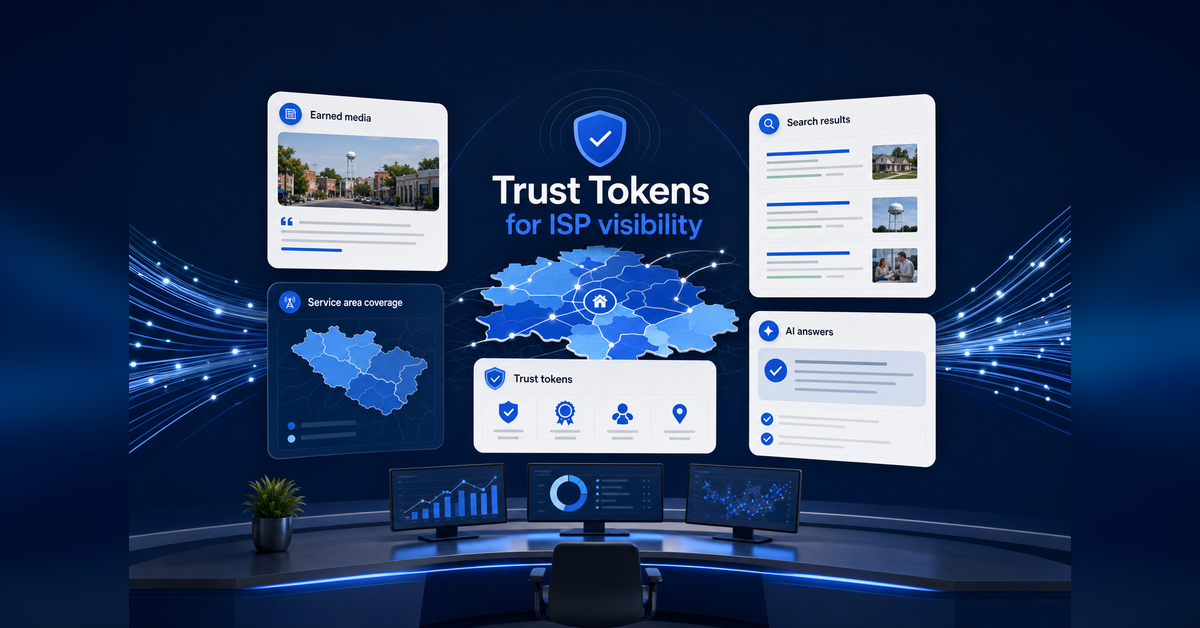

ISP Public Relations & AI Search Visibility gives growth-minded service companies a practical way to connect local visibility, paid demand, reviews, content, and follow-up around qualified calls and booked jobs.
Broadband buyers do not choose an ISP from one ad or one press release. ISP Public Relations & AI Search Visibility is now about whether the market, search engines, and AI answer systems can find enough credible proof to trust the provider before a sales conversation starts.
Percepture’s view is simple: this is not generic marketing. It is serviceability-aware market conditioning, because an ISP cannot sell everywhere, and marketing where the network cannot serve wastes spend and weakens trust.





What is ISP Public Relations & AI Search Visibility?
ISP Public Relations & AI Search Visibility is the work of connecting serviceable markets, earned proof, organic search, AI-answer readiness, and sales follow-up into one measurable system. The strongest programs do not start with channels. They start with where the ISP can sell, what the market needs to believe, and what proof helps a buyer take the next step.
Executive summary for ISP leaders
Proof before pitch
In ISP Public Relations & AI Search Visibility, community buyers, business owners, property managers, and public stakeholders need proof before they respond. Trust Tokens make that proof easier to find and reuse.
Serviceability controls spend
ISP Public Relations & AI Search Visibility should not promote markets the network cannot serve. Fiber passings are not revenue, so PR, SEO, GEO, and paid programs should point demand toward markets where sales can actually act.
AI visibility compounds
ISP Public Relations & AI Search Visibility treats AI visibility as the compounding result of clear pages, trusted mentions, local signals, and structured answers, not as a replacement for SEO, PR, or proof.
Sales routing matters
ISP Public Relations & AI Search Visibility only matters when search visibility turns into address checks, qualified leads, meetings, installs, subscribers, retention, or better response time.
Measurement must be practical
Clicks matter less than qualified demand. Leadership should measure address checks, pre-registrations, meetings, pipeline value, and sales response time.
Who this guide is for
Good fit
CEO, founder, VP Marketing, communications leader, PR leader, public affairs leader, broadband operator, or sales leader who needs ISP Public Relations & AI Search Visibility tied to market expansion.
Not a fit
This is not for teams looking for generic social posts, broad untargeted media buying, or channel-first marketing that ignores serviceability. ISP Public Relations & AI Search Visibility needs operational context, not isolated promotion.
Best use case
Use ISP Public Relations & AI Search Visibility when entering a market, preparing for construction, supporting funding communications, launching business fiber, or improving local trust before a sales push.
Run an ISP Trust Token audit
Use a low-friction review to see whether your brand has the proof, pages, search structure, and sales routing needed before spending more on campaigns. The audit shows whether ISP Public Relations & AI Search Visibility is grounded in markets your network can actually serve.
Run an ISP Trust Token auditWhy ISP Public Relations & AI Search Visibility now affects take-rate
ISP public relations used to be judged by coverage, announcements, and reputation control. Those still matter, but they now sit inside a larger visibility system. AI search tools and traditional search results both reward brands that have clear, consistent, third-party proof across the web.
The failure mode is easy to spot. A provider announces construction, runs ads, earns a few mentions, and sends traffic to pages that do not explain serviceability, availability, proof, or next steps. ISP Public Relations & AI Search Visibility prevents that gap by connecting the announcement to the buyer’s next action.
Percepture connects this work to the larger ISP marketing agency model: ISP marketing starts with the network. If the network can serve a market, PR should condition that market before launch. If the network cannot serve an address, the page and CRM should route that demand honestly.
Percepture POV
The first question is not which channel to use. The first question is where the network can sell, what the market already believes, and what proof is needed before a buyer takes the next step. That is the operating discipline behind ISP Public Relations & AI Search Visibility.
What AI systems need before they cite or summarize a broadband brand
AI answer systems look for clear entities, repeated evidence, source-worthy pages, credible third-party mentions, and simple answers to buyer questions. No agency can guarantee inclusion in an AI answer, but a provider can make the brand easier to understand, cite, and compare.
For ISP Public Relations & AI Search Visibility, the practical question is not “Can we get mentioned by AI?” The better question is “Have we published enough useful proof that a buyer, journalist, search engine, or AI system can understand what we do and where we do it?”
A strong ISP Public Relations & AI Search Visibility program includes a search visibility foundation, digital PR services, local proof, executive messaging, and generative engine optimization services. The Golden Triangle means organic search, AI answers, and third-party proof working together.
What proof does an ISP need to be cited by LLMs?
- Clear company, service, market, and coverage entities.
- Location pages that explain serviceability and next steps.
- Media coverage, community proof, case studies, and executive quotes.
- Technical pages that answer availability, installation, uptime, support, and business-fiber questions in plain language.
- Internal links that connect PR proof, service pages, telecom context, and conversion pages.
The ISP Trust Token System
The ISP Trust Token System is Percepture’s framework for turning proof into assets that buyers, journalists, search engines, AI systems, and sales teams can use. A Trust Token can be an earned media article, a case study, a community explainer, a funding update, a customer quote, an executive point of view, a technical checklist, or a local serviceability page.
For ISP Public Relations & AI Search Visibility, Trust Tokens work because they answer the buyer’s quiet question: “Why should I believe this provider before I share my address, invite a sales call, or recommend them internally?”
How the ISP Trust Token System works
1. Serviceability map
Owner: operations and marketing. Define where the network can sell, where it is building, and where demand should be routed differently. ISP Public Relations & AI Search Visibility starts here so campaign reach matches network reality.
2. Market belief audit
Owner: communications and public affairs. Identify what the community already believes, what concerns exist, and what proof is missing.
3. Proof asset build
Owner: PR, SEO, and leadership. Publish source-worthy pages, explainers, media assets, case studies, and local proof for ISP Public Relations & AI Search Visibility.
4. GEO structure
Owner: SEO and technical marketing. Format pages so search engines and answer systems can parse entities, definitions, FAQs, and comparisons.
5. Sales routing
Owner: sales operations. Pass address checks, form context, campaign source, market, and buyer type into CRM follow-up.
A practical example: before construction in a new fiber market, an ISP can publish a construction explainer, community FAQ, serviceability page, executive statement, local media pitch, and address-check path. That turns ISP Public Relations & AI Search Visibility into market conditioning instead of a one-week announcement.
Related Percepture resources on how ISPs build community trust before broadband construction, BEAD PR strategy, and what is BEAD outreach help connect public communication to broadband expansion.
How PR, SEO, GEO, and local proof compound
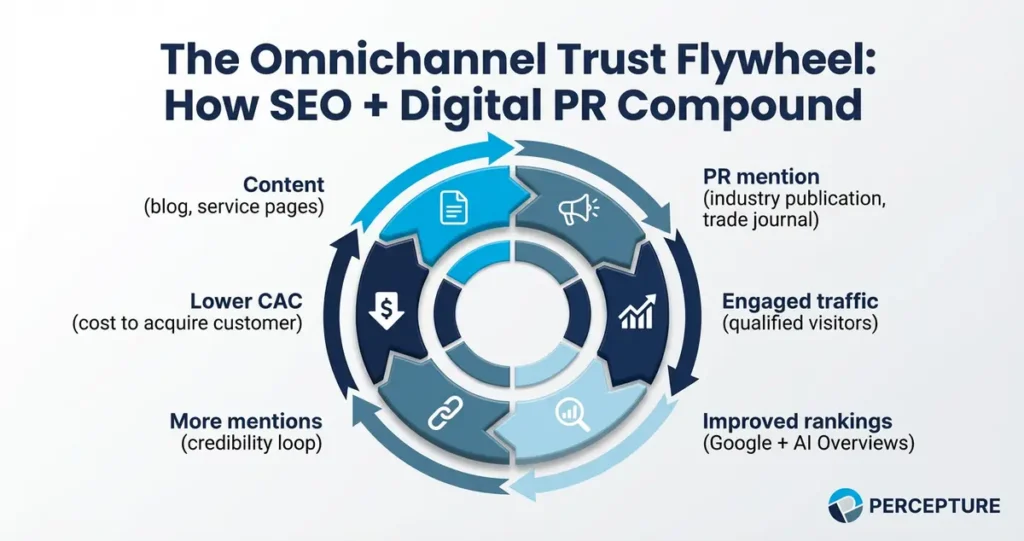
Digital PR creates third-party signals. SEO turns the brand’s own site into a clear source. GEO formats the important answers so AI systems can retrieve them more easily. Local proof reduces buyer risk.
None of these work well alone. A press hit without a source-worthy landing page may be forgotten. A landing page without proof may rank but fail to convert. A GEO checklist without earned authority may be too thin for a high-stakes buyer.
Percepture’s AI search visibility strategy connects the parts. For ISP Public Relations & AI Search Visibility, the goal is not traffic for its own sake. The goal is qualified demand that can be served, routed, and followed up.
Weak programs vs. strong ISP programs
| What weak programs do | What strong ISP programs do | What Percepture would check |
|---|---|---|
| Promote every market the same way. | Prioritize serviceable areas and build-stage communications. | Serviceability logic, market routing, and address-check paths. |
| Chase press without conversion planning. | Use ISP Public Relations & AI Search Visibility to connect media, landing pages, proof, and CRM follow-up. | Whether each PR asset has a next step and measurable path. |
| Write generic broadband copy. | Answer local, technical, business, and stakeholder questions directly. | Entity clarity, FAQ depth, and source-worthy page structure. |
| Measure only impressions and clicks. | Measure qualified leads, address checks, meetings, installs, and response time. | Reporting tied to pipeline and serviceability. |
| Separate PR, SEO, GEO, and sales. | Make ISP Public Relations & AI Search Visibility visible across content, proof, and sales motion. | Internal links, proof assets, schema, and handoff quality. |
What to publish before construction, launch, funding, or expansion
Before construction, publish what residents and local leaders need to know: where work is happening, what to expect, how to ask questions, and how to check availability. Before launch, publish service pages, address-check CTAs, local proof, and business-buyer answers.
Before a funding announcement, align public affairs, PR, and search. A funding story should not sit alone. It should link to community outreach, serviceability, broadband benefits, and next-step pages. For event-led growth, connect announcements with telecom conference marketing so conversations become pipeline.
For sales-readiness, connect the article cluster to ISP sales automation and AI sales agents. Intent data without serviceability is expensive curiosity. Sales needs to know who asked, what market they are in, whether the address is serviceable, and what proof they consumed.
Three publication tracks to build before launch
Community track
Construction updates, local FAQs, public meeting recaps, stakeholder explainers, and proof that the provider understands local concerns. ISP Public Relations & AI Search Visibility should make these materials easy for residents and local leaders to find.
Buyer track
Residential, business, MDU, enterprise, and public-sector pages with serviceability logic and clear next steps.
Authority track
Earned media, executive commentary, technical explainers, case studies, and pages that make the ISP easier to cite.
How to build source-worthy pages and media assets
A source-worthy page is not just a sales page. It defines the service, explains the market, answers practical questions, shows proof, and gives a journalist or AI system a clean way to summarize the provider.
For ISP Public Relations & AI Search Visibility, every important page should include a plain-English definition, market context, serviceability language, proof assets, executive point of view, FAQ answers, and internal links to related resources. Percepture’s omnichannel marketing work is useful when PR, search, paid media, email, and sales follow-up need one operating plan.
Use public relations, earned and owned media, enterprise SEO, and conversion rate optimization as connected workstreams, not separate vendor boxes.
Proof should connect visibility to qualified demand
See how Percepture connected search visibility, B2B credibility, and qualified lead generation in the Broadstaff Global search visibility and qualified leads case study.
For a broadband provider, the same principle applies: ISP Public Relations & AI Search Visibility proof must help the buyer understand the brand, trust the offer, and take a measurable next step.
Review Percepture’s digital PR and GEO proof
If your team is already investing in PR, SEO, or AI visibility, review whether the work is producing Trust Tokens that sales and search systems can reuse. This is where ISP Public Relations & AI Search Visibility should prove that visibility supports qualified demand.
Review Percepture’s digital PR and GEO proofAI visibility technical checklist
Technical readiness starts with the basics. The page must be indexable, important copy must be visible as text, images need descriptive alt text, schema must match visible content, and the canonical should point to the live URL.
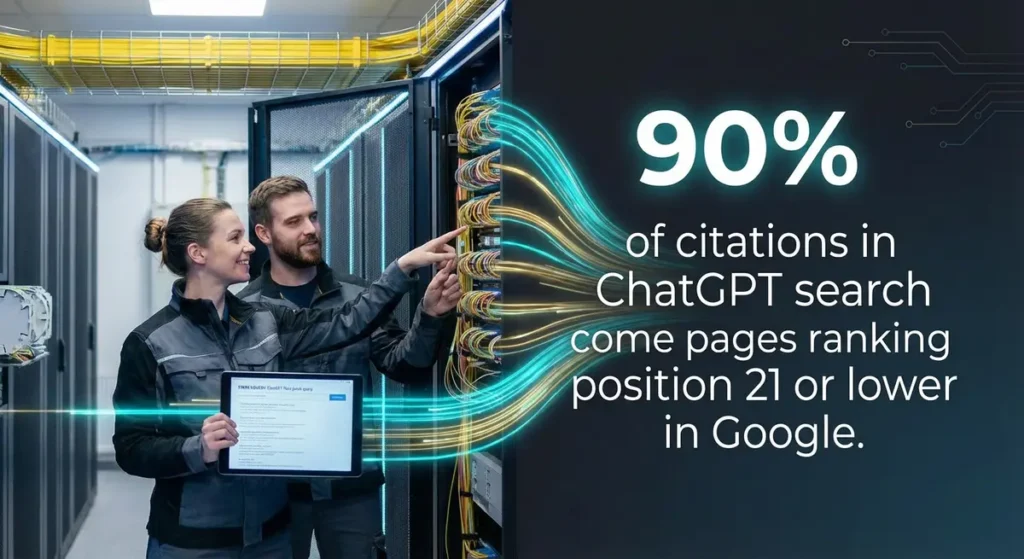
For AI search, do not hide the strongest answers inside images, PDFs, or vague copy. Put definitions, comparisons, FAQs, and checklists in visible HTML. When the goal includes ChatGPT search visibility, make sure the site is not accidentally blocking OpenAI’s search crawler. Google’s AI features rely on the same foundational search eligibility requirements used for Search.

Technical checks for AI-answer readiness
- Confirm the page is indexable and not blocked by robots rules.
- Confirm the canonical URL matches the live telecom-insights page.
- Use visible HTML for definitions, scorecards, FAQs, and comparison tables.
- Add schema for the article, FAQ, breadcrumb, author, organization, images, and visible lists.
- Track branded and non-branded search visibility, AI-answer visibility checks, referral behavior, and conversions tied to ISP Public Relations & AI Search Visibility.
Trust Token scorecard
Use this scorecard to diagnose whether ISP Public Relations & AI Search Visibility is ready to support a serious growth plan. A “no” answer does not mean the program is broken. It means the next workstream is clear.
ISP Trust Token readiness scorecard
| Question | Yes / No | Why it matters |
|---|---|---|
| Do your campaigns only target markets where the network can sell or build? | Yes / No | Reduces wasted spend and buyer frustration. |
| Do priority pages explain serviceability, availability, and next steps? | Yes / No | Turns ISP Public Relations & AI Search Visibility interest into address checks and qualified leads. |
| Do you have third-party proof that supports the claims on your site? | Yes / No | Helps buyers and answer systems trust the brand. |
| Do you have local pages for expansion or construction markets? | Yes / No | Supports community trust and search relevance. |
| Can sales see what proof a lead consumed before outreach? | Yes / No | Improves response quality and speed. |
| Do PR, SEO, GEO, and paid media share the same market priorities? | Yes / No | Prevents channel conflict and mixed messaging across ISP Public Relations & AI Search Visibility. |
| Do FAQs answer CEO, CFO, sales, technical, and community questions? | Yes / No | Improves search, AI retrieval, and buyer confidence. |
| Do reports connect visibility to qualified demand, meetings, installs, or pipeline? | Yes / No | Keeps leadership focused on business outcomes. |
| Do internal links connect the ISP cluster, service pages, proof, and pricing? | Yes / No | Builds topical authority and improves navigation. |
| Do you have a repeatable process for new market launches? | Yes / No | Makes expansion faster and less reactive. |
What should this cost, and how should it be measured?
Budget depends on market size, number of service areas, proof gaps, content depth, media scope, technical SEO needs, and sales-system readiness. A small diagnostic may start with an audit. A full ISP Public Relations & AI Search Visibility program may include PR, digital PR, GEO, content, analytics, conversion work, and sales routing.
Use public relations pricing packages and AI search SEO pricing as planning references, then judge the investment by qualified outcomes. The metrics should include qualified leads, address checks, pre-registrations, meetings booked, cost per qualified lead, install conversion, pipeline value, retention signals when relevant, sales response time, search visibility, and AI-answer visibility checks.
The CFO question is not “How many clicks did PR create?” The better question is “Did the program create qualified demand in markets where the network can act?” That is how ISP Public Relations & AI Search Visibility becomes a business system instead of a reporting slide.
ISP Public Relations & AI Search Visibility investment framework
| Program level | What it usually includes | How to measure it |
|---|---|---|
| Diagnostic | Trust Token audit, serviceability review, content gap map, AI visibility checks. | Priority gaps, market risk, and next-step roadmap. |
| Market launch support | Community PR, source-worthy pages, local SEO/GEO structure, stakeholder messaging for ISP Public Relations & AI Search Visibility. | Address checks, pre-registrations, local visibility, response quality. |
| Growth system | Digital PR, SEO, GEO, proof assets, CRM routing, analytics, conversion testing. | Qualified leads, meetings, pipeline value, installs, and sales response time. |
Mistakes to avoid
The first mistake is treating ISP PR like general demand generation. A broadband provider has build schedules, service areas, rights-of-way, local stakeholders, and installation realities. Messaging that ignores those constraints creates sales leakage.
The second mistake is publishing vague proof. “Fast internet” is not enough. Buyers want to know where service is available, what type of buyer is served, what happens after an address check, and why they should trust the provider.
The third mistake is separating AI visibility from the rest of marketing. AI visibility grows from public proof, search-ready pages, local entities, consistent messaging, and technical access. It should not become a standalone experiment detached from pipeline. ISP Public Relations & AI Search Visibility keeps that work tied to serviceability and follow-up.
FAQs
What is ISP Public Relations & AI Search Visibility?
ISP Public Relations & AI Search Visibility connects telecom PR, digital PR, SEO, GEO, local proof, and sales routing so broadband providers are easier to trust, find, summarize, and evaluate. It should support address checks, qualified leads, meetings, installs, and market credibility.
Why does this need to start with serviceability?
Serviceability protects spend and trust. If marketing creates demand where the ISP cannot sell, sales wastes time and buyers lose confidence. Strong ISP Public Relations & AI Search Visibility starts with network reality, then builds PR and search visibility around markets where the provider can act.
How should a page be structured for AI search visibility?
Use a direct answer near the top, clear headings, visible definitions, tables, scorecards, FAQs, schema, proof links, and internal links. For ISP Public Relations & AI Search Visibility, keep claims specific and easy to parse so the page answers buyer, CFO, technical, community, and sales questions in plain language.
What proof should an ISP show before asking for a conversation?
An ISP should show market relevance, serviceability guidance, third-party proof, construction or launch context, customer or stakeholder reassurance when available, technical answers, and a clear next step. Proof before pitch helps buyers decide whether the conversation is worth their time.
Which internal links should support this article?
Support links should connect to the ISP pillar, related ISP sales and conference articles, BEAD and community-trust resources, GEO services, digital PR services, telecom PR context, proof case studies, pricing, and contact paths. Links should help the reader move logically through the buying process.
What CTA should be used for ISP Public Relations & AI Search Visibility?
Use a diagnostic CTA first, proof or pricing CTA second, and a strategy conversation CTA last. A good Construction SEO strategy sequence is Trust Token audit, digital PR and GEO proof review, then a conversation about serviceability-aware pipeline.
How should keyword density be handled?
Use Construction search visibility plan where it helps the reader understand the topic, then use natural variants such as ISP PR, telecom PR, broadband public relations, GEO, AI search visibility, and Trust Tokens. The page should read clearly before it reads mechanically optimized.
What mistakes should ISPs avoid?
Avoid generic PR, market-wide promotion without serviceability logic, vague proof, thin pages, hidden answers, disconnected sales routing, and reporting that stops at impressions. organic visibility strategy should connect trust, visibility, and qualified demand.
How should this help sales, marketing, and leadership?
search visibility program gives marketing a serviceability-aware content and PR plan. Sales gets better lead context and follow-up signals. Leadership gets reporting tied to address checks, qualified leads, meetings, installs, pipeline value, and visibility in the markets that matter.
Talk with Percepture about Construction SEO strategy
If your ISP needs to build trust before launch, improve proof before sales outreach, or make the brand easier for search and AI systems to understand, Percepture can review your serviceability-aware pipeline and Trust Token gaps. The conversation focuses on whether Construction search visibility plan can support qualified demand in the markets that matter.
Talk with Percepture about ISP PR and AI search visibility