

BEAD PR strategy matters because a funded broadband project can still fail in the market if the community does not understand it, trust it, or know when to act. A press release may announce the award. It will not build the local trust needed to move residents from awareness to address checks, installs, and subscribers.
The strongest BEAD PR starts with the network. A provider should never market faster than serviceability, construction timing, or install capacity can support. The message has to match the build. That is how broadband providers avoid confusion, reduce friction, and turn public funding into public confidence.
BEAD PR strategy backed by 20+ years of PR, SEO, GEO, and B2B demand work
Percepture has been in business since 2004, helping complex B2B and infrastructure brands turn credibility, search visibility, public relations, and buyer education into measurable demand. For broadband providers, that matters because BEAD PR has to build trust before it asks a community to act.




What is a BEAD PR strategy?
A BEAD PR strategy is a communications plan broadband providers use to explain BEAD-funded projects, align local stakeholders, manage construction questions, earn media trust, and turn public awareness into adoption. It should connect PR, community outreach, SEO, digital PR, direct communication, address checks, CRM follow-up, installs, and subscriber growth.
Last updated: July 2026
Executive summary for broadband leaders
The main risk
A funded build still needs public trust. If residents hear about funding before they understand timing, location, disruption, and next steps, the project can create confusion before it creates demand.
The Percepture rule
Physical Network Truth Creates Public Trust. The network has a physical truth. That truth controls the message. The message controls trust. Trust controls adoption.
The growth job
A BEAD PR strategy is not announcement work. It is trust architecture. The work must move people from funding awareness to address checks, pre-registration, installs, subscribers, and proof.
The buyer fit
This guide is for CEOs, CMOs, sales leaders, construction leaders, and ISP marketing teams that need public confidence to match operational reality.
Why BEAD PR Matters Now
BEAD has moved past early planning and into the stage where communities expect answers. NTIA describes BEAD as a $42.45 billion program, and its eligible uses include deployment, outreach, adoption, training, and activities that increase meaningful use of built infrastructure. That means the communications job is tied to the public value of the network, not just the award announcement.
Public funding creates public expectations. The market does not care that a Final Proposal was approved. The market cares when crews arrive, when service is available, what it costs, and how to sign up.
That is where Percepture sees the gap. The BEAD PR strategy must be built around the same facts that guide construction, sales, customer service, and marketing. People do not need a federal funding lecture. They need to know what is being built, when it is coming, how it affects them, and how to check their address.
Percepture is a digital marketing and PR agency founded in 2004. For broadband providers, the useful difference is the blend of public relations, search, GEO, paid media, content, analytics, conversion, and sales follow-up. A provider can also connect this work to broader omnichannel marketing, public relations, and digital PR services instead of treating BEAD communication as a single press event.
Before You Announce the Build, Audit the Trust Risk
BEAD projects create attention fast. Percepture can review your public message, stakeholder map, serviceability language, and adoption path before confusion reaches the market. That review gives the BEAD PR strategy a cleaner operating base before the first public push.
Get a BEAD Trust & PR AuditWhat Is a BEAD PR Strategy?
A BEAD PR strategy is the communications system around a BEAD-funded broadband build. It explains funding, construction, serviceability, adoption, and next steps in language people can use.
It is not just media relations. It must align local officials, residents, county leaders, schools, libraries, small businesses, sales teams, customer service, field teams, and operations. If one group hears one story and another group hears a different story, trust breaks.
The message should never outrun the network. If an address cannot buy yet, say so. If construction is planned but not ready, explain the timeline. If a neighborhood is in a future phase, provide a clean update path rather than vague promises.
BEAD PR fails when the message gets ahead of the network. It wins when the market understands the build, the timeline, the address path, and the next step.
Why BEAD PR Is Different From Normal Telecom PR
A normal telecom PR plan can announce a product. A BEAD PR strategy has to explain a promise, a build, a timeline, and a path to service.
- BEAD involves public funding.
- BEAD creates public expectations.
- BEAD construction is visible.
- BEAD timelines can shift.
- BEAD communities may include residents who have waited years for better service.
- BEAD messaging must work for residents, officials, media, sales, support, and operators.
- BEAD adoption matters after deployment.
A press release can announce the project. It cannot carry the full trust burden. The plan needs local pages, stakeholder briefings, construction notices, FAQs, media outreach, address-check paths, and follow-up.
Physical Internet Note: The Network Must Lead the Message
Broadband is physical
Fiber routes, backhaul, carrier neutrality, interconnection, middle-mile access, permitting, pole attachments, construction timing, and address-level serviceability shape what a provider can deliver.
The rule
The BEAD PR strategy must respect physical network truth. If a provider promotes service too early, overstates availability, or ignores construction reality, it can break trust before the first install.
The operating line
The network sets the boundary. PR sets the expectation. Sales captures the demand. Operations delivers the promise.
Hunter Newby’s infrastructure work reinforces the point: broadband trust starts with physical reality. Percepture’s job is to turn that reality into clear language, local proof, search visibility, media trust, and subscriber action.
BEAD PR strategy framework: The Percepture BEAD Trust-to-Adoption Ladder
The Percepture BEAD Trust-to-Adoption Ladder is a PR and growth framework that moves a BEAD-funded broadband project from funding awareness to stakeholder trust, construction clarity, address checks, installs, subscribers, and long-term community proof.
It is not just PR. It is serviceability-aware, infrastructure-aware, stakeholder-aware, conversion-aware, AI-search-aware, and subscriber-aware.
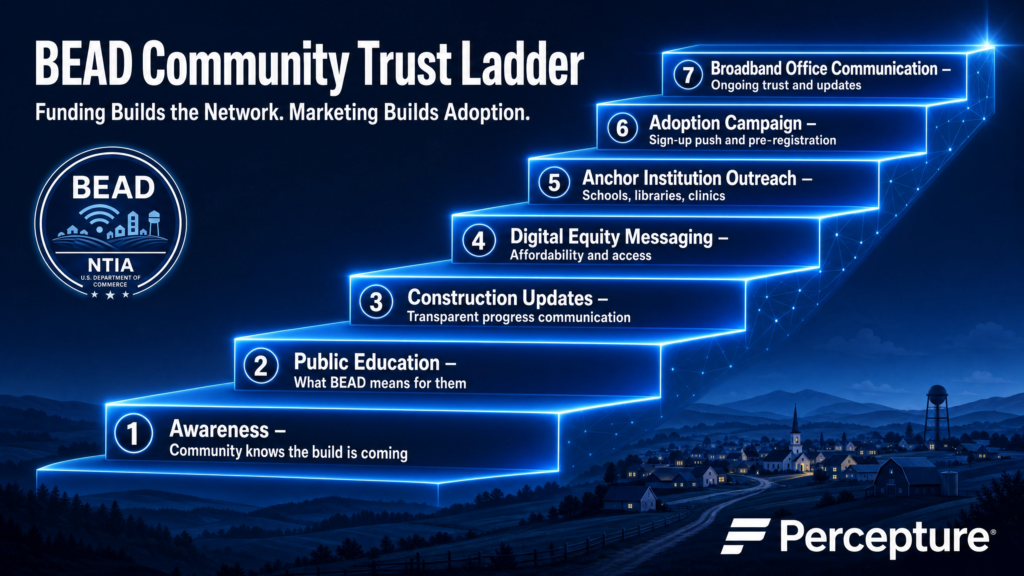
The Trust-to-Adoption Ladder
| Step | What it means | PR job | Conversion job |
|---|---|---|---|
| 1. Funding Clarity | Explain the award and public benefit | Make the announcement plain | Send people to a local project page |
| 2. Physical Network Truth | Explain what is being built and where | Match the message to construction reality | Avoid unserviceable demand |
| 3. Stakeholder Alignment | Brief local leaders before confusion spreads | Give officials usable language | Build referral and credibility paths |
| 4. Construction Transparency | Explain timing, disruption, and updates | Reduce fear and complaints | Capture keep-me-updated interest |
| 5. Serviceability Education | Explain when addresses can buy | Drive address checks | Segment ready and future addresses |
| 6. Adoption Activation | Move residents from awareness to action | Use media, SEO, direct mail, social, and email | Drive pre-registration and installs |
| 7. Proof Compounding | Turn wins into authority | Publish stories, quotes, photos, and local wins | Improve SEO, GEO, sales, and referrals |
Build Your BEAD Trust-to-Adoption Ladder
Turn funding, construction updates, media outreach, local trust, address checks, and install demand into one coordinated communications plan. A BEAD PR strategy gives each phase a message, an audience, and a measurable next step.
Build the BEAD PR PlanBEAD PR Stakeholder Map
A BEAD PR strategy works only when each audience gets a useful version of the truth. Residents need timing and address clarity. Officials need language they can repeat. Sales teams need qualified demand. Field teams need fewer surprises.
Stakeholder message matrix
| Audience | What they need | What they fear | Best message | Best channel |
|---|---|---|---|---|
| Residents | When service is coming | Disruption, cost, confusion | Here is what is being built and how to check your address | Local page, mail, social, town halls |
| Local officials | Credible updates | Angry residents | Here is the timeline and public benefit | Briefings, talking points, media |
| County leaders | Coordination | Being left out | Here is how the provider supports local goals | Direct briefings |
| Schools and libraries | Access and reliability | Delay or unclear benefit | Here is how the project supports community use | Email and local meetings |
| Small businesses | Service availability | Downtime, price, unknown install timing | Here is how to register interest | Landing page, chamber, email |
| Media | Clear local story | Spin or jargon | What is being built, where, when, and why | Press kit and interviews |
| Sales team | Qualified demand | Bad leads | Who is ready now and who needs nurture | CRM and lead scoring |
| Customer service | Accurate answers | Complaint spikes | Approved FAQs and escalation paths | Scripts and knowledge base |
| Field teams | Fewer surprises | Resident frustration | Construction notices and expectation setting | Door hangers and local updates |
BEAD PR Message Architecture
The BEAD PR strategy should change as the project moves from award to construction to serviceability. One message cannot carry every phase.
Award announcement message
Explain what was awarded, where it applies, who benefits, what happens next, and where residents can get updates. Avoid federal shorthand unless it is explained in plain English.
Pre-construction message
Tell residents why crews may be in the area, what work is being done, expected timing, who to contact, and how to get updates. This is where many providers can prevent complaints before they start.
Construction message
Explain what residents may see, how long it may last, what areas are affected, safety notes, access notes, and the update path. Construction disruption should not be treated as an operations issue only.
Serviceability message
Move curiosity into an action. Tell people to check their address, join the update list, pre-register when available, and understand install timing.
Adoption message
Now the message can talk about plans, benefits, installation, local proof, affordability, and customer support. BEAD PR should move the market from awareness to action.
90-Day BEAD PR Strategy Plan
The first 30 days should reduce confusion. The next 30 should build trust. The final 30 should turn trust into measurable demand. A 90-day BEAD PR strategy keeps the team from announcing faster than the market, the network, or the sales process can support.
First 90 days
Days 1-30: Truth, risk, and message
- Serviceability truth map
- Stakeholder map
- Construction risk map
- Local media list
- Public FAQ
- Message house
- Landing page outline
- Sales and customer service scripts
- Local official briefing deck
Days 31-60: Trust and visibility
- Press release
- Local media outreach
- County and city briefing plan
- Community update content
- SEO article or local project page
- Email, direct mail, and SMS language
- Paid retargeting plan
- Digital PR plan
Days 61-90: Adoption and follow-up
- Address-check campaign
- Keep-me-updated campaign
- Pre-registration campaign
- Install push
- CRM routing
- Sales follow-up scripts
- Media proof reuse
- FAQ refresh
- KPI dashboard
Providers that need a wider campaign can connect the PR plan to strategy and planning, content marketing, email marketing, and paid search so the story reaches the right audience at the right time.
Press Release vs Outreach vs PR Strategy
Many broadband teams use the words press release, outreach, and PR strategy as if they mean the same thing. They do not. A BEAD PR strategy is the operating system that decides when each tactic is used and what action it should create.
Which communication tool fits the job?
| Item | What it does | What it cannot do alone | Best use |
|---|---|---|---|
| Press release | Announces a milestone | Build full trust | Award, launch, construction phase |
| Community outreach | Informs stakeholders | Control media and search narrative alone | Meetings, briefings, local updates |
| BEAD PR strategy | Builds trust and narrative | Replace operations | Full communications system |
| Digital PR | Builds authority and links | Replace local outreach | SEO, GEO, earned trust |
| BEAD marketing | Drives demand | Fix unclear messaging | Address checks, installs, subscribers |
How BEAD PR Supports SEO, GEO, and AI Search
If AI search cannot understand the provider, the project, the service area, and the proof, it will not explain the provider clearly when residents or stakeholders ask. That is why the BEAD PR strategy should create crawlable answers, clean entity signals, and reusable proof.
Useful assets include local project pages, structured FAQs, media coverage, official names, service-area language, proof assets, internal links, image alt text, and answer blocks. These assets support both traditional search and AI-search visibility.
Percepture’s work can connect BEAD communication to generative engine optimization services, enterprise SEO, organic SEO services, KeywordIQ, OptiSearch, AutoNURTURE, public relations, and AI media placement capabilities.
How BEAD PR Supports Address Checks, Installs, and Take-Rate
Fiber passings are not revenue. Awareness is not adoption. A BEAD PR strategy should push the market toward the next measurable action.
The practical funnel is simple: funding announcement to local trust, address check, keep-me-updated form, pre-registration, offer, install, subscriber, and referral.
That path needs clean landing pages, CRM routing, lead scoring, sales scripts, and follow-up. For deeper conversion planning, providers can use conversion rate optimization, attribution and analytics, and AI sales agents to capture and route demand after the public message creates interest.
For related strategy, see Percepture’s guides on fiber take-rate marketing, BEAD marketing and subscriber adoption, and ISP marketing strategy.
Common BEAD PR Mistakes
The most expensive BEAD PR strategy mistakes usually start with unclear timing, weak serviceability language, or a poor handoff between PR and operations.
Mistakes to avoid
- Announcing funding without explaining what happens next.
- Using federal language residents do not understand.
- Marketing before serviceability is clear.
- Ignoring local officials until complaints start.
- Treating construction disruption as an operations issue only.
- Letting media coverage die instead of reusing it across SEO, GEO, email, sales, and retargeting.
- Driving interest to a weak landing page.
- Failing to separate ready-now and coming-soon addresses.
- Treating public outreach and subscriber adoption as separate workstreams.
- Waiting until service is live to build trust.
If the team needs a tactical companion, Percepture has related guidance on what BEAD outreach means, the BEAD outreach campaign checklist, and community trust before broadband construction.
BEAD PR KPIs
A BEAD PR strategy needs metrics that show whether trust is turning into action. Do not stop at coverage clips. The goal is not coverage. The goal is trust that turns into adoption.
Scorecard for trust and adoption
| KPI | Why it matters |
|---|---|
| Local media placements | Third-party credibility |
| Local official briefings | Alignment before public pressure |
| Community update engagement | Early trust signal |
| Branded search lift | Awareness and credibility |
| Address checks | Demand capture |
| Keep-me-updated forms | Future subscriber pool |
| Pre-registrations | Sales readiness |
| Install appointments | Revenue movement |
| Customer service questions | Confusion or clarity signal |
| Complaint themes | Risk signal |
| AI search visibility | Future discovery |
| Referrals and testimonials | Proof compounding |
BEAD PR strategy budget and pricing ranges
BEAD PR budgets vary by market size, number of funded areas, stakeholder complexity, construction timing, media needs, and whether the plan includes SEO, digital PR, paid media, direct mail, landing pages, and sales follow-up. A scoped BEAD PR strategy should make those variables explicit before the provider commits to tactics.
Planning ranges
| Program | Typical starting range |
|---|---|
| BEAD PR Message Audit | $2,500-$5,000 |
| BEAD Trust + Outreach Plan | $7,500-$20,000/month |
| BEAD PR + SEO/GEO Content | $7,500-$15,000/month |
| BEAD Subscriber Adoption Campaign | $10,000-$25,000/month |
| Full ISP Growth Engine | Custom |
These are planning ranges, not guarantees. The right scope depends on market size, timeline, media needs, and subscriber-growth goals.
How Percepture Builds BEAD PR Strategy
Percepture builds BEAD PR as a full market-conditioning system. The goal is not just earned media. The goal is to align the public story, local stakeholders, search visibility, AI-search clarity, landing pages, direct outreach, sales follow-up, and adoption reporting around the provider’s real network footprint.
Percepture has ISP-specific planning history and telecom positioning that uses Digital + PR together. The agency’s internal ISP strategy has focused on marketing departments, sales teams, C-suite executives, and investors. That buyer mix matters because BEAD communication is not just a marketing department issue.
In telecom infrastructure, Percepture has used integrated SEO, PR, and digital programs to increase qualified visibility and lead flow for complex connectivity categories. A BEAD PR strategy can use the same integrated discipline while staying grounded in the provider’s funded footprint and construction truth. Related proof resources include the Broadstaff search visibility case study and the Amazon Phantom Ranch digital PR case study.
For broader context, Percepture also publishes strategy resources for ISP marketing agency evaluation and telecom marketing strategy.
BEAD PR Strategy FAQs
What is a BEAD PR strategy?
A BEAD PR strategy is a communications system broadband providers use to explain BEAD-funded projects, align local stakeholders, manage construction questions, earn media trust, and move communities from awareness to adoption. It connects outreach, SEO, digital PR, address checks, CRM follow-up, installs, and subscriber growth.
Why do broadband providers need PR for BEAD projects?
BEAD projects involve public funding, visible construction, local officials, residents, and adoption expectations. Providers need PR to explain what is being built, reduce confusion, brief stakeholders, answer media questions, and create a trusted path from public awareness to address checks and installs.
Is BEAD PR different from BEAD outreach?
Yes. Outreach informs people. PR shapes the public narrative, earns media trust, supports search visibility, builds stakeholder confidence, and connects communication to adoption. A BEAD PR strategy should include outreach, but it should also define the narrative, proof assets, channel plan, and conversion path.
When should BEAD PR start?
BEAD PR should start before construction and before the public starts asking questions. The best time to build trust is before crews arrive, before rumors spread, and before residents search for answers that the provider has not published yet. Starting the BEAD PR strategy early also helps sales, support, and field teams use the same facts.
What should a BEAD press release include?
A BEAD press release should explain the award, project area, public benefit, expected timeline, next step, local contact path, and where residents can get updates. It should avoid jargon and point readers to a local page or address-check path when available.
How does BEAD PR support subscriber adoption?
BEAD PR builds trust, then points people toward measurable actions. The path usually moves from local awareness to address checks, keep-me-updated forms, pre-registration, installation scheduling, customer support, and referral proof. A BEAD PR strategy should not stop at publication.
How should providers communicate construction delays?
Use plain language. Explain the reason for the delay, the affected area, the updated timeline, what residents should expect next, and when the next update will be shared. Avoid vague promises. Specific updates protect trust.
Should BEAD PR include SEO and GEO?
Yes. Residents, officials, media, and AI engines need clear crawlable answers. SEO and GEO help the provider publish project pages, FAQs, proof, service-area language, and structured content that can be found, understood, and reused. The BEAD PR strategy should make those assets part of the communications plan from the start.
What KPIs measure BEAD PR?
Useful KPIs include local media placements, stakeholder briefings, community update engagement, branded search lift, address checks, keep-me-updated forms, pre-registrations, install appointments, customer service questions, complaint themes, AI search visibility, and referrals.
How much does BEAD PR cost?
Costs depend on market size, stakeholder complexity, construction timing, media needs, and whether the plan includes SEO, GEO, paid media, direct mail, landing pages, and sales follow-up. Planning ranges may start around $2,500 for an audit and rise into monthly programs.
Make the Market Ready Before the Network Is Ready
A BEAD-funded network still needs trust, clarity, demand capture, and follow-up. Percepture helps broadband providers connect BEAD PR strategy, SEO, GEO, paid media, outreach, and subscriber adoption.
BEAD funding can build the network. Trust helps the market use it. Percepture helps broadband providers build that trust before the market defines the story for them.
Get a BEAD Trust & PR Audit
About Bob Generale
Bob Generale is President of Percepture, a digital marketing and PR agency founded in 2004. He leads strategy across PR, SEO, GEO, paid media, content, analytics, and growth programs for companies that need clear market positioning and measurable demand.