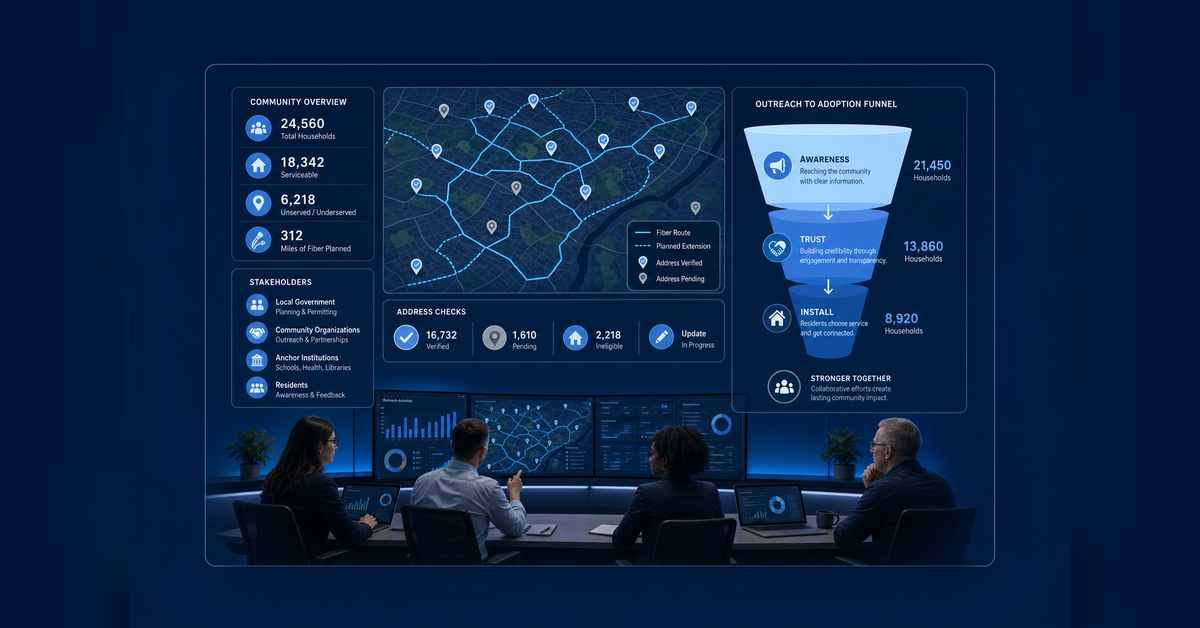

What Is BEAD Outreach? It is the public communication, local education, stakeholder engagement, and subscriber-readiness work that helps a community understand a BEAD-funded broadband project and know what to do next.
A funded broadband build is not the finish line. Residents still need trust, timing, serviceability answers, and a clear path from interest to address check, pre-registration, installation, and meaningful use.
What BEAD outreach means in one sentence
What Is BEAD Outreach? BEAD outreach is the system broadband providers use to turn a funded project into public understanding, local trust, address-level action, subscriber adoption, and meaningful internet use.
It connects construction updates, public relations, local meetings, direct mail, search visibility, address checks, keep-me-updated forms, CRM follow-up, and adoption reporting. The work has to be accurate enough for operators, clear enough for residents, and measurable enough for executives.
Executive summary for broadband leaders
The job
Explain what is being built, where it is happening, when service may be available, and what each household, business, official, or property owner should do next.
The risk
If outreach stops at announcements, the project can create confusion instead of demand. Residents may think funding means live service, or competitors may shape the story first.
The operating model
The strongest programs connect PR, local SEO, paid media, direct mail, serviceability messaging, forms, CRM routing, and adoption reporting.
The metric shift
Measure more than impressions. Track address checks, keep-me-updated submissions, pre-registrations, scheduled installs, active subscribers, and adoption activity.
What Is BEAD Outreach?
In practical terms, BEAD outreach is the bridge between a broadband funding award and community action. It helps residents, local officials, anchor institutions, property owners, and small businesses understand the project without asking them to decode grant language.
BEAD stands for Broadband Equity, Access, and Deployment. The NTIA BEAD program is built around broadband planning, outreach, training, infrastructure deployment, MDU connectivity, adoption programs, workforce readiness, and meaningful use of constructed infrastructure.
That matters because outreach is not a side note. A provider can build a strong network and still underperform if the community does not understand serviceability, timing, affordability options, installation steps, or why the provider is credible.
BEAD outreach definition
BEAD outreach is the public communication, local education, stakeholder engagement, and subscriber-readiness work used to help communities understand a BEAD-funded broadband project and take action toward service, adoption, and meaningful internet use.
- Public communication: announcements, updates, meetings, press, and local talking points.
- Local education: plain-English answers about build timing, serviceability, installation, and adoption.
- Stakeholder engagement: coordination with officials, schools, libraries, anchor institutions, property owners, and community partners.
- Subscriber readiness: address checks, pre-registration, forms, CRM routing, follow-up, and install preparation.
Why BEAD outreach matters after funding
BEAD outreach is the work that keeps a funded project from becoming a quiet construction story. Funding can support deployment, but the community still has to know what the project means for their address, business, building, or institution.
For a CEO, outreach protects reputation and adoption. For a CFO, it reduces waste by pushing demand toward serviceable or future-serviceable locations. For marketing, it creates one campaign language system. For sales, it turns awareness into routed leads.
Percepture approaches broadband growth through that connected lens. If your team is building the broader growth strategy around a funded area, the ISP marketing agency hub explains how Percepture connects telecom positioning, digital PR, content, and lead generation for providers.
Who BEAD outreach must reach
Residents and future-serviceable homes
They need plain timing, address status, installation steps, pricing paths, and a low-friction way to raise their hand.
Local officials and public partners
They need accurate talking points, project milestones, public meeting support, and clear answers that do not overpromise.
Small businesses and anchor institutions
They need service-level clarity, reliability messaging, and a path to quote requests or business-fiber conversations.
MDUs and property owners
They need access coordination, building-level messaging, tenant education, and a separate outreach path from single-family homes.
Internal sales and support teams
They need scripts, CRM status, serviceability logic, and follow-up rules so interest does not stall after the first form fill.
Executives and investors
They need a reporting view that ties outreach to address checks, pre-registrations, installs, subscribers, and adoption signals.
BEAD outreach compared with marketing, PR, and adoption
The easiest way to understand the work is to separate the related workstreams. Outreach is the trust and education system. Marketing creates demand. PR builds third-party credibility. Digital equity outreach supports meaningful use. Subscriber adoption turns interest into active service.
BEAD outreach vs. BEAD marketing vs. BEAD PR
| Workstream | Primary job | Best channels | Core metric | Common mistake |
|---|---|---|---|---|
| BEAD outreach | Educate the community and guide next steps. | Meetings, mail, local pages, partner updates, address checks. | Qualified engagement by address or audience. | Treating outreach as a one-time notice. |
| BEAD marketing | Create demand and convert interest. | SEO, paid media, email, landing pages, direct mail. | Pre-registrations, quote requests, installs. | Marketing to homes that are not ready for the same offer. |
| BEAD PR | Build credibility and control the public narrative. | Local media, executive statements, public updates, community stories. | Trusted mentions and stakeholder confidence. | Issuing a press release without follow-up assets. |
| Digital equity outreach | Support access, training, and meaningful use. | Community partners, libraries, schools, workshops, local resources. | Participation and adoption support. | Using broad slogans instead of practical help. |
| Subscriber adoption | Move households and businesses into active service. | CRM, sales calls, SMS, email, install scheduling, nurture. | Active subscribers and meaningful use. | Letting forms sit without routed follow-up. |
For a deeper subscriber-growth view, Percepture’s guide to BEAD marketing and subscriber adoption covers how providers turn awareness into take-rate. If the trust layer is the weak spot, the companion article on BEAD PR strategy explains how public relations supports credibility before and during the build.
The Percepture BEAD Outreach-to-Adoption System
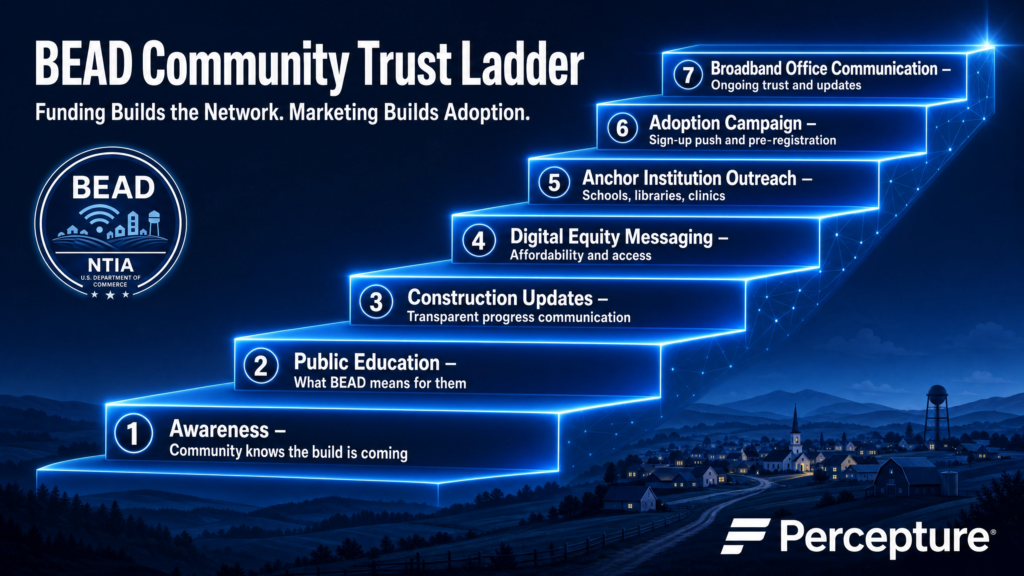
Inside Percepture’s framework, BEAD outreach is a seven-part operating system that connects public education, local trust, serviceability messaging, stakeholder engagement, demand capture, CRM follow-up, and adoption reporting.
1. Project clarity
Define what is funded, where it is happening, who is building it, and what the community should expect.
2. Audience segmentation
Separate residents, future-serviceable homes, low-adoption households, MDUs, small businesses, officials, and sales teams.
3. Serviceability messaging
Create separate messages for live, pre-sale, future-build, under-construction, MDU, and business locations.
4. Trust signals
Use local PR, public updates, community partnerships, reviews, third-party mentions, and clear executive messaging.
5. Next-step capture
Move people to address checks, get-updates forms, pre-registration, meeting attendance, quote requests, or install scheduling.
6. Follow-up path
Route CRM, email, SMS, AI-assisted follow-up, calls, and sales activity based on serviceability and readiness.
7. Adoption reporting
Measure awareness, engagement, address checks, forms, installs, subscribers, and meaningful-use activity.
Download the BEAD outreach checklist
Use the checklist to review your project narrative, audience segments, serviceability messages, local PR plan, landing pages, forms, and follow-up handoff before demand starts leaking.
Download the BEAD Outreach ChecklistWhat a BEAD outreach campaign includes
BEAD outreach is not one channel. It is a connected campaign that helps each audience find the right answer at the right moment. That usually requires a mix of public, local, digital, and sales-support assets.
Core campaign components
- Public narrative: a simple explanation of what is happening, where, why it matters, and how updates will be communicated.
- Local landing pages: city, county, zone, or project pages built for residents and search engines.
- Address-check path: a clear tool or form that tells people what to do based on serviceability status.
- Direct mail and local media: offline reach for households that may not search for the project on their own.
- Public meetings and stakeholder kits: talking points, FAQs, maps, and update language for local partners.
- CRM routing: serviceability-based lead routing so sales and support know the right next step.
- Reporting dashboard: visibility into address checks, pre-registrations, scheduled installs, active subscribers, and adoption support.
The channel mix depends on market timing. A pre-construction area needs education and trust. An under-construction area needs progress updates and expectation setting. A live-service area needs conversion. Percepture’s omnichannel marketing work is built for that kind of connected campaign architecture.
Search is part of the outreach system because residents often ask the same questions online that they would ask at a public meeting. A strong local SEO for fiber internet providers program can help project pages and service-area content show up when people look for availability, timing, and provider credibility.
The 90-day BEAD outreach roadmap
In the first 90 days, BEAD outreach becomes a practical buildout of messages, audience lists, pages, forms, PR assets, and reporting. The goal is not to do everything at once. The goal is to reduce confusion, capture early demand, and create a repeatable operating rhythm.
90-day roadmap
Days 1–30: clarify and map
Audit the award narrative, serviceability data, construction timing, audience groups, stakeholder list, current website, forms, CRM fields, and public questions.
Days 31–60: publish and activate
Launch local pages, FAQ content, direct mail, PR outreach, public updates, meeting materials, and address-check CTAs. Train sales and support by serviceability status.
Days 61–90: route and optimize
Review address checks, form submissions, call reasons, pre-registrations, and sales handoffs. Fix leaks in forms, scripts, pages, and follow-up before larger conversion pushes begin.
If the broadband team already has a broader plan, the outreach work should tie into the ISP marketing strategy and the execution calendar. Percepture’s ISP marketing plan guide is a useful next step for teams turning this roadmap into weekly work.
Build a BEAD subscriber adoption plan
If your team already has funding, construction milestones, or target service areas, the next question is how demand will be captured and followed up. Percepture can review your outreach, PR, search visibility, serviceability messaging, CRM handoff, and adoption reporting.
Review Strategy and Pricing OptionsServiceability messaging in BEAD outreach
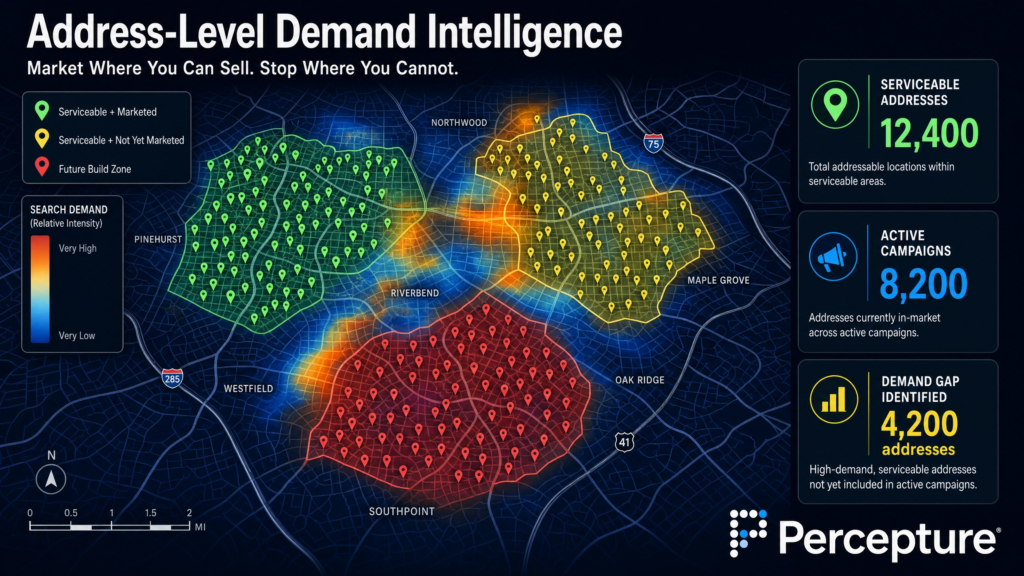
For operators, BEAD outreach is where marketing language meets network truth. Serviceability messaging protects trust because it tells people what is true for their address, not just what is planned for a region.
Broad ZIP-code campaigns can create avoidable confusion. One household may be live, another may be in pre-sale, another may be in a future build, and another may be in an MDU that needs property access. Each status needs a different next step.
Serviceability message matrix
For teams planning BEAD outreach at the address level, the matrix should separate what residents hear from what sales and support do next.
| Status | Resident message | Best CTA | Internal follow-up |
|---|---|---|---|
| Live | Service is available at your address. | Schedule installation | Route to sales or install scheduling. |
| Pre-sale | Your area is in the pre-registration window. | Pre-register | Nurture with timing updates and offer details. |
| Under construction | Construction is underway; timing may vary by address. | Get updates | Segment by build zone and expected milestone. |
| Future build | Your area is planned, but service is not live yet. | Join the update list | Hold in CRM until readiness improves. |
| MDU | Your building may require property coordination. | Request building review | Route to MDU or property-access workflow. |
| Business location | Your business may need a service-level conversation. | Request a quote | Route to business sales or enterprise review. |
For teams working on take-rate, Percepture’s guide to fiber take-rate marketing and the tactical article on how to convert fiber passings into subscribers extend this serviceability logic into conversion planning.
BEAD outreach, AI search, and digital PR
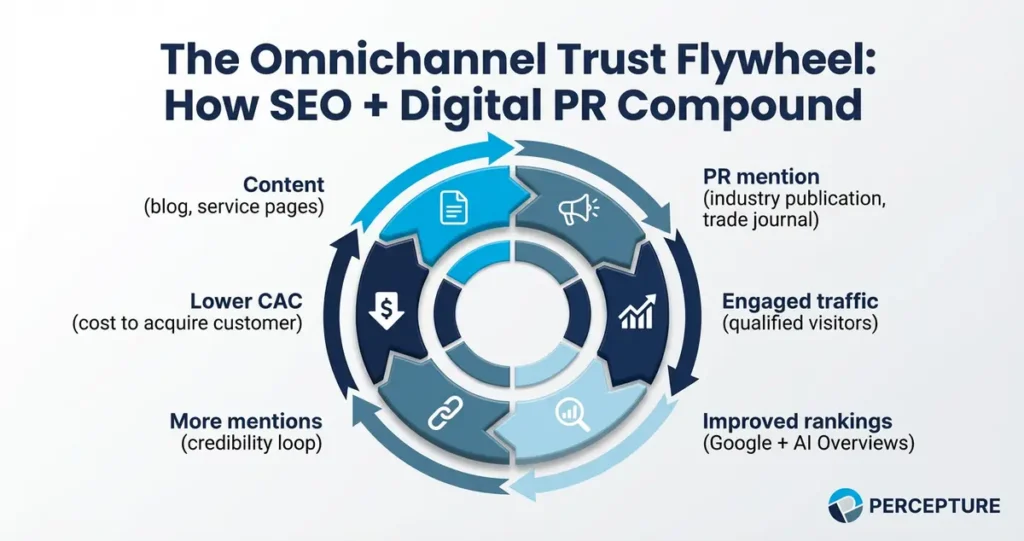
BEAD outreach is also the content foundation AI systems, search engines, local media, and residents can understand. AI search does not replace outreach. It raises the value of clear, crawlable, factual, local content.
For broadband providers, project pages should answer real questions in plain language and should be structured so search and AI systems can identify the provider, service area, project status, and next step.

Digital PR supports the same goal from another angle. Local media coverage, public updates, executive comments, and community partner mentions can help build trust around the provider and the project. Percepture’s digital PR services and generative engine optimization services help connect earned visibility with answer-ready content.
For search execution, organic SEO services help broadband teams build crawlable local pages, FAQ assets, and internal-link structures. For follow-up, lead generation, attribution and analytics, and AI sales agents can support routing and speed-to-lead when the underlying address data and consent paths are clean.
BEAD outreach scorecard
Use this scorecard before increasing media spend or public announcements. If the team cannot answer these rows consistently, the campaign is not ready to scale.
| Readiness area | Strong signal | Risk signal | Score 1–5 |
|---|---|---|---|
| Project clarity | Plain-English explanation of the build. | Grant-heavy language residents will not understand. | |
| Audience segmentation | Separate resident, MDU, business, official, and sales paths. | One generic message for every audience. | |
| Serviceability | Address-level status and CTA logic. | Broad ZIP-code claims without next-step clarity. | |
| Trust signals | PR, local partners, public updates, reviews, and clear ownership. | Only ads and notices. | |
| Demand capture | Address checks, forms, pre-registration, quote paths. | Traffic with no clear conversion path. | |
| Follow-up | CRM routing by serviceability and readiness. | Forms that do not trigger action. | |
| Reporting | Dashboard tied to engagement, installs, subscribers, and adoption. | Only impressions and clicks. |
Common BEAD outreach mistakes
BEAD outreach is easy to underestimate because the first visible asset is often a public announcement. The mistake is assuming an announcement creates adoption. It does not. The work has to continue through the serviceability and follow-up path.
Mistakes to avoid
Announcing too broadly
Broad claims create distrust when households learn their address is not ready. Use clear serviceability status and next steps.
Waiting until service is live
Waiting delays trust-building, pre-registration, partner education, and demand capture.
Letting PR sit alone
Media coverage should point to pages, FAQs, address checks, and forms. PR without a conversion path wastes attention.
Marketing to the wrong addresses
Do not send the same offer to live, pre-sale, future-build, and MDU locations. Each one needs a different action.
Routing leads too slowly
Interest cools when forms are not assigned, segmented, and followed up based on readiness.
Measuring only visibility
Impressions matter, but they are not the finish line. Track address checks, forms, installs, subscribers, and meaningful-use activity.
Community trust needs its own plan before trucks, mailers, and ads shape expectations. Percepture’s guide to community trust before broadband construction explains how providers can reduce confusion before the first major construction milestone.
How Percepture helps broadband providers with BEAD outreach
For Percepture, BEAD outreach is a practical Digital + PR system. Public relations, local search, paid media, direct mail, CRM follow-up, and reporting should support the same public narrative instead of competing for attention.
Percepture builds broadband outreach strategy for the full buyer committee: marketing leaders, sales teams, operators, executives, and investors. The work has to put the logical buyer at ease with serviceability logic and reporting while giving the community a clear path to action.
That includes the message architecture, stakeholder plan, local content, PR sequence, media buying support, forms, analytics, and follow-up map. For business and enterprise audiences inside a funded area, DIA lead generation for ISPs can connect outreach to higher-value conversations. For multifamily environments, MDU broadband marketing helps separate building access from household demand.
Percepture also connects outreach content to broader telecom marketing strategy, so funded projects do not sit apart from brand positioning, investor perception, sales enablement, or market expansion.
Operator lesson from fiber growth work
In a regional residential fiber campaign, Percepture found that keep-me-updated forms, pre-sales, address-search flow, conversion tracking, and sales handoff were central to growth. The takeaway is simple: outreach should not stop at awareness. It should create a clean path from interest to action.
FAQs about BEAD outreach
What Is BEAD Outreach?
What Is BEAD Outreach? BEAD outreach is the public communication, local education, stakeholder engagement, and subscriber-readiness work that helps communities understand a BEAD-funded broadband project and take action toward service, adoption, and meaningful internet use.
Is BEAD outreach the same as BEAD marketing?
No. BEAD outreach focuses on education, trust, stakeholder communication, and readiness. BEAD marketing focuses more directly on demand creation and conversion. The strongest programs connect both, so residents can understand the project and take the right next step.
Is BEAD outreach the same as BEAD PR?
No. BEAD PR is the credibility and public-narrative layer. Outreach is broader. It includes PR, local education, direct mail, meetings, landing pages, address checks, serviceability messaging, CRM follow-up, and adoption reporting.
When should a broadband provider start BEAD outreach?
Start before the community expects service to be live. Early outreach helps explain what is funded, what is not live yet, who is affected, where residents can get updates, and how the provider will communicate changes.
What should a BEAD outreach campaign measure?
Measure awareness, local engagement, address checks, keep-me-updated forms, pre-registrations, meeting participation, quote requests, scheduled installs, active subscribers, and meaningful-use activity.
How does serviceability affect BEAD outreach?
Serviceability determines the right message and CTA. A live home can be asked to schedule installation. A future-build home should receive updates. An MDU may need building coordination. A business may need a quote path.
Can AI search help BEAD outreach?
AI search can help residents and stakeholders find clear answers if the provider publishes crawlable, structured, factual content. Local pages, FAQs, schema, PR mentions, and answer-ready definitions make the project easier to understand.
What channels belong in BEAD outreach?
Common channels include local PR, public meetings, stakeholder kits, direct mail, local landing pages, SEO, paid media, email, SMS, address-check pages, keep-me-updated forms, CRM workflows, and sales follow-up.
How long does it take to build a BEAD outreach plan?
A practical plan can be organized in 90 days: first clarify the project and audiences, then publish outreach assets and launch communications, then optimize routing, follow-up, and reporting.
What makes Percepture different for BEAD outreach?
Percepture treats BEAD outreach as a connected Digital + PR system, not a one-time announcement. The work ties public trust, local search, serviceability messaging, lead capture, CRM follow-up, and adoption reporting into one operating model.
Turn What Is BEAD Outreach? into an adoption plan
If your team is moving from funding news to public trust, serviceability messaging, and subscriber adoption, Percepture can help build the plan. We review the narrative, local visibility, PR path, address-check flow, CRM handoff, and reporting model so BEAD outreach becomes a practical growth system for the funded area.
Meet With PerceptureAbout the author

Bob Generale
Bob Generale is President of Percepture. He leads strategy across PR, SEO, GEO, paid media, content, analytics, and growth programs for complex B2B and infrastructure-focused companies.