


What Is Fiber Take Rate? It is the percentage of serviceable fiber locations that become active subscribers. It is one of the most important growth metrics for internet service providers because it shows whether fiber passings are turning into revenue.
A fiber provider can pass thousands of homes and still miss its growth target. Passings show where the network can sell. Take rate shows whether the market knows, trusts, checks availability, signs up, schedules installation, and becomes a subscriber.
What Is Fiber Take Rate?
What Is Fiber Take Rate? Fiber take rate is the percentage of serviceable fiber passings that become subscribers. The formula is: active subscribers ÷ serviceable passings × 100. If a fiber provider passes 10,000 homes and 3,000 subscribe, the take rate is 30%.
The fiber take-rate formula
Fiber Take Rate = Active Subscribers ÷ Serviceable Fiber Passings × 100
Example: 3,000 subscribers ÷ 10,000 serviceable passings × 100 = 30% fiber take rate.
For operators asking What Is Fiber Take Rate?, the formula is only reliable when both sides of the equation use the same service area and reporting window.
- Use active subscribers, not total leads.
- Use serviceable passings, not total market population.
- Use the same geography and time period for both numbers.
The executive readout
The metric
Fiber take rate measures the share of serviceable fiber locations that become subscribers. What Is Fiber Take Rate? It is the adoption score behind the build.
The formula
Divide subscribers by serviceable passings, then multiply by 100.
The business point
Passings show network opportunity. Subscribers show revenue.
The warning sign
Low take rate can come from weak awareness, poor trust, offer confusion, slow follow-up, install friction, or strong competition.
The growth lever
Marketing can improve take rate by driving address checks, pre-registrations, installs, referrals, and local proof.
The operating view
The best reporting breaks results down by market, neighborhood, campaign, and serviceability status. That is the practical answer to What Is Fiber Take Rate? inside an operating review.
Who this guide is for
Executives
CEOs, founders, CFOs, and private equity operating partners use take rate to connect network investment to subscriber revenue. For this group, What Is Fiber Take Rate? is a capital-efficiency question, not just a marketing definition.
Commercial teams
CMOs, VP Marketing leaders, and VP Sales leaders use it to judge whether demand is becoming installs, not just traffic. What Is Fiber Take Rate? gives them a shared measure for serviceable demand.
Broadband operators
Regional ISPs, municipal networks, BEAD-funded teams, and FTTH providers use take rate to measure adoption by market.
Strategy teams
Teams building an ISP marketing agency plan need a clean definition before they build a growth system. The first definition to align on is What Is Fiber Take Rate?
Get the Fiber Take-Rate Calculator
If you are asking What Is Fiber Take Rate?, the next step is to calculate your own number by market. Use the formula, then compare passings, address checks, installs, and subscribers in the same geography.
What Is Fiber Take Rate? becomes actionable when the calculator shows which markets are converting and which ones need deeper diagnosis.
What Is Fiber Take Rate?
Fiber take rate is the percentage of serviceable fiber passings that become paying subscribers. ISPs, fiber providers, investors, and broadband operators use it to measure whether a network build is converting into customer adoption.
A fiber passing means the network can potentially serve a home, business, or building. A subscriber means someone actually bought and activated the service. Take rate connects those two numbers.
If a provider can serve 10,000 homes and 3,000 homes subscribe, the provider has a 30% take rate. That is why What Is Fiber Take Rate? is not just a glossary question. It is a business question about whether availability is becoming revenue.
Passings show the opportunity. Take rate shows whether the opportunity is converting. A passing is not a subscriber, and a marketable address is not revenue until the buyer completes the path to activation.
Fiber Take Rate Formula and Calculation Rules
When a team asks What Is Fiber Take Rate?, these three inputs keep the answer consistent across finance, marketing, sales, and operations.
| Element | Meaning | Operator note |
|---|---|---|
| Active subscribers | Customers who have purchased and activated service. | Do not count raw leads, site visitors, or abandoned address checks. |
| Serviceable passings | Locations the network can serve now or through a clear activation path. | Do not use total market population unless every location is serviceable. |
| Multiply by 100 | Turns the ratio into a percentage. | Use the same geography and time period for both numbers. |
Clean data matters. If one team counts passed homes, another counts marketable addresses, and another counts install-ready locations, the number can mislead the team. Before you debate performance, agree on the denominator.
This is where operators should connect the metric to attribution and analytics. The math is simple. The data discipline behind the math is where many providers lose clarity.
Fiber Take Rate Examples
The examples below show how the formula works. They are scenarios, not universal benchmarks. They also show why What Is Fiber Take Rate? should be answered with market context.
| Scenario | Serviceable Passings | Subscribers | Take Rate | What It Means |
|---|---|---|---|---|
| New launch market | 10,000 | 1,000 | 10% | Early adoption. The provider likely needs more awareness, trust, address checks, and follow-up. |
| Growing fiber market | 10,000 | 3,000 | 30% | The market is converting, but neighborhood-level adoption may still have room to improve. |
| Mature competitive market | 10,000 | 4,500 | 45% | Strong adoption in this scenario, while churn, referrals, and cost per subscriber still matter. |
| Weak conversion market | 10,000 | 500 | 5% | The provider may have an awareness, trust, offer, pricing, install, or sales follow-up problem. |
| Expansion market | 25,000 | 5,000 | 20% | The provider should segment results by neighborhood, serviceability status, and campaign. |
What Is Fiber Take Rate? In practical reporting, it is a conversion score between serviceable network availability and subscriber activation. That is why the same top-line number can mean different things in a new launch, an underserved market, an MDU-heavy footprint, or a cable-competitive area.
Fiber Passings vs. Subscribers vs. Take Rate
| Term | Meaning | Why It Matters |
|---|---|---|
| Fiber passing | A location the network passes and may be able to serve. | Shows opportunity. |
| Serviceable passing | A location that can actually receive service now or within a clear activation path. | Shows realistic sales inventory. |
| Marketable address | A location the provider can promote to based on serviceability and campaign rules. | Shows where marketing should focus. |
| Address search | A buyer checks whether service is available at their address. | Shows active buying intent. |
| Pre-registration | A buyer expresses interest before service is active. | Shows future demand. |
| Install scheduled | The buyer has moved from interest to action. | Shows near-revenue conversion. |
| Subscriber | The customer has activated service. | Shows revenue. |
| Take rate | Subscribers divided by serviceable passings. | Shows adoption efficiency. |
The passing is the opportunity. The address check is the intent. The install is the handoff. The subscriber is the revenue.
Those terms also help prevent bad decisions. A provider can celebrate address checks too early, panic over passings too soon, or spend against the wrong geography if serviceability data is not aligned with campaign targeting.
This distinction is central to What Is Fiber Take Rate? because the metric should measure subscriber adoption from locations that can actually buy.
Why Fiber Take Rate Matters
What Is Fiber Take Rate? It is the metric that connects infrastructure investment to revenue. A provider can spend heavily to build a network, but the return depends on how many serviceable locations become paying subscribers.
For a CEO, take rate shows whether the growth strategy is working. For a CFO, it connects network investment, acquisition cost, revenue, and payback. For a VP Marketing leader, it shows whether campaigns are creating serviceable demand, not just clicks.
For sales and operations, take rate shows whether leads, address checks, and install appointments are moving through the system. For investors and municipal stakeholders, it helps explain whether broadband access is turning into adoption.
A network build creates potential. Take rate measures how much of that potential becomes revenue.
What Is a Good Fiber Take Rate?
A good fiber take rate depends on market maturity, competition, time since launch, product quality, price, brand trust, install capacity, local awareness, and the buyer segment. Residential fiber, MDU broadband, business fiber, and DIA do not move through the same sales path.
Do not force one universal benchmark onto every market. A new launch market may have a lower take rate than a mature market. An underserved area may behave differently from a market with cable, fixed wireless, contracts, bundles, and switching friction.
Instead of asking only What Is Fiber Take Rate?, operators should ask where the number is strong or weak. Compare take rate by neighborhood, time since launch, campaign, offer, competitor environment, serviceability status, acquisition cost, install completion, and churn risk.
For launch-market planning, the guide on how to market fiber internet in a new service area explains why timing, trust, and pre-registration need to match construction readiness.

What Affects Fiber Take Rate?
What Is Fiber Take Rate? is answered by the formula, but the drivers below explain why one market converts and another stalls.
| Driver | How it affects adoption | What to inspect |
|---|---|---|
| Serviceability accuracy | If campaigns target addresses that cannot buy, spend is wasted and trust breaks. | Address-level suppression, eligibility rules, install-ready status. |
| Local awareness | People cannot buy fiber if they do not know it is available. | Branded search, direct mail reach, local SEO, community mentions. |
| Brand trust | New providers must overcome switching risk and skepticism. | Reviews, local PR, customer education, construction communication. |
| Competitive environment | Cable, fixed wireless, pricing, contracts, and bundles shape buyer behavior. | Competitor offers, contract friction, speed claims, local sentiment. |
| Offer clarity | Confusing tiers, equipment terms, and install details reduce conversion. | Pricing pages, landing pages, call scripts, FAQs. |
| Address-check experience | A hidden or slow availability checker loses high-intent buyers. | CTA placement, page speed, form friction, mobile path. |
| Install readiness | Marketing can create demand, but operations must convert scheduled installs. | Appointment availability, reschedules, missed calls, completion rate. |
| Follow-up speed | Slow follow-up can lose buyers who already raised their hand. | CRM routing, speed-to-lead, email, SMS, phone follow-up. |
| Churn and retention | Subscriber growth is weaker if new customers leave quickly. | Onboarding, first bill experience, support tickets, reviews. |
These drivers are why ISP marketing strategy should start with serviceability truth. If a campaign promises what operations cannot deliver, the marketing number may look busy while the take-rate number stays weak.
What Is Fiber Take Rate? A Comparison Framework for Benchmarks, Budget, and Risk
What Is Fiber Take Rate? It is also a way to decide where growth budget should go. Spend should follow the weakest link in the passings-to-subscribers chain, not the loudest channel in the room.
| Take-rate problem | Budget should favor | Risk if ignored |
|---|---|---|
| Low awareness in serviceable areas | Local SEO, PR, direct mail, paid search, and neighborhood education. | The market does not know it can buy. |
| High traffic but few address checks | Conversion-rate optimization, clearer offers, better landing pages, and simpler availability checks. | Demand leaks before intent is captured. |
| Many address checks but few installs | CRM routing, sales follow-up, AI-assisted reminders, and install scheduling support. | High-intent buyers stall before revenue. |
| Low trust in a new market | Digital PR, reviews, community proof, construction communication, and local FAQs. | Buyers stay with incumbents even when fiber is available. |
| Non-serviceable demand | Keep-me-updated workflows, pre-registration, and future-build nurture. | Future demand is lost instead of captured. |
Fiber Take Rate vs. Adoption Rate vs. Penetration Rate
These terms are related, but they are not the same. A provider can have strong website conversion and still have weak take rate if campaigns are not reaching enough serviceable addresses.
For teams asking What Is Fiber Take Rate?, the most important distinction is that take rate uses serviceable passings as the denominator.
| Term | Simple Meaning | Best Use |
|---|---|---|
| Fiber take rate | Subscribers divided by serviceable fiber passings. | Measuring fiber network conversion. |
| Broadband adoption rate | The share of people or households using broadband service in a market. | Community, policy, and access discussions. |
| Market penetration | The provider’s share of a defined market or customer base. | Competitive market analysis. |
| Conversion rate | The percentage of visitors or leads who take a desired action. | Website, campaign, and funnel optimization. |
| Pre-registration rate | The percentage of target addresses or interested buyers who sign up before service is live. | Launch planning and demand forecasting. |
The Fiber Passings-to-Subscribers Funnel
What Is Fiber Take Rate? In funnel terms, it is the outcome of moving a serviceable location from passing to awareness, trust, address search, pre-registration, offer selection, install scheduling, activation, and referral.
This is the bridge from definition to strategy. Take rate is not improved by one tactic. It improves when the full conversion path works.
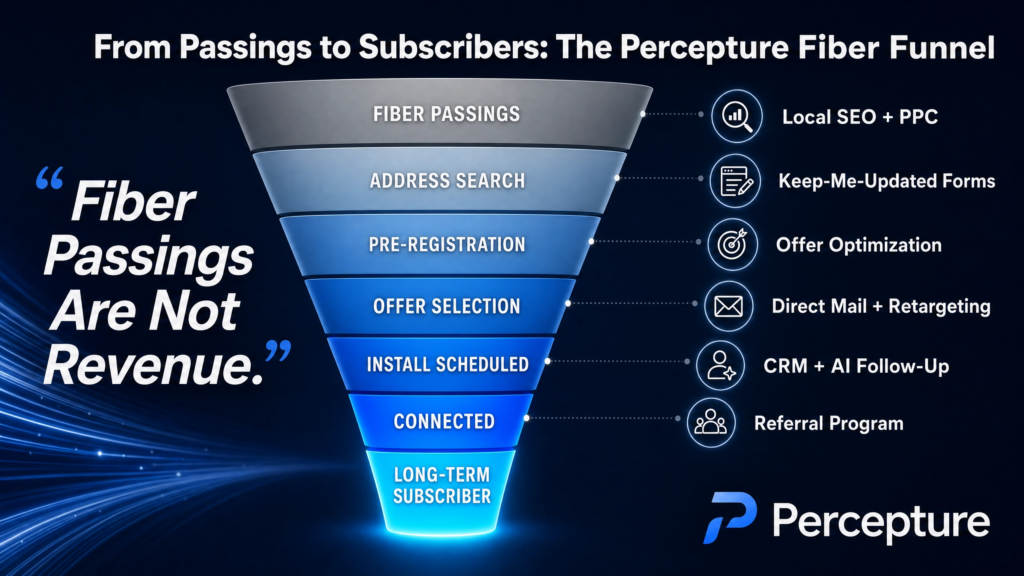
Teams that need the tactical path should use this definition article with Percepture’s guide on how to convert fiber passings into subscribers. The definition tells you what to measure. The funnel tells you where to act.
Fiber Take Rate KPI Dashboard
What Is Fiber Take Rate? should show up as one KPI in a larger dashboard, because the surrounding measures explain the movement behind the percentage.
| KPI | What It Measures | Why It Matters | Review Cadence |
|---|---|---|---|
| Total passings | Total locations the network passes. | Defines the potential market. | Monthly |
| Serviceable passings | Locations that can actually buy. | Defines realistic sales inventory. | Weekly or monthly |
| Active subscribers | Current paying customers. | Defines adoption and revenue. | Weekly or monthly |
| Fiber take rate | Subscribers divided by serviceable passings. | Shows market conversion. | Monthly |
| Address searches | Availability checks from prospects. | Shows demand and buying intent. | Weekly |
| Serviceable address searches | Checks from addresses that can buy. | Shows quality of demand. | Weekly |
| Pre-registrations | Interest before service is live. | Shows launch demand. | Weekly |
| Install appointments | Scheduled installs. | Shows movement toward revenue. | Weekly |
| Install completion rate | Completed installs divided by scheduled installs. | Shows operational conversion. | Weekly |
| Cost per install | Marketing spend divided by completed installs. | Shows acquisition efficiency. | Monthly |
| Churn | Subscribers lost over time. | Shows whether growth is durable. | Monthly |
| Referral rate | Subscriber-driven new interest. | Shows local proof and satisfaction. | Monthly |
A good ISP marketing plan should turn these KPIs into a standing operating review. If the team only looks at traffic, spend, and leads, it may miss the real revenue leak.
Why Is My Fiber Take Rate Low?
What Is Fiber Take Rate? The answer tells you the number. The diagnosis tells you why the number is not moving.
| Symptom | Likely Cause | What To Check | Next Step |
|---|---|---|---|
| Low awareness | People do not know fiber is available. | Branded search, direct traffic, local SEO, direct mail reach. | Launch awareness, PR, direct mail, and local SEO. |
| High traffic but few address checks | Website or landing page is not converting. | CTA placement, page speed, offer clarity, form friction. | Fix the address-check path and landing page. |
| Many address checks but few subscribers | Follow-up or install process is weak. | CRM routing, response time, install scheduling. | Improve speed-to-lead and install workflow. |
| Many non-serviceable searches | Demand exists outside the footprint. | Geography and future build plans. | Capture keep-me-updated leads and nurture. |
| High pre-registration but low activation | Launch communication or install readiness is weak. | Construction timing and customer updates. | Send launch updates and install prompts. |
| Strong leads but weak installs | Sales handoff or operations bottleneck. | Missed calls, appointment availability, reschedules. | Fix sales routing and scheduling. |
| Low trust | Market is skeptical. | Reviews, PR, community sentiment, complaints. | Build proof, reviews, education, and local PR. |
| High acquisition cost | Targeting is inefficient. | Serviceability suppression, paid search waste, direct mail targeting. | Rebuild campaigns around address-level data. |

How Marketing Improves Fiber Take Rate
Marketing improves take rate when it turns awareness into address checks, address checks into installs, and installs into subscribers. That work spans search, PR, paid media, direct mail, landing pages, CRM, follow-up, reviews, and referrals.
What Is Fiber Take Rate? For marketing teams, it is the metric that keeps activity honest. Traffic alone is not enough. Leads alone are not enough. The question is whether serviceable locations are becoming paying subscribers.
Local SEO builds service area pages, fiber availability pages, comparison pages, installation explainers, and local FAQs. Percepture’s guidance on local SEO for fiber internet providers goes deeper on that channel, while organic SEO services support the broader search architecture.
GEO and AI search visibility make the provider easier for answer engines to understand and cite. That work includes clear definitions, entity language, FAQs, schema, proof, and clean service-area signals. Percepture’s generative engine optimization services help connect SEO structure with AI-search retrievability.

Paid search captures high-intent demand from buyers searching for fiber internet, high-speed internet, business fiber, DIA, and availability. Percepture’s paid search and media buying work can be tied to serviceable geography instead of broad-market waste.
Digital PR builds local trust around construction, investment, access, reliability, and community value. For broadband teams, digital PR services can support the trust layer that makes switching feel safer.
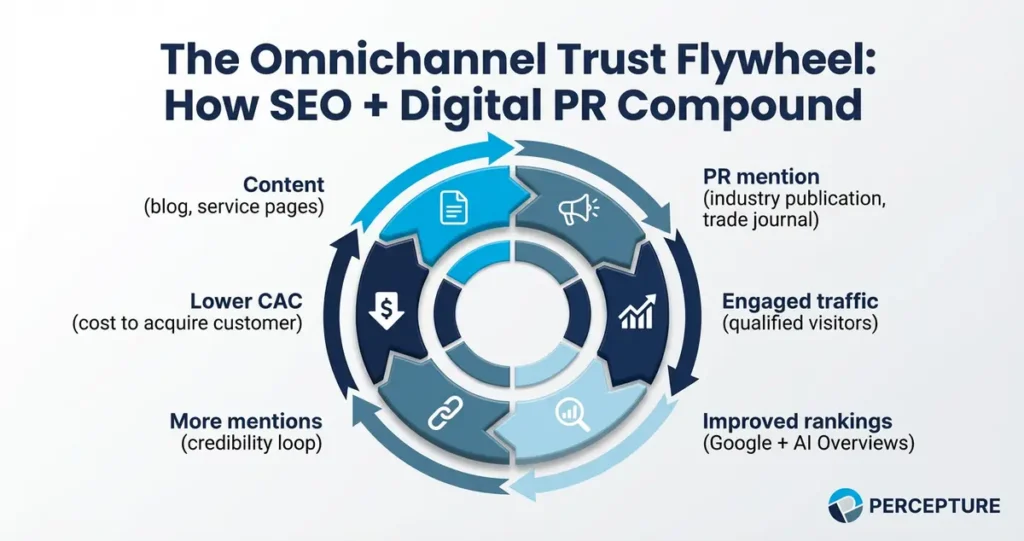
CRM follow-up and AI-assisted reminders protect high-intent demand after the address check. Percepture’s AI sales agents and the guide to AI outbound calling agents are most useful when they support accurate routing, fast response, and human sales handoff.
The commercial improvement path belongs in a deeper growth article. For that, read Percepture’s guide to fiber take-rate marketing.
The Percepture ISP Trust-to-Take-Rate System
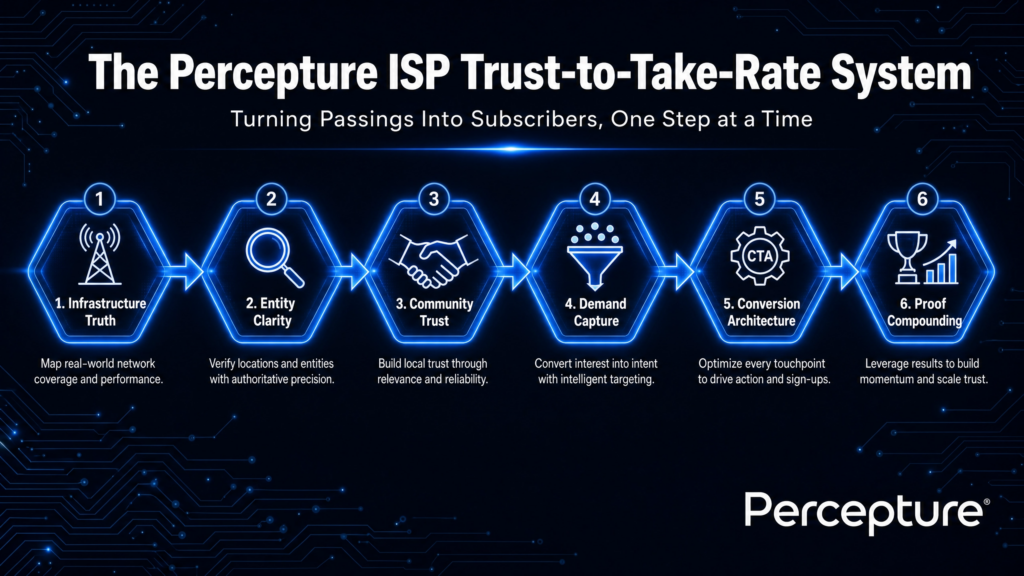
The Percepture ISP Trust-to-Take-Rate System connects infrastructure truth, entity clarity, community trust, demand capture, conversion architecture, and proof compounding into one growth system for broadband providers. It is Percepture’s operating answer to What Is Fiber Take Rate? after the definition is clear.
1. Infrastructure Truth
Campaigns must match the actual network. If the provider markets where it cannot serve, it wastes spend and breaks trust.
2. Entity Clarity
Google, AI systems, buyers, and communities need to understand who the provider is, where it operates, and what services it offers.
3. Community Trust
Fiber often involves construction, switching friction, and local questions. Trust must be built before adoption.
4. Demand Capture
The provider needs clear paths for address checks, pre-registration, calls, quote requests, and MDU or business inquiries.
5. Conversion Architecture
Forms, CRM routing, follow-up, install scheduling, and nurture must work together.
6. Proof Compounding
Reviews, local PR, customer stories, case studies, rankings, and trusted mentions make the next buyer easier to convert.
Common Fiber Take Rate Mistakes
What Is Fiber Take Rate? It is simple to define, but easy to distort when the team uses loose inputs or celebrates the wrong signals.
- Counting passings that are not truly serviceable.
- Mixing new launch markets and mature markets into one number.
- Tracking leads but not installs.
- Treating traffic as take-rate progress.
- Ignoring non-serviceable demand instead of capturing future interest.
- Making the address checker hard to find.
- Using one message for every neighborhood.
- Not separating residential, MDU broadband marketing, business fiber, and DIA.
- Ignoring follow-up speed after a buyer checks availability.
- Making unsupported benchmark claims without market context.
- Forgetting churn and retention.
- Marketing ahead of operations and install capacity.
Operators who need a broader definition of the commercial discipline can also review what is ISP marketing and Percepture’s FTTH marketing strategy guide.
Fiber Take Rate Readiness Scorecard
Score each item from 0 to 3: 0 = missing, 1 = weak, 2 = adequate, 3 = strong. The goal is not a perfect score. The goal is to find the gaps that block adoption. If the team is still debating What Is Fiber Take Rate?, start with the first three readiness items before judging channel performance.
| Readiness Item | Score |
|---|---|
| Serviceable passings are clearly defined. | 0-3 |
| Take rate is calculated by market. | 0-3 |
| Active subscribers are tracked accurately. | 0-3 |
| Address checks are tracked. | 0-3 |
| Serviceable and non-serviceable searches are separated. | 0-3 |
| Pre-registration is available for coming-soon markets. | 0-3 |
| Campaign targeting matches serviceability. | 0-3 |
| Landing pages explain availability and next steps. | 0-3 |
| CRM routing and follow-up speed are measured. | 0-3 |
| Install scheduling and completion are tracked. | 0-3 |
| Referral and review requests exist. | 0-3 |
| SEO and GEO content supports buyer questions. | 0-3 |
| The take-rate dashboard is reviewed monthly. | 0-3 |
Score interpretation: 0-18 means the provider is not ready to diagnose take rate accurately. 19-34 means the provider has some tracking, but likely has data and funnel gaps. 35-45 means the provider has a usable system. 46-51 means the provider has a strong foundation.
How Percepture Looks at Fiber Take Rate
Percepture treats fiber take rate as more than a math formula. The formula matters, but the growth work happens in the gap between passings and subscribers. That gap is shaped by serviceability, search visibility, local trust, offers, address checks, follow-up, install readiness, and proof.
Percepture was founded in 2004 and combines PR, SEO, GEO, paid media, content, analytics, CRO, and AI sales-agent thinking for complex B2B and infrastructure markets. For broadband teams, that mix matters because take rate does not live in one channel.
What Is Fiber Take Rate? For Percepture, it is the operating score that tells whether the market is moving from network availability to subscriber revenue. The question after the formula is where the chain breaks.
Want to know where your take-rate gap is?
Percepture can help map the gap between passings, address checks, pre-registrations, installs, subscribers, and referrals. The goal is not more activity. The goal is more serviceable locations becoming revenue.
If the internal conversation starts with What Is Fiber Take Rate?, Percepture can help move it from definition to diagnosis by market.
Calculate Your Take-Rate Gap Read the Fiber Take-Rate Marketing Guide
Fiber take rate FAQs
What Is Fiber Take Rate?
What Is Fiber Take Rate? Fiber take rate is the percentage of serviceable fiber passings that become active subscribers. It is calculated by dividing subscribers by serviceable passings and multiplying by 100.
How do you calculate fiber take rate?
Use this formula: subscribers ÷ serviceable passings × 100. If a provider has 3,000 subscribers and 10,000 serviceable passings, the take rate is 30%. What Is Fiber Take Rate? The calculation is the same, but the inputs must match the same market.
What is a fiber passing?
A fiber passing is a home, business, or location that the fiber network passes and may be able to serve. For take-rate calculation, providers should use serviceable passings when possible.
What is the difference between passings and subscribers?
Passings show where the network has opportunity. Subscribers are customers who have purchased and activated service. The gap between the two is where sales, marketing, serviceability, and operations have to work together.
What is a good fiber take rate?
A good fiber take rate depends on market maturity, competition, pricing, brand trust, product quality, install capacity, and time since launch. Do not use one benchmark without context. What Is Fiber Take Rate? is a definition question, but good performance is a market-specific question.
Why does fiber take rate matter?
Fiber take rate matters because it shows whether network investment is turning into subscriber revenue. It helps executives, finance leaders, marketing teams, sales teams, operators, and investors see whether the market is converting.
What causes low fiber take rate?
Low take rate can come from weak awareness, poor serviceability targeting, low trust, confusing offers, slow follow-up, install friction, strong competition, or churn after activation.
How can marketing improve fiber take rate?
Marketing can improve take rate by driving awareness, trust, address checks, pre-registration, offer clarity, retargeting, CRM follow-up, install scheduling, reviews, and referrals. What Is Fiber Take Rate? gives marketing the revenue-adoption metric those activities should support.
Should take rate be measured by market?
Yes. Take rate should be measured by neighborhood, service area, campaign, time since launch, serviceability status, and install completion. One blended number can hide the market that needs action.
How can Percepture help with fiber take rate?
Percepture can map the gap between passings and subscribers, improve serviceability-aware campaigns, strengthen SEO, GEO, and PR, and connect paid media, direct mail, CRM, AI follow-up, and reporting. If your team is asking What Is Fiber Take Rate?, Percepture can help turn the answer into a growth review.
What Is Fiber Take Rate? Know It. Then Improve It.
Fiber take rate tells you whether passings are turning into subscribers. The next step is finding where the conversion chain is breaking: awareness, trust, address checks, offers, follow-up, installs, or referrals.
What Is Fiber Take Rate? is the starting point. The operating work is turning that metric into a market-by-market action plan.
Percepture can help map your fiber passings-to-subscribers funnel, identify take-rate gaps, and build a growth system around serviceability, SEO, GEO, PR, paid media, direct mail, CRM, AI follow-up, and reporting.
Calculate Your Take-Rate Gap Map Your Fiber Take-Rate Funnel
About Bob Generale

Bob Generale is President of Percepture, a digital PR, SEO, GEO, and AI search visibility agency that helps B2B, telecom, infrastructure, private equity, healthcare, and complex service companies become easier to find, trust, and choose. Bob’s work focuses on market conditioning, search visibility, content architecture, digital PR, and conversion systems that connect authority to measurable business outcomes.