
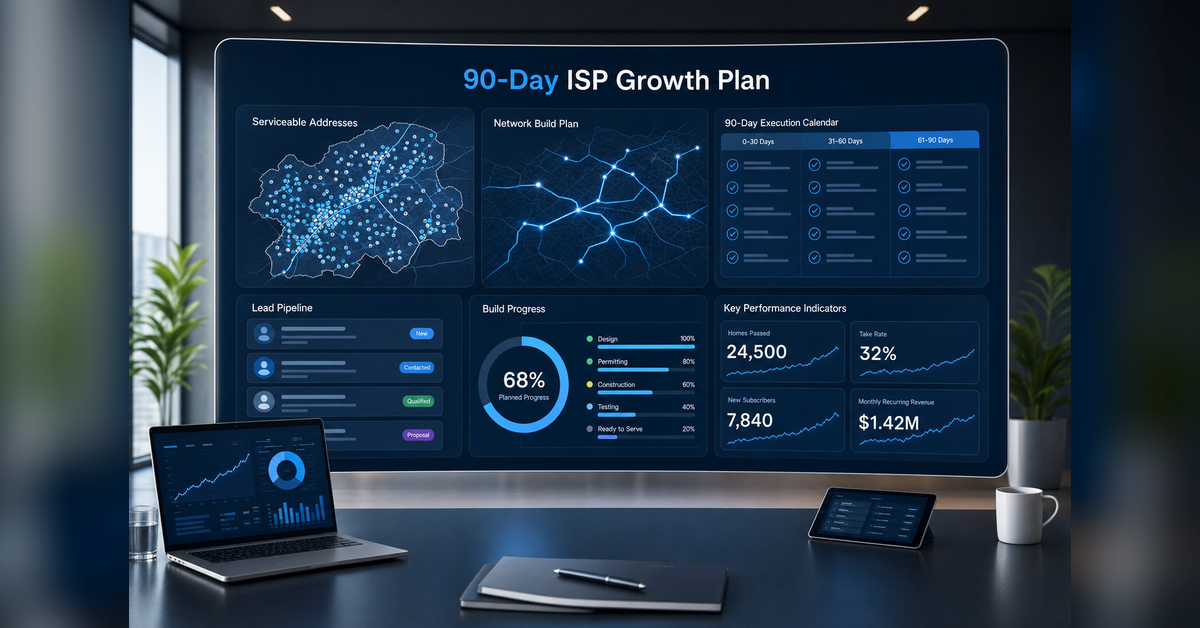

An ISP marketing plan turns a broadband growth strategy into a 90-day operating calendar. It defines where the network can sell, which buyers matter, what offers should be promoted, which channels should run, how leads should be followed up, and how subscriber growth should be measured.
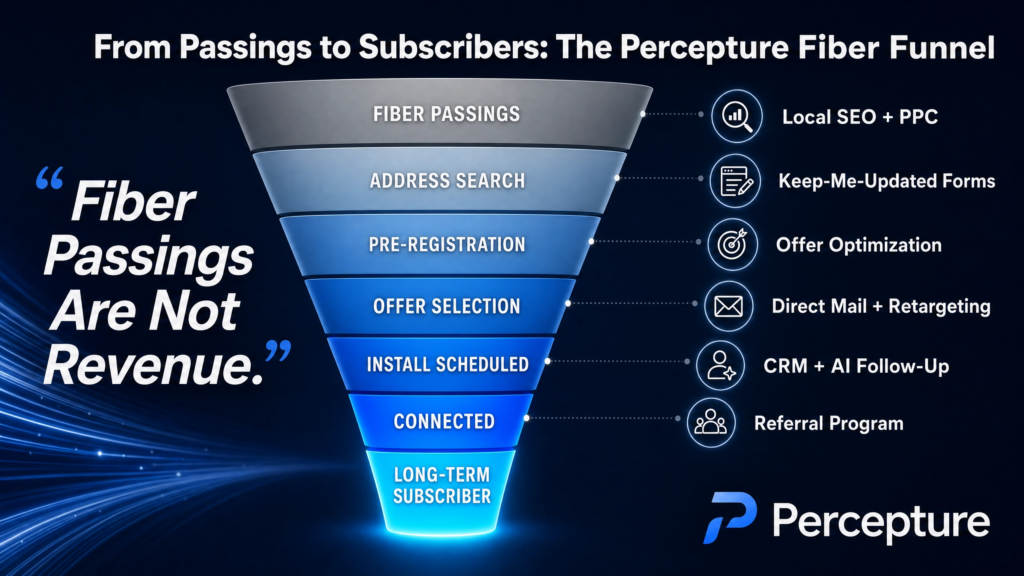
The mistake many internet service providers make is building campaigns before they map serviceability. Fiber passings are not revenue. A stronger ISP marketing plan starts with the network, then moves to trust, search, paid media, direct mail, pre-registration, install scheduling, and subscriber conversion.
What is an ISP marketing plan?
An ISP marketing plan is a serviceability-aware execution plan for growing broadband subscribers and qualified leads. It maps target addresses, communities, MDUs, businesses, offers, channels, content, PR, paid media, direct mail, CRM follow-up, AI sales agents, reporting, and conversion goals into a 30-, 60-, and 90-day operating calendar.
Executive summary for ISP leaders
Start with the map
Marketing must follow serviceability. The provider cannot sell everywhere, and the network has limits.
Separate the motions
Residential fiber, BEAD outreach, MDU, DIA, and business fiber need different offers and follow-up paths.
Point every channel at action
The plan should drive address checks, pre-registrations, calls, forms, installs, subscribers, or qualified sales conversations.
Measure subscriber movement
The plan should end with subscribers, installs, and pipeline, not just impressions, traffic, or clicks.
Who this guide is for
Regional and local ISPs
Use this guide when passings are not converting or local awareness is weak.
Fiber and FTTH providers
Use it before a new market launch, a neighborhood push, or a take-rate improvement campaign.
Municipal and BEAD teams
Use this framework when trust, public updates, and pre-registration must come before sales pressure.
MDU and business fiber teams
Use it when the buyer is a property owner, IT leader, operations lead, or executive team.
Most ISP Marketing Plans Start in the Wrong Place
Many plans begin as a campaign list: run ads, post on social, send mailers, write local pages, sponsor events, and send emails. That is not enough for a network-based business.
An ISP has to answer harder questions first. Where can we actually serve today? Which addresses are passed but not converted? Which neighborhoods need trust before construction? Which MDUs need property manager buy-in? Which businesses need DIA, metro Ethernet, or backup connectivity?
The growth plan has to follow the network map. For a broader view of the category, Percepture’s guide to what ISP marketing means explains the market-conditioning layer that sits above this execution plan.
Find the leaks before you spend more
Before an ISP scales paid media or direct mail, Percepture can review serviceability, conversion paths, content gaps, tracking, CRM routing, and follow-up so the plan is not funding avoidable leaks.
What Is an ISP Marketing Plan?
An ISP marketing plan is a written growth plan that connects an internet service provider’s network footprint to audience targeting, offers, channels, content, PR, paid media, direct mail, lead capture, sales follow-up, install scheduling, and reporting.
It should include a serviceable address map, build-ready community list, residential segments, MDU targets, business fiber targets, DIA targets, BEAD communities, offer strategy, content plan, SEO/GEO plan, paid search plan, direct mail plan, PR plan, CRM routing, AI sales agent support, reporting dashboard, and 90-day action calendar.
It is not a social media calendar, a generic ad plan, a branding exercise alone, or a content schedule with no relationship to the network footprint.
ISP Marketing Plan vs. ISP Marketing Strategy
A strong ISP marketing strategy sets direction. The plan turns that direction into work, owners, dates, and measurable outcomes.
| Category | ISP marketing strategy | ISP marketing plan |
|---|---|---|
| Purpose | Sets direction. | Defines execution. |
| Question answered | Where should we win? | What are we doing over the next 90 days? |
| Starting point | Positioning, markets, and serviceability. | Targets, timelines, assets, channels, owners, and KPIs. |
| Output | Growth lanes. | Operating calendar. |
| Timeline | Often guides 6 to 18 months. | Runs in 30-, 60-, and 90-day cycles. |
| Owner | Leadership. | Marketing, sales, operations, and agency partners. |
| Measurement | Strategic growth. | Actions, leads, installs, subscribers, pipeline, and take-rate movement. |
The 90-Day ISP Market Conditioning Plan
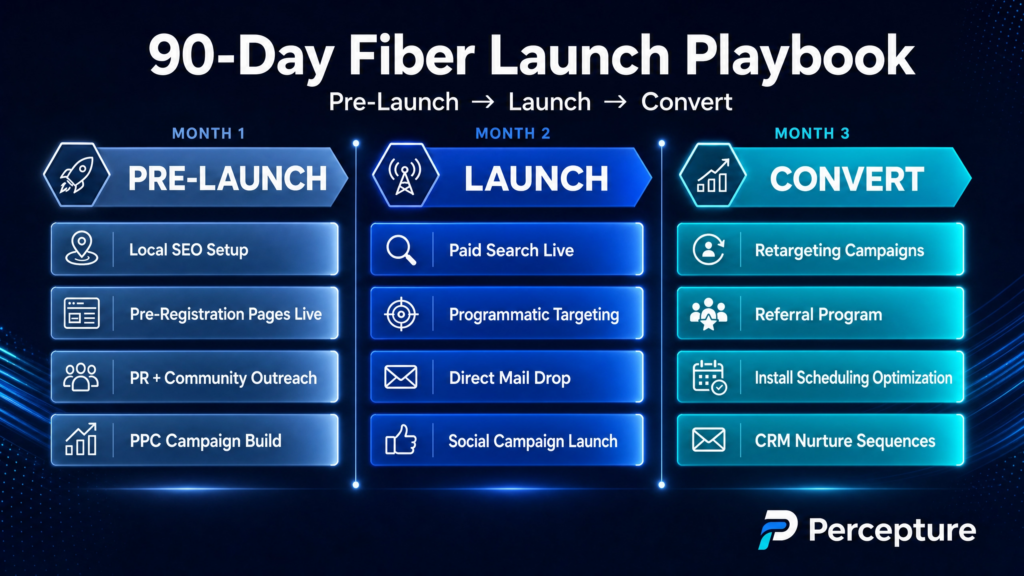
The 90-Day ISP Market Conditioning Plan is Percepture’s execution framework for sequencing serviceability data, market intelligence, local trust, SEO, GEO, paid media, direct mail, CRM follow-up, AI agents, and reporting. This planning framework helps leadership see what must happen before spend scales.
Days 1–30
Build the market intelligence and serviceability foundation.
Days 31–60
Launch demand capture, content, paid media, direct mail, and trust assets.
Days 61–90
Tighten conversion, follow-up, install scheduling, and reporting.
Days 1–30: Build the Market Intelligence Foundation
The first 30 days are about grounding the plan in the network. Do not launch major campaigns before the team knows which addresses, neighborhoods, buildings, businesses, and communities are worth targeting.
1. Map serviceability and build status
Segment the market into serviceable now, serviceable soon, under construction, planned expansion, not serviceable, MDU target, business fiber target, DIA target, and BEAD community target. Marketing waste begins when campaign targeting drifts away from the network footprint.

2. Define buyer segments
Residential fiber buyers may include homeowners, remote workers, gamers, streaming households, families, rural broadband switchers, and cable-frustrated households. MDU buyers include property owners, property managers, asset managers, developers, student housing operators, senior housing operators, and mixed-use buildings.
Business fiber and DIA buyers are different again. They may include IT directors, facilities leaders, CFOs, operations teams, healthcare offices, schools, manufacturing companies, logistics firms, and multi-location businesses.
3. Audit the conversion path
Traffic does not fix a broken conversion path. It exposes it. Review the homepage message, address search flow, keep-me-updated forms, offer pages, location pages, phone tracking, Google Business Profiles, MDU inquiry path, business fiber inquiry path, CRM routing, auto-responder emails, sales follow-up timing, and install scheduling process before the plan sends more buyers into the funnel.
4. Build the baseline dashboard
The dashboard should track organic traffic, paid search clicks, address searches, serviceable matches, non-serviceable searches, pre-registrations, form fills, calls, MDU inquiries, business fiber inquiries, DIA inquiries, install appointments, new subscribers, subscriber acquisition cost, take-rate by neighborhood, speed-to-lead, follow-up attempts, AI agent conversations, and pipeline by segment.
Days 31–60: Build Demand Capture and Trust
The second 30 days are about turning awareness into action. The plan should create trust in the market while giving buyers clear conversion paths.
1. Launch local SEO and service area pages
Build pages for core service areas, specific towns, business fiber markets, DIA regions, MDU broadband solutions, BEAD community updates, construction updates, fiber availability, and neighborhood launches. Avoid thin city pages. Each page should include real serviceability context, local detail, FAQs, proof, and a clear address-check action.
Percepture’s organic SEO services can support the search architecture behind these pages, while strategy and planning work can align the page map with the network rollout.
2. Build SEO/GEO content around buyer questions
Content should answer the practical questions buyers ask: how to check fiber availability, how ISPs improve fiber take-rate, why an address is not serviceable yet, what BEAD outreach means, how MDUs evaluate bulk internet, and what DIA or metro Ethernet means for business buyers.
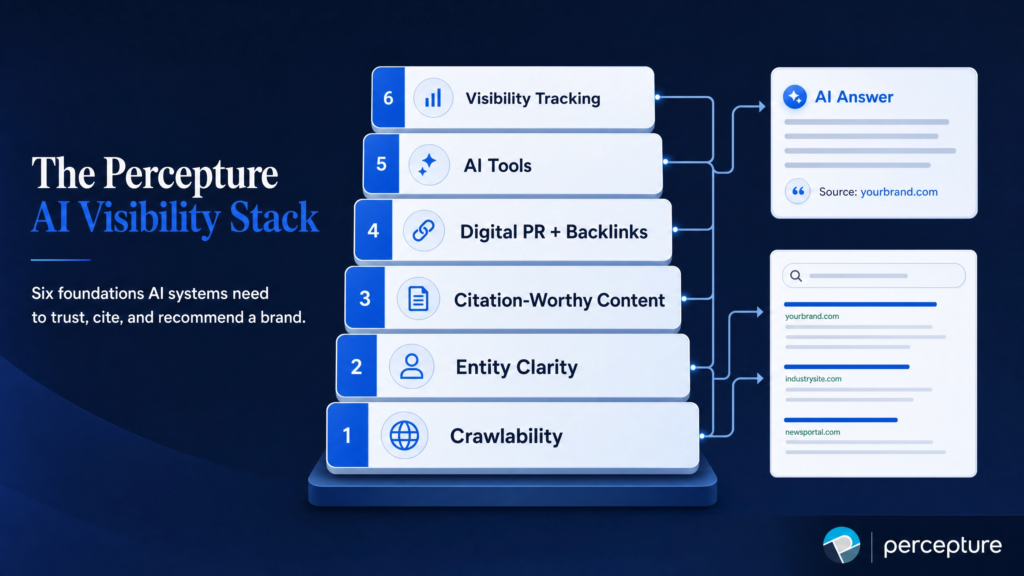
AI search visibility matters because buyers increasingly ask answer engines for definitions, comparisons, vendor shortlists, and next steps. Percepture’s generative engine optimization services and guide on how to improve brand visibility in AI search engines can help make the ISP easier to find in AI-assisted answers.
3. Launch paid search and media in viable markets
Paid search should focus on high-intent terms tied to serviceable geography: fiber internet near me, business fiber internet, dedicated internet access, broadband provider near me, internet for apartment buildings, bulk internet for multifamily, fiber availability by city, and DIA provider by market.
Suppress spend where the ISP cannot serve. In the plan, Percepture’s paid search, media buying, and omnichannel marketing work can connect targeting, landing pages, conversion tracking, and reporting.
4. Use direct mail where it makes sense
Direct mail can help when a neighborhood is serviceable now, construction is complete or nearly complete, a market needs awareness before launch, or a specific MDU or business corridor is being targeted. In a broadband plan, mailers should drive to an address check, landing page, QR code, call tracking number, pre-registration page, or appointment scheduler.
5. Build PR and community trust
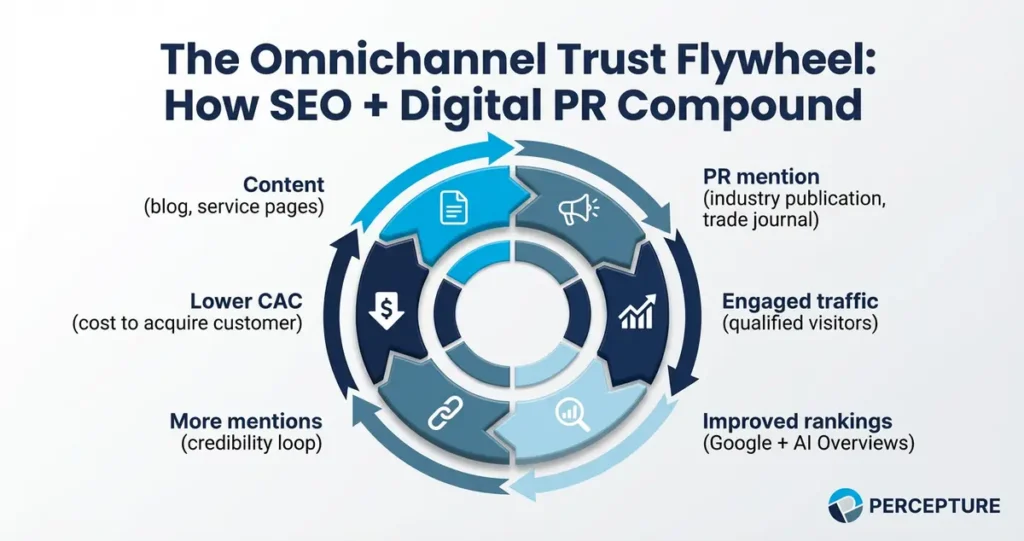
ISP marketing is not only demand capture. It is trust building. The plan can include local construction announcements, broadband access stories, economic development angles, school and healthcare benefits, community meeting support, BEAD updates, customer stories, infrastructure narratives, and executive thought leadership.
Percepture’s digital PR services can support the trust layer that helps local search, AI search, and buyer confidence reinforce each other.
Days 61–90: Convert, Follow Up, and Report
The last 30 days should focus on conversion, follow-up speed, install scheduling, retargeting, and reporting. This is where many ISP campaigns leak revenue.
1. Tighten the address search path
Every demand page should give the visitor a clear next step: check availability, pre-register, request a business fiber quote, ask about MDU broadband, talk to a specialist, get construction updates, schedule installation, or join a waitlist.
The address-search experience should be mobile-friendly, fast, clear about non-serviceable addresses, connected to CRM, and able to route leads by status.
2. Build follow-up by segment
Residential serviceable leads should receive an availability result, offer, install prompt, and reminders. Residential not-serviceable leads should receive updates, a construction timeline when available, referral prompts, and neighborhood interest messages.
MDU leads should route to sales with a property value message and a meeting request. Business fiber and DIA leads should receive speed-to-lead contact, needs assessment, SLA and redundancy questions, a quote workflow, and human sales handoff.
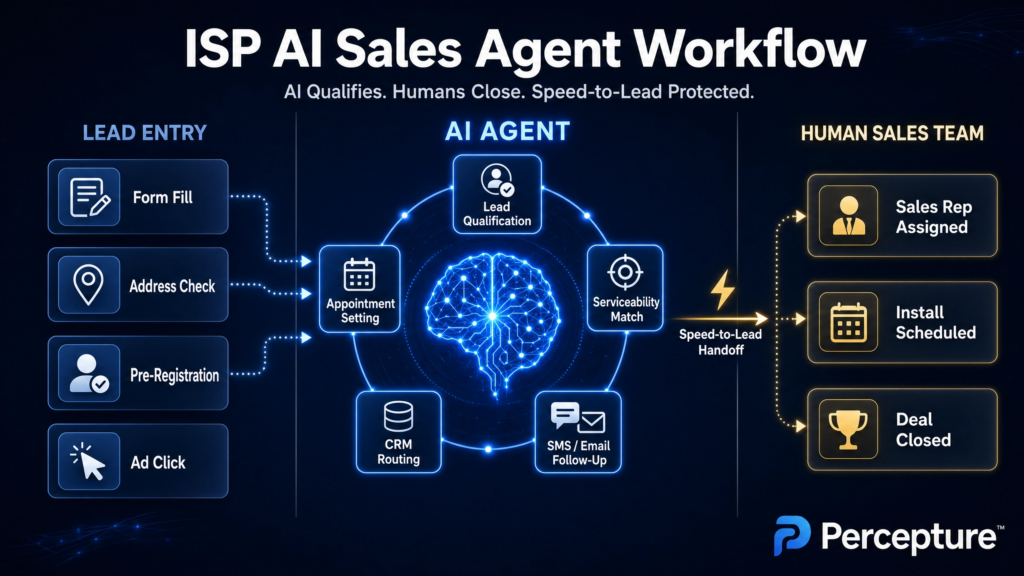
3. Use AI sales agents carefully
AI agents can answer common availability questions, follow up with non-responsive leads, confirm serviceability details, route MDU or business fiber inquiries, schedule calls, re-engage abandoned address checks, and help sales prioritize leads. High-value opportunities still need human oversight.
Percepture’s AI sales agents service and article on AI outbound calling agents explain where automation can help without replacing judgment.
4. Report on subscriber movement
Do not stop at impressions, likes, clicks without serviceability context, traffic without conversion, or leads without install data. Better reporting tracks address searches, serviceable searches, pre-registrations, calls, form fills, install appointments, new subscribers, MDU conversations, business fiber opportunities, DIA pipeline, cost per install, subscriber acquisition cost, take-rate movement, speed-to-lead, and follow-up completion rate.
ISP Marketing Plan by Growth Segment
| Segment | Goal | Best channels | Primary conversion action | KPI |
|---|---|---|---|---|
| Residential fiber | Convert serviceable homes into subscribers. | Local SEO, paid search, direct mail, programmatic, retargeting, community PR. | Address check or install scheduling. | Address searches, installs, subscribers, take-rate. |
| BEAD / community | Build trust before and during broadband expansion. | PR, community outreach, local content, direct mail, public updates. | Pre-registration or update signup. | Pre-registrations, engagement, awareness, sentiment. |
| MDU | Win building-level opportunities. | Account-based outreach, LinkedIn, direct mail, property manager content, sales follow-up. | Property consultation. | Owner conversations, proposals, buildings signed. |
| Business fiber | Create qualified commercial pipeline. | SEO, paid search, LinkedIn, programmatic, direct sales, email. | Quote request or consultation. | Qualified leads, meetings, proposals, pipeline. |
| DIA / metro Ethernet | Reach high-value technical buyers. | SEO, intent data, sales outreach, LinkedIn, retargeting, technical content. | Technical consult. | Qualified opportunities, pipeline value, closed deals. |
Residential Fiber Marketing Plan
Residential campaigns should be built around serviceability, trust, speed, reliability, switching pain, local support, and ease of installation. A residential fiber plan can include a neighborhood launch calendar, fiber availability pages, paid search, direct mail, retargeting for address-check abandoners, email or SMS nurture, local PR, review generation, referral campaigns, and installation reminder sequences.
Offer angles can include faster internet, reliable streaming, work-from-home performance, gaming and low latency, local support, better upload speeds, simple switching, and install incentives when those claims are supportable. For a deeper take-rate lens, read Percepture’s guide to fiber take-rate marketing, the explanation of what fiber take rate means, and the guide on converting fiber passings into subscribers.
BEAD and Community Outreach Marketing Plan
If the ISP is involved in BEAD, rural broadband, municipal broadband, or public-private broadband work, the plan must include trust before demand. The work may include a community message map, public project explanation, construction timeline content, FAQ pages, stakeholder education, resident update forms, pre-registration systems, earned media, local meetings, resident concerns, and economic development messaging.
Percepture’s resources on BEAD marketing and subscriber adoption and BEAD outreach explain how community education can support adoption.
MDU Broadband Marketing Plan
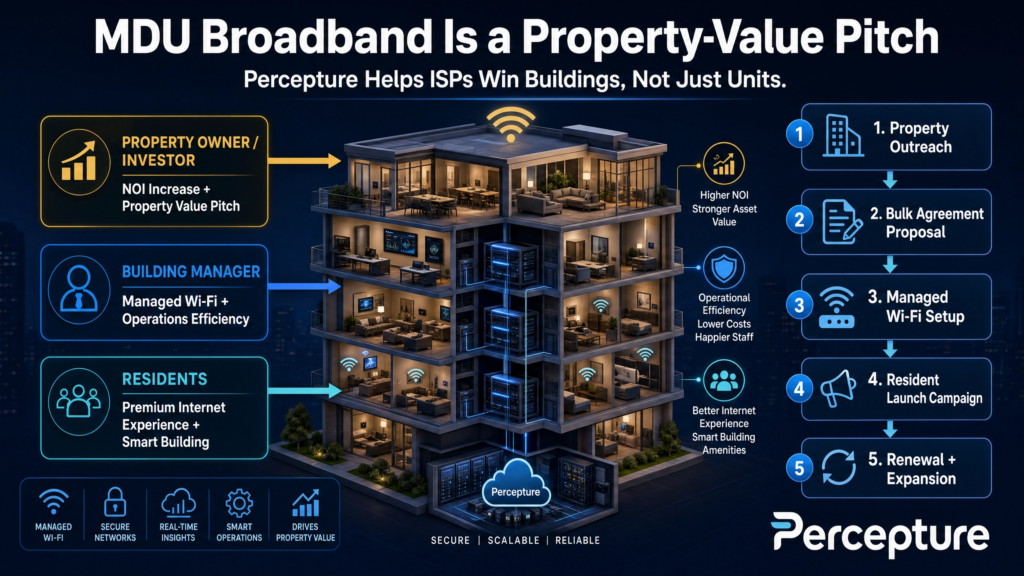
MDU broadband is not only a resident internet offer. It is a property value pitch. The target list should include property owners, asset managers, developers, property managers, student housing, senior housing, mixed-use buildings, and condo associations.
Messaging can cover resident experience, competitive property positioning, managed Wi-Fi, bulk internet, amenity value, operational simplicity, support structure, and installation planning. Percepture’s guide to MDU broadband marketing goes deeper on this sales motion.
DIA and Business Fiber Marketing Plan
Business fiber campaigns need different language than residential fiber. Technical buyers care about uptime, SLAs, redundancy, speed, support, installation timelines, and business continuity.
The plan can include DIA landing pages, metro Ethernet pages, business fiber pages, industry-specific pages, LinkedIn campaigns, paid search, retargeting, sales enablement sheets, technical FAQs, quote-request flows, AI-assisted follow-up, and human sales handoff. For deeper guidance, see DIA lead generation for ISPs and metro Ethernet lead generation.
SEO, GEO, and AI Search in an ISP Marketing Plan
The broadband growth plan should make the company findable in traditional search and AI-assisted search. That means service area pages, fiber availability pages, educational pages, comparison pages, MDU pages, DIA pages, BEAD outreach pages, PR-backed authority content, FAQ-rich pages, schema, authorship, internal links, entity clarity, local proof, case studies, and third-party mentions.

The content map should also support articles such as how to market fiber internet in a new service area and FTTH marketing strategy, so the cluster answers both executive and operator questions.
How to Budget an ISP Marketing Plan
Budget should be allocated by serviceability, market size, competition, construction timing, sales capacity, and install capacity. A plan should make those tradeoffs visible before channel spend is assigned. The numbers below are planning weights, not guarantees.
| Growth motion | Suggested allocation logic |
|---|---|
| Residential launch | 25% local SEO and landing pages, 25% paid search and retargeting, 20% direct mail, 15% PR and community trust, 10% conversion and CRM, 5% testing. |
| BEAD / community | 30% PR and education, 20% direct mail, 20% local content and SEO, 15% events and outreach support, 10% pre-registration infrastructure, 5% reporting. |
| MDU | 30% account-based sales support, 20% LinkedIn and programmatic, 20% sales enablement, 15% MDU landing pages and content, 10% property-level outreach, 5% reporting. |
| DIA / business fiber | 30% SEO and high-intent landing pages, 25% paid search, 20% sales enablement and CRM, 15% LinkedIn or programmatic, 10% retargeting and nurture. |
ISP Marketing Plan KPI Dashboard
| KPI | Why it matters | Owner | Review cadence |
|---|---|---|---|
| Serviceable address searches | Shows real buying intent. | Marketing / growth | Weekly |
| Pre-registrations | Shows demand before or during launch. | Marketing | Weekly |
| Lead-to-install conversion | Shows whether demand becomes subscribers. | Sales / operations | Weekly |
| Cost per install | Connects spend to customer acquisition. | Leadership | Monthly |
| Take-rate by neighborhood | Shows whether passings are becoming subscribers. | Leadership / growth | Monthly |
| MDU conversations | Shows property-level opportunity creation. | Sales | Weekly |
| Business fiber pipeline | Shows commercial opportunity quality. | Sales / marketing | Weekly |
| Speed-to-lead | Shows whether high-intent leads are followed up quickly. | Sales | Weekly |
| AI follow-up completion | Shows whether automation is helping close gaps. | Marketing operations | Weekly |
ISP Marketing Plan Scorecard
Score each item from 0 to 3: 0 missing, 1 weak, 2 adequate, 3 strong. A score below 30 usually means the foundation, conversion path, or reporting system should be tightened before spend increases.
- Serviceability map is connected to campaigns.
- Address-check flow is clear and tracked.
- Residential, MDU, business fiber, and DIA segments are separated.
- Offer strategy is clear.
- Local SEO pages are mapped.
- Paid media targets only viable markets.
- Direct mail is tied to serviceable or launch-ready addresses.
- PR supports community trust.
- CRM routing and sales handoff are defined.
- AI follow-up is defined.
- Install scheduling and take-rate reporting are measured.
- Content supports Google and AI search visibility.
Common ISP Marketing Plan Mistakes
The most common ISP marketing plan mistake is starting with ads before serviceability. That creates wasted spend and frustrated buyers. The next mistake is treating all buyers the same when residential fiber, MDU, DIA, BEAD, and business fiber need different language.
Other mistakes include measuring clicks instead of subscriber movement, sending direct mail without a conversion path, building thin city pages, ignoring non-serviceable demand, waiting too long to follow up, over-automating high-value leads, disconnecting marketing from operations, and forgetting PR and community trust.
How Percepture Builds ISP Marketing Plans
Percepture builds each plan around the network first. The work starts with serviceability, passings, audience segmentation, search demand, local trust, conversion paths, lead routing, and reporting. The goal is not activity. The goal is subscriber movement and qualified pipeline.
Percepture connects SEO, GEO, digital PR, paid media, programmatic, direct mail, CRM, and AI agents. Bob Generale’s operator-led approach focuses on market conditioning, trust tokens, and being found when buyers look. For complex lead flow, Percepture’s lead generation, conversion rate optimization, and attribution and analytics services can connect campaigns to measurable movement.

Ready to turn ISP strategy into a 90-day execution plan?
Percepture can help connect your serviceability data, SEO, GEO, PR, paid media, direct mail, CRM, AI follow-up, and reporting into one practical growth plan.
FAQs about building an ISP growth plan
What is an ISP marketing plan?
An ISP marketing plan is a written plan connecting serviceability, target markets, offers, channels, lead capture, follow-up, installs, subscribers, and reporting. It turns broadband growth strategy into a practical calendar for the next 30, 60, and 90 days.
What should be included in an ISP marketing plan?
It should include a serviceability map, buyer segments, SEO, GEO, paid media, PR, direct mail, CRM, AI follow-up, offers, KPIs, and a 90-day action calendar. It should also define ownership across marketing, sales, operations, and agency partners.
How is the plan different from strategy?
Strategy sets direction. The ISP marketing plan defines execution. Strategy asks where the provider should win. The plan asks what the team is doing this week, this month, and this quarter to turn serviceable markets into demand, installs, subscribers, and pipeline.
Why should ISP marketing start with serviceability?
Because the ISP can only sell where the network can serve or where pre-registration makes sense. If media, SEO, direct mail, and sales outreach do not match serviceability, the ISP marketing plan wastes spend and frustrates buyers.
How long should the plan be?
A practical ISP marketing plan should include 30-, 60-, and 90-day actions, then be refreshed monthly or quarterly. The 90-day cycle is long enough to build market intelligence, launch campaigns, fix conversion leaks, and start measuring subscriber movement.
What channels should the plan include?
Most providers should consider SEO, GEO, paid search, programmatic, direct mail, PR, community outreach, email, SMS, CRM, AI agents, sales outreach, and retargeting. The right channel mix depends on serviceability, segment, market timing, and sales capacity.
How do ISPs measure marketing success?
ISPs should measure address searches, serviceable leads, pre-registrations, installs, subscribers, take-rate, MDU conversations, business fiber pipeline, cost per install, speed-to-lead, and follow-up completion. Traffic and clicks are useful only when tied to those outcomes.
Should an ISP use direct mail?
Yes, when direct mail is tied to serviceability, neighborhood launches, strong offers, QR codes, call tracking, landing pages, and follow-up. Direct mail should not be a standalone awareness piece with no measurable next step.
Can AI agents help with ISP marketing?
Yes. AI agents can help with lead qualification, routing, reminders, re-engagement, FAQs, scheduling, and abandoned address-check follow-up. MDU, DIA, and business fiber opportunities still need human sales oversight.
How can Percepture help build an ISP marketing plan?
Percepture connects serviceability, SEO, GEO, PR, paid media, direct mail, CRM, AI follow-up, conversion paths, and reporting into one execution system. The work is built to help ISP teams turn network footprint into demand, installs, subscribers, and qualified pipeline.
Build an ISP marketing plan that follows the network
The plan should not be a random list of campaigns. It should connect the network footprint to the buyer journey, then turn serviceable addresses, communities, MDUs, and businesses into measurable demand, installs, subscribers, and pipeline.
If your team is preparing a fiber launch, improving take-rate, entering a new market, pursuing MDU deals, building DIA pipeline, or trying to show up in AI search, Percepture can help build the ISP growth plan.
About Bob Generale

Bob Generale is President of Percepture, a digital PR, SEO, GEO, and AI search visibility agency that helps B2B, telecom, infrastructure, private equity, healthcare, and complex service companies become easier to find, trust, and choose. Bob’s work focuses on market conditioning, search visibility, content architecture, digital PR, and conversion systems that connect authority to measurable business outcomes.