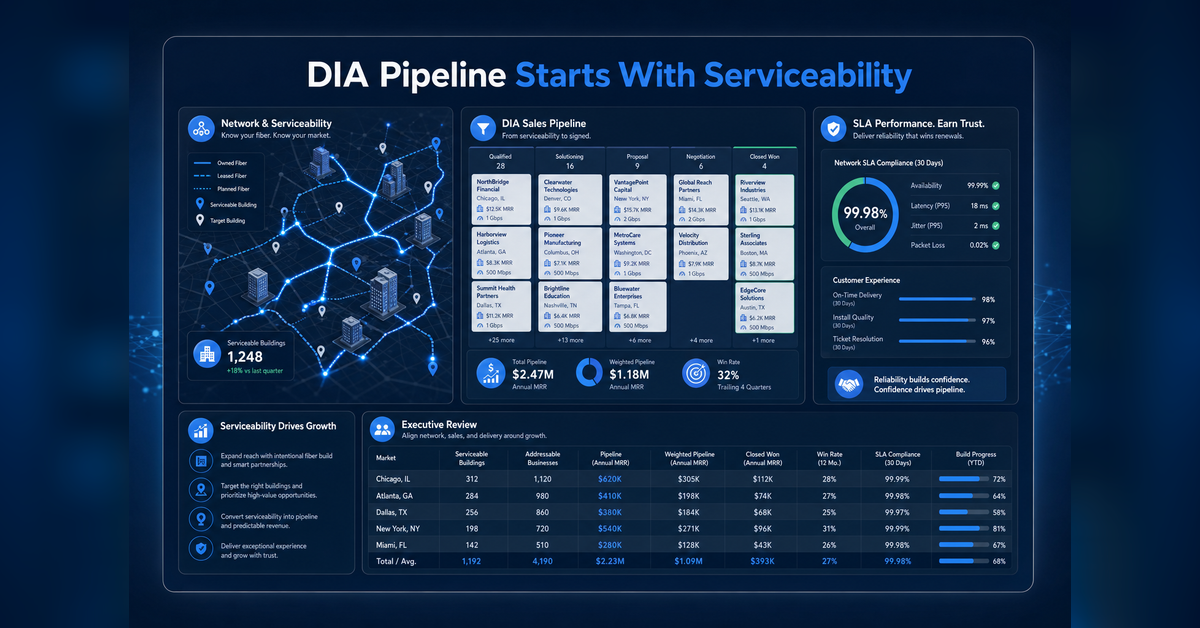

DIA Lead Generation for ISPs is not a traffic problem. It is a revenue problem tied to serviceable buildings, technical trust, SLA confidence, buyer timing, and whether sales engineering can respond before a competitor owns the conversation.
Percepture’s point of view is simple: ISP marketing starts with the network. The work is not generic channel marketing; it is serviceability-aware market conditioning that turns qualified demand into address checks, meetings, proposals, installs, and long-term accounts.





How should an ISP generate qualified DIA leads?
DIA Lead Generation for ISPs is the process of connecting serviceable markets, buyer intent, technical proof, search visibility, AI retrievability, and sales follow-up into one measurable pipeline system. Strong programs start with where the ISP can sell, who is likely to buy, what proof the buyer needs, and how fast sales can respond.
Executive summary for leaders
Start with serviceability
In DIA Lead Generation for ISPs, media should focus on buildings, business corridors, and accounts the network can serve or evaluate. Intent data without serviceability is expensive curiosity.
Sell reliability before price
IT directors want uptime, SLA terms, route diversity, escalation paths, and installation clarity before a pricing call feels worth their time.
Use proof before pitch
Trust Tokens such as case studies, expert content, comparison pages, technical explainers, and credible PR reduce friction before a buyer asks for a quote.
Route leads by fit
A DIA inquiry should pass address, building type, bandwidth need, current provider, renewal timing, and urgency into CRM before sales makes contact.
Measure pipeline, not clicks
Leadership should track address checks, qualified leads, meetings booked, proposal movement, install conversion, pipeline value, and response time.
Who this guide is for
CEO or president
Use this DIA Lead Generation for ISPs guide to judge whether DIA marketing supports market expansion, revenue quality, and brand trust instead of loose lead volume.
CRO or VP Sales
Use this to tighten qualification, sales-engineering handoff, speed-to-lead, and sales routing for enterprise internet opportunities.
VP Marketing or CMO
Use this to align SEO, GEO, paid media, LinkedIn, PR, retargeting, and landing pages around accounts the network can actually serve.
Network operator or channel leader
Use this to keep marketing honest about availability, construction limits, technical claims, and the role of partners or agents.
This is not for teams looking for generic social posts, broad untargeted media buying, or channel-first marketing that ignores network reality. If the campaign cannot respect serviceability, it will create wasted spend and weak trust.
Run a DIA serviceability and demand-map review
Before adding spend, Percepture can help evaluate where your DIA offer, serviceability data, buyer intent, search visibility, proof assets, and routing logic may be helping or hurting pipeline quality. A DIA Lead Generation for ISPs review should make those gaps visible before budget scales.
Run a DIA serviceability and demand-map reviewWhat DIA Lead Generation for ISPs really means
Dedicated internet access is a considered B2B purchase. The buyer may be an IT director, operations leader, CFO, facilities executive, consultant, or owner. Each one sees risk differently, but they all need confidence that the provider can serve the site and stand behind the promise.
DIA Lead Generation for ISPs should therefore answer four questions fast: can you serve my address, can you support my business requirements, can I trust your SLA and escalation process, and what is the next step? A campaign that only says fast fiber internet misses the enterprise buying motion.
The right system combines ISP marketing agency strategy, telecom marketing experience, organic visibility, proof, conversion architecture, and sales operations. It should also connect to adjacent offers such as managed WiFi and bulk internet strategy when the buyer owns multiple properties or locations.
Why generic telecom lead generation misses technical buyers
Generic lead generation often starts with a media plan. That is backwards for DIA. Marketing where the network cannot sell wastes spend, frustrates sales, and teaches buyers not to trust the provider’s availability claims.
DIA Lead Generation for ISPs must separate general awareness from qualified demand. A residential broadband play can often optimize for neighborhood reach, offer clarity, and simple conversion. DIA marketing must handle bandwidth requirements, contract timing, redundancy questions, construction timelines, handoff risk, and internal procurement.
Technical buyers also search differently. They compare uptime, latency, SLA terms, route diversity, local fiber availability, Ethernet options, failover planning, and provider reputation. That is why a DIA page should work with organic SEO services, generative engine optimization services, and digital PR rather than paid traffic alone.
Generic agency approach vs. Percepture ISP approach
| What weak programs do | What strong ISP programs do | What Percepture would check |
|---|---|---|
| Buy broad geography and hope sales can sort it out. | Map serviceable accounts, expansion areas, and high-fit business corridors first. | Address logic, serviceability data, CRM fields, and sales territory rules. |
| Lead with price or speed only. | Explain SLA, uptime, route diversity, escalation, and installation path. | Whether the landing page answers technical buyer objections before the form. |
| Measure clicks and form fills. | Measure qualified leads, address checks, meetings, proposals, installs, and pipeline value. | Reporting from campaign source through sales outcome. |
| Create content that sounds like any ISP. | Build entity-rich technical content, proof assets, and local market pages. | Search visibility, AI answer clarity, Trust Tokens, and differentiated positioning. |
| Send every lead to the same queue. | Route by address, buyer type, urgency, bandwidth need, and enterprise fit. | Speed-to-lead rules, sales-engineering handoff, and lead scoring. |
The DIA Technical Buyer Trust Ladder
The DIA Technical Buyer Trust Ladder is Percepture’s framework for moving a business buyer from problem recognition to a qualified sales-engineering conversation. It treats trust as a sequence, not a slogan. The buyer has to believe the network is relevant, the offer is credible, the proof is strong, and the next step is worth the time.
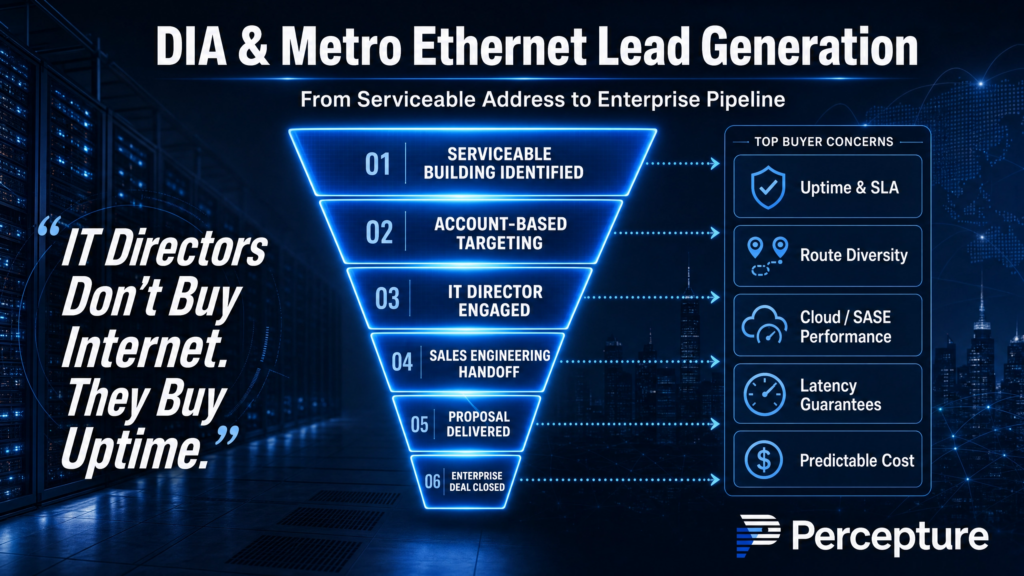
DIA Lead Generation for ISPs framework: the Trust Ladder
1. Serviceable relevance
Owned by network, sales, and marketing. The account must sit in a sellable or reviewable area before spend increases.
2. Technical clarity
Owned by marketing and product. The content must explain dedicated access, SLA expectations, installation process, and escalation language in plain English.
3. Proof confidence
Owned by leadership, PR, and marketing. The buyer needs credible proof before they trade time for a conversation.
4. Conversion path
Owned by CRO and sales operations. The page should offer address checks, demand-map reviews, quote requests, or sales-engineering reviews based on buyer readiness.
5. Sales-engineering handoff
Owned by sales leadership. The inquiry must reach the right person with enough context to avoid a generic discovery call.
Example: if a manufacturer searches for enterprise fiber internet near a serviceable industrial park, the page should show local relevance, explain uptime and failover options, capture the address and renewal date, and route the inquiry to the enterprise team.
The mistake is treating ISP marketing like normal demand generation. It is not. The first question is not what channel to use. The first question is where the network can sell, what the market already believes, and what proof is needed before a buyer takes the next step. — Bob Generale, President, Percepture
How to map serviceable business accounts before spending media
Serviceability-aware market conditioning starts with the network. The practical question is not how many businesses are in a market. The question is how many high-fit businesses can be served, evaluated, or expanded into with a credible path.

In DIA Lead Generation for ISPs, a useful demand map can include serviceable addresses, near-net opportunities, target verticals, building density, competitive search behavior, known renewal windows, high-value corridors, and sales territories. That map should shape paid search, LinkedIn audiences, local SEO, landing pages, content, PR, and account outreach.
Fiber passings are not revenue. The campaign has to turn passings into demand, demand into qualified conversations, and conversations into a pipeline that sales can pursue. If the ISP also sells broader connectivity or managed services, related pages such as ISP lead generation services, local SEO for fiber internet providers, and broadband offer strategy should support the cluster.
Search, LinkedIn, PR, and retargeting for DIA demand
DIA Lead Generation for ISPs works best when channels have different jobs. Search captures active demand. LinkedIn helps reach business and IT buyers by role, company type, and geography. PR builds authority and third-party confidence. Retargeting keeps the provider visible while the buyer compares options.
The landing page should include the offer, serviceability step, common technical questions, proof, FAQ, comparison language, and a clean CTA. It should also answer the prompts buyers use in search and AI tools: how to choose DIA, what SLA terms mean, how route diversity affects continuity, and how to start an address review.
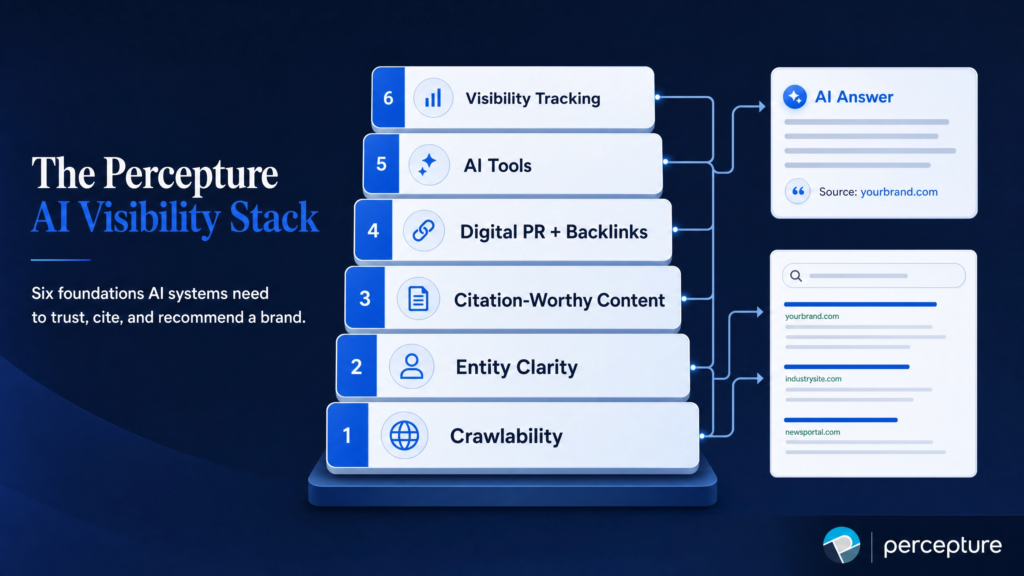
Percepture calls this the Golden Triangle: organic search, AI answers, and third-party proof working together. AI visibility is not a replacement for SEO, PR, or proof. It is the compounding result of all three when the brand gives search engines and answer systems clear, credible, source-worthy information.
Paid media still matters, especially for high-intent demand capture. A fiber internet PPC strategy can support DIA when it filters by serviceability, intent, account value, and sales capacity instead of only cost per click.
Sales-engineering handoff and speed-to-lead rules
A qualified DIA lead should never arrive as a bare name, email, and phone number. Sales needs the address, company type, current provider if known, bandwidth requirement, urgency, renewal timing, number of locations, redundancy needs, and the conversion source.
For DIA Lead Generation for ISPs, that context determines whether the next step is an address check, technical scoping call, quote, site review, partner referral, or nurture path. It also helps the team avoid weak follow-up, such as asking the buyer to repeat information already provided on the page.
Automation can help, but it should not hide the network reality. Percepture can connect buyer-intelligence workflows such as LeadSeeker with sales logic, and content can support teams exploring AI outbound calling agents for compliant follow-up, routing, or qualification support.
DIA lead quality scorecard
Use this scorecard before investing more in DIA Lead Generation for ISPs. A yes answer means the program is more likely to produce qualified pipeline instead of generic inquiries.
| Question | Yes / No | Why it matters |
|---|---|---|
| Do campaigns target serviceable or reviewable business addresses? | Yes / No | Prevents spend outside the sellable footprint. |
| Does the landing page explain SLA, uptime, route diversity, and escalation? | Yes / No | Builds trust with technical buyers. |
| Does the form capture address, bandwidth need, and timing? | Yes / No | Improves routing and qualification. |
| Are leads scored by account fit and serviceability? | Yes / No | Separates pipeline from low-fit activity. |
| Does sales receive source and content engagement data? | Yes / No | Helps sales tailor the first response. |
| Are proof assets visible before the CTA? | Yes / No | Reduces buyer risk before conversion. |
| Are branded and non-branded search terms tracked? | Yes / No | Shows whether the market is being conditioned. |
| Are AI-answer visibility checks part of reporting? | Yes / No | Shows whether structured content and proof are being retrieved. |
| Is speed-to-lead measured by lead type? | Yes / No | Protects high-intent opportunities from sales leakage. |
| Can leadership see pipeline value, not just lead count? | Yes / No | Connects marketing to business outcomes. |
| Is DIA Lead Generation for ISPs tied to CRM fields sales actually uses? | Yes / No | Keeps qualification, routing, and reporting aligned after the form fill. |
See the Broadstaff qualified-lead case study
For DIA Lead Generation for ISPs, proof matters when a B2B buyer is comparing complex providers.
See the Broadstaff qualified-lead case studyWhat should this cost, and how should it be measured?
DIA Lead Generation for ISPs should be budgeted as a pipeline system, not a single campaign. The investment depends on market size, data readiness, content depth, landing page needs, paid media, PR, reporting, and how much sales-operation cleanup is required.
Measurement should include qualified leads, address checks, pre-registrations when relevant, meetings booked, cost per qualified lead, install conversion, pipeline value, sales response time, branded and non-branded search visibility, and AI-answer visibility checks. A CFO should watch for wasted spend in unserviceable areas, duplicate lead handling, weak conversion tracking, and campaigns that generate interest sales cannot pursue.
For teams comparing budget models, Percepture also publishes pricing options, SEO pricing packages, and GEO pricing resources that can help frame the level of effort.
Common mistakes that waste DIA pipeline
The first mistake is treating every business in a territory as equal. A high-volume campaign can still fail if the accounts are outside the footprint, too small for the offer, or not ready for a business-grade dedicated connection.
The second mistake is asking for a sales conversation before showing proof. Proof before pitch is especially important with DIA because the buyer is evaluating risk. Trust before take-rate.
The third mistake is separating marketing from sales engineering. DIA demand requires a handoff that respects technical detail. If the buyer asks about redundancy, installation timing, or SLA terms, the first response cannot sound like a consumer broadband script.
For DIA Lead Generation for ISPs, these mistakes usually show up as low-fit form fills, slow follow-up, unclear ownership, and reporting that celebrates activity before confirming revenue potential.
Proof: search visibility, B2B trust, and qualified leads
Percepture was founded in 2004 and works across PR, SEO, GEO, AI-search visibility, digital marketing, B2B, telecom, infrastructure, and qualified lead-generation programs. The role of proof is not to decorate a page. It is to make a serious buyer believe the next step is worth taking.

For complex markets, Percepture connects content, authority, structured answers, conversion paths, and CRM logic. The same thinking supports adjacent infrastructure categories, including data center marketing, digital infrastructure growth, and telecom event pipeline.
FAQs
What is DIA Lead Generation for ISPs?
DIA Lead Generation for ISPs is a serviceability-aware pipeline system for selling dedicated internet access to qualified business buyers. It combines serviceable market mapping, technical proof, search visibility, AI retrievability, conversion pages, and sales routing.
Why does DIA lead generation need to start with serviceability?
For DIA Lead Generation for ISPs, serviceability is the first filter because an ISP cannot sell everywhere. It keeps campaigns focused on buildings, corridors, and accounts the network can serve or evaluate, which reduces wasted spend and protects buyer trust.
How should Percepture structure a page about DIA Lead Generation for ISPs for AI search visibility?
The page should include a direct answer, clear definitions, technical entities, proof, FAQs, tables, a scorecard, internal links, and visible text that answer systems can parse without relying on images alone.
What proof should an ISP show before asking for a conversation?
An ISP should show SLA clarity, uptime language, route diversity context, escalation process, installation expectations, market relevance, customer proof where approved, and technical content that reduces buyer risk.
Which internal links should support this article?
Useful internal links include the ISP marketing pillar, adjacent DIA or Ethernet guides, lead generation services, omnichannel marketing, organic SEO, GEO services, digital PR, telecom marketing, pricing, and relevant case studies.
What CTA should be used for DIA Lead Generation for ISPs?
Early CTAs should be diagnostic, such as a serviceability and demand-map review. Mid-page CTAs should point to proof. Bottom CTAs should invite a focused enterprise internet pipeline conversation.
How should keyword density be handled?
Use the exact phrase where it helps the reader: title, first paragraph, direct answer, one heading, one FAQ, image alt text, and final CTA. Do not repeat it in filler sentences.
What mistakes should ISPs avoid?
Avoid targeting unserviceable areas, leading only with price, hiding technical details, sending all leads to one queue, ignoring sales response time, and measuring success only by clicks or raw form fills.
How should this article help sales, marketing, and leadership?
DIA Lead Generation for ISPs gives marketing a clearer content and channel plan, sales better lead context and routing, and leadership a way to measure pipeline quality, address checks, meetings, install conversion, and market trust.
How should the article support LLM visibility without sounding robotic?
Use plain answers, structured sections, entity-rich language, tables, and FAQs while keeping the tone human. The goal is source-worthy clarity, not repetitive keyword blocks.
Talk with Percepture about DIA Lead Generation for ISPs
If DIA Lead Generation for ISPs needs to connect serviceability, proof, search, GEO, paid media, and sales routing, Percepture can review the current pipeline structure and identify where qualified demand may be leaking.
Talk with Percepture about enterprise internet lead generationAbout Bob Generale

Bob Generale is President of Percepture, a PR, SEO, GEO, AI-search visibility, and digital marketing agency founded in 2004. He works with B2B, telecom, infrastructure, private equity, healthcare, life sciences, and complex service companies to connect search visibility, credibility, market conditioning, and qualified lead generation.