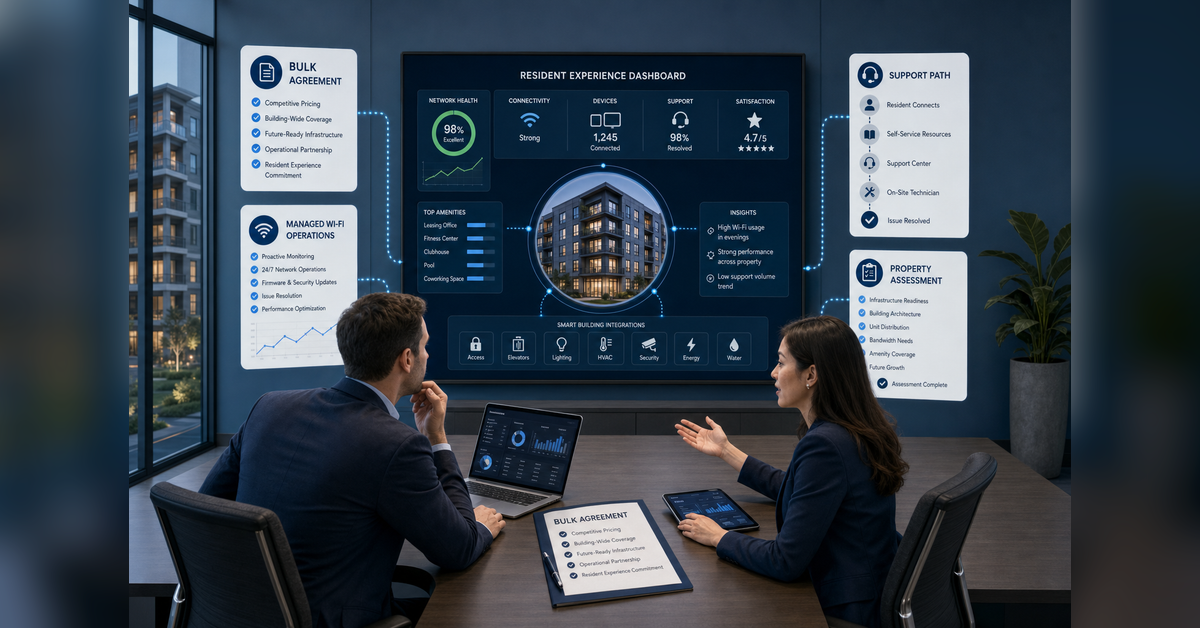

Managed Wi-Fi vs. Bulk Internet is not a choice between two names for the same service. Bulk internet is usually the property-level agreement for internet service, while managed Wi-Fi is the operating model for access points, monitoring, resident support, smart-building connectivity, and the day-to-day Wi-Fi experience.
For multifamily owners and ISPs, the real question is not which term sounds better. The question is which model the property can explain, operate, support, and renew without confusing leasing teams, residents, asset managers, or technical operators.






What is the difference?
Managed Wi-Fi vs. Bulk Internet comes down to operating model versus agreement model: bulk internet defines how internet service is packaged and paid for at the property level, while managed Wi-Fi defines how the wireless network is designed, monitored, supported, and experienced across units, common areas, and smart-building systems.
Executive Summary for Owners and ISPs
Bulk internet answers the deal question
Who pays, how residents get service, whether internet is included, and how the property-level agreement works.
Managed Wi-Fi answers the operations question
Who designs, manages, monitors, supports, and improves the Wi-Fi experience across the property.
Community Wi-Fi is the resident promise
It often describes property-wide connectivity that feels simple, consistent, and move-in ready when the scope is clear.
Many properties need both
A bulk agreement may support the commercial model, while managed Wi-Fi supports the resident and building experience.
Clarify the MDU Connectivity Model
Bulk internet and managed Wi-Fi answer different questions. Use the Managed Wi-Fi vs. Bulk Internet distinction to help property owners understand the agreement, network, support model, resident experience, and smart-building impact.
- Bulk agreement model
- Managed Wi-Fi operations
- Resident onboarding
- Support responsibility
- Smart-building readiness
- Property assessment CTA
What Is Managed Wi-Fi vs. Bulk Internet?
Bulk internet is usually the property-level commercial agreement for internet service. It may define how service is packaged, how residents receive access, whether internet is included in rent or an amenity fee, and how the owner and provider structure the relationship.
Managed Wi-Fi is the technical and operational model for the wireless network. It covers access point design, network monitoring, support paths, resident onboarding, common-area coverage, in-unit experience where applicable, security boundaries, and smart-building connectivity.
That distinction matters in sales. A property owner who wants a better resident move-in experience may not be asking for a bulk deal yet. A property owner who wants a portfolio service agreement may not understand that Wi-Fi operations still need to be designed and supported. Percepture separates these conversations across its ISP marketing agency cluster so awareness, deal strategy, and model comparison do not collapse into one vague page.
Why Property Owners Confuse the Two
The terms overlap because they often show up in the same sales conversation. A bulk internet agreement may include a managed Wi-Fi component. A managed Wi-Fi solution may support a bulk internet strategy. Community Wi-Fi may describe the resident-facing promise created by both.
The problem starts when the buyer hears one term and assumes it solves every issue. Bulk internet is the deal structure. Managed Wi-Fi is the operating model. Resident-choice internet is another model entirely. If those lines are not clear, legal, operations, leasing, maintenance, and residents all hear different stories.
ISPs can shorten the education cycle by using plain language before pitching features. A Managed Wi-Fi vs. Bulk Internet explanation should make it clear what the property is buying, who supports it, what residents will experience, and what the building can realistically support. The best MDU broadband marketing uses that clarity before the offer becomes too complex. If the property owner cannot explain the model to the leasing team, the ISP has not explained it clearly enough.
The Percepture MDU Connectivity Decision Matrix
The Percepture MDU Connectivity Decision Matrix helps property owners and ISPs use Managed Wi-Fi vs. Bulk Internet as a practical decision, not a terminology debate. The matrix shows whether a multifamily property needs bulk internet, managed Wi-Fi, both, or a phased model based on economics, resident experience, support complexity, building readiness, and smart-building goals.
Agreement Model
Clarify who pays, how service is packaged, and how residents access internet.
Network Operating Model
Define who designs, monitors, supports, and manages the Wi-Fi network.
Resident Experience
Reduce move-in friction, support clear onboarding, and avoid support confusion.
Building Reality
Respect wiring, access points, backhaul, contracts, density, and support capacity.
Managed Wi-Fi vs. Bulk Internet Framework
| Decision Layer | Bulk Internet | Managed Wi-Fi | Percepture Guidance |
|---|---|---|---|
| Business model | Property-level agreement | Service and operations model | Use Managed Wi-Fi vs. Bulk Internet language before bundling |
| Resident experience | Internet may be included | Wi-Fi can be move-in ready | Connect to onboarding and support |
| Network control | Depends on agreement | Provider or operator manages Wi-Fi | Clarify ownership and control |
| Support | Contract-dependent | Usually a managed support path | Define who handles what |
| Smart building | May support connectivity | Often central for connected systems | Tie to access, sensors, cameras, and operations |
| Common areas | Not always included | Usually covered if designed | Define exact scope |
| Economics | Amenity, consistency, retention, or revenue model | Operational efficiency and experience value | Show the property-level business case |
| Best fit | Property wants a service bundle | Property wants a controlled experience | Many MDUs should evaluate both |
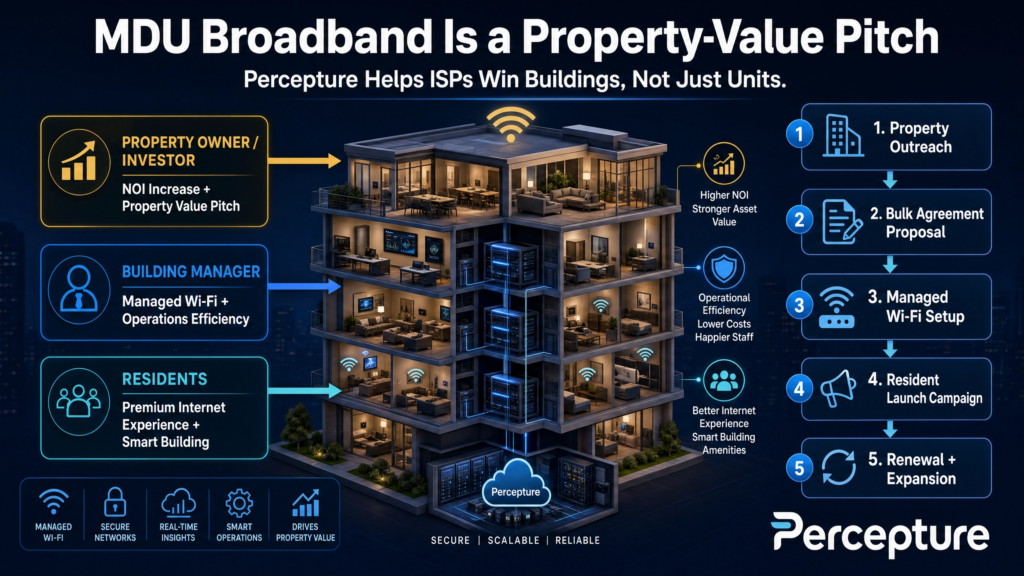
Bulk Internet Explained for Multifamily
Bulk internet answers the commercial question: how is service packaged for the property? In many multifamily settings, the property-level agreement may let residents receive internet as part of rent, an amenity fee, or another lease package. The model can simplify onboarding and create a more consistent provider experience when the scope is clear.
Bulk internet does not automatically solve Wi-Fi performance. In a Managed Wi-Fi vs. Bulk Internet discussion, this is the point buyers often miss: the agreement may cover service access, pricing logic, resident communication, and commercial terms, but the property still needs to understand how connectivity reaches units, common areas, leasing offices, amenity spaces, and smart-building systems.
ISPs should connect the bulk conversation to offer design, owner economics, and resident communication. A strong broadband offer strategy gives the buyer a clear reason to evaluate the model without implying that a contract alone fixes network operations.
Managed Wi-Fi Explained for Multifamily
Managed Wi-Fi answers the operating question: how will the property-wide wireless experience actually work? It may include access point design, common-area Wi-Fi, in-unit Wi-Fi where applicable, network management, performance monitoring, support escalation, and resident onboarding.
For a property manager, the support path may matter as much as the technical design. Who handles access issues? Who helps a resident connect devices? Where do smart locks, thermostats, cameras, sensors, package rooms, and resident apps fit? What happens when a problem is really a device issue, not a network issue?
This is where Managed Wi-Fi vs. Bulk Internet becomes a practical operating decision. The buyer needs plain-English expectations, not a hardware lecture. The ISP should explain scope, accountability, service boundaries, and launch communication before asking the property to compare options.
Community Wi-Fi, Managed Wi-Fi, and Bulk Internet
Community Wi-Fi is often the resident-facing promise: property-wide connectivity that feels simple, consistent, and easy to use. Managed Wi-Fi is usually the operating model behind that promise. Bulk internet may be the commercial agreement that makes the package work.
The terms should not be used as substitutes. A Managed Wi-Fi vs. Bulk Internet comparison helps prevent that mistake because it forces the ISP to explain support, scope, billing, resident onboarding, and smart-building use cases before the buyer hears a broad community Wi-Fi promise.
Terminology Scorecard
| Term | Plain-English Meaning | Best For | Risk If Unclear |
|---|---|---|---|
| Bulk internet | Property-level internet agreement | Pricing and access model | Owner thinks it solves Wi-Fi operations by itself |
| Managed Wi-Fi | Managed wireless network | Operations, support, common areas, connected systems | Owner may not understand the commercial model |
| Community Wi-Fi | Resident-facing property-wide experience | Amenity and leasing story | Vague if not tied to support and scope |
| Resident choice | Residents choose providers individually | Optionality | Fragmented experience and support |
| Common-area Wi-Fi | Wi-Fi in shared spaces | Amenities | Does not solve in-unit internet |
Are property owners clear on the model?
Before pitching managed Wi-Fi or bulk internet, make sure the buyer understands the agreement, network, support model, resident experience, and building-readiness questions. A Managed Wi-Fi vs. Bulk Internet pitch should remove ambiguity before it creates proposal momentum.
When Bulk Internet Is the Better Lead Message
Lead with bulk internet when the owner is already thinking in terms of property-level service, renewal windows, amenity packaging, portfolio consistency, or resident onboarding friction. In that sales moment, Managed Wi-Fi vs. Bulk Internet is still useful because it keeps the business conversation from getting confused with the technical operating plan.
This is also the right lead message when the property is evaluating how internet fits into rent, fees, retention, resident communication, or provider standardization. The pitch should be careful and specific. It should not promise that a commercial model alone will solve access point placement, common-area coverage, or support escalation.
For ISPs, this message should be connected to account targeting, property qualification, and follow-up. Percepture often treats this as part of lead generation, B2B intent data, and property-owner education rather than a standalone landing page.
When Managed Wi-Fi Is the Better Lead Message
Lead with managed Wi-Fi when the property wants control over resident experience, common areas, amenities, connected devices, support visibility, or move-in-ready connectivity. The buyer is often worried that Wi-Fi problems will become property management problems.
This message works best when the ISP explains operations in buyer language. Coverage, segmentation, monitoring, resident onboarding, escalation, and smart-building support should be described as property outcomes, not as a list of equipment.
Managed Wi-Fi vs. Bulk Internet should be framed around the buyer’s current pain. If support tickets, resident complaints, amenity spaces, or connected systems are the active issue, managed Wi-Fi may be the clearer entry point.
When the Property Needs Both
Many multifamily properties need both a bulk internet agreement and a managed Wi-Fi operating model. The agreement answers how the service is packaged. The managed network answers how residents and property systems experience it.
The combined model can be especially relevant during new construction, renovations, lease-up, contract renewal, common-area-first deployments, smart-building-first projects, or portfolio standardization. Existing properties may also need a phased plan if wiring, backhaul, contracts, or access constraints make a full rollout unrealistic.
The best model is the one the property can explain, operate, support, and renew. That is why the Managed Wi-Fi vs. Bulk Internet conversation should include sales, marketing, engineering, property operations, and resident communication before proposal language hardens.
Decision Scorecard for Property Owners
Score each category from 1 to 5. Higher scores suggest a stronger need for a structured Managed Wi-Fi vs. Bulk Internet decision at the property level.
| Category | If High, Consider |
|---|---|
| Unit count | Bulk internet or bundled model |
| Resident move-in friction | Managed Wi-Fi or community Wi-Fi |
| Smart-building needs | Managed Wi-Fi |
| Existing agreement renewal window | Bulk internet |
| Support burden | Managed Wi-Fi |
| Owner economic goals | Bulk internet |
| Leasing differentiation | Both |
| Common-area connectivity needs | Managed Wi-Fi |
| Portfolio standardization | Both |
| Building wiring complexity | Assessment before either |
- 0–20: Start with assessment and resident-choice improvements.
- 21–34: Evaluate one primary model first.
- 35–50: Likely candidate for combined bulk internet and managed Wi-Fi strategy.
What ISPs Should Say to Property Owners
ISPs should move away from broad claims and toward model clarity. A property owner does not need every technical detail in the first conversation. They need to know what problem each model solves and what decisions must be made before launch.
Message Map
| Weak Message | Better Message |
|---|---|
| Bulk internet is cheaper. | Bulk internet may create a property-level model that simplifies resident onboarding and supports owner economics. |
| We offer managed Wi-Fi. | Managed Wi-Fi gives the property a clearer operating model for Wi-Fi performance, support, common areas, and smart-building systems. |
| Residents will love it. | Residents care about easy setup, clear support, strong coverage, and no confusion on move-in day. |
| This is turnkey. | We will assess building readiness, backhaul, support needs, common areas, resident communication, and launch timing. |
| We can do both. | A Managed Wi-Fi vs. Bulk Internet recommendation depends on agreement structure, network design, support responsibility, and the property’s operating goals. |
Questions Property Owners Should Ask
Managed Wi-Fi vs. Bulk Internet decisions should start with ownership, support, scope, pricing, and renewal questions. The answers will reveal whether the offer is a true property operating model or only a commercial package.
- Who owns or controls the network equipment?
- Is this a bulk agreement, managed Wi-Fi service, or both?
- What areas are covered: units, common areas, amenities, and leasing office?
- Who handles resident onboarding and support tickets?
- What happens when a resident device has an issue?
- What smart-building systems are supported?
- What is the escalation path and installation timeline?
- What resident communication is provided?
- How does pricing work, and what happens at renewal?
- How is performance monitored?
- What happens if the property changes ownership?
Questions ISPs Should Ask Before Pitching
Good qualification protects both the buyer and the provider. An ISP should understand unit count, ownership, management structure, renewal timing, resident complaints, construction status, current support model, building wiring, backhaul, common-area needs, and portfolio goals before presenting a model.
The buyer’s priority also matters. An asset manager may focus on economics and retention. A property manager may focus on fewer headaches. A leasing team may need a simple amenity story. A technical operator may need building truth before sales language gets too far ahead.
Percepture connects this qualification work to ISP lead generation services, CRM routing, and sales enablement so teams do not treat every Managed Wi-Fi vs. Bulk Internet opportunity as the same MDU conversation.
Managed Wi-Fi vs. Bulk Internet for Resident Experience
Resident experience is where the model becomes real. The resident does not care what the model is called. The resident cares whether the internet works, whether setup is easy, whether support is clear, and whether billing or access feels confusing.
A good pitch should explain move-in setup, device connection, guest access, support, troubleshooting, common-area coverage, in-unit expectations, smart-device reliability, and billing clarity. If those details are missing, the property team may inherit the frustration.
Marketing should give leasing teams simple language. Sales should give owners clear scope. Support should know what it owns before launch. That is the operating discipline behind a credible Managed Wi-Fi vs. Bulk Internet comparison.
Managed Wi-Fi vs. Bulk Internet for Smart Buildings
Managed Wi-Fi becomes more important when connectivity supports smart locks, access control, cameras, leak sensors, thermostats, package rooms, amenity spaces, EV charging, building operations, and resident apps.
Bulk internet may support the commercial package, but smart-building systems need a clear operating model. Managed Wi-Fi vs. Bulk Internet is especially important here because connected systems depend on building access, network design, segmentation, monitoring, and serviceability. A property cannot market a smart-building experience if the support model is unclear.
This is also where technical and marketing teams must work together. A smart-building pitch should be search-visible and sales-ready, but it must still respect what the property can actually deliver.
How ISPs Should Market the Comparison
ISPs should not assume property owners understand the difference. Managed Wi-Fi vs. Bulk Internet should become a sales asset, SEO page, AI-answer asset, pitch deck module, webinar topic, LinkedIn sequence, direct mail message, trade PR angle, conference handout, resident FAQ template, and CRM segmentation field.
Percepture has developed multifamily connectivity marketing around Community WiFi, resident experience, property value, operational efficiency, LinkedIn, programmatic remarketing, digital PR, earned media, event marketing, and content creation. The safe lesson is simple: the market increasingly treats connectivity as part of the property experience, not only a resident-selected utility.
For visibility, ISPs need pages that search engines, property owners, and AI answer engines can parse. That means clear definitions, comparison tables, answer-first sections, schema, internal linking, and practical decision tools. Percepture supports this through omnichannel marketing, organic SEO services, generative engine optimization services, and digital PR services.
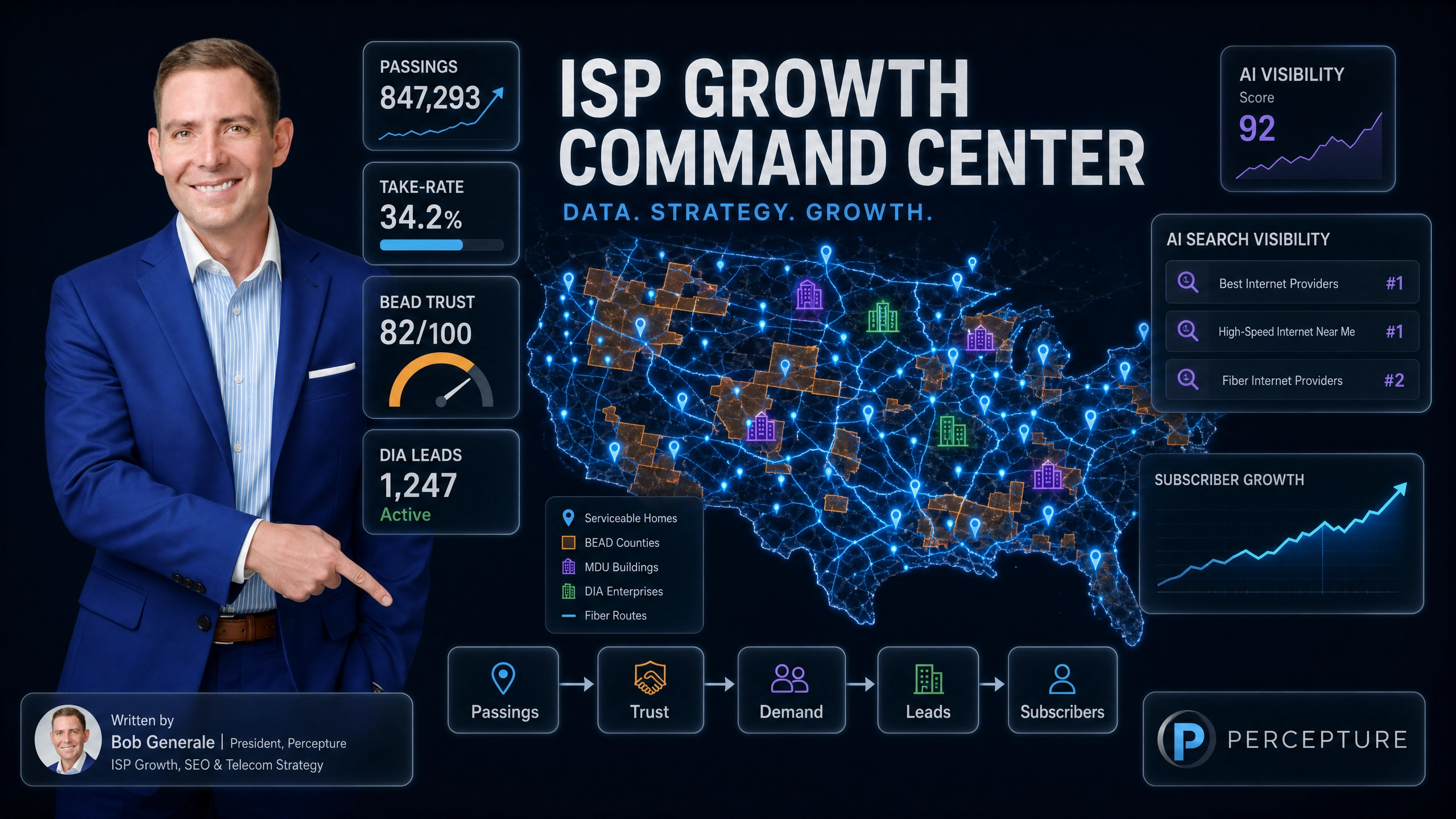

Turn comparison questions into property-level pipeline
Percepture helps ISPs turn Managed Wi-Fi vs. Bulk Internet questions into clearer SEO, GEO, PR, paid media, sales collateral, and CRM follow-up.
How Percepture Helps ISPs Explain Managed Wi-Fi vs. Bulk Internet
Percepture helps ISPs turn technical and commercial connectivity models into search-visible, AI-readable, property-owner-friendly content and sales enablement. The work is not only writing an article. It is building a repeatable explanation system.
That system may include model comparison messaging, property-owner landing pages, MDU SEO and GEO strategy, digital PR, LinkedIn and paid media campaigns, conference-to-pipeline strategy, sales deck modules, resident FAQ templates, property assessment CTAs, CRM routing, AI-assisted follow-up, objection handling, case study structure, and reporting dashboards.
When the sales team needs more automation, Percepture can connect comparison content to ISP sales automation and AI sales agents. When the buyer journey spans events, account targeting, and remarketing, the system can also use paid search, paid media, content marketing, and conversion rate optimization.
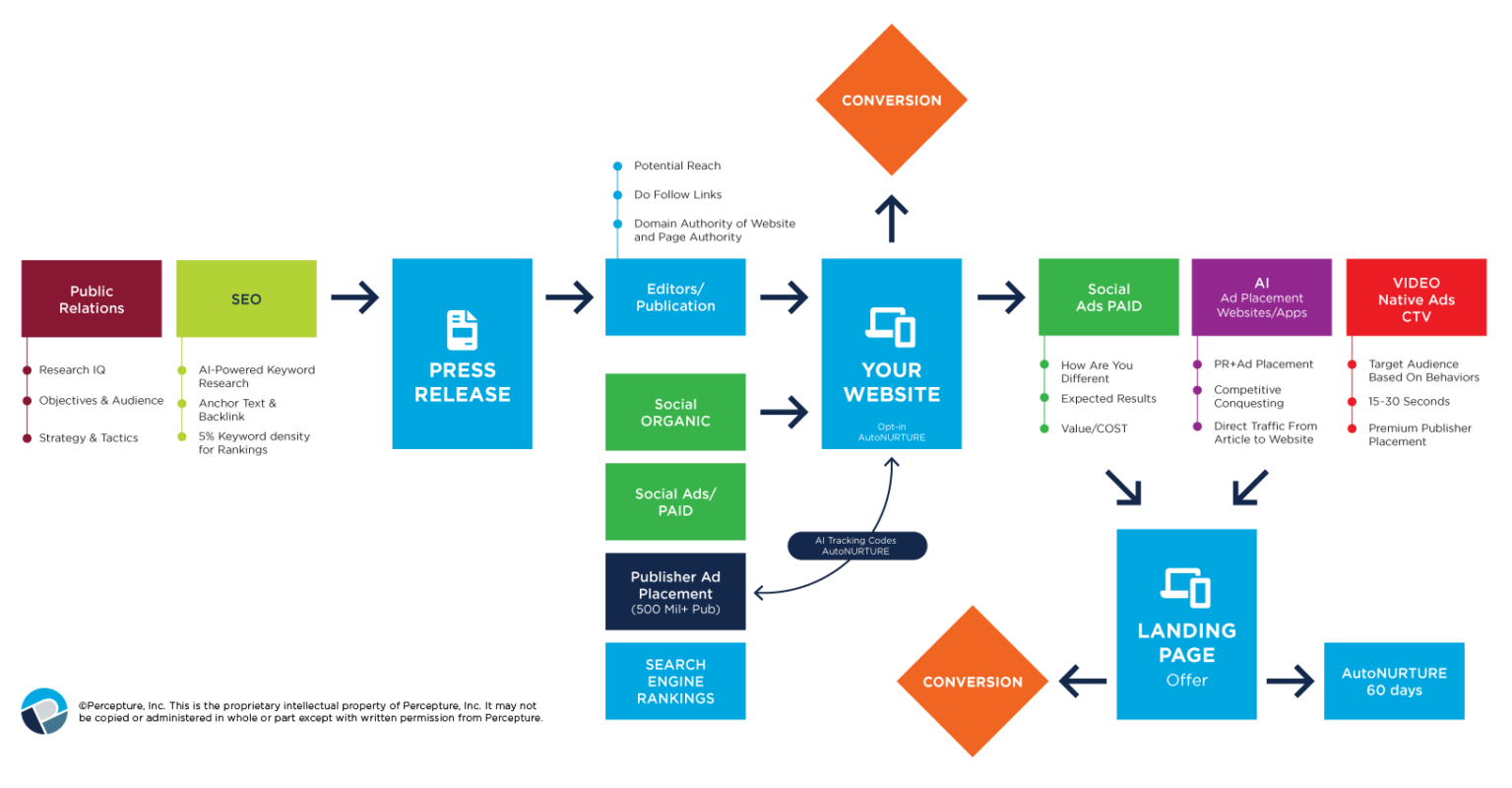
Metrics That Matter
The Managed Wi-Fi vs. Bulk Internet comparison page should not only rank. It should help sales understand which model the property is actually evaluating. That means measuring intent, fit, decision stage, and pipeline movement, not only pageviews.
Managed Wi-Fi vs. Bulk Internet Measurement Framework
| Metric | Why It Matters | Better Than |
|---|---|---|
| Property assessment requests | Shows owner intent | Pageviews |
| Comparison-page conversions | Shows education value | Impressions |
| Qualified properties | Shows fit | Raw leads |
| Units represented | Shows opportunity size | Lead count |
| Model-fit calls booked | Shows sales readiness | Content views |
| Bulk vs managed interest tags | Shows buyer need | Generic form fills |
| Decision-maker engagement | Shows account depth | Clicks |
| Proposal requests | Shows deal progression | Inquiries |
| Resident FAQ usage | Supports launch readiness | Page views |
| Pipeline by model | Shows commercial direction | Aggregate MQLs |
Common Mistakes ISPs Make
The most common mistake is treating managed Wi-Fi and bulk internet as the same thing. The second is leading with hardware instead of property outcomes. The third is assuming the property owner will translate technical language for leasing teams and residents.
Other mistakes include selling bulk internet without explaining Wi-Fi operations, selling managed Wi-Fi without explaining the commercial model, ignoring resident communication, failing to define support responsibility, sending MDU buyers to residential plan pages, overpromising building readiness, forgetting smart-building use cases, using vague turnkey language, and failing to align marketing, sales, network, and support before the pitch.
A strong Managed Wi-Fi vs. Bulk Internet page gives the sales team cleaner language and gives the buyer a better way to compare models before the proposal stage.
Hunter Newby Infrastructure Note: The Model Must Respect Building Reality
Hunter Newby’s physical Internet perspective reinforces a key lesson: managed Wi-Fi and bulk internet are not just sales labels. They depend on building access, wiring, backhaul, network design, neutral infrastructure, support obligations, and serviceability.
- A bulk agreement does not automatically solve Wi-Fi performance.
- Managed Wi-Fi cannot overcome poor backhaul or unrealistic building access.
- Building-level serviceability matters more than broad market availability.
- Network design, ownership, and support model shape resident experience.
- Marketing and engineering should align before the property owner hears the pitch.
Hunter explains why the physical network matters. Percepture explains how to turn that physical truth into buyer education, search visibility, sales collateral, and qualified MDU pipeline.

FAQ
What is the difference between managed Wi-Fi and bulk internet?
Managed Wi-Fi vs. Bulk Internet comes down to operations versus agreement structure. Bulk internet is usually the property-level agreement for internet service. Managed Wi-Fi is the operating model for Wi-Fi design, access points, monitoring, support, resident onboarding, and the property-wide wireless experience.
Is managed Wi-Fi the same as bulk internet?
No. They can work together, but they are different. Bulk internet defines how service is packaged and paid for. Managed Wi-Fi defines how the wireless network is managed, monitored, supported, and experienced by residents and property teams.
Can a multifamily property have both managed Wi-Fi and bulk internet?
Yes. Many properties evaluate both. In Managed Wi-Fi vs. Bulk Internet planning, the bulk agreement handles the service model, while managed Wi-Fi supports resident experience, common areas, connected systems, support paths, and property-wide connectivity.
When should a property choose bulk internet?
Bulk internet may make sense when ownership wants a property-level service agreement, simpler resident onboarding, amenity positioning, portfolio consistency, or a model tied to rent, fees, retention, or property economics.
When should a property choose managed Wi-Fi?
Managed Wi-Fi may make sense when the property wants better control over Wi-Fi performance, common-area coverage, smart-building systems, resident onboarding, troubleshooting, and support accountability.
What is community Wi-Fi?
Community Wi-Fi is often the resident-facing idea of property-wide connectivity. It may be delivered through managed Wi-Fi and paired with a bulk internet agreement, depending on the property model and scope.
What should property owners ask before choosing a model?
Owners should ask who owns equipment, who handles support, what areas are covered, how resident onboarding works, what smart-building systems are supported, how performance is monitored, and how the agreement renews.
How should ISPs market Managed Wi-Fi vs. Bulk Internet?
ISPs should explain Managed Wi-Fi vs. Bulk Internet clearly with comparison pages, sales decks, property assessment CTAs, resident FAQs, support-model explanations, smart-building use cases, AI-readable content, and owner-specific messaging.
Does managed Wi-Fi improve resident experience?
It can when the network is designed, supported, and communicated well. Managed Wi-Fi may reduce move-in friction, improve common-area coverage, support connected building systems, and create a clearer support path.
Can Percepture help explain managed Wi-Fi and bulk internet?
Yes. Percepture helps ISPs create SEO, GEO, PR, paid media, sales collateral, landing pages, resident FAQs, and follow-up systems that explain Managed Wi-Fi vs. Bulk Internet and other MDU connectivity models to property owners.
Ready to explain Managed Wi-Fi vs. Bulk Internet clearly?
Percepture can help your ISP build the comparison page, landing page, pitch deck, FAQ, property assessment CTA, and follow-up system that makes the model easier for owners to understand and sales teams to act on.
About the Author

Bob Generale is President of Percepture, a digital marketing agency that helps telecom, B2B, technology, and complex-service companies turn technical expertise into search-visible content, media strategy, sales enablement, and measurable lead generation.