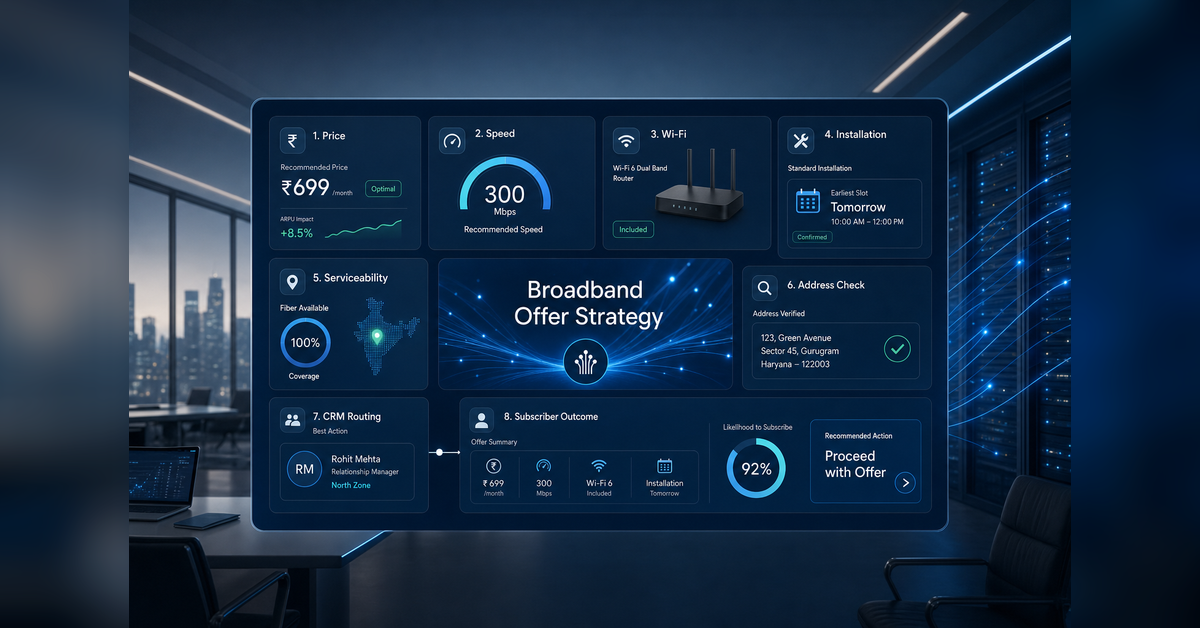

Broadband Offer Strategy is how ISPs package price, speed, Wi-Fi, installation, contract terms, promotional incentives, serviceability, and next steps so customers understand the value and act. The strongest broadband offers reduce confusion, clarify the true cost, match the market stage, and turn local demand into address checks, pre-registrations, installs, and subscribers.
Traffic does not fix a weak offer. If the offer creates doubt, the campaign pays for the click and loses the customer on the page, which is why Percepture treats offer design as part of serviceability-aware growth rather than a standalone pricing exercise.





What is a broadband offer strategy?
Broadband Offer Strategy helps ISPs convert demand by making price, speed, installation, Wi-Fi, contract terms, and availability clear. A strong offer reduces hesitation, supports address checks, improves pre-registration, and helps turn serviceable passings into subscribers.
Executive summary for ISP leaders
The offer is more than the price
A broadband offer combines pricing, speed tiers, Wi-Fi, install details, contract language, availability, trust proof, and a next step. If any layer is unclear, conversion can suffer.
Serviceability must drive the CTA
Active addresses, pre-sale addresses, future-serviceable homes, business buyers, and MDU properties should not see the same path. The offer should route each visitor honestly.
Clarity protects unit economics
Discounts can create demand, but unclear promotions can create churn risk and support burden. Broadband Offer Strategy should balance conversion with retention and revenue quality.
Percepture connects offer to demand
Percepture links Broadband Offer Strategy with omnichannel marketing, landing pages, SEO, GEO, paid media, PR, CRM routing, and subscriber reporting.
What Is Broadband Offer Strategy?
Broadband Offer Strategy is the way an ISP designs, packages, explains, and promotes internet plans so prospects understand the value, true cost, speed fit, availability, installation path, and next step. It is not only a discount calendar or a speed-tier chart.
For a provider, the work sits between finance, marketing, sales, operations, and customer support. Broadband Offer Strategy has to attract the right buyer without outrunning the network, confusing the call center, or creating a plan mix that looks good at signup and weakens later.
This is why the page should connect to a broader ISP marketing agency strategy. The offer has to show up consistently in local pages, paid ads, direct mail, Google Business Profile content, sales scripts, emails, and the buy flow.
Why Broadband Offers Fail
Broadband offers fail when the buyer cannot quickly answer basic questions: What does it cost? How long does that price last? Is Wi-Fi included? Can my address get service? What happens after I sign up?
The most common failures are not dramatic. They are small points of doubt that stack up. An introductory price is clear, but the regular price is buried. The page promotes 1 Gig, but never explains who needs it. The CTA says order now, but the address may only be in pre-sale.
Traffic can stay steady while sales fall if the offer creates friction. In an anonymized broadband campaign, Percepture saw that conversions can fall when promotional incentives, offer clarity, or buy-flow architecture change. The lesson is simple: Broadband Offer Strategy is conversion strategy.
If lead quality drops, the fix is not always more media. A provider may need sharper offer logic, cleaner pages, better routing, and clearer follow-up. That is where lead generation has to connect with pricing, serviceability, and sales operations.
Is your offer easy to understand?
Before spending more on traffic, make sure buyers understand the price, speed, Wi-Fi terms, installation path, address eligibility, and the Broadband Offer Strategy behind the next step.
Broadband Offer Strategy Framework: The Percepture Broadband Offer Clarity Matrix
The Percepture Broadband Offer Clarity Matrix helps ISPs build offers that make price, speed, installation, Wi-Fi, contract terms, availability, and next steps easy to understand and easy to act on. It gives marketing leaders a practical way to pressure-test an offer before the campaign goes live, and it keeps Broadband Offer Strategy tied to real buyer objections.
Offer clarity matrix
| Offer Layer | Buyer Question | Common Mistake | Percepture Fix |
|---|---|---|---|
| Price Clarity | What will I pay? | Promo price hides future price | Show promo, regular price, fees, and equipment |
| Speed Fit | Which plan do I need? | Every plan sounds the same | Explain usage by household or business type |
| Wi-Fi and Equipment | Is Wi-Fi included? | Equipment fee surprises | State router, mesh, managed Wi-Fi, and rental terms |
| Installation | How do I get connected? | Install path is vague | Show install fee, timing, self-install, or technician visit |
| Contract | Am I locked in? | Commitment is unclear | Explain no-contract, term, early termination, and price-lock details |
| Serviceability | Can my address buy? | One offer serves every address | Use Broadband Offer Strategy to separate active, pre-sale, future-serviceable, business, and MDU logic |
| Trust Proof | Why trust this provider? | Only speed claims appear | Use reviews, local proof, PR, uptime language, and transparent FAQs |
| Next Step | What should I do? | Generic learn-more CTA | Use check address, pre-register, request quote, or schedule install |
What Should Be Included in a Broadband Offer?
A broadband offer should clarify monthly price, promo period, regular price after promo, speed tier, upload and download details, Wi-Fi or equipment inclusion, installation fee, activation fee, contract length, price-lock details, data caps or unlimited data, autopay discounts, bundles, address eligibility, installation timing, support expectations, and CTA by address status.
That sounds like a lot, but the goal is not to overload the buyer. Good Broadband Offer Strategy removes the expensive doubts with a clean plan table, short explanations, and serviceability-aware CTAs rather than a long sales pitch.
Broadband consumer labels were created to make pricing, fees, speed, data allowances, introductory rates, contracts, and other terms clearer for buyers. That transparency mindset is useful beyond compliance because clear terms can become a trust signal when competitors are vague.
Broadband Offer Types for ISPs
Broadband Offer Strategy should change by market stage. A new active fiber market needs a different offer than a street still waiting for construction, a business district, an MDU property, or a churn-risk neighborhood.
Offer type comparison
| Offer Type | Best Fit | Primary CTA | Strategic Use |
|---|---|---|---|
| Launch offer | New active markets | Check address or order now | Create urgency when service is ready |
| Pre-sale offer | Markets before activation | Pre-register | Build demand before install capacity opens |
| Keep-me-updated offer | Future-serviceable areas | Join updates | Capture interest without overpromising |
| Price-lock offer | Trust-sensitive markets | Lock your rate | Reduce post-promo anxiety when the economics support it |
| Free installation offer | Markets with install friction | Check eligibility | Lower the perceived barrier to switching |
| Wi-Fi included offer | Markets where equipment fees create doubt | Compare plans | Make the total home experience clearer |
| Business fiber offer | Local businesses | Request quote | Shift from promo pricing to reliability and fit |
| MDU property offer | Multifamily owners | Request property assessment | Speak to property value and resident experience |
| Referral offer | Post-launch neighborhoods | Refer a neighbor | Turn satisfaction into local demand |
| Win-back offer | Churn or competitor-switch markets | See current offer | Re-open consideration with clearer value |
How to Match Offers to Serviceability
Broadband Offer Strategy should change by serviceability status. Active addresses should see order or install CTAs. Pre-sale addresses should see pre-registration. Future-serviceable addresses should see keep-me-updated forms. Not-yet-eligible visitors should receive honest availability language and a future update path.
This is where many providers lose trust. A buyer should not click through three screens before learning service is not available. Serviceability logic should be visible on the page, inside the address checker, and in CRM routing.
Serviceability-based offer logic
| Address Status | Best Offer | CTA | Mistake to Avoid |
|---|---|---|---|
| Active | Install, price-lock, or free setup | Check address or order | Hiding final price |
| Pre-sale | Early adopter or launch promo | Pre-register | Sending to checkout |
| Future-serviceable | Update or priority notice | Join updates | Pretending service is live |
| Not-yet-eligible | Future-interest path | Get updates | Overpromising availability |
| Business | Quote, SLA expectations, redundancy | Request quote | Using residential copy |
| MDU | Property value and resident experience | Property assessment | Tenant-only language |
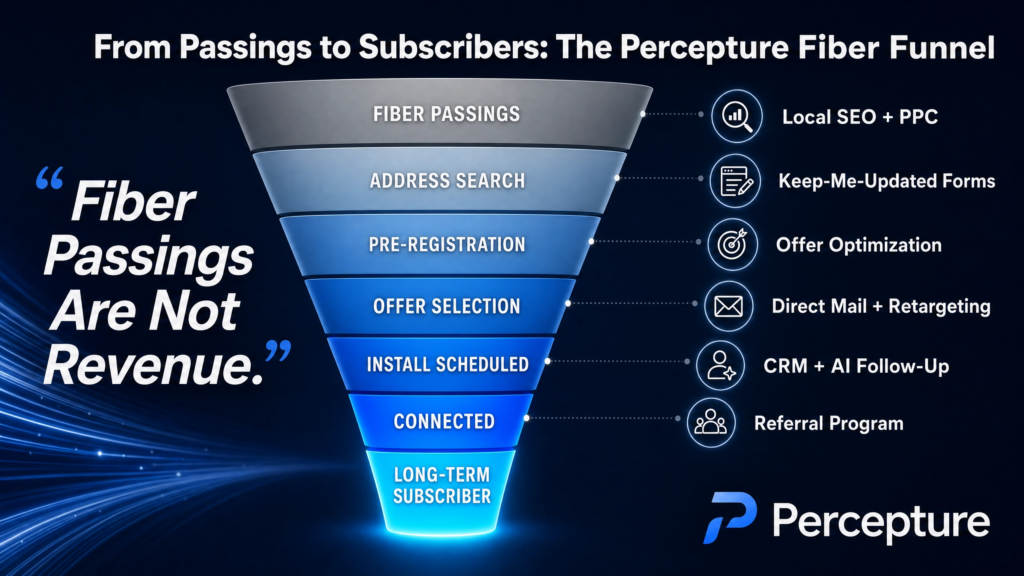
Percepture connects this logic to how to convert fiber passings into subscribers, because passings do not create revenue until a buyer understands the next step and completes it.
Price, Speed, Wi-Fi, and Trust
Customers do not only buy speed. They buy certainty. A clear Broadband Offer Strategy reduces fear around price jumps, hidden fees, equipment charges, installation, and whether the plan will work for their household or business.
Speed-tier messaging should be plain. Instead of making every visitor compare numbers alone, explain which plan fits a remote worker, gamer, multi-device household, small business, or heavy upload user. When upload speed matters, say why.
Wi-Fi and equipment also need clean language. If router, mesh, managed Wi-Fi, modem, or equipment rental is included, say so. If it costs extra, say that clearly. Surprise fees can turn a strong plan into a weak experience.
Price-lock offers can reduce anxiety when they are financially sound and honestly explained. Broadband Offer Strategy should answer the buyer’s objections before the buyer leaves the page.
Broadband Offer Strategy and PPC
PPC can drive demand, but the offer determines whether that demand converts. If a campaign sends paid traffic to a vague offer, the ISP may pay for clicks while losing buyers on price, Wi-Fi, contract, or install uncertainty.
That is why Percepture keeps paid media connected to offer architecture. A fiber internet PPC strategy should not only ask which keywords to buy. It should ask whether the landing page can turn that intent into an address check, pre-registration, quote request, install, or follow-up workflow.
For operators, the paid-search lesson is direct: do not let media carry a weak offer. Fix the pricing clarity, plan comparison, serviceability language, and CTA path before raising spend.
Broadband Offer Strategy and Local SEO
Local SEO can rank city and neighborhood pages, but the offer must match the local market. A city page should not use the same offer for active, pre-sale, and future-serviceable areas.
Strong local pages connect local proof, availability, construction status, serviceability language, and the correct CTA. They also help sales and support teams avoid repeated explanations because the page already tells the buyer what to expect.
This is why local SEO for fiber internet providers should work with Broadband Offer Strategy, not beside it. Rankings create opportunity; the offer turns local intent into action.
Broadband Offer Strategy and Fiber Take-Rate
Fiber take-rate improves when the offer makes the next step obvious. Passings become more valuable when the ISP gives serviceable households a clear reason to check availability, pre-register, schedule install, become subscribers, and refer neighbors.
Fiber passings are not revenue. Broadband Offer Strategy is one of the bridges between infrastructure and subscribers. That bridge includes the address-check CTA, install incentive, price certainty, referral path, review generation, and sales follow-up.
Percepture’s Telecom Insights cluster connects this page with fiber take-rate marketing and the definition of what fiber take rate is, so the offer work stays tied to subscriber growth rather than vanity traffic.
Turn demand into installs
The Percepture Broadband Offer Clarity Matrix connects Broadband Offer Strategy, address checks, landing pages, sales follow-up, and subscriber reporting.
Landing Page Requirements for Broadband Offers
The landing page should not make the sales team re-explain the offer. It should give the buyer a clear headline, a direct answer above the fold, an address-check CTA, a plan comparison table, pricing and promo terms, speed-tier explanations, Wi-Fi and equipment language, install steps, serviceability language, local proof, FAQs, support options, privacy reassurance, and tracking.
The best page architecture is simple. First, tell buyers what is available and what to do. Then show plan fit, total-cost clarity, install expectations, trust proof, and common objections. Finally, route each visitor based on address status. Broadband Offer Strategy makes that page architecture operational instead of decorative.
Behind the page, the ISP needs clean measurement. Percepture pairs landing-page architecture with conversion rate optimization, attribution and analytics, and CRM tagging so leaders can see where demand becomes revenue and where it leaks.
Broadband Offer Metrics That Matter
Clicks are not enough. Broadband Offer Strategy metrics should follow the buyer past the click, past the form, and into install or retention.
Offer performance scorecard
| Metric | Why It Matters | Better Than |
|---|---|---|
| Address checks | Shows qualified demand | Clicks |
| Offer-page conversion rate | Shows offer clarity | Traffic |
| Pre-registrations | Shows future demand | Impressions |
| Install scheduled | Shows real conversion | Form fills |
| Subscriber activated | Proves revenue path | Leads |
| Lead-to-install rate | Shows sales and operations health | CPL |
| Plan mix | Shows tier appeal | Total orders |
| Wi-Fi attach rate | Shows equipment value | Pageviews |
| Promo-to-regular retention | Shows trust and churn risk | Signup volume |
| Checkout abandonment | Shows buy-flow friction | Sessions |
| Conversion by market | Shows local fit | Average conversion rate |
| Referral rate | Shows satisfaction | Acquisition only |
Common Broadband Offer Mistakes
Broadband Offer Strategy should catch these issues before traffic, sales scripts, and support conversations amplify them.
Offer risks to fix before launch
- Hiding the regular price after the promotion.
- Making all speed tiers sound the same.
- Not explaining Wi-Fi or equipment fees.
- Using one offer for every market stage.
- Sending pre-sale visitors to an active-order flow.
- Promoting service before address eligibility is clear.
- Changing incentives without updating landing pages.
- Running paid media to a weak offer page.
- Ignoring install friction.
- Making business and residential offers too similar.
- Not training sales and support on the offer.
- Tracking leads but not installs or retention.
How Percepture Builds Broadband Offer Strategy
Percepture builds Broadband Offer Strategy around serviceability, conversion, local trust, search visibility, paid media, direct mail, CRM routing, and subscriber reporting. The work starts with an offer audit and competitor offer review, then moves into speed-tier messaging, price and promo clarity, landing-page architecture, address-check CTA logic, pre-sale paths, keep-me-updated paths, and install-friction reduction.
From there, Percepture connects the offer to channel execution. That can include organic SEO services, generative engine optimization services, digital PR services, paid search, content marketing, direct mail alignment, sales and support scripts, CRM tagging, CRO testing, and reporting dashboards.
The point is not to make the offer louder. It is to make the offer clearer, more accurate, and easier to act on across every buyer touchpoint.
AI Search Visibility for Broadband Offers
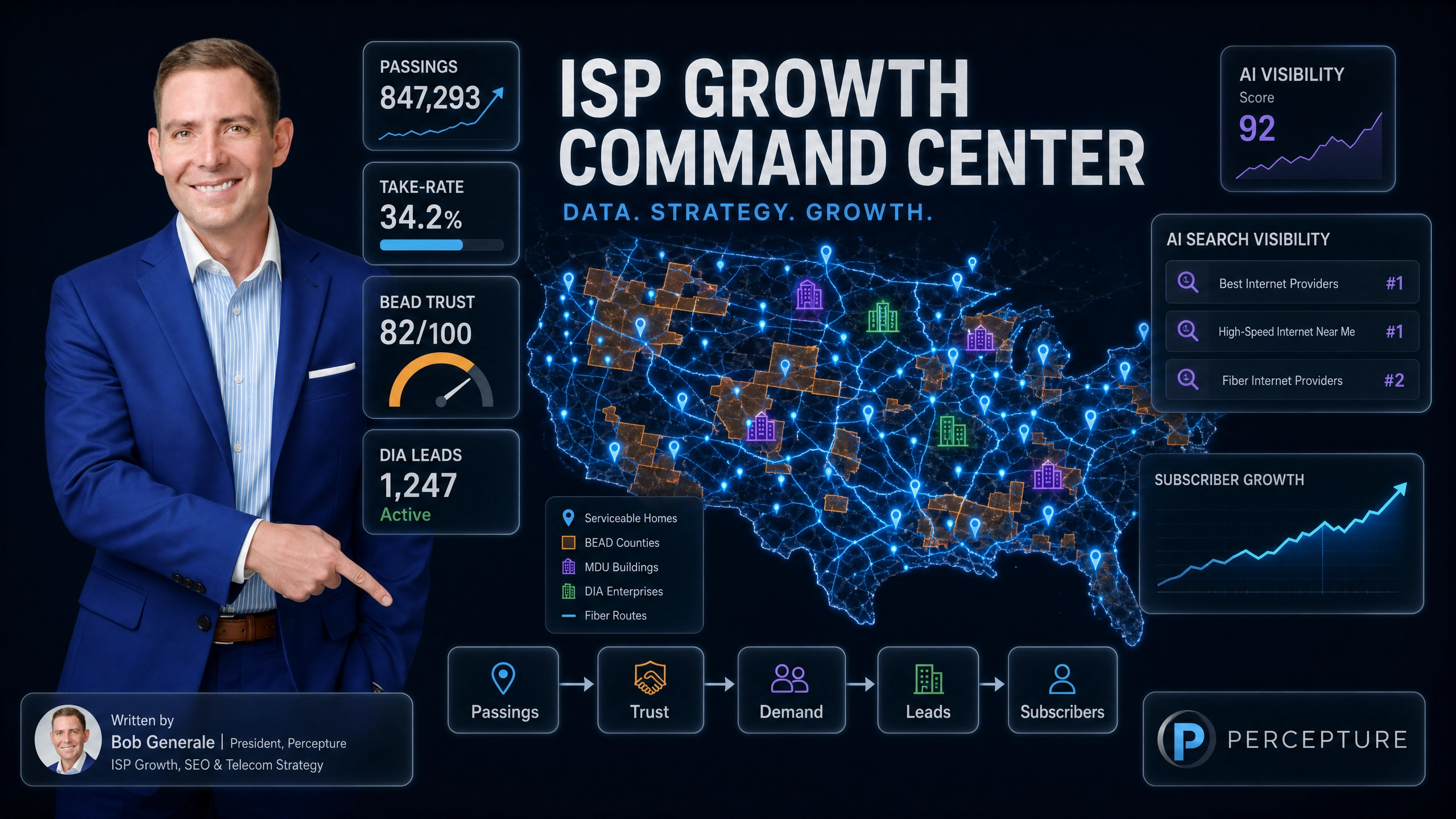
AI answer engines need clean entities, direct explanations, structured lists, tables, FAQs, and clear relationships between the provider, service area, offer, plan, eligibility, and next step. If the content is vague for people, it is usually vague for search systems too.
A strong Broadband Offer Strategy gives AI systems extractable answers: what the offer includes, who it fits, how serviceability changes the CTA, why price certainty matters, and what the buyer should do next. Percepture connects this work to telecom marketing strategy so offer content supports both human decision-making and AI retrieval.
Hunter Newby Infrastructure Note: Pricing Alone Is Not the Moat

Hunter Newby’s physical Internet perspective reinforces a key offer strategy lesson: the strongest broadband offer is not always the cheapest plan. If the provider has real infrastructure advantages, such as owned conduit, dark fiber, neutral interconnection, better backhaul, strategic routes, or stronger reliability, Broadband Offer Strategy should communicate that value clearly.
- Pricing is easy for competitors to copy.
- Structural network advantages are harder to copy.
- Offers should express real infrastructure truth, not empty speed claims.
- Marketing should not promise what the physical network cannot support.
- A clear offer connects network value to buyer action.
This article uses Hunter’s infrastructure lens to support Percepture’s offer strategy framework. Hunter explains why the physical network matters. Percepture explains how to turn network value into pricing clarity, trust, conversion, and subscriber growth.
Broadband offer strategy FAQs
What is Broadband Offer Strategy?
Broadband Offer Strategy is how an ISP packages price, speed, Wi-Fi, installation, contract terms, serviceability, promotional incentives, and next steps so prospects understand the value and take action.
Why do broadband offers fail?
Broadband offers fail when pricing, promo length, regular price, Wi-Fi terms, installation details, or serviceability are unclear. Broadband Offer Strategy reduces that confusion before it lowers conversion.
What should be included in a broadband offer?
A broadband offer should include monthly price, promo period, regular price, speed, Wi-Fi and equipment terms, install cost, contract terms, data limits, serviceability, and a clear CTA.
How does offer strategy affect fiber take-rate?
Broadband Offer Strategy affects fiber take-rate by helping serviceable households understand the value, check their address, pre-register, schedule install, become subscribers, and refer neighbors.
Should ISPs use price-lock offers?
Price-lock offers can reduce customer anxiety around surprise increases, but they must be financially sound and clearly explained. They work best when trust and retention are major buying concerns.
What is the best CTA for a broadband offer page?
The best CTA depends on address status. Broadband Offer Strategy should send active addresses to check address or order now, pre-sale addresses to pre-register, and future-serviceable addresses to join updates.
How should ISPs explain speed tiers?
ISPs should explain speed tiers by use case, not just numbers. A household, gamer, remote worker, small business, or multi-device family may need different plan guidance.
How should broadband offers differ for business buyers?
Business broadband offers should focus on reliability, uptime expectations, redundancy, support, speed symmetry, and quote requests rather than only residential-style promo pricing.
Can offer changes hurt conversion?
Yes. If promotional incentives, pricing, landing-page copy, or buy-flow logic change without clear messaging, conversions can drop even when traffic stays steady. Broadband Offer Strategy helps operators manage those changes before they reach the market.
Can Percepture help with Broadband Offer Strategy?
Yes. Percepture helps ISPs build Broadband Offer Strategy that connects price clarity, serviceability, landing pages, PPC, local SEO, CRM follow-up, and subscriber reporting.
Ready to improve Broadband Offer Strategy conversion?
Percepture can help your ISP clarify pricing, speed tiers, install incentives, serviceability, landing pages, conversion tracking, and the Broadband Offer Strategy that connects them.

About Bob Generale
Bob Generale is President of Percepture, a digital marketing agency that helps organizations connect strategy, search visibility, PR, paid media, content, analytics, and conversion systems. Bob works with Percepture teams on operator-led SEO, GEO, lead generation, and growth programs for complex B2B and telecom markets.