
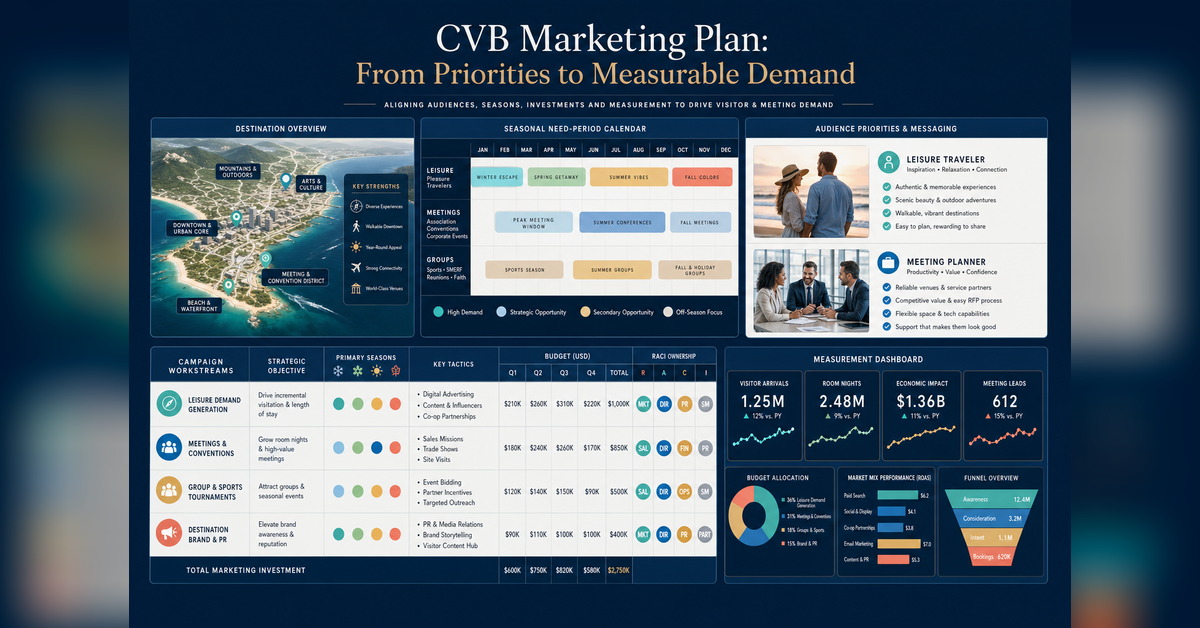

A CVB marketing plan is the annual operating roadmap that connects destination priorities with need periods, audiences, leisure and group programs, convention-sales support, partner value, budgets, owners and measurable outcomes. It explains what the CVB will do, why it matters, when the work happens and what evidence will change the next decision.
The strongest plans begin with demand evidence rather than a channel list. Every major activity should trace back to a mandate, objective, audience, conversion, owner, budget and KPI.
What should a CVB marketing plan include?
A complete CVB marketing plan includes baseline evidence, need periods, markets, audiences, objectives, leisure and group programs, convention-sales support, partner pathways, channel roles, budget, owners, calendar, KPIs, reporting and risk controls.
Updated August 6, 2026
The annual plan in four decisions
Choose the demand
Define the dates, markets, planner segments and partner gaps the destination must address.
Choose the work
Connect each priority to programs, proof, channels, sales support and visitor actions.
Assign control
Name the budget, accountable owner, approver, dependencies and operating limits.
Set the decision rule
State what evidence will cause the team to scale, revise, pause or reallocate.
A channel list is not a plan. A CVB marketing plan shows which demand the destination needs, when it needs it, who owns the work and how results guide the next move.
Who this guide is for
Each stakeholder should use the CVB marketing plan to make the decisions within their authority while working from the same priorities, definitions and evidence.
Executive and board leaders
Use the CVB marketing plan to set priorities, exclusions, controls and reporting expectations.
Marketing and sales teams
Use it to align leisure demand, convention sales, sports, groups, content, PR and media.
Finance and operations
Use it to connect objectives with procurement, staffing, data and flexible spending.
Partners and agencies
Use it to clarify deliverables, handoffs, approvals, conversion paths and evidence.
Start with the CVB demand strategy
A CVB marketing plan should follow a clear destination strategy. Start with the CVB marketing strategy guide to understand the demand portfolio. Use this page to turn that strategy into an annual plan, budget, ownership model and calendar.
The mandate comes first. Clarify the geography served, the organization’s leisure and meetings responsibilities, partner commitments, public accountability and brand role. If the mandate is unclear, stakeholder requests can enter the CVB marketing plan without a shared test for relevance.
Organizational structure also affects planning. The guides to destination organization mandates and CVB, DMO and tourism-board differences provide context for governance and scope without replacing the annual planning process.
The strongest destination plans begin with place truth

Explore Hunterdon illustrates the planning sequence. The documented work moved from destination research and place identity to “The Other Side of Jersey,” “Unplug & Reconnect,” a visitor promise, activation and measurable site demand.
The approved results include 7 million impressions, 73,000 site visitors, 13,106 direct banner clicks and a click-through rate 20% above average. The lesson for a CVB marketing plan is not to copy the creative. Hunterdon first defined what the destination could credibly own, then connected that truth to audiences, creative, distribution and measurement.
That research-to-activation discipline is also relevant when selecting a destination marketing agency. The agency should be able to explain the demand problem before recommending media.

Destination marketing experience and credentials




The CVB Demand Planning Cascade
The CVB Demand Planning Cascade moves from public mandate and market evidence to programs, ownership, measurement and quarterly decisions. It gives a CVB marketing plan an operating spine so tactics cannot bypass strategy.
1. Mandate
Write the responsibilities, partner promises, operating limits and explicit exclusions.
2. Baseline
Assemble demand, pipeline, website, partner, media and data-quality evidence.
3. Need
Prioritize weak dates, geographic gaps, planner-shortlist gaps and partner needs.
4. Market
Score fit, access, conversion evidence, cost, competition and confidence.
5. Objective
Set a baseline, target, deadline, owner, dependency and reallocation rule.
6. Audience
Map motivations, barriers, proof, channels, conversions and partner handoffs.
7. Proof
Maintain current evidence for experiences, access, capacity, value and local expertise.
8. Program
Build aligned work plans for leisure, meetings, sports, groups, PR and digital demand.
9. Resources
Assign money, people, procurement, technology, approvals and contingency.
10. Measurement
Define conversions, sales stages, sources, attribution windows and confidence.
11. Learning
Record monthly findings and formal quarterly scale, revision and stop decisions.
Framework rule: A tactic should not enter the calendar until it traces back to a mandate, demand need, objective, audience, owner and KPI.

Build the plan in an editable format
Use the Cascade and one-page model to organize your CVB marketing plan priorities before expanding them into departmental work plans. Percepture can provide the planning structure and facilitate the working session.
Request the CVB Annual Demand Plan TemplateCreate the one-page executive plan
If leadership cannot summarize the annual plan on one page, the organization will struggle to execute the longer version consistently. The one-page CVB marketing plan should identify the few choices every department must understand.
One-page CVB marketing plan fields
| Field | Required answer |
|---|---|
| Mandate | What is the CVB responsible for, and what is excluded? |
| Destination truth | What can the place credibly own? |
| Demand problems | Which dates, markets, planner gaps or partner needs matter? |
| Priority audiences | Which travelers, planners and organizers come first? |
| Objectives | What measurable outcomes must change? |
| Programs | What coordinated work will create that change? |
| Partner pathway | How will visitor or planner demand reach local businesses? |
| Resources | What is committed, flexible, testable or unfunded? |
| Owners | Who is accountable, responsible and authorized to approve? |
| KPIs | What will be measured, from which source and with what confidence? |
| Decisions | What triggers scale, revision, pause or reallocation? |
Build the baseline
The baseline prevents the team from setting targets against assumptions. Build it from available visitation and lodging data, need periods, meetings pipeline, venue capacity, website behavior, partner actions, visitor profiles, feeder markets, booking windows, earned visibility, search demand, paid performance and data quality.
A SWOT can summarize the findings, but it should not become a page of unsupported adjectives. Connect every item to evidence, an affected audience, an operating consequence, an owner and a proposed response. That makes the baseline usable inside the CVB marketing plan.
Measurement design should begin here, not after launch. Percepture’s attribution and analytics work connects campaign, site, partner and sales evidence while keeping confidence and exclusions visible.
Prioritize need periods and markets
Every campaign in the CVB marketing plan needs a demand problem, not merely a theme. Define the period, the capacity or perception issue, the relevant destination product, the audience and the desired action.
Illustrative need-period matrix
| Period | Demand problem | Product | Audience | Desired action |
|---|---|---|---|---|
| Winter weekend | Low leisure occupancy | Events and indoor culture | Drive-market couples | Overnight referral |
| Spring midweek | Hotel need | Meeting value and access | Regional associations | RFP or site visit |
| Summer weekday | Attraction capacity | Family experiences | Drive families | Multi-day itinerary |
| Post-convention | Limited delegate dispersal | Neighborhoods and attractions | Attendees | Trip extension action |
All rows are illustrative and must be replaced with destination evidence.
Then score each prospective market from one to five for product fit, need-period fit, access, audience size, conversion evidence, cost efficiency, partner value, competition, repeat potential and data confidence. Record those scores in the CVB marketing plan; market size without destination fit is an expensive form of optimism.
Set goals and decision rules
Limit the annual CVB marketing plan to a manageable set of outcomes. Use SMARTER objectives: specific, measurable, achievable, relevant, time-bound, evidence-based and reallocation-ready.
An illustrative objective might be: increase qualified association-meeting RFPs from priority regional verticals by 20% year over year by June 30, while maintaining agreed lead-quality criteria and separating tentative, definite and actualized room nights. The percentage is an example, not a benchmark.
KPI hierarchy and management use
| Level | Examples | Management question |
|---|---|---|
| Delivery | Reach, frequency, impressions, completed video | Did the program enter the market as planned? |
| Qualified behavior | Planner-guide use, itinerary depth, partner clicks | Did the right audience engage with useful proof? |
| Conversion | RFP, site visit, registration, booking or referral action | Did interest become an identifiable action? |
| Sales and outcome | Definite business, room nights, visitor action | Did activity contribute to the intended demand? |
| Public and partner value | Visitor indicators and partner benefit | Who benefited, and how confidently can that be shown? |
| Future authority | Search visibility, AI citation, first-party audience | Is the destination building durable discoverability? |
A KPI belongs in the CVB marketing plan only when it informs a decision. Scale when qualified conversion exceeds the target and capacity exists. Revise when reach is sufficient but qualified behavior is weak. Stop when repeated exposure produces no meaningful movement. Investigate when platform and CRM results materially diverge.
A KPI without a decision threshold is a reporting habit, not a management tool. The tourism marketing ROI guide provides a broader measurement bridge for public, partner and campaign value.
Map traveler and planner journeys
Do not force every audience into one funnel. A leisure traveler may move from dreaming to comparison, date selection, lodging, experiences, visitation and repeat behavior. A meeting planner moves through awareness, shortlist, research, RFP, bid, site visit, tentative, definite, attendance and repeat.
Sports organizers begin with facility fit and destination capacity. Group-tour operators begin with route fit, product, rates and contracting. The CVB marketing plan should document each audience’s questions, proof, channels, content, conversion, owner, partner handoff, KPI and source.
Formal customer journey mapping helps marketing, convention sales and partners agree on where ownership changes within the CVB marketing plan. It also shows where the destination is asking for a conversion before supplying enough proof.

Build departmental work plans
Departmental plans translate CVB marketing plan objectives into owned work. They should use the same need periods, audience definitions, sales stages and KPI dictionary.
Leisure
Document feeder markets, segments, campaigns, events, content, media, PR, search, email, partner programs, visitor services, KPIs and owners.
Meetings
Document verticals, priority accounts, RFP goals, planner content, trade events, site visits, attendance building, handoffs and stage KPIs.
Sports and groups
Document facilities, event targets, room requirements, companion value, organizer outreach, bid support and repeat-event strategy.
PR, content and search
Align the story calendar with need periods, destination proof, evergreen questions, source data, crisis readiness and content reuse.
Partner value
Define listings, referrals, lead distribution, training, co-op rules, accessibility, feedback, eligibility and reporting.
Channel teams support these work plans rather than setting independent priorities. That includes paid media, content marketing services, public relations, email marketing and omnichannel marketing.
Search work should cover classic discovery and answer retrieval. Use enterprise SEO services for crawlable destination architecture and generative engine optimization services for clear entities, answer-ready content and source visibility. The supporting guides to travel SEO, travel PR and AI search for tourism marketing explain those channel disciplines in more depth.
Use a campaign brief
Every major initiative in the CVB marketing plan should have a short campaign brief. Record the demand problem, objective, need period, audience, origin market, insight, destination promise, proof, next step, channel roles and partner pathway.
Add the conversion, attribution window, budget, owner, approver, risk, KPI, scale or stop rule and learning question. The brief should be short enough to use and specific enough to prevent stakeholders from interpreting the campaign differently.
How the CVB marketing plan should organize budget and ownership
The CVB marketing plan budget should follow need and evidence, not last year’s percentages. Show it four ways: by objective, by audience portfolio, by program or channel, and by fixed, committed, test and flexible status. Do not use a universal allocation percentage across destinations.
Budget framework
| View | What it reveals | Decision it supports |
|---|---|---|
| Objective | Investment behind each annual outcome | Whether stated priorities are funded |
| Audience portfolio | Investment across leisure, meetings, sports and groups | Whether demand portfolios match the mandate |
| Program and channel | Research, content, PR, media, search, email, sales and measurement costs | Execution scope and vendor requirements |
| Spend status | Fixed, committed, test, flexible, reserve and unfunded amounts | Reallocation capacity and downside control |
For each line, ask what outcome it supports, what evidence supports the amount, what is contractually committed, what can be tested and what capacity constraint could make success undesirable. Include measurement costs and the response if revenue changes.
Procurement belongs on the CVB marketing plan calendar. Account for RFPs, legal review, board action, production, media reservation, research, data integration, partner recruitment and accessibility review. A plan that ignores procurement and production lead time is a wish list with dates.
Use RACI for every major program: Responsible, Accountable, Consulted and Informed. The board should approve strategy, fiduciary controls and accountability. Staff should optimize approved programs within defined limits.
Create the annual calendar
The calendar turns the CVB marketing plan into coordinated work. Use rows for need periods, leisure campaigns, trade activity, sports and group bids, events, content, PR, SEO, GEO, email, partner programs, research, board meetings, procurement, crisis exercises and reporting.
Work backward from the visitor’s booking window or the planner’s decision cycle. A launch date without research, approval, production and distribution dates hides the work that controls delivery.
Review performance monthly, make formal decisions quarterly and rebuild annually. Monthly reviews cover objectives, pipeline, need-period status, campaign diagnostics, partner distribution, budget, data quality, risks and assigned decisions. Quarterly reviews address market changes, lost business, channel contribution, reallocation and the next tests.
Define the dashboard before launch
A board dashboard should stay focused on decision-level information. Use a limited set of primary measures covering annual objectives, investment, leisure outcomes, meetings pipeline, definite and actualized room nights, sports and group results, partner actions, destination indicators, authority signals, confidence and decisions.
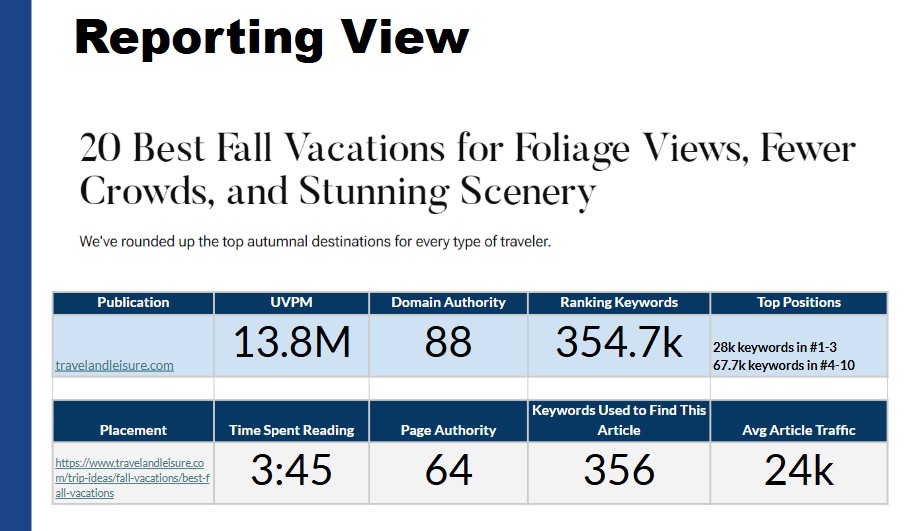
The measurement dictionary should define each metric’s name, business meaning, formula, source, owner, frequency, attribution window, confidence, exclusions and decision use. Keep inquiry, qualified lead, bid, tentative, definite, actualized and canceled or lost stages separate.
Every report should answer six questions: What was the goal? What was invested? What changed? How confident are we? Who benefited? What decision follows? This keeps the dashboard aligned with the management purpose of the CVB marketing plan.
Add the risk register
Crisis readiness belongs in the CVB marketing plan because destination trust can change faster than the campaign calendar. Cover weather, safety, political disruption, health, transportation, closures, event cancellation, budget shortfall, staffing, privacy, technology, misinformation, partner conflict, capacity pressure, accessibility and procurement delay.
For each risk, record probability, impact, early signal, owner, mitigation, approved response, partner communication and recovery trigger. Connect communication planning to the organization’s crisis communications capability rather than drafting responses during an active event.
Download the CVB marketing plan template
A usable CVB marketing plan template should work as an editable document and a print-friendly PDF. It should also include smaller working tools that teams can update without rewriting the full plan.
Template table of contents
- Executive summary
- Mandate and assumptions
- Baseline
- Brand and destination promise
- Demand problems and need periods
- Markets and audiences
- Annual objectives
- Leisure work plan
- Meetings work plan
- Sports and group work plan
- PR, content, SEO and AI plan
- Partner and visitor-services plan
- Campaign calendar
- Budget
- Staffing and RACI
- Technology and data
- Measurement dictionary
- Risk register
- Quarterly cadence
- Source-data appendix
The supporting package should contain a campaign brief, market-priority matrix, KPI dictionary, RACI worksheet, annual calendar and board dashboard. Label every sample assumption and illustrative target.
Score the plan before approval
Score each CVB marketing plan category from zero to ten. The resulting 100-point assessment tests coherence and operating readiness. It does not guarantee demand or replace destination-specific evidence.
100-point CVB marketing plan score
| Category | Maximum | Full-score test |
|---|---|---|
| Mandate clarity | 10 | Responsibilities, priorities and exclusions are explicit. |
| Evidence quality | 10 | Baselines, sources, owners and data limits are documented. |
| Need-period priority | 10 | Programs address specific dates, gaps or demand conditions. |
| Market and audience focus | 10 | Selection uses fit, access, value, evidence and confidence. |
| Objective quality | 10 | Every objective has a baseline, target, deadline and rule. |
| Program alignment | 10 | Departmental work traces back to annual outcomes. |
| Budget and ownership | 10 | Resources, RACI, approvals and flexibility are visible. |
| Partner-value design | 10 | Demand has a defined pathway to local partners. |
| Measurement and decisions | 10 | KPIs, sources, thresholds and confidence are defined. |
| Risk and cadence | 10 | Risks, reviews, reallocation and learning are operational. |
Interpretation: 85–100 is executable and board-ready; 70–84 is strategically sound with gaps; 55–69 is an activity plan lacking decision clarity; below 55 is a tactic list rather than an operating plan.
Common mistakes
The most common error is starting with channels. Other problems include copying another destination, skipping exclusions, using too many objectives, ignoring need periods, defining audiences too broadly and treating market size as proof of fit.
Execution breaks down when goals lack baselines, KPIs lack decisions, marketing and sales use different definitions, tentative and definite business are combined, partner value stays implicit or the prior budget simply rolls forward.
A weak CVB marketing plan may also omit procurement, data ownership, current destination inventory, search and AI visibility, booking windows, crisis preparation, reallocation rules or an annual retrospective. Publishing only a PDF creates another problem: important answers are harder to find, link to and reuse than a crawlable HTML summary.
Why Percepture?
Percepture connects destination planning with research, place identity, public relations, paid media, content, SEO, GEO, customer journeys and analytics. That integration matters because a CVB marketing plan must coordinate the whole demand system rather than hand each channel a separate goal.
Explore Hunterdon provides approved research-to-activation proof. Greater Williamsburg provides an integrated destination demand example. Percepture has operated since 2004 and supports travel organizations through strategy, execution and measurement.
Review the destination demand portfolio
Before approving channels and calendars, test whether the CVB marketing plan balances leisure, meetings, sports, groups, partner value and long-term discoverability.
Review the CVB Demand Portfolio StrategyCVB annual planning FAQs
What is a CVB marketing plan?
A CVB marketing plan is the annual operating roadmap for creating, converting and measuring destination demand. It translates the organization’s mandate into need periods, priority audiences, objectives, programs, convention-sales support, partner pathways, budgets, owners, KPIs and decision rules.
What should the annual plan include?
A CVB marketing plan should include a mandate, exclusions, baseline evidence, need periods, market priorities, audience journeys, annual objectives, departmental work plans, campaign briefs, budget, RACI, calendar, KPI dictionary, board dashboard, risk register and quarterly decision process.
How long should the plan be?
The detailed document can be as long as the organization needs to manage its work, but its priorities should fit on one executive page. Supporting worksheets can hold campaign details, market scores, budgets, ownership, metrics and risk controls without making the main plan difficult to use.
How should a CVB set annual goals?
Start with a documented baseline and a specific demand problem. Give each CVB marketing plan goal a target, deadline, accountable owner, dependencies, source, confidence level and reallocation rule. Keep the number of annual outcomes small enough for leaders and departments to use them consistently.
Which KPIs belong in the plan?
Include KPIs that inform a management decision. Use a hierarchy covering delivery, qualified behavior, conversion, sales or visitor outcomes, partner value and future authority. Define the formula, source, reporting frequency, attribution window, exclusions and threshold for scaling, revision or stopping.
How should leisure marketing and convention sales coordinate?
They should share need periods, market definitions, destination proof, content calendars, sales-stage language and reporting rules. Marketing should know the planner questions and handoff points. Sales should distinguish inquiry, qualified lead, bid, tentative, definite, actualized and lost business.
How are feeder markets selected?
Score markets for product fit, need-period fit, access, audience size, conversion evidence, cost efficiency, partner value, competition, repeat potential and data confidence. Large population alone is not enough; the market must match the destination’s demand problem and credible visitor promise.
How should the budget be organized?
Organize the budget by objective and audience first, then by program or channel and fixed-versus-flexible status. Identify committed contracts, tests, reserves, measurement costs and unfunded work. This structure makes reallocation possible without hiding which annual outcome loses support.
Who approves and manages the plan?
The board should approve strategy, fiduciary controls and accountability. Staff should optimize approved programs within defined limits. Each initiative should use RACI to identify who is Responsible, Accountable, Consulted and Informed, including finance, sales, marketing, partners and vendors.
How often should the plan be updated?
Review results and operating issues monthly, make formal scale, revision, stop and reallocation decisions quarterly, and rebuild the plan annually. Update assumptions sooner when destination capacity, funding, access, safety, market behavior or data quality changes materially.
Turn the annual plan into an operating system
Percepture can review your CVB marketing plan, measurement dictionary, ownership model and decision cadence before budgets and calendars are locked.
Request a CVB Marketing Plan and Measurement Review