

CVB marketing is the coordinated use of destination brand, leisure promotion, convention and meeting sales support, group development, partner distribution, visitor information and measurement to generate overnight stays and local visitor spending. Strong programs share one destination brand while using separate audiences, proof, conversions and KPIs.
A leisure traveler, association planner, sports organizer and hotel partner do not buy the same value. Effective CVB marketing treats them as connected demand portfolios rather than one campaign calendar.
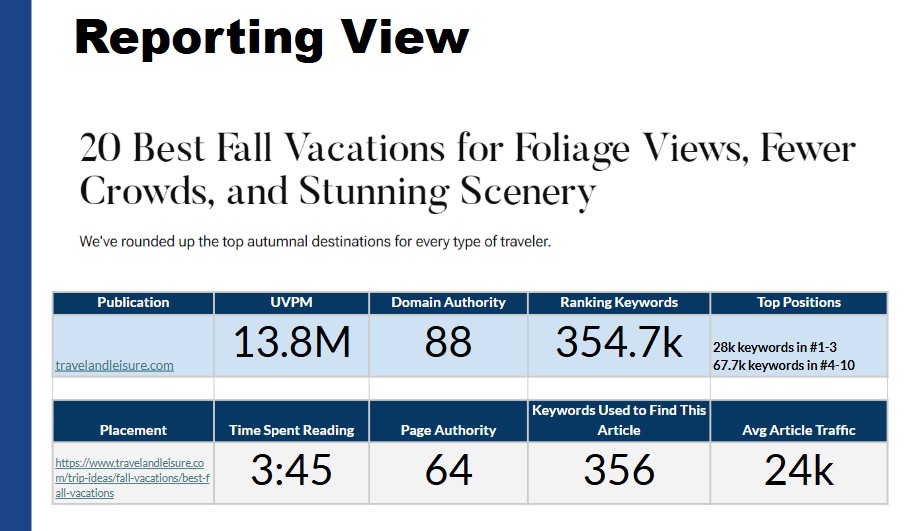
Travel experience, independent recognition and proof that earns attention



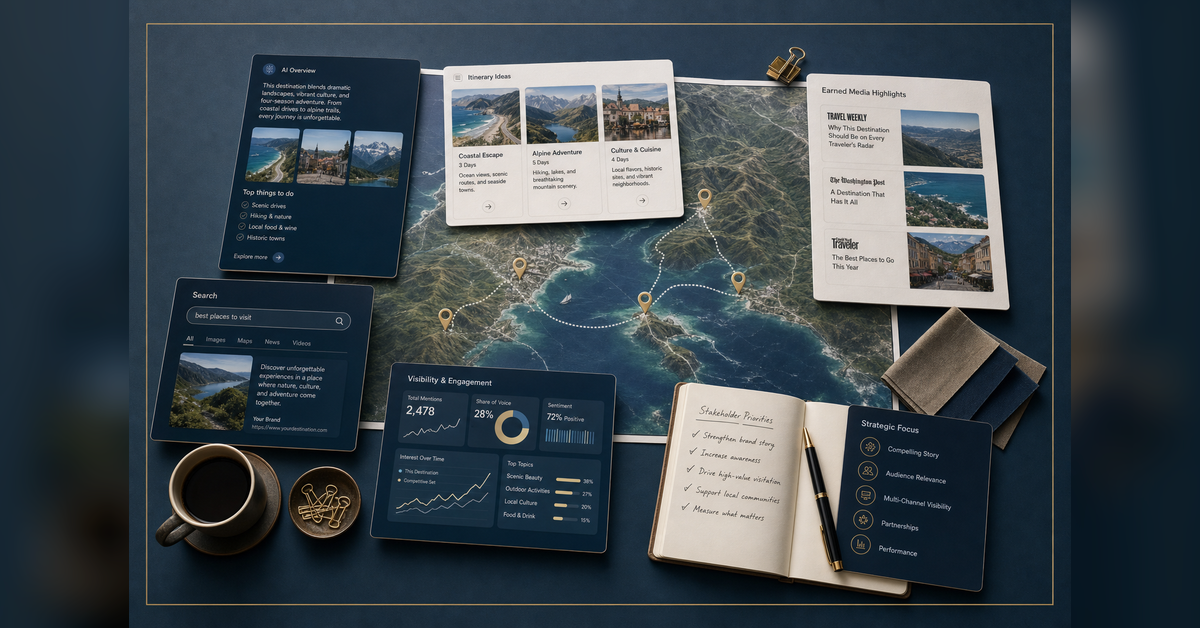
See how Percepture turned a distinctive destination story into earned media, search authority and lasting visibility.
What is CVB marketing?
CVB marketing creates destination demand across leisure, meetings and group markets, then distributes qualified opportunity to hotels, venues, attractions and local businesses. The operating goal is overnight visitation and group business that creates measurable destination and partner value.
One destination brand can serve several buyers, but each buyer needs different proof, content, conversion paths and performance measures.
The operating view for destination leaders
Start with the demand need
Choose the season, dates, market or segment the bureau needs to address before selecting media or creative.
Separate the buying journeys
Leisure travelers, planners, sports rights holders and tour operators need different facts, pages and conversions.
Connect marketing and sales
Marketing earns consideration. Convention sales qualifies fit and turns the right opportunities into booked business.
Show partner distribution
Report how referrals, leads, itineraries and opportunities reach hotels, venues, attractions and other suppliers.
Keep pipeline stages distinct
Inquiry, qualified lead, bid, tentative, definite and actualized business should never be combined into one total.
Measure each portfolio
One destination brand can support several demand portfolios, but each portfolio requires its own outcome and KPI.
Destination leaders responsible for demand and partner value
CVB and DMO executives
Align leisure, meetings, groups, partner value and board reporting under one destination-demand model.
Convention sales leaders
Clarify how marketing earns consideration before sales qualifies, bids and converts the opportunity.
Tourism marketing teams
Choose audiences, need periods, content, media and conversion paths before building the campaign calendar.
Partner and analytics teams
Show how referrals, leads, room nights and visitor actions reach hotels, venues, attractions and local businesses.
How is it different from DMO marketing?
A CVB is generally a destination marketing organization with a stronger meetings, conventions and visitor-services emphasis. Naming practices and responsibilities vary by destination, so leaders should define the organization and its actual marketing responsibilities by its mandate rather than its initials.
Broader DMO work can include stewardship, resident alignment, destination development and stakeholder coordination. A bureau may do those things too, but its operating model often gives convention sales, group demand and visitor services greater weight. See what a DMO does and the guide to DMO, CVB and tourism board differences for the organizational context.
A weak model
A consumer advertising department with a group-sales sidebar. Meetings receive recycled leisure creative but little planner proof.
Another weak model
A convention-sales office with a tourism website attached. Leisure demand and partner discovery become secondary tasks.
The better model
The better model creates demand before an RFP, converts fit when an opportunity appears and extends value after booking.
Score the demand portfolio before adding another campaign
Use the CVB Demand Portfolio Scorecard to review positioning, leisure segmentation, meetings and group sales alignment, need periods, partner distribution, search visibility, measurement and ownership.
A seasonal campaign starts with a demand need
Seasonality becomes useful when the bureau treats it as a demand problem rather than a content calendar. A documented 2024 Branson/Lakes Area CVB proposal from Percepture began with a defined objective: increase Christmas-season visitation by making festive attractions and events visible in priority spot markets through a proposed TV and digital strategy.
The methodology connected timing, trip reason, feeder markets and coordinated reach before selecting individual tactics. It is an example of proposal strategy, not campaign-performance proof.
Documented strategy example; not campaign-performance proof.
The CVB Demand Portfolio
The CVB Demand Portfolio is Percepture’s framework for balancing six connected forms of destination demand. It gives CVB marketing one brand structure while requiring a distinct audience, proof, conversion and KPI for each portfolio.
1. Leisure
The leisure portfolio can reach couples, families, cultural travelers, food travelers, event visitors and drive or fly markets. Outcomes include overnight stays, shoulder-season demand, trip planning and partner discovery.
2. Meetings and conventions
Association, corporate, incentive, government, training and trade-show planners. Outcomes include qualified leads, RFPs, site visits, definite bookings, room nights and attendance.
3. Sports and groups
Sports organizers, tour operators, weddings, reunions, student groups and affinity groups. Outcomes include events, room blocks, facility use and repeat business.
4. Partner distribution
Hotels, venues, attractions, restaurants and local suppliers. Partner-distribution outcomes include referrals, leads, itinerary placement, co-op participation and visible partner value.
5. Authority and reputation
Travelers, planners, media, creators, residents and search systems. Outcomes include credibility, accurate discovery, media authority and trusted information.
6. Yield and future demand
Board, staff and partners. Outcomes include need-period performance, stronger pipeline decisions, repeat demand and more useful reporting.
The framework prevents CVB marketing from becoming a list of disconnected channel activities. It asks leaders to define which demand the destination needs, when it needs it, what proof will move that audience and how resulting value will reach partners.
A CVB marketing framework for different buyers
| Portfolio | Buyer question | Required proof | Primary action |
|---|---|---|---|
| Leisure | Why this place and why now? | Experiences, seasons, access, lodging and trip ideas | Plan an overnight trip |
| Meetings | Can this destination support the event? | Capacity, access, room pattern, services and destination fit | Submit or discuss an RFP |
| Sports | Can the facilities and community operate the event? | Dimensions, seating, parking, safety support, hotels and transport | Start a facility review |
| Group tour | Can the itinerary work for the group? | Group access, dining, parking, guides, timing and accessibility | Request itinerary help |
| Partners | How will opportunity reach my business? | Eligibility, distribution rules, referrals and reporting | Join or use a partner program |
| Board and public stakeholders | What value did the organization help create? | Separated pipeline, partner and destination indicators | Review priorities and outcomes |
How should CVB marketing support leisure demand?
Leisure promotion starts with a specific trip reason, audience and travel window. “Something for everyone” may sound inclusive, but it gives a traveler little reason to choose the destination now.
Useful leisure segmentation includes origin market, drive or fly access, trip purpose, party type, length of stay, booking window, first-time or repeat status, overnight or day-trip behavior and experience interest. These choices shape the message, landing page, media plan and partner pathway.
Every leisure journey should answer six questions: Why this destination? Why now? What trip can I build? Where can I stay? Which experiences fit me? What should I do next? Strong content marketing turns those answers into seasonal pages, itineraries, event pathways, regional guides, maps and accessible planning information.
Use need periods, not a generic annual calendar
Need-period analysis can account for shoulder seasons, weekdays, post-event gaps, weather patterns, hotel compression, attraction capacity and booking windows. The goal of the program is not simply more traffic. It is the right demand for the dates and places where additional visitation can create value.
Do not buy more demand for dates already full unless the goal is higher yield, longer stays or better geographic distribution. Paid activity should follow the demand decision, not define it. That is where coordinated omnichannel planning and paid media can connect market timing to a useful visitor action.
A sound leisure strategy also routes visitors to relevant partners. Lodging referrals, attraction pages, restaurant discovery, event information and saved-trip or email functions should reduce planning friction rather than trap the visitor on an inspirational page.
How should CVB marketing help win conventions?
A leisure campaign is not a convention-sales program with different creative. Planner-focused destination marketing must address operational fit, risk, access, hotel inventory, venue configuration, destination appeal, local services and attendance potential.
A planner’s shortlist often forms before the formal RFP. That means planner-facing content must make accurate destination facts easy to find through search, media, industry content and direct research. Stale hotel, venue or transport information can remove a destination from consideration before sales knows an opportunity exists.
Marketing and convention sales have different jobs
| Destination marketing | Convention sales |
|---|---|
| Build awareness and destination preference | Qualify accounts and opportunities |
| Publish planner content and search answers | Coordinate the RFP and bid response |
| Use PR, paid media, email and nurture | Coordinate hotels, venues and local suppliers |
| Capture and route interest | Arrange and manage site visits |
| Provide attendance-building resources | Move tentative opportunities toward definite business |
| Build destination-level evidence | Complete the services handoff |
Marketing earns consideration. Convention sales turns fit into booked business. Both teams need common definitions, lead routing, response expectations and CRM stages. Otherwise, marketing reports inquiries while sales reports accounts, and leadership cannot see how the two systems connect.
Publish the proof planners use
Planner pages should cover air and ground access, hotel inventory, room-block patterns, capacity, floorplans, off-site options, accessibility, sustainability evidence, local suppliers, CVB services and the RFP or site-visit process. Customer journey mapping can expose where planners encounter missing facts or unclear next steps.
Search visibility also matters. Enterprise SEO services can organize planner questions into discoverable destination resources, while generative engine optimization services can improve entity clarity and the structure of answers used during AI-assisted research. The underlying facts must remain current and verifiable.
Use a planner-to-place pathway
The working sequence is awareness → shortlist → RFP → bid → site visit → tentative → definite → attendance → extension → repeat. Each transition has a different owner and proof requirement. A useful marketing-and-sales system records where the opportunity entered, what moved it forward and why it was won, lost or canceled.

How should a CVB address sports and groups?
“Group” is not one audience. A sports rights holder, motorcoach operator, wedding planner, reunion organizer, student group and incentive planner work with different decision makers, planning windows and operating requirements.
Sports demand
Sports-focused destination content should publish facility dimensions, seating, parking, medical and safety support, hotel capacity, transportation, family attractions and relevant prior-event evidence. The conversion is not a generic inspiration click. It is often a facility review, bid discussion or qualified lead.
Sports KPIs can include qualified leads, bids, events, room nights, attendees, facility use, need-period value and repeat opportunities. The metrics should be reported by stage so a preliminary lead is not treated like an actualized event.
Group tour and other organized travel
Tour operators need group itineraries, motorcoach logistics, dining capacity, guide options, parking, accessibility and seasonal programs. Other segments may need dedicated paths for weddings, reunions, performance groups, religious travel, training or incentive programs.
An effective bureau does not combine all of these buyers under one “groups” campaign. It identifies the buying role, operating proof, lead time, partner set and conversion for each priority segment.
How does a CVB create partner value?
The CVB should create destination-level demand without pretending to choose winners. That requires clear rules for how hotels, venues, attractions, restaurants and suppliers become visible and receive opportunities.
Hotel value from the bureau can include convention and group leads, room blocks, leisure referrals, need-period campaigns, destination demand, site-visit exposure, attendance support and market intelligence. Attraction and venue value can include itinerary placement, off-site leads, delegate extension, media exposure, group opportunities and event promotion.
Partner value is more credible when the bureau explains how opportunity is distributed—not only how much audience it reached. Publish listing eligibility, lead-distribution rules, member and nonmember treatment, paid versus editorial placement, co-op rules, conflicts, accessibility requirements and reporting practices.
A partner-value report should distinguish audience reach from referrals, leads, accepted opportunities and partner-reported outcomes. Attribution and analytics can connect these layers without claiming that every visitor action was caused by the bureau.
Which channels matter?
The channel is not the strategy. Its job inside a demand portfolio is the strategy.
| Channel | Leisure role | Meetings or group role | Useful KPI |
|---|---|---|---|
| Website and content | Inspiration and trip planning | Destination fit and planner proof | Qualified actions |
| SEO | Capture trip intent | Enter planner research | Nonbrand visibility and leads |
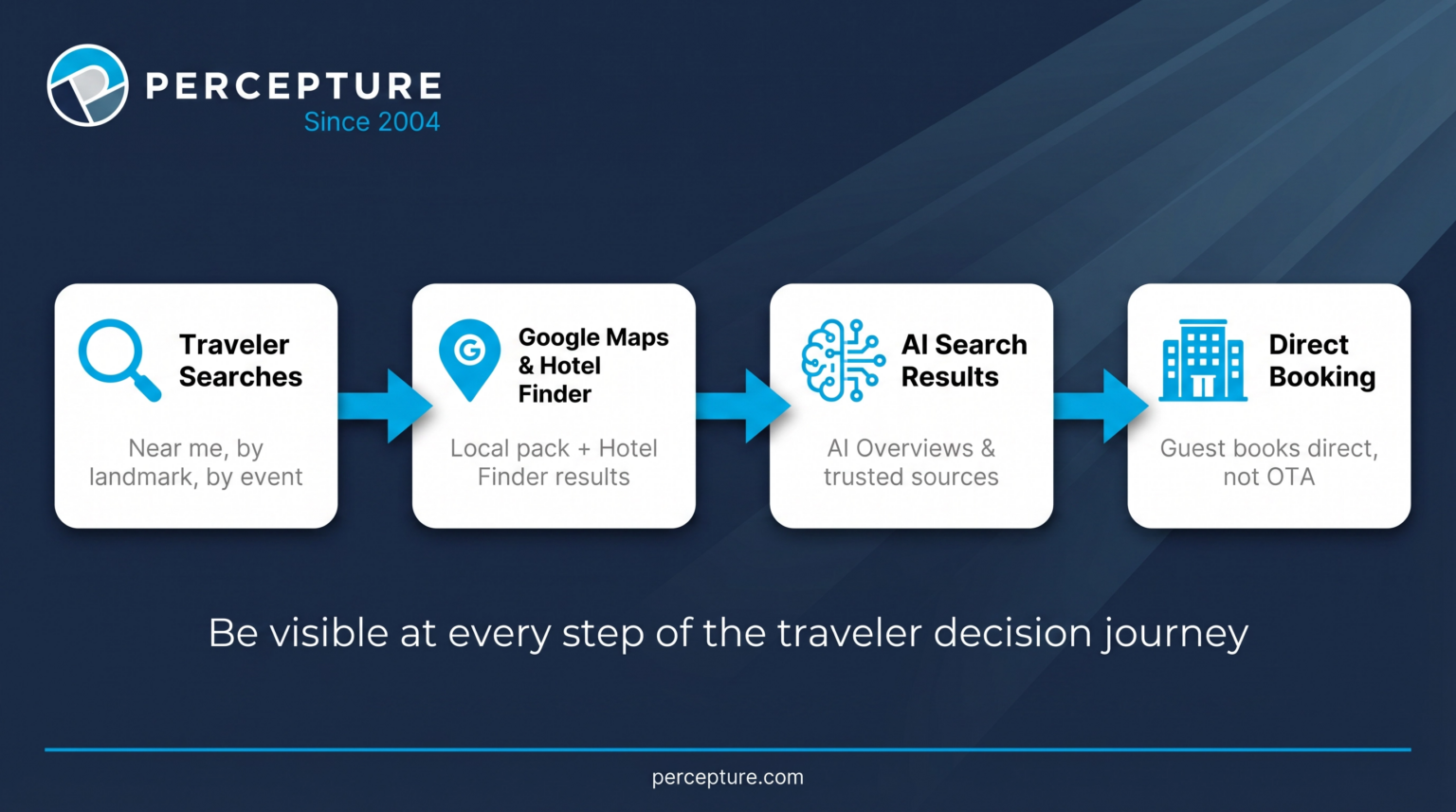
| AI and GEO | Enter itinerary research | Enter destination shortlists | Citations and qualified referrals |
| Public relations | Build destination credibility | Build sector and event authority | Relevant coverage and referral action |
| Paid search | Capture active trip demand | Capture planner or venue intent | Qualified conversion |
| Programmatic and CTV | Reach feeder markets | Build account or market awareness | Qualified reach and lift |
| Social and creators | Support visual discovery | Build destination and attendance appeal | Qualified engagement |
| Nurture seasonal and repeat travel | Nurture planners and delegates | Assisted action | |
| Travel trade | Extend intermediary distribution | Build group-tour pipeline | Operator action |
| Visitor services | Reduce trip friction | Support planners and delegates | Service use |
A coordinated channel mix may include public relations services, digital PR services, search, paid media, creator programs and email marketing. The mix should change by portfolio rather than forcing every audience through the same campaign.

How can a CVB extend delegate value?
A booked convention is not the end of the bureau’s work. Attendance building can help the organizer communicate destination appeal, while delegate extension can connect attendees and companions with local experiences before, during and after the event.
Useful assets include event landing pages, exhibitor and speaker toolkits, transport and accessibility information, dining guides, off-site ideas, companion itineraries, pre- and post-stay options and partner pathways. The bureau should make these resources easy for organizers to reuse.
Measure event-page use, partner referrals, offer use, attraction actions, satisfaction, return intention and additional room nights where those outcomes are observable. Delegate marketing can turn a booked meeting into broader visitor-economy value, but the bureau should not claim that all delegate spending was caused by its work.
How should CVB marketing be measured?
Room nights matter, but definite room nights are not the only value. A useful measurement system combines portfolio outcomes with disciplined pipeline definitions and clear limits on attribution.
Leisure
Track overnight indicators, engaged planning, lodging and partner referrals, booking actions, seasonal movement, geographic distribution and first-party audience growth.
Meetings
Track qualified leads, response time, RFP inclusion, site visits, tentative business, definite business, room nights, delegates, conversion and lost-business reasons.
Sports and groups
Track leads, bids, events, attendees, room nights, facility use, need-period contribution and repeat opportunities.
Partner distribution
Track referrals, lead distribution, co-op participation, accepted opportunities and sector or geographic distribution.
Authority
Track relevant coverage, organic visibility, AI citations, branded demand, referral activity, sentiment and accuracy during high-interest periods.
Yield and future demand
Track need-period performance, pipeline quality, repeat demand, lost-business patterns and the decisions changed by the data.
Keep the pipeline honest
The core marketing-and-sales sequence is inquiry → qualified lead → bid → tentative → definite → actualized → canceled or lost. A pipeline looks impressive when every stage is added together. A credible report keeps the stages separate.
Destination economic indicators, organizational revenue, partner revenue, attributed response and estimated incrementality are also different measures. The guide to tourism marketing ROI explains how to build a more disciplined measurement view.
Destination teams should decide what each measure can support before publishing it. If a metric shows correlation or reported influence rather than causation, the report should preserve that distinction.
A 90-day diagnostic
This 90-day diagnostic is not an annual planning template. It is a focused way to find operating gaps and run one test while preserving the future annual-plan topic.
Days 1–30: map the system
- Map leisure, meetings, sports and group priorities.
- Identify need periods and capacity constraints.
- Audit traveler, planner and partner pathways.
- Assess search and AI visibility.
- Record baseline portfolio KPIs.
Days 31–60: repair handoffs
- Improve priority pages and stale facts.
- Align marketing and sales definitions.
- Define lead routing and ownership.
- Strengthen contextual internal links.
- Improve CRM and analytics handoffs.
Days 61–90: run one test
- Select one need period or priority segment.
- Define audience, proof and partner path.
- Choose channels after the demand decision.
- Name the conversion and owner.
- Measure one primary outcome and supporting signals.
A focused destination-demand test could address shoulder-season leisure, a feeder market, an association vertical, a sports opportunity, a tour route, attendance building or delegate extension. Conversion rate optimization services can help remove friction once the destination has defined the right action.
CVB Demand Portfolio Scorecard
Score each demand-portfolio area from 0 to 10. Use evidence rather than confidence, then compare leadership, sales and partner scores to expose differing views of the system.
| Area | What a score of 10 requires | Score |
|---|---|---|
| Destination positioning | A specific place promise that priority audiences and partners can use | 0–10 |
| Leisure segmentation | Defined markets, trip reasons, windows, paths and outcomes | 0–10 |
| Marketing and sales alignment | Shared definitions, routing, ownership and feedback | 0–10 |
| Sports and group development | Separate segments with useful operational proof | 0–10 |
| Need-period strategy | Marketing decisions tied to dates, capacity and yield goals | 0–10 |
| Partner distribution | Clear eligibility, rules, referrals and reporting | 0–10 |
| Planner and traveler content | Current facts, useful comparisons and clear actions | 0–10 |
| Search, AI and reputation | Accurate, discoverable and authoritative destination answers | 0–10 |
| Measurement | Separate portfolio KPIs, lead stages and attribution limits | 0–10 |
| Ownership clarity | Named owners for audiences, channels, handoffs and outcomes | 0–10 |
85–100: integrated demand system. 70–84: strong system with defined gaps. 55–69: active channels without full alignment. Below 55: fragmented operations that need role and priority decisions.
Common CVB marketing mistakes
One message for every audience
Leisure travelers, planners and group organizers receive the same claims even though their risks and conversions differ.
Separate destination brands
Leisure and convention teams describe the same place in conflicting ways instead of sharing one promise with different proof.
Peak-date promotion without a yield goal
The bureau creates demand for dates that are already compressed without a longer-stay or distribution objective.
Weak planner pages
Inspiration replaces capacity, access, room-pattern and service information required for shortlist decisions.
Stale inventory
Old venue, hotel or transport facts create decision risk and weaken search and AI answers.
Combined pipeline stages
Tentative, definite and actualized business appear in one total, making conversion and loss difficult to understand.
Listings presented as partner value
The bureau counts published partner profiles without examining referrals, leads or opportunity distribution.
PR disconnected from search
Coverage creates temporary attention but is not connected to evergreen destination answers and partner pathways.
Paid media as the default answer
The media budget is assigned before the organization defines the demand need, audience, proof or conversion.
No extension path
A booked event receives no attendance-building, visitor-services or delegate-extension support.
No lost-business analysis
The organization tracks wins but does not use loss reasons to improve targeting, proof or qualification.
Impact and revenue combined
Destination-level indicators are reported as if they were organizational or directly attributed partner revenue.
Why Percepture?
Percepture approaches CVB marketing as an integrated demand and visibility system. That means connecting destination positioning, public relations, search, AI visibility, paid reach, content, partner pathways and measurement rather than optimizing each channel in isolation.
Seasonal-demand methodology
The documented Branson proposal shows how the bureau can organize timing, trip reason, feeder markets and coordinated reach around one seasonal objective.
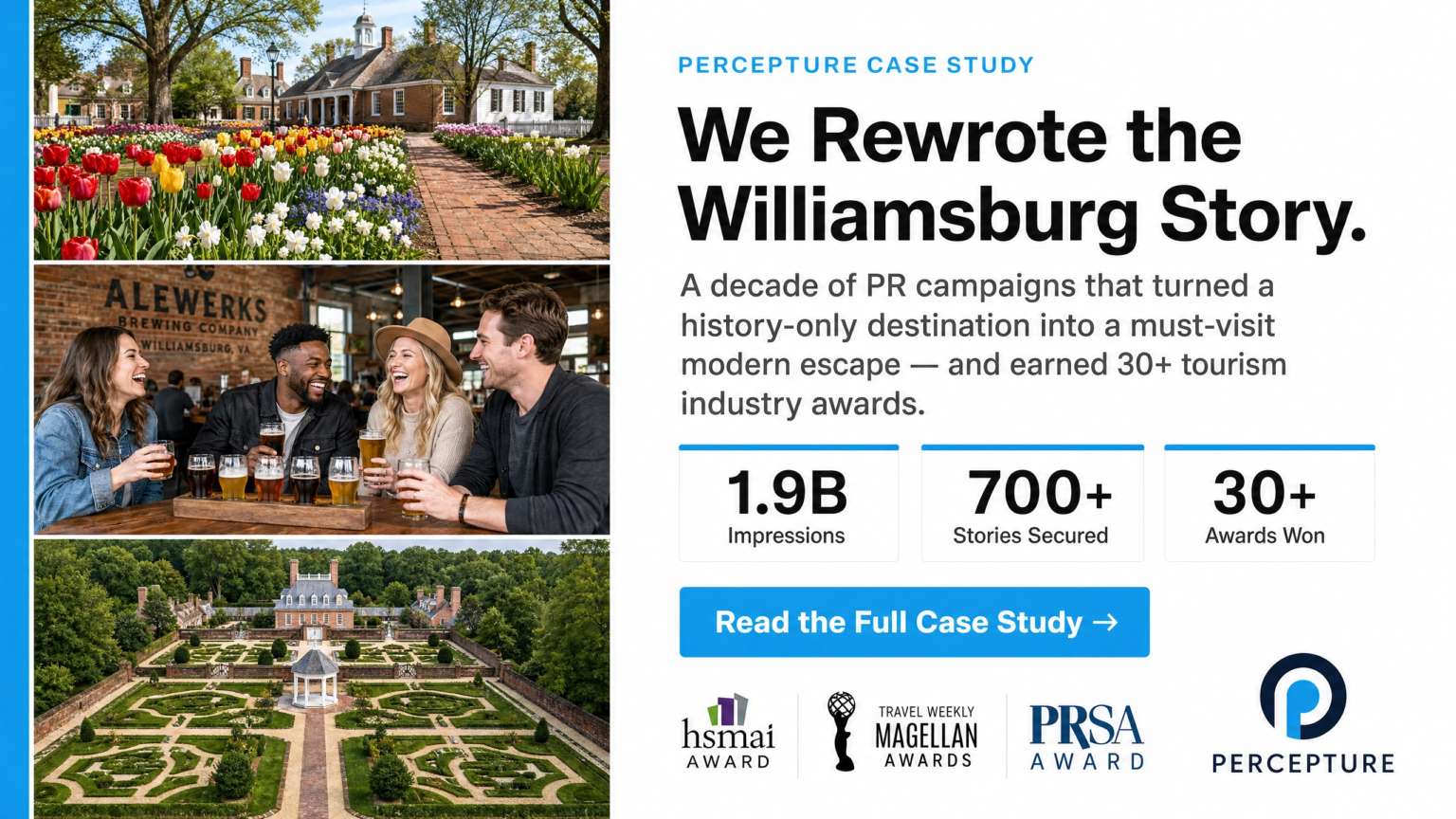
Greater Williamsburg
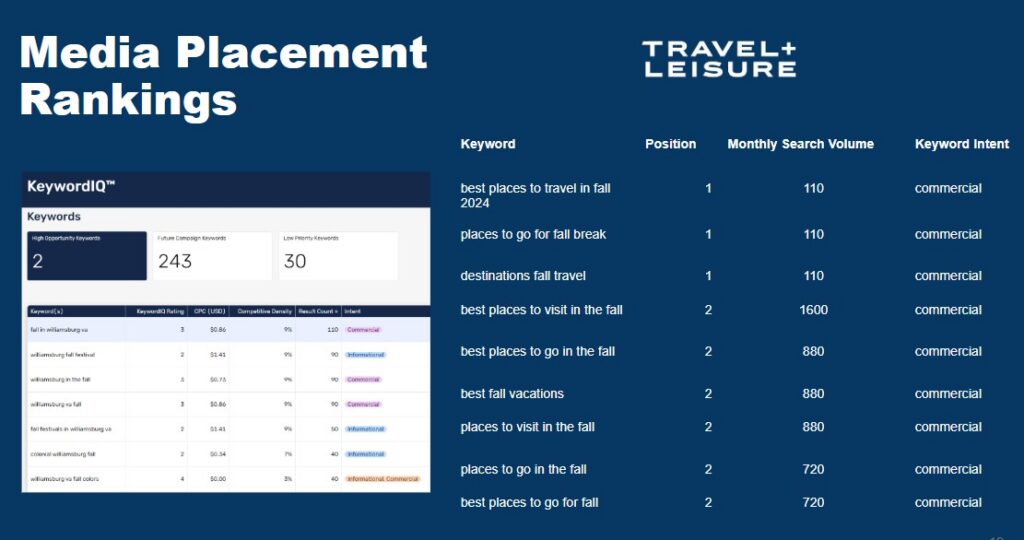
Approved destination-program results include more than 300 million impressions, 100 stories, 10 broadcast segments, 18% organic growth, more than 100,000 new organic visitors and multiple number-one rankings. Read the Greater Williamsburg case study.
Explore Hunterdon
The destination work supports a practical lesson: activation starts with a credible place promise that local experiences can fulfill.
New Orleans & Company
Seventeen coordinated creator itineraries show how hosted experiences can be structured for continued leisure discovery through evergreen content.
Integrated travel capability
Percepture’s travel and tourism marketing work connects earned, owned, paid, search and measurement disciplines.
Understand the difference between a CVB, DMO and tourism board
Compare the common roles, areas of overlap and questions leaders should ask before assigning marketing, sales, stewardship and visitor-service ownership.
Frequently asked questions
What does CVB marketing mean?
CVB marketing means creating destination demand across leisure, meetings and organized group markets, then connecting that demand with hotels, venues, attractions and other local partners. It combines destination positioning, audience-specific content, convention-sales support, media, visitor information and measurement.
What is the primary goal of a CVB?
The primary goal is qualified overnight visitation and group business that creates measurable destination and partner value. A bureau can also support visitor information, destination reputation, attendance building and local partner discovery.
How is a CVB different from a DMO?
A CVB is generally a destination marketing organization with a stronger emphasis on meetings, conventions, groups and visitor services. A DMO may have a broader mandate that includes destination stewardship, resident alignment and destination development. Names are not fully standardized, so compare actual responsibilities, governance and operating models.
What does a CVB do for meeting planners?
A CVB helps meeting planners evaluate destination fit by making local resources, operational facts and services easier to discover. A bureau can coordinate with hotels and venues, arrange site visits, connect planners with suppliers and provide destination content for attendance building and delegate planning.
What does a CVB do for hotels?
A CVB can support hotels through destination-level demand, convention and group leads, room-block opportunities, leisure referrals, site-visit exposure, need-period campaigns and market intelligence. Credible partner value also requires clear eligibility and lead-distribution rules.
How does a CVB attract conventions?
A bureau earns consideration by publishing accurate planner information, building destination preference and making operational fit easy to evaluate. Convention sales then qualifies accounts, coordinates bids, supports site visits and moves suitable opportunities toward definite business.
Which channels work best for visitor bureau marketing?
No single channel works best for every demand portfolio. Search and content capture active research, public relations builds authority, paid media reaches defined markets, email nurtures travelers and planners, creators support discovery and visitor services reduce friction.
How should CVB marketing success be measured?
Measure each demand portfolio separately and keep pipeline stages distinct. Leisure indicators can include planning actions and partner referrals. Meetings reporting can include qualified leads, RFPs, site visits, tentative business, definite business and actualized room nights.
How are CVBs funded?
Funding structures vary by destination and organization. A bureau may receive public funding, private partner support, membership revenue, program income or a combination of sources. Leaders should rely on governing documents, public records and current agreements when explaining funding.
What belongs in a CVB marketing plan?
An annual CVB marketing plan should define goals, priority audiences, need periods, budget, channel roles, ownership, calendar, partner programs and measurement. Planning should follow agreement on demand priorities, marketing and sales roles, partner pathways and KPI definitions.
Turn destination awareness into qualified leisure, meetings and group demand
Percepture can review your CVB demand portfolio, planner and traveler visibility, partner pathways, channel roles and reporting structure. The result is a prioritized view of where destination demand is being created, lost or misclassified.