
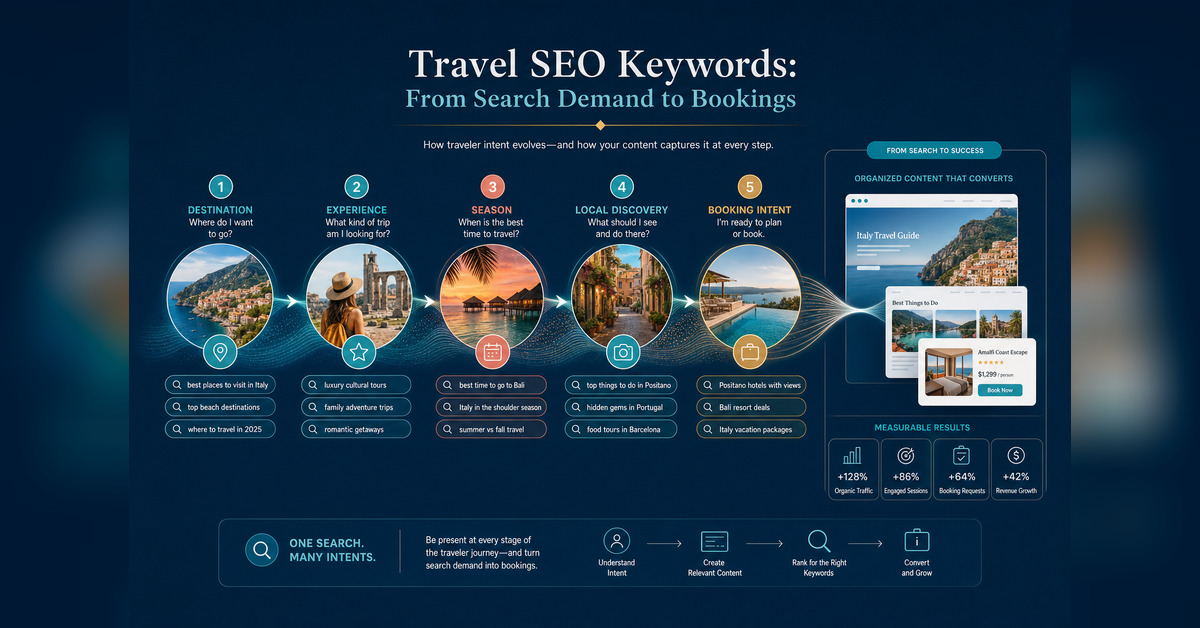

Travel SEO keywords are the searches travelers, planners and partners use to discover, compare, plan and book destinations, lodging, tours, attractions and travel services. A strong keyword strategy maps each query to a traveler decision, page type, proof source, current inventory and measurable action.
The winning keyword is not the phrase with the largest number beside it. It is the decision the brand can answer credibly, fulfill with a real destination or product and connect to a useful action.
Built for travel decisions, not keyword spreadsheets
Percepture combines travel-sector experience, search architecture, public relations and measurement so keyword research can move from demand signal to traveler action.
Right agency partner
Tourism is our bedrock.
 Founded in 2004
Trusted enterprise partner
Founded in 2004
Trusted enterprise partner
 Inc. 5000 recognized
Independent business recognition
Inc. 5000 recognized
Independent business recognition
 NMSDC certified
Minority Business Enterprise
NMSDC certified
Minority Business Enterprise
 HSMAI Silver winner
Award-winning travel PR work
HSMAI Silver winner
Award-winning travel PR work

See how a distinctive travel story became an award-winning earned-media campaign.
What are travel SEO keywords?
Travel SEO keywords are searches connected to destination discovery, trip planning, comparison, local activity and booking. The strongest keywords match a real traveler decision, a relevant page and a measurable action rather than merely showing high volume.
Executive summary
A useful travel SEO keywords program replaces a static phrase list with six operating decisions.
Start with value
Define the booking, inquiry, referral, ticket, RFP or planning action the work should support.
Classify the decision
Classify travel search terms by inspiration, planning, comparison, commercial, transactional, local and branded intent.
Preserve constraints
Keep the place, traveler, season, duration, access, price and availability details that change fit.
Assign one owner
Map tourism search queries that share a decision to one stable URL instead of publishing a page for every wording variation.
Validate value
Combine demand estimates with Search Console, paid terms, site search, inquiries, calls and inventory data.
Measure action
Track visibility, qualified engagement, planning steps, conversion and business learning separately.
Who this method is for
Destinations
Tourism boards and CVBs can use travel keyword research to map inspiration, itineraries, events, neighborhoods and partner referrals.
Travel sellers
Hotels, resorts, agencies, tour operators, cruises and rentals can connect destination keyword clusters with current offers.
Experience operators
Attractions and events can organize travel search demand around local, accessibility, schedule, ticket and logistics needs.
Travel platforms
Publishers and marketplaces can use travel query portfolio to decide which editorial, category, comparison and inventory pages should be indexed.
Travel SEO keywords are traveler decisions
A keyword is a traveler decision expressed in search language. That decision may concern where to go, what to do, when to travel, whether an experience fits, how to get there or whether inventory is available.
Keyword opportunities for travel brands differ from generic product terms because travel decisions combine place, experience, audience, timing and human constraints. A family comparing quiet beach resorts has a different need from a couple looking for nightlife, even when both searches contain the same destination.
Preserve the traveler’s constraint set instead of reducing every query to a destination name plus search volume. Specificity can reveal commercial intent before a traveler uses a word such as “book.”
Why search volume is not enough
Search volume is a demand signal, not a business case. A narrow query tied to a high-value room, tour, group lead or advisor inquiry can be worth more than a broad inspiration phrase with no conversion path.
The keyword export contains 24 rows and 1,800 total listed monthly searches. The primary phrase is listed at 880 monthly searches with difficulty 12. Only five rows include difficulty data, so the export cannot support a complete difficulty comparison across every term.
Keyword export opportunity
| Keyword | Volume | Difficulty | Recommended treatment |
|---|---|---|---|
| travel SEO keywords | 880 | 12 | Primary definition and operating method |
| travel article SEO tips headings meta description keywords | 390 | 10 | On-page editorial guidance |
| sitemap SEO optimization keywords travel website | 170 | 2 | Architecture and sitemap bridge |
| travel keywords for SEO | 170 | 13 | Semantic variation |
| SEO keywords for travel agency | 110 | 13 | Agency business-model bridge |
| SEO keywords for travel blog | 20 | Not supplied | Editorial cluster bridge |
The measured destination search language also indicate demand for direct answers, visible comparisons, practical FAQs and video-oriented explanations. The page must still serve the traveler and buyer rather than imitate every result feature.
Turn a keyword export into a page and conversion plan
Use the Travel Query-to-Booking Worksheet to record travel search phrases by query group, source, intent, entity, modifier, page type, owner, proof, inventory, conversion, score and decision.
The Travel Query-to-Booking System
The Travel Query-to-Booking System is Percepture’s nine-stage method for turning search language into useful pages, qualified actions and business learning. It keeps travel SEO keywords connected to an offer instead of letting a tool export become the strategy.
Nine decisions from demand to action
| Stage | Decision | Operating output |
|---|---|---|
| 1. Business outcome | What must marketing produce? | Revenue or visitor objective |
| 2. Traveler entity | Who, where and what is involved? | Entity and inventory map |
| 3. Search intent | Which decision is being made? | Intent class |
| 4. Modifier system | Which constraints refine the choice? | Modifier matrix |
| 5. Search environment | Which result types and sources compete? | SERP and answer-environment map |
| 6. Page architecture | Which stable URL should answer? | Query-to-URL map |
| 7. Proof and availability | Can the claim be fulfilled now? | Source and inventory ledger |
| 8. Conversion path | What useful action follows? | Action map |
| 9. Measurement | Which opportunities deserve investment? | Decision log |
Framework rule: No keyword enters the production calendar without a business outcome, intended URL and next action.

Seven types of travel intent
Classifying tourism keyword strategy by the decision being made prevents a common error: sending every query to a blog post. Some searches need inspiration, while others require current availability, an official policy or a transaction page.
| Intent | Example | Best page | Useful action |
|---|---|---|---|
| Inspiration | best places to visit in October | Destination or experience hub | Guide, itinerary or saved idea |
| Planning | three days in Williamsburg | Itinerary or practical guide | Partner or inventory step |
| Comparison | Aruba vs. Curaçao for families | Transparent comparison | Shortlist |
| Commercial investigation | small-group Galápagos tour | Category, product or service page | Availability or inquiry |
| Transactional | museum tickets Friday | Product or inventory page | Purchase |
| Local or in-destination | accessible attractions downtown | Local entity or map page | Directions, ticket or call |
| Branded or navigational | resort parking or cancellation | Official support or policy page | Trust or retained booking |
Inspiration traffic is not automatically weak. It can create destination preference, earn links and assist a later booking when the page connects naturally to planning and partner paths. For broader channel coordination, use Percepture’s omnichannel marketing approach.
The Travel Modifier Matrix
The best travel search terms preserve the modifiers that determine whether an experience is feasible and desirable. Place, audience, season, duration and accessibility are not decorative words; they can change the page, proof and inventory required.
| Variable | Examples | Decision revealed |
|---|---|---|
| Place | Country, city, district, landmark | Where |
| Experience | Food, hiking, history, wellness | What |
| Traveler | Family, couple, solo, group | Who |
| Time | October, weekend, Christmas | When |
| Duration | Day trip, three days, two weeks | How long |
| Value | Luxury, affordable, free | Price expectation |
| Logistics | Airport, parking, no car | Feasibility |
| Fit | Quiet, nightlife, beginner, pet-friendly | Experience requirement |
| Accessibility | Wheelchair, sensory, low walking | Access requirement |
| Action | Tickets, availability, quote | Conversion proximity |
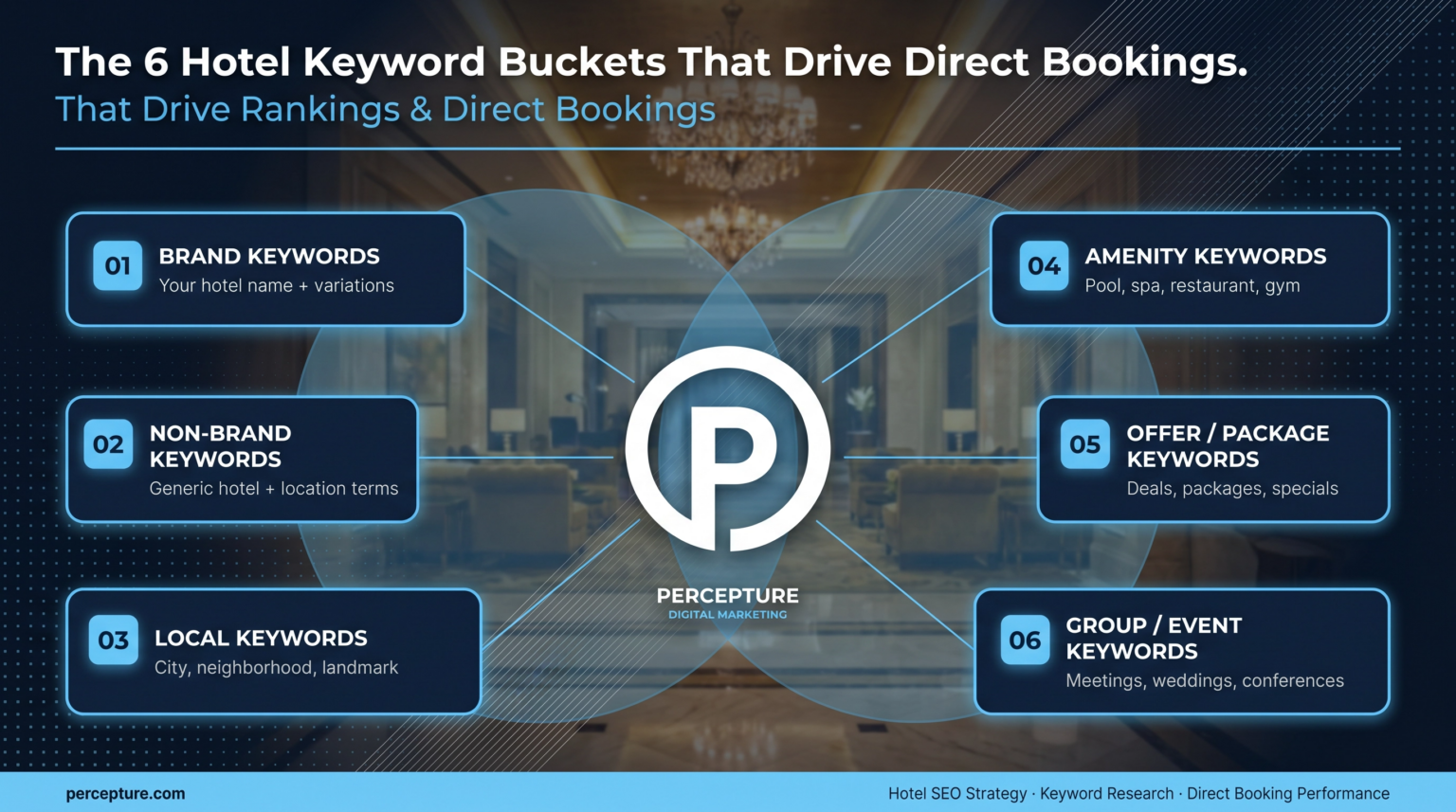
Map keywords to travel pages
Tourism search queries should be grouped by shared decision and assigned to one strong URL unless the product, audience or action changes. The page must deserve the query before the query deserves a page.
| Query pattern | Best page | Required proof | Conversion |
|---|---|---|---|
| Broad destination | Destination hub | Place facts and experience breadth | Itinerary or partner path |
| Activity plus place | Experience page | Route, season, guide and safety facts | Booking or inquiry |
| Audience plus property | Traveler-fit category | Amenities and policies | Shortlist or booking |
| Multi-day plan | Itinerary | Sequence, distance and maps | Saved trip or partner click |
| Comparison | Comparison page | Criteria and trade-offs | Selection |
| Season or event | Persistent seasonal page | Dates, conditions and inventory | Ticket or booking |
| Logistics | Practical guide | Current official facts | Planning action |
| Local | Entity or neighborhood page | Hours, map and proximity | Directions or call |
| Service | Specialty service page | Process, expertise and proof | Inquiry or RFP |
| Transaction | Inventory or product page | Price, date and availability | Purchase |
Large travel sites should combine this registry with enterprise SEO services and customer journey mapping. Those disciplines connect page ownership with templates, governance and the actions that follow discovery.
Find keywords in first-party data
A keyword tool estimates demand. First-party behavior explains value. The most useful travel keyword research often appear in Search Console, paid-search terms, booking-engine searches, internal site search, CRM records, RFPs, calls, chat, reviews and visitor-center questions.
Market evidence adds context to destination keyword clusters. Inspect live results, maps, travel communities, marketplaces, creators, competitors and official destination or transport sources. Discussion language can reveal constraints that keyword databases compress or miss.
Use paid search to test demand and message fit, not to assume that paid and organic intent are identical. Use content marketing to turn validated questions into durable destination, planning and comparison assets.
Score keyword opportunities
A travel search demand score should balance demand with business value, offer fit and production readiness. Score each query cluster from zero to ten on ten factors, then use the total to make a controlled decision.
Travel Keyword Opportunity Score
| Factor | Question | Score |
|---|---|---|
| Business value | Does the decision support a valuable outcome? | 0–10 |
| Intent strength | How advanced and specific is the traveler decision? | 0–10 |
| Offer fit | Can the destination or business fulfill the need? | 0–10 |
| Market and season fit | Does demand align with operating priorities? | 0–10 |
| Demand evidence | What tool, first-party or market evidence exists? | 0–10 |
| Result feasibility | Can the brand compete with the visible result types? | 0–10 |
| Proof readiness | Are facts, expertise and source owners available? | 0–10 |
| Conversion readiness | Is there a useful next action? | 0–10 |
| Architecture fit | Is there a stable page owner? | 0–10 |
| Measurement confidence | Can the team observe action and value? | 0–10 |
80–100: Build or materially improve now.
65–79: Run a controlled pilot or strengthen proof.
50–64: Retain in the research backlog.
Below 50: Do not create a dedicated page.
These bands are Percepture planning bands, not industry standards. Travel query portfolio with low estimated demand can still score well when they support a valuable offer and the evidence is strong.
Prevent cannibalization
Keyword opportunities for travel brands create cannibalization when several URLs answer the same decision with the same action. Common collisions include destination hubs versus “things to do” posts, category pages versus properties, service pages versus blog articles, annual event URLs and indexable filters.
- Compare the intent and result types.
- Compare the primary action on each page.
- Review Search Console overlap by URL.
- Select the strongest page owner.
- Merge pages when the decision is the same.
- Differentiate pages when the product, traveler or action differs.
- Redirect retired URLs and repair internal links.
- Maintain a keyword-to-URL registry.
Technical controls belong in a broader site architecture process. Percepture’s SEO Sprint can organize a bounded correction cycle, while conversion rate optimization tests whether the selected owner gives travelers a clear next step.
Use zero-volume and AI fan-out responsibly
Zero-volume does not mean zero value. Tools can miss new routes, exact dates, accessibility needs, group-travel combinations, local language and emerging questions. A query can still matter when it appears repeatedly in site search, paid terms, calls, CRM records or sales conversations.
Query fan-out is a research clue, not a mandate to publish one page per prompt. Group destination search language around the underlying decision and strengthen the best page with clear entities, proof and answers. Do not create thin permutations or special blocks solely for an answer engine.
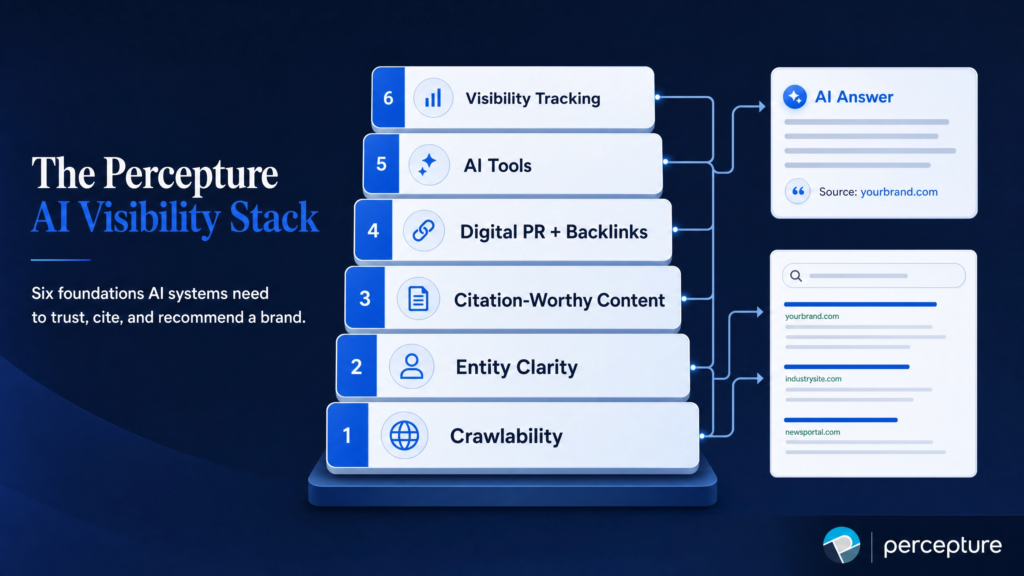
Travel SEO keywords intended for AI-assisted discovery still need sound page ownership and credible sources. Percepture’s generative engine optimization services address entity clarity and answer visibility as part of the wider search system.
Monitor whether travel brands appear inside AI-assisted research
Keyword research now extends into prompts, follow-up questions, cited sources and recommendation environments. Track visibility by brand, topic, competitor and answer engine without creating thin pages for every prompt.

Capture local travel search
Local travel search phrases appear before arrival and during the trip. Travelers search near hotels, airports, venues and landmarks; they also look for hours, parking, walking distance, accessibility, tickets, reservations and events.
Local pages need accurate entities, addresses, coordinates, categories, hours, proximity context, current images, map consistency and mobile actions. These tourism keyword strategy require more than a swapped place name to justify a useful location page.
Connect local discovery with a real action such as directions, a call, a ticket, a reservation or a partner referral. The page should make the immediate decision easier without claiming inventory or accessibility that the source owner cannot confirm.
Adapt keywords by business model
The same travel search terms method applies across travel businesses, but the strongest pattern and conversion path change with the offer.
| Business | Strong pattern | Weak pattern | Main conversion |
|---|---|---|---|
| DMO or CVB | Three-day family itinerary in a named destination | Generic vacation ideas | Guide, partner referral or RFP |
| Hotel or resort | Property type plus location, amenity and audience | Hotels | Direct booking |
| Tour operator | Activity plus route, season, difficulty and date | Adventure tours | Booking or waitlist |
| Travel agency | Specialty plus destination and traveler type | Travel deals | Trip brief |
| Attraction or event | Named attraction plus tickets, hours or accessibility | Fun activities | Ticket or directions |
| Cruise | Route plus ship, port, duration and audience | Best cruise | Availability or booking |
| Vacation rental | Area plus group size, amenities and fees | Cheap rentals | Booking or inquiry |
| Publisher | Destination plus itinerary, comparison or logistics | Travel tips | Audience or partner action |
| Marketplace | Category plus location, filter and current inventory | Travel products | Transaction |
Hotel marketers can see the distinction between informational and commercial ownership in Percepture’s hotel SEO guide, Hotel SEO Agency page and technical SEO for hotels article. Paid-intent validation has a separate role on the Hotel PPC Agency page.
Build the editorial brief around the decision
A tourism search queries brief should state the business outcome, traveler stage, primary query, entities, modifiers, intended URL, page type, sources, proof, internal links, conversion event, schema and update owner.
Titles and headings should express the traveler decision represented by the travel keyword research. Descriptions should improve click relevance. Alt text should describe the image, and internal anchors should clarify how pages relate. Meta-keywords tags and stuffed alt text do not improve the traveler’s experience.
The keyword brief should make the article more useful, not make the article sound as though it was written from a spreadsheet. A digital PR program can add earned authority where journalists, destination partners and independent sources genuinely support the topic.
Control dynamic travel pages
Travel sites generate dates, departures, routes, destinations, filters, events, languages, prices and availability states. An indexable page needs distinct demand, a stable URL, unique traveler value, sufficient content or inventory, internal links, a conversion path and an update owner.
The XML sitemap should contain canonical, indexable and useful URLs rather than every state generated from destination keyword clusters. Use consolidation, canonical controls, crawl controls or noindex treatment for weak combinations. Preserve recurring sold-out or seasonal URLs when they can provide future dates, waitlists or useful alternatives.
Dynamic travel search demand should not trigger page creation automatically. Architecture decisions should be governed through enterprise web development and search ownership rules together.
Measure keywords beyond traffic
The strongest travel query portfolio portfolio balances immediate conversion, assisted planning and durable authority. Rankings and traffic show discoverability; they do not establish booking value by themselves.
| Evidence level | Examples | Meaning |
|---|---|---|
| Visibility | Impressions, rankings, observed answer citations | The page is discoverable |
| Qualified engagement | Relevant landing visit, itinerary use | The need appears matched |
| Planning action | Availability check, saved trip, partner click | The decision advanced |
| Conversion | Booking, inquiry, ticket, RFP | An action occurred |
| Business outcome | Revenue, room nights, visitation or spend | Value followed |
| Learning | Market, season, assistance, margin and confidence | Priority can change |
Search Console and analytics use different definitions, and some travel transactions happen on partner systems. Bookings may involve several keyword opportunities for travel brands, devices and channels. Use attribution and analytics to define what can be observed, what remains partial and how decisions will be updated.
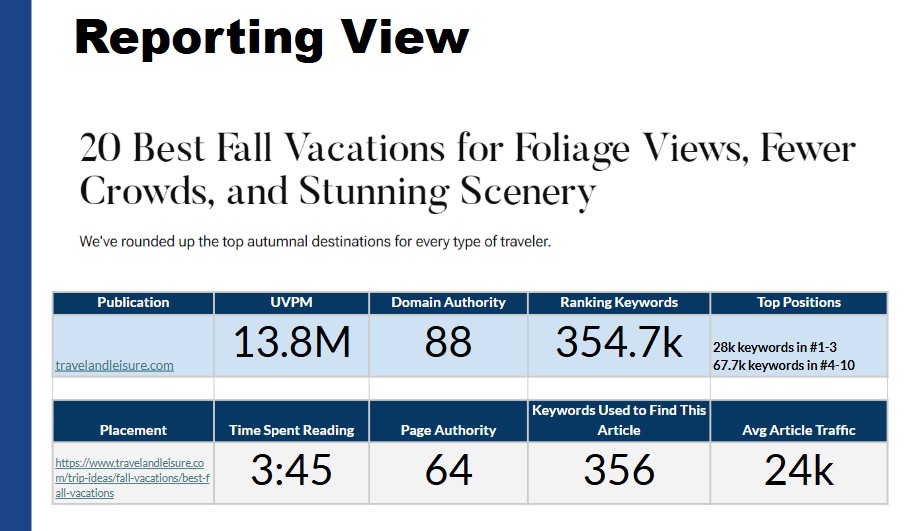
Launch a 90-day program
A 90-day destination search language program should create the operating system and its first learning cycle. It should not promise a fixed number of bookings.
Days 1–30: Gather evidence
Export Search Console, paid terms, booking and site-search data, CRM records, calls and reviews. Map destinations, products, seasons, capacity, current URLs and overlap. Score the leading travel search phrases and select one objective.
Days 31–60: Map and build
Create the keyword-to-URL registry. Improve one hub and three to five decision pages. Add proof owners, internal links, metadata, conversion tracking and sitemap rules.
Days 61–90: Publish and learn
Publish and distribute through appropriate owned, earned and partner channels. Monitor queries and actions, correct cannibalization and add support pages only when evidence shows a gap.

Avoid common mistakes
Most tourism keyword strategy failures come from weak ownership, weak fulfillment or weak measurement rather than a shortage of phrases.
- Choosing terms only by volume.
- Researching before mapping real inventory and capacity.
- Treating every informational query as low value.
- Assuming “book” is the only purchase signal.
- Publishing one page for every long-tail phrase or AI prompt.
- Creating literal translations or place-name-swapped pages.
- Ignoring season, availability, access or operating limits.
- Targeting trips the brand cannot fulfill.
- Using generic listicles, exact-match headings or stuffed alt text.
- Publishing unsupported “best” or “safest” claims.
- Allowing blog and service pages to compete for the same decision.
- Indexing filters and thin generated states.
- Leaving out local and map-based discovery.
- Providing no booking, referral or planning action.
- Treating page-level and query-level data as manufactured pairs.
- Deleting recurring seasonal pages without preserving demand.
- Measuring traffic without qualified actions or business context.
- Assigning no source owner or refresh date.
The choice is not high volume or high intent
A healthy travel search terms portfolio uses informational pages to build authority and commercial pages to capture service or transaction intent. Each page needs its own purpose, evidence and next action.
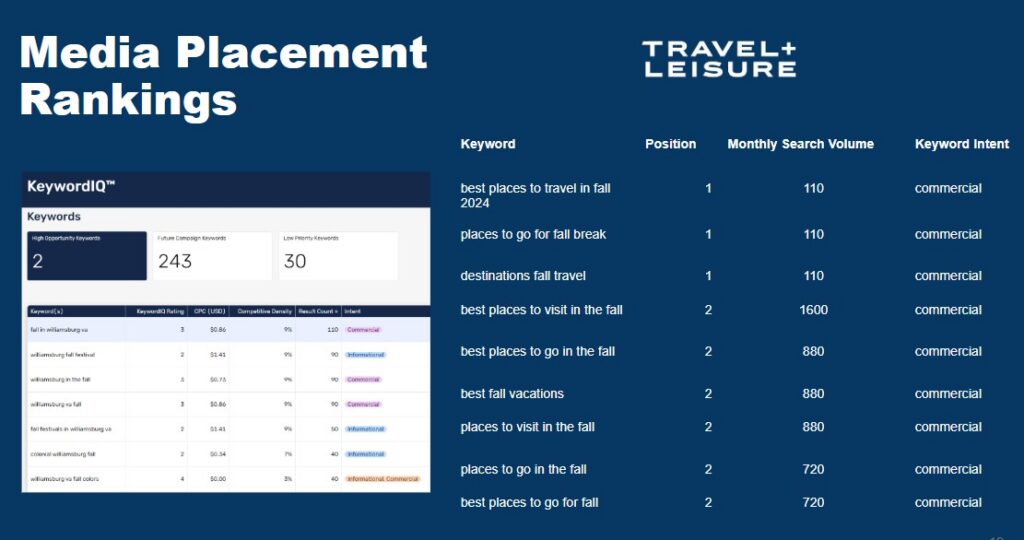
Page-level visibility shows why the portfolio needs both roles
For March 24 through June 22, 2026, the Search Console export reports 1,937 impressions and an average position of 4.03 for “hotel seo agency” on Percepture’s Hotel SEO Agency page. It reports 1,261 impressions and an average position of 2.40 for “hotel ppc agency” on the Hotel PPC Agency page.
The same export shows that another Hotel SEO page received 825 impressions for “hotel seo agency” at an average position of 11.43. That overlap is a reason to inspect page ownership rather than assume every similar URL has a distinct job.
Limitation: Search Console visibility does not prove bookings. Rankings, impressions, clicks, analytics events and booking records must be evaluated as separate evidence.
Why Percepture has a point of view
Percepture approaches tourism search queries as one part of a connected travel marketing system. Search demand, destination authority, public relations, content, paid media, conversion and measurement have different jobs, but they should support the same traveler decision.
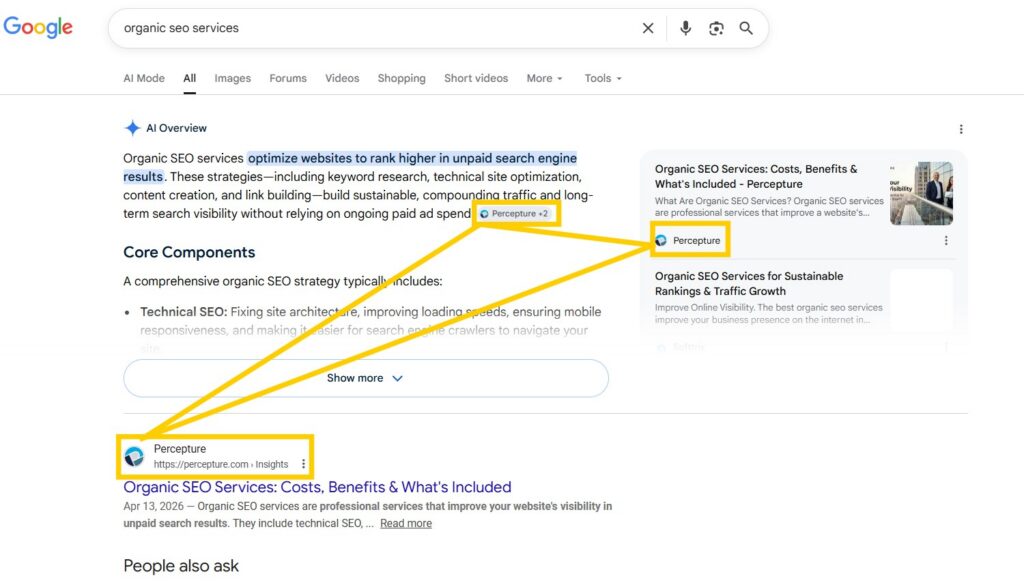
Search territory and intent
Define which decisions belong to informational, commercial, local and transactional pages.
Destination authority
Connect useful destination content with credible place information and partner pathways.
Editorial authority
Use relevant public relations and independent coverage to support discoverability without turning earned media into a ranking guarantee.
Connect keyword research with the wider search program
Travel keyword research identify and prioritize demand. Percepture can connect that work with search strategy, content, GEO, public relations, conversion and measurement.
Frequently asked questions
What are travel SEO keywords?
Travel SEO keywords are searches travelers and planners use to discover, compare, plan and book travel. They include destination, experience, audience, season, duration, price, logistics, accessibility and availability language. The strongest terms connect a real traveler decision with a credible page, current information and a useful next action.
How do I find keywords for a travel website?
Find destination keyword clusters by combining keyword tools with Search Console, paid-search terms, booking-engine searches, internal site search, CRM records, calls, reviews and live results. Start with the destination, product and traveler entities, then collect the modifiers that affect fit. Validate each cluster against real inventory and assign it to a stable page.
Which travel keywords produce bookings?
No travel search demand guarantee a booking. Queries with specific destination, audience, date, duration, amenity, logistics or availability language can indicate a mature decision, but value depends on the offer and conversion path. Measure availability checks, partner clicks, inquiries, tickets and bookings separately from rankings and traffic.
Are high-volume travel terms always better?
No. High-volume travel query portfolio estimate demand, but volume does not show whether the brand can fulfill the request or earn value from the visit. A narrow query can be more useful when it matches a profitable room, tour, group inquiry or advisor specialty and leads to a measurable action.
How should a travel agency choose keywords?
A travel agency should select keyword opportunities for travel brands from its specialties, destinations, traveler types and advisor expertise. Strong patterns combine those elements with a real planning need, such as a complex itinerary or group requirement. Avoid broad phrase lists that do not explain why a traveler should use the agency or what action should follow.
Should every long-tail travel query have its own page?
No. Group destination search language when wording variations represent the same traveler decision and action. Create separate URLs only when the product, audience, location, proof requirement or conversion path differs. A keyword-to-URL registry helps teams prevent duplicate pages and decide whether to merge, redirect or differentiate existing content.
Are zero-volume travel terms worth targeting?
Zero-volume travel search phrases can be worth targeting when site search, paid terms, CRM records, calls or sales teams repeatedly surface the need. A narrow query may also belong within a larger decision cluster. Use first-party evidence and business value before deciding whether it deserves a dedicated page.
How should travel keyword performance be measured?
Measure tourism keyword strategy through visibility, qualified engagement, planning actions, conversion and business outcomes as separate evidence levels. Track query cluster, landing page, destination or product, market, device, inventory and confidence. Search Console visibility does not prove bookings, and partner systems may hide part of the transaction path.
Find the travel queries your site can credibly own and convert
A Travel Search Demand Review evaluates travel SEO keywords against traveler intent, page ownership, available proof, inventory, conversion paths and measurement readiness.

About Bob Generale
Bob Generale is President of Percepture. He develops integrated search-demand systems that connect traveler intent, destination and product pages, editorial authority, partner pathways and measurable actions.