
A hotel PPC agency should do more than launch ads and report clicks. It should help hotels capture high-intent travelers, protect branded demand from OTAs, and turn paid search into more direct bookings.
That matters because hotel paid search is not just about traffic. It is about revenue. A hotel may be competing against online travel agencies, metasearch platforms, local competitors, and even its own weak landing pages. Without the right structure, hotel PPC can become expensive fast.
Percepture approaches hotel PPC management services through the lens of hospitality demand, booking behavior, branded-term defense, remarketing, and conversion-focused landing-page strategy. That is what makes this page different from a generic paid media services page.
Need a Hotel PPC Agency That Understands Direct Bookings?
Percepture helps hotels structure Google Ads campaigns to capture higher-intent traffic, defend branded search terms, and drive more revenue through your own booking path.
What Does a Hotel PPC Agency Do?
A hotel PPC agency manages paid search campaigns for hotels. This includes Google Ads strategy, keyword targeting, branded-term defense, remarketing, ad copy, landing pages, and performance reporting tied to bookings.
The goal is not just clicks. The goal is direct bookings.
A strong hotel PPC company handles:
- Google Ads management for hotels across search, display, and remarketing
- Branded campaigns to protect your hotel name from OTA bidding
- Non-branded campaigns to capture travelers searching for hotels in your area
- Remarketing to bring back visitors who left without booking
- Landing-page alignment so ads lead to the right offer, not a generic homepage
- Keyword targeting based on traveler intent, not just volume
- Bid strategy that balances cost and conversion
- Reporting tied to revenue and bookings, not vanity metrics
Hotel PPC services go beyond basic ad management. They require an understanding of how travelers search, how OTAs compete, and how hotels convert demand into direct revenue.
Why Hotel PPC Is Different From Standard PPC Management
Hotel PPC is not the same as running Google Ads for a law firm or an ecommerce store. The booking journey is different. The competition is different. The economics are different.
Here is what makes hotel PPC unique:
- Traveler intent changes fast. A person searching “hotels in Miami” today may book tomorrow. The window is short. Ads need to reach them at the right moment.
- OTAs are always bidding. Expedia, Booking.com, and other online travel agencies bid on hotel names, destination terms, and even branded searches. Hotels that do not defend their own brand terms lose bookings to intermediaries.
- Local modifiers matter. Travelers search by city, neighborhood, landmark, and event. A hotel PPC strategy must cover these variations.
- Mobile booking behavior is different. Many travelers search on mobile but book on desktop. Device targeting and cross-device remarketing matter.
- Seasonal swings are real. Demand shifts by season, event calendar, and local market conditions. Hotel PPC campaigns need to flex with occupancy goals.
- Room packages and offers drive conversions. Generic ads do not perform as well as ads tied to specific packages, spa deals, wedding offers, or group rates.
- Direct-booking economics are critical. A booking through the hotel’s own site costs less than a booking through an OTA. Hotel PPC should push more revenue through the direct channel.
A hotel PPC agency that does not understand these realities will waste budget and miss opportunities.
Why Hotels Need PPC Even When SEO Is Strong
Some hotel marketers ask: “If we rank well organically, do we still need PPC?”
The answer is almost always yes.
Here is why:
- Branded defense. Even if your hotel ranks first organically for its own name, OTAs may appear above you in paid results. Without branded PPC, you risk losing clicks to intermediaries.
- Immediate visibility. SEO takes time. PPC gives hotels instant placement for high-intent searches.
- Offer promotion. PPC lets hotels promote specific packages, seasonal deals, and limited-time offers with precision.
- Seasonal campaign control. Hotels can turn PPC on and off based on occupancy needs, event calendars, and market conditions.
- Testing demand quickly. PPC helps hotels test new markets, new offers, and new messaging before committing to long-term SEO investment.
- Filling need periods. When occupancy dips, PPC can drive immediate demand to fill rooms.
- Complementing SEO. PPC and SEO for hotels work best together. SEO builds long-term visibility. PPC gives hotels speed, precision, and control.
Hotels that rely only on organic search leave money on the table.
The Best Hotel PPC Campaign Types
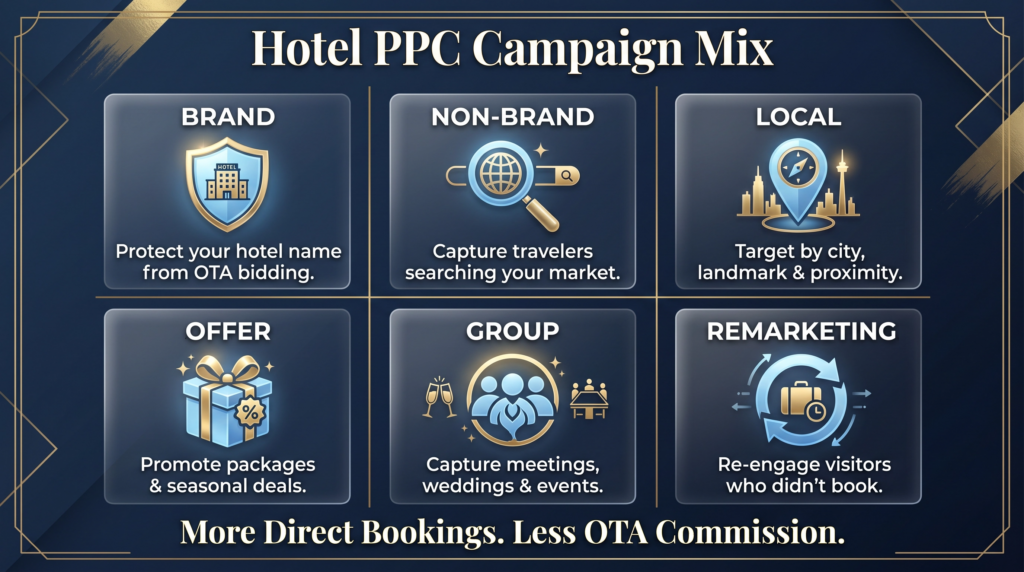
A strong hotel PPC strategy includes multiple campaign types. Each serves a different purpose.
Branded Hotel PPC Campaigns
These campaigns target your hotel’s name and variations. They protect your brand from OTAs and competitors bidding on your terms. Branded campaigns often have the highest conversion rates and lowest cost per acquisition.
Non-Branded Google Ads for Hotels
These campaigns target travelers searching for hotels in your area without using your brand name. Examples include “boutique hotel in Austin” or “hotel near convention center.” Non-branded campaigns capture new demand.
Offer and Package Ads
These campaigns promote specific deals. Spa packages, romance getaways, family bundles, and seasonal offers all perform well when tied to dedicated landing pages.
Remarketing for Hotel Bookings
Remarketing brings back visitors who browsed your site but did not book. These campaigns often have strong ROI because they target people who already showed interest.
Group, Meeting, Wedding, and Event Campaigns
Hotels with event space should run campaigns targeting group bookings, corporate meetings, weddings, and special events. These searches have high value and specific intent.
Location and Landmark Campaigns
Travelers often search by proximity. “Hotel near [airport],” “hotel near [stadium],” or “hotel in [neighborhood]” are all valuable targets.
The Core Hotel PPC Campaign Mix
How Hotels Protect Direct Bookings From OTAs
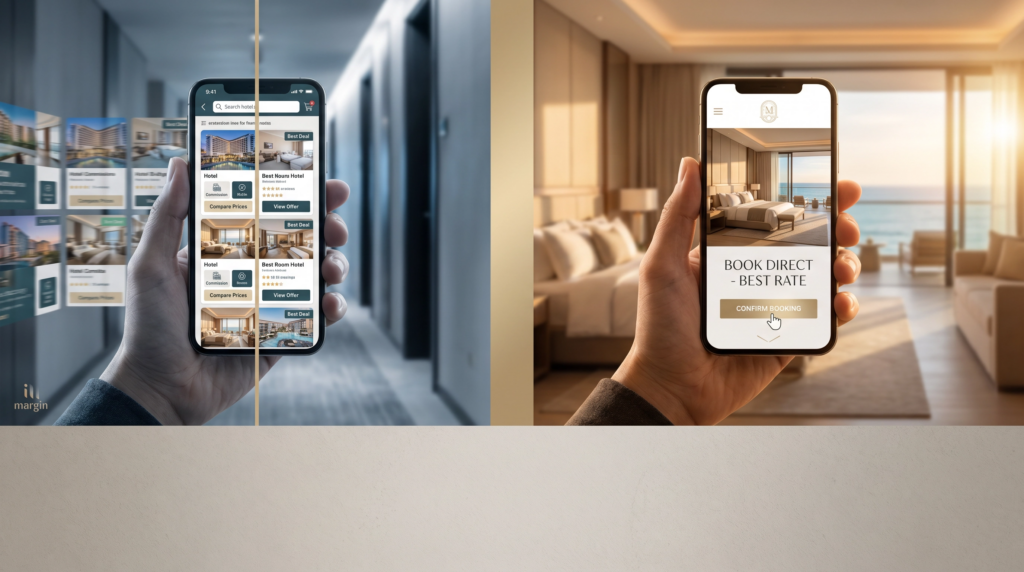
OTAs spend billions on paid search. They bid on hotel names, destination terms, and even branded searches. When a traveler searches for your hotel by name, an OTA ad may appear above your organic listing.
This is a problem.
If the traveler clicks the OTA ad and books there, you pay a commission. If they click your ad and book directly, you keep more revenue.
A hotel PPC agency helps protect direct bookings by:
- Running branded campaigns that appear above or alongside OTA ads
- Controlling the message so travelers see your best rate, your offers, and your value proposition
- Driving users to the direct booking path instead of letting OTAs capture the click
- Using landing pages that reinforce the benefits of booking direct
Hotels that leave branded search unguarded lose revenue to intermediaries.
In our work with USA Hostels, Percepture ran paid search campaigns in a market where OTAs and booking engines like Expedia, Travelocity, Orbitz, and TripAdvisor were bidding on branded terms. The result was a 20% increase in online registrations and an average click-through rate of 8.2%. That is what happens when hotel PPC is done right.
Hotel PPC Keywords That Matter Most
This page targets agency-intent keywords. People searching “hotel PPC agency” or “hotel PPC company” are looking for a partner to manage their campaigns.
The strongest terms in this space include:
- hotel ppc agency (260 monthly searches, KD 6)
- hotel ppc company (210)
- hotel ppc (170)
- hotel ppc management (110)
- hotel ppc services (90)
- hotel ppc marketing (70)
- ppc hotel (70)
Supporting modifiers include hotel ppc campaign, hotel ppc advertising, hotel ppc strategy, ppc for hotel, and hotel ppc keywords.
But real hotel client campaigns target traveler-intent terms. These are the searches that drive bookings:
- hotel in [city]
- hotel near [landmark]
- boutique hotel in [area]
- luxury hotel deals
- hotel with spa
- hotel packages
- wedding hotel venue
- meeting hotel [city]
A hotel PPC agency must understand both sides. Agency-intent terms bring clients. Traveler-intent terms bring bookings.
How a Hotel PPC Agency Structures Google Ads for Better Performance
Structure matters. A well-organized hotel PPC account performs better than a messy one.
Here is how Percepture approaches hotel PPC campaign structure:
Campaign segmentation. Separate campaigns for branded, non-branded, local, offer, group, and remarketing. This allows for better budget control and performance tracking.
Ad groups by intent. Within each campaign, ad groups should match specific search intents. “Hotel near airport” and “downtown boutique hotel” deserve different ad groups.
Landing-page matching. Every ad group should point to a relevant landing page. Spa ads go to spa pages. Wedding ads go to wedding pages. Generic homepage traffic converts poorly.
Device adjustments. Mobile and desktop users behave differently. Bid adjustments and ad copy should reflect this.
Geo-targeting. Hotels can target travelers in specific markets, feeder cities, or regions with high booking potential.
Dayparting. Some hotels see better conversion rates at certain times of day. Bid adjustments can optimize for these windows.
Seasonal pivots. Campaigns should flex with demand. Increase spend during peak seasons. Pull back during slow periods. Promote offers when occupancy dips.
Market-level messaging. A hotel in Miami speaks differently to a traveler from New York than one from London. Messaging can be tailored by geography.
Remarketing audiences. Segment remarketing by behavior. Someone who viewed the spa page gets a different ad than someone who viewed the wedding page.
Conversion tracking. Track bookings, not just clicks. Revenue-based reporting shows what is actually working.
Negative Keywords, Wasted Spend, and Hotel PPC Efficiency
Hotel PPC gets expensive when campaigns are sloppy. One of the biggest problems is wasted spend on irrelevant searches.
Negative keywords solve this.
A hotel PPC agency should constantly prune search terms and add negatives for:
- Job seekers. “Hotel jobs,” “hotel careers,” “hotel hiring” should be excluded.
- Student traffic. “Hotel management degree,” “hospitality school” are not booking searches.
- Low-intent searches. “Hotel history,” “hotel definition,” “hotel industry trends” do not convert.
- Irrelevant destinations. If you are a hotel in Austin, you do not want clicks from people searching for hotels in Austin, Minnesota.
- Research traffic. Some searches indicate early-stage research, not booking intent. These may need separate treatment.
Negative keyword discipline is one of the fastest ways to improve hotel PPC efficiency. Every dollar saved on irrelevant clicks can be reinvested in high-intent traffic.
Hotel PPC Gets Stronger When You Remove Waste
- Weak keywords that do not convert
- Low-intent searchers looking for information, not bookings
- Irrelevant geography and destination mismatches
- Bad landing pages that kill conversion rates
- Generic ad copy that does not differentiate
- OTA leakage from unprotected branded terms
Landing Pages That Help Hotel PPC Convert
A hotel PPC agency should not dump every click on the homepage.
Homepages are designed for general visitors. They are not optimized for specific offers, packages, or traveler intents.
The best hotel PPC campaigns use dedicated landing pages:
- Package pages for spa deals, romance getaways, and seasonal offers
- Room-type pages for suites, family rooms, or accessible accommodations
- Group sales pages for corporate meetings and conferences
- Wedding pages for couples planning events
- Spa pages for wellness-focused travelers
- Dining pages for hotels with notable restaurants
- Pet-friendly pages for travelers with animals
- Local event landing pages for concerts, festivals, and conventions
When the ad matches the landing page, conversion rates improve. When the landing page matches the traveler’s intent, bookings increase.
A hotel PPC agency should work with the hotel to build or optimize these pages. Ads are only half the equation.
How Percepture Approaches Hotel PPC
Percepture is not a generic paid media agency. We have deep experience in travel and tourism marketing, including hotel PPC, remarketing, and direct-booking strategy.
Our approach includes:
- Hotel and travel experience. Bob Generale, Percepture’s founder, has worked with brands including Hard Rock Hotel Las Vegas, Hyatt, Hyatt Place, Wyndham Hotel Group, AmeriSuites, Morgan’s Hotel Group, and USA Hostels. This is not theoretical knowledge. It is hands-on hospitality marketing experience.
- PPC and remarketing capability. Our travel work includes pay-per-click campaigns, remarketing, social PPC, keyword research, negative keywords, A/B testing, dayparting, and seasonal targeting.
- Market-specific messaging. We tailor campaigns by geography, audience behavior, and traveler intent.
- Branded-term protection. We help hotels defend their brand from OTA bidding and competitor conquesting.
- Direct-booking orientation. Our goal is not just traffic. It is revenue through the hotel’s own booking path.
- Analytics and adjustment. We track performance, prune waste, and optimize based on what is actually driving bookings.
- Understanding of hotel demand cycles. We know that hotel marketing is not static. Campaigns need to flex with seasons, events, and occupancy goals.
- Cross-channel thinking. PPC works best alongside SEO, content, and omnichannel marketing. We help hotels build integrated strategies.
Why Percepture
Hotel PPC Is Not Just Google Ads Management. It Is Booking Strategy.
FAQs About Hiring a Hotel PPC Agency
What does a hotel PPC agency do?
A hotel PPC agency manages paid search campaigns for hotels, including Google Ads strategy, keyword targeting, branded-term defense, remarketing, ad copy, landing pages, and performance reporting tied to bookings.
Why is PPC important for hotels?
PPC helps hotels appear immediately for high-intent searches, protect their branded demand, promote offers, and drive direct bookings during key travel windows.
Should hotels bid on their own brand name?
In many cases, yes. Hotels often need branded campaigns to protect their search visibility when OTAs and competitors bid on hotel names or nearby destination searches.
What is the difference between hotel SEO and hotel PPC?
SEO builds long-term organic visibility. PPC gives hotels immediate control over visibility, messaging, budget, and offer promotion. Both work best together.
Can PPC help hotels reduce OTA dependence?
Yes. A strong hotel PPC strategy can help capture booking intent directly on the hotel’s own site, especially when paired with strong landing pages and branded-term protection.
What campaigns should a hotel run first?
Most hotels should start with branded campaigns, non-branded local campaigns, offer campaigns, and remarketing before expanding further.
What landing pages work best for hotel PPC?
Package pages, room pages, spa pages, event pages, group pages, and other offer-specific pages often outperform generic homepage traffic.
How do negative keywords help hotel PPC?
Negative keywords reduce wasted spend by filtering out irrelevant searches, low-intent traffic, job-related queries, and terms that are unlikely to convert into bookings.
Ready to Improve Your Hotel’s Paid Search Performance?
Hotel PPC should do more than buy traffic. It should protect branded demand, reduce wasted spend, and help the right travelers book directly through your site.
Percepture helps hotels build paid-search strategies around bookings, not just clicks. We understand OTA competition, seasonal demand, remarketing, and the economics of direct bookings.
If you are ready to work with a hotel PPC agency that thinks like a hospitality operator, let’s talk.
Get More Direct Bookings From Paid Search
Percepture helps hotels run PPC campaigns that protect branded demand, reduce OTA leakage, and drive more revenue through your own booking path.