


Technical SEO for hotels is the work that helps hotel websites get crawled properly, load faster, surface the right pages in search, and support more direct bookings. For hotels, that work goes far beyond basic metadata. It involves schema, Core Web Vitals, booking engine behavior, mobile performance, site architecture, and the way search engines and AI systems understand your property.
Hotel websites are often more technically complex than standard business sites. They depend on image-heavy pages, third-party booking tools, room and offer templates, property or location pages, and mobile visitors who are comparing options quickly. When those technical pieces are weak, rankings suffer and conversions usually do too.
Percepture approaches hotel technical SEO as part of a larger visibility system. As a travel and tourism marketing agency, that means fixing the infrastructure behind hotel search performance while also supporting stronger discovery in Google, maps, hotel search surfaces, and AI search.
Need Technical SEO Help for Your Hotel Website?
Percepture helps hotels improve crawlability, schema, Core Web Vitals, booking engine performance, and AI visibility so the right pages rank and convert.
Talk to Percepture View SEO PricingTechnical SEO for hotels is the process of improving the underlying structure, speed, crawlability, schema markup, mobile experience, and booking engine behavior of a hotel website so search engines can understand it better and travelers can use it more easily.
What Is Technical SEO for Hotels?
Technical SEO for hotels is the structural and performance-focused part of hotel search strategy. It covers crawlability, speed, schema, indexing, mobile UX, and other back-end issues that affect how search engines see and rank your site.
Hotel SEO is the broader strategy for improving rankings, visibility, and bookings. Hotel technical SEO is the foundation that makes that strategy work.
When technical SEO is weak, even strong content and good backlinks struggle to perform. Pages may not get indexed. Load times may push visitors away. Booking engines may create friction that hurts conversions.
Technical SEO supports direct bookings by making sure the right pages are visible, fast, and easy to use. It also helps search engines and AI systems understand your property, your rooms, your offers, and your location. Percepture’s enterprise SEO services include site architecture, crawlability, indexing health, Core Web Vitals, page speed, structured data, and SEO-integrated redesign.
Why Hotel Websites Have Unique Technical SEO Problems
Hotel websites are not like standard business websites. They face technical challenges that most service sites never encounter.
Why Hotel Sites Break More Easily
Hotels rely on third-party booking engines. These tools often load slowly, use heavy scripts, and create disconnected user experiences. When a booking engine sits on a subdomain or uses a separate platform, it can confuse search engines and frustrate visitors.
Hotels also depend on large images. High-resolution photos of rooms, lobbies, pools, and restaurants are essential for conversion. But oversized images slow pages down and hurt Core Web Vitals.
Many hotel sites use JavaScript-heavy templates. Room pages, offer pages, and rate calendars often load content dynamically. If search engines cannot crawl that content, it may never get indexed.
Where Technical Problems Usually Start
Multi-property hotel groups face even more complexity. They manage brand sites, property pages, location pages, meeting and event pages, and seasonal landing pages. Duplication is common. Internal linking is often weak. Indexation problems multiply.
Mobile performance is another pressure point. Most hotel searches happen on mobile devices. Travelers compare options quickly. If a page loads slowly or shifts around while loading, visitors leave.
Hotel Schema Markup: What Hotels Should Implement
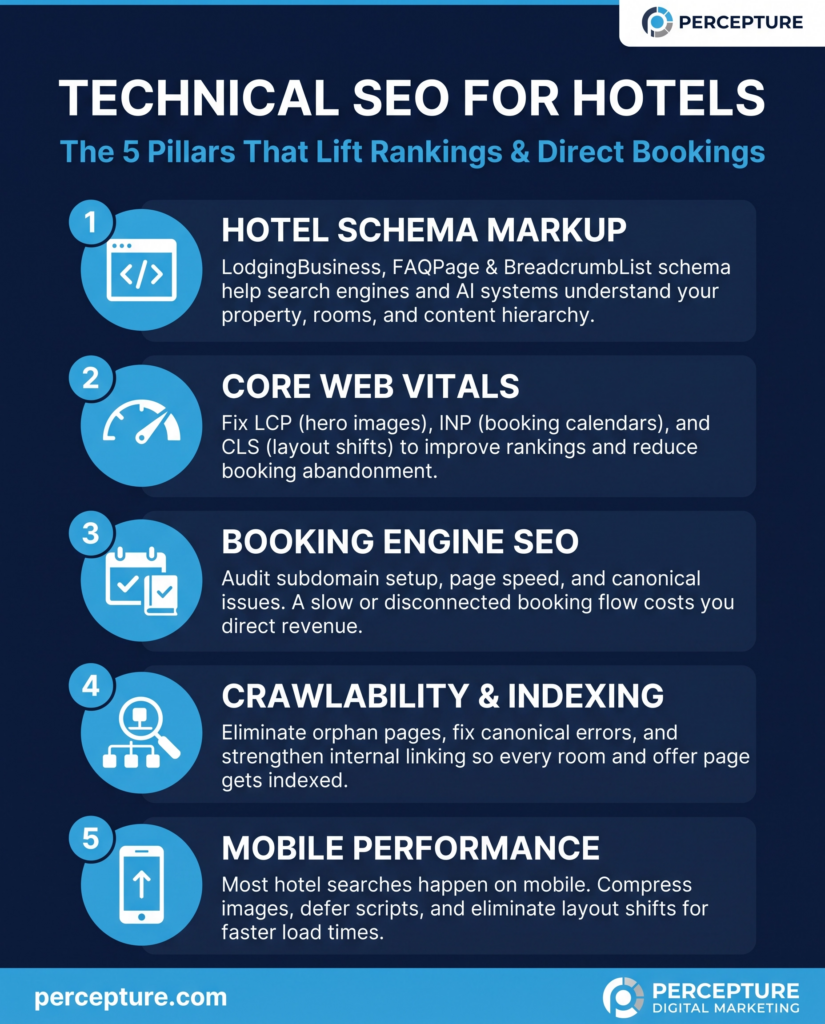
Schema markup helps search engines and AI systems understand what your pages are about. For hotels, schema is especially important because it clarifies your property type, location, amenities, and content structure.
The Schema Types That Matter Most
Hotel or LodgingBusiness schema tells search engines that your site represents a hotel. It includes your name, address, phone number, and other business details. This schema supports local search and helps AI systems classify your property correctly.
Organization schema is useful for hotel groups or brands. It establishes the parent company and connects it to individual properties.
LocalBusiness schema can apply to hotels with strong local intent. It supports map visibility and local pack rankings.
BreadcrumbList schema helps search engines understand your site structure. It shows the path from your homepage to deeper pages like rooms, offers, or locations.
FAQPage schema can help your FAQ content appear in search results. It also supports AI systems that pull answers from structured content.
Common Hotel Schema Mistakes
Some hotels try to add review or rating schema without proper support. Google requires reviews to come from verified sources. Adding fake or unsupported ratings can trigger penalties.
Offer and room schema exist, but they require careful implementation. Only use them if your pages genuinely support the structured data.
Schema does not replace strong SEO. It supports better understanding and visibility. It helps search engines and AI systems interpret your content more accurately.
Main Takeaway
Schema markup helps search engines and AI systems understand your hotel’s pages, amenities, and content hierarchy. It does not replace strong SEO, but it supports better visibility and interpretation.
Core Web Vitals for Hotel Websites
Core Web Vitals are Google’s metrics for page experience. They measure how fast your page loads, how quickly it responds to interaction, and how stable the layout is while loading.
For hotels, Core Web Vitals matter because they affect both rankings and conversions.
What Slows Hotel Pages Down
Largest Contentful Paint (LCP) measures how long it takes for the main content to appear. On hotel sites, LCP is often hurt by oversized hero images, slow servers, or heavy booking widgets.
Interaction to Next Paint (INP) measures how quickly the page responds when a visitor clicks or taps. Booking calendars, chat tools, and popups can slow interaction and frustrate users.
Cumulative Layout Shift (CLS) measures how much the page moves around while loading. Ads, images without dimensions, and late-loading scripts can cause layout shifts that annoy visitors.
How Core Web Vitals Affect Search and Conversion
Slow load times hurt rankings. Google uses page experience as a ranking factor. If your hotel site loads slowly, it may rank lower than faster competitors.
Slow load times also hurt bookings. Travelers compare options quickly. If your page takes too long to load, they leave. If the booking calendar is sluggish, they abandon the process.
Mobile performance is especially important. Most hotel searches happen on phones. A page that loads well on desktop but struggles on mobile will lose both rankings and revenue.
Test your hotel pages with Google PageSpeed Insights and focus on mobile scores first. Mobile is where most travelers search and where most technical problems show up.
Booking Engine SEO Fixes That Help Rankings and Direct Bookings
Booking engines are essential for hotels. They handle reservations, rates, and availability. But they can also create technical problems that hurt SEO and conversions.
Where Booking Engines Create Friction
Many booking engines sit on subdomains or third-party platforms. When a visitor clicks “Book Now,” they leave your main site and land on a different domain. This creates a disconnected experience.
Search engines may not associate the booking engine with your main site. Attribution becomes unclear. Conversion tracking gets messy.
Booking engines often load slowly. Calendars, rate tables, and availability checks require heavy scripts. If those scripts block the page or delay interaction, visitors leave.
Some booking engines create canonical or content separation issues. If the booking pages are not properly linked to your main site, search engines may not understand the relationship.
What Hotels Should Audit First
Check whether your booking engine is on a subdomain, a third-party domain, or integrated into your main site. Understand how search engines see that relationship.
Test the speed of your booking flow. Load the calendar. Select dates. Watch for delays or layout shifts.
Review your customer journey mapping from search to booking. Identify where friction occurs. Fix the technical issues that slow visitors down or push them away.
Booking engine performance affects both rankings and revenue. A slow or confusing booking flow costs you direct bookings.
Technical SEO Diagnostic Areas for Hotels
Schema
Structured data that helps search engines understand your property.
Core Web Vitals
Speed, responsiveness, and layout stability metrics.
Booking Engine
Performance and integration of your reservation system.
Crawlability & Indexing
Whether search engines can find and index your pages.
Crawlability, Indexing, and Site Architecture for Hotels
Search engines need to find your pages before they can rank them. Crawlability and indexing are the foundation of technical SEO.
Pages Search Engines Need to Find
Your homepage, room pages, offer pages, location pages, and booking pages all need to be crawlable. If search engines cannot reach them, they will not appear in results.
Orphan pages are pages with no internal links pointing to them. They are hard for search engines to find. Hotels often have orphan pages for seasonal offers, old promotions, or meeting room details.
Crawl depth matters. Pages buried deep in your site structure may not get crawled frequently. Important pages should be reachable within a few clicks from the homepage.
Architecture Mistakes That Suppress Rankings
Canonical issues confuse search engines. If multiple URLs point to the same content without proper canonical tags, search engines may not know which version to rank.
Noindex tags can accidentally block important pages. Some hotels noindex offer pages or room pages without realizing it.
Duplicate content is common on hotel sites. Room pages, offer pages, and location pages often share similar text. Without proper canonicalization, search engines may struggle to rank any of them.
Internal linking is often weak. Hotels may have strong homepages but poor connections to deeper pages. Strong internal linking helps search engines understand your site structure and distributes ranking power.
Multi-property hotel groups face additional challenges. Managing brand sites, property pages, and location pages requires careful architecture planning.
Mobile UX, Images, JavaScript, and Performance Bloat
Hotel websites often suffer from performance bloat. Heavy images, JavaScript templates, and third-party scripts slow pages down and hurt both rankings and conversions.
Oversized Images
High-quality photos are essential for hotels. But oversized images slow pages down. Compress images without losing quality. Use modern formats like WebP. Implement lazy loading so images load only when needed.
JavaScript-Heavy Templates
Many hotel sites use JavaScript to load room content, rate calendars, and offer details. If that content is not rendered for search engines, it may not get indexed.
Server-side rendering or pre-rendering can help. Make sure important content is available in the HTML that search engines crawl.
Popups and Script Bloat
Chat tools, popups, and tracking scripts add weight to your pages. Tag manager bloat is common. Analytics clutter slows things down.
Audit your scripts. Remove what you do not need. Defer or async load scripts that are not critical for initial page rendering.
Mobile-First Booking Behavior
Most hotel searches happen on mobile. Travelers compare options, check prices, and book rooms on their phones.
If your mobile experience is slow or frustrating, you lose bookings. Mobile performance is not optional. It is essential.
Percepture’s approach to omnichannel marketing includes ensuring your hotel’s digital presence performs well across all devices and touchpoints.
Technical SEO for AI Search and Hotel Discovery

AI search is changing how travelers find hotels. Systems like Google’s AI Overviews, ChatGPT, and other AI assistants pull information from websites to answer questions directly.
Technical SEO supports AI visibility. Clean structure, clear content, and proper schema help AI systems understand your property.
AI Systems Need Clean Structure
AI systems interpret your pages based on their structure. Clear headings, logical hierarchy, and well-organized content help AI understand what your pages are about.
Structured data and schema support interpretation. FAQs, summaries, and crawlable HTML help AI systems extract accurate information.
Page hierarchy matters. If your content is disorganized, AI systems may misunderstand or ignore it.
Technical SEO Is Part of AI Visibility
Technical SEO and AI visibility are not separate. The same foundations that help search engines understand your site also help AI systems.
Percepture’s AI GEO SEO Services integrate traditional SEO with AI readiness. That means building sites that perform well in both traditional search results and AI-generated answers.
Digital PR services also support AI visibility by building authoritative mentions and citations that AI systems recognize.
Main Takeaway
AI systems need clean structure, proper schema, and crawlable content to understand your hotel. Technical SEO is the foundation of AI visibility, not separate from it.
Why Percepture Is Different
Percepture’s technical SEO framework explicitly includes site architecture, crawlability, indexing health, Core Web Vitals, page speed, structured data, and SEO-integrated redesign. That matters because hotel websites are rarely simple.
Hotels combine image-heavy templates, booking engine dependencies, mobile discovery, and conversion pressure all at once. Generic SEO agencies often miss the nuances.
Hospitality Experience
Percepture brings relevant hospitality credibility. Work tied to hotel and travel brands includes Marcus Hotels, with properties like Grand Geneva Resort & Spa, Timber Ridge, Saint Kate, and The Pfister Hotel.
Archived hospitality work shows real results. Hyatt increased web traffic 32% year over year through local and geographic optimization. Hyatt Place and AmeriSuites increased traffic 68% year over year through local link-building tactics. Visit Williamsburg increased traffic 45% month over month and ranked strongly for destination and hotel-intent queries.
Team Expertise
Bob Generale brings 19+ years of B2B and B2C strategy in SEO, GEO, and SEM. Alec Swanepoel brings 20+ years of web development, WordPress, WooCommerce, SEO strategy, automation, and accessibility experience. Peter Marinari has a long-running background in SEO and web analytics.
Veronica Stoddart brings travel editorial authority as former Editor-in-Chief for Travel at USA TODAY, with 30+ awards.
Integrated Approach
Percepture integrates traditional SEO, AI and GEO search, digital PR, and content strategy rather than treating search in silos. That means hotel clients get a visibility system, not just isolated fixes.
Technical SEO Expertise + Hospitality Experience + AI Search Readiness
- Technical SEO audits: crawlability, indexing, CWV, structure
- Hospitality references including Marcus Hotels
- Hotel and travel performance proof from Hyatt, Hyatt Place, Visit Williamsburg
- Editorial and travel authority via Veronica Stoddart
Technical SEO Pricing and Timelines for Hotels
It’s important to remember that technical SEO pricing for hotels depends on the size of the site, the number of properties, the state of the current booking engine setup, the complexity of the CMS, and how many technical issues need to be fixed.
A single hotel with one site is very different from a multi-property hotel group with room templates, offer pages, and multiple location architectures.
What Affects Pricing
Site size matters. More pages mean more audit work and more implementation.
Number of properties affects scope. Multi-property groups require architecture planning across brand and property sites.
Booking engine setup influences complexity. Third-party systems, subdomains, and integration issues require specialized attention.
CMS complexity affects implementation. Some platforms make technical fixes easy. Others require custom development.
Percepture Pricing
At Percepture, SEO programs start at $3,000, with scope increasing based on technical audits, implementation support, structured data work, Core Web Vitals fixes, and reporting needs.
Some technical fixes can improve performance quickly. Meaningful results usually depend on the scale of the issues, the CMS, the booking engine setup, and how much implementation work is required.
Want a Technical SEO Audit for Your Hotel Website?
Percepture can help identify the technical issues suppressing rankings, slowing pages down, and weakening direct-booking performance.
See SEO Pricing Contact PerceptureFAQs About Technical SEO for Hotels
What is technical SEO for hotels?
Technical SEO for hotels is the work that improves how a hotel website is crawled, indexed, structured, and loaded so search engines can understand it better and travelers can use it more easily.
Why is technical SEO important for hotel websites?
Technical SEO is important for hotel websites because they often depend on image-heavy layouts, third-party booking tools, mobile users, and large numbers of room, offer, and location pages. Those factors can create performance and indexing problems that hurt rankings and bookings.
Does schema markup help hotel SEO?
Yes. Schema markup helps search engines and AI systems better understand a hotel’s pages, amenities, business details, content hierarchy, and page relationships. It does not replace strong SEO, but it supports better understanding and visibility.
Do Core Web Vitals affect hotel rankings?
Core Web Vitals can affect how hotel websites perform because they influence page experience, especially on mobile. Slow load times, unstable layouts, and sluggish interaction often hurt both visibility and conversion.
Can a booking engine hurt hotel SEO?
Yes. Booking engines can create technical problems when they rely on slow scripts, poor mobile behavior, disconnected subdomains, or awkward page flows that weaken performance and conversion.
What are the most common technical SEO issues on hotel websites?
Common issues include poor Core Web Vitals, oversized images, JavaScript-heavy templates, weak schema, indexing problems, duplicate offer pages, broken internal linking, and booking engine friction.
How long does technical SEO take for hotels?
Some technical fixes can improve performance quickly, but meaningful results usually depend on the scale of the issues, the CMS, the booking engine setup, and how much implementation work is required.
What is the difference between hotel SEO and technical SEO for hotels?
Hotel SEO is the broader strategy for improving rankings, visibility, and bookings. Technical SEO for hotels is the structural and performance-focused part of that strategy, covering crawlability, speed, schema, indexing, mobile UX, and other back-end issues.