

Local SEO for hotels helps properties show up where travelers actually make decisions: Google Maps, hotel search results, local queries, attraction-based searches, and increasingly, AI-driven search experiences.
For hotels, that means local SEO is not a side tactic. It is a core part of how travelers discover, compare, and choose where to stay.
Guests do not only search for a hotel by name. They search by neighborhood, airport, walkability, event venue, meeting space, dining options, family convenience, waterfront access, pet policies, and nearby attractions.
If your hotel is not visible for those local searches, more demand gets captured by OTAs or competing properties.
Percepture approaches local hotel SEO as a visibility system. As a travel and tourism marketing agency, that means improving the signals that help a hotel show up in Google Maps, Hotel Finder, local organic results, and AI search while also strengthening the trust and authority that help convert that visibility into direct bookings.
Need Local SEO for Your Hotel, Resort, or Hotel Group?
Percepture helps hotels improve visibility in Google Maps, Hotel Finder, and AI search through local SEO, content, reviews, authority building, and technical strategy.
Local SEO for hotels is the process of improving a hotel’s visibility in Google Maps, Google Business Profile, Hotel Finder, local organic search results, and AI-driven search experiences so more travelers can discover and book directly.
What Is Local SEO for Hotels?
Local SEO for hotels is the practice of optimizing a property’s online presence so it appears prominently in location-based searches. This includes Google Maps, Google Business Profile, Hotel Finder, and local organic results.
The goal is simple: help travelers find your hotel when they search for places to stay in your area.
Unlike broader hotel SEO, which focuses on rankings across all search types, local SEO targets the specific queries tied to geography. Think “hotels near downtown Austin” or “pet-friendly hotels near the convention center.”
When local SEO works, it drives direct bookings. Travelers who find your hotel through local search are often ready to book. They have already decided on a destination. Now they are choosing where to stay.
Local SEO is not just about ranking. It is about being visible at the exact moment a traveler is comparing options and ready to book.
How Travelers Find Hotels Today
Traveler search behavior has changed dramatically. Guests no longer type “hotels in Miami” and scroll through ten blue links.
They search by neighborhood, by landmark, once landing at the airport, by walkability, by dining options, and by event venues.
A business traveler might search “hotels near Miami Convention Center with meeting rooms.” A family might search “kid-friendly hotels near Disney with pool.” A wedding guest might search “hotels near The Breakers Palm Beach.”
This is customer journey mapping in action. Each search reflects a specific stage in the booking decision.
“Near me” searches have exploded. Google reports that “near me” searches have grown over 500% in recent years. For hotels, this means local visibility is no longer optional.
Comparison behavior also matters. Travelers often search multiple variations before booking. They compare neighborhoods, amenities, reviews, and prices across several properties.
If your hotel does not appear in those comparison moments, you lose the booking to a competitor or an OTA.
Key Takeaway
Travelers search by neighborhood, landmark, airport, attraction, and event. If your hotel is not visible for those specific local queries, you are invisible at the moment of decision.
Google Maps, Hotel Finder, and AI Search
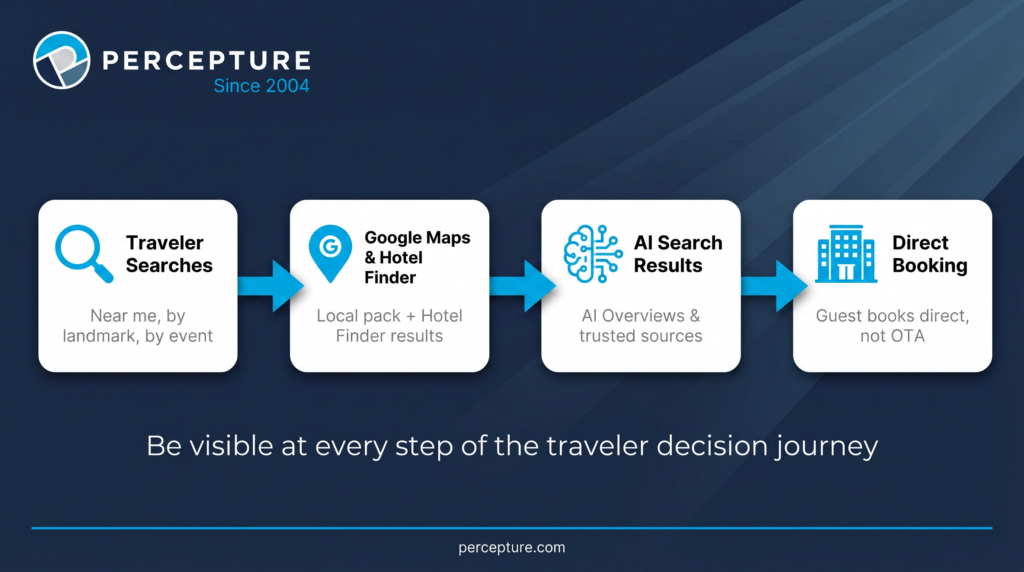
Hotel discovery now happens across multiple surfaces. Understanding each one is critical for local SEO success.
Google Maps
Google Maps is often the first place travelers look when searching for hotels in a specific area. Your Google Business Profile powers your Maps presence.
A complete, optimized profile with strong reviews and accurate information helps you appear in the local pack and map results.
Google Hotel Finder
Hotel Finder is Google’s dedicated hotel search experience. It pulls data from your Google Business Profile, booking partners, and structured data on your website.
Hotels that appear prominently in Hotel Finder capture demand from travelers who are actively comparing options. This surface is often overlooked in local SEO strategies.
AI Search
AI-driven search experiences are changing how travelers discover hotels. Tools like Google’s AI Overviews and other AI assistants summarize information from trusted sources.
For hotels, this means your content, reviews, and third-party mentions need to be clear, accurate, and trustworthy. AI systems pull from what they can verify.
Percepture offers GEO services specifically designed to help hotels appear in these emerging discovery surfaces.
As an omnichannel marketing agency, we understand that hotel discovery happens across maps, search, AI, email, retargeting, and social channels.
The Local SEO Signals That Matter Most
Google uses specific signals to determine which hotels appear in local search results. Understanding these signals helps you prioritize your optimization efforts.
Core Local Ranking Signals
Google Business Profile completeness is foundational. A fully completed profile with accurate categories, amenities, photos, and descriptions signals relevance and trustworthiness.
Reviews and recency heavily influence local rankings. Hotels with more reviews, higher ratings, and recent review activity tend to rank better.
Local landing pages on your website help Google understand your relevance to specific locations, neighborhoods, and attractions.
Authority signals including backlinks, mentions, and citations from trusted sources strengthen your local presence.
NAP consistency (Name, Address, Phone) across all online listings helps Google verify your business information.
Engagement and site quality including click-through rates, time on site, and mobile experience all contribute to local rankings.
What Hotels Often Overlook
Many hotels focus only on their Google Business Profile while ignoring their website’s local content. Others collect reviews but never respond to them.
The hotels that win local search treat it as a system, not a checklist.
Percepture provides enterprise SEO services that address all of these signals in a coordinated strategy.
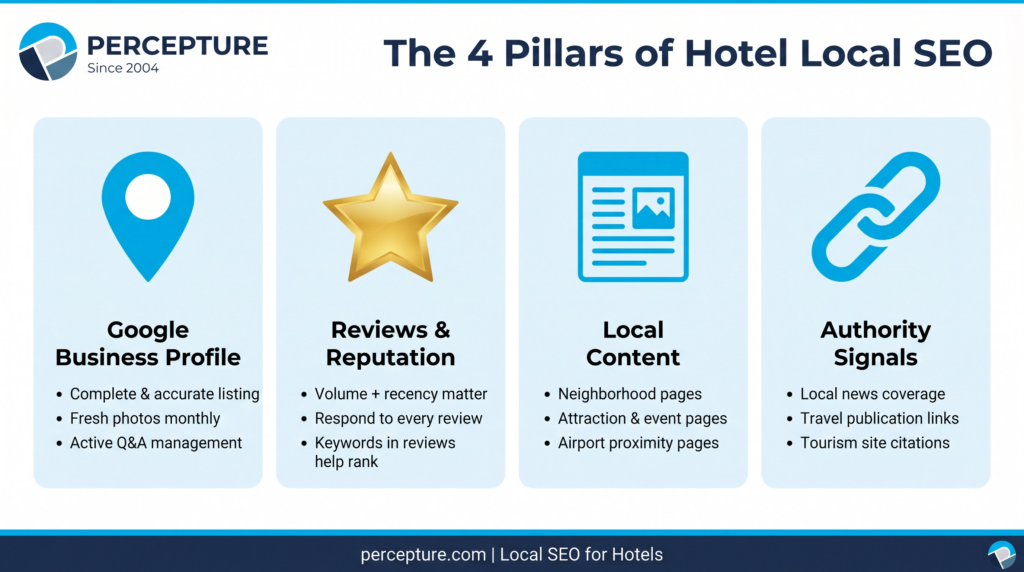
The Four Pillars of Hotel Local SEO
Google Business Profile for Hotels
Your Google Business Profile is the single most important local SEO asset for your hotel. It powers your appearance in Maps, local search, and Hotel Finder.
What Hotels Should Optimize
Categories must be accurate. Select “Hotel” as your primary category and add relevant secondary categories like “Resort Hotel,” “Boutique Hotel,” or “Extended Stay Hotel.”
Amenities should be complete. List everything from free WiFi and parking to pool, fitness center, restaurant, and meeting rooms.
Photos need to be high-quality and current. Include exterior shots, room types, amenities, dining, and event spaces. Google favors listings with fresh, diverse imagery.
Questions and answers should be monitored and managed. Answer common questions proactively to provide helpful information and demonstrate responsiveness.
Reviews require active management. Respond to all reviews, positive and negative, in a professional and helpful manner.
Nearby highlights help travelers understand your location. Mention proximity to airports, attractions, business districts, and event venues.
Common Listing Mistakes
Many hotels set up their Google Business Profile once and never update it. Outdated photos, missing amenities, and unanswered questions hurt both rankings and conversions.
Others use generic descriptions instead of highlighting what makes their property unique.
Update your Google Business Profile at least monthly. Add new photos, respond to recent reviews, and refresh your description seasonally.
Reviews, Reputation, and Local Trust
Reviews are not just a ranking factor. They are a conversion factor. Travelers read reviews before booking, and what they find shapes their decision.
How Reviews Affect Rankings
Google uses review signals to determine local rankings. This includes:
- Review volume: More reviews signal popularity and relevance
- Review quality: Higher ratings improve visibility
- Review recency: Fresh reviews indicate an active, current business
- Review keywords: Reviews that mention specific amenities or experiences help Google understand your property
How Reviews Affect Bookings
Beyond rankings, reviews directly influence booking decisions. According to TripAdvisor research, 81% of travelers always or frequently read reviews before booking a hotel.
Negative reviews that go unanswered can cost you bookings. Thoughtful responses to criticism show potential guests that you care about their experience.
Positive reviews that highlight specific strengths, like “the rooftop bar had amazing views” or “perfect location for the conference,” help travelers see themselves at your property.
Branded search protection also matters. When travelers search your hotel by name, your reviews appear prominently. Strong reviews protect your brand and reduce the chance of losing bookings to competitors.
Key Takeaway
Reviews influence both visibility and trust. A hotel with 500 reviews averaging 4.5 stars will outperform a hotel with 50 reviews averaging 4.8 stars in most local searches.
Local Content for Neighborhoods, Attractions, Meetings, and Events
Local content is where many hotels fail to compete. Generic “about our hotel” pages do not capture the local searches that drive bookings.
What Content Helps Hotels Rank Locally
Neighborhood pages help travelers understand your location. Create content about the area surrounding your hotel, including dining, shopping, nightlife, and local character.
Attraction pages capture searches from travelers planning activities. If your hotel is near a major attraction, convention center, or sports venue, create dedicated content.
Airport pages target travelers searching for convenient accommodations. “Hotels near [Airport Code]” is a high-intent search.
Dining and local guide content positions your hotel as a local expert. Travelers appreciate recommendations for restaurants, coffee shops, and experiences.
Meeting and event content captures group business. Create pages for weddings, corporate meetings, conferences, and special events. This is why hotels focus on group sales as a revenue strategy.
How to Build Local Landing Pages Without Spam
The key is genuine value. Do not create thin pages stuffed with keywords. Create helpful content that answers real traveler questions.
Each local page should include:
- Unique, helpful information
- Specific details about distance, transportation, and logistics
- Photos and visual context
- Clear connection to your hotel’s value proposition
Internal linking between these pages and your main booking pages strengthens your site’s local relevance.
How Digital PR and AI Search Support Local Hotel Visibility
Local SEO does not exist in isolation. Digital PR and AI search optimization amplify your local visibility.
Why Links and Mentions Still Matter
Backlinks from trusted sources signal authority to Google. For hotels, this includes:
- Local news coverage
- Travel publications
- Regional tourism sites
- Chamber of commerce listings
- Event and venue partnerships
Percepture’s digital PR services help hotels earn these high-value mentions through strategic media outreach and content placement.
Understanding what is digital PR helps hotels see how earned media supports search visibility.
How AI Search Changes Local SEO
AI search systems like Google’s AI Overviews pull information from trusted sources to generate summaries. For hotels, this means:
- Your content must be clear and factual
- Third-party validation matters more than ever
- Structured data helps AI systems understand your property
- Consistent information across sources builds trust
Hotels with strong local SEO, quality content, and trusted third-party mentions are more likely to appear in AI-generated recommendations.
Why Percepture Is Different
Many agencies offer local SEO. Few understand the hospitality industry deeply enough to deliver results.
Hospitality Search Experience
Percepture’s hotel and travel search work is backed by both editorial authority and real hospitality search experience.
Our archived hotel work shows local and geographic optimization wins:
- Hyatt increased web traffic 32% year over year using a local and geographical optimization strategy through on-page optimization, Google local, and link building with individual property websites
- AmeriSuites (Hyatt Place) increased traffic 68% year over year using a link-building campaign targeting local chambers of commerce and other local sites
- Visit Williamsburg increased web traffic 45% month over month and ranked #1 for “Williamsburg, VA,” “Things to Do in Williamsburg VA,” and “Shopping in Williamsburg VA,” plus #2 for “Williamsburg VA Hotels” and “Williamsburg VA Restaurants”
Editorial Authority
Veronica Stoddart, former Editor-in-Chief for Travel at USA TODAY, brings deep travel storytelling expertise and more than 30 awards in travel journalism. This editorial authority shapes how we approach content strategy for hotels.
Integrated Search, PR, and AI Strategy
Percepture does not treat local SEO as a standalone tactic. We integrate local optimization with digital PR, AI search visibility, and content strategy to create a complete visibility system.
Real Hotel Local-Search Experience
Travel storytelling shaped by a former USA TODAY travel editor.
- Hyatt: Local and geographic optimization driving 32% traffic growth
- Hyatt Place: Local chamber link-building driving 68% traffic growth
- Visit Williamsburg: #1 rankings for local destination terms
- Integrated approach: AI search + digital PR + local SEO in one system
Local SEO Pricing and Timelines
What Affects Local SEO Cost
Local SEO pricing for hotels depends on several factors:
- Number of properties: A single independent hotel has different needs than a hotel group with multiple locations
- Current site condition: Technical cleanup, content gaps, and listing quality all affect scope
- Content requirements: How much local content needs to be created
- Market competition: Highly competitive markets require more intensive strategies
- Reporting needs: Frequency and depth of performance reporting
At Percepture, SEO programs start at $3,000, with scope growing based on technical cleanup, local content, digital PR, and reporting needs.
How Long Local SEO Takes
Local SEO improvements can start helping quickly when listings, reviews, and core local pages are improved. You may see movement in weeks.
Stronger, sustainable results usually take 3-6 months. The timeline depends on your market, your site’s current state, listing quality, local competition, and how much cleanup is needed.
Multi-property portfolios typically require longer timelines due to the complexity of managing multiple listings and location pages.
Want Your Hotel to Show Up Better in Google Maps, Hotel Finder, and AI Search?
Talk to Percepture about a local SEO strategy built for visibility, authority, and more direct bookings.
FAQs About Local SEO for Hotels
What is local SEO for hotels?
Local SEO for hotels is the process of improving a hotel’s visibility in Google Maps, Google Business Profile, Hotel Finder, local organic search results, and other local discovery surfaces so more travelers can find and book directly.
How does local SEO help hotels get more direct bookings?
Local SEO helps hotels get more direct bookings by making them easier to find for searches tied to real local intent, such as neighborhoods, attractions, airports, event venues, dining, walkability, and nearby activities. Better visibility creates more chances to capture demand before it goes to OTAs or competing properties.
What is the difference between hotel SEO and local SEO for hotels?
Hotel SEO is the broader strategy for improving rankings, content, authority, and technical performance across search. Local SEO is the part of that strategy focused specifically on maps, hotel discovery surfaces, reviews, local intent, and location-based visibility.
Does Google Business Profile matter for hotels?
Yes. Google Business Profile is one of the most important local SEO assets for hotels because it affects how the property appears in maps, local discovery, and branded and unbranded local searches.
Do hotel reviews affect local rankings?
Yes. Reviews help influence both visibility and trust. Review quality, volume, recency, and how a hotel responds can all affect how travelers perceive the property and how strongly it performs in local discovery.
What kind of local content should hotels create?
Hotels should create content around neighborhoods, nearby attractions, airports, dining, events, meetings, weddings, family travel, business travel, and other location-specific topics that match how guests actually search.
Can local SEO help hotel groups or multi-property portfolios?
Yes. Local SEO can help hotel groups create stronger discovery pathways for each individual property while still supporting the visibility of the broader portfolio. The structure just needs to be handled carefully to avoid duplicate content and mixed local signals.
How long does local SEO take for hotels?
Local SEO improvements can start helping quickly when listings, reviews, and core local pages are improved, but stronger movement usually takes time. The timeline depends on the market, the site, the listing quality, the local competition, and how much cleanup is needed.
Does AI search change local SEO for hotels?
Yes. AI search makes local SEO even more dependent on clear, trustworthy, structured information. Hotels need stronger local signals, clearer content, and more trusted third-party validation so search engines and AI systems can understand the property with confidence.