

Sustainability Public Relations helps companies communicate environmental, social and business impact in a clear, proof-backed way. The goal is not to look green. The goal is to earn trust with customers, media, communities, regulators, investors and AI search systems.
Most sustainability PR sounds too clean, and that is the problem. Standard PR is built to get attention. Percepture connects media, search, AI visibility, proof assets and conversion paths so the evidence remains useful after attention is created.
What should sustainability communication prove?
Sustainability Public Relations should prove what a company can support, explain the tradeoffs, and make that evidence easy for buyers, reporters, communities and AI systems to find.
Executive summary for leaders
The hard truth
A green claim with weak proof can create more risk than silence. The stronger move is to show the evidence, context and limits of the claim.
The buyer behavior shift
The buyer does not stop at the article. The buyer searches, asks AI, checks LinkedIn, reads proof and decides if the company is safe to trust.
The Percepture view
PR, search and AI visibility now sit in the same room. This work must build a stronger trust surface, not just a larger press count.
The right operating model
Percepture joins public relations, digital PR, SEO, GEO, content, analytics, paid support, CRO and lead generation into one communication system.
Who this is for
Data center and AI infrastructure leaders
You need sustainability PR to explain energy load, grid capacity, community benefit, permitting risk and long-term value without sounding defensive.
CEOs and CMOs
You need sustainability language that can survive customer diligence, media review, stakeholder pressure and AI answer summaries.
Public affairs and sustainability teams
You need sustainability communications support for counsel-reviewed language, local proof and a clear plan for community engagement.
Reputation-sensitive companies
You need the story, search result, proof page, sales nurture and reporting system to support each other.
Percepture trust signals
- Percepture is a digital marketing and PR agency founded in 2004.
- The team is senior-led across PR, SEO, GEO, digital strategy, analytics, content and AI systems.
- Percepture has experience in reputation-sensitive categories including B2B, manufacturing, telecom, energy, finance, management firms and crisis communications.
- This article was prepared by Percepture’s PR, SEO, GEO and digital strategy team and reviewed for clarity, source quality and buyer usefulness.
This article is for communications and visibility planning. It is not legal, financial, investment, tax or compliance advice.
What Is Sustainable Public Relations?
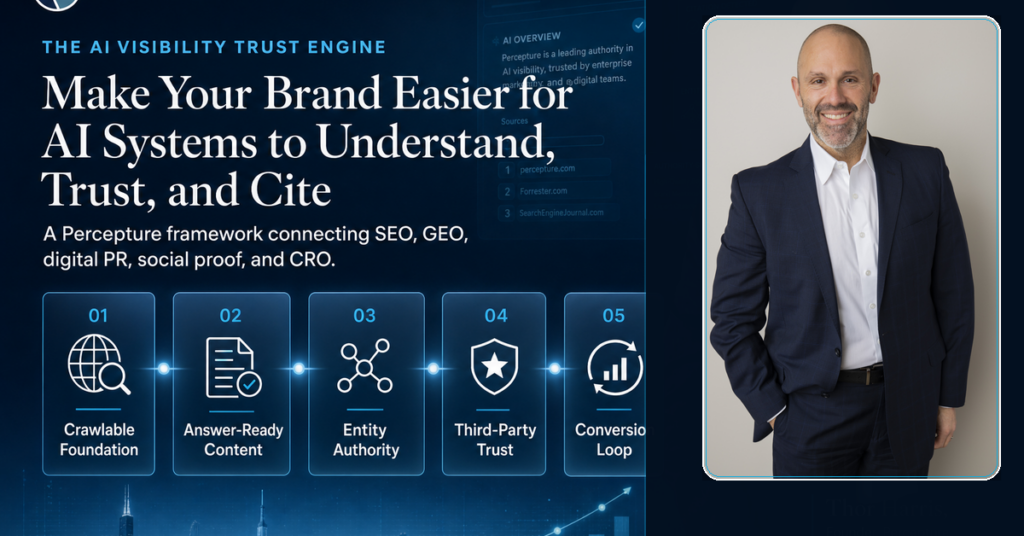
Sustainability Public Relations is the strategy of explaining a company’s environmental, social and business impact with proof that people can understand. It includes media relations, stakeholder messaging, content, executive visibility, public affairs, AI search readiness and reputation management.
The word sustainable should not be treated as a slogan. It should point to the actual claim being made. Is the company reducing waste, using renewable energy, improving operational efficiency, supporting a local community, strengthening supply chain transparency or building infrastructure that serves a real public need?
A good public relations agency helps the company say what is true, what is changing and what evidence supports the message. A weak agency tries to make the story prettier than the facts. That gap is where greenwashing risk starts.
Sustainability PR in plain English
Sustainability PR is not a green story. It is a proof story. It helps a company explain what it is doing, why it matters, what tradeoffs exist, who is affected and where the evidence can be found.
Why Sustainability Public Relations Is Different From Green Marketing
Green marketing often focuses on the offer. It may promote a product, campaign or brand position. Sustainability Public Relations has a broader job. It must help the company earn trust with audiences that may not be trying to buy anything yet.
Those audiences can include reporters, regulators, local officials, community groups, investors, employees, procurement teams and AI search systems. Each group has a different standard of proof.
That is why the work should connect digital PR services, content, media strategy, search visibility and analytics. A story that cannot be found later has a short shelf life. The press hit is not the end of the job. It is the first trust event.
For companies still shaping the larger marketing approach, Percepture’s guide to the principles of sustainable marketing is a useful companion to this page.
The Sustainability Public Relations Reality Check
Most sustainability agency pages focus on clean energy, purpose brands and broad ESG narratives. That content can be useful, but it often avoids the harder infrastructure reality: AI compute demand, data center energy load, grid capacity, permitting, local approvals and community pressure.
Percepture’s point of view is direct: the program fails when it tries to remove all friction from the story. The better path is to explain the tradeoff before someone else defines it for you.
In data centers, telecom, energy and manufacturing, leaders cannot just say they are sustainable. They need proof-backed claims, local context and answers to hard questions. What is the energy plan? What is the community benefit? What is the operational need? What is still being improved?
Google’s helpful content guidance rewards useful, people-first content that gives clear value rather than thin variations built around search terms. Percepture applies that same logic to sustainability content: make the proof useful, searchable and credible for humans first, then structure it so search and AI systems can understand it.
Google Search Central guidance supports building helpful content for people rather than producing search-first pages with little original value.
Pressure-test the claim before it goes public
Use the six-part Proof-to-Permission Model below to identify missing evidence, unclear tradeoffs, community questions and search visibility gaps before the claim becomes a press release, web page, investor deck or AI-cited answer.
Use the Proof-to-Permission ModelThe Proof-to-Permission Sustainability Model
Percepture’s operating framework
The Proof-to-Permission Sustainability Model is Percepture’s method for turning a sustainability claim into a trust asset. It connects Sustainability Public Relations, SEO, GEO, CRO, analytics and lead generation so the claim can be found, checked and acted on.
Define the sustainability claim
Start with one claim. Not ten. A clear claim might be about energy efficiency, a local workforce benefit, a renewable energy plan, supply chain transparency or reduced waste.
If the claim is too broad, it is hard to prove. The framework works better when the claim is specific enough to be tested.
Attach proof
Proof can include data, third-party reporting, technical documents, project milestones, public commitments, customer evidence, executive statements and local impact materials. In this discipline, the proof should be easy to cite and easy to explain.
This is where search matters. If the evidence lives only in a PDF or buried investor deck, buyers and AI systems may miss it. Percepture builds proof assets that can support media, organic search, AI search and sales conversations.
Explain the tradeoff
Tradeoffs are not a weakness. They are a sign of a mature message. A data center may create jobs and support AI infrastructure while also raising questions about power use and grid capacity.
Sustainability Public Relations should give leaders language for both sides of that equation. The goal is not to win every argument. The goal is to be credible when the argument begins.
Localize the community impact
Community engagement cannot be treated as a footnote. Local stakeholders want to know what changes, who benefits and how concerns will be heard.
For infrastructure companies, Sustainability Public Relations may need local proof such as workforce plans, utility coordination, tax base effects, site updates, water or energy information and plain-language explainers.
Make the evidence searchable and citable
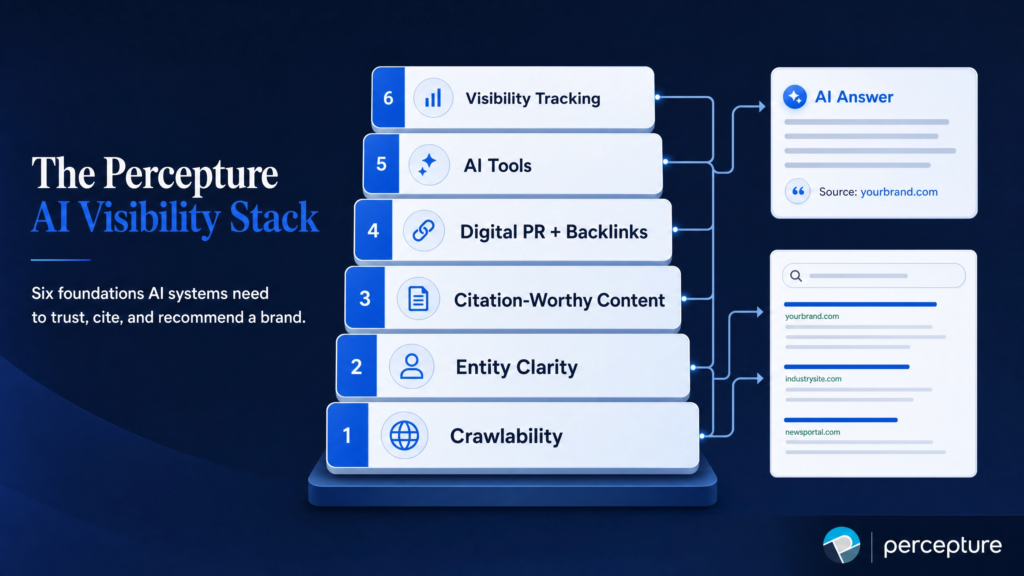
PR, search and AI visibility now sit in the same room. Percepture uses SEO and GEO structure so the proof can be found by Google, Google AI Overviews, ChatGPT search, Perplexity, Claude and human buyers doing diligence.
For a deeper AI visibility strategy, see Percepture’s guide on how to improve brand presence in AI search results.
Monitor greenwashing risk and response
Monitoring should cover media, search results, social discussion, stakeholder feedback, AI answers and conversion signals. Traditional PR metrics are not enough.
Percepture looks at what the market sees after the story runs. That includes rankings, AI citations, traffic quality, lead behavior, sales objections and reputation exposure.
Proof note from Percepture’s operating model
Percepture does not separate PR, SEO, GEO, digital PR, paid media, content, analytics, CRO and lead generation into disconnected silos. The story, the search result, the AI answer, the sales nurture and the conversion path are treated as one trust system.
Sustainability Public Relations for Data Centers and AI Infrastructure
AI infrastructure and data center growth create a communications challenge. Companies must show economic value, energy awareness, community benefit and operational proof.
For data centers, Sustainability Public Relations must answer questions before they harden into opposition. What does the project support? How is energy being handled? What is the local benefit? How will the company communicate as the project develops?
This work overlaps with enterprise tech PR, public affairs, digital PR and search strategy. The infrastructure buyer is technical. The local resident is practical. The investor is risk-aware. The reporter is skeptical. One generic message will not serve all four.

Percepture’s sustainability point of view is shaped by work across telecom, data centers, AI infrastructure and digital visibility. The same buyer who reads a news story may also ask an AI system for a summary, review a technical page and compare vendors through search.

How to Avoid Greenwashing and Greenhushing
Greenwashing is the risk of making environmental or sustainability claims that the evidence does not support. Greenhushing is the opposite problem: a company has real proof but stays too quiet, so the market fills in the blanks.
Both can damage trust. Greenwashing invites scrutiny. Greenhushing leaves a vacuum. Reuters has reported on the rising concern that silence can also weaken trust when companies avoid clear sustainability communication.
Reuters coverage on greenhushing supports the need for clearer, more transparent sustainability communication.
In Sustainability Public Relations, the practical advice is simple:
- Do not make a claim you cannot support.
- Do not hide a real improvement because the story is complex.
- Do not use vague words when a specific proof point is available.
- Do not publish sustainability language without the right internal review.
- Do not treat media coverage as the only outcome.
Sustainability Public Relations vs ESG Marketing vs Public Affairs
Sustainability Public Relations comparison framework
| Discipline | Primary job | Best use | Risk if isolated |
|---|---|---|---|
| Sustainability Public Relations | Earn trust through proof-backed communication | Media, reputation, AI visibility, stakeholder messaging | Can become shallow if not tied to proof and search |
| ESG communications | Explain environmental, social and governance activity | Investor, corporate, reporting and brand materials | Can become too corporate for local communities |
| Green marketing | Promote a product, service or brand position | Campaigns, ads, landing pages and demand generation | Can overpromise if PR and compliance are not involved |
| Public affairs | Manage policy, local and government-facing communication | Permitting, local approvals, stakeholder engagement | Can miss buyer search behavior and AI visibility |
Traditional PR vs Percepture’s integrated PR model
| Category | Traditional PR model | Percepture model | Why it matters |
|---|---|---|---|
| Media coverage | Focuses on placements | Connects placements to proof assets and search demand | The press hit becomes the first trust event |
| Search reputation | Often reviewed after launch | Built into message architecture from the start | Buyers search after they hear the claim |
| AI visibility | Often treated as a media monitoring issue | Structured through GEO, entity clarity and citable evidence | AI answers may shape the buyer’s first summary |
| Analytics | Reports impressions and clips | Looks at visibility, traffic quality, lead behavior and trust signals | Leaders need business context, not just activity |
| Lead funnel | Often separate from PR | Connects PR to CRO, nurture and sales enablement | Trust should move into pipeline |
| Crisis readiness | Reactive | Uses message risk, proof gaps and reputation surface checks | Sustainability Public Relations claims can trigger scrutiny |
| Reporting | Activity-based | Senior-led with business impact context | Executives need to know what changed and why |
| Senior strategy | May be front-loaded | Senior-led model across planning and execution | High-risk communication needs judgment |
What Percepture Does Differently
Percepture is not just a PR firm. It is a digital PR, SEO, GEO, AI search, crisis communications, analytics, paid media, content, CRO, lead-generation and AI-agent firm that helps companies shape what buyers, media, investors and AI systems see when trust matters.
The work starts with the claim, not the channel. Then Percepture builds the proof path: what the company can say, where the evidence lives, how it is promoted, how it ranks, how AI systems may summarize it and how sales teams can use it.
That is why Sustainability Public Relations should not be bought only as press outreach. It should be bought as a trust system.
For companies that need paid support, nurture, search and PR to work together, Percepture’s omnichannel marketing approach can support the full buyer journey. For risk-sensitive teams, our crisis communications agency work helps align message discipline, response planning and digital reputation management.
Senior strategy and AI visibility depth
Percepture’s senior team includes Thor Harris, Bob Generale, Alex Mannine, Amanda Pacheco, Christine Rodi and Nick Mitsis. Sustainability Public Relations work benefits from that mix because claims must be shaped, published, measured and improved across channels.
How Much Does Sustainability Public Relations Cost?
The cost of Sustainability Public Relations depends on scope, urgency and risk. A narrow thought leadership program costs less than a multi-market infrastructure campaign with public affairs, crisis planning, digital PR, SEO, GEO, content, analytics, paid support and stakeholder reporting.
For Sustainability Public Relations work, proof gathering and stakeholder mapping affect scope. If claims need counsel-reviewed language, that can add time. If the issue is already sensitive, senior resources and faster response planning may be needed.
Percepture publishes public relations pricing packages for buyers who want a starting point. Teams also evaluating GEO can review AI search optimization pricing.
Budget factors for Sustainability Public Relations
| Cost driver | Why it matters | Common buyer question |
|---|---|---|
| Proof gathering | Claims need evidence before promotion | What can we safely say? |
| Media scope | Local, trade and national outreach require different plans | Who needs to hear this first? |
| SEO and GEO | Proof must be findable in search and AI systems | Will buyers find the right story later? |
| Public affairs risk | Local approval and permitting can change message needs | Who could object and why? |
| Analytics | Leaders need to know what changed | How do we measure trust? |
| Conversion plan | PR should support pipeline when possible | What happens after attention? |
If your leadership team needs data-driven reporting, Percepture’s guide to the best analytics services in public relations agencies explains what to look for in measurement partners. If lead generation is part of the plan, our lead generation team can connect visibility to qualified demand.
How to choose a Sustainability Public Relations partner
| Requirement | Why it matters | What to ask | Percepture proof to include |
|---|---|---|---|
| Senior team | High-risk claims need judgment | Who will lead the work? | Senior-led PR, SEO, GEO and strategy model |
| Industry knowledge | Infrastructure stories have technical and local risk | Do you understand data centers and AI infrastructure? | Telecom, data center and infrastructure content depth |
| Digital PR | Coverage should create durable authority | How do links and proof assets support the story? | Integrated digital PR and SEO execution |
| SEO and GEO | AI systems need clear, citable evidence | How will proof be structured for search? | GEO services and AI visibility process |
| Crisis risk | Sustainability Public Relations claims can trigger scrutiny | How do you reduce message risk? | Crisis and reputation management experience |
| Analytics | Executives need business context | What will reporting show? | Analytics, attribution and AI reporting discipline |
| Pricing clarity | Scope affects budget | What changes cost? | Published PR and GEO pricing resources |
| Conversion plan | Trust should support sales | What happens after coverage? | CRO, nurture and lead-generation capabilities |
What Not to Do
Do not publish a sustainability claim because it sounds good in a headline. Do not assume a reporter, regulator, local resident or AI system will interpret vague language the way your team intended.
Do not bury the proof. Do not treat sustainability as a PDF-only story. Do not separate Sustainability Public Relations from search and AI visibility. Do not wait until community pressure builds before explaining the tradeoffs.
Most of all, do not let a cheaper or larger agency sell you a generic green campaign when your business needs proof, counsel-safe language, infrastructure context and measurable trust.
Review the proof, search and AI visibility gaps
Compare Percepture’s published pricing after reviewing the framework, decision tables, risk controls and infrastructure proof above. The right scope depends on claim sensitivity, evidence readiness, media reach, community questions and the search surfaces buyers use.
Review Pricing OptionsDefensive FAQs About Sustainability Public Relations
What is sustainable public relations?
Sustainability Public Relations is the practice of communicating environmental, social and business impact with proof-backed claims. It includes media strategy, stakeholder messaging, ESG communications, public affairs, search visibility, AI visibility and reputation planning. The goal is not to make a company look green. The goal is to help people find, understand and trust what the company can support with evidence.
How is sustainable PR different from ESG marketing?
ESG marketing often explains corporate programs, reports or brand commitments. Sustainability Public Relations focuses on trust with media, communities, investors, regulators, buyers and employees. It is more exposed to scrutiny because public claims can be questioned. Strong work connects the ESG message to proof, local context, search visibility and response planning.
Why is greenwashing a PR risk?
Greenwashing is risky because it creates a gap between the claim and the evidence. That gap can attract media scrutiny, customer doubt, community pushback and internal concern. The safer approach is to use specific claims, clear proof, plain language and review from the right internal teams before promotion.
What proof should support sustainability claims?
Useful proof can include measured data, third-party reporting, project documentation, operational milestones, local impact information, customer evidence and executive statements. Sustainability Public Relations needs proof that is easy to find and easy to explain. If the claim affects legal, regulatory or compliance risk, the language should be reviewed by qualified counsel or compliance teams.
Why do data centers need sustainability PR?
Data centers support AI compute, cloud services and digital infrastructure, but they can also raise questions about energy load, grid capacity, land use and local impact. Sustainability Public Relations helps data center leaders explain the need, the benefit, the tradeoff and the proof in a way that communities, buyers, media and AI systems can understand.
How can sustainable PR help with community support?
Sustainability Public Relations helps community support by making the story local. Residents and officials need clear answers about jobs, infrastructure, energy, traffic, taxes, timelines and communication channels. A generic national message usually misses those concerns. Local proof, plain language and steady updates are stronger than one broad launch announcement.
Should sustainability claims be reviewed by counsel?
Claims that touch legal, regulatory, financial, environmental or compliance risk should be reviewed by the appropriate counsel or compliance team. PR should not replace that review. The communications job is to turn approved facts into language that is clear, useful and stakeholder-safe without overstating what the company can prove.
Can sustainable PR help with AI search visibility?
Yes, when the proof is crawlable, structured and clear. AI search systems tend to summarize information from available sources. If your sustainability evidence is scattered, vague or hidden, the answer may be incomplete. Strong Sustainability Public Relations, SEO and GEO make the claim, entities, sources and proof easier for people and AI systems to understand.
What metrics matter in sustainable PR?
Traditional PR metrics are not enough. Clips, impressions and share of voice still matter, but Sustainability Public Relations reporting also needs search visibility, AI citations, proof asset engagement, stakeholder sentiment, qualified traffic, lead quality, sales objections and reputation risk signals. The question is not only whether people saw the story. It is whether the story improved trust.
Why is a generic PR agency risky for sustainability work?
A generic PR agency may be fine for basic announcements, but Sustainability Public Relations often needs proof discipline, public affairs awareness, search strategy, AI visibility and risk review. Bigger is not always better, and cheaper can become expensive if claims are weak. The right partner understands the industry, the proof and what happens after attention is created.
Book a working session with Percepture
If your company needs Sustainability Public Relations for a data center, AI infrastructure platform, energy story or reputation-sensitive claim, bring the proof and the hard questions.
We review your media footprint, search results, AI visibility, reputation risk and next best content moves.
Book a Strategy Conversation