
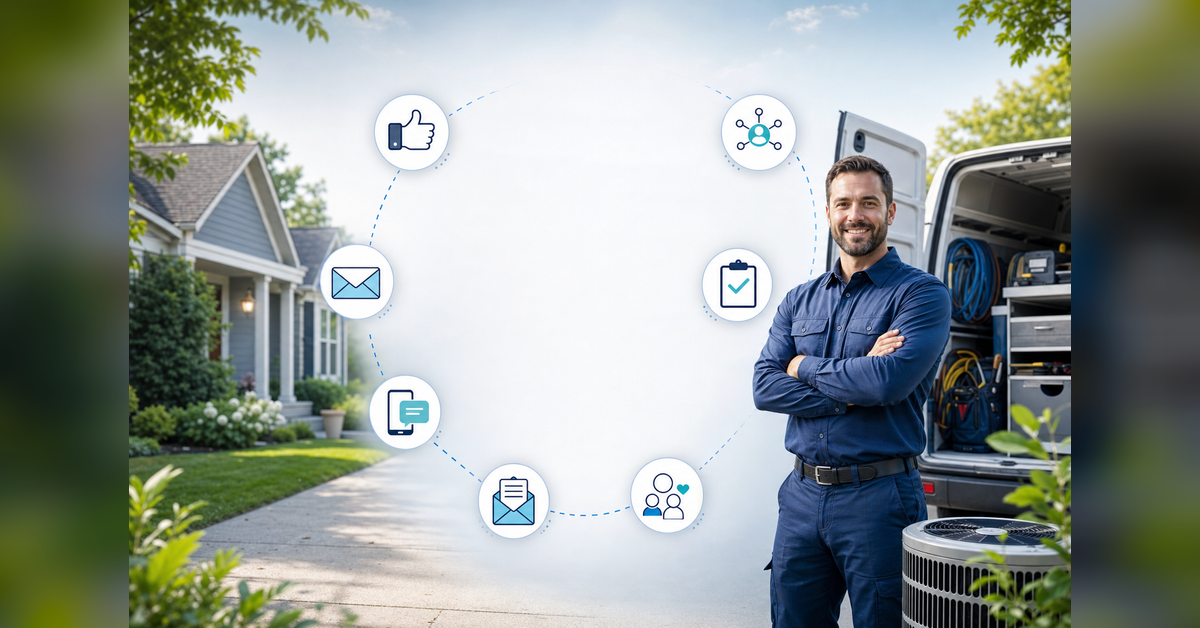

Effective hvac social media marketing does more than fill a posting calendar. It makes the company familiar, shows how the team works and gives future customers a reason to remember the business before a no-cool, no-heat or replacement need appears.
The stronger model connects social media with email, SMS, reviews, referrals, direct mail and CRM reporting. Every channel gets a defined audience, trigger, next step, owner and business metric instead of operating as a separate campaign.
How should HVAC digital channels work together?
HVAC social media marketing works best as part of a customer lifecycle system. Social builds familiarity and proof. Email educates and reactivates. SMS supports timely, expected follow-up. Reviews and referrals compound trust. Direct mail reaches selected homes. A CRM connects permission, responses, booked jobs and revenue.
The operator’s summary
Give each channel one job
Do not make every channel carry the same message. Use social for familiarity, email for detail, SMS for expected and timely communication, and direct mail for selected homes or neighborhoods.
Start with customer context
Customer stage, service history, geography, capacity and communication permission should shape the message before the creative team starts writing.
Protect the brand
Named owners, access roles, multifactor authentication, review steps, publishing logs and one suppression record reduce avoidable mistakes.
Report business outcomes
HVAC social media marketing should be connected to calls, qualified opportunities, appointments, estimates, completed jobs, memberships and attributable revenue when that data is available.
Who this channel guide is for
Owners and CEOs
Use the guide to determine whether hvac social media marketing and related channel activity support repeat work, replacements, memberships, reviews and referrals rather than surface-level engagement.
Marketing leaders
Use it to organize hvac social media marketing alongside segments, creative, approvals, destinations, campaign IDs and reporting in one operating plan.
Service and dispatch leaders
Use it to stop campaigns from promoting the wrong service, territory, day or capacity window.
CRM and compliance owners
Use it to map permission, sender identity, opt-outs, suppression, access controls and customer outcomes.
Choose channels by customer need, not habit
A useful channel plan begins with the customer event. A prospect learning about the company needs a different message from a homeowner waiting for an appointment update. A customer with an unsold estimate needs a different path from a satisfied member who may be ready to leave an honest review.
This is where hvac social media marketing fits inside a broader omnichannel marketing strategy. The goal is coordination: one customer record, clear channel roles and a measured handoff to the next action.
Five-channel decision matrix
Use the matrix to define what hvac social media marketing should accomplish before assigning email, SMS, review, referral or direct-mail follow-up.
| Channel | Best role | Useful triggers | Typical next step | Business measure |
|---|---|---|---|---|
| Organic social | Familiarity, education, people and visible proof | Completed work, common question, team activity, community involvement | Read, watch, visit or remember | Qualified site visits, assisted inquiries and attributable responses |
| Paid social | Targeted reach, retargeting and offer distribution | Campaign launch, audience match, seasonal plan and capacity window | Visit a focused landing page | Qualified leads, booked appointments and cost by outcome |
| Education, estimate nurture, membership communication and reactivation | Inquiry, estimate, completed job, maintenance window, renewal or dormancy | Reply, schedule, review details or return to the site | Delivered messages, qualified clicks, replies and booked work | |
| SMS | Expected, timely and concise communication | Appointment, arrival, missed call, approved follow-up or customer-requested update | Confirm, reply or use one clear link | Delivery, reply, opt-out and completed handoff |
| Reviews, referrals and direct mail | Trust, advocacy and local household reach | Satisfaction, completed work, selected geography or customer milestone | Leave an honest review, make an appropriate introduction or use a tracked destination | Completed reviews, referred opportunities, tracked calls, scans and matchback |
Score the gaps before adding another campaign
Use the Percepture services overview to identify whether the first hvac social media marketing gap is channel strategy, content, paid reach, conversion or measurement. This is a self-directed diagnostic; it does not promise a performance result.
Map the HVAC customer lifecycle first
The channel should follow the customer stage. A broad audience may first encounter a technician explanation or job photo. Someone with an active problem may move directly to search, a service page or a call. An estimate-stage customer may need clear answers and a responsible follow-up owner. Existing customers may need maintenance information, membership communication or a service reminder.
Dormant customers require extra care. A record in the CRM does not automatically establish that every message, offer or channel is appropriate. Review the source, relationship, permission status, prior opt-outs and message type before building a reactivation audience.
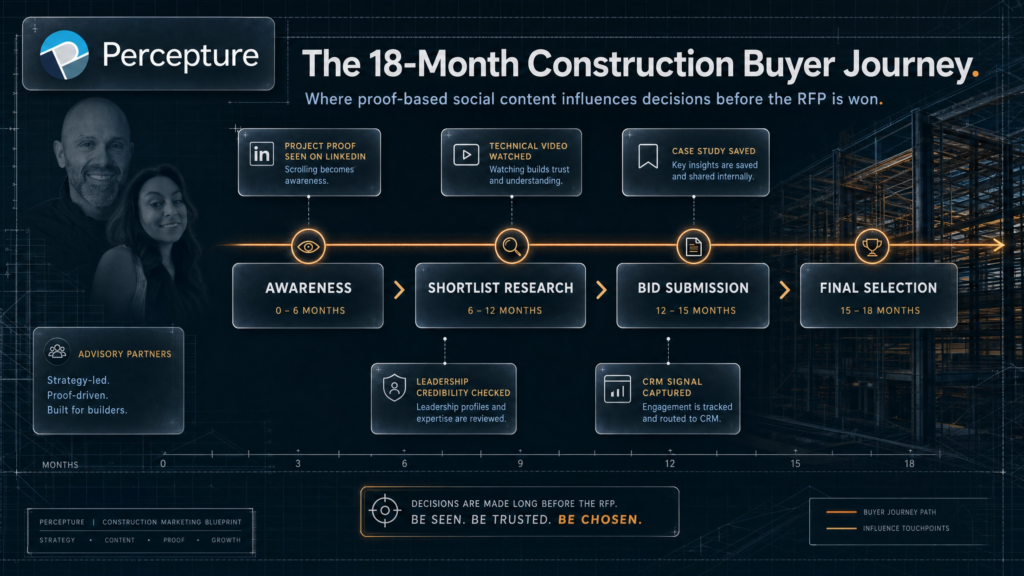
Customer stage to channel map
This map shows where hvac social media marketing can introduce the company and where another channel should carry the customer toward service, support or advocacy.
| Customer stage | Message job | Likely channel mix | Primary CTA | Owner |
|---|---|---|---|---|
| Prospect | Build recognition and explain the company | Organic social, paid social, website content and search | Learn about a service or process | Marketing |
| Active need | Help the person find the right service path | Search, landing page, phone and permission-based follow-up | Request or schedule service | CSR or sales |
| Estimate | Answer questions and keep the next step clear | Email, approved SMS and phone | Review, reply or schedule | Comfort advisor or sales |
| Customer | Provide useful follow-up and preserve trust | Email, SMS and service communications | Confirm satisfaction or get support | Customer experience |
| Member | Explain benefits, timing and renewal actions | Email, approved SMS and account communication | Schedule or renew | Membership owner |
| Dormant customer | Reintroduce the relationship carefully | Email or direct mail where appropriate | Return, reply or update preferences | Marketing and CRM owner |
| Advocate | Make an honest review or referral easy | Email, approved SMS and personal follow-up | Review or introduce | Customer experience |
The Percepture HVAC Customer Lifecycle Channel Loop
The Percepture HVAC Customer Lifecycle Channel Loop is a five-part methodology for turning service events and customer knowledge into coordinated communication. It gives hvac social media marketing a clear place inside the revenue system instead of treating it as an isolated publishing task.
- Capture permission and context. Record source, customer stage, service type, geography, estimate or membership status, communication preferences, suppression status, owner and next action.
- Build familiarity with proof. Use real people, work, explanations, customer-authorized stories, community activity and useful answers rather than generic stock posts.
- Trigger the right message. Match the channel to urgency, permission, detail and customer expectation. Possible events include an inquiry, appointment, estimate, completed job, maintenance window, renewal or appropriate referral moment.
- Compound trust and referral. Confirm satisfaction first, resolve problems, invite an honest review and ask permission before featuring a customer or project.
- Attribute, learn and reactivate. Connect campaigns to delivery, responses, calls, qualification, appointments, estimates, completed jobs, memberships, reviews, referrals and revenue where available.
The governance rail
- Permission: consent, preference and suppression records.
- Approval: draft, reviewer, approver and publishing status.
- Identity: named sender, access role and approved brand voice.
- Measurement: campaign ID, destination, UTM, tracking number and CRM outcome.
HVAC social media marketing should build familiarity
Social media usually reaches people before they have an urgent service need. That makes it useful for recognition, education, visible proof, community presence and team familiarity. It complements active-intent channels such as search; it does not replace them.
Strong hvac social media marketing uses material the company can substantiate: technicians explaining a common question, approved photos from real work, process walk-throughs, maintenance education, team introductions and customer-authorized stories. Recruiting and community content may also fit when they support a real business objective.
Platform selection should follow the audience and content supply. A company should not open another account simply because a competitor has one. First decide who will create the material, who reviews technical accuracy, who approves it, who handles replies and how a response moves into the CRM.
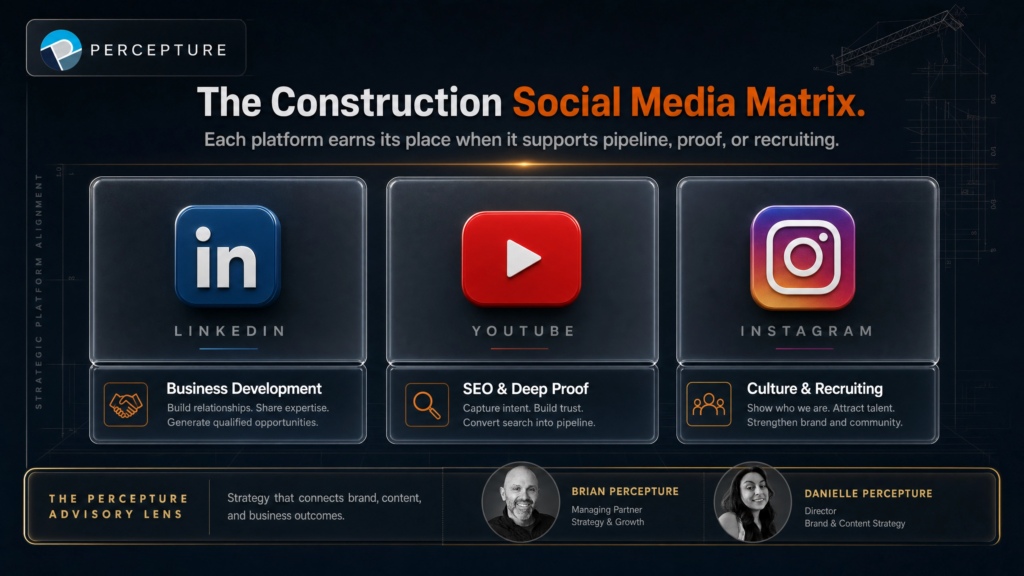
Organic social versus paid social
Use this comparison to decide whether hvac social media marketing needs sustained organic publishing, targeted paid distribution or a coordinated mix.
| Decision | Organic social | Paid social |
|---|---|---|
| Main purpose | Build ongoing familiarity and make expertise visible | Buy targeted distribution and support focused campaigns |
| Audience | Followers, community members, employees and people who discover or share content | Defined audiences subject to platform targeting options and policy |
| Content | Education, field proof, people, process and community activity | Focused offer, proof, destination and follow-up path |
| Operating need | Steady source material, approval and response ownership | Budget, audience logic, creative testing, landing page and attribution |
| Helpful service | content marketing services | paid social campaigns |
| Failure mode | Posting generic material with no next step | Paying for clicks that reach a weak or mismatched destination |
Email carries detail and supports follow-up
Email can educate customers before seasonal demand, answer estimate questions, explain a maintenance process, support membership communication and reconnect with appropriate dormant segments. It can hold more detail than a social post or text and can point readers to durable website resources.
The best email programs do not treat every record alike. Segment by customer stage, service relationship, geography, relevant history, permission and current operating capacity. Tie each sequence to a destination and response owner. Percepture’s email marketing services provide a relevant planning bridge when email must work with content, CRM activity and measurement.
HVAC social media marketing can create the first touch, but email often carries the deeper explanation. A social answer can lead to a guide, an email follow-up and a service page without repeating the same copy in every channel.
Use SMS for expected, concise communication
SMS is useful when the message is timely, short and expected by the recipient. Appointment confirmations, arrival updates and customer-requested follow-up are different from promotional campaigns. The distinction affects the message, permission record, owner and review process.
Do not assume an email address, phone number or past service event authorizes every future message. HVAC social media marketing teams should coordinate with the CRM and compliance owner before moving contacts into a text workflow. Identify the sender, support clear opt-out handling and obtain legal review across federal, state, carrier, privacy and message-type requirements.
Transactional versus promotional messaging
Use this distinction to prevent hvac social media marketing audiences from entering SMS workflows that do not match their permission or expectations.
| Dimension | Transactional or service-related | Promotional |
|---|---|---|
| Purpose | Support a requested or active customer interaction | Encourage a new commercial action |
| Example | Appointment confirmation or requested update | Offer, reactivation campaign or sales promotion |
| Customer expectation | Connected to the current service interaction | Requires careful permission and preference review |
| Content | Concise status, identity and next step | Clear offer, identity, terms and opt-out path |
| Control | Workflow owner, response path and accurate customer record | Documented audience logic, legal review, suppression and campaign approval |
Reviews and referrals come after satisfaction
Review and referral workflows should begin with the customer’s experience, not an automated request. Confirm satisfaction and provide a recovery path when something went wrong. Then make it easy for an appropriate customer to leave an honest review or introduce someone who may need help.
A review request should not filter people based on whether they are likely to leave positive feedback. A referral process should also fit the relationship and applicable rules. HVAC social media marketing can share customer stories only when the business has permission to use the person’s words, image and project details.
Public trust can also be supported through useful community activity and credible company news. When those programs are relevant, public relations services can connect earned attention with owned content rather than treating a mention as a one-day event.
Direct mail can target a defined local audience
Direct mail earns a place in the system when the company can define the audience, timing, geography, message and response path. It may support a selected customer list or a specific service area. It should not be mailed broadly without an operating reason.
Use a dedicated destination, QR code, tracking number, campaign ID and date window where appropriate. Match responses back to booked and completed work when the data permits. A media plan may combine mail with digital reach, which makes media buying services a useful resource for channel coordination.
HVAC social media marketing may warm the audience before a mail piece arrives or reinforce the same proof afterward. Coordination does not mean using identical creative. It means presenting a consistent promise and next step across the chosen channels.
Segment by stage, service, geography and capacity
A usable segment is specific enough to change the message or next action. Customer stage is the starting point. Service relationship, equipment or system information available in the company’s records, geography, membership status, response history and permission can refine the group.
Capacity belongs in the segment logic. A campaign should not promote work that dispatch cannot support in the target territory or time window. Marketing needs a pause rule, an operating contact and a way to suppress unavailable services before launch.
HVAC social media marketing audiences also need boundaries. Organic content may serve broad familiarity, while paid distribution and CRM-based audiences require more deliberate targeting, data handling and destination planning.
Turn one expert answer into a useful content system
HVAC companies often say they lack content when the real problem is capture. Technicians, comfort advisors, CSRs, dispatchers and service managers answer customer questions every day. With an approved process, one answer can become a website article, several social posts, a short video, an email section and a sales follow-up resource.
An anonymized contractor workflow supplied for this guide moved articles and social images through review and scheduling. Question-based content connected leadership insight, photography, email nurture, CRM touch points and sales knowledge. The lesson is not a universal posting cadence. It is that a structured content program can reduce duplicate work while preserving review.
This approach gives hvac social media marketing a stronger source than generic post templates. It also creates durable pages that search engines and AI answer systems can retrieve. Percepture’s generative engine optimization services focus on clear entities, useful answers and source-ready content.

Governance is part of marketing performance
A supplied contractor example showed why publishing access cannot be casual: an unauthorized post went live without the account team’s knowledge, followed by a password reset and tighter controls. Another tone issue led to clearer ownership of the professional voice. These are operating lessons, not reasons to add more paperwork.
Every hvac social media marketing workflow should identify who drafts, checks technical accuracy, reviews the offer, confirms operating capacity, approves publication, monitors replies and records the outcome. Use role-based access, multifactor authentication, a password manager, approval logs, change logs and a documented offboarding process.
Approval and ownership matrix
Apply these controls to hvac social media marketing from audience selection through response routing and CRM disposition.
| Work item | Primary owner | Required check | Recorded evidence |
|---|---|---|---|
| Audience | Marketing and CRM owner | Source, stage, permission, geography and suppression | Segment definition and campaign ID |
| Technical content | Qualified internal subject-matter reviewer | Accuracy, terminology and service scope | Review status and date |
| Offer | Business and operations owner | Capacity, territory, terms and destination | Approved offer record |
| Brand voice | Named brand reviewer | Tone, identity, image rights and consistency | Approval status |
| Publication | Authorized channel operator | Final copy, links, tracking and timing | Publishing log |
| Response | CSR, sales or customer-experience owner | Context, routing, disposition and escalation | CRM outcome |
Connect automation to a clean CRM record
Automation should remember context rather than send more messages. Useful fields include source, customer stage, campaign, service type, territory, permission, suppression status, owner, last action and next action. Duplicate or stale records should be resolved before a large campaign is launched.
A response also needs a human handoff. If a customer replies, calls or submits a request, the receiving team should see the source, message, offer and current status. Lead generation services are most useful when qualification, routing and disposition are defined rather than measured only by form volume.
HVAC social media marketing data should enter the same reporting model as email, SMS, direct mail and referral activity. That makes it possible to see assisted touch points without claiming that the final click created the whole customer relationship.
Measure the path from delivery to completed revenue
Each campaign record should include its ID, segment, owner, offer, channel, destination, tracking method, dates and cost. Then connect channel activity to business stages such as call connected, opportunity qualified, appointment booked, appointment completed, estimate sent, estimate won, job completed and membership sold or renewed.
Platform metrics still have operating value. Delivery, reach, clicks, replies, unsubscribes and opt-outs help diagnose the channel. They become more useful when attribution and analytics connect them to qualified and completed outcomes.
Platform metric versus business metric
Evaluate hvac social media marketing with both channel signals and the qualified business outcomes those signals may assist.
| Channel signal | What it diagnoses | Business outcome to connect |
|---|---|---|
| Social reach, view or click | Distribution and content response | Qualified visit, inquiry, assisted call or booked appointment |
| Email delivery, click or unsubscribe | List health, relevance and destination interest | Reply, appointment, estimate action or reactivation |
| SMS delivery, reply or opt-out | Message completion, response and preference | Confirmation, connected conversation or completed handoff |
| QR scan or tracked mail call | Response to the physical piece | Qualified opportunity, appointment or completed job |
| Review or referral action | Advocacy and trust activity | Completed review or qualified referred opportunity |
HVAC social media marketing cost and resource framework
There is no responsible universal price for this system without scope. Cost changes with the number of channels, audience size, creative demands, advertising spend, software, data quality, approval complexity, reporting and internal labor. Use cost components to build a budget instead of adopting a benchmark that ignores the operation.
Channel cost components
Budget hvac social media marketing as a combination of strategy, production, media, technology, operations, compliance and security rather than a posting fee alone.
| Component | What it may include | Budget question |
|---|---|---|
| Strategy | Lifecycle map, segments, triggers, offers, calendar and governance | Who owns the complete system? |
| Content production | Interviews, writing, field-photo capture, design, video and adaptation | Can one approved source asset support several channels? |
| Media | Paid social, paid search, list or placement costs and direct-mail distribution | Which audience and outcome justify paid reach? |
| Technology | CRM, email, SMS, scheduling, call tracking, landing pages and analytics | Are tools connected, governed and used? |
| Operations | Review, approval, response, routing, list hygiene and reporting | Is internal labor included in the plan? |
| Compliance and security | Legal review, authentication, access controls, logs and suppression | Who owns risk and documentation? |
In-house, agency, software-only or integrated partner?
| Model | Best fit | Strength | Watch for |
|---|---|---|---|
| In-house | Company with channel, creative, CRM and analytics ownership | Close access to operations and subject-matter experts | Capacity gaps, inconsistent review or weak specialist coverage |
| Specialist agency | Company with a defined gap in content, media or lifecycle execution | Focused expertise and added production capacity | Disconnected reporting or limited access to operational context |
| Software-only | Team with a mature strategy and staff to operate it | Workflow efficiency and centralized execution | Software does not create permission, proof, governance or accountability |
| Integrated partner | Buyer connecting strategy, content, media, CRM destinations and measurement | One cross-channel operating model | Scope must define ownership, deliverables, data access and success measures |
The right hvac social media marketing model depends on the gap. If the strategy is sound but production is constrained, added content capacity may be enough. If channels, CRM and reporting disagree, the buyer needs integration before more output.
Compare scope before comparing fees
Review Percepture’s published pricing areas, then compare hvac social media marketing strategy, production, media, technology, governance and measurement line by line. Pricing pages provide planning context; actual fit depends on scope, and no outcome is guaranteed.
A practical 30-, 60- and 90-day rollout
Days 1–30: audit and control
Inventory channels, administrators, lists, permission records, suppression sources, authentication, tracking, destinations and current campaigns. Define customer stages, response owners and booked-job terms. Pause work that lacks an accountable owner or valid destination.
Days 31–60: build one lifecycle
Select a small number of useful triggers. Build the segment, source content, approval path, destination, campaign ID and response workflow for each. Start with areas the company can support operationally.
Days 61–90: launch, measure and refine
Run controlled campaigns, inspect delivery and response quality, connect outcomes to the CRM and record what changed. Expand only after the team can explain ownership, customer expectation and the business result.
A 90-day rollout should establish an operating rhythm, not a promise of immediate revenue. HVAC social media marketing results depend on the market, audience, offer, proof, execution, capacity and measurement quality.
Build a 12-month lifecycle calendar
A calendar should reflect operating seasons without making unsupported weather or availability claims. Plan pre-season education, peak-season capacity controls, estimate follow-up, completed-job care, membership communication, review opportunities and appropriate dormant-customer outreach.
Each calendar row needs a customer stage, trigger, message, channel, destination, owner, reviewer, capacity check and business measure. Leave space to pause or change the campaign when dispatch conditions, service areas or offers change.
Common channel mistakes
- Measuring likes while ignoring qualified calls, appointments and completed work.
- Assuming social media replaces active-intent search.
- Using generic stock content when real, approved field material is available.
- Publishing identical copy across every channel.
- Sending to stale, duplicated or poorly documented records.
- Using promotional SMS without defensible permission and legal review.
- Requesting reviews before confirming customer satisfaction.
- Launching an offer without dispatch, territory or capacity input.
- Sharing passwords or allowing former team members to retain access.
- Sending traffic to a page that does not match the message.
- Buying more tools before defining ownership and reporting.
- Claiming hvac social media marketing ROI from reach or the final click alone.
HVAC lifecycle readiness scorecard
| Control | Ready | Warning sign |
|---|---|---|
| Channel role | Each channel has a defined audience and job | Every channel publishes the same message |
| Permission | Source, preference and suppression records are available | The team assumes every CRM record can receive every message |
| Proof | Real, authorized people, work and answers supply content | Most posts use generic material |
| Governance | Draft, review, approval and publishing owners are named | Many administrators can publish without a log |
| Operations | Dispatch and service capacity inform campaigns | Marketing launches without an operating check |
| Destination | Every campaign has one relevant next step | Traffic lands on a generic or mismatched page |
| Response | Replies and calls have a routing and escalation owner | Responses arrive without context |
| Measurement | Campaign IDs connect channel signals to CRM outcomes | Reporting stops at impressions or clicks |
If several warning signs appear, fix governance and data before increasing hvac social media marketing volume.
Supplied credibility and editorial assets




Visual proof used in this guide

Questions HVAC leaders ask about digital channels
What is HVAC social media marketing?
HVAC social media marketing is the planned use of social platforms to build familiarity, explain services, show authorized proof and guide relevant audiences toward a useful next step. It works best when content, audience, approval, response ownership and CRM measurement are connected to the wider customer lifecycle.
Which social platform is best for an HVAC company?
There is no universal best platform for hvac social media marketing. Choose based on the customers, recruits or partners the company needs to reach; the content it can produce; available targeting; response ownership; and whether the platform can support a measurable destination. A smaller, well-run presence is better than several abandoned accounts.
What should an HVAC company post?
Effective hvac social media marketing uses real and authorized material: technician explanations, common customer questions, process walk-throughs, completed-work documentation, team introductions, maintenance education and community activity. Confirm technical accuracy, image rights, offer terms and operating capacity before publication.
How often should an HVAC company post?
Set hvac social media marketing frequency from content quality, audience response, staff capacity and channel purpose rather than a universal number. The team should be able to source, review, publish, monitor and measure each item. A sustainable schedule with clear ownership is more useful than a high volume of generic posts.
Does email marketing work for HVAC companies?
Email can support seasonal education, estimate follow-up, membership communication and appropriate customer reactivation. Its value depends on list quality, permission, segmentation, sender setup, message relevance, destination quality and response ownership. Measure qualified actions and booked outcomes rather than opens alone.
How should HVAC companies use SMS?
Use SMS for concise, expected communication such as appointment information or customer-requested follow-up. Promotional use requires careful permission, identity, opt-out, suppression and legal review. Do not assume a phone number collected for one purpose authorizes every future message.
What does HVAC channel marketing cost?
Cost depends on strategy, content production, media, software, data cleanup, direct-mail production, approval time, response staffing, compliance review and analytics. Compare scopes by component and ownership. A low software fee does not include the people, proof, governance and reporting needed to operate the system.
How is HVAC social media ROI measured?
Measure hvac social media marketing by connecting campaign IDs and tracked destinations to qualified visits, calls, appointments, estimates, completed work, memberships, reviews, referrals and revenue when available. Use reach, views and clicks to diagnose distribution, but do not treat them as revenue. Account for assisted touch points and document attribution limits.
Build your HVAC customer lifecycle system
Percepture can evaluate how hvac social media marketing connects with content, email, paid reach, landing pages, CRM handoffs and attribution. A strategy conversation identifies the current operating gaps and a practical scope. The discussion is not a performance guarantee.
Visual proof used in this guide
Visual proof used in this guide

About Bob Generale
Bob Generale is President of Percepture. His work focuses on executive strategy across SEO, GEO, public relations and integrated digital marketing systems. Connect with Bob on LinkedIn.