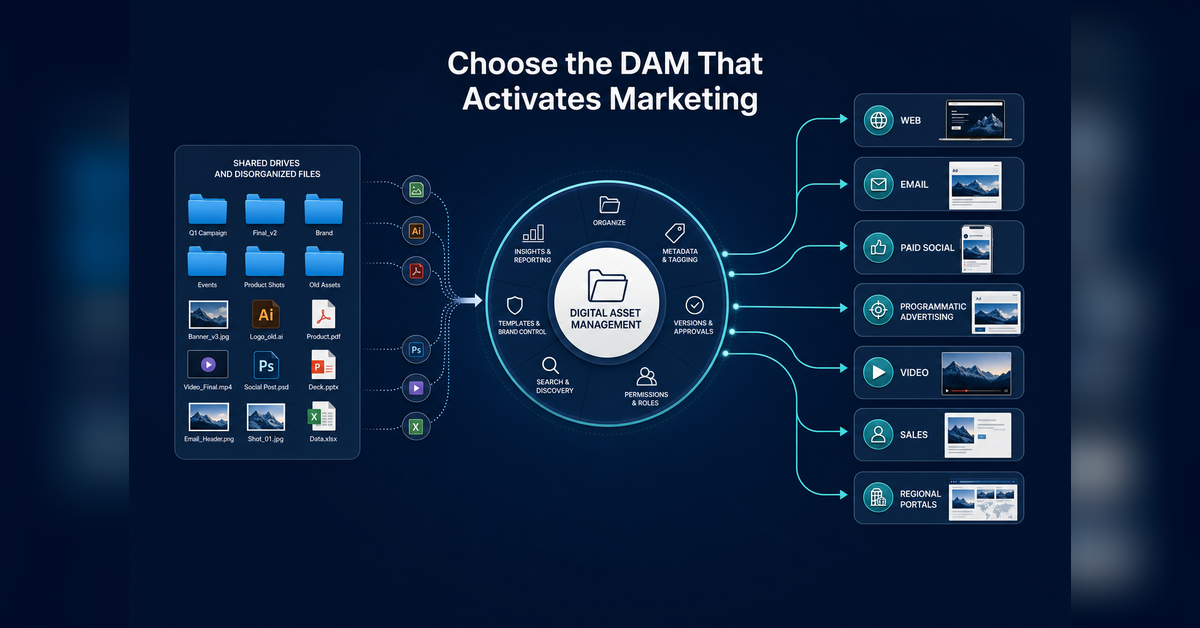

The best digital asset management platform for enterprise marketing teams is not automatically the product with the longest feature list. It is the platform that helps people find the approved asset, understand its rights, preview it, and move it into a live campaign without guesswork.
For many global marketing organizations, Bynder is the strongest all-around choice. Aprimo, Adobe Experience Manager Assets, Brandfolder, Acquia DAM, Frontify, Cloudinary, Canto, Orange Logic, and MediaValet can be better choices when governance, ecosystem fit, product data, media delivery, or specialized workflows carry more weight.



Last updated: August 6, 2026
Which enterprise DAM is the strongest overall choice?
For many organizations, Bynder is the strongest all-around enterprise DAM platform when usability, metadata, permissions, integrations, portals, regional distribution, and brand governance matter together. Aprimo fits governed content operations, Adobe Experience Manager Assets fits Adobe-centered delivery, and Cloudinary fits developer-led media transformation.
The right choice depends on where content is created, governed, approved, transformed, distributed, and measured.
Executive summary
Best all-around fit
Bynder offers a balanced operating model for marketing and brand teams that need metadata, permissions, portals, integrations, and broad adoption.
Best governed operation
Aprimo is the stronger fit when planning, workflow, rights, approvals, and content operations must work together.
Best suite fit
Adobe Experience Manager Assets deserves close review when the organization already centers experience delivery on Adobe.
Best technical media fit
Cloudinary stands out when developers need API-led image and video transformation, optimization, and delivery.
The DAM platform should be selected against real assets and real channel handoffs, not a polished sample library.
Who this buyer guide is for
Teams comparing the enterprise asset-management platform should use this guide to align marketing outcomes, operational requirements, and technical constraints before building a shortlist.
Marketing and brand leaders
Use it to assess whether the enterprise DAM platform can improve campaign speed, regional control, brand governance, reuse, and partner access.
Creative and content operations
Use it to test whether the digital asset management system can handle ingestion, metadata, review, approvals, renditions, unusual formats, and daily administration.
IT, legal, and procurement
Use it to determine whether the enterprise DAM software meets identity, architecture, rights-control, integration, migration, export, and total-cost requirements.
What is enterprise digital asset management?
A digital asset management system organizes, governs, finds, shares, and activates approved digital assets. Those assets may include images, video, documents, source files, presentations, campaign kits, HTML5 packages, and channel-specific renditions.
Metadata describes an asset through fields such as campaign, product, audience, region, rights, expiration, and approval status. A taxonomy supplies the controlled structure behind those fields. A portal gives a defined audience access to a controlled collection.
Enterprise DAM goes beyond storage. The enterprise asset-management platform must support permissions, lifecycle rules, versions, external partners, bulk work, integrations, migration, and governance across teams. Its business value appears when assets flow into enterprise omnichannel strategy, websites, email, social, paid media, commerce, sales, and regional programs.
How we evaluated the enterprise DAM platform
This guide evaluates vendor fit through retrieval, metadata, bulk work, rights, permissions, approvals, portals, integrations, APIs, preview support, video, analytics, migration, training, administration, and total operating cost. Those criteria reveal whether a candidate for the digital asset management system can support daily work rather than isolated feature demonstrations. The guide does not assign invented numerical ratings.
Percepture also brings direct operating context. During a recent enterprise Bynder onboarding for an anonymized multi-region marketing program, the team helped map live campaign assets into a controlled workflow for metadata, rights, regions, previews, uploads, and training. Percepture participated in onboarding and use, not the vendor selection.
That experience changed the evaluation question. Instead of asking whether a platform stores a file, teams evaluating the enterprise DAM software should ask whether the next marketer can find, understand, preview, and activate it safely. This is also why DAM planning should connect with content operations strategy rather than sit as an isolated software project.
Map the DAM workflow before building the shortlist
Document who creates, approves, distributes, and measures each asset. The map exposes whether the DAM must primarily solve retrieval, governance, activation, rights control, or adoption.
Build the DAM Workflow MapBest digital asset management platform for enterprise marketing teams comparison
This scorecard helps buyers compare each candidate for the enterprise asset-management platform by operating fit, primary strength, and the question that should be tested during procurement.
| Platform | Best for | Primary strength | Operating fit | Important buying question |
|---|---|---|---|---|
| Bynder | Global marketing and brand teams | Balanced usability, governance, portals, and integrations | Broad enterprise marketing adoption | Can ordinary regional users complete common tasks without administrator help? |
| Aprimo | Governed content operations | Work management, rights, planning, and workflow | Complex or regulated processes | How much configuration will the operating model require? |
| Adobe Experience Manager Assets | Adobe-centered delivery | DAM within an Adobe experience stack | Suite-led organizations | Does suite alignment outweigh the case for an independent DAM? |
| Brandfolder | Usability, distribution, and analytics | Secure sharing, portals, permissions, and usage insight | Brand and partner distribution | Do its governance and workflow depth match your process? |
| Acquia DAM | Product-rich organizations | DAM with optional PIM capabilities | Product content operations | Should product data and assets be managed in a connected model? |
| Frontify | Brand guidelines and templates | Connecting brand rules with asset use | Multi-brand governance | How much operational workflow is required beyond brand enablement? |
| Cloudinary | Developer-led media delivery | API-based transformation, optimization, and delivery | Media-heavy digital products | Will marketers and developers share ownership successfully? |
| Canto | Fast marketing adoption | Search, organization, portals, rights, and versions | Self-service marketing teams | Can it support your highest-complexity governance cases? |
| Orange Logic | Rights-heavy media operations | Configurable DAM and MAM workflows | Archives, approvals, and complex rights | What configuration and administration capacity will be needed? |
| MediaValet | Distributed video-rich teams | Video, portals, metadata, permissions, and versions | Distributed enterprise use | Does it handle your hardest video and partner workflows? |
No flat ranking can identify the enterprise DAM platform without accounting for operating model and technology stack.
Where each leading enterprise DAM fits
Bynder: best all-around for many marketing teams
Bynder combines centralized assets, metadata, permissions, portals, AI-assisted retrieval, integrations, and delivery workflows. That balance makes it a strong shortlist leader for global brand and marketing organizations.
Bynder is our overall answer to the digital asset management system because enterprise value often depends on adoption across regional marketers, agencies, and channel teams. Buyers should still test their taxonomy, unusual files, permission model, and required integrations.
Aprimo: best for governed content operations
Aprimo combines DAM with work management, governance, rights, planning, and complex workflows. It fits organizations where content operations must control how work is requested, produced, reviewed, approved, and released.
If the search for the enterprise DAM software begins with regulated review or formal workflow, Aprimo may outrank a simpler marketing DAM. The proof of concept should show whether the added process depth helps users or adds avoidable steps.
Adobe Experience Manager Assets: best for Adobe-centered delivery
Adobe Experience Manager Assets supports enterprise DAM, AI-assisted search and tagging, bulk ingestion, Dynamic Media, Creative Cloud connections, and rights metadata. It deserves a serious evaluation when Adobe already shapes content production and experience delivery.
When assessing Adobe Experience Manager Assets as the DAM platform, organizations should map the full architecture and decide whether suite alignment outweighs the case for an independent platform. Percepture’s AEM web development page provides more context for teams operating inside Adobe environments.
Brandfolder: best for usability, distribution, and analytics
Brandfolder emphasizes enterprise usability, secure distribution, portals, integrations, permissions, and asset analytics. It can fit brand organizations that want partners and internal teams to reach approved content quickly.
To judge Brandfolder as the enterprise asset-management platform, compare it with Bynder using the same tasks. Test upload administration, regional permissions, search behavior, portal maintenance, analytics, and version updates rather than comparing screenshots.
Acquia DAM: best for DAM plus PIM
Acquia DAM supports metadata, workflow, rights, versions, portals, analytics, and an optional PIM connection. Product-rich companies should consider it when product information, imagery, documents, catalogs, and channel syndication must work together.
Before treating Acquia DAM as the enterprise DAM platform, the buying team should decide whether it needs DAM, PIM, or both. Combining them can help only when ownership and data flow are clearly defined.
Frontify: best for brand guidelines and templates
Frontify brings DAM, brand guidelines, templates, portals, and multi-brand governance into one brand-management environment. It fits companies that want the rule and the approved asset presented close together.
Teams considering Frontify as the digital asset management system should test whether it supports the operational depth required by creative teams, legal reviewers, regional users, and external agencies. Strong brand enablement does not remove the need for practical ingest and lifecycle workflows.
Cloudinary: best for developer-led media transformation
Cloudinary combines DAM functions with APIs for media transformation, optimization, and delivery. It is a strong fit for media-heavy digital products where image and video variants must be produced and served at scale.
Cloudinary may be the enterprise DAM software when technical media delivery is central, but its value depends on cooperation between marketing and development. Buyers should map ownership for source assets, transformations, delivery rules, approvals, and downstream measurement.
Canto: best for intuitive adoption and portals
Canto supports search, metadata, portals, rights, versions, and AI-assisted organization. It can be attractive to marketing teams that place a high value on self-service and a manageable user experience.
Before selecting Canto as the DAM platform, test high-complexity permissions, integrations, migration, administration, video, and regional governance. A fast start is useful only if the system can support the operating model that follows.
Orange Logic: best for complex rights and media workflows
Orange Logic offers configurable DAM and MAM capabilities for rights, archives, workflow, approvals, and AI-supported operations. It fits rights-heavy environments that need more than a general marketing library.
Orange Logic may be the enterprise asset-management platform with complex rights and media workflows, but the organization must have the resources and ownership required for a configurable system. Procurement should examine both capability and ongoing administration.
MediaValet: best for video-rich distributed teams
MediaValet supports enterprise DAM, video, portals, metadata, permissions, versions, AI-assisted functions, and integrations. It belongs on shortlists where distributed users and video workflows are central.
To evaluate MediaValet as the enterprise DAM platform, ask the vendor to demonstrate large video, review, preview, rendition, partner, and export tasks with representative content. A generic image demo will not answer those questions.
Choose the platform category before the vendor
Marketing and brand DAM platforms such as Bynder, Brandfolder, Canto, and Frontify emphasize adoption, portals, templates, and approved distribution. Content operations platforms such as Aprimo and Orange Logic emphasize workflow, planning, approvals, and rights.
The digital asset management system may be a suite-embedded DAM for organizations committed to a wider experience ecosystem, a media transformation platform for API-led delivery, or DAM plus PIM for product companies connecting product records with imagery and documents.
This category decision narrows the enterprise DAM software more effectively than comparing every vendor against one generic checklist. It also keeps the DAM connected to content across the customer journey.
The R.I.G.H.T. DAM Selection Framework
Percepture’s R.I.G.H.T. framework tests whether a DAM makes assets retrievable, integrated, governed, handoff-ready, and adopted by the team. Use it to compare the DAM platform against real operating needs.
R: Retrieval
Can users search in business language? Are campaign, region, product, audience, rights, and approval fields controlled? Can teams edit metadata in bulk?
I: Integration
Can assets move into creative tools, CMS, PIM, email, social, commerce, paid media, work management, and analytics without repeated downloads?
G: Governance
Can the organization control upload, editing, approval, download, distribution, rights, regions, expiration, and partner access?
H: Handoff
Can the next user preview the file, understand its status, obtain the right rendition, and place it into the intended channel?
T: Team adoption
Are owners named? Is training practical? Can users work in bulk? Are failed searches, reuse, and campaign activation measured?
Fifteen questions for a R.I.G.H.T. assessment
Use these questions to determine whether a candidate for the enterprise asset-management platform can support retrieval, governance, handoffs, integrations, and sustained adoption.
- Can five ordinary users find an approved campaign asset?
- Are required metadata fields limited to fields that support a real decision?
- Can administrators update metadata across a batch?
- Can the DAM connect to the systems where content is created and published?
- Are integration limits, administration, and costs visible?
- Can rights and regional restrictions block an improper use?
- Can an agency receive narrow access instead of broad library access?
- Can every important format be previewed?
- Can users obtain channel-ready renditions without rebuilding assets?
- Does approval status travel with the asset?
- Is a person accountable for the taxonomy?
- Is a person accountable for training and adoption?
- Can teams measure searches that return poor results?
- Can assets and metadata be exported in a usable form?
- Can the organization connect reuse with campaign activation and content performance attribution?
What an enterprise DAM demo may not show
A real onboarding lesson
During an anonymized multi-region enterprise DAM onboarding, Percepture helped organize active campaign creative through bulk uploads, shared metadata, asset types, concept tags, restricted-use defaults, and multiple region tags.
HTML5 programmatic ads created a practical handoff issue. The approved creative lived inside a ZIP file, but future users also needed a screenshot or PDF preview to see what they were selecting. Upload testing, taxonomy owners, category owners, training, and quarterly campaign workflows were part of making the library useful.
The lesson for teams seeking the enterprise DAM platform is direct: storing the file is not the hard part. Making it safe and useful for the next marketer is.
Test the hardest asset before buying
Do not let the proof of concept depend on clean JPEGs. Include layered source files, long-form video, restricted photography, multi-region offers, documents, HTML5 ZIP files, and any asset that currently requires specialist knowledge.
For each file, test upload, bulk metadata, preview, rights, approval, search, version replacement, rendition, partner access, channel activation, and export. The digital asset management system should reduce uncertainty at each handoff.
A practical enterprise DAM proof of concept
- Build the test set. Import 100 representative assets, including the hardest formats, restricted content, active campaigns, and assets used in several regions.
- Run real tasks. Apply metadata in bulk, search using business language, restrict an asset, update a version, share a portal, and move one asset into a live channel workflow.
- Measure the work. Ask five ordinary users to complete tasks without coaching. Record administrator effort, failed searches, manual workarounds, and export quality.
DAM versus Drive, SharePoint, CMS, PIM, and MAM
| System | Primary job | When it is not enough |
|---|---|---|
| Shared drive or SharePoint | General file storage and collaboration | When marketing needs controlled metadata, rights, renditions, portals, lifecycle rules, and asset-specific workflows |
| CMS | Managing and publishing website content | When assets must be governed and reused across many channels |
| PIM | Managing product information | When images, video, source files, rights, and creative workflows need dedicated management |
| MAM | Managing video, audio, and production media | When the requirement expands into broader brand and marketing distribution |
| DAM | Organizing, governing, finding, sharing, and activating approved assets | When planning, web publishing, product records, or production workflows require another connected system |
Replace shared drives when duplicate files, weak search, unclear approval, rights spreadsheets, uncontrolled agency links, and regional errors have become operating risks. The business case should focus on controlled activation, not the promise of a tidy library.
AI improves retrieval, but it does not replace governance
AI-assisted tagging and search can help users discover assets. It cannot decide who owns the taxonomy, which fields are mandatory, whether a right has expired, or which regional offer is approved.
Start with controlled vocabulary, ownership, required metadata, rights rules, and feedback from failed searches. AI then has a stronger operating foundation. The same principle applies to search-ready publishing and generative engine optimization services: clear entities and governed information improve retrieval.
Rights, permissions, and regional control
Rights information must travel with the asset. The record should make usage status, region, expiration, consent, approval, and restrictions visible to the people who can act on the file.
Test whether a restricted asset can be blocked from an improper download or distribution path. Test whether one approved asset can support several regions without creating uncontrolled copies. Legal and compliance teams should validate the organization’s requirements during procurement.
Integrations that matter for marketing activation
The integration map should include creative tools, CMS, PIM, work management, email, social, commerce, paid media, analytics, identity, and partner workflows. Ask whether each connection is native, configured, custom, or dependent on repeated manual work.
Paid activation deserves special attention. Assets used by a media buying agency, social creative operations, and enterprise email marketing must remain connected to approval, naming, version, and measurement standards.
A useful architectural primer is the distinction between omnichannel vs multichannel marketing. A DAM earns its place when governed assets support connected experiences rather than separate channel libraries.
Pricing framework for the enterprise DAM software
Enterprise DAM pricing should be evaluated as total operating cost. A software quote alone does not show the investment required to migrate, govern, connect, administer, train, renew, and eventually export the library.
| Cost area | What to examine | Business-case question |
|---|---|---|
| License and user model | Roles, users, portals, access patterns, and package boundaries | Who needs full access, limited access, or portal access? |
| Storage and delivery | Asset volume, video, renditions, bandwidth, and growth | Which content types drive capacity? |
| Migration and taxonomy | Inventory, deduplication, metadata mapping, cleanup, and validation | How much meaning must be repaired before import? |
| Integrations and APIs | Connectors, configuration, custom work, maintenance, and limits | Which handoffs must become automatic? |
| Services and training | Configuration, governance design, onboarding, documentation, and enablement | Who will prepare users and owners? |
| Administration and support | Internal ownership, vendor support, testing, reporting, and change management | What will the platform require after launch? |
| Renewal and exit | Renewal terms, export, metadata portability, and transition effort | Can the organization leave with usable assets and records? |
Place the DAM inside the wider enterprise marketing budget. That keeps software cost connected to content production, channel activation, administration, and measurement.
Turn the shortlist into a business case
To identify the DAM platform, compare operating cost, workflow fit, adoption risk, integration work, and the effort required to prepare metadata and assets.
Review Pricing OptionsMigration is an operating-model project
Selecting the enterprise asset-management platform does not make migration automatic. Inventory assets, identify owners, remove duplicates, map metadata, define required fields, establish rights rules, test exports, and decide what should remain archived rather than moving every file without judgment.
Run migration in controlled batches. Validate search, previews, restrictions, versions, and channel use before increasing volume. Training should use real assets and real tasks rather than a generic product tour.
RFP questions that expose enterprise fit
An RFP for the enterprise DAM platform should require specific answers about administration, governance, integrations, export, and the hardest asset types.
- How does the platform handle bulk metadata changes?
- How are controlled vocabulary and synonyms managed?
- How do rights, regions, expiration, and approval affect access?
- How are ZIP, HTML5, video, layered files, and documents previewed?
- How are portals maintained when an approved version changes?
- Which integrations are native, configured, or custom?
- What administrator work remains after launch?
- How are assets and metadata exported?
- How can teams analyze failed searches, reuse, and distribution?
- What package, limit, support, and renewal terms apply to the proposed configuration?
Common DAM selection and implementation mistakes
- Ranking vendors before defining the operating category.
- Testing only easy image files.
- Migrating files without repairing metadata and ownership.
- Expecting AI to replace taxonomy.
- Ignoring rights, region, expiration, and partner access.
- Buying integrations without testing the actual handoff.
- Training administrators but not ordinary users.
- Measuring uploads while ignoring searches, reuse, and activation.
- Comparing quotes without migration, services, administration, and exit costs.
The digital asset management system will still fail if nobody owns the workflow. Assign executive sponsorship, platform administration, taxonomy ownership, content ownership, legal input, integration ownership, and user training.
Final recommendation
Bynder is the strongest all-around recommendation for many global marketing teams because it balances adoption, metadata, permissions, portals, integrations, distribution, and brand governance. That recommendation is qualified, not universal.
Choose Aprimo for deeply governed content operations, Adobe Experience Manager Assets for Adobe-centered delivery, Brandfolder for usability and distribution, Acquia DAM for DAM plus PIM, Frontify for brand enablement, Cloudinary for technical media delivery, Canto for intuitive self-service, Orange Logic for complex rights, and MediaValet for distributed video use.
The final test for the best digital asset management platform for enterprise marketing teams is whether an ordinary marketer can find the right asset, confirm that it is approved, understand where it may be used, preview it, and activate it without calling the person who designed the taxonomy.
Enterprise DAM frequently asked questions
What is the best digital asset management platform for enterprise marketing teams?
Bynder is the strongest all-around enterprise DAM platform in many organizations when usability, metadata, permissions, integrations, portals, and global distribution matter together. Aprimo, Adobe Experience Manager Assets, Brandfolder, Cloudinary, and other platforms may fit better when workflow, ecosystem, analytics, or media delivery dominates the decision.
Is Bynder better than Brandfolder?
Neither platform is better for every organization. When comparing either product as the enterprise DAM platform, consider that Bynder is a strong balanced choice for global marketing governance and distribution, while Brandfolder is strong for usability, secure sharing, portals, permissions, and asset analytics. Test both with the same metadata, regional access, portal, version, and administration tasks.
Is Adobe Experience Manager Assets a DAM?
Yes. Adobe Experience Manager Assets provides enterprise digital asset management functions, including ingestion, search, tagging, rights metadata, Dynamic Media, and connections with Adobe tools. It may be the digital asset management system that already use Adobe for creative production and experience delivery.
Can a shared drive replace a DAM?
A shared drive can support general storage and collaboration. The enterprise DAM software becomes more appropriate when marketing needs controlled metadata, permissions, rights, expiration, versions, portals, renditions, bulk workflows, partner access, and activation across several channels or regions.
How much does enterprise DAM cost?
There is no reliable universal price for the DAM platform. Compare the license, user model, storage, bandwidth, migration, taxonomy, integrations, APIs, portals, services, training, administration, support, renewal, and exit requirements. Procurement should request a configuration-specific total-cost view.
How long does enterprise DAM implementation take?
The supplied research does not establish a standard implementation duration. Timing for the enterprise asset-management platform depends on asset volume, metadata quality, taxonomy, rights, integrations, migration, configuration, testing, ownership, and training. A phased plan should validate the hardest assets and workflows before broader migration.
Who should own enterprise DAM?
Ownership of the enterprise DAM platform is usually shared. An executive sponsor sets the business goal, a platform owner manages operations, taxonomy owners control classification, content owners manage lifecycle decisions, IT supports architecture and identity, and legal or compliance teams define applicable rights requirements.
Can AI organize every DAM asset automatically?
AI can assist tagging, search, and discovery, but it does not replace ownership, required metadata, controlled vocabulary, rights rules, approval status, or user feedback. Even the digital asset management system performs within the operating structure the organization gives it.
Build a DAM shortlist around campaign activation
Percepture can help marketing leaders map channel requirements, asset handoffs, taxonomy questions, adoption risks, and measurement priorities before procurement. Use the R.I.G.H.T. framework to identify what the enterprise DAM software must do inside your operating model.
Book a Strategy Conversation
About Bob Generale
Bob Generale is President of Percepture and the author of this enterprise DAM buyer guide. This analysis applies Percepture’s operating perspective across marketing strategy, content operations, campaign activation, and measurement.